
Indonesian Culture and Etiquette: Temples, Dress and Everyday Respect
Read the setting, ask permission and leave room for local customs to differ.
Original conceptual temple illustration, not a photograph of a particular site’s permitted visitor areas.
Indonesian culture and etiquette cannot be reduced to a single temple dress code. The expectations at a Balinese Hindu temple, a Jakarta mosque, a family home and a beach restaurant are not interchangeable. Respect begins with recognising which setting you have entered, rather than treating one successful encounter as a national rule.
The aim is not to memorise an intimidating catalogue of taboos. Carry adaptable clothing, pause at boundaries, ask before joining an activity and accept a clear refusal without negotiation. The framework below combines published local guidance with practical ways to apply it without claiming first-hand experience.
This article contains affiliate links. Taylor’s Trailblazing Travels may earn a commission when you book or buy through them, at no extra cost to you.
Context first
A beach, village, home and sacred site need different behaviour.
Permission
Being allowed to visit is not permission to join every ritual.
Dress
Pack light layers that can cover shoulders and legs.
Photos
Ask about people, ceremonies and restricted spaces separately.
Indonesian culture and etiquette: use a context-first approach
Before entering a new place, answer three questions: what is happening here, who is responsible for welcoming visitors, and what would interrupt the people already using it? This turns respect into a practical decision rather than a vague instruction to be polite.
| Setting | A sensible starting approach | Ask rather than assume |
|---|---|---|
| Beach or resort leisure area | Use the clothing appropriate to the activity and venue. | Whether swimwear is acceptable in restaurants or shared indoor spaces. |
| Town, village or market | Change from swimwear and use comfortable, modest everyday clothing. | Whether a doorway, courtyard or event is private. |
| Balinese temple | Check clothing and visitor boundaries with the attendant. | Which courtyards and ceremonies are open to you. |
| Mosque | Follow the visitor process and modest-dress instructions. | Head covering, footwear, access and prayer-time arrangements. |
| Home or community event | Let the host establish the welcome and seating. | Shoes, photographs, food and whether an invitation includes the whole party. |
These are editorial starting points, not a claim that every community follows identical rules. Bali’s local visitor guidance specifically calls for covered, appropriate clothing and respect for sacred places and ceremonies. It should not be silently treated as the rulebook for every island. [1]
When a sign and an internet guide differ, ask the staff responsible for that site. When visitors nearby behave badly, do not use them as evidence of permission. A local boundary remains a boundary even when someone else has ignored it.
Dress for transitions, not only the day’s first stop
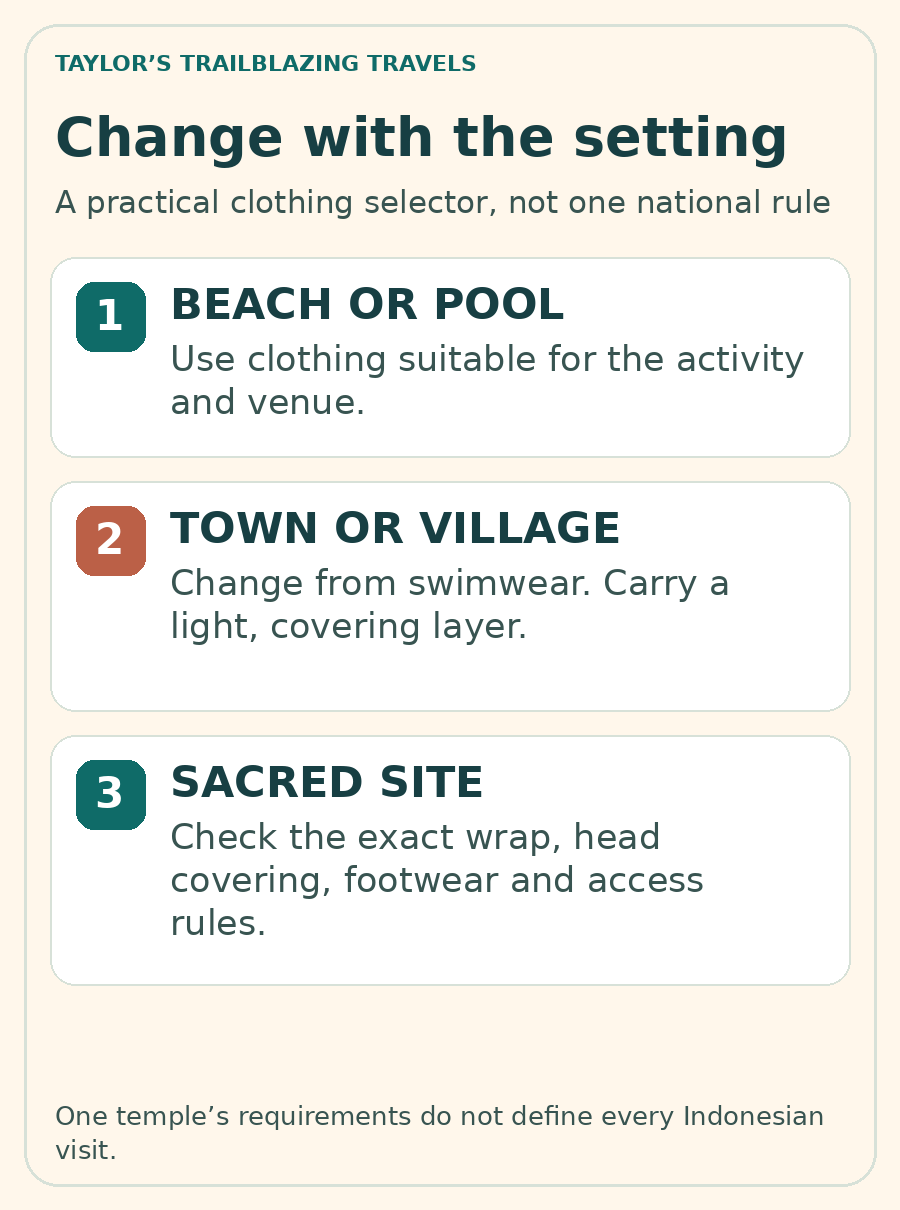
A practical day bag contains a light layer that covers the shoulders and clothing or a wrap that can cover the legs. This is an adaptable packing recommendation, not an instruction to buy specialist travel clothing. A loose shirt and suitable long trousers can solve more transitions than a last-minute attempt to improvise at an entrance.
Indonesia’s tourism guidance for Bali advises modest clothing beyond beach and resort settings and a sarong and sash for temple visits. Check the individual site’s instructions: ordinary covered clothes may still need a specific temple wrap, and a rented sarong does not replace an otherwise suitable outfit. [2]
Test the outfit as well as the photograph
Consider sitting, bending, steps and rain, not just standing in front of a mirror. A wrap that opens while climbing steps or a thin garment that becomes transparent when wet may not solve the practical problem. Keep a separate dry layer for a site that involves water rather than assuming wet swimwear is acceptable elsewhere.
Do not generalise a head-covering rule to every Indonesian street or every woman. At a mosque, follow the actual visitor requirements. Istiqlal’s published visitor guidance calls for modest covered clothing and a head covering for women; that is a named site’s instruction, not a nationwide dress rule. [3]
For travellers who cannot manage a particular garment, shoe-removal step or surface, ask about an accessible arrangement before arriving. Explain the practical requirement rather than silently ignoring a rule. A respectful alternative viewpoint may be preferable to struggling with an inaccessible entrance.
Balinese temples: separate clothing, access and participation
A sarong and sash are not an all-access pass. Treat areas reserved for worship as closed to sightseeing unless the responsible attendant explicitly says otherwise. Ask which courtyards visitors may use and stay within those boundaries.
Three permissions need separate consideration: entering the visitor area, taking photographs and joining a ritual. Paying an entry charge establishes only the access included in that admission. Booking a tour does not remove a temple’s own authority over the visit.
Offerings are not obstacles to rearrange
The small offerings known as canang sari are part of Balinese religious practice. Watch where you step, avoid touching or moving them and leave shrines and sacred objects alone. Indonesia’s tourism guidance also advises using the right hand when giving or receiving items and avoiding touching people’s heads in this cultural setting. [2]
If you accidentally disturb something, stop, apologise and ask what to do. Do not try to repair a ritual object by guessing, or turn the incident into a comic photograph. A modest, direct apology is usually the most constructive starting response; the person responsible can decide what needs correcting.
Entry restrictions deserve a private question
Some temple rules address circumstances such as menstruation. Read the posted conditions and ask discreetly where clarification is needed. Bali Tourism Board’s etiquette guidance specifically advises against entering temples during menstruation. Do not assume that silence, a tour ticket or another visitor’s behaviour overrides the site’s instructions. [8]
Being a respectful spectator can be a complete visit. There is no obligation to imitate worshippers or join a purification ritual for the sake of a photograph. Decline an activity politely when it does not feel appropriate to your beliefs, health or comfort.
Mosques and Java’s heritage sites need their own checks
Indonesia’s tourism ministry describes Jakarta’s Istiqlal Mosque as open to the public for worship and visits, with appropriate clothing and compliance with its rules. That does not mean a visitor can wander into every space at every time. Use the visitor entry process and let staff explain where to wait and where photography is permitted. [4]
At a mosque, ask where footwear should be removed and where it can be kept, then follow the route provided. Avoid stepping into a prayer area while trying to work out what everyone else is doing. Speak quietly and keep an accompanying group together without blocking the entrance.
A scarf can be useful where a head covering is required, but it should not be presented as the only clothing consideration. Covered arms and legs, an appropriate overall fit and the visitor robe offered by a particular site may all matter. The named site’s instructions are more reliable than a generic social-media outfit suggestion. [3]
Do not copy Bali rules onto Borobudur
Borobudur is a different heritage and religious setting. Indonesia’s tourism ministry documents the use of special upanat sandals for visitors climbing the temple structure, part of its conservation approach. Confirm the current ticket and footwear arrangements with the official operator rather than assuming a general grounds ticket includes climbing. [5]
More broadly, treat historic reliefs, statues and restricted structures as objects to protect, not surfaces for a pose. A designated visitor route may serve both conservation and religious needs. Staying on that route is useful even when the reason for a restriction is not obvious from where you stand.
For churches, community buildings and other religious spaces elsewhere in Indonesia, use the same method: establish whether visitors are welcome at that time, follow the local dress and footwear arrangements and avoid interrupting worship. The method travels better than a single prescribed costume.
Ceremonies and photography: ask four separate questions
A public view of a ceremony is not automatically an invitation to enter, photograph closely or take part. Use a short permission sequence: may I watch, where should I stand, may I photograph, and may I join? The answer to one does not imply the answer to the others.
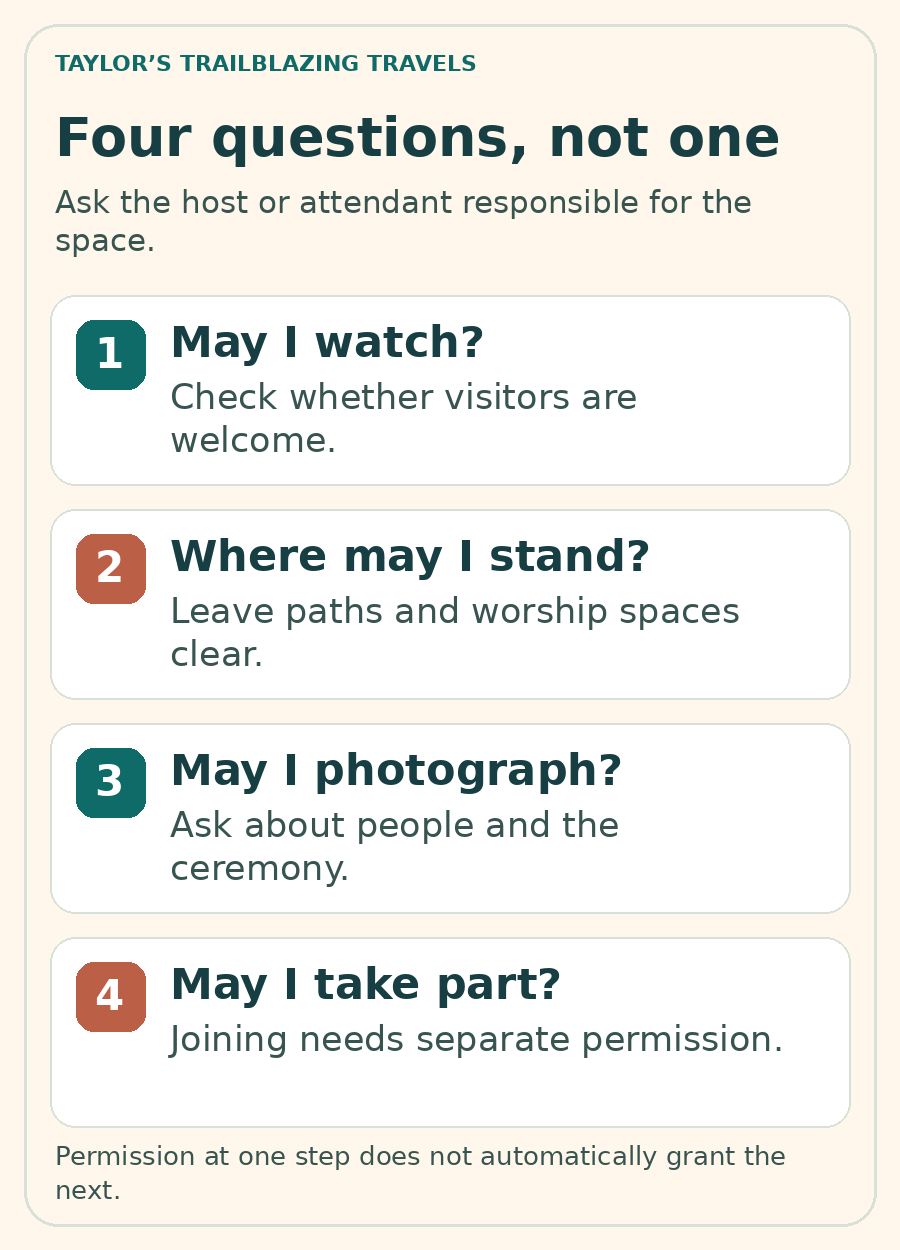
This sequence is an original visitor framework. It makes a practical distinction between observing an event and using it as the setting for your own activity. Ask the host, guide or attendant responsible for the space, not merely another tourist who has already walked in.
Photograph people as people
Obtain permission before making a close photograph of an individual. For children, seek the responsible adult’s permission and respect the child’s own willingness as well. Do not pressure someone to pose, repeat a task or move from where they are worshipping. Permission to take an image should not be stretched into permission to publish an intimate or embarrassing moment.
If a site prohibits flash, tripods or recording, follow that restriction. Do not assume that a drone is simply a more convenient camera: ask about site permission and applicable aviation requirements separately. This guide does not establish drone authorisation.
Leave room for the event to continue
Stand where directed, keep paths open and move when participants need the space. Avoid making a ceremony wait while a group organises a photograph. Bali’s visitor guidance specifically emphasises respectful conduct during religious and traditional activities. [1]
When an event is private, a polite refusal is the end of the request. You can still have a worthwhile day elsewhere. Building an itinerary around access that nobody has confirmed encourages the wrong kind of pressure on hosts and travellers alike.
Ramadan and Nyepi: respect can change the timetable
Religious observance can affect when a visit is practical. Ask your host about nearby celebrations, prayer times, meal arrangements and transport restrictions for your actual dates. Do not copy a date from last year’s article into this year’s itinerary.
During Ramadan
Be considerate around people who are fasting. Ask where visitors can eat and drink appropriately during the day and use designated places rather than making assumptions about public settings. Confirm meal and attraction opening arrangements directly. A hotel, city neighbourhood and small community may handle visitor needs differently.
Istiqlal’s Ramadan information illustrates why a place of worship should be treated as an active institution, with organised worship and visitor requirements rather than an attraction operating independently of the religious calendar. It is a useful reminder to ask about the day’s programme, not a timetable for future visits. [3]
During Bali’s Nyepi
Nyepi is Bali’s day of silence. Indonesia’s tourism ministry describes restrictions on ordinary activities and a 24-hour interruption to access in and out of the island, while essential services such as hospitals are exceptions. Confirm the exact dates and operational notices for your year before arranging arrival or departure. [6]
Choose accommodation for the stay-in arrangements, not simply for its proximity to an attraction. Ask how meals, lighting, emergency assistance and any communications restrictions will be handled. This is a practical preparation question, not a reason to expect normal sightseeing during the observance.
Keep the days around major ceremonies flexible too. A road procession or changed access arrangement may require a different route. Avoid treating a religious event as an inconvenience that staff ought to remove; ask what alternative works within the observance.
Everyday courtesy without overthinking every gesture
Greet people before moving into a request, use a calm tone and allow time for an answer. At a home or small establishment, watch where the host pauses and ask before entering further. These ordinary habits reduce ambiguity without requiring a visitor to perform unfamiliar customs perfectly.
In Bali, the tourism ministry advises keeping composure rather than reacting with loud confrontation. It also notes the right-hand convention and the sensitivity around touching the head. Apply that information thoughtfully, while recognising that a disability or other practical limitation may need a simple explanation. [2]
Food, invitations and personal boundaries
Ask before accepting food when ingredients affect allergies, religious practice or dietary needs. An appreciative refusal is better than pretending a dish is suitable. Do not assume a host should already know your requirements, and do not treat curiosity about a local dish as permission to enter a kitchen or touch ingredients.
When invited to a family or community activity, clarify the timing, dress and whether an accompanying friend is included. Keep gifts modest and ask a trusted local contact about suitability rather than assuming that a gift from home will fit every household.
Bargaining is not a test of dominance
Where prices are negotiable, agree the amount before the service or purchase and keep the exchange courteous. Where prices are displayed as fixed, do not assume bargaining is expected. You can decline a price without implying that the seller owes you a transaction at your preferred amount.
If you make a mistake, acknowledge it and follow the correction. A genuine question and a brief apology are more useful than a long explanation of what another website said. The objective is to reduce the inconvenience to the host, not to prove that the misunderstanding was someone else’s fault.
When a guide helps, and what to ask before booking
A good guide can explain visitor boundaries, introduce the meaning of a ceremony and help you ask questions appropriately. This has value when you want interpretation, not merely a vehicle and a series of photo stops. Ask prospective guides to explain their qualifications and their relationship with the sites you want to visit.
Before paying, ask who provides the interpretation, which language is used, whether temple clothing or entrance charges are included and what happens if a ceremony limits access. A driver, a tour escort and a site specialist may perform different roles. Choose the role you need rather than relying only on the word guided.
For a Bali temple visit, compare Tirta Empul visits on GetYourGuide. This is an attraction-level comparison page, not a recommendation to join every listed ritual. Read each operator’s description, ask about visitor permissions and confirm inclusions for your date. Commercial listings do not override temple instructions. [7]
Independent visiting can be entirely appropriate where the site’s visitor arrangements are clear and you are comfortable following them. A guide is particularly useful when language or unfamiliar access rules would otherwise leave you guessing. Neither option requires treating local people as a performance.
Browse the site’s Indonesia Food & Culture hub as more destination-specific guides are added. Keep specific site rules alongside this broader framework rather than expecting one national article to answer every local access question.
Final questions before a respectful visit
Must every visitor wear a sarong everywhere in Indonesia?
No. A Balinese temple requirement should not become a national everyday dress rule. Check the setting, the individual site and the activity. Adaptable modest clothing is useful; the exact garment requirement belongs to the host or site.
Does buying a temple ticket mean I may enter the prayer areas?
No. Visitor access, worship access and participation in a ritual are separate matters. Ask which areas are open to you and stop at the stated boundary even when another visitor goes further.
What if a custom conflicts with a health or mobility need?
Explain the practical need before the visit and ask for an appropriate alternative. Do not promise to manage an unsafe step or remove essential support just to avoid a conversation. Viewing from another area may be the most workable choice.
Can I attend a ceremony I happen to encounter?
Ask the responsible host or attendant whether visitors may watch and where to stand. Do not assume that an open gate or a camera visible in someone else’s hands is an invitation. Accept a refusal without trying a different person until someone agrees.
The approach worth remembering
Prepare clothing that adapts, read the setting, ask permission and follow the answer. Respectful travel does not depend on flawless performance; it depends on being willing to stop, listen and change course when the people responsible explain what is appropriate.
Sources and editorial approach
This guide draws on local tourism and named-site guidance, with an original context-and-permission framework. It does not claim first-hand visits or a single set of customs for all communities. The responsible host or site determines visitor access.
Independent editorial review: 2 November 2026. Selected official and operator information was rechecked; prices, conditions and links can change, so confirm key details with the provider before travel.
- Badung Regency – Bali foreign visitor rules under Circular 07/2025
- Indonesia Ministry of Tourism – Cultural travel and etiquette in Bali
- Istiqlal Mosque – Visitor requirements and Ramadan 1447 information
- Indonesia Ministry of Tourism – Visiting Istiqlal Mosque
- Indonesia Ministry of Tourism – Borobudur upanat conservation footwear
- Indonesia Ministry of Tourism – Understanding Nyepi in Bali
- GetYourGuide – Tirta Empul visitor experiences
- Bali Tourism Board – Temple etiquette
Illustrations in this article were created for Taylor’s Trailblazing Travels. Third-party photographs, where used, are credited beside the image or in the source list.