Sapa Travel Guide: Town, Rice Terraces and Mountain Villages
Choose the right base, protect your full days and plan for the mountains you can actually see.
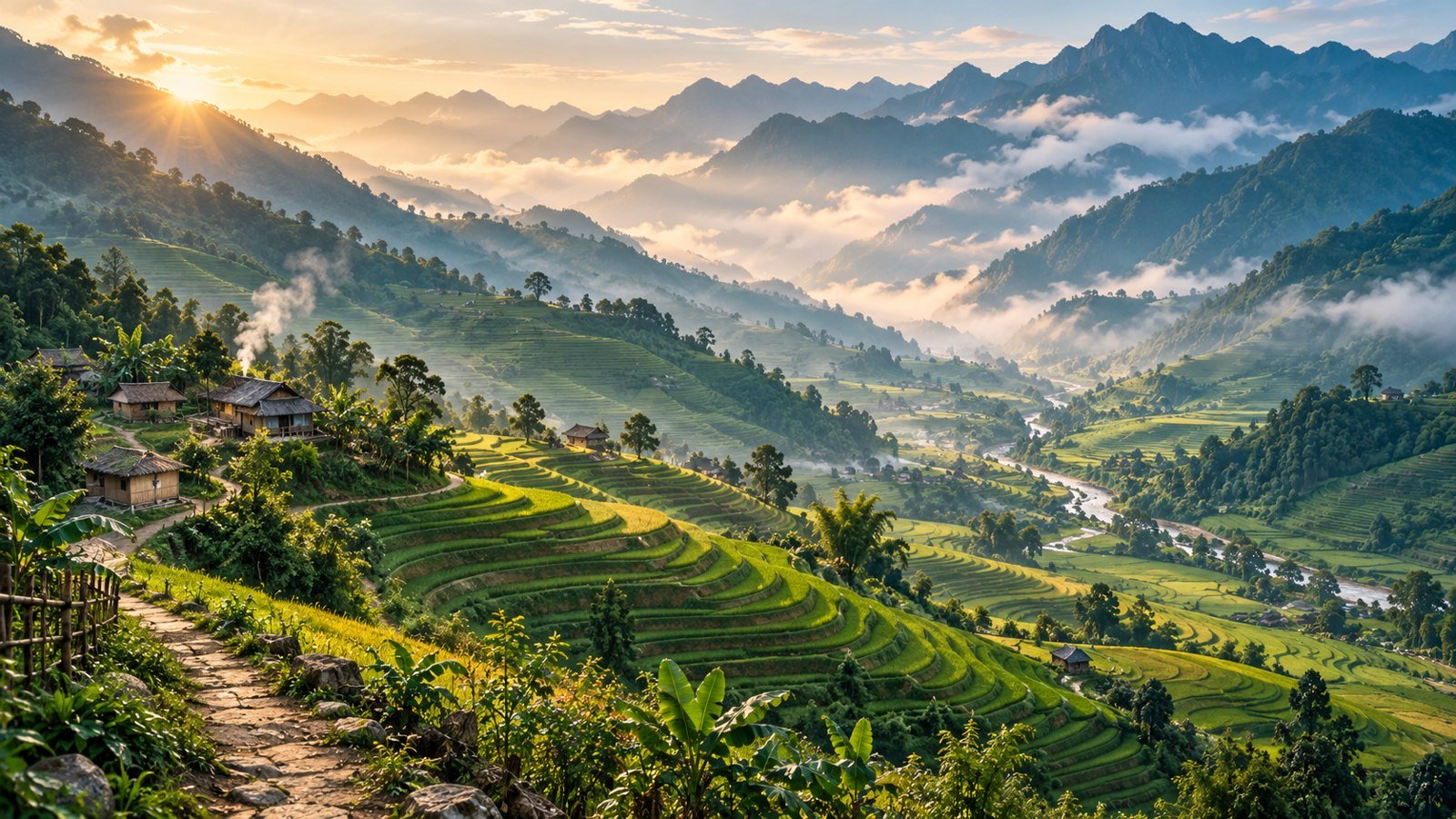
AI-created editorial illustration inspired by Sapa’s mountain valleys; not a photograph of a particular village or current field conditions.
Sapa town sits above a valley of working rice terraces, with Fansipan rising over the surrounding mountains. That geography creates two quite different holidays: using town as a convenient base for outings, or staying in the countryside and giving the valley more time. [1]
This Sapa travel guide starts with that choice. It then builds a short stay around full days, realistic transfers and the season’s landscape, so you can decide what deserves your time before booking a room.
Start with the base
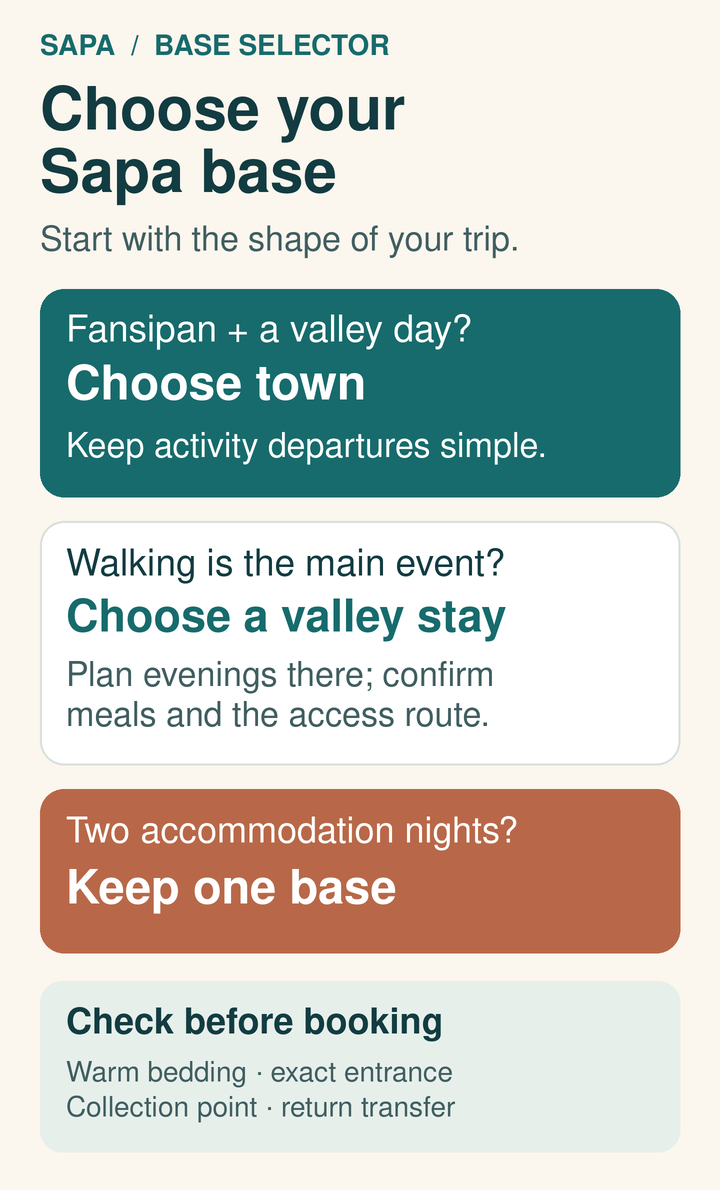
Choose town for repeated activity departures; choose the valley when the stay itself is part of the experience.
Count full days
Two accommodation nights usually leave one full day; three leave two under the daytime-transfer plans here.
Choose your priority
Give a substantial village walk and a Fansipan excursion their own time, rather than forcing both into one day.
Keep a flexible order
Decide which outdoor day comes first after checking the local forecast and operating information.
Choose your Sapa base before choosing a hotel
First separate the town from the surrounding countryside. Vietnam Tourism describes both town accommodation and stays among the terraces, including family homestays. They serve different kinds of trip. A scenic photograph is therefore a poor substitute for checking the address and access arrangements. [2]
Swipe across the table to read all columns.
| Base | Choose it when… | Check before paying |
|---|---|---|
| Central Sapa | You want to organise outings from town, eat out between activities and keep arrival and departure straightforward. | The walking route to your meeting point, traffic noise, room heating and whether a vehicle can reach the entrance. |
| A hotel on the town’s edge | You want a quieter-looking setting or valley-facing room while still using town as your activity base. | The actual route into town and the return climb; a short map distance does not prove level access. Ask about transfers. |
| A valley stay around Lao Chai or Ta Van | Walking and unhurried evenings at your accommodation matter more than repeated trips into town. | The exact village and road access, meal arrangements, bathroom type, bedding, and collection point for each outing. |
The Lao Chai–Ta Van corridor appears in published itineraries through Muong Hoa Valley. Check each property’s position against your intended route. [6]
Use this decision rule: if both Fansipan and a full valley walk are priorities on a short stay, favour one town base. If the main pleasure will be walking from your accommodation and spending two evenings there, favour a valley stay. For two nights, moving hotels usually adds more administration than value.
Compare the same dates and room conditions using Agoda’s Sapa accommodation search and Booking.com’s Sa Pa accommodation search. These are destination searches, so inspect each property’s map position before comparing prices. No particular room, rate or availability is assumed here. [3] [4]
For a homestay, ask who hosts guests and whether meals are shared with the household. The word alone does not answer whether you will have a private bathroom, a quiet room or time with a host family. For any view-focused stay, ask yourself whether you would still enjoy the room and communal spaces on a day of cloud.
Two or three nights: build the stay around full days
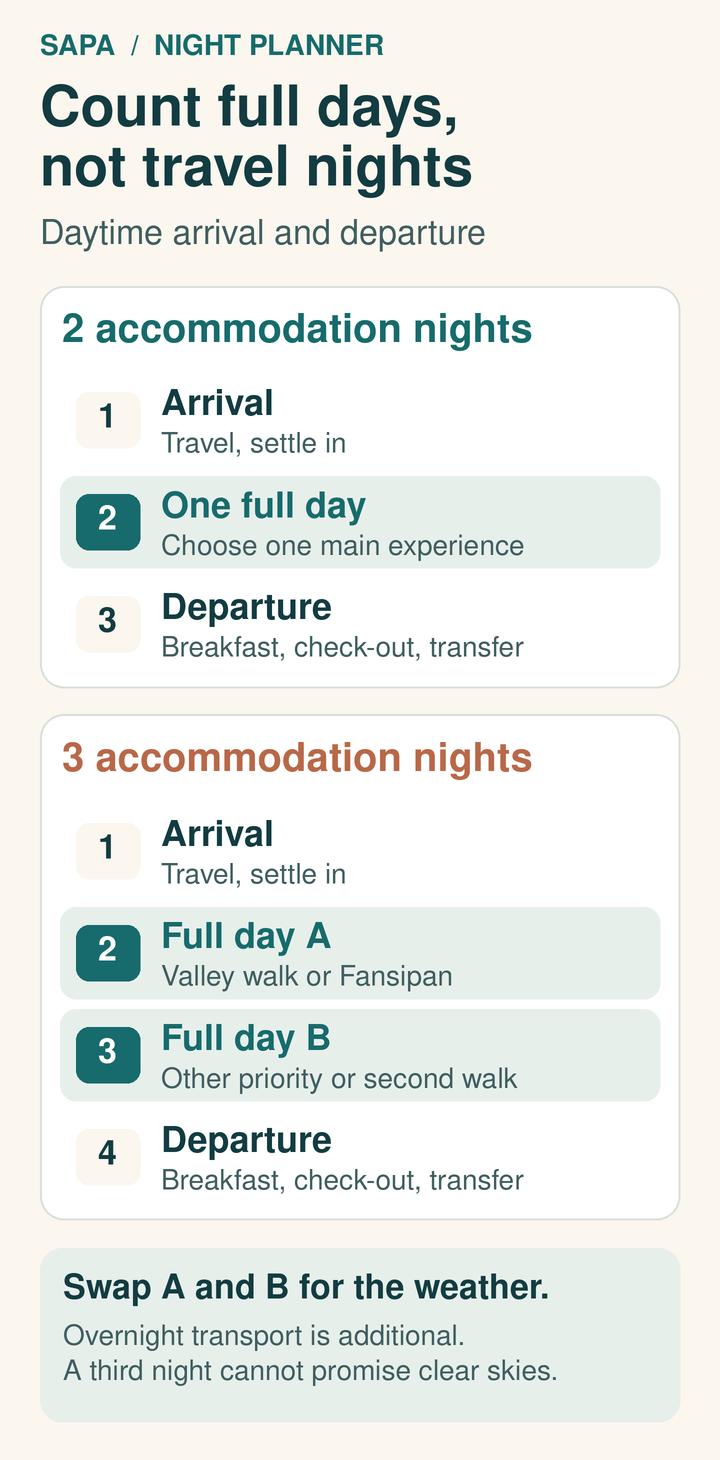
Two nights make sense for one main experience; three nights are the better starting point if you want both valley walking and Fansipan. These are editorial pacing recommendations, counting nights in accommodation in the Sapa area. An overnight train or bus is additional travel time.
The plans below assume a daytime arrival and departure, broadly consistent with Sapa Express advertising a six-hour Hanoi–Sapa daytime journey. They leave the arrival afternoon light and avoid treating the departure morning as a guaranteed excursion slot. Timetable example checked on 23 October 2026. [5]
Swipe across the table to read all columns.
| Day | Two nights: one priority | Three nights: two full days |
|---|---|---|
| Arrival | Travel, settle in, have a short look around your base and agree the next day’s arrangements. | The same gentle arrival. Check the walking forecast and Fansipan operating notice before fixing the order. |
| First full day | A guided valley walk; choose Fansipan instead if the summit is your main reason for coming. | Valley walk or Fansipan, whichever suits the conditions. Keep the evening uncomplicated. |
| Following day | Breakfast, check-out and onward travel. Add a small nearby stop only if the actual departure permits it. | The other main experience, or a second village walk if walking matters more than the summit. |
| Departure after night three | — | Allow for the transfer from your accommodation to the bus stop or Lao Cai station. |
For a walking-led three-night stay, a useful alternative is one night in town followed by two in the valley. Arrange a guided walk that finishes near the second property and agree luggage transport separately. Do this for the experience of staying in the countryside, rather than simply to tick off another hotel.
A third night buys a second full day and room to change the order; it cannot guarantee clear weather. After an overnight journey, protect time for breakfast, washing and rest. Only count early room access if the accommodation has confirmed it.
Valley walking, Fansipan or time in town?
Make a valley walk the centre of a village-focused visit
Choose the route around your walking ability and interests, then choose a guide. ETHOS, a Sapa-based operator, describes options ranging from gentle village walks to more demanding multi-day treks and says it tailors routes to guests’ fitness and pace. [7]
Before booking, ask for walking distance, total ascent and descent, likely surfaces, toilet stops and the plan if paths become unsuitable. Also establish whether transport back to your accommodation is included. “Village walk” is not a difficulty grade.
One concrete comparison option is the Sapa terrace and village trek on GetYourGuide. The listing advertises about 6½ hours and 10–12 km of walking, through Y Linh Ho, Lao Chai and Ta Van, with a guide, lunch and entrance tickets. The published eligibility rules exclude children under five, pregnant travellers, people with mobility impairments and people over 75. Check the selected option, meeting place, transfer coverage and cancellation terms for your date; this is a substantial walk, not a short sightseeing stroll. Listing checked on 23 October 2026. [6]
Choose Fansipan for a mountain excursion
Sun World’s route combines access to Hoang Lien cable-car station, the cable car and a summit area above 3,000 metres. The Muong Hoa funicular from Sun Plaza and the upper Fansipan funicular are separate stages; the upper train reduces the stair climbing but does not establish a completely step-free visit. Check exactly which stages your ticket includes and ask the operator about your access needs. [8]
Allow a generous half-day in your plan, with longer available for queues, transfers and time at the complex. That allowance is editorial judgement, not a promise about queue length. Summit trekking is a different undertaking from taking the cable car and should be planned separately.
Check the official Sun World Fansipan information before setting out. Its latest operating notice reviewed here says hours can change with weather and operating circumstances. A reservation cannot promise a clear view. [9]
Use town time deliberately
Use Sun Plaza, the Stone Church and Sa Pa Lake as central orientation points. [8]
Town time works well for an arrival afternoon, a meal and arrangements for the next day. For a less weather-dependent cultural activity, Vietnam Tourism points to textile workshops; its food suggestions include local tofu, chayote leaves and rainbow trout. A workshop or leisurely meal can be a worthwhile choice even when distant views disappear. [2]
If you have one full day, choose the experience you would regret missing most. Trying to combine a long valley trek with a summit excursion leaves little space for either.
Back to guideChoose the season for the landscape you actually want
Rice terraces change through a working agricultural cycle. Broad “best time” advice cannot tell you whether a particular field will be flooded, green, ripe or already cut on your visit.
Swipe across the table to read all columns.
| Period | Likely emphasis | Planning response |
|---|---|---|
| April–May | Water-filled terraces and field preparation or planting. [10] | Come for reflections and farming activity rather than expecting mature green rice. |
| June–July | Greener terraces, summer rain and potentially muddy paths. [10] | Keep walking routes adjustable and favour good footwear over a tightly packed checklist. |
| August–September | Ripening and harvesting; ETHOS reports cutting as early as August in lower valleys and September higher up. Altitude and weather affect timing. [11] | Ask a local host about the specific valley shortly before travel if golden fields are your priority. |
| October–November | Cooler, generally drier walking conditions, with many fields already harvested in the local operator’s seasonal account. [10] | Choose this for walking and mountain scenery without assuming an uncut golden crop. |
| December–March | Cold, misty and cloudy conditions are characteristic of Sapa’s winter. [12] | Confirm warm bedding or heating and plan something enjoyable without a panoramic view. |
There is a real distinction between pleasant autumn weather and the harvest itself: national tourism material also mentions golden fields in early October, whereas the local harvest account describes earlier cutting. Treat these as broad observations, not competing promises for your dates. [11] [12]
If rice colour is the main reason for the trip, seek recent photographs from your intended village and retain flexibility. If mountain walking is the priority, judge the forecast, path conditions and guide’s advice more heavily than a month label.
For the wider trip, use the Vietnam weather and season guide to compare your Sapa dates with the rest of the route.
Back to guideGetting to Sapa: the Lao Cai connection matters
From Hanoi, the main choice is a direct road journey to Sapa or a train to Lao Cai followed by a road transfer. The railway does not deliver you into Sapa town: Chapa Express places it roughly 35 km from Lao Cai station. [13]
Swipe across the table to read all columns.
| Option | Published journey basis | What still needs planning |
|---|---|---|
| Daytime road service | Sapa Express advertises a 07:00 departure from Hanoi and 13:00 arrival in Sapa: six scheduled hours. [5] | Getting to the departure point, traffic allowance and the final leg to your accommodation. |
| Train plus transfer | Chapa describes approximately eight hours between Hanoi and Lao Cai; Vietnam Tourism allows about another hour by road to Sapa. [13] [2] | Station check-in, waiting for the onward vehicle and any further journey to a valley stay. |
The rail option therefore means roughly nine hours moving, before station time and connections. Choose it because an overnight rail journey suits you, not because the word “Sapa” in a ticket description implies a town-centre arrival. Confirm whether the fare is for one berth or a whole cabin, where to check in and whether the Lao Cai transfer is included.
For road travel, favour daytime: FCDO reports more coach crashes at night. [14]
Use 12Go’s Hanoi–Sapa route comparison to compare the actual vehicle, departure and arrival points, luggage conditions and cancellation rules. The route page lists bus and van services, with filters for transport type and stations. Check each result rather than assuming every offer includes the last transfer. [15]
Arrange the last mile with the accommodation
Send your host the exact ticket details and ask for a written collection plan, price and drop-off point. For a valley property, establish whether your vehicle can reach the door or whether you must carry luggage along a path. Arrange the reverse journey at the same time if you have an early departure.
For a flight from Hanoi, the conservative plan is to return to Hanoi the previous day. This is an editorial buffer against delay, not an official minimum connection. If travelling elsewhere in northern Vietnam, compare a separate transfer day with returning through Hanoi using current services; do not count an unverified direct connection as sightseeing time.
Back to guideVisit villages as someone’s guest
Make the relationship part of the booking: ask who will guide you, how hosts are involved and whether a home visit or craft demonstration has been agreed. Paying for a guide, meal or workshop gives the visit a clear purpose; entering a home or field simply because it looks photogenic does not.
ETHOS’s visitor guidance recommends asking before photographing people, dressing respectfully, staying on paths to protect crops and irrigation, and avoiding gifts of sweets or money to children. Follow a refusal without negotiating and take rubbish back out with you. [16]
If someone offers goods or accompanies you, establish politely whether anything is being offered for payment. ETHOS advises a courteous, firm refusal when you do not want to buy. For textiles you do want, ask how and by whom they were made, and agree a price before purchasing. [7]
Change the plan when conditions change
FCDO also flags mountain terrain, swollen rivers and landslides during rains; it advises reputable guides and insurance covering the activity. [14]
Agree a weather fallback with your guide before starting. Be ready to stop or change the route if conditions deteriorate.
For a walking day, pack shoes with grip, a rain layer, drinking water and a warm layer appropriate to the forecast. ETHOS includes these in its trip preparation advice. Keep valuables and spare clothing protected from rain, and ask your guide what the specific route requires. [7]
Save your host’s contact details, meeting point and essential maps before departure. If you need mobile data for contacting drivers or translation, browse the Airalo eSIM store and select Vietnam. Airalo lists Vietnam plans and a device compatibility check; review your phone, package and activation requirements before buying. The store link is general, and no valley-wide signal guarantee is implied. Keep an offline copy of the information you need. [17]
Back to guideBook the complete stay, including the transfers
Price the trip in this order: return transport from Hanoi, accommodation, the last-mile transfers, your main guided activity or attraction, then meals and a contingency allowance. A cheap room becomes less useful if it requires repeated paid journeys to the activities you chose.
Swipe across the table to read all columns.
| Travel style | Main spending decision | Potentially missed cost |
|---|---|---|
| Town base with one valley day | Room quality versus the cost of a suitable guide and route. | Return transport if the walk finishes outside town. |
| Valley homestay | The accommodation, meals and hosting arrangement as a whole. | Town collection, onward connections and any separate Fansipan outing. |
| View-focused hotel or lodge | Whether the room and facilities justify the price even in cloud. | Meals, transfers and the specific room category with the advertised view. |
This is a comparison method, not a quoted daily budget. Enter the same dates, guest ages, occupancy and cancellation conditions when comparing stays. Ask for the final total including compulsory charges, rather than treating a search-page starting price as the trip cost.
Secure the arrival journey and first night together. Then confirm your guide or activity and its meeting arrangements. If the view or weather is central to the choice, check change and cancellation cut-offs before committing to inflexible bookings. For family rooms, private cabins or particular access needs, obtain written confirmation of the actual arrangement.
Back to guideFrequently asked questions
Do I have to stay overnight in a village to visit the terraces?
No. The example guided valley trek starts in Sapa and returns the same day. Choose an overnight village stay for time at the property and with its hosts, rather than as a prerequisite for visiting the terraces. [6]
Is Sapa workable with young children or limited walking ability?
Request a manageable outing and a door-to-door plan before booking. Give the guide the children’s ages and everyone’s walking or access needs, rather than choosing by a tour’s headline description. For Fansipan, ask about the entire route: a cable car does not establish step-free access throughout. [8]
Is Sapa sensible as a day trip from Hanoi?
For most leisure trips, no. Using the six-hour daytime coach example gives about 12 scheduled hours of road travel for a return journey, before local transport or sightseeing. That calculation is why this guide recommends staying overnight rather than treating Sapa as a quick excursion from Hanoi. [5]
Choose your next step
Choose your main reason for coming first. For terraces and village walking, prioritise a suitable guide and a base that lets you spend time in the valley. For a broader first visit, take three nights in town and keep the two full days interchangeable. Then book the transport and last mile together, with enough flexibility that an uncertain view does not define the whole trip.
This is a research-led guide, reviewed on 23 October 2026 using national tourism information, transport and attraction operators, local guiding organisations and the booking listings cited below. The base selector, night plans and comparison method are editorial judgements, not findings from a personal stay. Journey examples are published schedules rather than live availability; no hotel rate, tour price or room inventory has been quoted. Seasonal guidance describes patterns and local observations, not a forecast.
Sources
Sources consulted for this guide on 23 October 2026. Provider information describes published offerings; prices and availability vary by date.
- Vietnam Tourism — Sa Pa
- Vietnam Tourism — Sa Pa for sustainable travellers
- Agoda — Sapa accommodation search
- Booking.com — Sa Pa accommodation search
- Sapa Express — Hanoi–Sapa services
- GetYourGuide — Sapa: Eco Adventure Terrace Fields and Local Villages Trek
- ETHOS — Frequently asked questions about travelling in Sapa
- Sun World — Fansipan travel guide
- Sun World — Fansipan cable-car operating notice, 28 September 2026
- ETHOS — Sapa through the seasons
- ETHOS — The rice harvest in Sapa: tradition and community
- Vietnam Tourism — Weather and climate in Vietnam: Sa Pa
- Chapa Express Train — FAQs and Hanoi–Lao Cai journey information
- FCDO — Vietnam: safety and security
- 12Go — Hanoi to Sapa route comparison
- ETHOS — Ethical trekking in Sapa: a traveller’s checklist
- Airalo — Vietnam eSIM information
Illustrations in this article were created for Taylor’s Trailblazing Travels. Third-party photographs, where used, are credited beside the image or in the source list.