Ha Giang Travel Guide: Mountain Loop, Stops and Travel Practicalities
Choose the right transport, count actual mountain days and leave room for the road to change your plans.
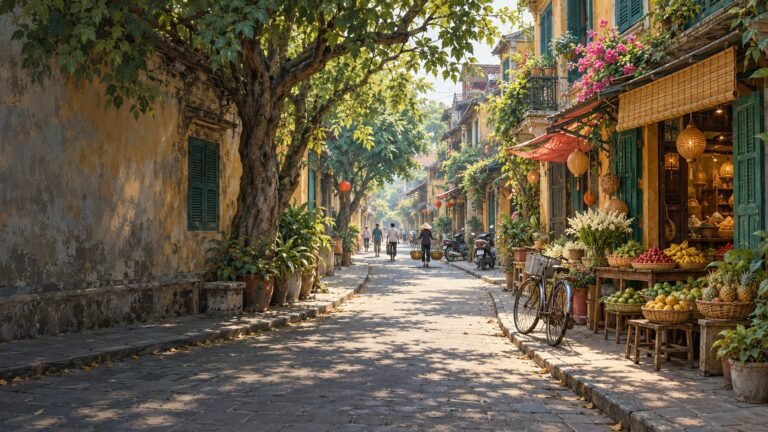
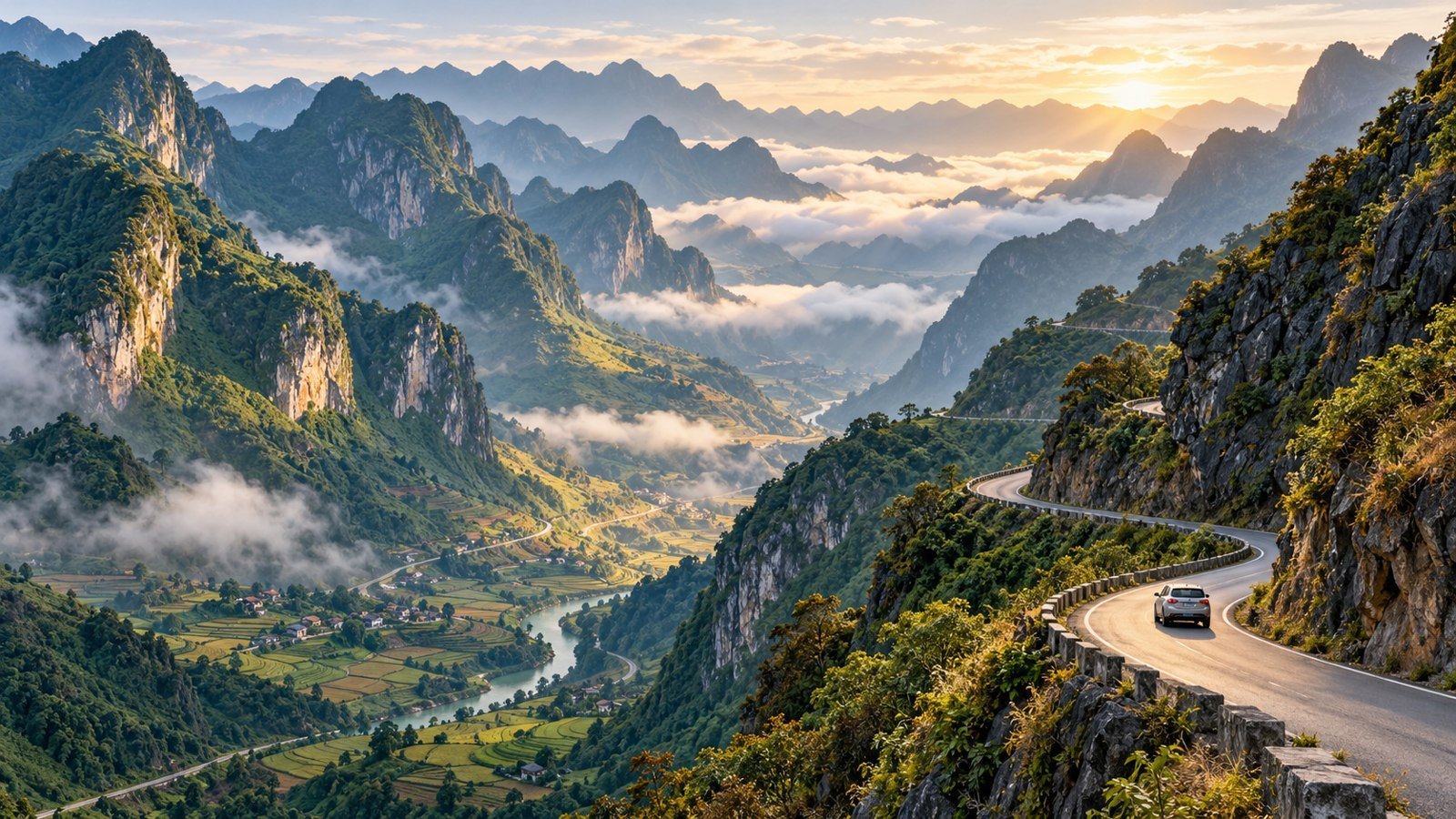
AI-created editorial illustration inspired by the Ha Giang region; not a photograph or a precise depiction of a particular road.
Ha Giang is a journey through limestone mountains, high passes and inhabited valleys. The Dong Van Karst Plateau is a UNESCO Global Geopark; Ma Pi Leng and the Nho Que gorge are among its defining landscapes. [1]
The useful first decision is how you will travel. A car with a driver, a motorbike passenger trip and self-riding make different demands on comfort, experience and preparation. This Ha Giang travel guide helps you choose a mode, build a realistic loop and decide which stops deserve your time.
Choose transport first
Comfort, riding eligibility and the operator’s arrangements come before the cheapest headline price.
Count mountain days
Ask where each advertised day starts and ends; a Hanoi transfer can consume a package day.
Give each stop a job
Choose scenery, cultural visits and rest deliberately instead of collecting every viewpoint.
Keep a changeable plan
Agree how the route, overnight stops and payment change if weather or road access deteriorates.
Choose your transport before choosing a loop
Use this as a personal suitability check, then investigate the actual vehicle, driver and itinerary.
Swipe across the table to read all columns.
| Mode | Choose it when | Resolve before paying |
|---|---|---|
| Car with a driver | You prefer a seat inside a vehicle, want to travel together or do not want to ride. | Vehicle size, seat belts, luggage space, driving hours and whether each proposed stop is accessible by that vehicle. |
| Motorbike passenger with a hired rider | You want a motorbike journey and are comfortable spending substantial time as a passenger. | Who rides your bike, suitable helmet and protective clothing, group size, breaks and a practical way to stop or change transport. |
| Self-ride | You already have relevant riding experience and pass the licence and insurance checks below. | The actual bike, its condition and your entitlement to ride it. A rental offer is not proof of eligibility. |
Car tours are an established option: YESD publishes a four-day itinerary with a driver and guide. Its four days include Hanoi transfers, illustrating why the duration alone tells you little about time in the mountains. [2] Hiring a rider removes the task of controlling the bike; it does not remove motorcycling risk. “Easy rider” describes an offer, not an independently verified safety standard.
The self-riding gate
For UK licence holders, FCDO specifies a 1968 International Driving Permit alongside the UK licence and compulsory third-party insurance. It recommends motorbikes only for experienced riders; helmets are mandatory for riders and passengers. [3] Check that you hold full motorcycle entitlement for the proposed bike before obtaining the IDP; the permit translates existing entitlements rather than adding a missing one. Other nationalities must check the rules for their own licence. [4] [5]
Ask your travel insurer to confirm cover for your exact activity: self-riding or travelling as a passenger, the bike involved, medical treatment, emergency transport and repatriation. Ask about licence, engine-size, helmet and other conditions rather than assuming a general “adventure” label is sufficient. Vehicle third-party cover and your own medical cover answer different questions. [6]
Questions for any operator
Tuyen Quang’s tourism department issued motorcycle-tour management guidance in April 2026 covering travel contracts, qualified guides, drivers, vehicles and route safety plans. [7] Ask for the named operating company, your written itinerary, who will drive, how breaks work and what happens after a breakdown or injury. Request a clear answer on the maximum group size and whether a guide accompanies the whole trip. A booking-platform rating cannot answer those questions for you.
Back to guideUnderstand the route before adding stops
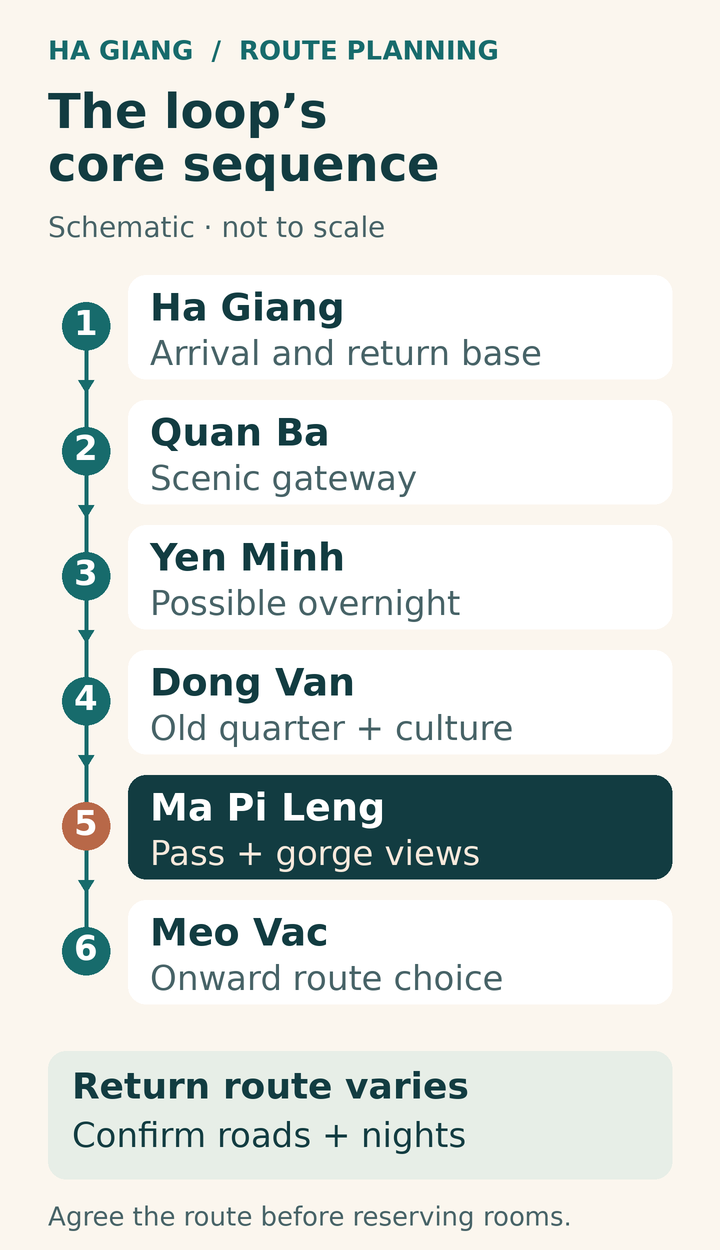
A common outward sequence is Ha Giang → Quan Ba → Yen Minh → Dong Van → Ma Pi Leng → Meo Vac. Return routes vary: Vietnam Tourism’s example continues via Bao Lam and Bac Me, while other itineraries use Du Gia. Request the actual road sequence and overnight places, rather than relying on the word “loop”. [8] [12]
Ha Giang is the gateway and a useful arrival base; it is not the base for every mountain outing. Plan successive overnight stops so you can spend time along the route without retracing the whole drive each evening.
Place names can look inconsistent in newer information. Ha Giang and Tuyen Quang provinces merged into the present Tuyen Quang province in July 2025. This guide uses Ha Giang as the familiar travel-region and gateway name, and names towns and stops individually. [9]
On a quote or map, mark three things first: where you sleep, the longest driving day and the final return to Ha Giang. Only then add optional visits. Road distance alone does not account for breaks, viewpoints, slow sections or time spent getting from a parking place to an attraction.
Choose stops for what they add
Swipe across the table to read all columns.
| Stop or area | Why keep it | How to use your time |
|---|---|---|
| Quan Ba / Tam Son | Heaven Gate introduces the plateau’s mountain scenery. [1] | Use it as an early scenic pause; avoid turning the first day into a race through every lookout. |
| Yen Minh | A practical staging point on the route towards Dong Van. [8] | Consider an overnight here if it makes the following day more comfortable. |
| Sa Phin and Dong Van | The Vuong family palace and Dong Van’s old quarter add historical and architectural interest. [1] | Choose a proper visit, with time to understand the setting, instead of a photograph from the entrance. |
| Ma Pi Leng | The high pass overlooks the Nho Que gorge. [1] | Protect daylight for the drive and approved stopping places; a river excursion is a separate time commitment. |
| Meo Vac | It follows the pass on the classic eastward route. [8] | Use it to reassess the onward journey, meal break or overnight rather than automatically pushing on. |
Add one meaningful detour
Lung Tam offers a different focus through its Hmong hemp-weaving cooperative. Thon Tha, near the gateway, offers village homestays and can make the arrival night part of the visit. Ask hosts about a suitable local market day; schedules should shape the route rather than be assumed. [10]
Lung Cu adds a northern excursion, while Du Gia appears in some southern return itineraries. [11] [12] Choose the extra that interests you most and ask what must be shortened elsewhere. Adding both to a compressed trip can consume the time you hoped to spend walking, talking to a guide or stopping for a view.
For a scenery-led first visit, protect the pass day and one cultural visit. Add a boat trip, a substantial walk or another detour only after the operator shows where its travel and activity time fit. For a village-led visit, reduce viewpoint stops and spend longer with a locally arranged guide or host.
Ask before photographing people or entering working or private spaces. Choose an organised cultural visit for the explanation and interaction it offers; do not assume every settlement welcomes an unannounced group.
Back to guideCount mountain days separately from Hanoi travel
The following is an editorial pacing framework, not an official minimum or a promise that a route will be passable.
Swipe across the table to read all columns.
| Actual mountain time | Planning approach | What to give up |
|---|---|---|
| Three days | Discuss a compact route with few activities beyond the main journey. | Multiple detours, long walks and the expectation of lingering at every stop. |
| Four days | A useful starting point for a first circuit, with more room for breaks and a selected extra. | The temptation to fill the extra day with a second list of attractions. |
| Five days or more | Request shorter driving days or longer stays where your interests justify them. | A fixed assumption that more days must mean a longer loop. |
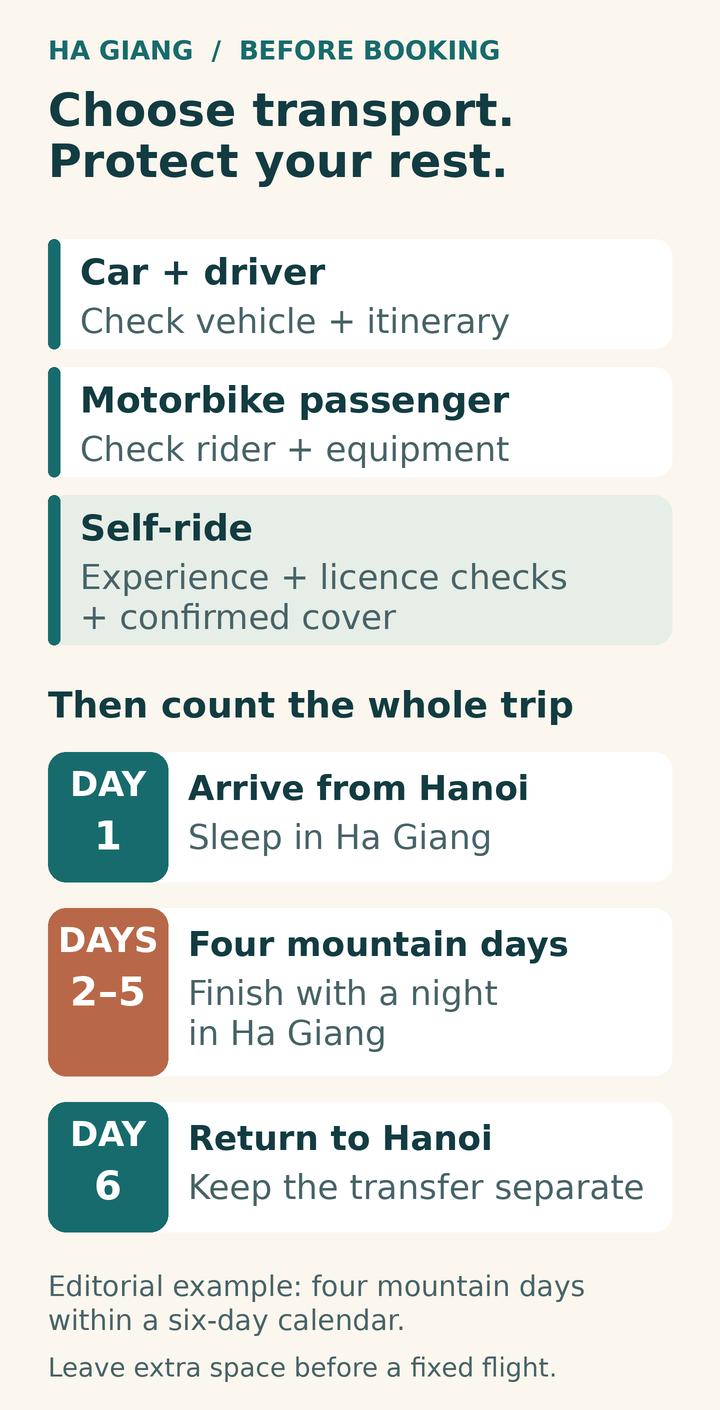
A six-day calendar for four mountain days
- Day 1: transfer from Hanoi, meet the operator and sleep in the Ha Giang area.
- Days 2–5: four agreed mountain days, returning to Ha Giang for the final night.
- Day 6: travel back to Hanoi.
This example protects a night before departure and avoids coupling the final mountain day with an immediate long transfer. It is a comfort and contingency allowance, not a weather buffer that guarantees your onward connection. Keep additional space before an international flight or another expensive, inflexible departure.
If you have only two days available from Ha Giang, ask for a shorter excursion, perhaps centred on Quan Ba, instead of buying a nominal full loop whose daily hours you would not choose independently. If your total allowance includes Hanoi travel, reduce the mountain plan again.
Let conditions decide the day’s ambition
Vietnam Tourism identifies September to November as a favourable general window, with buckwheat flowering in October and November. It also notes cold winters and wetter, more slippery roads from May to August. These are seasonal patterns: they do not establish the forecast, visibility or road condition for your trip. [11]
Heavy rain can cause landslides and road closures; remote rescue can be difficult. [3] Ask the operator and accommodation about the specific next section each morning, alongside the local forecast. A destination-wide weather icon does not tell you whether a pass is clear.
Change the plan when a road is closed, visibility is too poor for the planned activity, the driver is tired or anyone is no longer comfortable continuing. Shorten the day, wait, change route or stay another night. Do not try to recover lost time by extending the mountain journey into darkness.
Use open, authorised viewpoints and follow barriers and local instructions. Agree a substitute for a cancelled boat trip or exposed walk before setting off. If the view is hidden, a meal, palace visit or unhurried afternoon may be a better use of the day than waiting beside a road for a photograph.
Back to guideArrange the Hanoi transfer and the rest afterwards
Vietnam Tourism gives roughly six to seven hours by car or sleeper bus from Hanoi to the Ha Giang area. Treat that as an indication, not a door-to-door commitment: the booked service, collection route, stops and conditions determine your journey. [11]
Compare Hanoi–Ha Giang buses, vans and private transfers on 12Go, then inspect the selected service’s operator, collection point, drop-off and arrival time. The route page lists several vehicle types; its headline prices and quickest results should not replace the details of your chosen departure. [13]
- Match the drop-off to your actual hotel or tour meeting point, including any extra transfer.
- Check whether a sleeper berth is single or shared, what luggage is accepted and what happens if arrival is delayed.
- Ask whether an early arrival includes an immediately available bed, or only a place to wait until check-in.
FCDO links greater night-bus crash risk to driver fatigue. [3] A daytime transfer with an arrival night is the clearest option for protecting rest. If you choose an overnight bus, do not treat reaching Ha Giang as evidence that you are rested enough to self-ride that morning. Agree a later start or another night.
Back to guideChoose each overnight for the next day
For the arrival and final nights, prioritise an address your transport can reach, a confirmed check-in arrangement and a quiet place to sleep. A Thon Tha homestay can add a village stay; confirm its transfer and meal arrangements with the host. [10]
On the loop, select the overnight sequence with the driver before reserving rooms separately. Yen Minh can break the outward journey; Dong Van lets you give the town time; Meo Vac may suit the next leg after the pass. [8] Ask how each choice changes that day’s driving rather than picking a room solely for its photograph.
For independent reservations, start with Ha Giang accommodation on Agoda for the gateway nights and Dong Van accommodation on Booking.com for a mountain overnight. Check the map pin against the agreed route and compare the complete stay price and cancellation terms. These are destination searches, not personal hotel recommendations.
For a package, get the room arrangement in writing: dormitory or private room, private or shared bathroom, room-sharing rules, meals and any upgrade charge. Ask about warm bedding, hot water and evening noise. “Homestay” alone does not settle any of those details.
Back to guideCompare the full trip cost, not just the tour headline
Ask two operators to price the same brief: your party size, dates, actual mountain days, transport mode, overnight places and room type. Then add missing items before comparing totals.
Swipe across the table to read all columns.
| Part of the quote | Confirm exactly |
|---|---|
| Transfers and transport | Hanoi travel both ways; local pick-up; driver or rider; guide; fuel; tolls; parking; luggage. |
| Nights and meals | Arrival and final gateway nights; loop rooms; private-room supplement; listed meals, water and drinks. |
| Visits and changes | Entrance fees; boat trip; any route-specific permission and its handling; weather substitutions; extra nights; cancellation and refund terms. |
| Responsibility | Who operates the trip; vehicle cover; any insurance actually included; what your own travel policy must cover. |
Comparable trip total = the quoted package + required transfers + missing nights, meals and visits + your chosen upgrades. Keep a separate contingency for disruption. Compare the total for the same party, then divide by travellers if a per-person figure helps; a private car’s party price and a motorbike tour’s per-person price need this adjustment.
Two different offers worth comparing
The four-day Ha Giang Loop offer with a rider option on GetYourGuide advertises a maximum of six bikes. Its rider is included only when the passenger option is selected, and room and transfer choices need checking. [14] The four-day private Jeep itinerary on GetYourGuide lists a driver, guide and three nights in private rooms, with collection in Ha Giang. Confirm your party’s vehicle and Hanoi arrangements separately. [12]
Use these listings to compare modes and inclusions, then ask the operator the questions above. Published descriptions are not an independent assessment of driving standards, vehicle condition or the day’s road safety. Recheck the selected option and its cancellation conditions before paying.
Back to guideSet up documents, cash and offline information
Passport and border-area arrangements
Vietnam’s immigration portal says foreign visitors must arrange temporary-residence declaration through their accommodation provider. Bring your passport for the host’s registration process. [15] Do not use a passport as a rental deposit. [3]
Border-area visits may need permission, and restrictions are not always signposted. [3] Ask the operator or accommodation to check the exact itinerary with the local authorities, especially for border-area detours. A blanket claim that every visitor needs one identical “Ha Giang permit” is not a sufficient explanation.
Cash and a small working bag
Vietnam Tourism warns that cash machines are scarce along the loop. Carry enough Vietnamese dong for agreed cash payments, small purchases and a reserve before leaving the gateway. [8] Confirm any balance due with the operator. Keep essential documents, medicine, a warm layer and waterproof protection accessible rather than buried with stored luggage.
Connectivity that still works as a plan when the phone does not
Save your itinerary, offline maps, accommodation addresses, driver and operator numbers, and your insurer’s emergency-assistance details. Agree a meeting point and a contact method if the group separates. Do not assume a particular mobile plan will provide a signal on every mountain section.
If a compatible eSIM would simplify arrival, browse Airalo and select Vietnam. Its Vietnam page lists data-only packages, so check the exact plan’s network, activation terms and your phone’s compatibility and carrier lock before buying. Data-only service is not a normal voice-call package; make a separate plan for calling local contacts. [16] The Vietnam SIM and eSIM guide explains the wider route and data choices.
Back to guideFrequently asked questions
Can I see the Ha Giang Loop without riding a motorbike?
Yes. Driver-led car and Jeep itineraries are available. Confirm the actual vehicle, route and stops, then compare how much time is spent driving with the time available out of the vehicle. A car booking does not automatically make every viewpoint, boat boarding or accommodation entrance accessible. [2] [12]
Does “four-day loop” include the journey from Hanoi?
It depends on the offer. The YESD example includes Hanoi travel within four days; the Jeep listing starts with collection in Ha Giang. Ask for each day’s starting and finishing place before comparing them. [2] [12]
Can I book the transfer, driver and rooms separately?
You can investigate separate bookings, but settle the route and driver first. Get one written list of who is responsible for each transfer and night, and who can change a reservation if the road plan changes. The potential saving is only useful if the itinerary still works as a whole.
Should I still go if the forecast is wet?
Do not make the decision from a rain symbol alone. Ask about warnings, the specific roads, visibility and what the operator will do if conditions worsen. Be willing to delay or shorten the trip. A flexible booking gives you options; it does not establish that the route is suitable to travel.
Choose your next step
Choose the mode you are comfortable and eligible to use, then ask for an itinerary showing actual mountain days, nightly stops and the longest driving stretch. Protect the pass day, select a small number of meaningful extras and compare complete trip totals. Book the version that leaves room to rest and change course when conditions require it.
This research-led guide was reviewed on 23 October 2026 using UNESCO, Vietnamese tourism and government information, UK government guidance, transport listings and the operator offers cited below. The transport selector, pacing framework and cost-comparison method are editorial recommendations. They are not based on a personal trip or an inspection of operators, vehicles or roads. Published itineraries establish what is offered, not availability or safety on a future departure; no live fare or hotel rate is quoted.
Sources
Sources consulted for this guide on 23 October 2026. Provider information describes published offerings; prices and availability vary by date.
- UNESCO — Dong Van Karst Plateau UNESCO Global Geopark
- YESD — Ha Giang Loop four-day car tour
- FCDO — Vietnam: safety and security
- NI Direct — Car hire, driving abroad and International Driving Permits
- GOV.UK — Driving licence categories
- FCDO — Foreign travel insurance
- Tuyen Quang Department of Culture, Sports and Tourism — Motorcycle-tour management notice, 14 April 2026 (Vietnamese)
- Vietnam Tourism — The Ha Giang Loop: a four-day road trip
- Tuyen Quang government — Maintaining growth targets post-merger, 7 July 2025
- Vietnam Tourism — Ha Giang adventures
- Vietnam Tourism — Tuyen Quang / Ha Giang destination guide
- GetYourGuide — Ha Giang four-day private Jeep tour with local guide
- 12Go — Hanoi to Ha Giang transport listings
- GetYourGuide — Ha Giang Loop four-day Easy Rider tour, maximum six bikes
- Vietnam Immigration Department — E-visa portal frequently asked questions
- Airalo — Vietnam eSIM plans
Illustrations in this article were created for Taylor’s Trailblazing Travels. Third-party photographs, where used, are credited beside the image or in the source list.