Best Time to Visit Vietnam: A North, Central and South Weather Guide
Match the month to your route, then protect the parts of your holiday that depend on good weather.
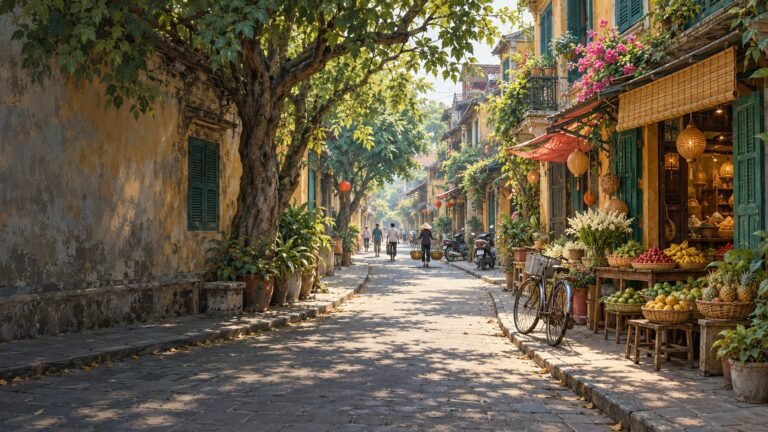
AI-created illustration of contrasting weather over a Vietnamese-inspired landscape; not a photograph of a particular day or location.
The best time to visit Vietnam depends on which part of your holiday you most want to get right. A northern walking trip, a central-coast beach break and a southern winter escape do not share one perfect season. Even the national tourism guidance treats destinations separately. [1]
Start with your non-negotiable experience, then choose a route that fits it. This guide uses regional climate patterns to narrow the choice and practical planning scenarios to show where flexibility matters.
Choose your anchor
Let the experience you would most regret losing determine the season.
Separate the coastlines
Phu Quoc and the central coast need different weather checks.
Leave room to change
Protect outdoor plans with a spare day or a genuine alternative.
Use forecasts later
Climate helps choose dates; current alerts guide daily decisions.
Best time to visit Vietnam: compare the months
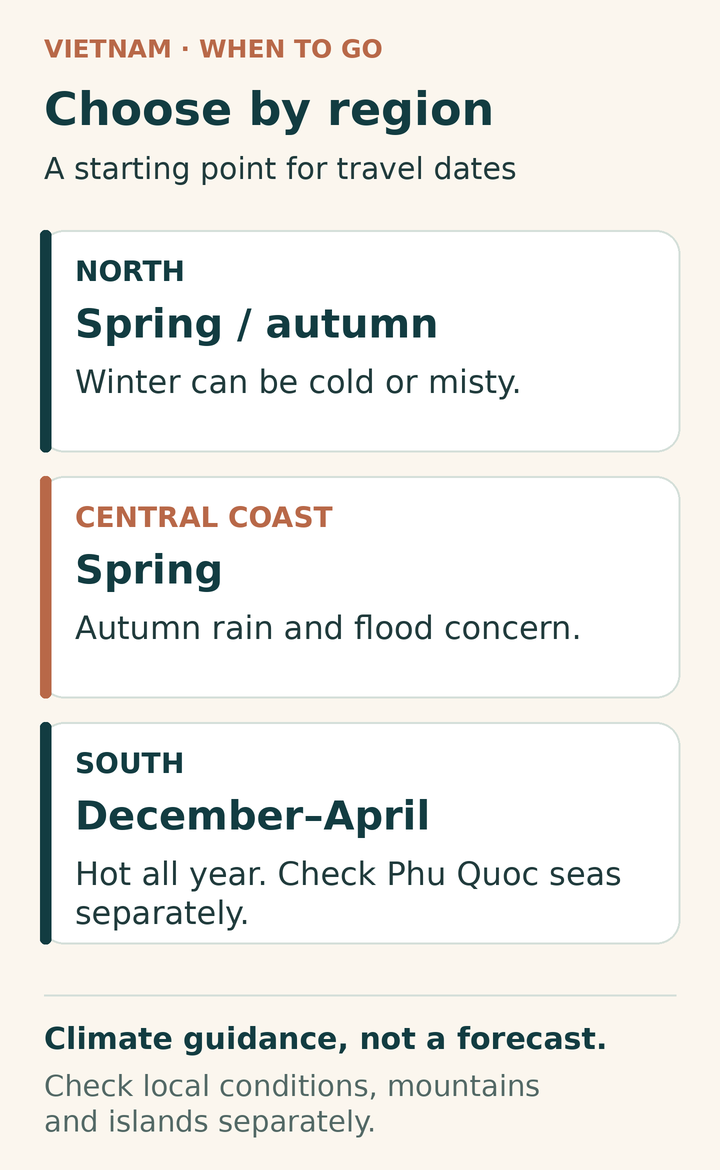
Use this table to shortlist a season, then read the section for your actual destinations. A month labelled rainy can still contain worthwhile sightseeing days; a favourable month can still bring disruption. Transitions are gradual and do not happen on the first day of a calendar month.
| Month | North: Hanoi and nearby lowlands | Centre: Hue–Hoi An coast | South: Ho Chi Minh City and mainland |
|---|---|---|---|
| January | Cool; cloud or drizzle | Cooler; lingering rain | Drier, warm |
| February | Cool; variable skies | Often improving | Drier, warm |
| March | Warming; mist possible | Favourable spring window | Drier, increasingly hot |
| April | Warmer; heat building | Warm; heat building | Dry-season heat |
| May | Hotter; rain increasing | Hot; often sunnier | Rainy-season transition |
| June | Hot, humid, rainy | Hot; plan midday breaks | Hot; showers |
| July | Hot, humid, rainy | Hot; often sunnier | Hot; showers |
| August | Hot, humid, rainy | Hot; transition varies | Hot; showers |
| September | Autumn transition | Rain and storm exposure | Hot; showers |
| October | Often more comfortable | Heavy-rain/flood concern | Rainy; variable |
| November | Cooler autumn days | Rain/flood concern persists | Transition varies |
| December | Cooler; mist possible | Rain can linger | Drier-season start |
If your dates are flexible, compare two versions of the holiday: the full route in a broadly compatible month, and a shorter regional trip in your preferred month. The second can give you a better holiday than adding flights simply to include every famous stop.
Northern Vietnam: city comfort, bay visibility and mountain cold
Hanoi and the lowlands
Hanoi has a noticeably seasonal climate: humid summer heat, cooler winters that can be drizzly, and shorter spring and autumn transitions. The national tourism board highlights September to November for the capital. [2] For a holiday built around walking, that makes autumn a useful starting point; choose spring when combining the north with the central coast matters more.
A city break is easier to adapt than a succession of exposed day trips. Keep indoor visits and cafés available as alternatives, and avoid allocating every day to an excursion that needs clear skies. This is especially useful when you have only a few nights and cannot wait for conditions to change.
Ha Long Bay
For the bay, separate warmth from visibility. Official tourism guidance describes summer as hot with storm potential and winter as cooler with mist; spring and autumn are highlighted for cruising. [3] Mist may suit the landscape you want to photograph, but it is a poor basis for promising sunshine, swimming or a distant viewpoint.
Place a cruise before a flexible city stay where possible, rather than immediately before an important onward departure. Ask what happens if the sailing is cancelled, including arrangements for the land transfer. A different departure day is only useful if your hotel and onward plans allow it.
Sa Pa and the northern mountains
Sa Pa has a cooler highland climate, cold winters and occasional frost around Fansipan. Spring and autumn are commonly favoured in the destination guidance. [4] Do not use a Hanoi temperature as your mountain packing forecast. Check the overnight conditions and the elevation of the excursion, not just the town.
If a clear panorama or a particular rice-field appearance is the main reason for travelling, ask a local operator about current conditions before finalising the excursion. A seasonal photograph is inspiration, not evidence of what a specific field or viewpoint will look like on your date.
Back to the guide ↑Central Vietnam: spring is a useful starting point, but check the exact stop
Hoi An, Da Nang and Hue
Da Nang Tourism Promotion Centre favours February to April for visiting Hoi An’s ancient town. Its guidance describes May to August as generally drier but hot, and September to January as the rainy season. [5] Treat a spring visit as the first option to compare when outdoor sightseeing and beach time both matter.
Hue deserves its own check. Its destination guidance highlights February to April and warns of heavy rain and typhoons in September to November. [6] If Hue, Da Nang and Hoi An are all on the itinerary, favour the overlap between their better periods, rather than assuming the weather at one hotel represents the whole coast.
For a summer visit, plan outdoor sightseeing early, leave the hottest part of the day less demanding and choose accommodation where you would enjoy spending a quiet afternoon. For an autumn visit, a cheap room is useful only if the trip still works when an excursion is cancelled.
Central Vietnam’s October–November flooding is more than a sightseeing inconvenience. FCDO advice describes disruption to roads and essential services, with possible landslides and infrastructure damage. Follow local restrictions and stay out of flooded areas. [11]
Nha Trang and Da Lat are different cases
Nha Trang, farther down the coast, has its own seasonal pattern. Its tourism page gives January to August as the broadly drier period and September to December as the rainy season. [7] Use that to shortlist dates, but check sea conditions separately for an island outing.
Da Lat is a highland destination, not a continuation of the beach climate. Official guidance describes chilly nights, rain from May to October and a drier December–March window. [8] Adding it to a coastal route changes both your clothing needs and the conditions you should check before an outdoor activity.
Back to the guide ↑Southern Vietnam: mainland showers and island seas need different plans
Ho Chi Minh City and the southern mainland
Ho Chi Minh City stays hot through the year. Its official destination page identifies December to April as the dry season and May to November as the rainy period, when afternoon showers are common. [9] The practical distinction is how much of each day depends on being outdoors, rather than whether the month contains any rain.
A flexible city visit can alternate walks with indoor stops. A boat outing, countryside transfer or day with several fixed pickups has less room to adapt. Do not translate “afternoon showers” into a guarantee that every morning will be dry or that heavy rain will always pass quickly.
Phu Quoc
Phu Quoc’s current destination guidance describes November to April as the drier season and May to October as the rainy period, with rougher seas. [10] For a holiday whose main purpose is the beach, December to March is a sensible part of that window to compare first. This is a planning preference, not a guarantee of calm water.
A rainy-season city break and a rainy-season island break can therefore be very different purchases. Before booking the latter, decide whether a pool, dining and time at the hotel would still make the stay worthwhile if boat trips or beach days were lost. If the answer is no, change the season or choose another kind of trip.
Back to the guide ↑Choose the season around the holiday you actually want
The following framework is an editorial decision tool. It weighs the experience most dependent on weather, your tolerance for heat or rain, and whether an alternative would still feel like a good holiday. It does not calculate a probability of sunshine.
| Your priority | Compare first | Protect the decision |
|---|---|---|
| A first trip across three regions | March or April | Keep the north flexible for mist and allow for increasing heat farther south. |
| Northern cities and mountain scenery | Autumn, with local checks for each highland stop | Give the key outdoor day more than one possible date. |
| Hoi An plus coastal downtime | Spring | Choose a base that suits both the town and the beach; do not make every day a boat day. |
| A winter sunshine escape | Southern mainland plus Phu Quoc | Keep the island stay away from a tight, separate-ticket departure connection. |
| Fixed July or August leave | A central-coast-focused trip if you tolerate heat | Use a slower daily pace, with current storm checks and shaded or indoor alternatives. |
| Fixed October leave | A north-focused trip | Do not add the central coast merely to complete a standard route. |
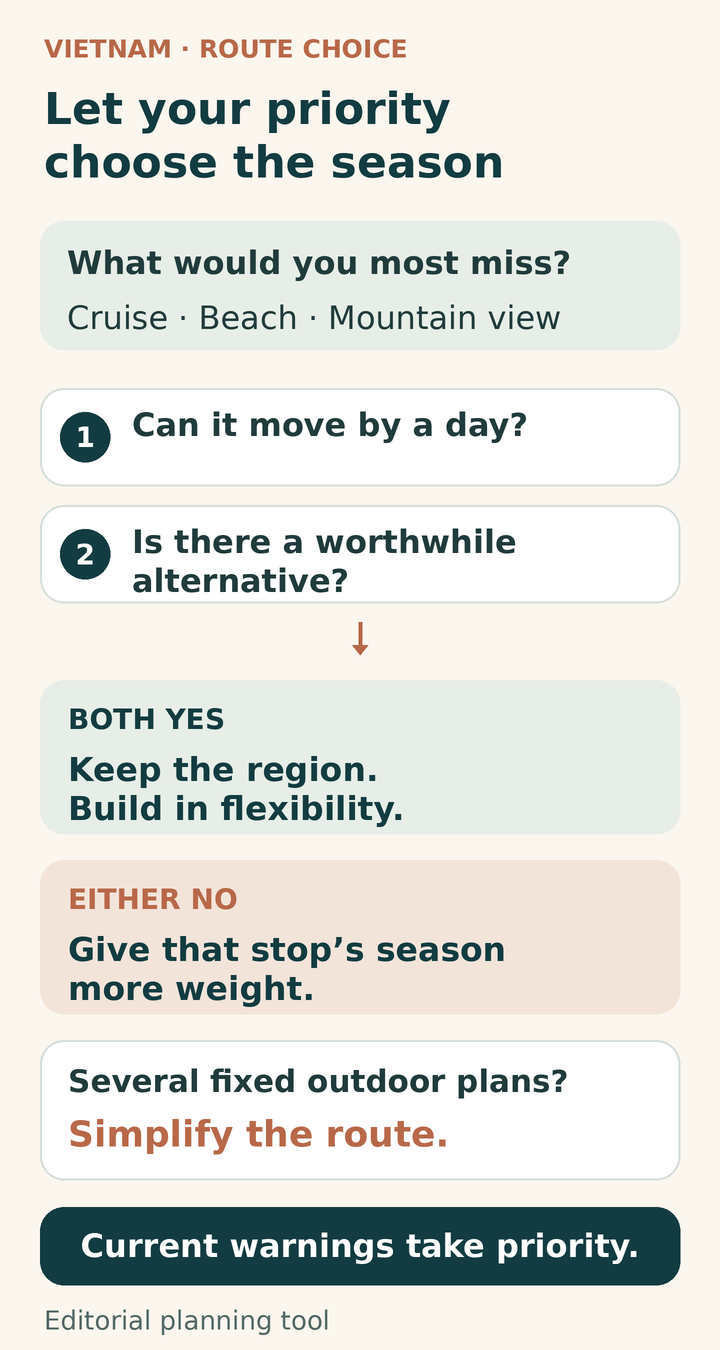
The three-question test
- Which one experience would you most regret losing: a cruise, mountain views, beach time or outdoor heritage sightseeing?
- Could it move by a day without losing a paid flight, tour or hotel reservation?
- Would the alternative still be worth the journey?
If an experience cannot move and has no worthwhile substitute, give its season more weight than the rest of the route. If several experiences are equally inflexible, simplify the trip. That is usually more useful than searching for a supposedly perfect national weather forecast months ahead.
Example: on a two-week holiday with one fixed cruise night, four beach nights and several flexible city days, choose dates around the cruise and beach. If your only available month poorly suits the chosen coast, replace that beach segment instead of treating five weather-dependent nights as a minor compromise.
Balance weather with holiday crowds and booking flexibility
Tet, the Vietnamese Lunar New Year, changes travel planning independently of the weather. The date moves through January or February; official tourism advice warns about business closures and heavy demand around transport hubs, and recommends confirming travel well ahead. [13] Check the actual holiday dates for your year before making a flight or hotel purchase.
There is no dependable “cheapest month in Vietnam” for every route and traveller. Compare total trip costs for your exact dates, including the terms of any changes you might need. A lower room rate is not a saving if an inflexible onward journey makes a weather change expensive.
Choose a base that works on a disappointing day
For a city stay, look for convenient access to the places you would use in wet weather. For a beach stay, assess the hotel as somewhere you might spend several hours. Check room-specific cancellation deadlines and whether transport or excursions have separate terms.
Once the month and route are chosen, compare Hanoi stays on Agoda and Hanoi stays on Booking.com. For a central-coast plan, browse Hoi An accommodation on Agoda; for a southern city base, compare Ho Chi Minh City stays on Agoda. These are destination searches: select your dates and inspect each room’s conditions.
Keep a note of the last date on which a change is affordable. A forecast check after that deadline may still help with safety, but it cannot recover flexibility you have already given up.
Back to the guide ↑Turn a weather forecast into a practical decision
Climate tables help select a travel window. Once the trip is close, use current regional forecasts and official alerts. FCDO identifies May to November as the usual tropical storm season and points travellers to Vietnam’s National Centre for Hydro-Meteorological Forecasting and the Japan Meteorological Agency; storms can also occur outside the usual season. [11] [12]
| What you are seeing | What to do next |
|---|---|
| Ordinary rain in the forecast, with no relevant warning | Reorder flexible city activities, carry rain protection and reconfirm an outdoor booking if needed. |
| An operator flags possible cancellation or difficult conditions | Ask for its decision time and written options; check the next hotel and onward connection before accepting a change. |
| A storm, flood, evacuation or route-closure warning affects your area | Follow official instructions. Do not enter closed areas or keep travelling simply to use a paid reservation. |
A small buffer with a clear job
Keep the last night before an important departure at the departure city when the alternative involves a weather-sensitive sea or long overland connection. This is a buffer recommendation, not a guarantee that one night is enough in a severe event. If an official warning changes the situation, reassess the whole connection.
Save your accommodation, transport operator and insurer contacts somewhere you can reach without a data connection. Ask who will tell you about a cancellation and what the next decision will be. “We will see tomorrow” is useful only when you know where you can stay tomorrow.
Avoid these planning mistakes
- Using one national forecast for every destination.
- Assuming a nearby island shares the mainland’s sea conditions.
- Choosing the lowest price without checking cancellation terms.
- Making a scenic excursion the only route to a crucial onward flight.
- Treating a favourable seasonal label as permission to ignore a current warning.
Frequently asked questions
Should a Vietnam trip run north to south or south to north?
Choose the direction around your most weather-dependent stop, confirmed transport and international flights. Reversing a two-week route does not remove a regional wet season. It is worth doing when it improves a particular connection or gives a key excursion a more useful alternative date.
Does a rainy-day symbol mean the whole day will be lost?
No. It does not describe the timing, duration or intensity of rain on its own. Read the detailed local forecast and any warnings before deciding what to change. Keep a city sightseeing plan flexible, and ask the operator about a boat or mountain activity.
Is September–November good everywhere because it is autumn?
No. Northern autumn can be attractive, while the central coast has a different seasonal pattern. Hue’s official guidance warns of heavy rain and typhoons during September–November. A north-focused autumn trip is a different proposition from a coast-to-coast route. [2] [6]
Can I rely on a dry-season beach stay for swimming?
A drier season helps you choose dates; it does not establish that the sea is safe on a particular day. Follow beach warnings and local advice. Choose the hotel and surrounding area so that a day out of the water still has something worthwhile to offer.
Your next step
Choose a priority, then a season, then a route. For a broad first visit, compare March and April before fitting every stop into a fixed itinerary. If your dates are already set, let the regional pattern determine which places deserve the most time. Keep one meaningful alternative for each major outdoor experience, and give current warnings the final say.
This is a research-led planning guide. Regional climate tendencies were checked against official tourism guidance, with FCDO advice used for disruption and safety decisions. The route choices, three-question test and response ladder are editorial planning judgements; they are not weather forecasts or measured risk scores.
Sources and research
Sources checked for this editorial review on 23 October 2026. Conditions can change; use the relevant official page when finalising your plans.
- Vietnam Tourism: Weather and climate in Vietnam
- Vietnam Tourism: Ha Noi — seasonal guidance
- Vietnam Tourism: Ha Long — climate and cruising seasons
- Vietnam Tourism: Sa Pa — highland climate
- Da Nang Tourism Promotion Centre: Hoi An Ancient Town — best time to visit
- Vietnam Tourism: Hue — climate and seasonal risks
- Vietnam Tourism: Nha Trang — coastal climate
- Vietnam Tourism: Da Lat — highland climate
- Vietnam Tourism: Ho Chi Minh City — wet and dry seasons
- Vietnam Tourism: Phu Quoc — island weather
- FCDO: Vietnam safety and security — extreme weather and natural disasters
- FCDO: Vietnam warnings and insurance — tropical storm season
- Vietnam Tourism: Plan your trip — public holidays
Illustrations in this article were created for Taylor’s Trailblazing Travels. Third-party photographs, where used, are credited beside the image or in the source list.