
Mai Chau Travel Guide: Villages, Cycling and Countryside Stays
Choose your village setting and room first. Then build a valley stay with room for cycling, conversation and a proper rest.
AI-created editorial illustration inspired by Mai Chau; not a photograph of a particular village, property or current crop.
Mai Chau’s valley brings together rice fields, mountain scenery and villages where White Thai families offer accommodation in stilt houses. Lac and Pom Coong are established homestay villages, with paths connecting settlements and paddies. [1]
This Mai Chau travel guide focuses on a countryside stay built around those villages. The most useful decisions are where to sleep, what the actual room includes and how much uninterrupted time to leave. Choose Mai Chau for a manageable programme of village visits and locally planned cycling; if a demanding mountain trek is your main goal, plan that as a separate trip.
Choose the room
A village address does not tell you whether sleeping space or bathrooms are shared.
Keep one full day
Two nights leave an uninterrupted day between arrival and departure.
Check the ride locally
Ask about surfaces, traffic, gradients and a shorter return before setting out.
Price the whole stay
Compare room, meals, transfers and chosen activities together.
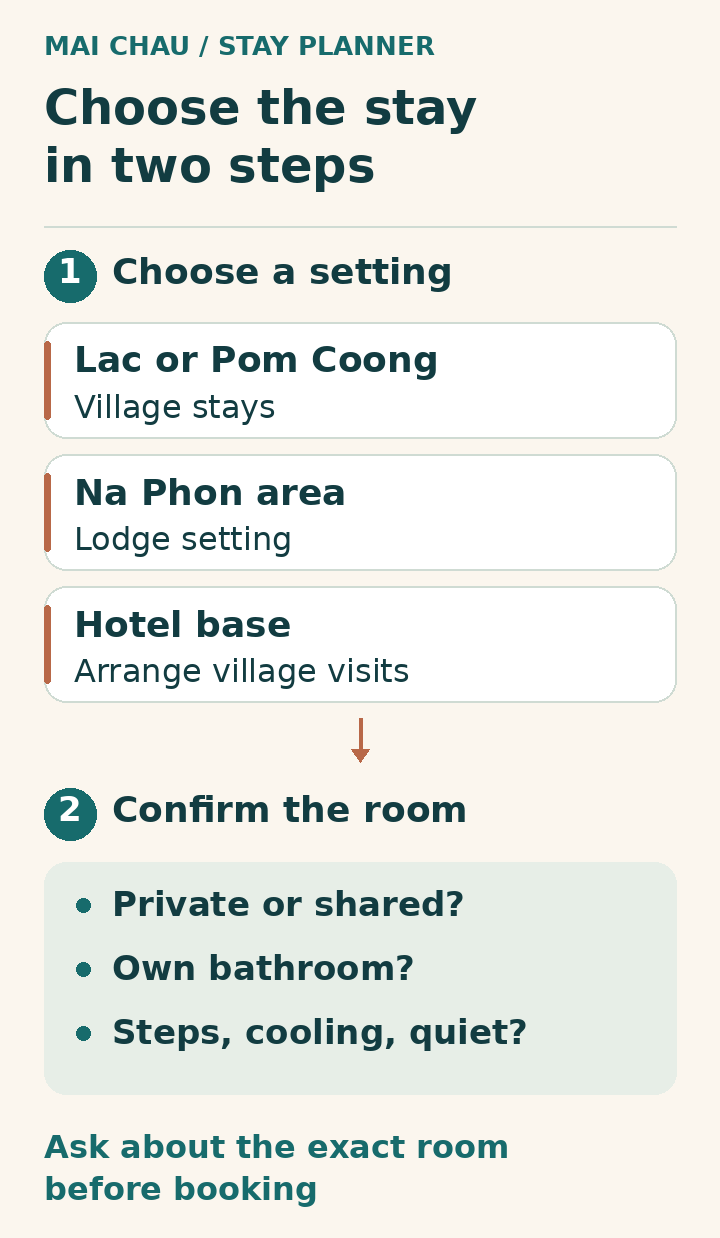
Choose your Mai Chau base and room together
The national tourism board describes traditional stilt-house accommodation in Lac and Pom Coong as commonly having shared bathrooms and open sleeping areas. It also identifies hotels and lodges as alternatives. [3] Use the selector below to turn a setting preference into a room requirement; these are planning judgements, not ratings of individual hosts.
Swipe across the table to read all columns.
| Setting and room choice | Choose it when… | Confirm before paying |
|---|---|---|
| Lac or Pom Coong; communal stilt-house stay | Sharing space is part of the experience you want. | Who shares the sleeping area, bathroom location, bedding, screens or nets, stairs and evening noise. |
| Village address; a room explicitly sold as private | You want a village base and a door you can close. | Whether the bathroom is also private, who occupies adjoining space, cooling and the exact room photographs. |
| Na Phon area; lodge room | Time at the accommodation matters as much as outings. | Room-to-restaurant steps, the route to villages, transport after dinner and which view the booked category provides. |
| Hotel room; arranged village visits | You prefer to separate where you sleep from where you spend the day. | The room category, village transport, meals and any cycling or guiding charges. |
For step-free requirements, ask for a continuous route from vehicle drop-off to the room, bathroom and dining area, with recent photographs or a short video. The words “homestay”, “lodge” or “ground floor” do not answer that question. For a light sleeper, ask about the location of group dining and evening entertainment before prioritising a view.
Compare Mai Chau stays on Agoda, then check the map and room details against your priorities.
Two researched examples to compare
Mai Chau Ecolodge describes a hill setting in the Na Phon area. Its Superior room description includes air conditioning, a private balcony and an en-suite shower. [4] [5] It is a useful candidate for someone seeking a private lodge room; check the access route and chosen room category rather than assuming every room has the same position. Compare Mai Chau Ecolodge rooms on Agoda.
Mai Chau Lodge lists conventional hotel rooms alongside a separate glamping-dome category. [6] It is a useful comparison for a hotel-based visit, but select the accommodation type deliberately: a low headline rate should not decide whether you end up in a room or a dome. Compare Mai Chau Lodge room types on Booking.com.
These examples are based on published property information, not personal stays or inspections. Availability, room inclusions and rate conditions need checking for your dates.
Build one or two full days, then count the nights
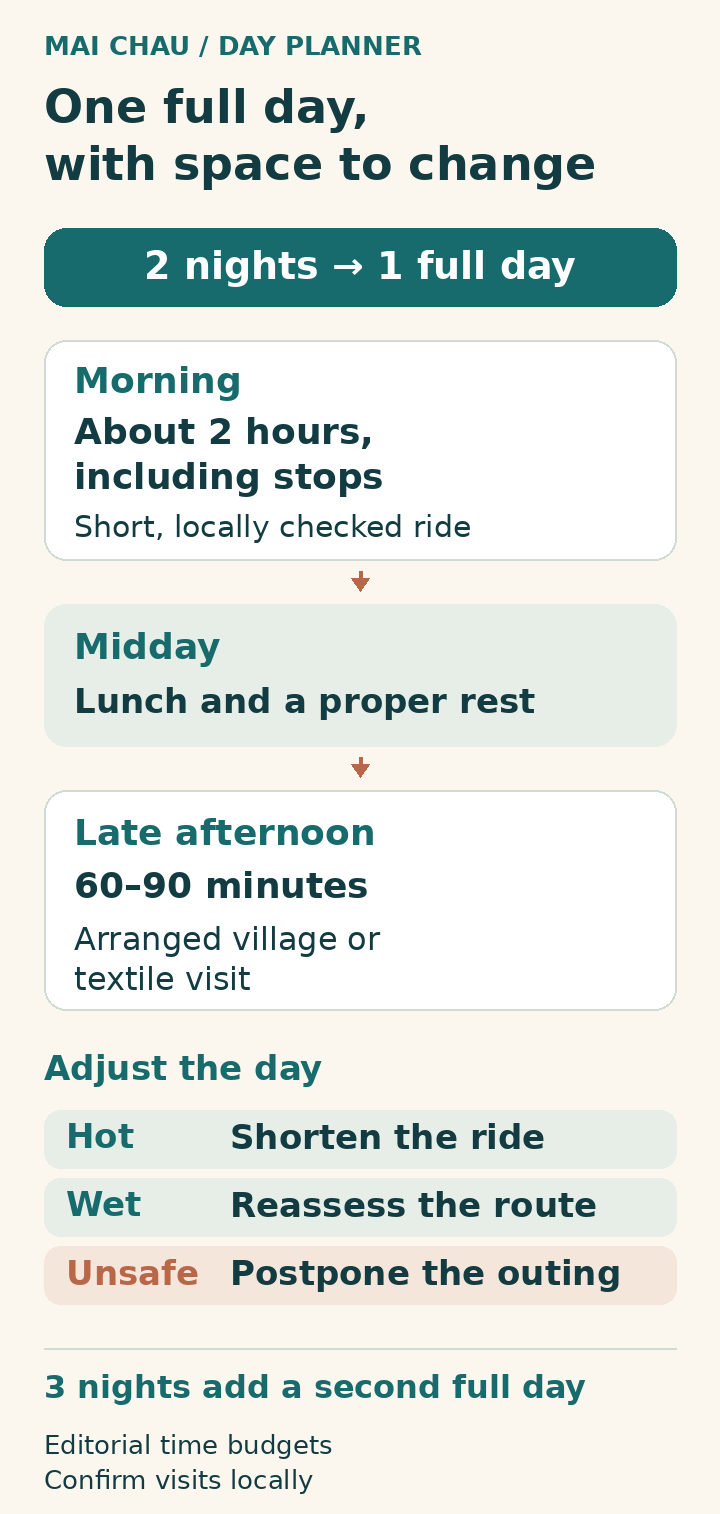
For this guide’s programme, two nights mean an arrival day, one uninterrupted day and a departure day. Three nights add a second full day. A one-night stop is worthwhile if you mainly want an evening meal and a short outing, but do not count both travel days as full days in the countryside.
Use the following as an editorial time budget. The two-hour and 60–90-minute blocks include stops; they are not route timings, opening hours or promises of guided-tour availability. Confirm any household visit or workshop before including it.
Swipe across the table to read all columns.
| Part of the day | Suggested plan | Change it when needed |
|---|---|---|
| Arrival afternoon | Settle in, check the next day’s route and arrange dinner. Add only a short orientation walk if you have energy. | A delayed transfer simply removes the walk. |
| Full day: morning | Allow about two hours for a locally checked valley ride with stops, starting from your accommodation or an agreed meeting point. | Shorten the ride in uncomfortable heat; choose a walk or a confirmed cart outing if cycling does not suit everyone. |
| Full day: midday | Lunch, shade and a proper rest. Keep this block free of compulsory sightseeing. | Return earlier if the morning has been tiring. |
| Full day: late afternoon | Allow 60–90 minutes for a prearranged village or textile visit, or a short walk close to your base. | In rain, use an agreed indoor activity only if reaching it is safe. |
| Departure morning | Breakfast and packing, with the transfer meeting point already settled. | Do not put a distant attraction before an onward connection. |
What the second full day adds
Keep one day centred on cycling and the other on a slower visit, meal and recovery time. You can swap their order after checking the forecast and local conditions. If the first ride goes well, ask a guide about a different route rather than extending it into unfamiliar roads simply to fill the day.
A couple wanting privacy might choose a lodge room and one guided morning. Friends happy to share could choose a village stay and spend more time over an arranged dinner. A family or mixed-energy group should organise an alternative for anyone who stops cycling, with a clear place to reunite. None needs to fill both days with paid excursions.
Choose a ride you can comfortably finish
Vietnam’s tourism board describes independent and guided cycling in Mai Chau, with accommodation providers able to help arrange outings. It also identifies electric carts as an alternative. [3] Ask about availability and boarding arrangements; a cart is not automatically suitable for every mobility need.
Request a route based on your starting point and least confident rider. “Valley cycling” should not be treated as confirmation of a flat, traffic-free or accessible route. Ask which sections use roads, where surfaces or gradients change, and where you can turn back without committing to the entire loop.
- Check bike size, brakes and tyres, and obtain a correctly fitting helmet. Ask for another bike if anything feels unreliable.
- Try a short 15–20-minute out-and-back near the start before accepting a longer ride. This is a suggested confidence check, not a route description.
- Agree who to contact, where to meet and how to return if someone is tired or the weather changes. Take water and keep the accommodation pin available offline.
- Choose a guide if you need route support or an arranged introduction to a household. A guide does not remove the need to assess your own comfort.
Stop and reassess when the surface or visibility makes riding uncomfortable. The FCDO warns that flooding and landslides can disrupt roads in Vietnam. [9]
Back to guideGive village visits time and permission
Textile weaving is part of the White Thai cultural life highlighted by the national tourism board. It also recommends local dishes such as cơm lam, rice cooked in bamboo, and grilled chicken. [3] One arranged visit and a meal can give a day more focus than a long list of photo stops.
Ask your host or guide who is welcoming visitors, what a demonstration includes and what payment is expected. A shop being open does not make a private house open to visitors. Ask before photographing people, entering rooms or touching a loom; follow the host’s guidance about shoes and seating. Stay on agreed paths and out of planted fields.
When buying a textile, ask who made it and how. That is more useful than assuming every item for sale was woven in the village. If a hands-on activity matters to you, book it specifically rather than expecting a demonstration to become a lesson.
Arrange dinner in advance, including the time, number of people and dietary requirements. Ask about ingredients and preparation when allergies matter, and confirm whether drinks are extra. You can enjoy a hosted meal while sleeping in a private hotel room; a communal bedroom is not a condition of a respectful village visit.
Back to guideChoose dates for comfort, then check conditions
The national tourism board highlights March–May and September–November as appealing periods, while also identifying May–September as the wetter part of the year. The overlap matters: May and September should not be sold as reliably dry. It also notes cool, misty mornings. [1]
Use those broad seasonal pointers to shortlist dates, then check the forecast and ask your accommodation about road and path conditions shortly before travel. Treat rice colour as a bonus. If fields at a particular stage are the main reason for visiting, request recent, dated photographs from the village you intend to stay in rather than relying on a fixed harvest-month promise.
For a hot day, shorten the morning ride and protect the midday break. For a wet but locally passable day, reassess surfaces and consider a prearranged indoor visit. If roads or paths are unsafe, postpone the outing; an indoor destination is not a reason to make an unsafe journey. Follow local advice.
If Mai Chau is one stop on a longer journey, use the North, Central and South Vietnam weather guide to choose the wider route as well.
Back to guideGetting from Hanoi: protect the time you came for
12Go lists Hanoi–Mai Chau journeys by bus, van and taxi or private transfer. Its route summary gives a broad three-to-five-hour journey range, although individual advertised services vary. [7] Treat half a day for the transfer and settling in as a planning allowance, with extra margin for your own pickup and onward plans.
Before booking, confirm the actual Hanoi meeting point, the Mai Chau drop-off pin, luggage allowance and whether the final journey to your accommodation is included. Ask about the return separately. A route labelled “Hanoi” should not be assumed to collect you at Noi Bai Airport.
Compare Hanoi–Mai Chau transport on 12Go. Compare the stops and terms with a transfer quote from your accommodation, especially for a group or an airport arrival.
When a day trip makes sense
A researched example on GetYourGuide combines cycling and a handicraft workshop with return transport from Hanoi. Its published overview allows 12 hours, including 3½ hours by coach in each direction: seven hours of road travel within that advertised day. It also specifies basic bicycles without gears or suspension. [8]
That is a reasonable option to compare if you cannot spare a night and are comfortable with a long travel day. An overnight stay gives you more control over the ride’s timing and midday rest. Check pickup eligibility, the current itinerary, bicycle suitability and cancellation terms for the date you want; the advertised timings are not a guarantee.
See the Mai Chau cycling and handicraft day trip on GetYourGuide.
Back to guideSettle the practical details before you leave
Compare the cost of the visit, not just the bed
For a two-night stay, request a total covering two nights’ accommodation, the meals you want, return transport and your chosen bike hire, guiding or workshop. Note which charges are per room, per vehicle or per person, and whether breakfast and taxes are included. Then compare cancellation deadlines and payment methods. A low room price alone does not tell you what the visit will cost.
Keep directions and contact details available
Save your accommodation pin, transfer instructions and a contact number offline before leaving Hanoi. Ask how to contact the host if mobile data is unavailable. For an eSIM, compare your existing roaming arrangement with a country package and check device compatibility and activation conditions before paying.
Airalo’s Vietnam offering includes data-only plans, so do not assume it supplies an ordinary local telephone number. [10] Browse Airalo eSIMs and select Vietnam. Check network coverage for your accommodation; no service is guaranteed by this guide on every village lane.
Recognise the older address
Older listings may describe Mai Chau as being in Hoa Binh province. The 2025 provincial reorganisation merged Hoa Binh, Vinh Phuc and Phu Tho into the new Phu Tho province. [2] Use the exact property pin and current contact details to confirm the destination when names differ across booking pages.
Back to guideFrequently asked questions
Can I combine Mai Chau and Pu Luong in the same stay?
They can form part of a longer route, but decide whether you want two different bases before adding an excursion. Pu Luong is presented by Vietnam’s tourism board as a separate nature-reserve outing from Mai Chau. [1] Request a route-specific transfer quote and a walking plan matched to your group. For only one full day in Mai Chau, this guide recommends keeping that day in the valley.
What should I confirm for a young child?
Ask about the exact bed or cot, stair and balcony access, the bathroom route and the evening meal. For any cycle outing, confirm the child’s bike or suitable passenger equipment in advance; do not assume adult hire bikes can carry a child. Keep a non-cycling option and a return arrangement so one person’s tiredness does not determine the whole group’s day.
How should I check whether a stay’s environmental claims matter?
Ask for the practices behind the description: refill drinking water, waste handling, local employment and how activities pay participating households. If an independent certification matters to your choice, request its name and current evidence. A property name containing “eco” is not, by itself, evidence that this guide has verified a certification.
Choose your next step
For a first Mai Chau visit, start with two nights and one full valley day. Choose the exact room around your privacy, bathroom and access needs, then organise a short locally checked ride and one unhurried village visit. Add a third night when you want more rest or the freedom to move the outdoor day.
If you have only a day, compare the advertised time in the valley with the road journey before booking. The strongest plan is the one whose room, pace and return arrangements suit the people travelling.
Researched against Vietnam’s national tourism guidance, the official provincial reorganisation, primary accommodation and activity pages, transport listings and FCDO advice. Property examples describe published features, not personal stays or inspections. The room selector, night recommendations and daily time budgets are editorial planning tools. Weather pointers are seasonal guidance, not a forecast; no dated room availability, transfer performance or village-wide mobile coverage has been established.
Sources
Sources consulted for this guide on 23 October 2026. Provider information describes published offerings; prices and availability vary by date.
- Viet Nam National Authority of Tourism — Mai Chau
- Government of Vietnam — National Assembly resolution on provincial reorganisation, 12 June 2025
- Viet Nam National Authority of Tourism — 7 essential things to do in Mai Chau
- Mai Chau Ecolodge — Location
- Mai Chau Ecolodge — Accommodation
- Mai Chau Lodge — Accommodation categories and hotel information
- 12Go — Hanoi to Mai Chau
- GetYourGuide — Full-Day Cycling & Handcraft Workshop in Mai Chau Valley
- FCDO — Vietnam travel advice: safety and security
- Airalo — Vietnam eSIM plans
Illustrations in this article were created for Taylor’s Trailblazing Travels. Third-party photographs, where used, are credited beside the image or in the source list.