Hue Travel Guide: Imperial Heritage and a Relaxed City Stay
Choose a comfortable base, give the palaces and tombs their own time, and leave space for the river and the city between them.
AI-generated editorial illustration inspired by Hue’s imperial architecture; not a photograph of a particular monument.
Hue rewards a little space in the itinerary. Its former imperial capital, royal tombs and river setting belong to the same story, but they occupy different parts of the city and its surroundings. UNESCO recognises a heritage landscape shaped by the Nguyen dynasty, whose capital was here from 1802 to 1945. [1]
This Hue travel guide is for a stay with time to look closely: a morning among palaces, another in the tomb landscapes, and afternoons that can accommodate lunch, a rest and a walk. The main decisions are how many usable days you have, where you sleep and which monuments genuinely interest you.
For the wider route, start with the Vietnam travel hub.
Nights
Three nights creates two full days between arrival and departure.
Base
Choose daily convenience first; check the exact room and map pin.
Heritage
Pair a landscape tomb with a contrasting architectural style.
Pace
Protect the morning; keep the hottest or wettest hours flexible.
How many nights to allow in Hue
Count the mornings you can protect from travel. Two hotel nights usually contain one complete day; three nights contain two. That distinction matters when the main sights involve outdoor walking and separate journeys.
For a transparent comparison, assume you are ready to explore at 15:00 on arrival day and leave your hotel at 11:00 on departure day. Two nights gives 44 hours locally, with one complete middle day. Three nights gives 68 hours, with two complete middle days. These are editorial assumptions, not hotel check-in rules or transport schedules.
| Stay | Comfortable core plan | What makes it work |
|---|---|---|
| Two nights | Imperial City plus one selected tomb | A midday rest and a short afternoon outing; accept a smaller heritage selection |
| Three nights | Imperial City and a separate two-tomb morning | Two full days, with room for the river, food and an unhurried return |
| Four nights or more | Slower access needs, additional tombs or a separate countryside day | Add a specific interest rather than repeating similar visits |
On a small screen, scroll the table sideways to read every column.
A later departure can change the two-night calculation. With a confirmed afternoon train and agreed bag storage, the final morning may hold a tomb outing. Work backwards from the station reporting time, hotel bag collection and lunch before relying on it. A late arrival followed by an early departure leaves very little flexibility.
For a relaxed stay, reserve one substantial heritage outing per day. A longer booking is particularly useful if you want a guide, need frequent sitting breaks or would otherwise rush straight from a monument to an onward connection.
Where to stay: convenience, the Citadel or a garden setting
Start with the routine you want each day. A central room that you can return to after lunch may contribute more to a relaxed trip than a distant property with a larger pool. Hue’s south-bank visitor quarter includes Pham Ngu Lao, Chu Van An and Vo Thi Sau; the tourism authority identifies these as the walking-street area. Kim Long, north of the river, offers a different setting of garden houses and lanes. [3] [4]
| Base | Choose it for | Check before booking |
|---|---|---|
| Central south bank, around Le Loi and the visitor quarter | Meals, evening wandering and an easy hotel break | Room position near bars, vehicle access and the actual walk to the river |
| Citadel side | Making the historic city your main focus | Walking route to the visitor entrance, nearby dinner options and evening return arrangements |
| Kim Long or a garden property on the outskirts | Time at the accommodation and a quieter setting | Restaurant hours, transfer costs, steps and how far the property is from your chosen sights |
On a small screen, scroll the table sideways to read every column.
For a first visit, shortlist central south-bank accommodation unless the historic neighbourhood itself is the priority. Around the livelier streets, request a room away from evening activity and ask about sound insulation. Near the Citadel, measure the walking route to the public entrance: being beside a wall does not mean being beside the gate.
Use Booking.com’s Hue accommodation search and Agoda’s Hue hotel search to compare map positions, room conditions and cancellation terms for your dates. Both links open city searches, not a particular recommended hotel. Compare the same room occupancy, breakfast arrangement and total payable price. [5] [6]
Confirm bag storage before check-in and after check-out, whether your room requires stairs, and whether an early arrival needs an extra night. For an outlying property, price the complete daily transfer pattern before deciding that the room is better value.
Give the Imperial City and the tombs different mornings
The city heritage morning
The Imperial City, often called Dai Noi, sits within the wider historic Citadel. The whole heritage listing also includes monuments beyond these walls. [1] Give the palace enclosure its own visit, then decide whether to add the Royal Antiquities Museum or a market stop after lunch. Avoid treating the surrounding city and all the outlying tombs as a single attraction.
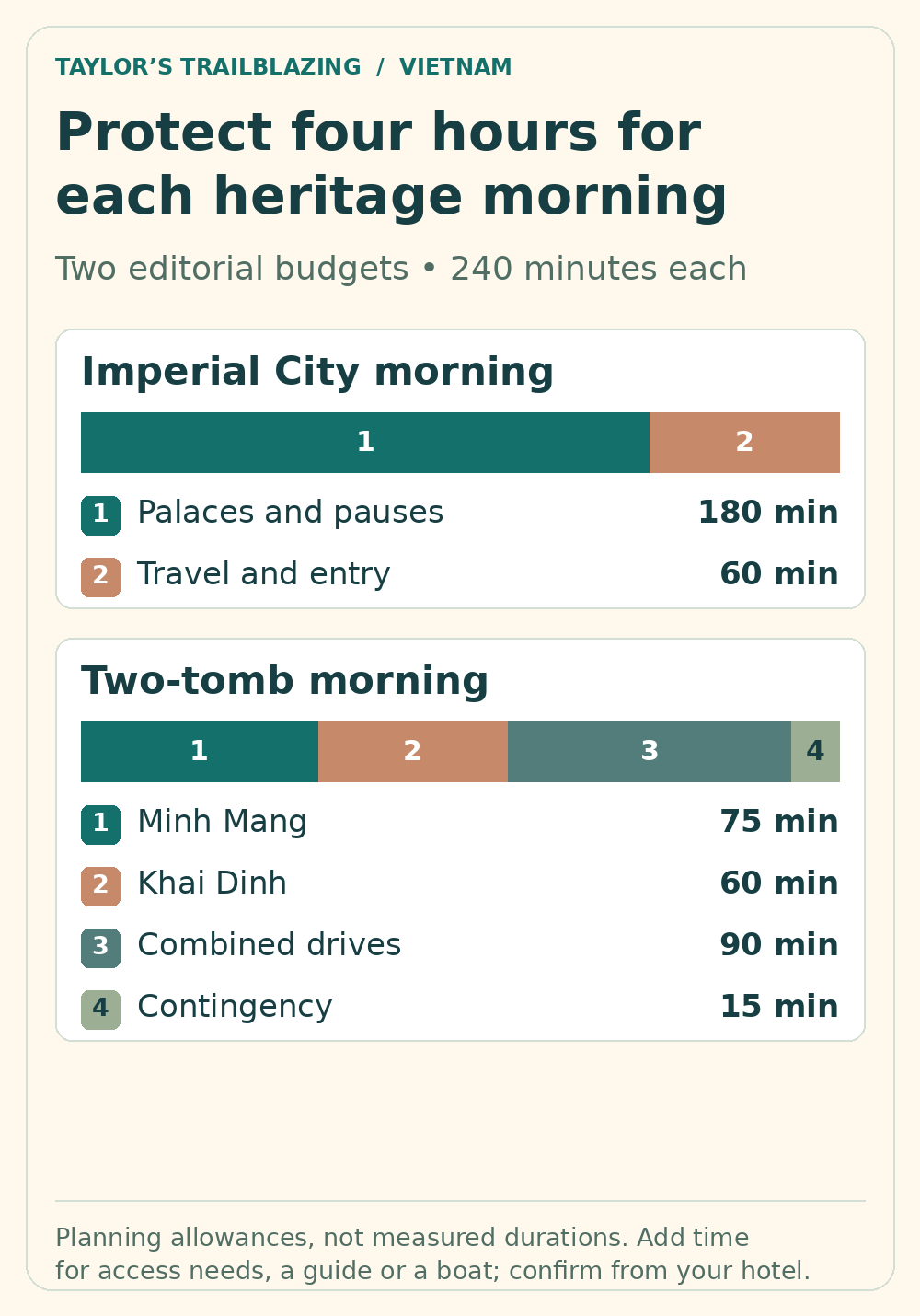
Allow a four-hour hotel-to-hotel block for the Imperial City: three hours on site, including pauses, plus one hour for local journeys, entry and finding your way. This is an editorial planning allowance. Someone reading every display or taking a detailed guided visit may want longer.
Choose tombs for contrast
The three widely visited tombs offer markedly different settings. The distinctions below follow Vietnam Tourism’s descriptions; the pairings are editorial choices. [7]
| Tomb | Main character | Best reason to include it |
|---|---|---|
| Minh Mang | Ordered architecture, ponds and a large landscaped setting | A sense of imperial planning and space |
| Tu Duc | A lake and gardens shaped as a retreat, used during the emperor’s lifetime | Landscape, poetry and a less formal visual contrast |
| Khai Dinh | Ascending terraces, mixed architectural influences and elaborate interior mosaics | A distinct architectural style; the climbing is an important constraint |
On a small screen, scroll the table sideways to read every column.
Minh Mang plus Khai Dinh is a useful contrast for travellers comfortable with steps. Choose Minh Mang plus Tu Duc if landscaped settings appeal more, while confirming the exact access arrangements at both. A garden setting does not establish a step-free route.
A sample two-tomb morning reserves 75 minutes at Minh Mang, 60 at Khai Dinh, 90 for the combined car journeys and 15 for delays: 240 minutes in total. All four inputs are illustrative allowances, not measured journey times. Ask a driver to check the circuit from your actual hotel. Adding a boat, third tomb or lengthy lunch needs additional time.
Heritage tickets, opening hours and booking limits
The following adult admission prices were checked against the city’s official 2026 fee information on 23 October 2026. Choose the exact combination of sites when buying. [8]
| Admission | Price | Planning use |
|---|---|---|
| Imperial City | 200,000 | The main palace visit |
| Minh Mang, Tu Duc or Khai Dinh | 150,000 each | Choose individual admission for a smaller plan |
| Imperial City plus two of those three tombs | 420,000 | Three listed combinations are offered |
| Imperial City plus all three tombs | 530,000 | A fuller heritage programme |
On a small screen, scroll the table sideways to read every column.
Imperial City plus one tomb costs 350,000 VND separately. With two tombs, the 420,000 VND combination saves 80,000 against individual admission. The four-site pass saves 120,000 against 650,000 in separate tickets. Buy the sights you want: the extra tomb also requires transport, walking and time.
The official visitor leaflet gives three- and four-site combination tickets a maximum validity of 48 hours from the first visit. Keep the two principal heritage mornings consecutive and confirm the selected dates at purchase. [9]
The visitor leaflet distinguishes ticket-office hours from entry and exit gate closing times. These standard arrangements were checked on 23 October 2026; reconfirm any closure or event affecting your day. [9]
| Season | Ticket offices | Entry gates close | Exit gates close |
|---|---|---|---|
| 16 March–15 October | 06:30–17:30 | 18:00 | 18:30 |
| 16 October–15 March | 07:00–17:00 | 17:30 | 18:00 |
On a small screen, scroll the table sideways to read every column.
The Royal Antiquities Museum and An Dinh Palace are separately listed at 50,000 VND each; do not assume either is included in the Imperial City ticket. [8] Check guides, performances and other optional services separately. The official online ticket terms say successful paid bookings currently cannot be cancelled or changed, so review sites, dates and visitor categories before payment. [10]
A practical two- or three-night itinerary
These plans assume a mid-afternoon arrival, a late-morning departure and a central base. Move the outdoor visits around the forecast, while keeping combination-ticket visits within their validity. All timings are editorial planning suggestions.
| Day | Two-night plan | Three-night plan |
|---|---|---|
| Arrival | Settle in, find dinner and take a short river walk if conditions suit | The same easy arrival; leave major admission visits for tomorrow |
| First full day | Imperial City morning, a midday rest, then one tomb such as Tu Duc if energy allows | Imperial City morning; lunch and rest; an optional short river or market outing |
| Following day | Breakfast, bag collection and departure; add a tomb only with a genuinely later connection | Two-tomb morning; keep the afternoon for downtime or a modest additional visit |
| Final morning | — | Pack, breakfast and leave with a transfer buffer |
On a small screen, scroll the table sideways to read every column.
For the two-night version, start the afternoon tomb outing early enough to return comfortably before dinner. Skip it if the morning runs long. With three nights, a separate Kim Long and Thien Mu outing is a sensible optional afternoon: the tourism authority groups the garden-house district and pagoda along the same part of a city visit. Ask permission before entering any house. [3]
Food deserves an actual pause in the schedule. Banh beo are small steamed rice cakes often topped with shrimp; banh khoai is a filled crispy pancake, commonly accompanied by a substantial dipping sauce. These are good dishes to seek out between longer visits. Ingredients can include shellfish, pork, fish sauce and peanuts, so dietary requirements need a direct conversation. [11]
Keep a beach, lagoon or distant excursion for an extra day if it is a priority. Fitting one into every spare hour changes the character of this stay and leaves little room for weather or a delayed arrival.

Arrive sensibly and simplify the local journeys
Phu Bai is Hue’s airport; Vietnam Tourism places it about 15 km from the city. Compare the full journey to your accommodation when choosing between arrival there and a connection via Da Nang. [2] A flight arrival time still leaves baggage collection, meeting the driver and the road transfer.
From Da Nang, the railway offers the coastal approach via Hai Van. Vietnam Railways describes its heritage service as an approximately three-hour journey, but its public page contains differing timetable blocks. Use the actual dated booking result for departure and arrival times. [12] As a cautious planning choice, leave roughly half a day for the complete hotel-to-hotel move, adjusting it to your ticket and transfers.
Compare Da Nang–Hue trains, buses and transfers on 12Go alongside the railway’s direct booking options. The route page lists these transport types, but select your own date and check the exact station or pickup point, luggage terms and final stop. [13] For a road transfer, ask whether the price covers a direct journey or sightseeing stops; a pass-road excursion needs a different time budget from a simple transfer.
For the next stop, use the Da Nang travel guide to plan time in the city, or the Hoi An travel guide if your coastal route continues there. Keep the connecting journey in the schedule when allocating nights to each place.
For the tomb circuit
A car with driver keeps a two-tomb morning straightforward. Agree the stops, waiting time, return destination and total vehicle price. An English-speaking driver and a licensed heritage guide provide different services.
If you also want a boat and Thien Mu, compare this private Hue tombs, pagoda and dragon-boat tour on GetYourGuide. The listing offers two- or three-tomb options, driver or licensed-guide choices, and a five- to six-hour duration. Allow for entrance fees and check the option details; out-of-centre pickups attract a surcharge. The provider lists it as unsuitable for wheelchair users and people with mobility impairments. [14] It is a longer alternative to the four-hour car-only example.
Save your hotel address, tickets and pickup details offline. If you need mobile data for contacting a driver, check Airalo and select a Vietnam plan; it offers Vietnam eSIMs, but check device compatibility, unlocking and the plan’s activation terms before buying. [16] [17] An existing suitable data plan is sufficient.
Plan around heat, rain and the walking involved
Vietnam Tourism identifies February–April as a favourable general window for Hue, describes hot summers, and places the wetter season broadly in September–December. These are climate patterns rather than a promise for your dates. [2] A garden and palace itinerary is easiest to adjust when the main outdoor visit starts early and the afternoon remains flexible.
Central Vietnam can experience flooding in October and November, and storms can interrupt transport. Follow local instructions and current forecasts; during severe weather, change the excursion or onward journey instead of attempting to work around flooded roads. [15] A spare afternoon can absorb ordinary rain, but it cannot guarantee a connection will run.
If Hue is one stop on a longer journey, compare its seasonal pattern with the other regions in the guide to the best time to visit Vietnam.
Ask about the route inside the sight
Khai Dinh’s climbing terraces are a clear consideration for anyone who finds steps difficult. [7] For every chosen monument, ask about the distance from vehicle drop-off, thresholds, gradients, resting places and toilets. Request specific answers from the attraction or guide, ideally with current photographs. A private car solves the journey between sites; it does not establish access inside them.
Keep water available and take a sitting break before fatigue dictates the day. Ask your hotel for a room that fits your access needs, including the route to breakfast. Dress appropriately for temples and royal places of worship; FCDO guidance generally advises covering shoulders and knees and following the signs at each site. [15]
For local journeys, ask your accommodation to arrange a reputable taxi or use an official booking app and check the vehicle details. [15] This itinerary does not require hiring a scooter. If rain is persistent but travel remains safe, shorten the outdoor plan and consider An Dinh Palace or the Royal Antiquities Museum, checking opening and access first.
Build a budget that protects the relaxed pace
Budget for the room, food, heritage admission and journeys separately. The useful saving may come from choosing a central base or one fewer outing, rather than purchasing a larger monument pass.
The example below is an editable spending model for two adults sharing one room for three nights. It assumes three daily food allowances per person across the arrival, departure and two full days. Only the heritage ticket input is an official advertised price; all other figures are illustrative allowances to replace with your own quotes and choices.
| Item | Calculation | Total |
|---|---|---|
| Shared room | 3 nights × 1,000,000 | 3,000,000 |
| Food and drinks | 2 people × 3 days × 350,000 | 2,100,000 |
| Imperial City plus two tombs | 2 adults × 420,000 | 840,000 |
| Local sightseeing transport | One shared allowance | 900,000 |
| Arrival and departure transfers | Combined allowance | 600,000 |
| Illustrative total | Two adults, three nights | 7,440,000 |
On a small screen, scroll the table sideways to read every column.
The ticket calculation uses the published three-site rate. [8] The model excludes travel to or from Hue, a guide, boat trips, additional attractions, shopping and insurance. It is not a live package price. Check whether tax, breakfast or a transfer is already included before adding a cost twice.
The biggest adjustable line is often the room: changing the nightly assumption by 500,000 VND changes this three-night total by 1,500,000 VND. For a solo traveller, vehicle and room costs may fall largely on one person; do not simply halve the example.
Book in this order: onward transport that determines your usable days; accommodation with suitable cancellation and access terms; any guide or private outing; then the correct heritage ticket. Before leaving Hue, keep time for returning to the hotel, collecting bags and reaching the station or airport. A monument visit should not consume the buffer for a connection you cannot miss.
Frequently asked questions
Can Hue work as a day trip from Da Nang?
A day trip can suit someone who wants a selected introduction and accepts substantial travel around it. For the relaxed stay described here, sleeping in Hue creates time for early visits, a proper midday break and separate city and tomb outings. If you only have one day, choose a limited itinerary rather than expecting every major tomb.
Do I need a guide for the Imperial City?
A guide is useful if the history and meaning of the buildings matter more to you than covering ground. Agree the meeting point, language, duration and fee in advance. Independent visitors can set their own pace; either way, leave time for pauses and avoid booking the next activity against an optimistic finish time.
What should families confirm before booking?
Check the hotel’s room occupancy and bed arrangements, the attraction’s current child ticket categories and any proof of age required. For private transport, request a suitable child seat explicitly rather than assuming one is available. Build the day around the slowest walker and keep a simple alternative if a long outdoor visit becomes too much.
Can I leave luggage at the hotel while sightseeing?
Ask the property before relying on it, including after check-out. Confirm collection hours, any fee and how bags will be stored. Keep passports, money, medicine and valuables with you or in suitable secure storage. If you need a shower or private room before a late departure, ask about paid late check-out or a day room.
Give Hue the mornings it deserves
For a relaxed first stay, choose three nights, a base that makes meals and midday breaks easy, and two heritage mornings with different characters. Give the Imperial City room in the schedule, choose tombs for their appeal, and use the remaining time for the river and food. If you have two nights, keep the same priorities and reduce the number of sights. The most useful itinerary is the one that still works after a slow lunch or an ordinary delay.
Sources and research notes
Provider and official information checked on 23 October 2026. The planning models are original editorial examples, with their assumptions stated beside them. Prices, timetables, products and terms can change; check the relevant provider before booking. This guide does not claim a personal visit, product test or live booking.
- UNESCO World Heritage Centre — Complex of Hué Monuments
- Vietnam Tourism — Hue destination guide
- Vietnam Tourism — 3 days in Hue for culture seekers
- Vietnam National Authority of Tourism — Hue walking-street area
- Booking.com — Hue accommodation search
- Agoda — Hue accommodation search
- Vietnam Tourism — An inside guide to the Hue Tombs
- Hue city legal information portal — 2026 heritage admission fees
- Hue Monuments Conservation Centre — 2026 visitor information leaflet
- Hue Monuments Conservation Centre — Online ticket transaction terms
- Vietnam Tourism — How to eat like a local in Hue
- Vietnam Railways — Hue–Da Nang heritage train
- 12Go — Da Nang to Hue route comparison
- GetYourGuide — Private Hue royal tombs, Thien Mu and dragon-boat experience
- FCDO — Vietnam safety and security advice
- Airalo — Vietnam eSIMs
- Airalo Help Centre — What is an eSIM?
Illustrations in this article were created for Taylor’s Trailblazing Travels. Third-party photographs, where used, are credited beside the image or in the source list.