Pu Luong Travel Guide: Rice Terraces, Hikes and Eco-Stays
Choose a hillside base, match the walks to your ability and leave enough time to enjoy the view.
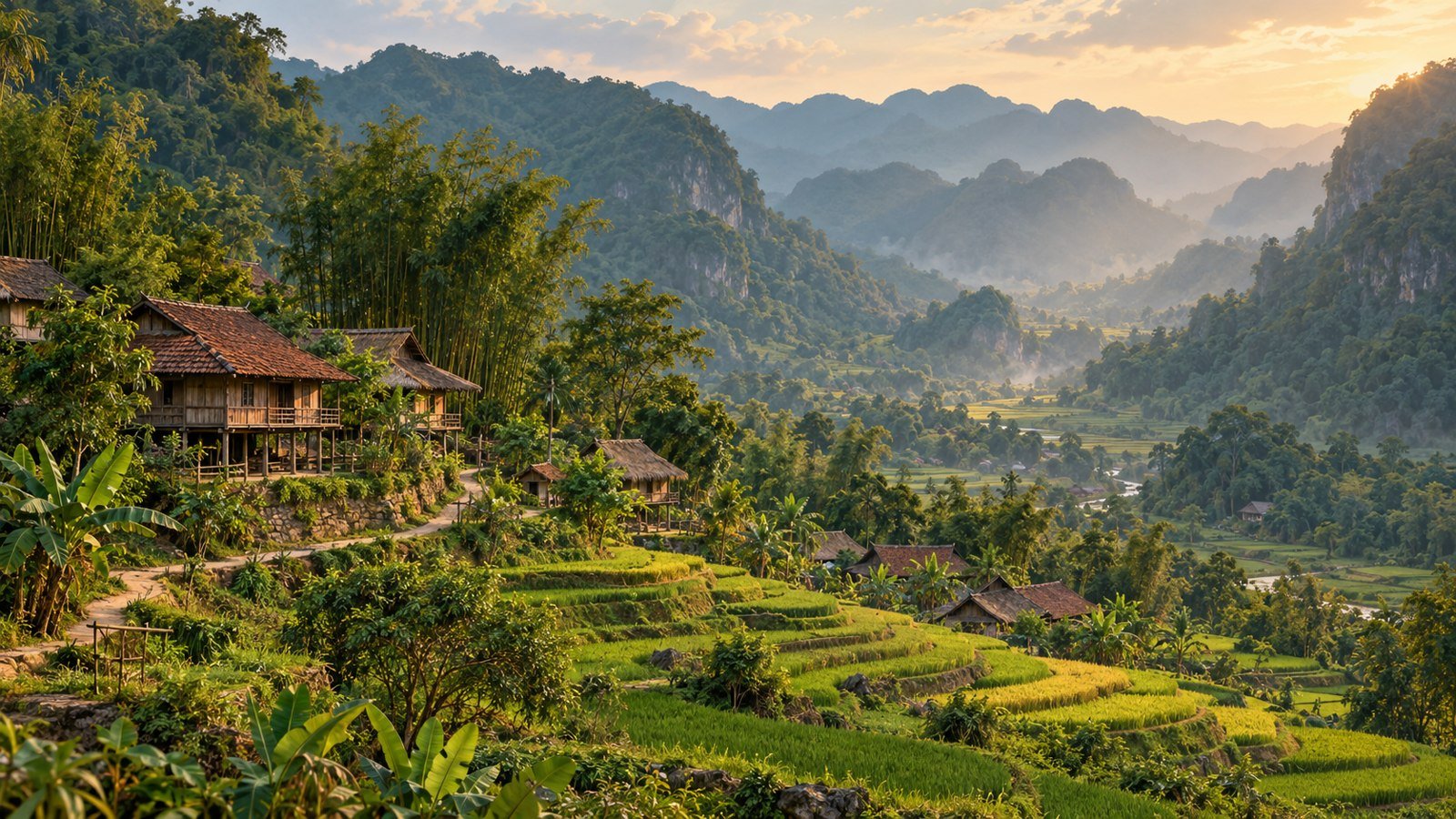
AI-created editorial illustration inspired by Pu Luong; not a photograph of a particular property or current crop conditions.
Pu Luong rewards a slower kind of countryside break: looking out over terraces, walking between villages and returning to the same comfortable base. Vietnam’s national tourism authority describes a landscape of cultivated valleys, forested mountains and stilt-house communities. [1]
The useful question is how much remoteness you actually want. A beautiful room can involve steps, a steep final approach or an awkward transfer. This Pu Luong travel guide helps you choose the room and the walks separately, then build a stay around both.
A useful first stay
Two nights give one full day between arrival and departure; three nights give two.
Start your base search
Compare the Don village area, then inspect each property’s actual access.
Choose effort twice
Room access and excursion difficulty are separate decisions.
What makes the budget work
Price the room, both transfers, meals and outings together.
Is Pu Luong right for your trip?
Choose Pu Luong when a terrace view, a village walk and an unhurried evening are enough to anchor a day. Reconsider it if your priority is a busy town, a large choice of evening venues or completely spontaneous transport. For visitors who prefer variety every few hours, a shorter countryside stop may be the better use of time.
Count full days, not the number on the tour title
Hanoi–Pu Luong journeys are commonly described as roughly four to five hours by road. The actual journey depends on the route, collection stops and where your accommodation is. [1] [7] A same-day return would therefore allocate around eight to ten hours to the main road journeys alone, before stops or activities. That calculation is why an overnight stay matters.
Swipe across the table to read all columns.
| Time on site | What it gives you | Best use |
|---|---|---|
| One night | Arrival afternoon and departure morning, if connections allow | One short local outing and the accommodation itself; accept a small weather margin. |
| Two nights | One full day, plus the two partial days | A first visit with one main village or terrace walk. |
| Three nights | Two full days, plus the two partial days | Two different outings, or one outing with a flexible recovery or weather day. |
More nights help only if you want that pace. A non-walking traveller who enjoys the lodge may welcome three nights; someone treating the terrace view as a quick photograph may prefer to spend the extra night elsewhere.
Back to guideChoose your village base before your room
Don, also written Ban Don or Đôn, is a useful starting point for comparing accommodation. Kho Muong and Hieu offer different settings, so the name “Pu Luong” alone tells you too little about the last part of the journey. Independent guide Vietnam Coracle distinguishes the concentration of retreats around Don from the steeper, more secluded approaches to villages such as Kho Muong. [3]
Swipe across the table to read all columns.
| Base | Why shortlist it | The decision to resolve |
|---|---|---|
| Don village area | Useful for comparing retreats and arranging local outings from one base. | Can the transfer reach your entrance, and how far are the room and restaurant apart? |
| Kho Muong | A valley-village setting for travellers who actively want a more secluded stay. | What vehicle can use the final approach, and what happens to luggage or access in rain? |
| Hieu village area | Worth considering when the village and waterfall surroundings are central to your visit. | Which part of the village is the property in, and how much walking separates it from the drop-off? |
The trade-off is practical: choosing a more secluded room can add transfers to every outing. Do not choose a village purely because it appears close to another pin on a map.
The two separate access checks
First ask for the route from vehicle to reception, bedroom, bathroom and dining area: steps, surfaces, lighting and handrails. Then ask about the proposed excursion: walking time, ascent and descent, slippery sections and the earliest return option. A short outing can suit a traveller whose room access does not; a comfortable hotel can still sell a demanding trek.

Build your days around one main outing
Don and the villages of Uoi and Lan form one useful area to discuss with a guide. Kho Muong village and its cave are another choice; Hieu village and its waterfall are a separate outing. Pu Luong Retreat’s local guide places Hieu about 20 km by road from its Don base, or a 12 km trek, which illustrates why these should not all be treated as neighbouring short walks. [2]
Swipe across the table to read all columns.
| Format to request | What to agree | When it fits |
|---|---|---|
| Up to 90 minutes | A short return walk on confirmed surfaces, with a turn-back point. | Arrival afternoon, mixed abilities, or a day centred on the lodge. |
| Half-day village outing | Actual walking time, hills, breaks and whether vehicle transfers are included. | Your main full day when you want terraces and village context. |
| Longer guided route | Distance, ascent, ground conditions, lunch, water and a way to shorten the day. | Travellers who are comfortable walking for several hours on uneven ground. |
Vietnam Tourism notes that marked trails and maps are limited and recommends local guides. [1] A guide is especially useful when you need to avoid steep sections, combine villages without retracing a long route or adapt to recent rain.
For a bookable comparison, view this Pu Luong half-day village trek on GetYourGuide. Its description offers alternative stops depending on conditions; it does not promise every named village and waterfall in one outing. Confirm the route, your hotel’s collection eligibility and any vehicle used for transfers. [8]
A cave or waterfall is optional. After heavy rain, choose a different activity if access or water conditions are doubtful. FCDO warns about mountain terrain, flooding, landslides and difficult rescue access. Check local advice and insurance cover for your chosen activity. [9]
Two nights or three: a workable rhythm
With two nights, use the arrival afternoon for settling in and a short agreed walk. Give the middle day to one main guided outing; keep departure morning local. With three nights, add a second full day for a different village area, a craft activity if available or simply rest. Swap the two full days when conditions warrant it instead of adding more stops to the same day.
Back to guidePlan for rice seasons and changeable conditions
Pu Luong Retreat describes two rice crops, broadly March–June and August–October, with the Don area’s harvest-viewing windows around May–June and September–October. [2] Treat those as broad local patterns. Fields are not planted or harvested simultaneously, and a photograph from one week does not predict the same view on your dates.
Swipe across the table to read all columns.
| Your priority | Starting point | What to ask locally |
|---|---|---|
| Ripening rice | Investigate May–June or September–October. | Which nearby fields are still standing, and can the host send a recent dated picture? |
| Green terraces | Look within a growing cycle rather than assuming harvest week. | How advanced is the crop around the actual accommodation? |
| Longer walks | Choose dates with flexibility, then decide the route close to departure. | Have rain, heat or damaged paths changed the proposed walk? |
| A restorative lodge stay | Give room comfort and the view more weight than crop colour. | What heating or cooling, covered seating and indoor dining does the exact room offer? |
If golden rice is the only reason for the trip, ask about field conditions before accepting a non-refundable booking. If the landscape, food and quiet are enough, you have more freedom. Use the broader Vietnam weather guide when fitting this stop into a longer north-to-south itinerary.
Back to guideArrange the whole journey to your accommodation
Pu Luong Retreat advertises a Hanoi shuttle. 12Go also lists Hanoi–Pu Luong road services. [4] [7] A shared tourist transfer is different from a local public bus: confirm the named operator, exact stops and any change of vehicle instead of assuming a single direct ride to every lodge.
Swipe across the table to read all columns.
| Option | Useful when | Check before payment |
|---|---|---|
| Accommodation-arranged shuttle | You want the lodge to coordinate the last part of the journey. | Collection area, operating date, final drop-off, luggage and return service. |
| Shared service booked separately | You want to compare operators and departure choices. | Whether the named stop is your property, a meeting point or a transfer hub. |
| Private car with driver | You need a tailored departure, more luggage space or agreed stops. | Total vehicle price, luggage capacity, child seats if needed and all road charges. |
| Connection from Mai Chau | Both countryside areas are already part of your route. | A specific onward driver and destination address; avoid an improvised late arrival. |
Compare Hanoi–Pu Luong road services on 12Go, then send the advertised arrival point to your accommodation before booking. Journey durations on comparison pages are planning inputs, not an arrival guarantee.
Keep your arrival afternoon light and leave a margin before onward commitments. For a flight, returning to Hanoi the previous day is the more comfortable editorial choice. If travelling onward to Ninh Binh or Mai Chau, have both properties agree the collection and arrival details.
Back to guideChoose an eco-stay by its practical details
Words such as “eco”, “retreat” and “homestay” do not answer the questions that determine a comfortable stay. Treat them as a starting point for enquiry. Ask who hosts you, how waste and refill water are handled, how local guides are paid and whether environmental claims have identifiable evidence. Do not infer independent certification from a property name.
Two researched examples to compare
Pu Luong Retreat publishes several room categories and wings, with air conditioning and heating listed for named categories. [5] That makes the precise room and wing worth checking: a general property description is less useful than confirmation of the room you are actually reserving. Check Pu Luong Retreat room options on Booking.com, comparing the same room, meal basis and cancellation terms. [11]
Pu Luong Natura’s own page lists both rooms with private facilities and a private room in a traditional stilt house with shared bathrooms, reached by wooden stairs. [6] This is a useful reminder that a private bedroom does not necessarily mean an en-suite bathroom. Compare Pu Luong Natura Bungalow on Agoda and confirm the room category with the property. [12]
These examples illustrate different booking questions; they are not a ranking or evidence of personal stays. Current rates, availability and room arrangements depend on the selected dates.
Get the essentials in writing
- Exact room type, bed arrangement, private or shared bathroom, and heating or cooling.
- Vehicle access and the route to the bedroom and meals, including the number of steps where that matters.
- Meal arrangements, dietary needs, drinking-water provision and payment methods.
- Any nearby construction or group events, and the cancellation terms if your transfer cannot operate.
Travellers with limited mobility should request recent access photographs or a video, together with measurements that match their needs. A reassuring “easy access” message is too vague to base a booking on.
Back to guideCompare the cost of the complete stay
The room price is only one part of a Pu Luong break. Compare like-for-like totals in Vietnamese dong, then use your card provider’s current exchange rate and fees if you need a GBP comparison. No fixed fare, live room price or exchange rate is assumed here.
Swipe across the table to read all columns.
| Budget line | Quantity to price | Avoid this mismatch |
|---|---|---|
| Accommodation | Two room nights, including applicable taxes | A per-person price compared with a whole-room price. |
| Hanoi return journey | Four shared seats in total, or one vehicle in each direction | A one-way price treated as the whole journey. |
| Local transport and guide | Your chosen outing, for the whole party | Guide-only compared with a quote including collection and return. |
| Meals and drinks | Everything not already included in the room or outing | Counting breakfast twice while leaving evening meals out. |
| Other costs | Confirmed admissions, activities and agreed luggage or last-mile charges | Assuming a transfer to “Pu Luong” reaches the room entrance. |
The total is accommodation + both main transfers + local transport and guiding + uncovered meals and activities. For the two adults, divide that whole-party total by two to compare per-person offers. Keep a separate contingency; it is not money already spent.
A more expensive room may be better value if it removes an additional transfer or includes meals you would otherwise buy. Equally, a package is poor value if its walking programme does not suit you. Resolve the base and access questions first, ask for an itemised total, then decide which booking method works best.

Small preparations that make the stay easier
Bring footwear you already know is comfortable on uneven ground, a waterproof layer, sun protection and a day bag that leaves your hands free. Ask the guide what the particular route requires. Pack a light spare layer for evenings and keep essential items accessible during the road transfer.
Download your accommodation address and booking details, save the driver’s number and carry enough dong for agreed cash-only expenses. Check payment arrangements before departure rather than making an unverified assumption about a nearby cash machine.
If you need mobile data, open the Airalo store and select Vietnam. Check that your phone is unlocked and supports eSIM, then review the package’s activation and data terms. Airalo’s Vietnam page lists data-only options; these do not provide ordinary voice calls or texts. Mobile data is not a promise of coverage on every hillside, so keep essential directions offline. [10]
Ask permission before photographing people or entering homes, agree a fee before taking a workshop and stay on agreed paths around working fields. A weaving visit should be an invitation, not an entitlement. Choose locally arranged activities for their relevance and the host’s consent rather than for a staged “untouched village” story.
Three mistakes to avoid
Booking a remote room before arranging the final transfer; treating every short walk as easy; and using an old terrace photograph as a guarantee of your dates. All three are easier to resolve with specific questions before payment.
Frequently asked questions
Can Pu Luong work if I do not want to trek?
Yes, if you want time at the accommodation and can comfortably manage its access. Ask for a short local walk or a vehicle-assisted outing with optional stops. Choose the room for how you will spend the day, not just the view in the booking photograph.
Should I move accommodation during a short stay?
Usually not for two nights. The change introduces another transfer and check-in, while only one full day separates arrival and departure. For a longer walking trip, moving between villages can make sense when a guide has planned the route and luggage arrangements.
Can I combine Mai Chau and Pu Luong?
Yes, but give the two stays different purposes: for example, a village and cycling base in Mai Chau, then a terrace walk and hillside stay in Pu Luong. Natura advertises roughly 1½–2 hours by car from Mai Chau; use that only as a starting point and confirm the actual addresses and road conditions. [6]
Do I need to book every walk before arriving?
Agree essential needs in advance: language, mobility, maximum walking time and any private-guide requirement. Finalise the precise route with current local conditions. A flexible route is more useful than a promise to complete a long list of stops in unsuitable weather.
Are all activities included in a lodge booking?
No assumption is safe. A room-only reservation and a stay with guided excursions can have very different inclusions. Ask whether transfers, guides, meals, admissions and activities are included in the exact offer you are considering, and compare the complete written total.
Choose your next step
Start with two nights around Don, a room whose access you understand and one main guided outing. Add a third night when you want another walking day or the freedom to wait for better conditions. Choose a more secluded village only when its approach and daily logistics are part of the experience you want.
The strongest Pu Luong plan remains worthwhile without perfect rice colour. A suitable room, a well-matched walk and enough time to pause will matter more than trying to fit every cave, waterfall and village into the same afternoon.
This research-led guide combines national tourism guidance, official property information, transport and activity listings, and independent geographical context. The base selector, walking-request bands, pacing model and quote worksheet are editorial planning tools, not official grades or field-tested itineraries. Research reviewed on 23 October 2026; accommodation access, crop conditions, transport and activity details should be reconfirmed for your dates.
Sources
Sources consulted for this guide on 23 October 2026. Provider information describes published offerings; prices and availability vary by date.
- Vietnam National Authority of Tourism — Pu Luong for nature lovers
- Pu Luong Retreat — villages, terraces and nearby sights
- Vietnam Coracle — Pu Luong Nature Reserve travel guide
- Pu Luong Retreat — road access and shuttle arrangements
- Pu Luong Retreat — room categories and facilities
- Pu Luong Natura — accommodation and services
- 12Go — Hanoi to Pu Luong transport comparison
- GetYourGuide — From Pu Luong: Half-Day Trek to Rice Terraces & Local Villages
- FCDO — Vietnam safety and security
- Airalo — Vietnam data eSIMs
- Booking.com — Puluong Retreat property listing
- Agoda — Pu Luong Natura Bungalow property listing
Illustrations in this article were created for Taylor’s Trailblazing Travels. Third-party photographs, where used, are credited beside the image or in the source list.