Where to Stay in Umeda: Hotel Areas Around Osaka Station
Choose the station side that works for your journeys—not just the shortest distance on a booking map.
- Five hotel examples
- Station-side comparison
- A repeated-walk calculation
Original stylised illustration of Umeda’s station-and-tower setting; not a photograph or a view from a listed hotel.
A Umeda hotel can look almost attached to Osaka Station yet involve an unexpectedly long arrival. The deciding detail may be the wrong station side, a basement concourse or a lift journey to reception. Compare those practical details before paying extra for a central pin.
This guide is for travellers who have already chosen northern Osaka and now need to choose a workable hotel area. The accommodation examples illustrate different locations rather than a ranked list of winners. No room rate or availability for your dates is assumed.
This guide contains affiliate links. Taylor’s Trailblazing Travels may earn a commission when you book through them. Recommendations are chosen to help with the accommodation decision.
Name the railway
JR, Hankyu, Hanshin and Osaka Metro are not interchangeable starting points.
Choose the side
Match the hotel to the gate you will actually use.
Count return trips
An afternoon hotel break increases the value of a shorter approach.
Compare the room
Beds, space and cancellation conditions can outweigh a small walking difference.
Where to stay in Umeda: choose your station side
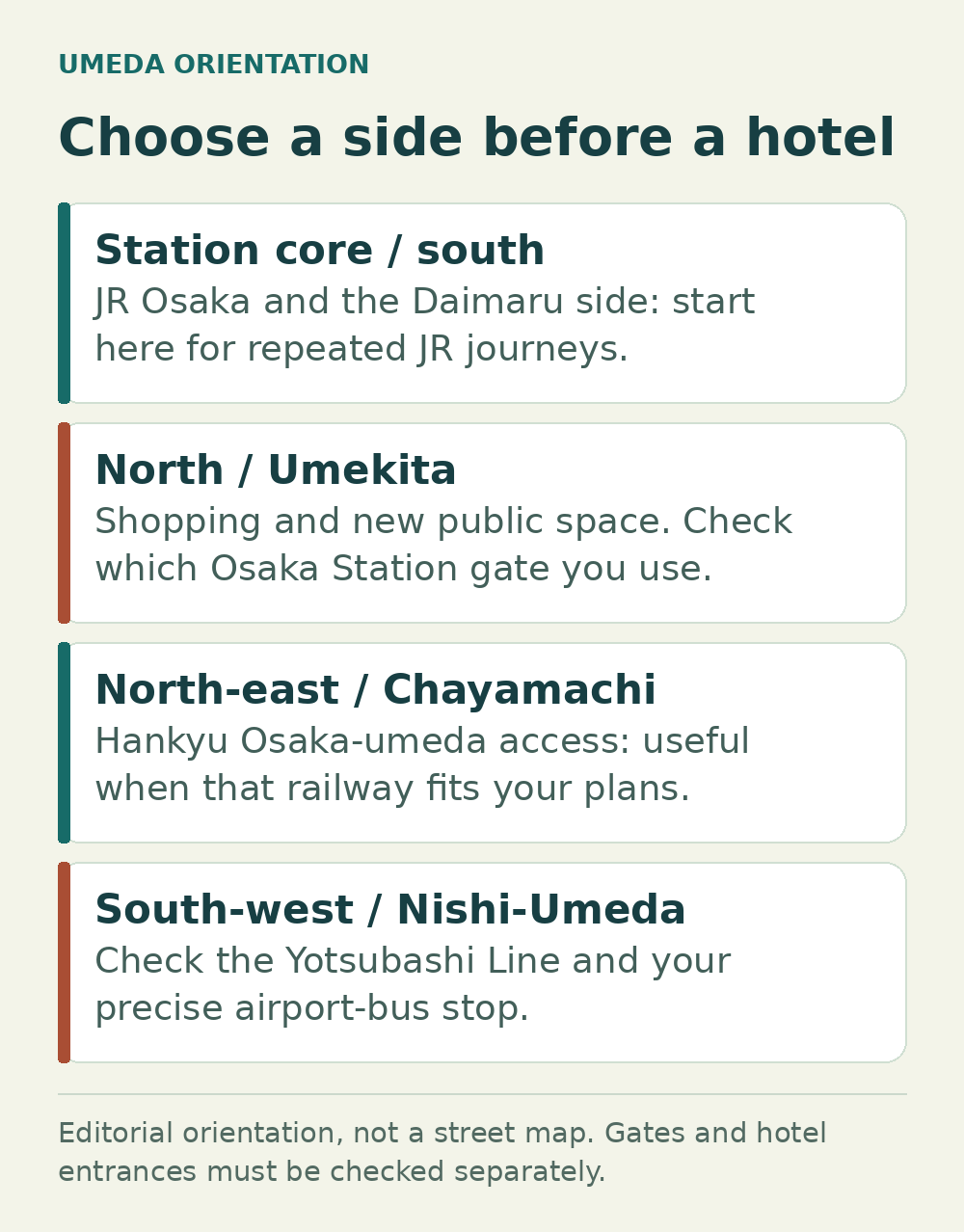
Use these as practical search zones, not official boundaries. A property near the edge may suit two zones. The recommendations are editorial judgements based on the access details below.
| Search zone | Best starting fit | Trade-off to check |
|---|---|---|
| JR station core / south side | Frequent JR trips, luggage-heavy arrivals and short stays | Hotel reception may still be several floors above street level. |
| North side / Umekita | Shopping, public space and a modern city setting | Different Osaka Station gates can produce different walks. |
| Chayamachi / Hankyu side | Plans built around Hankyu Osaka-umeda | You may cross more of the district for JR or Hanshin journeys. |
| Nishi-Umeda / south-west | Yotsubashi Line journeys and a hotel near the appropriate airport-bus stop | Not the same approach as the Midosuji Line’s Umeda station. |
| Higashi-Umeda / eastern streets | A Tanimachi Line itinerary or a particular eastern-side hotel | Check the immediate street and the route back after dinner. |
Osaka Metro distinguishes Umeda on the Midosuji Line, Higashi-Umeda on the Tanimachi Line and Nishi-Umeda on the Yotsubashi Line. They form a connected interchange area, but they are not one platform or one entrance.[1]
Understand the station names before you arrive
JR Osaka Station and Shin-Osaka are different stations. The Shinkansen uses Shin-Osaka; reaching a hotel in Umeda normally adds a local rail, metro or road connection. Do not treat a seller’s broad “Osaka” destination as the last step of your journey.[1][2]
Hankyu and Hanshin both use the Osaka-umeda name, but their stations are separate. The hotel’s operator-specific walking instructions are more useful than a map search for “Umeda Station”. For example, Hotel Hankyu RESPIRE quotes around five minutes from Hankyu but around ten from Hanshin.[3]
Save an arrival card
Before travelling, save the hotel’s full name, Japanese address, relevant operator, recommended exit, street entrance and reception floor. Add the alternative lift route if you cannot use stairs. A screenshot of the hotel pin alone does not tell you how to leave a large station.
Indoor passages are useful in rain, but a longer, clearly signed surface route can be easier for a first arrival. Do not assume every passage, shopping-centre door or lift is accessible throughout the night; ask the hotel which approach it recommends at your arrival time.
Five hotels that illustrate different Umeda locations
These are researched location examples, not personally inspected recommendations or a claim that one hotel is cheapest. Compare the exact room, occupancy and package; even two rooms in the same building can suit different travellers.
Hotel Granvia Osaka: reduce the external street walk
Granvia is directly connected to JR Osaka Station on the station’s south side. Its published access guide places reception on the nineteenth floor. The appeal is a compact JR arrival, not an instant platform-to-bedroom journey.[2]
Start here for a short rail-led stay or when avoiding an outdoor luggage walk matters. Compare room size and view carefully before paying a station-location premium. Check Granvia Osaka on Booking.com
Hotel Hankyu RESPIRE OSAKA: north-side shopping convenience
RESPIRE’s official guide gives approximately three minutes from JR Osaka’s third-floor Bridge Exit and six from the Umekita Underground Gate. Those figures describe different starting points, which is exactly why a generic “three minutes from Osaka Station” label is incomplete.[3]
This is a useful candidate for a shopping-oriented stay that still needs JR and Midosuji access. Enter children’s ages and the real bed requirement when comparing room categories rather than relying on a general family-friendly label.[9]
Compare RESPIRE room optionsHotel Hankyu GRAN RESPIRE OSAKA: a separate north-western choice
GRAN RESPIRE is a different hotel from RESPIRE. Its official access guide uses the Umekita Underground Gate and West Gate as reference points. Check the full property name on both the booking confirmation and the map, particularly when travelling with another party.[6]
Consider it when the Umekita setting is part of the stay’s appeal. It is not automatically the shorter walk to the conventional platform you need. Check GRAN RESPIRE on Booking.com
Hotel Intergate Osaka Umeda: the Nishi-Umeda side
Intergate quotes five minutes from JR Osaka’s Sakurabashi Exit and three minutes from Nishi-Umeda Exit 10. It also lists luggage storage and a universal room, although a room and route suitable for your particular requirements must be confirmed.[4]
This is worth comparing for a south-western base and repeated Yotsubashi Line journeys. A short quoted exit walk does not establish that the same exit has the lift you need. Compare Intergate Osaka Umeda
Hotel Hankyu International: choose Chayamachi deliberately
The hotel’s official guide quotes approximately three minutes from Hankyu Osaka-umeda’s Chayamachi Exit. That can make sense for a Hankyu-focused itinerary; it is not a three-minute promise from every JR platform.[5]
Treat the more northerly location as a choice, rather than assuming all hotels carrying “Hankyu” share the same entrance. Compare its room offer with the more station-centred alternatives before deciding.
Calculate the walking difference over the whole stay
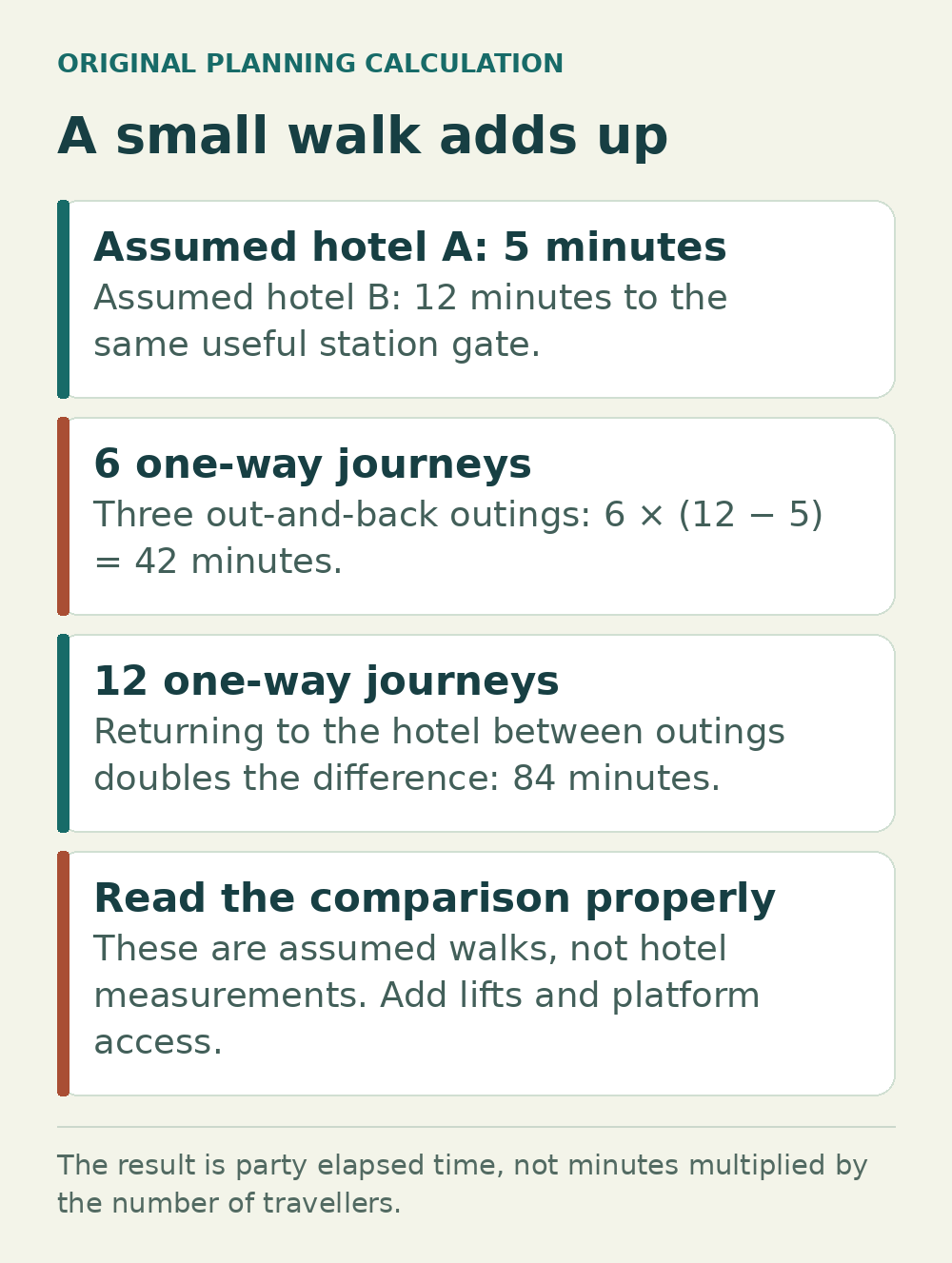
A seven-minute difference in a hotel description sounds negligible. Whether it is worth paying to remove depends on how often you repeat it. The following is an original scenario using assumed walks to the same useful station gate—not measurements of the hotels above.
| Pattern over three days | Hotel A: 5 minutes | Hotel B: 12 minutes | Difference |
|---|---|---|---|
| One outing and return daily: 6 one-way journeys | 30 | 72 | 42 |
| Two outings and returns daily: 12 one-way journeys | 60 | 144 | 84 |
The calculation is journeys × (longer walk − shorter walk). It excludes the identical train ride, and it must not multiply elapsed time by the number of people. Add lift waits, platform access or an awkward crossing separately when they differ.
For a couple spending the full day out, extra room space may be worth more than forty-two minutes spread across a stay. For a family returning between outings, the same location difference can feel much larger. A step-free route, pain-free walking distance or a necessary bed arrangement should overrule a small financial calculation.
Match airport and intercity arrivals to the hotel
Compare the complete arrival: terminal or train platform → local connection → correct Umeda exit or bus stop → hotel entrance. Check the last useful service for your actual flight date, allowing for immigration, baggage and disruption rather than treating the scheduled landing time as your departure from the airport.
Do not copy old airport-bus stop names from an outdated hotel review. Check the operator’s current stop map as well as the hotel’s instructions, and distinguish the Kansai Airport route from the Itami route.[2]
For departure morning, build the route in reverse. A hotel that works beautifully for arrival may be inconvenient for an early coach, different railway or different airport. One extra taxi can erase a small room-rate saving.
Compare the real room cost, including Osaka tax
Collect like-for-like totals for the same dates and guests. Record whether the price buys a double, twin, triple or connecting arrangement; whether breakfast is included for everyone; and the latest cancellation time in the hotel’s local time zone. “Sleeps four” is not a description of four full-sized beds.
Osaka’s accommodation tax changed on 1 September 2025. Per person per night, the room-charge bands are: below ¥5,000, no tax; ¥5,000 to below ¥15,000, ¥200; ¥15,000 to below ¥20,000, ¥400; and ¥20,000 or more, ¥500. The official tourism guidance excludes meals from the accommodation charge and includes applicable service and mandatory cleaning charges.[7]
For an illustrative three-night booking for two adults whose taxable room charge is ¥12,000 each per night, the accommodation tax is 2 × 3 × ¥200 = ¥1,200. That is an arithmetic example, not a hotel quote. Confirm whether it is already included in the booking total rather than adding it twice.
Value also depends on how you use the property. Breakfast has little benefit if your train leaves before service; a lounge has little benefit when you return after it closes. Conversely, laundry or luggage storage can simplify a longer stay. Verify the facilities and hours attached to the particular rate.
Make the final choice for your traveller type
Families and travellers who need fewer obstacles
Prioritise the actual room layout and a workable lift route before a view or a tiny location saving. Ask about cot availability, connected-room confirmation, bathroom steps and whether staff can assist with the recommended arrival path. Do not assume a general accessibility icon answers those questions.
Evening food, noise and late returns
Look at the immediate street, not only the district. Check recent room-specific comments about road or railway noise, then ask for a suitable room position. A higher floor or a quiet-room request is not a guarantee. For repeated nights around Namba, compare the inconvenience of travelling back north rather than choosing Umeda by habit.
The mistakes to avoid
Do not confuse RESPIRE with GRAN RESPIRE, Hankyu with Hanshin, or Osaka with Shin-Osaka. Do not book a non-refundable room before confirming essential bedding and access arrangements. Finally, do not pay for “near the station” until you know which part of the station that claim uses.
Questions before booking
Is Umeda the same as Osaka Station?
Umeda is the wider district; JR Osaka is one station within its connected transport area. Several neighbouring stations use Umeda or Osaka-umeda in their names.[1][3]
Must I stay directly over the station?
No. A clearly understood five- or ten-minute approach can be perfectly reasonable. Compare its repeated cost with room space and the journeys you actually plan.
Is a station-connected hotel automatically step-free?
Not necessarily along every approach. Request a complete route from your arriving platform or bus stop and confirm the room itself meets your needs.
Should I change hotels for one Osaka sightseeing day?
Usually avoid a move merely to save a modest local journey. A very early fixed departure, a two-day park visit or a major access requirement can justify a different calculation.
The decision to make
Choose the side first, the correct railway second and the room third. For frequent JR journeys, begin with the station core or the nearby north side; choose Chayamachi or Nishi-Umeda when its specific connection better matches the trip. A well-understood entrance is more valuable than an impressive but ambiguous proximity claim.
How this guide was researched
Hotel locations and access claims were compared using the official pages listed below. Area recommendations and the repeated-walk model are original editorial judgements, not a record of hotel stays, measured walks or live room-price testing. Recheck access and rate conditions for your dates.
Sources
Hotel, transport and tourism sources are listed below. Access instructions, taxes and booking conditions can change. Hotel walk times are provider estimates; original models are labelled separately.
- Osaka Metro — station and route directory
- Hotel Granvia Osaka — official access guide
- Hotel Hankyu RESPIRE OSAKA — official location guide
- Hotel Intergate Osaka Umeda — official facilities and access
- Hotel Hankyu International — official access guide
- Hotel Hankyu GRAN RESPIRE OSAKA — official location guide
- Osaka Convention & Tourism Bureau — accommodation tax
- 12Go — Tokyo to Osaka route comparison
- Booking.com — Hotel Hankyu RESPIRE OSAKA listing
Illustrations in this article were created for Taylor’s Trailblazing Travels. Third-party photographs, where used, are credited beside the image or in the source list.