Where to Stay in Ginza: Convenient Hotel Zones and Value
Choose central Ginza for shops, Yurakucho for JR journeys or Higashi-Ginza for suitable airport trains, then compare the whole stay.
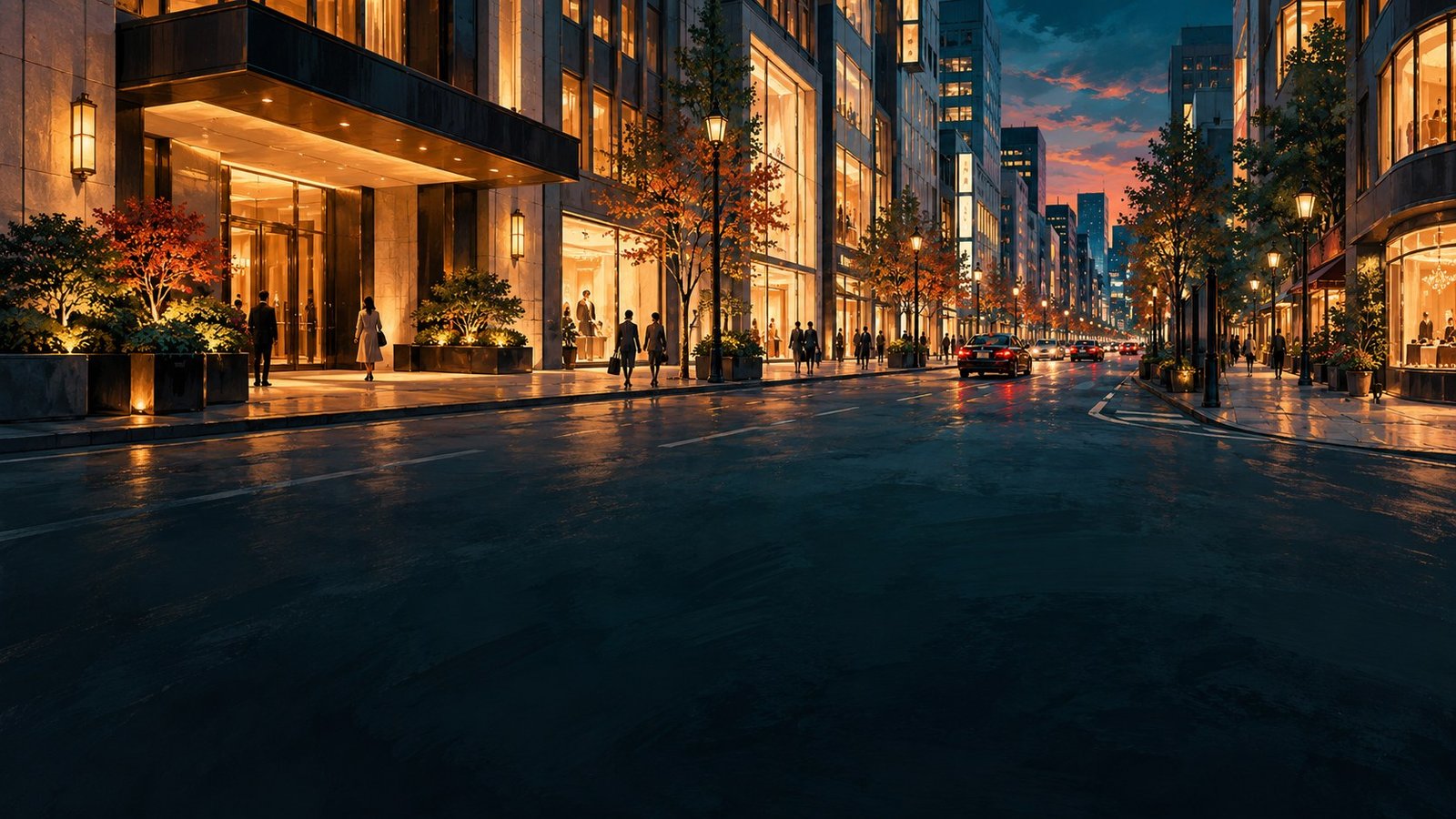
An original AI-generated illustration of a Ginza hotel stay; this is an imagined street scene, not a photograph of a named hotel.
The most useful answer to where to stay in Ginza starts with a station entrance and a room category. A hotel beside the shops may suit a leisurely Tokyo break; another a few streets away may make repeated rail journeys easier. Ginza has three Tokyo Metro lines, while nearby Higashi-Ginza adds the Toei Asakusa Line and its airport connections.[2][4][5]
Start with central Ginza for shopping and restaurant evenings, the Yurakucho/Hibiya edge for JR access, or Higashi-Ginza for suitable airport through trains. Then compare northern Ginza and the southern streets towards Shimbashi if their actual rooms and quotes work better. Moving towards an edge creates more options, but does not establish that the room will be cheaper.
This research-led guide compares location and published room specifications, rather than claiming personal hotel stays. The five properties are examples of different choices, with no date-specific room availability or hotel-rate ranking implied.
Some links in this guide are affiliate links. Taylor’s Trailblazing Travels may earn a commission if you book or buy through them, at no extra cost to you.
Shopping-led stay
Central Ginza
Start around the main shopping streets and the Ginza Station entrances.
Repeated JR journeys
Yurakucho edge
Compare the actual station walk; some central Ginza hotels are close too.
Airport-train option
Higashi-Ginza
Check that the selected through service reaches your airport terminal.
Value test
Whole-stay cost
Room category, breakfast, taxes and the final transfer all affect the comparison.
Where to stay in Ginza: five useful hotel zones
Think of these as overlapping search areas, not formal hotel districts. Central Ginza focuses on the shopping streets around Ginza Station; Yurakucho/Hibiya sits towards the JR railway; Higashi-Ginza is the eastern side around the theatre and station. The north leads towards Kyobashi, while southern Ginza approaches Shimbashi. GO TOKYO places the wider Ginza area within walking reach of both Yurakucho and Tokyo stations, but that broad description is not a hotel-to-platform route.[1]
Swipe across the table to compare →
| Search area | Put it first when… | Station or street anchor | Main compromise to check |
|---|---|---|---|
| Central Ginza | You want to browse, dine and return to the hotel between stops. | Ginza Station; the main shopping streets. | “Central” can hide a longer walk to your particular railway line. |
| Yurakucho / Hibiya edge | JR travel and evening dining both matter. | JR Yurakucho and Hibiya Station. | The hotel may be outside the Ginza postal address; verify its room-facing direction. |
| Higashi-Ginza | You want the Asakusa Line or an eastern Ginza base. | Higashi-Ginza Station and Kabukiza. | A short subway walk does not mean equally short JR access. |
| Northern Ginza | You are comparing alternatives around Ginza 1-chome towards Kyobashi. | Ginza-itchome Station; the exact hotel pin. | Ginza-itchome is on the Yurakucho Line, not the Ginza Line.[3] |
| Southern Ginza | You want a choice between Ginza and Shimbashi routes. | Ginza 7–8-chome; Shimbashi Station. | A hotel between stations may involve a moderate walk whichever route you choose. |
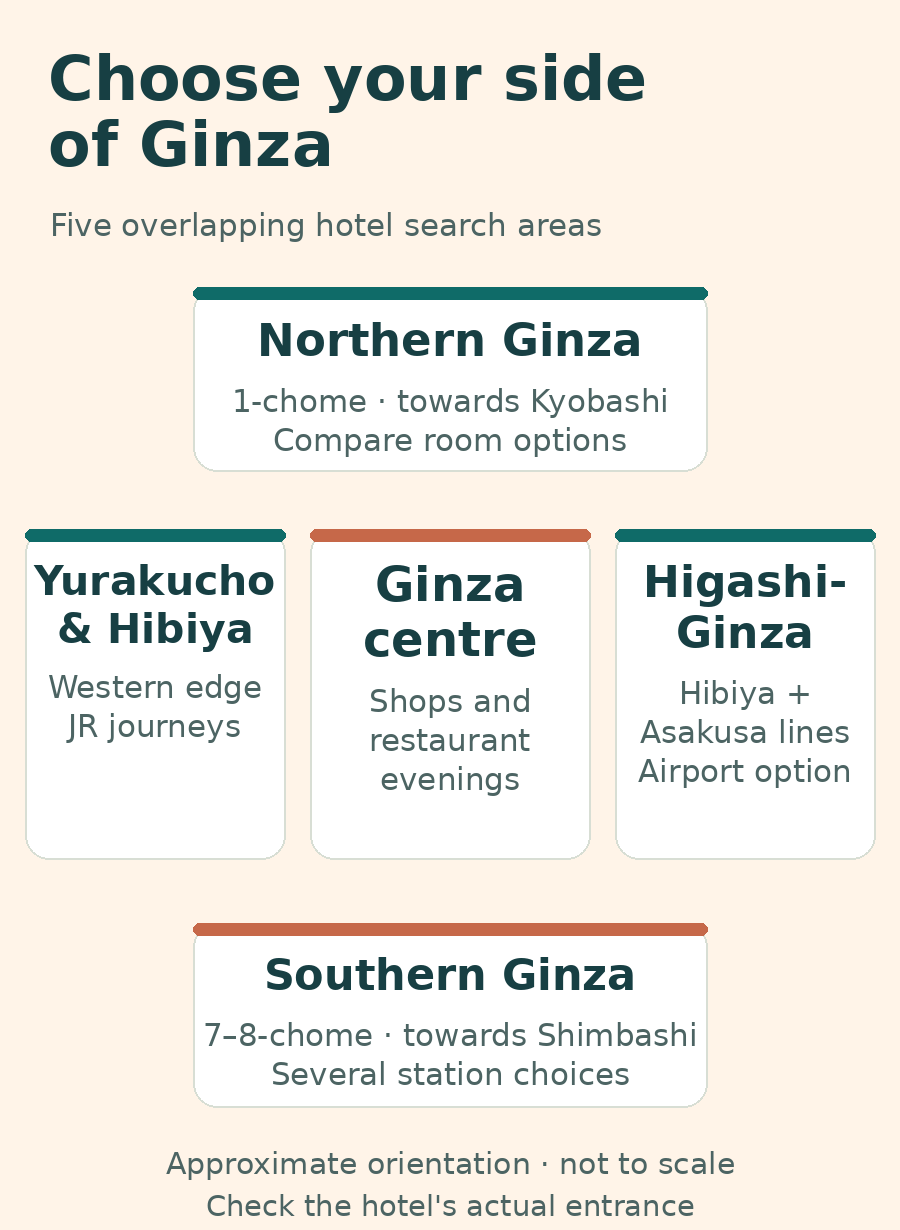
For a shopping-led stay, the ability to drop bags at the hotel is a concrete advantage. For a rail-led trip, use your likely departure station as the centre of the search instead. A hotel’s neighbourhood label is less useful than the directions from the exit you will actually use.
Booking websites can draw “Ginza” broadly: Booking.com’s district results include properties in surrounding areas as well as central Ginza.[19] Open the map before comparing the lowest displayed prices.
Compare Ginza-area stays on Agoda Compare Ginza-area stays on Booking.com
Choose around the journeys you will repeat
Give repeat journeys more weight than the one journey that looks simplest on arrival. List each expected one-way walk between your hotel and a station. Four days with one outing and return each day creates eight walks; an airport arrival and departure normally creates only two.
Swipe across the table to compare →
| Your pattern | First search | What should carry most weight? |
|---|---|---|
| Shopping and restaurant break | Central Ginza | Distance to your chosen shops and evening reservations; enough room to unpack. |
| A different JR outing most days | Yurakucho edge and central hotels close to JR | The station walk repeated across the whole stay. |
| Short stay with substantial luggage | Higashi-Ginza, if the train route fits | A manageable route from the airport train, including lifts and crossings. |
| Room space takes priority | All five zones | The exact room layout and full-stay quote; postcode alone cannot answer this. |
A four-day walking comparison
MUJI HOTEL GINZA advertises a three-minute walk from JR Yurakucho’s central entrance. Mitsui Garden Hotel Ginza-gochome advertises eleven minutes from Yurakucho’s Ginza Exit.[7][12] Using those published figures, eight walks total 24 minutes from MUJI and 88 minutes from Mitsui: a 64-minute difference across four days.
This is an original planning calculation, not a timed walking test. The entrances differ; station corridors, traffic signals, luggage and your pace add time. It nevertheless shows why a seemingly minor daily distance can outweigh a convenient arrival.
For the reverse priority, Mitsui advertises one minute from Higashi-Ginza Exit 4, while Hotel Musse Ginza Meitetsu gives six minutes from Exit A1.[12][15] Across just two airport-related walks that is a ten-minute difference using the hotels’ figures. If your stay uses JR repeatedly, assess both patterns before paying a premium for airport proximity.
Five hotel examples with room choices worth comparing
These properties were selected to illustrate different locations and room configurations. Selection is based on published operator information checked on 18 October 2026, not a star-rating contest or a claim that any property is cheapest. Room names on booking websites can differ, so match the dimensions and bedding to the operator’s description.
Swipe across the table to compare →
| Hotel and area | Room example | Why compare it? | Key check |
|---|---|---|---|
| MUJI HOTEL GINZA · central/northern shopping streets | Type B: 20 m²; Type C: 24–25 m².[6] | A shopping base with useful room-size choices. | Type C has separate bathtub and shower-only options. |
| remm Hibiya · western edge | Economy Double: 15 m²; Twin: 23 m².[9][10] | Compare a compact room with a materially larger alternative. | Economy Double has a shower booth and no bathtub. |
| Mitsui Garden Hotel Ginza-gochome · Higashi-Ginza | Standard Queen: 18.5 m²; Superior, 3 beds: 28.1 m².[11] | A short Higashi-Ginza walk and a genuine three-bed option. | Book the stated bedding configuration. |
| Daiwa Roynet Hotel Ginza PREMIER · Ginza 1-chome | Standard Double: 18 m²; Standard Twin: 23 m².[13] | A north-side comparison with several room sizes. | The double and twin offer different bed arrangements. |
| Hotel Musse Ginza Meitetsu · southern Ginza | Moderate Double: 17.4 m²; MUSSE Double: 23 m².[15] | Compare room categories within one southern location. | Do not confuse Moderate Small Double with Moderate Double. |
MUJI HOTEL GINZA: useful for returning between shops
MUJI’s Type A is only 14–15 m², so the brand name alone does not guarantee a spacious room. Type B and Type C make a more useful comparison for two adults with luggage; Type C’s bathroom choice also matters.[6] The hotel publishes short walks to both Ginza Station and JR Yurakucho, making this an example where central shopping and JR access can overlap.[7]
The value question is whether the particular room justifies its quote. Choose it for the location and configuration you want, rather than assuming a minimalist interior means budget pricing.
Check MUJI HOTEL GINZA on Booking.com
remm Hibiya: decide whether the compact double is enough
The hotel gives roughly four minutes from JR Yurakucho’s Hibiya Exit, with Hibiya subway access also nearby.[8] Its Economy Double has one 140 cm-wide bed and a shower-only bathroom. The Twin offers two 110 cm-wide beds, a bathtub and a larger published floor area.[9][10]
A solo traveller who spends little time in the room may prefer the compact option. Two adults who want separate beds or room to unpack should compare the Twin’s total price before treating the headline double rate as a bargain.
Check remm Hibiya on Booking.com
Mitsui Garden Hotel Ginza-gochome: compare bedding before size
The official brochure distinguishes a 17.3 m² Standard Double, an 18.5 m² Standard Queen, a 24.7 m² Superior with two beds and a 28.1 m² Superior with three beds.[11] That last option is useful when three people want separate beds rather than relying on an unspecified extra-bed request.
Its one-minute advertised Higashi-Ginza walk is the main location advantage; the eleven-minute published JR walks make the trade-off clear.[12] Check the full name carefully because several different Mitsui Garden properties serve the wider Ginza area.
Check Mitsui Garden Ginza-gochome on Agoda
Daiwa Roynet Hotel Ginza PREMIER: a northern alternative
The hotel’s published access puts Ginza-itchome Exit 10 about one minute away and JR Yurakucho about eight minutes away.[14] The 18 m² Standard Double has a 152 cm-wide bed; the 23 m² Standard Twin has two 110 cm-wide beds. Those categories do not accept an extra bed.[13]
This is a useful comparison if northern Ginza suits your routes. Choose by room and rate conditions; the word “PREMIER” does not tell you whether the smallest double will fit your luggage comfortably.
Check Daiwa Roynet Ginza PREMIER on Agoda
Hotel Musse Ginza Meitetsu: southern Ginza with several station choices
Musse gives approximately six minutes to JR Shimbashi, Ginza and Higashi-Ginza, using its specified exits.[15] Its Moderate Small Double is 14–14.2 m² with a 140 cm-wide bed; Moderate Double is 17.4 m² with a 160 cm-wide bed. Smoking and non-smoking versions exist in those categories, so select deliberately.[16]
The larger MUSSE Double adds room space within the same location.[15] Compare it against a smaller central hotel room when the total quotes are close, particularly if you expect to spend time in the room between outings.
Work out the value of the whole stay
Ask for comparable totals for the same dates, number of guests, bed arrangement and cancellation terms. Then add the extras you would actually buy. Breakfast is valuable only if you want it and can use it before departure; an included meal you skip saves nothing.
For the wider spending plan, use the Japan trip-budget guide to set Tokyo accommodation alongside the rest of your route.
When a lower nightly quote costs more
This original model uses two adults sharing one room for four nights. Every amount below is an illustrative assumption, not a current Ginza hotel offer. The room totals are assumed to include all applicable taxes. The ¥3,000 allowance represents additional transport caused by the less convenient option; it is not an advertised taxi fare.
Swipe across the table to compare →
| Cost component | Option A: ¥30,000 room-only | Option B: ¥33,000 with breakfast |
|---|---|---|
| Four nights | ¥120,000 | ¥132,000 |
| Breakfast for two, four mornings | ¥14,400 at an assumed ¥1,800 each | Included |
| Additional local transfer allowance | ¥3,000 | ¥0 |
| Comparable stay total | ¥137,400 | ¥132,000 |
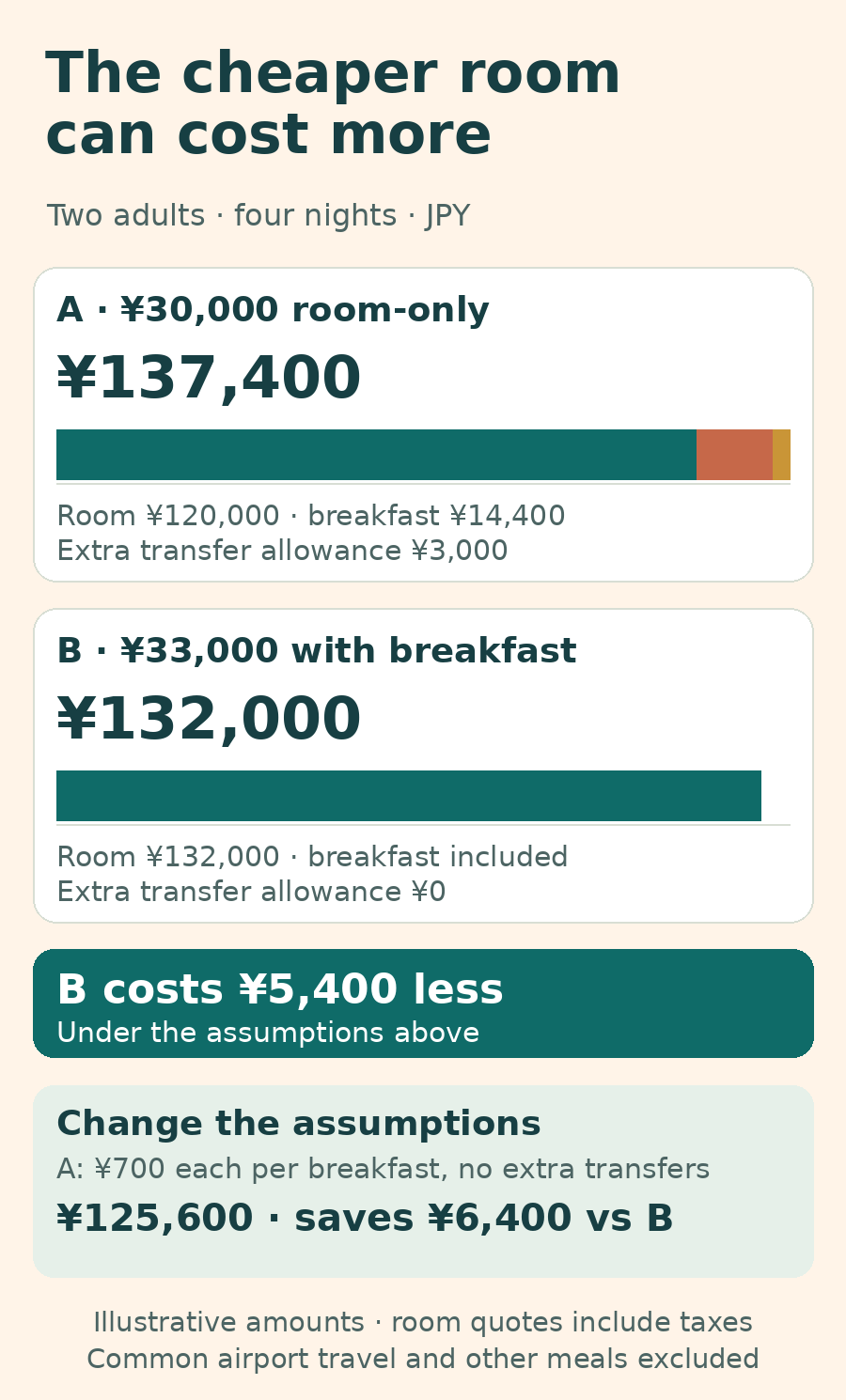
Option B’s room quote is ¥3,000 higher per night but its comparable total is ¥5,400 lower. With these assumptions, A’s extras are worth ¥4,350 per night across the stay: that is the maximum premium B could charge before losing its cost advantage.
Change the behaviour and the answer changes. If A’s guests instead budget ¥700 each for a simple breakfast and use no additional paid transfers, A totals ¥125,600 and becomes ¥6,400 cheaper than B. Replace these assumptions with your own quotes and habits. Common airport fares, lunch, dinner and sightseeing are outside this comparison because they have not been assumed to differ.
Allow for the accommodation tax on your stay date
For stays through 31 March 2027, Tokyo’s accommodation tax is ¥100 per person per night on a taxable accommodation charge of ¥10,000 to under ¥15,000, and ¥200 at ¥15,000 or more; below ¥10,000 is exempt. The taxable charge includes the accommodation and its service fee, but excludes meals and consumption tax.[17]
From 1 April 2027, the approved system charges 3% where the taxable accommodation charge is ¥13,000 or more per person per night, with charges below that threshold exempt.[18] As a worked example, two adults staying four nights at a taxable ¥15,000 each per night incur ¥1,600 under the current system or ¥3,600 under the new one. Ask whether the displayed booking total includes this tax or whether it is collected separately.
Airport and local transport: check the actual route
Haneda and Narita through trains
Higashi-Ginza’s Toei Asakusa Line has through-running connections with Keikyu for Haneda and Keisei for Narita. Suitable services can remove a train change. Check the train’s destination and stopping pattern rather than assuming every departure follows your route. Toei specifically distinguishes the Skyliner, which runs towards Nippori/Ueno and does not through-run onto the Asakusa Line.[5]
This makes Higashi-Ginza a useful first search for substantial luggage. However, direct trains still involve airport walking, the station exit and the final hotel approach. A brief journey shown between stations is not a promise of the same airport-to-reception time.
If you prefer comparing coach or private-transfer alternatives, Toei’s airport guide provides the rail baseline. 12Go also lists a real Narita Airport–Tokyo route comparison covering several transport types.[20] Its destination is wider Tokyo: select the actual arrival point or confirm your hotel’s full address and luggage capacity for a private transfer. Do not treat a Tokyo search result as a guaranteed Ginza hotel drop-off.
Compare Narita Airport–Tokyo transport on 12Go
When an airport car changes the hotel choice
If an airport car suits your budget, hotel drop-off can reduce the value of paying a premium merely for the shortest airport-station walk. Compare a Haneda or Narita transfer on GetYourGuide[24] with a Narita-to-central-Tokyo transfer on Viator.[25] Confirm the Ginza hotel address, luggage, child seats and waiting-time rule. This Viator option is not wheelchair accessible and lists 60 minutes of waiting from landing; confirm how it handles immigration delays.[25]
Ginza, Ginza-itchome and Higashi-Ginza are different decisions
Ginza Station serves the Ginza, Marunouchi and Hibiya lines. Ginza-itchome serves the Yurakucho Line, while Higashi-Ginza combines Hibiya Line access with the Toei Asakusa Line.[2][3][12] Choose your likely line first, then check its platform-to-street route. The closest exit on a hotel map may involve stairs.
For a very early intercity train, compare the extra arrival margin from Ginza with staying at Tokyo Station itself. A single morning departure may be worth the compromise; daily long-distance departures shift the balance towards the station. This is a different decision from selecting a Ginza shopping base.
Save the hotel’s Japanese address and the correct entrance before travelling. Mobile data can help with a changed exit or arrival plan. If your existing roaming allowance does not cover your needs, Airalo offers Japan eSIM plans; check the chosen plan’s activation rules and ensure the device is compatible and network-unlocked.[21][22]
Check the room details that a location score misses
Two adults and luggage
Look at the exact floor plan, bed width and space around the bed. A 15 m² room and a 23 m² room are different propositions, but the additional area may be in the bathroom or entrance rather than where you want to open a suitcase. Treat total floor area as a starting point.
Compare one double bed with two separate beds on equal terms. At remm Hibiya the Twin changes both space and bathroom provision, so a higher quote buys more than a second mattress.[9][10]
Three or more guests
Start with occupancy and bedding rather than the lowest two-adult price. Mitsui Garden Ginza-gochome’s named three-bed rooms provide an obvious starting point.[11] Daiwa Roynet Ginza PREMIER also lists larger categories, including a 72 m² four-bed room that can take a fifth guest using an added bed.[13] Ask for the total with every guest included; child age rules and extra bedding can change which option is viable.
Sleep, access and longer stays
No entire Ginza microzone can promise a quiet bedroom. Ask the hotel about the available room’s direction, road or railway exposure, nearby works and whether the requested position can be confirmed. A “quiet room requested” note is not the same as a guaranteed allocation.
For step-free travel, confirm the station lift route and the hotel’s own entrance and bathroom arrangement. Book a suitable accessible room explicitly if required; a larger standard room is not a substitute for verified access features.
For a longer stay, laundry can affect both packing and cost. MUJI says it has no coin-operated laundry, while Musse lists a laundromat.[7][15] Check opening arrangements and charges directly if this will influence your choice.
Before paying, save the cancellation deadline in the stated time zone, the full tax-inclusive total, meal inclusions, occupancy and room type. If a better quote appears later, check the existing booking’s cancellation terms before replacing it.
Useful questions
Is Ginza a sensible base if most evenings will be in Shibuya or Shinjuku?
It can work, but count the return journeys before choosing it. Ginza makes the most sense when you will use its own shops, restaurants or eastern-central Tokyo connections often. If nearly every late evening ends elsewhere, staying closer to those plans may be more convenient. Compare your actual routes and last departures; a central position on the city map does not make every trip equally easy.
Can you find value in Ginza without choosing the smallest room?
Yes, but establish it from comparable quotes. Search more than one microzone and compare a larger room in one property with a smaller room in another. Breakfast, cancellation flexibility and additional transfers can reverse the apparent price difference. The cost model above is designed for this calculation and does not assume that any edge of Ginza is always cheaper.
Should a first-time visitor choose Ginza or Higashi-Ginza?
Start with Ginza when its three Metro lines and shopping streets fit your daily plans. Start with Higashi-Ginza when the Asakusa Line and a suitable airport through service are especially useful.[2][5] Then compare the exact hotel entrances: the districts overlap on foot, and a well-positioned hotel can serve both purposes.
Does a hotel near Yurakucho count as a Ginza stay?
For practical trip planning, it can. GO TOKYO describes Ginza as about five minutes’ walk from JR Yurakucho.[1] The hotel’s own position still matters: a western-edge hotel may suit JR journeys and visits to Ginza without having a Ginza postal address. Check both the map and the named entrance rather than rejecting or accepting it on the booking-area label alone.
Match the Ginza address to your trip
Choose the Ginza location that suits the days you will actually have. Central shopping streets are useful when you will return between shops and restaurants; Yurakucho-facing locations deserve priority for repeated JR journeys; Higashi-Ginza is a strong starting point when its train connections fit your arrival. Keep northern and southern Ginza in the comparison until the exact room and whole-stay price make the decision clear.
Sources and checks
Research-led hotel and neighbourhood guidance with original planning comparisons. Sources below were consulted on the dates shown. Check room details, access notices, transport and booking conditions for your own travel dates.
- GO TOKYO: Ginza district guide
- Tokyo Metro: Ginza Station and its lines
- Tokyo Metro: Ginza-itchome Station
- Toei Transportation: Higashi-ginza Station
- Toei Transportation: airport access and through services
- MUJI HOTEL GINZA: room categories, sizes and occupancy
- MUJI HOTEL GINZA: access, luggage and guest questions
- remm Hibiya: location and station walks
- remm Hibiya: Economy Double specifications
- remm Hibiya: Twin Room specifications
- Mitsui Garden Hotel Ginza-gochome: official English brochure
- Mitsui Garden Hotel Ginza-gochome: station access
- Daiwa Roynet Hotel Ginza PREMIER: current room specifications
- Daiwa Roynet Hotel Ginza PREMIER: location
- Hotel Musse Ginza Meitetsu: English rooms and access
- Hotel Musse Ginza Meitetsu: room types and smoking options
- Tokyo Metropolitan Government: accommodation tax for guests
- Tokyo Metropolitan Government: approved accommodation-tax change from April 2027
- Booking.com: Ginza accommodation search area
- 12Go: Narita Airport to Tokyo route comparison
- Airalo: Japan eSIM plans
- Airalo: device compatibility requirements
- MUJI HOTEL GINZA: reservation-system security notice, 2 October 2026
- GetYourGuide: private Haneda or Narita airport transfer to Tokyo hotels
- Viator: Narita to central Tokyo private transfer, pickup and access terms
Illustrations in this article were created for Taylor’s Trailblazing Travels. Third-party photographs, where used, are credited beside the image or in the source list.