Cherry Blossom Season in Japan: Planning Regions and Dates
Choose a season, keep room to adapt, and build a trip that works beyond one peak-bloom date.
- Dates before destinations
- Local reports before detours
- 10–14-night route options
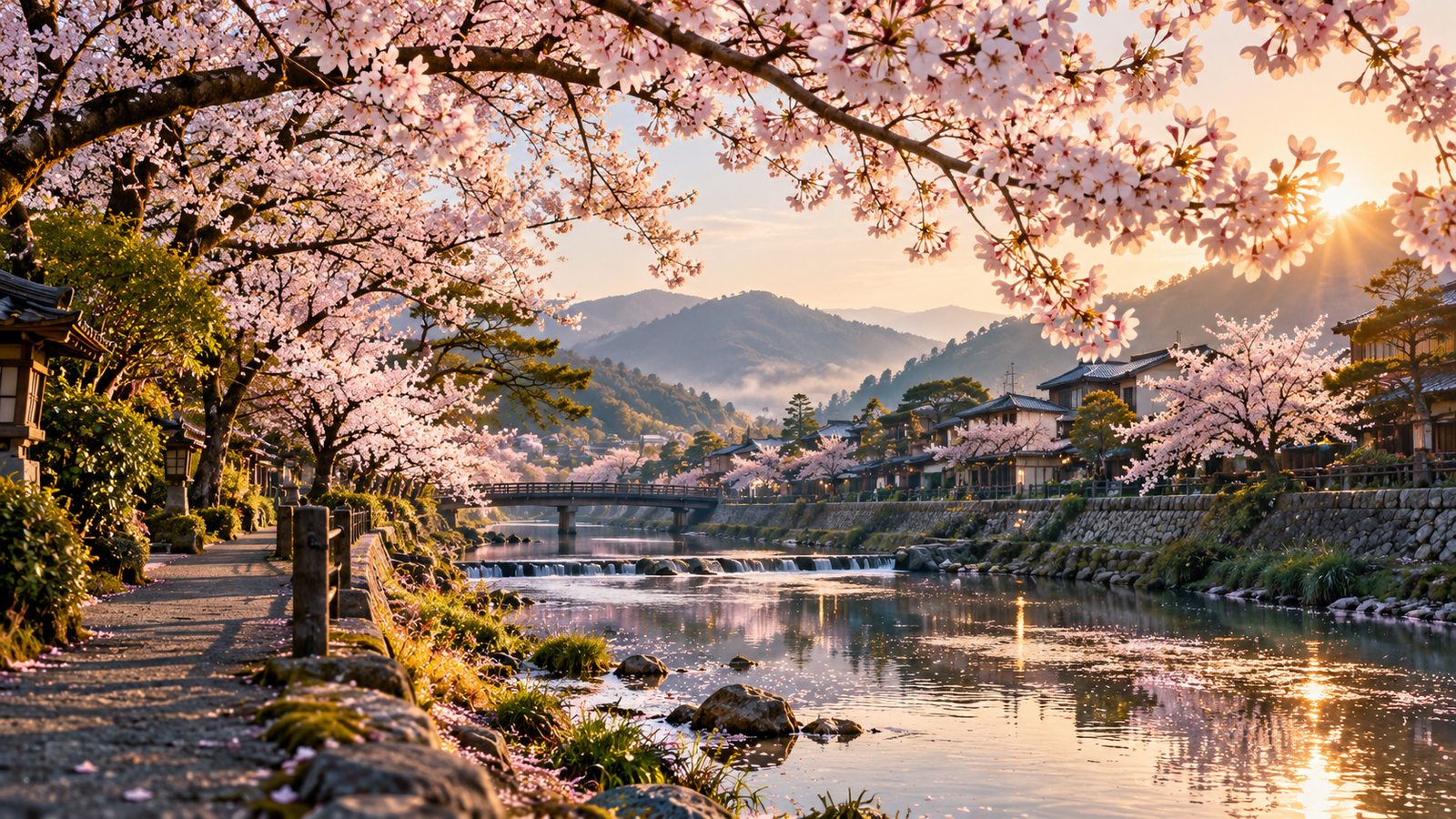
AI-created editorial illustration of Japan’s cherry blossom season; it does not show current bloom conditions or a verified location.
Cherry blossom season in Japan is easier to plan when you make two separate decisions: which region broadly matches your holiday dates, and which garden or town is flowering once you arrive. Trying to settle both from a single national forecast months ahead gives a fragile itinerary.
This guide focuses on those regional and timing decisions. The planning windows are typical patterns, checked on 18 October 2026; the route and contingency suggestions are editorial planning models, not measured success rates. For the wider trip, start with the Japan planning hub.
Cherry blossom season in Japan: choose a region for your dates
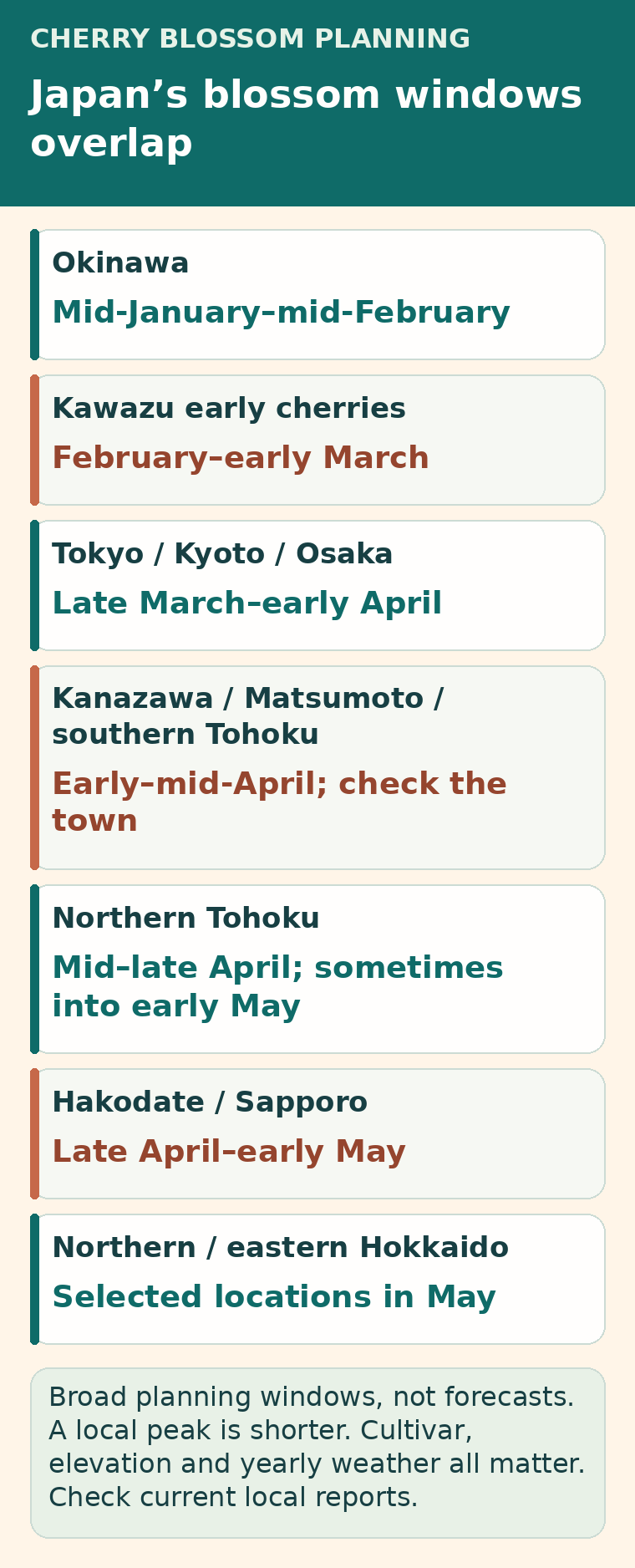
Start with the dates you can actually travel. The table gives broad seasonal starting points, then the decision that matters within each window. These are overlapping regional patterns: the blossom at one park occupies only part of its region’s wider season.
Typical planning windows, checked 18 October 2026. These are not annual forecasts or guaranteed viewing periods.
Swipe the table sideways to compare all columns.
| Your travel window | Where to investigate first | What to allow for |
|---|---|---|
| Mid-January–mid-February | Okinawa, including northern main-island blossom locations | Expect dark pink, bell-shaped kanhizakura, a different blossom experience from pale Somei Yoshino avenues. [3] |
| February–early March | Kawazu on the Izu Peninsula | Choose this specifically for its early-flowering cherries; check the town’s reports before travelling. [4] |
| Late March–early April | Tokyo, Kyoto, Osaka; also research Fukuoka, Hiroshima and Shikoku | Several places can peak close together. Going farther south does not reliably buy an extra week. [1] [14] |
| Early–mid-April | Kanazawa, Matsumoto and southern Tohoku | Kanazawa is usually an early-April candidate; Matsumoto and the Shiroishi River area offer early-to-mid-April possibilities. Verify each location. [5] [6] [7] |
| Mid–late April | Northern Tohoku, with Hirosaki on the shortlist | Hirosaki’s traditional season extends from late April into early May, but an early spring can shift the useful window forward. Check its own updates. [8] [14] |
| Late April–early May | Hakodate and Sapporo | Both cities are typical candidates for this period. Their calendars still vary by year, location and variety. [9] [10] |
| Later in May | Selected northern and eastern Hokkaido locations | Research the individual town. Historical JMA normals are later in places such as Wakkanai and Kushiro; they are not a promise that Sapporo will still be flowering. [11] |
If Tokyo and Kyoto are essential, a trip spanning the end of March and beginning of April is a sensible starting point. If your only holiday falls in late April, choose whether blossoms or those particular cities matter more. A northern trip may suit the flowers better; a Tokyo–Kyoto trip can still be worthwhile with a different spring emphasis.
Use the table as a shortlist
Pick two plausible regions, then compare the actual viewing sites, travel effort and cancellation terms. Avoid booking a five-region itinerary simply because the table shows five different blossom windows.
First bloom, full bloom and your useful viewing window
A first-bloom forecast does not mean a park is already covered in flowers. JMA records first bloom when five or six flowers have opened on its designated sample tree. Full bloom is the first day when roughly 80% or more of that tree’s flowers are open. Neither measurement describes every tree across a city. [2]
Tokyo’s 1991–2020 normal dates are 24 March for first bloom and 31 March for full bloom. These are historical reference points, not advance bookings advice for a particular year. Adding seven days to any published first-bloom forecast does not produce a dependable full-bloom forecast. [2]
For photographs of dense canopies, follow the full-bloom estimate and then current park reports. For a pleasant walk, partially open trees and falling petals may be perfectly satisfying. Decide which experience you want before paying to rearrange the trip.
Temperature affects how buds develop, and winter conditions also matter; the process is more complicated than “a warm day means early flowers”. JMC incorporates autumn and winter temperatures, growth and historical information in its model. Wind and heavy rain can then bring down flowers already at full bloom. [14] [15]
A festival date is an event date
Food stalls, illuminations and scheduled celebrations can continue when the principal trees are before or past their peak. Check the current bloom report separately from the festival calendar.
Build your backup around varieties and elevation
The least disruptive alternative may be another garden in the same city. Shinjuku Gyoen’s official guide identifies Somei Yoshino around late March to early April, Ichiyo in early to mid-April, and Kanzan in mid- to late April. Its earlier cherries offer another possibility before the main season. These are cultivar patterns, not confirmation that those trees will flower throughout your visit. [12]
This matters when a headline says “Tokyo’s blossoms are finished”. It may describe the dominant Somei Yoshino display, while other varieties remain worth checking. Look for dated photographs and a named cultivar rather than assuming that every sakura spot is at the same stage.
Elevation creates another layer of choice. On Mount Yoshino, lower, middle and higher areas have different flowering patterns, with peak bloom staggered over several days; JNTO describes early to mid-April as a general visiting window. Consult reports for the part of the mountain you intend to reach. A photograph from the lower slopes does not establish the condition farther up. [13]
Kanazawa’s Kenrokuen also contains different cherry varieties, while Matsumoto publishes reports for individual locations. Both approaches are more useful than treating an entire prefecture as a single blossom stop. [5] [20]
Prepare three named options per base
Choose a main display, a garden with varied cultivars and a feasible nearby alternative. Save their official pages together. The fallback must be reachable within your available day, with the walking, access and opening arrangements checked.
A practical 10–14-night strategy for Tokyo and Kansai
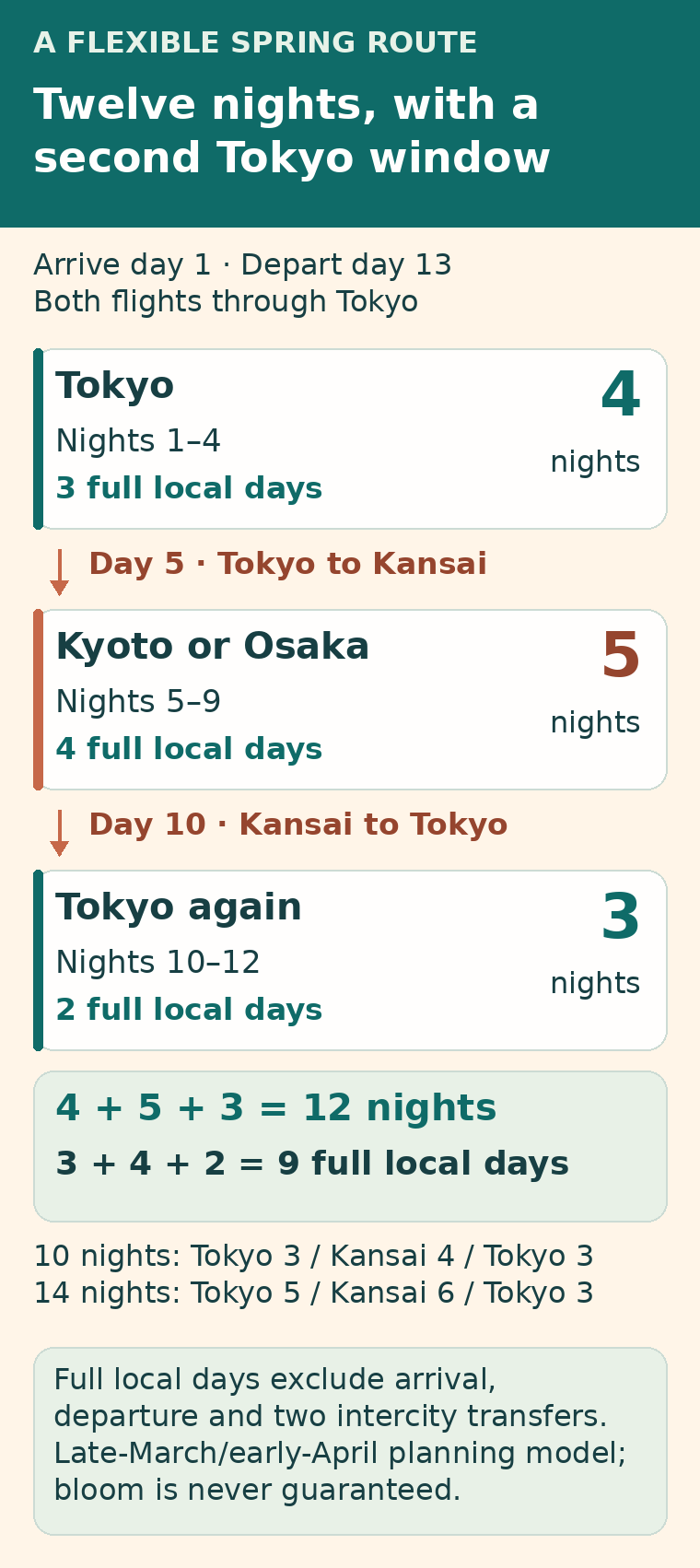
For a first trip that also includes temples, food and city sightseeing, use a small number of bases and leave several blossom visits movable. The following original planning model assumes arrival and departure through Tokyo, 12 nights in Japan, and a broad late-March/early-April window. It does not calculate a probability of seeing flowers.
An illustrative 12-night route; nights refer to accommodation in Japan and exclude the outbound flight.
Swipe the table sideways to compare all columns.
| Nights | Base | Purpose |
|---|---|---|
| 1–4: four nights | Tokyo | First look at city reports; keep two separate half-days available for blossom walks among other plans. |
| 5–9: five nights | One Kansai base: Kyoto or Osaka | Use local reports to choose viewing days. Stay in one city, with outings that fit your interests and realistic travel time. |
| 10–12: three nights | Tokyo | A later look at the same region before departure; choose the best current display rather than repeating a fixed attraction list. |
For example, arrival on 25 March and departure on 6 April produces this 12-night span. Those dates illustrate the shape of the trip; they are not a forecast or a claim that flights or rooms are available.
Moving on days 5 and 10 leaves nine full days without an intercity transfer, excluding arrival and departure. Keep both transfer days light and any remaining plans local. Returning to Tokyo puts visits at both ends of the holiday, but costs another intercity journey and hotel change.
For ten nights, use three in Tokyo, four in Kansai and three back in Tokyo. For fourteen, five, six and three is a calmer version. Add useful time at the existing bases before adding another distant city. Travellers flying into one region and home from the other can use a two-base route and save the return journey. The wider guide to how many days to spend in Japan helps balance blossom time with the rest of the trip.
Compare the right transfer
If Osaka is your Kansai base, the Tokyo–Osaka comparison below can help you compare transport options. Check the actual departure and arrival stations, total journey, fare conditions and change rules against the operator. A Tokyo–Osaka listing is not a Tokyo–Kyoto ticket.
Compare Tokyo–Osaka transport on 12GoThis route suits travellers who want Tokyo and Kansai even without peak blossom. If sakura is the overriding reason for a mid- or late-April trip, build a Tohoku itinerary from the outset; for a late-April/May trip, investigate Hokkaido. Avoid attaching a distant northern flight to a short Tokyo–Kyoto holiday without allowing a proper travel day and checking the return connection.
What to change when the blossoms arrive early or late
Use this order of decisions before changing hotels. It prioritises preserving useful holiday time and makes the cost of chasing flowers visible.
An editorial contingency selector. Choose from current reports, not from a fixed calendar.
Swipe the table sideways to compare all columns.
| What you find | First response | When to change region |
|---|---|---|
| Your chosen park is still in bud | Move the walk later in your stay. Check an earlier-flowering variety or another nearby location already reporting flowers. | Only if a better display is confirmed elsewhere and the travel still fits your remaining nights. |
| Full bloom is happening now | Use the next suitable weather window. Move flexible indoor sightseeing to a less promising day. | There is little reason to leave a good local display solely to pursue a more famous one. |
| The main display has passed | Look for later cultivars, another elevation or attractive falling-petal scenes close by. | Consider a northern move only after checking the named destination, accommodation and door-to-door journey. |
| A storm has affected the area | Check fresh reports and local travel conditions. Plan an indoor alternative while conditions are poor. | Do not assume neighbouring regions are unaffected; confirm conditions before buying a new journey. |
Before making a major change, answer four questions: what is flowering now, how much viewing time remains after travel, what will the change cost, and would the destination still interest you if the display fades?
A five-hour journey each way would consume ten hours before local travel or viewing. That hypothetical calculation can make an overnight stay more sensible than an exhausting day trip, but it can also make staying put the better decision. A forecast alone is too weak a reason to lose a large part of a short holiday.
Keep your final night within a sensible journey of the departure airport. Blossom flexibility works best in the middle of a holiday, where changing a day does not jeopardise the flight home.
Book the accommodation you need, with useful flexibility
Secure an affordable base once your dates and region make sense. Waiting for a highly detailed blossom forecast may leave fewer suitable options, while paying a large premium for a single “peak” night does not remove weather uncertainty. Compare the total stay, room type and cancellation deadline before choosing a flexible rate.
For Kyoto, check the map as carefully as the headline price. Choose a location that serves several of your planned outings and lets you reach a blossom walk early, rather than a room whose appeal depends on one particular tree flowering.
Compare Kyoto stays for the same dates
Use both city searches to compare room types, total costs and cancellation conditions. These links open Kyoto accommodation searches, not a particular property or a guarantee of blossom-season availability.
Compare Kyoto stays on Agoda Compare Kyoto stays on Booking.comIf a flexible rate costs more, judge the extra charge against the non-refundable amount you might lose and your realistic willingness to move. Keep a note of the cancellation deadline and its time zone. Check any replacement booking before cancelling the room you already have. Use the Japan trip-cost guide for UK travellers to assess the whole holiday, including any extra journeys.
Late-April and early-May northern blossom trips can overlap Golden Week, one of Japan’s busiest domestic travel periods. Treat accommodation and longer-distance transport as advance decisions; escaping the main Honshu blossom season does not necessarily mean escaping holiday crowds. [16]
Check attraction arrangements separately. Shinjuku Gyoen required advance booking during specified busy periods in 2026, and one date was subsequently removed. This illustrates why you should read the notice for your own visit year and day, rather than carry forward an old booking rule. [17]
A forecast-checking routine that leads to better decisions
At this guide’s check on 18 October 2026, the JMC national forecast page still covered the 2026 season. No dates in this guide are presented as 2027 predictions. When planning another spring, check the year and publication date before relying on any forecast. [14]
- Months ahead: choose the broad season and region. Use historical patterns to make a shortlist, and book a trip you would enjoy beyond the flowers.
- When that year’s forecasts appear: compare both first-bloom and full-bloom columns. Save the update date and location; a national map may show only first bloom.
- In the final fortnight: check whether the picture has changed enough to move a flexible day or base. Read cancellation deadlines before acting.
- During the trip: use named park or local tourism reports, ideally with dated photographs, alongside the short-range weather forecast. Check again before a long excursion.
The checking intervals above are planning suggestions. National forecasts are useful for the route; a recent report from the exact garden is usually more useful for choosing tomorrow’s walk. Be wary of undated pictures and last year’s festival posts.
Keep the local reports accessible
Save the important pages and maps before travelling. If your existing mobile plan does not meet your needs, Airalo offers Japan eSIM options for compatible, unlocked devices. Check coverage, data allowance, validity and activation terms for the specific plan; the link opens Airalo, where you can select Japan. [18]
View Airalo and choose a Japan eSIMMake the viewing day work
Reserve a comfortable block of time for one area rather than trying to tick off every famous park. An early walk can leave the afternoon available for other sightseeing; a scheduled evening illumination needs its own current hours and admission check.
Take layers, a weatherproof outer layer and comfortable shoes. If you plan a picnic, first confirm that the site permits one, and bring a bag for your rubbish. Leave branches and flowers untouched, and follow local instructions about alcohol and permitted areas. Hanami is shared public space, not a private photoshoot. [19]
Choose an indoor alternative near the same base before the weather changes. That might be a museum, a food-focused afternoon or an indoor cultural activity. This prevents poor weather turning into a costly last-minute cross-country journey.
A sensible stopping point
Once you have enjoyed a good display, let the rest of the holiday regain its own shape. More travel does not necessarily improve the experience, especially when it replaces a place you were looking forward to visiting.
Questions before you go
Should I book a trip for the first-bloom date?
Use it as a signal that the season is starting, then look at the separate full-bloom forecast and current conditions at the places you want to visit. A single first-bloom date is too narrow a basis for an overseas holiday.
Will Kyoto always flower after Tokyo?
No fixed order should determine your tickets. Regional windows overlap and the weather affects each place differently. Choose the order that works for your flights and wider plans, then use the annual forecasts to adjust flexible outings.
Can I still see cherry blossom in Tokyo in the second half of April?
Some late varieties may offer a chance. Shinjuku Gyoen lists Kanzan as a mid- to late-April cultivar. Check current reports for that variety; do not expect the same display as the main Somei Yoshino season. [12]
Is Golden Week a safe choice for Hokkaido blossom?
It overlaps the usual season in parts of Hokkaido, but it guarantees neither bloom nor a quiet trip. Hakodate and Sapporo are generally late-April/early-May candidates; the specific year may differ. Check current reports and accommodation before committing. [9] [10]
Is it worth booking a blossom tour?
A guide can add local context and help with an unfamiliar area, but cannot control flowering. Before paying, ask what happens if the planned trees are not in bloom, whether the route can change and which costs or admissions are included. Choose it for the guiding as well as the flowers.
Karen’s planning takeaway
Choose a region that broadly fits your dates, then secure a route with enough time to enjoy it. For a first Tokyo–Kansai visit, two main bases and movable blossom walks are usually a more useful starting point than repeated long detours. Once in Japan, let current local reports guide the next outing, and keep the wider holiday worth taking whatever the trees do.
Sources and further reading
The numbered sources identify official and provider information relevant to the facts in this guide. Recheck changing prices, timetables and opening rules for your trip; routes, allowances and decision tools are editorial planning examples.
- JNTO: national cherry blossom season and regional forecast overview
- Japan Meteorological Agency: flowering, full bloom and Tokyo historical normals
- Visit Okinawa Japan: cherry blossom varieties and usual season
- Kawazu Tourist Association: Kawazu-zakura flowering season (brochure)
- Visit Kanazawa: cherry blossom guide and varied garden cultivars
- Visit Matsumoto: spring cherry blossom itinerary and usual timing
- Travel to Tohoku: Hitome Senbonzakura along the Shiroishi River
- Hirosaki Tourist Information: the city through the seasons
- Visit Sapporo: spring and the usual cherry blossom window
- Travel Hakodate: cherry blossom viewing locations and usual season
- Japan Meteorological Agency: Hokkaido flowering and full-bloom normals
- Shinjuku Gyoen: cherry blossom cultivars and their different flowering periods
- JNTO: Yoshino cherry blossoms and staggered mountain flowering
- Japan Meteorological Corporation: 2026 forecast and forecasting method
- Weathernews: rain and wind affecting flowers at full bloom, April 2026
- JNTO: May travel and Golden Week
- Ministry of the Environment: Shinjuku Gyoen advance-booking arrangements in 2026
- Airalo: Japan eSIM availability, compatibility and activation checks
- JNTO: hanami manners and practical preparation
- Visit Matsumoto: location-by-location flowering reports (Japanese)
Illustrations in this article were created for Taylor’s Trailblazing Travels. Third-party photographs, where used, are credited beside the image or in the source list.