Japan · Tokyo · Viewpoint comparison
Tokyo’s Best Observation Decks: Which Viewpoint Should You Choose?
Six skyline choices, the ticket differences that matter, and a practical way to protect your sightseeing time.
Choose SHIBUYA SKY for the feeling of being outside above Tokyo, Skytree for the highest viewing platforms in this shortlist, or Tokyo City View when you want Tokyo Tower in the picture. The Metropolitan Government observatories make a strong free alternative.[1][3][5][6] Each solves a different problem; buying the tallest or most photographed option is not automatically the best use of your evening.
This comparison of Tokyo observation decks weighs the view itself, indoor or outdoor access, booking commitment, cost and fit with the rest of your day. Recommendations are editorial judgements based on the venues’ published information, checked on 17 October 2026. The time budgets below are transparent planning estimates, with room for queues, rather than timed visits.
Taylor’s Trailblazing Travels may earn a commission when you book or buy through an affiliate link in this guide, at no extra cost to you. This helps fund the research and upkeep of the site.
Choose the experience
Decide whether you want outdoor space, extreme height or a particular landmark in your photographs.
Match your day
A viewpoint near your other plans usually makes a better short visit than a detour across Tokyo.
Protect your flexibility
Check the precise cancellation terms before making a weather-sensitive booking.
Start with one deck
Add another only if its perspective or time of day offers something you actively want.
Tokyo observation decks compared
The shortlist covers six different reasons to go up: outdoor atmosphere, height, landmark photography, visiting an icon, saving money and an indoor family break. These are best-fit choices, rather than a ranking by height or popularity. The price column is for ordinary adult admission; age bands, special events and extras differ.
Swipe or scroll sideways to read every column.
| Viewpoint | Choose it for | Main trade-off | Adult ticket snapshot |
|---|---|---|---|
| SHIBUYA SKY | Open rooftop above Shibuya; indoor gallery too | The rooftop depends on conditions | Online: ¥2,700 before 15:00; ¥3,400 from 15:00.[1][2] |
| Tokyo Skytree | Indoor panorama at 350m; optional 450m level | Greater height makes the city feel more distant | From ¥1,800 for Tembo Deck; from ¥3,000 for Deck + Galleria.[3][4] |
| Tokyo City View | Tokyo Tower in the skyline, from Roppongi Hills | Indoor viewing; events can restrict particular areas | Ordinary online admission: ¥2,200 for the current period.[6][8] |
| Tokyo Tower | Going inside the landmark itself | The tower cannot be the subject of your skyline photograph from inside it | Main Deck ¥1,500; Top Deck Tour ¥3,300 online.[9] |
| Metropolitan Government observatories | A free indoor view from Shinjuku | Allow spare time for a variable queue | Free.[5] |
| Sunshine 60 TENBOU-PARK | An indoor park setting for a family stop in Ikebukuro | Less compelling if your day is on the other side of Tokyo | ¥700 weekdays; ¥900 weekends/holidays and busy season; ¥1,200 peak season.[10][11] |
For a short first visit, choose the experience you most want and place it into an existing neighbourhood day. Paying twice for broadly similar city panoramas is worthwhile only if you enjoy observation decks in their own right.
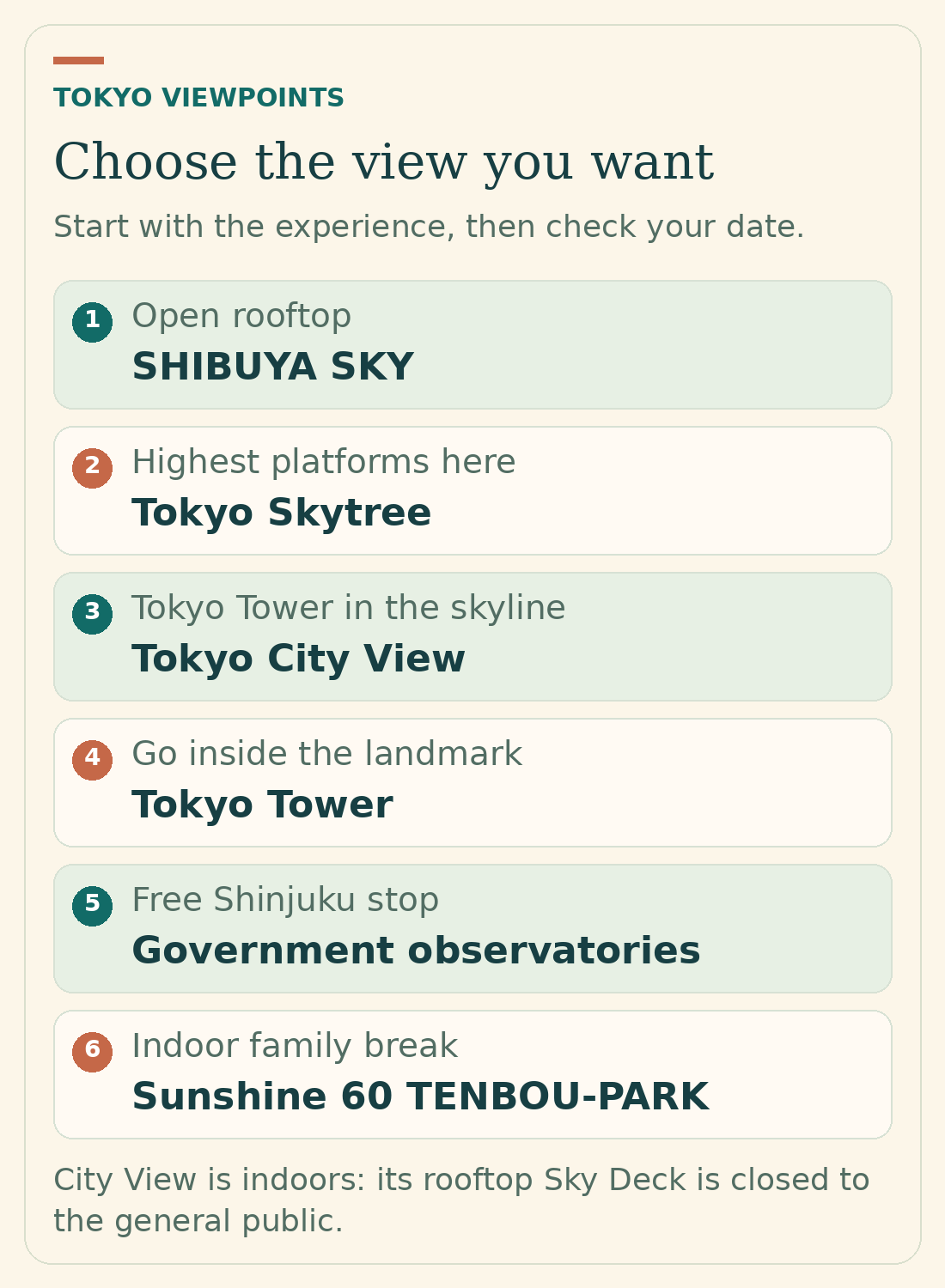
SHIBUYA SKY or Skytree: open air or maximum height?
SHIBUYA SKY: choose it for the rooftop experience
SHIBUYA SKY’s outdoor SKY STAGE is its main distinction. The complex also contains the indoor SKY GALLERY, and rises roughly 229m above Shibuya. Direct access from Shibuya Station makes it convenient when the rest of your afternoon is already in the area.[1]
The editorial case for paying is the combination of skyline, open space and changing light. If you would be disappointed by an indoor-only visit, make that part of your booking decision. Rain, strong wind, lightning and other conditions can close the rooftop, even when admission to the facility continues.[2]
Ticket sales use an advance calendar whose booking window may change. Check the dates actually on sale before planning around a specific slot. When adult tickets sell out online, the official site says the counter allocation is also sold out. Build your Shibuya day around a confirmed slot, and leave enough time to reach the actual entrance rather than arriving at the station as your booking begins.[2]
For local context as well as the view, Check the Shibuya walking tour with SHIBUYA SKY admission. This Alva Japan Tours option combines a guided walk with admission. Its advertised duration is two hours, but the provider explicitly says the exact deck entry depends on availability and sunset is not guaranteed. Choose it for the guided experience, after checking the confirmed arrangements.[12]
Skytree: choose it for the scale of the city
Skytree’s enclosed Tembo Deck is at 350m, while the additional Tembo Galleria follows a sloping glazed passage from around 445m to 450m. This is the choice for a broad sense of Tokyo’s scale. A traveller who enjoys identifying districts across a vast panorama has a stronger reason to upgrade than someone who simply wants one good city photograph.[3]
For a brief visit, the lower deck is a reasonable starting choice. Pay for the Galleria when the higher vantage point is part of the attraction for you. The official site lists a ¥1,400 Galleria add-on sold inside the Tembo Deck on the day, subject to sales restrictions; compare it with the combined ticket for your date before deciding to upgrade later. Tickets bought at the 4F counter or machines add a ¥500 issuing fee per ticket.[4]
Compare Skytree ticket options on GetYourGuide and Check Skytree admission options on Viator against the official ticket choices. Both listings offer deck options, so compare the same level and date. The Viator listing checked here is supplied by LINKTIVITY and describes the Galleria as an upgrade; it was non-refundable at the review date. Read the selected option, rather than assuming the product heading includes both levels.[13][14]
Tokyo City View or Tokyo Tower: look at the icon or go inside?
Tokyo City View: the stronger choice for Tokyo Tower photographs
Tokyo City View occupies the 52nd floor of Roppongi Hills Mori Tower. Its indoor panorama includes Tokyo Tower, Skytree and Rainbow Bridge when visibility allows. That makes it a good fit for travellers whose preferred image contains a recognisable tower among the surrounding buildings.[6]
The outdoor Sky Deck is no longer open to the general public. Do not book this as an alternative open-air rooftop to SHIBUYA SKY.[7]
Dates matter here. At the 17 October 2026 check, the operator listed closures on 27 October and 10–12 November 2026. It also warned that the Fuji-facing central section would be restricted on 28–30 October and 4–9 November. Check the current visitor information and ticket calendar, especially if one viewing direction is the reason for your visit.[8]
Pair it with a Roppongi afternoon or evening. If you also want the Mori Art Museum, check that exhibition’s dates and the exact combination ticket. Being in the same tower does not make museum admission part of every observatory booking.[8]
Tokyo Tower: choose it when the building is part of the appeal
Tokyo Tower offers a 150m Main Deck and a Top Deck Tour that includes both 150m and 250m levels. The Main Deck is the less expensive way to experience the tower. The Top Deck Tour makes sense for someone who specifically wants the upper level, rather than someone who is trying to collect a second skyline at minimal cost.[9]
Its published Main Deck hours extend to 23:00, with last admission at 22:30, subject to congestion. This can help when dinner comes before sightseeing. Check the day’s operation before relying on a late arrival.[9]
Check Tokyo Tower Main Deck tickets on Viator if you prefer arranging admission with your other activities. This listing is for the 150m Main Deck, not the Top Deck Tour, and was non-refundable when checked. Compare the final price with Tokyo Tower’s official tickets and follow the seller’s e-ticket delivery instructions.[15]
The free option and the family option
Metropolitan Government observatories: a flexible Shinjuku stop
The two observatories are 202m above the ground, and entry is free. For an evening view, the South Observatory normally stays open until 22:00, with entry closing at 21:30. The North normally closes at 17:30, but stays open later when the South is closed.[5]
The normal closure pattern is the first and third Tuesdays for the South, and the second and fourth Mondays for the North, with holiday adjustments and additional inspection closures. Use the official calendar. Free entry still involves waiting; the operator warns that queues vary.[5]
This is especially useful when you are already in Shinjuku, want to decide after seeing the weather, or are travelling with someone unsure about heights. There is no ticket cost to justify if you decide on a short look. Its main compromise is an unpredictable wait.
Sunshine 60: give children something beyond the windows
TENBOU-PARK’s indoor lawn setting, baby crawl space and nursery facilities give it a different purpose from a quick lift ride and panorama. It is the most convincing choice in this shortlist for a family already spending time around Ikebukuro who wants to combine a view with an indoor break.[10]
Keep expectations clear: an indoor attraction may operate in rain while the view becomes indistinct. Sunshine’s own FAQ makes that distinction. It also confirms a wheelchair-friendly main route and space for pushchairs.[17]
For weekends, public holidays and designated busy days, the operator requires advance timed reservations while admission restrictions apply. Date-specific web tickets are offered from two months ahead. Do not assume that its lower price means you can always walk straight in.[11]
Check Sunshine 60 admission on GetYourGuide alongside the official tickets. Check whether you have selected admission alone or an audio-guide option, and compare the cancellation deadline. The selected date and entry instructions still matter.[16]
How much of your day should a viewpoint take?
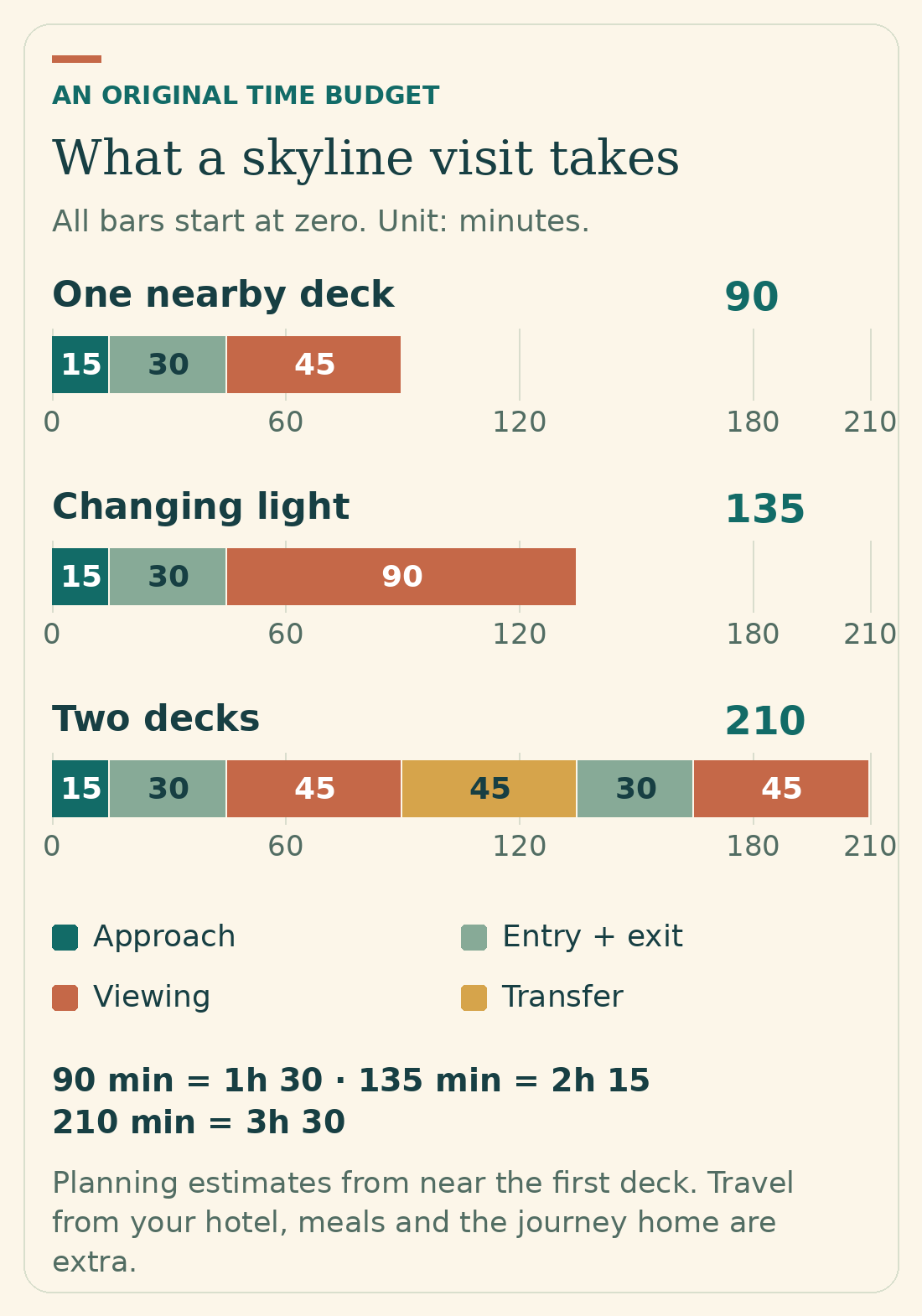
A deck can look like a one-hour attraction and still consume most of an afternoon once you add getting there, finding the entrance and waiting for lifts. Use the following model to decide how much skyline time belongs in your itinerary.
Swipe or scroll sideways to read every column.
| Plan | Time allowed | How the estimate is built |
|---|---|---|
| One nearby deck, brief panorama | 90 minutes | 15 minutes approaching + 30 minutes for entry, lifts and exit + 45 minutes viewing |
| One nearby deck, changing light | 135 minutes | 15 minutes approaching + 30 minutes for entry, lifts and exit + 90 minutes viewing |
| Two decks with a transfer | 210 minutes | First 90-minute visit + 45-minute transfer + 30 minutes entering/leaving the second deck + 45 minutes viewing |
These are starting allowances, not promises. A busy queue can exceed the entire access buffer. For sunset, work backwards from that date’s sunset time and your actual timed ticket, allowing for the journey from the admission gate to the viewing area. A booking beginning at sunset may put you in a lift while the light changes.
Three traveller scenarios
- One free evening after a full day: choose a viewpoint close to your existing plans. An exhausted traveller gains little by crossing the city solely to swap one indoor panorama for another.
- A couple wanting a memorable rooftop visit: reserve SHIBUYA SKY and keep the surrounding Shibuya plans flexible. Treat the outdoor experience as the reason for the spend, with an indoor or ground-level fallback if conditions change.
- A skyline enthusiast with two suitable days: Skytree in daylight and Tokyo City View after dark create a more meaningful contrast than rushing two decks during the same light. Choose this because you want both perspectives, not because a first Tokyo itinerary requires two tickets.
Pay for a difference you will notice
At Tokyo Tower, two adult Main Deck tickets total ¥3,000, compared with ¥6,600 for two online Top Deck Tours. The additional ¥3,600 should buy an upper-level experience you actively want. At Skytree, buying two ordinary adult tickets at the 4F counter or machines adds ¥1,000 in issuing fees to the underlying admission price. These calculations use the official prices above and exclude transport, food and other booking extras.[4][9]
For families, enter each child’s age or school category into the venue’s own booking system before comparing the total. Adult headline prices alone cannot tell you which option is cheaper for your group.
For the wider budget, use the Japan trip cost guide, then decide how much of your Tokyo spending one skyline visit deserves.
Book the right ticket and keep the view in perspective
Check the selected option, including cancellation
Before paying, confirm the attraction name, included levels, date, arrival window, party details and the actual admission barcode or voucher instructions. A timed ticket does not remove every queue, and a marketplace’s general cancellation message does not settle the terms of your selected product.
For example, Skytree’s official LINKTIVITY cancellation policy lists a 20% charge from 30 days before admission until the entry start time, then no cancellation afterwards, with the fee waived for cancellations within 59 minutes of purchase. Certain combination packages cannot be cancelled after purchase. That matters if you intend to reserve now and make a final decision when the weather forecast improves.[18]
For City View, use the current event and access calendar alongside the ticket page. For Sunshine, check whether your day requires an advance reservation. Keep confirmations accessible on your phone and read any instruction about exchanging a voucher for a separate entrance ticket.
Weather changes the value of the visit
Make two separate decisions: whether the facility is operating, and whether the visibility is good enough for your main goal. A sheltered deck can solve exposure to rain; it cannot make distant buildings appear through cloud. If you mainly want a broad daytime panorama, a flexible clear spell is more useful than a rigid booking justified only by its height.
After dark, decide whether the city lights themselves are enough. Keep dinner or a neighbourhood walk nearby so that a disappointing view does not turn into a wasted cross-city outing. Follow the operator’s own closure notices rather than assuming weather at street level matches conditions above.
Photography and access need different checks
For photographs through glass, switch off the flash, avoid shooting towards bright indoor lights and keep other visitors’ reflections out of the frame where possible. Try a darker part of the window area without blocking access. These practical techniques are more useful than assuming extra height will improve every photograph.
Equipment rules differ. SHIBUYA SKY does not allow tripods, monopods or selfie sticks onto the rooftop, and the Metropolitan Government observatories ask visitors not to use tripods. Travel light and check your intended camera setup against the venue’s rules.[2][5]
For step-free access, match the actual viewing level to your needs. Tokyo Tower publishes an accessible route to the Main Deck and advises asking staff when moving between its two Main Deck floors. Sunshine confirms that its main visitor route accommodates wheelchair users. If lift access, a mobility aid or a pushchair is essential, check the full route with the venue before choosing an upper-level or rooftop experience.[17][19]
Group the visit geographically
Use SHIBUYA SKY on a Shibuya day, the Government observatories in Shinjuku, Sunshine in Ikebukuro and City View in Roppongi. Skytree is reached via Oshiage or Tokyo Skytree Station; Tokyo Tower lists nearby options including Akabanebashi and Kamiyacho. Check the venue entrance as well as the station: a railway arrival is not the same as arriving at the ticket gate.[20][21]
Questions before you go
Can I expect to see Mount Fuji?
The Government observatories’ guide identifies clear, cold days from December to February as more promising.[5] Treat Fuji as a bonus: visibility on your day decides the outcome, so avoid buying an expensive ticket solely on that expectation.
Which choice makes sense if I am nervous about heights?
An indoor viewpoint with a modest time commitment is a sensible first step. The free Government observatories let you try the experience without feeling obliged to stay to justify a ticket. Start away from the windows, and agree with your companions that leaving early is acceptable. Choose ground-level skyline views if going up does not appeal.
Can I visit straight from the airport with a suitcase?
Arrange storage first. SHIBUYA SKY asks visitors not to bring large luggage, including wheeled cases, and requires restricted rooftop belongings to be put in lockers. Sunshine’s observatory has no luggage storage service, although the wider Sunshine City complex has lockers. Leave enough time to find available storage before a timed booking.[2][17]
Make your choice
Choose one viewpoint for the memory you want: the rooftop at SHIBUYA SKY, the height of Skytree, Tokyo Tower framed from City View, or the experience of going inside Tokyo Tower itself. For a lighter commitment, the Government observatories or Sunshine can fit more comfortably into the day. Reserve after comparing the exact ticket, weather flexibility and journey, then leave time to enjoy Tokyo at street level too.
Sources
Official visitor information and the identified booking listings were consulted for this guide. Prices and dated operating information were checked on 17 October 2026; recheck the relevant venue and your selected ticket before travelling.
- Shibuya Scramble Square — SHIBUYA SKY overview and station access
- SHIBUYA SKY — current tickets and rooftop precautions (Japanese)
- Tokyo Skytree — viewing floors and panorama guide (Japanese)
- Tokyo Skytree — current tickets, starting prices and counter fees (Japanese)
- Tokyo Metropolitan Government — observatory visiting information and calendar (Japanese)
- Tokyo City View — indoor observatory and visible landmarks
- Tokyo City View — notice ending general public access to the rooftop Sky Deck
- Roppongi Hills Museum / Observatory — current admission, opening and area restrictions
- Tokyo Tower — official fees and business hours
- Sunshine 60 TENBOU-PARK — visiting with children
- Sunshine 60 TENBOU-PARK — official ticket calendar, prices and reservations
- GetYourGuide / Alva Japan Tours — Shibuya walking tour with SHIBUYA SKY admission and timing conditions
- GetYourGuide — Tokyo Skytree admission options
- Viator / LINKTIVITY — Skytree admission and optional Galleria
- Viator / Royal Smart Tourism — Tokyo Tower Main Deck e-ticket and delivery terms
- GetYourGuide — Sunshine 60 TENBOU-PARK admission options
- Sunshine 60 TENBOU-PARK — FAQ, visibility, pushchairs and accessibility
- Tokyo Skytree — official cancellation policy (Japanese)
- Tokyo Tower — accessibility information
- Tokyo Skytree — official public transport access (Japanese)
- Tokyo Tower — station access and approach information
Illustrations in this article were created for Taylor’s Trailblazing Travels. Third-party photographs, where used, are credited beside the image or in the source list.