Where to Stay in Kuching: Waterfront, Old Town and Quieter Areas
Stay close to the evenings you want, then choose the room that suits your sleep and access needs.
Conceptual Kuching waterfront illustration; this composite is not an actual hotel view or a measured representation of the city.
Affiliate disclosure: Taylor’s Trailblazing Travels may earn a commission if you book or buy through links in this guide, at no extra cost to you. Recommendations are selected for their usefulness to the trip.
Deciding where to stay in Kuching is easier when you start with how you want to spend the evening. A room close to the waterfront or Old Town makes it simpler to go out, return for a rest and head out again. A more secluded setting can suit a slower stay, but it changes the transport and meal decisions.
The difficult part is quietness. A river view, a garden or an elevated address does not tell you what reaches the bedroom after dark. This guide separates the main search pockets, compares five actual properties and explains how to check the room rather than trusting an area label.
First-visit starting point
Waterfront and Old Town for a stay that repeatedly returns to the central streets.
Quietness is specific
Ask about the actual room, nearby venues and works on your dates.
Views are categories
A hotel near the river may sell both river-facing and other rooms.
Outer-retreat trade-off
Count the city returns before comparing a cheaper nightly quote.
Where to stay in Kuching: choose the daily pattern
The waterfront and Old Town overlap, so treat these as useful search pockets rather than sharply separated districts. Sarawak Tourism Board describes the waterfront as a south-bank promenade used for food, performances, events and everyday social life. [1] Being near that activity is an advantage when you want to join it; it calls for more careful room selection when you want to sleep early.
| Search pocket | Best fit | Trade-off to investigate |
|---|---|---|
| South-bank waterfront and Plaza Merdeka end | Repeated promenade visits, a recognisable central base and easy returns to the room. | Choose the view category and ask about events, road exposure and works. The Waterfront Hotel sits above Plaza Merdeka. [2] |
| Main Bazaar, Carpenter Street and Wayang Street | Heritage-building stays and evenings built around the old streets. | Compare stair routes, room outlook and nearby activity. The Ranee and The Marian are useful contrasting examples. [5] [9] |
| Central streets set back from the river, including Jalan Mathies | A larger-hotel option while retaining a central base. | Check the exact walk, gradient and room position. Pullman is at Interhill Place on Jalan Mathies; its current renewal notice needs checking. [11] |
| Santubong/Damai Road: outside the city-centre stay | Time at a retreat, with city visits planned deliberately. | A separate road journey, transport quotes and a return plan. Cove 55 is an example in this area. [12] |
A city-focused visitor should not move out to Santubong merely because it appears under “Kuching” in a hotel search. Conversely, someone who wants long periods at a retreat should not choose a central room only to avoid one airport transfer. Compare the days you intend to repeat.
Apply three priorities in order
- Keep essential needs first: the correct occupancy, sleeping arrangement and a usable route to the room.
- Choose the area that reduces the journeys you will make most often.
- Use the exact room position, current works and booking terms to settle the shortlist.
For a couple wanting heritage character, Old Town may win even without a guaranteed river view. For a family needing a particular bed layout, the suitable room can outweigh the area’s atmosphere. A light sleeper should make a satisfactory answer about exposure and works a condition of proceeding.

Waterfront or Old Town: what changes day to day
Waterfront: pay for convenience you will use
The main benefit is the ability to revisit the riverfront without organising a separate outing. You can return to the room between daytime plans and dinner, or leave companions to rest while others go out. That flexibility is especially useful on a short stay.
Do not confuse a waterfront address with a booked river view. The Waterfront Hotel explicitly sells Premier Twin rooms in city-view and river-view categories. [3] Decide whether the view is worth the difference in your actual quote, and compare it separately from breakfast or cancellation terms.
Ask where the pedestrian entrance is, which side of the building your room faces and whether the walk to your preferred evening destination involves crossings or steps. A hotel photograph taken from an upper floor does not show the route from reception.
Old Town: character comes with room-level differences
The Ranee is a converted pair of shophouses on Main Bazaar, while The Marian occupies a restored mansion on Wayang Street. [5] [6] [9] These are different building types with different room approaches; neither should be treated as a standard modern hotel floor plan.
Choose this pocket because the old streets are part of your stay, then identify the room you are buying. Ask whether its outlook is towards a road, courtyard, air well or neighbouring premises. If you need an uninterrupted lift route, ask about every change of level, including the entrance and bathroom.
For late check-in, keep the property’s full name and reception instructions offline. An address in the right street is useful, but the entrance can matter more when arriving with bags in rain or after dark.
Back to top ↑How to find a quieter stay without leaving central Kuching
Start by looking away from the busiest frontage, then investigate the building. A side street, upper floor or inward-facing room is a candidate to assess, not evidence of silence. Traffic, loading areas, bars, hotel events and renovation work can affect different sides of the same property.
The Ranee’s Deluxe Suites have either a back-alley outlook or an internal air-well outlook. [7] That gives you a specific question to ask about exposure. The Marian’s own description mentions nearby night activity and retained wooden stairs despite its hilltop garden setting. [9] Neither “courtyard” nor “garden” should replace a room-specific answer.
Ask: “For these dates, which available room is furthest from road and venue noise, lifts, service areas and building works? What outlook does it have, and is that allocation guaranteed or only requested?” A useful answer names a room category or position and explains any limits.
Check two current works notices
As checked on 6 November 2026, The Waterfront Hotel announces phased guest-room enhancement works with an estimated end in the second quarter of 2027. [4] Pullman’s official page also warns of continuing renewal and possible unavailable areas, with reopening dates subject to change. [11] Ask about the floors, work hours and facilities relevant to your stay rather than assuming a past estimated completion date has settled the matter.
If the answer is vague and quiet sleep is essential, compare another suitable room or property with better-confirmed conditions. A refundable booking can preserve flexibility while an allocation is unresolved, but check its actual deadline: a special request is not itself a contractual guarantee.
With access needs, ask for the route from vehicle drop-off to reception and room. “Central”, “hilltop” and “boutique” do not establish a manageable gradient or continuous step-free access. Current photographs and a written description are more useful than a generic facilities tick.
Back to top ↑Five hotel examples to apply the location choices
These researched hotel examples show how the location and room trade-offs apply to actual properties. Compare the same dates, party size, room category, meals, compulsory charges and cancellation terms across the linked offers. The final room allocation still needs confirming with the property.
The Waterfront Hotel: Plaza Merdeka and the riverfront end of town
The hotel is above Plaza Merdeka at 68 Jalan Tun Abang Haji Openg. [2] Its Premier Twin city-view and river-view categories both specify two super-single beds and a maximum of two adults. [3] They provide a clear like-for-like starting point if two separate beds suit the trip.
The central position is the reason to consider it; the current works notice should be resolved before booking for quietness or a particular facility. Compare The Waterfront Hotel on Agoda or check matching offers on Booking.com.
The Ranee Boutique Suites: individual rooms on Main Bazaar
Standard Suites can face an internal courtyard or the river; the named loft suites use private stairs. [7] Choose by the actual category and access, not a photograph from a different suite. Its published minimum guest age is 12, with no cots or extra beds, so families should check eligibility before selecting it. [8]
This is a strong candidate for travellers who actively want a heritage-building stay and can match its room conditions. It is less suitable when a specific outlook or stair-free route is essential but unconfirmed. Check The Ranee on Agoda and compare the corresponding Booking.com room terms.
The Marian: a central garden setting with practical qualifications
The Mary Sharp room category offers queen or twin beds, an en-suite bathroom and air-conditioning. [10] Ask which room can be allocated and how many steps it involves. Its historic setting is the attraction; the property’s own account of busy surroundings makes a blanket “quiet retreat” description inappropriate.
Consider it when character and the garden setting matter, after checking the room and nearby event arrangements. Compare The Marian Boutique Lodging House on Booking.com or check matching Marian offers on Agoda. [16] Confirm bed choice and the room approach directly if either is essential.
Pullman Kuching: an elevated central hotel on Jalan Mathies
Accor lists a Deluxe King city-view room and a separate Premium Deluxe King river-view category. [11] Those categories help distinguish a view upgrade from the basic location decision. Ask for the walking approach you would actually use and the current room allocation.
It can suit someone who wants a larger central hotel, provided the continuing renewal works and available facilities fit the stay. Check Pullman Kuching on Agoda or compare Pullman on Booking.com. Do not assume an elevated room automatically solves noise.
Cove 55: a separate Santubong retreat decision
Cove 55 lists its address on Jalan Sultan Tengah, the Santubong/Damai Road. [12] Its room information distinguishes ground-floor Garden Rooms with courtyards, first-floor Balcony Rooms and standalone villas; only some villas have private pools. [13]
Choose it when time at the property is a purpose of the trip. Confirm the room, meal options and transport before treating it as a base for repeated city evenings. Compare Cove 55 on Agoda and check the equivalent Cove 55 category on Booking.com. A ground-floor category does not by itself establish the accessibility of every part of the stay.
Back to top ↑Does an outer base still save money after city trips?
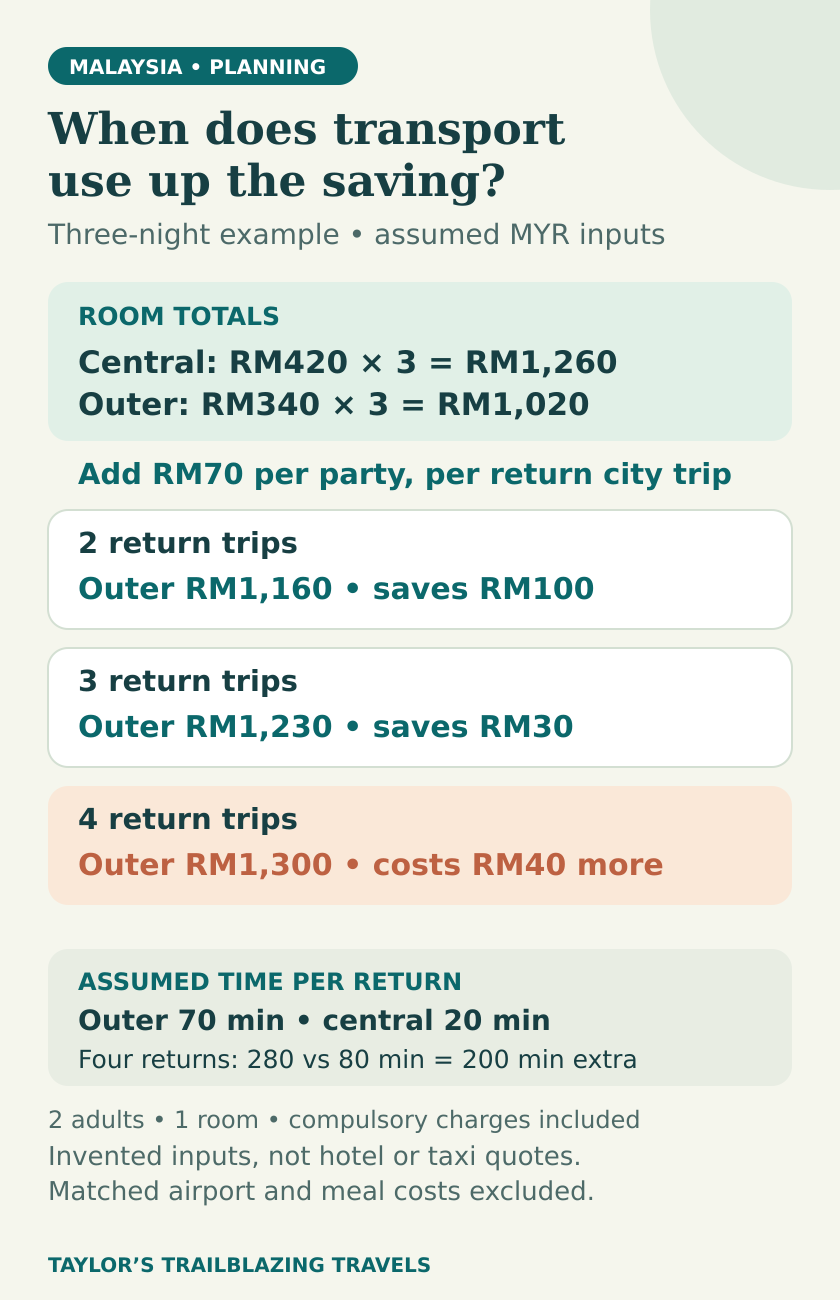
The following model tests a cheaper outer-room quote; it does not claim that Santubong hotels are usually cheaper. Assume two adults sharing one room for three nights, a central room at RM420 per night and an outer room at RM340. These are invented inputs, not prices for any property above.
The outer room saves RM80 per night, or RM240 over the stay. Now assume each return city trip costs RM70 for the party. Central equivalents are walked at no monetary cost. All room and transport inputs are assumed to include compulsory charges; matched airport and meal costs are excluded from this particular comparison.
| Return visits to the central area | Central room total | Outer room plus transport | Result |
|---|---|---|---|
| Two | RM420 ×3 = RM1,260 | RM340 ×3 + RM70 ×2 = RM1,160 | Outer base saves RM100 |
| Three | RM1,260 | RM1,020 + RM210 = RM1,230 | Outer base saves RM30 |
| Four | RM1,260 | RM1,020 + RM280 = RM1,300 | Outer base costs RM40 more |
The break-even point is RM240 ÷ RM70 = about 3.43 return trips. In this example, the fourth return trip removes the room saving. Count a separate evening outing as another return if you come back to the hotel after the daytime visit.
Add the time, not just the fare
Assume 70 minutes for an outer return journey and 20 minutes for its central walking equivalent. Four returns use 280 versus 80 minutes, a difference of 200 minutes. These are editorial inputs, not measured Kuching routes; waits, traffic and your actual entrance may change them.
Replace every input with your own quotes and routes. If the outer property costs more even before transport, the reason to choose it should be the stay you want there. If you will make only one or two city visits, its daily pattern may work well. Different airport charges, meal costs or an extra hotel-change transfer belong in the real comparison too.
Compare entered offers with the Hotel Comparison Calculator. It has no MYR option, currency conversion or live prices; use one supported currency consistently. [14]
Plan the arrival and the journeys beyond the hotel
Give a driver or transfer provider the full property name and exact entrance. “Waterfront” can mean the public promenade or a hotel name, and a broad Kuching search area can include an outlying retreat. Ask the hotel where a vehicle can stop with luggage and whether reception is reached by a lift, steps or a separate walkway.
For a late arrival, a large party or an outer base, compare the hotel’s transfer quote with a pre-booked vehicle. Confirm the number of people and bags, any child-seat requirement, waiting time after landing, late-flight arrangements and the return pickup. Avoid assuming that a city-centre transfer price covers Santubong.
A Viator airport-transfer listing offers Kuching city-centre or Damai Beach hotel options and requires the correct arrival/departure time option; its terms flag luggage limits and festive-season charges. [15] Compare that private Kuching airport transfer with the hotel’s quote. For Cove 55 or another specific outlying address, get explicit coverage and the final amount confirmed before paying.
A one-off airport journey should rarely settle the whole hotel choice. Count daily movements as well: dinner, an afternoon rest, an early tour pickup and returning after dark. If arranging a day trip, check whether your chosen property is inside the operator’s pickup area and whether an outer-area supplement applies.
When staying centrally, save a rain plan for the journeys you otherwise expect to walk. When staying outside the centre, arrange the return rather than relying on finding an available vehicle at a particular late hour. None of the model’s assumed timings guarantees a real transfer.
Back to top ↑Before booking: turn the shortlist into a specific room
- Use the full room name and permitted occupancy, not only the number of beds shown in a photograph.
- Separate a confirmed view category from a requested high floor or quiet position.
- Ask about nearby venues, hotel events and building works during the stay.
- Get the arrival-to-room access route explained if steps, gradients or luggage handling matter.
- Compare breakfast, compulsory charges, deposits and the cancellation deadline in one currency.
- Price any outer-area transfers and tour-pickup supplements before choosing the base.
For a short central break, switching hotels between waterfront and Old Town rarely earns its packing and check-in time unless the second property gives something specifically important. A city-plus-retreat split can be more meaningful when each part has its own purpose; add the relocation cost and avoid treating the transfer day as a full day in both places.
Back to top ↑Questions travellers ask
Are the waterfront and Old Town separate places to stay?
They overlap. Use the waterfront label for the riverfront emphasis and Main Bazaar, Carpenter Street or Wayang Street to narrow a heritage-street search. Then check the actual entrance and room outlook rather than relying on the broad neighbourhood label.
Which central area is reliably quiet?
No whole central area can be promised quiet. Begin with rooms away from the busiest frontage and investigate their exposure to venues, roads, service areas and works. A clear written answer about a particular room is more useful than an unsupported area-wide claim.
Is a river-view room worth paying more for?
It can be if you expect to enjoy the view from the room. Compare it as a separate upgrade, keeping breakfast, occupancy and cancellation conditions consistent. A central city-view room can provide much of the same location convenience at a different quote.
Can a family use any of the boutique hotel examples?
Check the exact property policy and room occupancy first. The Ranee publishes a minimum guest age of 12 and says it does not provide cots or extra beds. [8] Elsewhere, two beds alone do not establish that every member of a family may occupy the room.
Should an early flight mean staying away from the waterfront?
Not automatically. First obtain a workable pickup time and transfer arrangement for the actual hotel. If changing accommodation would add packing, a second transfer and lost city time, compare those costs with simply arranging an early vehicle from the existing base.
Is Santubong a good base for a short Kuching city visit?
It can work when the retreat is a main reason for travelling and city visits are limited. For repeated central meals, walks and rests back at the room, a central base usually makes the daily pattern simpler. Price both the journeys and the time before deciding.
Your next decision
For most short stays focused on central Kuching, begin with the waterfront or Old Town and choose the room carefully. If quietness matters more than the view, prioritise a specific, confirmed room position over a broad neighbourhood promise. Use an outer retreat when spending time there is part of the holiday, and price the city trips you will still make. The best base is the one whose daily pattern suits you, with its room and transport conditions made clear before payment.
Sources and editorial checks
This research-led guide compares official property descriptions, room categories, location information and current notices checked on 6 November 2026. Search pockets are editorial groupings, not administrative boundaries or measured walking routes. No property is certified quiet or continuously step-free here. The cost and time examples use invented inputs to explain a decision; they are not hotel quotations, taxi fares or measured journeys. Confirm room allocation, access, works and final terms for your dates.
- Sarawak Tourism Board: waterfrontChecked 6 November 2026
- The Waterfront Hotel: locationChecked 6 November 2026
- The Waterfront Hotel: Premier roomsChecked 6 November 2026
- The Waterfront Hotel: enhancement noticeChecked 6 November 2026
- The Ranee: heritage buildingChecked 6 November 2026
- The Ranee: Main Bazaar addressChecked 6 November 2026
- The Ranee: suite layouts and outlooksChecked 6 November 2026
- The Ranee: guest policiesChecked 6 November 2026
- The Marian: setting and buildingChecked 6 November 2026
- The Marian: Mary Sharp roomsChecked 6 November 2026
- Accor: Pullman KuchingChecked 6 November 2026
- Cove55: Santubong addressChecked 6 November 2026
- Cove55: room and villa distinctionsChecked 6 November 2026
- Hotel Comparison CalculatorChecked 6 November 2026
- Viator: Kuching airport transferChecked 6 November 2026
- Agoda: The Marian property listingChecked 6 November 2026
Illustrations in this article were created for Taylor’s Trailblazing Travels. Third-party photographs, where used, are credited beside the image or in the source list.