
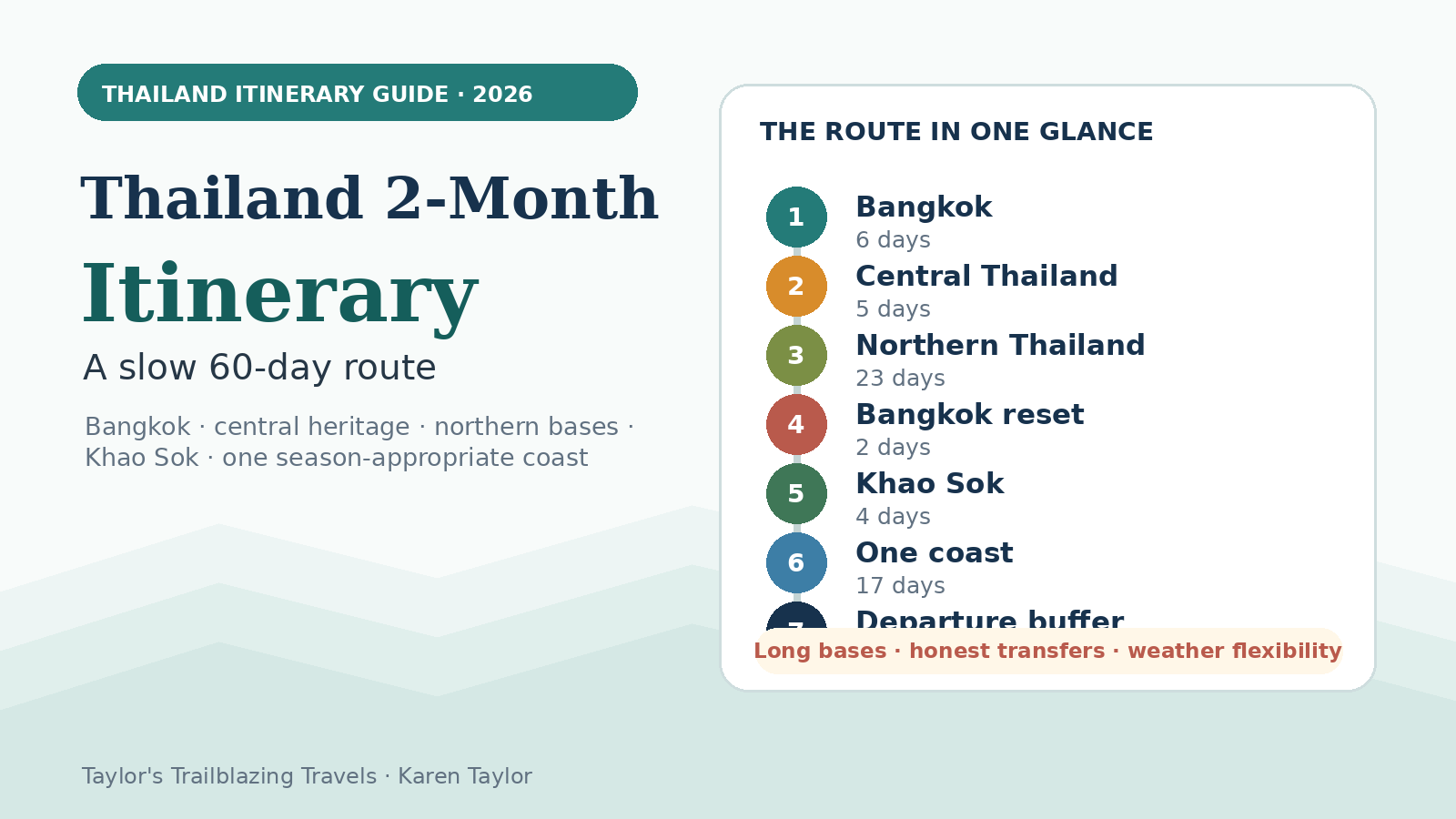
A realistic first-timer route through Bangkok, central Thailand, the north, rainforest and one season-appropriate southern coast.
Affiliate disclosure
This guide contains carefully selected affiliate links. If you book through one of them, Taylor’s Trailblazing Travels may earn a commission at no extra cost to you. Links appear only where they help you compare a transport leg, a suitable activity or travel-day connectivity.
A two-month trip creates a rare luxury: enough time to slow down. It also creates a planning trap. Once sixty days appear on a calendar, it is tempting to add every city, island and mountain town that looks interesting. The result can still feel rushed, because moving every three nights means packing, checking out, waiting for transport and learning a new neighbourhood twenty times.
A 60-day route may be longer than the entry permission granted to some travellers. Check the official Thai e-Visa or immigration rules for your nationality and travel dates before booking.
This Thailand 2 month itinerary takes the opposite approach. It uses six substantial bases, four shorter transitions and a final departure buffer. Bangkok gets time to become more than an airport stop. Chiang Mai becomes a temporary home rather than a four-temple checklist. Khao Sok is treated as a rainforest stay, not a photograph between two vans. Most importantly, the southern section follows one coast that suits the dates instead of forcing an expensive cross-country island collection.
The route is written for independent travellers who want structure without booking every breakfast. Real journey times include stations, luggage, waiting and hotel transfers. Prices are planning ranges rather than promises, and the sections that can change—entry rules, weather, air quality, transport schedules and marine conditions—are linked to current official or direct sources.
A realistic Thailand 2 month itinerary spends 60 days across Bangkok, Kanchanaburi, Ayutthaya, Chiang Mai, Pai, Chiang Rai, Sukhothai, Khao Sok and one southern coast. Use long bases of six to ten nights, count transfer days honestly, choose the Andaman or Gulf islands according to the season, and return to Bangkok for the final three days. A sensible mid-range land budget is roughly 228,000-330,000 baht for one person before international flights, depending on room style, domestic flights and tours.
Route length
Exactly 60 days, including arrival, every transfer and a three-day international-flight buffer.
Best pace
Five to ten nights in major bases, with short heritage stops only where a longer stay is unnecessary.
Best season
November to February is simplest, although northern air quality and coast conditions still need live checks.
Choose one coast
Use the Andaman or lower Gulf section, not both, unless the south is the main purpose of the whole trip.
Book first
Entry-critical documents, international flights, scarce sleeper berths, special stays and limited holiday dates.
Keep flexible
Marine tours, mountain viewpoints and at least one half-day in every long base.
The complete Thailand 60-day route at a glance
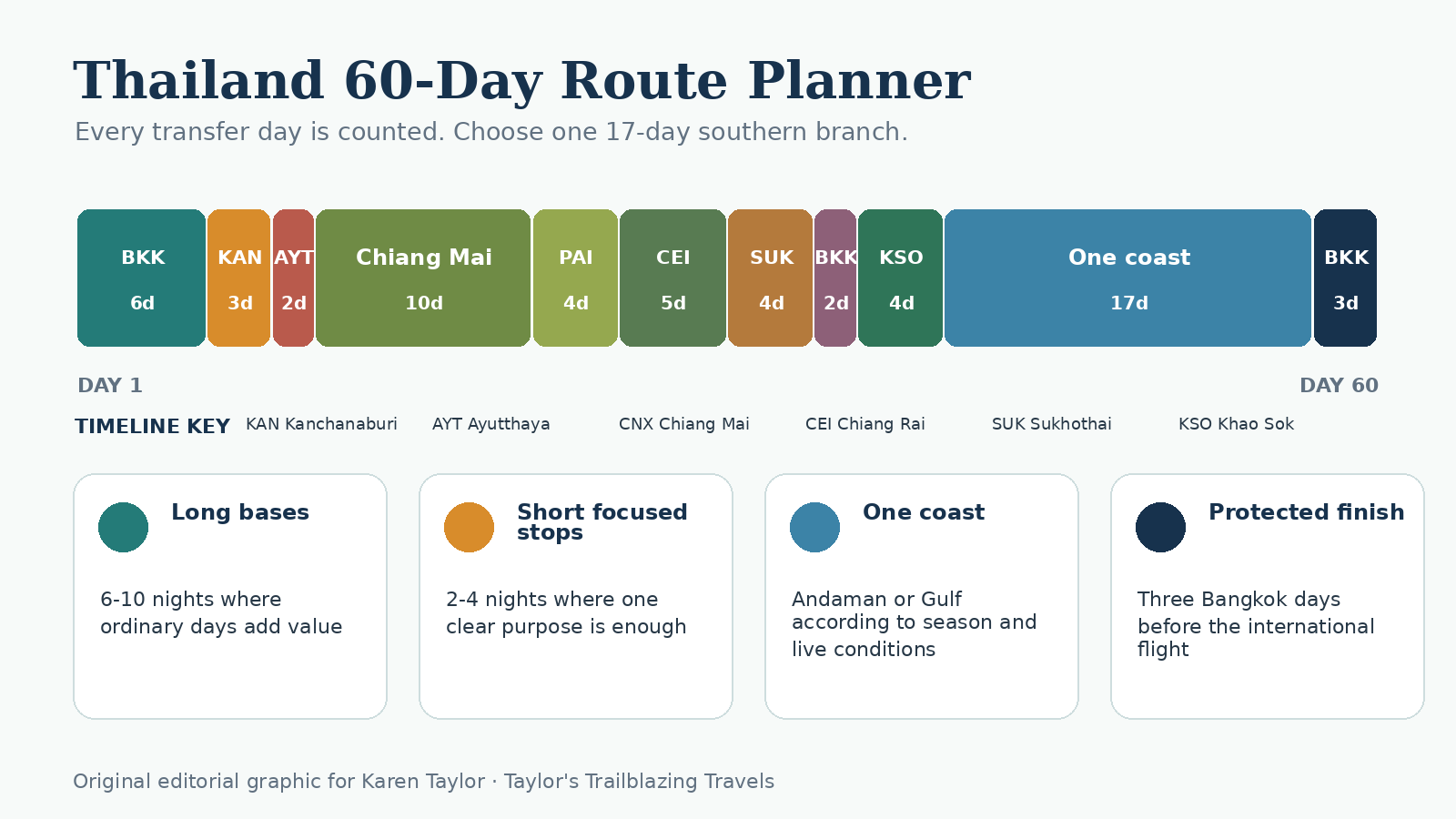
The itinerary below adds to exactly sixty days. Arrival days and transfer days are included rather than hidden between destinations. The southern block offers two alternatives of the same length, so choosing the Gulf instead of the Andaman does not change the total.
| Days | Base | Nights | Main purpose | Key planning note |
|---|---|---|---|---|
| 1-6 | Bangkok | 6 | Arrival, neighbourhoods, temples, food and recovery | Keep Day 1 light and avoid a prepaid evening |
| 7-9 | Kanchanaburi | 3 | River history, slower scenery and one nature day | Choose town or riverside seclusion deliberately |
| 10-11 | Ayutthaya | 2 | UNESCO temple landscape and a quieter evening | One overnight is better than a rushed same-day loop |
| 12-21 | Chiang Mai | 10 | Old City, markets, day trips, food and ordinary local days | Shorten or replace this block when smoke is severe |
| 22-25 | Pai | 4 | Mountain scenery and a genuine change of pace | The road is winding; do not plan a major activity on arrival |
| 26-30 | Chiang Rai | 5 | Temples, tea country and slower northern day trips | Use a driver or tour selectively rather than every day |
| 31-34 | Sukhothai | 4 | Historic park, cycling and a lower-north transition | Stay near the park for atmosphere or New City for transport |
| 35-36 | Bangkok | 2 | Laundry, admin, repacking and southbound reset | This is functional breathing room, not wasted time |
| 37-40 | Khao Sok | 4 | Rainforest, lake experience and recovery | Confirm whether pickup is from the village or lake pier |
| 41-57 | One southern coast | 17 | Two or three beach bases with flexible sea days | Choose Andaman or Gulf according to live conditions |
| 58-60 | Bangkok | 3 | International-flight buffer, shopping and departure | Sleep in Bangkok before the long-haul flight |
What is deliberately not included
Phuket, Krabi, Koh Samui, Koh Phangan and Koh Tao do not all appear in the same version. Neither do Mae Hong Son, Lampang, Nan, Isan, Trat and every national park. Leaving good places out is what makes the places you keep enjoyable. A two-month trip is long enough to go slowly, but it is not long enough to cover Thailand without compromise.
The route also avoids a border run. Entry permission is a legal and practical matter, not an itinerary attraction. Check the rules for your own passport before buying non-refundable bookings and use the official immigration or embassy route when a visa or extension is needed.
Back to contents · Back to top
Why this slow Thailand itinerary works
The route follows a broad north-to-south story, but it does not insist on a perfect straight line. Bangkok appears three times for different reasons: arrival recovery, a practical reset before the south and protection before the international flight. Those returns may look inefficient on a map. In real life, they simplify luggage, transport choices and the final connection.
Long bases create better days
Ten nights in Chiang Mai does not mean ten consecutive sightseeing days. It means a temple morning, a market evening, a mountain day, a cooking class or café day, laundry, illness recovery, a quiet afternoon and room for a place you discover after arrival. The same principle applies at the coast. A seventeen-day beach block is not excessive when two rain days, a transfer, a rest day and several ordinary swims are part of the plan.
Short stays have one clear job
Ayutthaya and Kanchanaburi are not miniature versions of Bangkok. Each stop earns its place through a distinct experience. Ayutthaya provides a concentrated historic landscape; Kanchanaburi adds river history and access to green scenery. Four nights in Sukhothai allows the historic park to be visited without turning the lower north into another frantic checklist.
The south remains flexible
The strongest decision in this itinerary is choosing one coast late enough to use credible weather information. A sunny marketing photograph does not change monsoon winds, ferry disruption or the fact that marine conditions can vary sharply from one week to the next. The route therefore reaches Khao Sok first, then branches west or east.
Karen’s pacing test
Before adding a stop, write down the checkout time, journey to the terminal, waiting time, main journey, local transfer, check-in and first meal. When a three-hour ticket consumes seven hours of the day, ask whether the new base offers enough value to justify packing again. This test removes more weak stops than any list of “must-sees”.
The final buffer protects the expensive ticket
An island ferry, domestic flight and international departure should not form one fragile chain. Separate tickets usually offer no protection when the first operator is delayed. Returning to Bangkok for Days 58-60 protects the long-haul flight, creates space for shopping and gives you a place to solve luggage or document problems before departure.
Back to contents · Back to top
Entry rules before planning a 60-day Thailand stay
A sixty-day route sits close to the limit of common visitor permissions, so entry rules must be checked before the route is treated as final. They vary by nationality, passport type and purpose of travel. Airline staff and immigration officers use the rules that apply on the actual date, not the version remembered from a previous holiday.
Current position for British citizen passport holders
When this guide was checked on 22 August 2026, UK government guidance said British citizen passport holders arriving for tourism could receive permission to stay for 60 days and could apply to extend that stay by up to 30 days. The same guidance said the passport should have at least six months remaining and at least one blank page. It also required the Thailand Digital Arrival Card to be completed within the three days before arrival. [1] [2]
That does not mean every traveller receives the same permission. Check your passport against the official Thai eVisa or embassy information and keep proof of onward travel, accommodation and sufficient funds available if requested. [3]
Do not use the itinerary as an immigration calculation
“Sixty days” in an article and the date stamped or recorded by immigration are not interchangeable. Count the actual permitted period shown on entry. If arrival or departure dates change, recalculate immediately. Overstaying can lead to fines and more serious consequences, so the final flight should sit comfortably inside the authorised stay.
| Check | When | What to save | Why it matters |
|---|---|---|---|
| Passport validity and blank page | Before booking | Passport scan stored securely | Airline boarding and Thai entry requirements |
| Visa-free or visa requirement | Before booking | Official rule for your nationality | Determines the legal trip length |
| Thailand Digital Arrival Card | Within the official pre-arrival window | Submission confirmation | Required arrival information |
| Onward flight | Before departure | Offline ticket confirmation | May be requested by airline or immigration |
| Insurance wording | Before paying large balances | Policy and emergency contact details | Two months creates more exposure than a short holiday |
| Permission granted on arrival | At the airport | Photograph or note of the permitted date | This date controls the final departure |
Practical safeguard
Build the itinerary as 59 nights and 60 calendar days, then check the actual flight dates against the permission granted. Do not assume an extension will be automatic, and do not create a last-day international departure that leaves no room for a date misunderstanding.
Back to contents · Back to top
Choose the route for your month, not for a generic weather chart
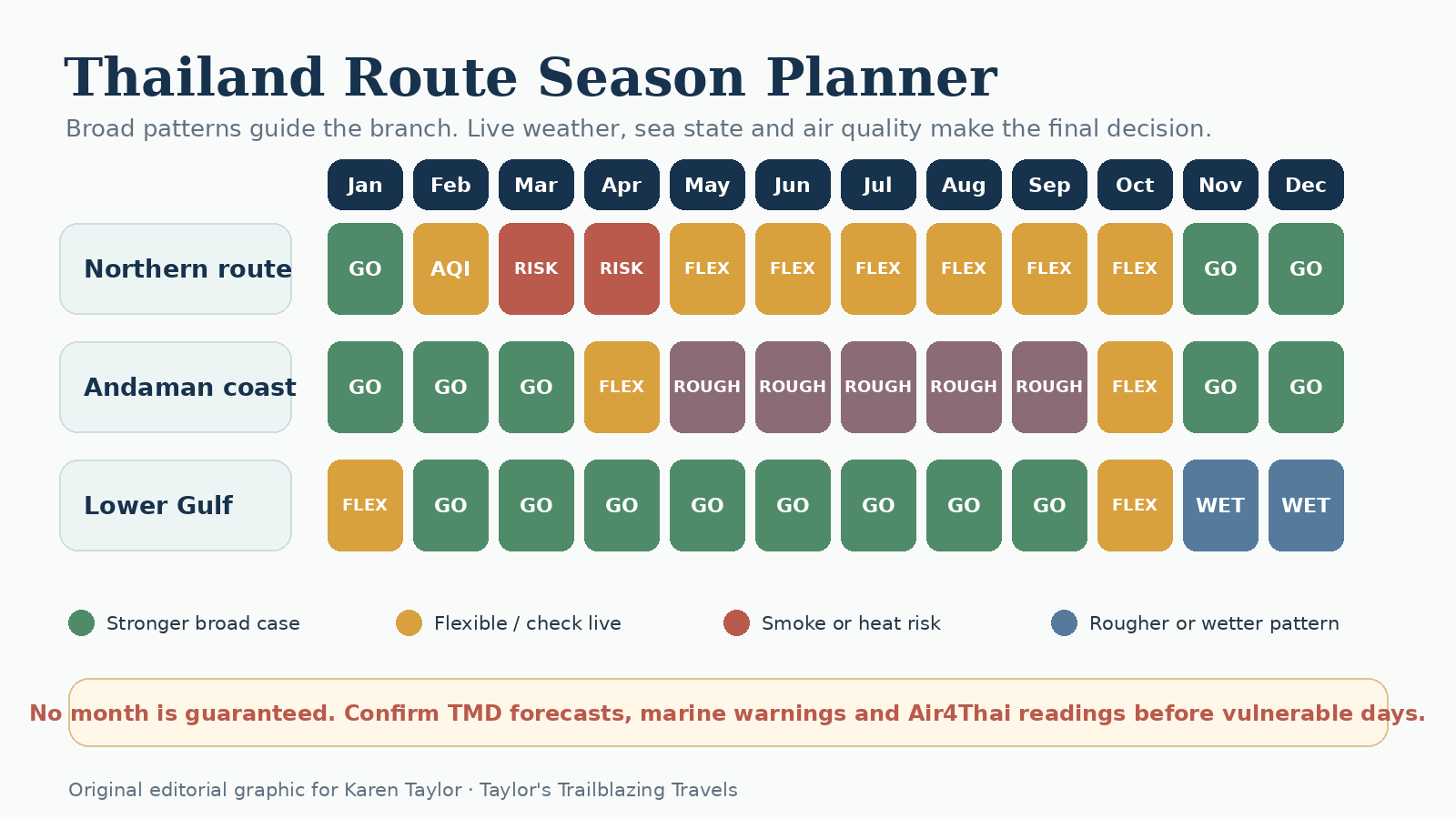
Thailand does not have one national beach season. The Andaman coast and lower Gulf can experience different rainfall and sea patterns, while northern Thailand has a separate air-quality problem that can outweigh a comfortable temperature forecast. Use long-range patterns to choose a broad route, then use current forecasts, marine warnings and air-quality readings for the final decision.
| Travel period | Northern section | Southern preference | Best adjustment |
|---|---|---|---|
| November to January | Usually the easiest period for the full northern route, although cool mountain nights are possible | Andaman often has the clearest planning case; Gulf conditions still need checking | Keep the standard route and book high-demand holiday dates early |
| February | Start in the north when possible and watch air quality daily | Andaman commonly remains attractive | Keep a refundable alternative if haze builds earlier than expected |
| March to April | Heat and smoke can make the long northern block a poor choice | Coast choice depends on live marine conditions and heat tolerance | Replace Pai and Chiang Rai with central, eastern or southern bases |
| May to June | Greener landscapes and lower crowds, with increasing rain | Consider the Gulf, but do not treat any island as rain-proof | Book flexible ferries and avoid stacking prepaid boat days |
| July to September | Rain is part of the trip; road and waterfall conditions matter | Lower Gulf often has the stronger broad pattern than the Andaman | Use Samui, Phangan and Tao with weather buffers |
| October | Transitional and changeable | Both coast plans require caution | Keep the final 17-day block flexible until close to travel |
Northern smoke season needs a replacement plan
Air quality in Chiang Mai, Pai and Chiang Rai can deteriorate during the burning season, often in the late dry season. The exact timing and severity change each year. A two-month traveller should not simply hope that ten prepaid northern nights will be comfortable. Check the Pollution Control Department’s Air4Thai readings and local health advice, then be willing to shorten the north.
A sensible replacement keeps the character of the route varied. Add more time in Kanchanaburi, Sukhothai, Bangkok neighbourhoods, the eastern seaboard or the chosen southern coast. Moving from Chiang Mai to another northern valley rarely solves a regional haze event.
Marine weather controls more than boat tours
Rough conditions can affect ferries, snorkelling visibility, pier choice and the comfort of a transfer with luggage. The Thai Meteorological Department provides provincial forecasts and marine information for Chiang Mai, Krabi and Surat Thani. [4] [5] [6] Check these sources again shortly before any vulnerable journey.
Do not schedule every good-weather day in advance
At each coast, reserve one or two high-priority marine experiences with flexible terms, then leave several days open. A calm morning may be better used for a boat trip than the date selected six weeks earlier. Conversely, a windy day is not wasted when the base offers cafés, cooking, massage, walking, markets or a comfortable place to read.
Back to contents · Back to top
Days 1-6: Bangkok without treating it as a waiting room
Six nights is enough to recover from the flight, understand the transport system and experience several versions of Bangkok without crossing the city for every meal. Choose a base near BTS or MRT unless the riverside or Old Town is the main reason for the stay.
Day 1: arrive and protect your energy
Check in, buy water, eat near the hotel and take a short walk. Do not book a dinner cruise, rooftop slot or non-refundable evening tour after a long-haul arrival. Immigration queues, baggage and traffic can turn a scheduled afternoon landing into a late hotel arrival.
Day 2: learn the neighbourhood and one transport line
Use the first full morning for the immediate area, a market or a simple riverside route. Learn how to reach the nearest rail station and how long the walk feels in heat. That knowledge makes every later day easier than beginning with a multi-transfer itinerary.
Day 3: Old Town and major temples
Visit the Grand Palace area, Wat Pho and the river with an early start, modest clothing and a midday rest. The strongest version of this day chooses two or three major sights rather than trying to complete every temple between breakfast and sunset.
Day 4: modern Bangkok
Use the BTS or MRT for a contrasting day around Siam, Lumphini, Benjakitti, Chinatown, Ari or another district that suits your interests. A two-month trip does not require every Bangkok day to be a headline attraction. An ordinary lunch, a park and a neighbourhood walk help the city become legible.
Day 5: guided experience or focused interest
This is a good place for a small-group food tour, canal trip, cooking session or carefully chosen cultural experience. Select one activity that would be difficult to organise independently, then keep the rest of the day light.
Optional Bangkok tours
For a first visit, a well-matched guided food, canal or temple experience can add context without controlling the whole Bangkok stay. Compare the start point, group size, duration, inclusions and cancellation terms before booking.
Day 6: flex day and Kanchanaburi preparation
Use the final Bangkok day for laundry, a missed neighbourhood, shopping or rest. Confirm the departure point for Kanchanaburi and allow for the fact that Bangkok terminals can be a substantial journey from the hotel.
Where to stay in Bangkok
| Area | Best for | Main advantage | Trade-off |
|---|---|---|---|
| Sukhumvit near BTS/MRT | First-time visitors who prioritise easy transport | Strong rail access, food and services | Less historic atmosphere and heavy traffic at street level |
| Silom or Sathorn | Rail access, food and a calmer business-district base | BTS/MRT options and good onward connections | Some streets become quiet outside business hours |
| Riverside | Views, slower evenings and river transport | Distinctive setting and easy boat access | Hotels can be expensive and rail access varies |
| Old Town | Temples and historic Bangkok | Walkable access to major heritage sights | Less convenient for much of modern Bangkok |
| Ari | Cafés and a more residential feel | Relaxed base on the BTS line | Farther from the river and Old Town |
Back to contents · Back to top
Days 7-9: Kanchanaburi for river history and breathing room
Kanchanaburi adds a quieter landscape before the northern route. Three nights allow one history-focused day, one nature or river day and a departure morning without turning the stop into a rushed excursion from Bangkok.
Day 7: travel from Bangkok and settle in
Current route listings commonly place the road or rail journey at roughly two and a half to four hours before hotel transfers, depending on the service and departure point. [8] Leave Bangkok in the morning, arrive for lunch and use the afternoon for the River Kwai Bridge area, riverside walking or the local museum that best matches your interests.
Compare Bangkok to Kanchanaburi transport
Trains, buses, vans and private vehicles can start from different parts of Bangkok. Compare the real departure point, luggage rules and arrival location rather than choosing only by the headline journey time.
Day 8: history with enough time to absorb it
Choose a coherent historical route rather than collecting every wartime site. A museum, cemetery and bridge or railway section can fill a meaningful day. Read the interpretation carefully and allow quiet time; these places are not simply photo stops.
Day 9: nature day or slow riverside day
Erawan National Park is the obvious active choice, but it involves road time, heat, steps and seasonal water conditions. An alternative is a slower river day, a local cave or a smaller excursion from town. The better option is the one that leaves enough energy for the next transfer.
Town centre or floating river stay?
Stay in or near town when independent food, museums and onward transport matter. Choose a remote river property when the accommodation itself is the experience and you are comfortable using its meals and transfers. A beautiful isolated room can become restrictive when every journey requires a boat or arranged vehicle.
Practical check before booking
Ask the property for the complete transfer instructions, latest arrival time, meal availability and the cost of returning to town. “Kanchanaburi” in a hotel listing can describe a very wide area.
Back to contents · Back to top
Days 10-11: Ayutthaya as an overnight heritage stop
Ayutthaya can be visited from Bangkok, yet an overnight stay changes the pace. Arrive after Kanchanaburi, see a smaller cluster in the late afternoon, then begin the main temple route before day visitors and the strongest heat arrive.
Day 10: Kanchanaburi to Ayutthaya
This transfer is less straightforward than the map suggests. Direct services can be limited, while changing through Bangkok or using a private vehicle may be simpler. Compare the complete journey and avoid assuming two famous central-Thai destinations are linked by a frequent tourist shuttle.
After checking in, choose one nearby ruin, the riverfront or the night market rather than trying to start a full temple circuit. The UNESCO-listed historic city is a landscape, not one monument. [15]
Day 11: early temple circuit and northbound departure
Begin with the monuments that matter most to you, then move outward. Bicycles suit confident riders in cooler conditions; tuk-tuks or a hired car reduce heat exposure and save time between wider sites. Keep bags at the accommodation or station only after confirming the closing time and collection arrangement.
The cleanest onward move is an evening or overnight journey towards Chiang Mai. Current route results show direct train and bus choices, with overnight rail services taking roughly twelve hours and some buses taking around eight and a half hours before local transfers. [9] A lower sleeper berth is useful when available, but the timetable and arrival hour matter more than the romance of the train.
Compare Ayutthaya to Chiang Mai transport
Check whether the service is direct, the exact station or terminal, the seat or berth class, arrival time and cancellation conditions. An overnight ticket should save a hotel night without destroying the first Chiang Mai day.
Why two days is enough here
This itinerary returns to historic landscapes in Sukhothai, so Ayutthaya does not need four nights. The overnight stop provides a different atmosphere and a logical northbound connection without borrowing too much time from Chiang Mai.
Back to contents · Back to top
Days 12-21: ten nights in Chiang Mai
Chiang Mai is the emotional centre of this slow route. Ten nights create space for the Old City, markets, food, mountain scenery and ordinary days when the only plan is a café, laundry and dinner. That mix is more useful than ten separate day tours.
Days 12-13: arrive, recover and learn the Old City
After an overnight journey, make Day 12 deliberately small. Check in, eat, walk one manageable section of the moat and sleep. Use Day 13 for an Old City temple route, but select a few temples with contrasting architecture or history rather than entering every compound on the map.
Day 14: Doi Suthep and the western city
Visit Doi Suthep early or later in the day, allowing for road time and steps. Pair it with one western-city stop such as Nimman, the university area or a quiet café. Combining the mountain with a distant eastern or riverside plan creates unnecessary crossing.
Day 15: market, food or cooking day
A market visit or cooking class makes sense here because you already know the base and are not immediately travelling again. Check whether a class includes transport, market time, dietary adaptations and a realistic finish rather than choosing by the number of dishes alone.
Day 16: completely free
This day is part of the itinerary. Use it for laundry, a long breakfast, a haircut, admin, a massage or a place discovered during the first four days. Long travel becomes tiring when every blank square is treated as a planning failure.
Day 17: choose one major day trip
Doi Inthanon offers altitude, viewpoints, waterfalls and a long road day. Mae Kampong offers a village setting and a different pace. An ethical nature experience or a specialist interest tour may suit another traveller better. Choose one major outing now and keep a second option for later only if energy and conditions justify it.
Compare Chiang Mai day trips
Use a tour when the destination is awkward without a car or when a guide adds meaningful context. Compare the actual pickup zone, group size, walking level, entrance fees, meal arrangements and return time.
Day 18: neighbourhood day
Spend time beyond the Old City. Nimman is convenient for cafés and modern Chiang Mai; Wat Ket and the riverside feel different again. The goal is not to decide which district is “best”, but to experience how the city changes when you stop commuting to the same temple cluster.
Day 19: second flexible experience
Choose a second day trip, craft session, food experience or gentle local day according to what the first week revealed. This is also the day to abandon an attraction that no longer appeals. A slow itinerary should become more personal as it progresses, not remain a contract written before departure.
Day 20: markets and evening atmosphere
Align the route with the Saturday or Sunday walking street when possible, but do not distort the whole trip for one market. Arrive early, carry small notes and expect crowding. If markets are not enjoyable, use the evening for a neighbourhood meal or riverside walk instead.
Day 21: Pai preparation and quiet finish
Pack lightly for the Pai section if the Chiang Mai property can store a larger case safely. Confirm the minivan departure point and motion-sickness strategy. The road is famous for bends, so the cheapest or latest service is not automatically the most comfortable.
Best Chiang Mai areas for a ten-night stay
| Area | Best for | Advantages | Limitations |
|---|---|---|---|
| Old City | First visits, temples and walkable mornings | Central heritage base with abundant food | Traffic and tourist concentration vary by street |
| Tha Phae and east of the moat | Markets, nightlife and easy pickups | Convenient for many tours and evening plans | Can be busy and noisy |
| Nimman | Cafés, remote work and modern amenities | Strong food, coffee and serviced-apartment choice | Aircraft noise and less historic atmosphere |
| Riverside or Wat Ket | Slower evenings and more space | Distinctive setting away from the busiest lanes | More transport needed for Old City days |
| Santitham | Longer stays and local food | Often better value near Nimman and the north moat | Street-by-street walkability varies |
Smoke-season replacement
When air quality is poor, do not keep the full ten-night commitment because the room is non-refundable. Protect health first and reduce outdoor exertion. A replacement could add four nights to Bangkok, three to Kanchanaburi and three to the coast, or substitute another region after checking its current conditions.
Back to contents · Back to top
Days 22-25: Pai without turning the mountain road into a race
Pai divides travellers. Some enjoy the scenery, cafés and relaxed rhythm; others find the centre too tourist-oriented. Four nights is enough to settle, explore selectively and leave without pretending it represents all of northern Thailand.
Day 22: travel slowly and do very little
Current Chiang Mai-Pai listings commonly show minivan journeys of around four to four and a half hours, with fares starting near 330 baht at the time checked. [10] The winding road can make a nominally short transfer tiring. Book an earlier service, keep water and medication accessible and avoid a sunset tour on arrival day.
Compare Chiang Mai to Pai transport
Look beyond the departure time. Check the pickup point, vehicle type, luggage allowance, arrival area and recent traveller feedback. A private transfer can become reasonable for a group that values stops and reduced waiting.
Day 23: local circuit with a safe transport choice
Use a reputable driver, organised small tour or suitable rental vehicle if you are legally qualified and genuinely experienced. Do not learn to ride a scooter on mountain roads because the destination appears relaxed. Choose a manageable circuit of viewpoints, hot springs, cafés or natural stops rather than a dawn-to-dark list.
Day 24: one slow day
Walk, read, eat and let Pai be a small town rather than an activity hub. Remote accommodation may provide atmosphere, but check how you will reach dinner after dark. A central stay is often easier for solo travellers and anyone who does not drive.
Day 25: flexible morning and return or onward move
This itinerary continues towards Chiang Rai. Direct transport can be limited or indirect, so compare returning through Chiang Mai with any through service available on the date. A private vehicle can reduce friction for two or more travellers, but a very long mountain day still needs breaks.
Skip Pai when the road or atmosphere does not suit you
Use the four nights in Chiang Mai, Lampang, Mae Kampong or another base instead. An itinerary is not weakened by removing a famous stop that conflicts with motion sickness, road anxiety, air quality or personal interests.
Back to contents · Back to top
Days 26-30: Chiang Rai for temples, tea country and slower northern days
Five nights makes Chiang Rai more than a quick White Temple excursion. The city itself is manageable, while the wider province rewards selective day trips. Choose quality over distance; the Golden Triangle, mountain viewpoints, tea plantations and major temples cannot all be experienced properly in one day.
Day 26: arrive and use the city centre
Check in near the night bazaar, clock tower or a quieter central district, then keep the day local. Learn the bus terminal and organise the one or two excursions that truly need a driver.
Day 27: contemporary temple day
Combine the White Temple with no more than one or two other major sites. Their artistic details deserve time, and transport between them adds up. A private driver may offer the most control for a couple or group, while a small tour can be better for a solo traveller.
Day 28: tea country or Doi Tung
Choose a focused mountain route. Check travel time, road conditions and what the visit actually includes. A viewpoint-heavy day can disappoint in haze or low cloud, so keep an alternative city plan.
Day 29: free or Golden Triangle day
The Golden Triangle is worthwhile when border history and the wider Mekong region interest you. It is less compelling when the goal is simply to stand beside a sign. A free city day, local museum or café route may add more to a long trip.
Day 30: rest and prepare for Sukhothai
The journey to Sukhothai is long enough to shape the day. Buy food, confirm the terminal and avoid booking a late non-refundable arrival activity. Current route results indicate limited direct options and a journey commonly around seven to eight hours. [11]
Compare Chiang Rai to Sukhothai transport
Check whether the service is direct, which Sukhothai terminal it uses and how you will reach Old Sukhothai or New City after arrival. A change that looks minor can add hours when the connection is infrequent.
Back to contents · Back to top
Days 31-34: Sukhothai and the lower north
Sukhothai provides a calm transition after the mountain loop. The UNESCO World Heritage property includes the historic town and associated towns, so the experience is broader than one photogenic Buddha image. [16] Four nights allow the central zone, a quieter outer area and a recovery day before returning south.
Day 31: long arrival day
Treat the Chiang Rai-Sukhothai journey as the day’s main event. Check whether the accommodation is near New Sukhothai, Old Sukhothai or the historic park because those labels affect the final transfer. Eat locally and postpone the cycle route until morning.
Day 32: central historic park
Start early and use a bicycle, electric option or suitable local transport according to heat and mobility. The central monuments are the natural first focus, but leave room to stop rather than chasing every numbered ruin. Carry water and respect protected areas and temple etiquette.
Day 33: outer zones or Si Satchanalai
Choose one broader history day. The outer zones offer a quieter extension, while Si Satchanalai requires more transport and deserves a deliberate visit. A driver can make the day efficient, although a slow morning near the main park may be more valuable after several long northern moves.
Day 34: free morning and southbound preparation
Use the final day for an easy ride, museum, café or pool. Confirm the route back to Bangkok. Depending on the current schedule, this may be a bus, a flight from Sukhothai or Phitsanulok, or a rail connection after a road transfer. Compare the complete hotel-to-hotel chain.
Old Sukhothai or New Sukhothai?
| Base | Best for | Advantages | Limitations |
|---|---|---|---|
| Old Sukhothai | Early park access, cycling and quiet evenings | Less transport before the main historic visit | Fewer city services and some restaurants close early |
| New Sukhothai | Bus access, local food and practical services | Easier terminal connections and broader everyday facilities | Requires transport to the historic park |
| Resort outside both | Pool time, space and a retreat atmosphere | Comfortable recovery after the northern loop | Meals and transport may depend on the property |
Back to contents · Back to top
Days 35-40: Bangkok reset and Khao Sok rainforest
The middle Bangkok return may look unadventurous, yet it improves the whole trip. Two nights provide reliable laundry, repacking, medicine or equipment replacement and a choice of southbound transport. Then four nights in Khao Sok create a genuine rainforest section before the coast.
Days 35-36: practical Bangkok reset
Stay near the airport, rail connection or departure terminal that suits the next leg rather than automatically returning to the opening neighbourhood. Use one day for admin and one for a Bangkok experience missed earlier. This is also the right point to reduce luggage, collect stored items or change the southern plan after checking the weather.
Day 37: travel to Khao Sok
Overland routes from Bangkok are long. Current listings commonly show overnight bus or train-and-van combinations of roughly fifteen and a half to seventeen hours, while flying to Surat Thani and continuing by road can reduce time but adds an airport chain. [12] Choose by complete cost, arrival hour and sleep quality.
Compare Bangkok to Khao Sok routes
Check whether the destination is Khao Sok village, a hotel pickup, Surat Thani or the lake pier. The words “Khao Sok” can hide a significant final road transfer, so confirm the exact endpoint before paying.
Day 38: village and national-park day
Use the first full day for the village side: a guided walk, river activity or a quieter forest day that fits the weather. Khao Sok’s value lies in the rainforest environment rather than completing a fixed attraction list. Tourism Authority information describes the area as a major nature destination with rainforest, limestone scenery and Cheow Lan Lake. [17]
Day 39: Cheow Lan Lake experience
A lake day or overnight is one of the route’s major experiences, but the logistics vary. Ask where transport begins, whether park and pier fees are included, what luggage can be taken, the bathroom arrangement, meal provision and whether the accommodation is basic or comfort-focused. Do not infer luxury from a dramatic photograph.
Day 40: recovery and coast decision
Keep the final day flexible. A late return from the lake, heavy rain or an early coast departure can make a packed schedule unrealistic. Use this day to confirm the current ferry or road chain and decide between the Andaman and Gulf branch.
Village stay, lake stay or both?
| Format | Best for | Advantages | Trade-offs |
|---|---|---|---|
| Village only | Flexibility, lower cost and rainforest activities | Easy food choice and simpler onward transport | Misses the overnight lake atmosphere |
| Lake day trip | Travellers wanting scenery without rustic overnight conditions | Returns to a normal room and full luggage | Long day and less quiet time on the water |
| One village night plus lake overnight | Most first-time visitors with four days | Combines both environments | More luggage handling and package dependence |
| Two lake nights | Nature-focused travellers comfortable with isolation | Slower lake rhythm and more dawn/evening time | Facilities and communication may be limited |
Back to contents · Back to top
Days 41-57: Andaman coast option
Choose the Andaman branch when Krabi and nearby marine conditions suit the dates. The route uses Ao Nang or Krabi as the practical first base, Koh Lanta as the slower island stay and an optional final mainland or near-airport base. It does not add Phuket merely because Phuket is famous.
Days 41-46: Ao Nang or Krabi area – six nights
Current Khao Sok-Krabi listings commonly place the road journey at roughly three to five hours, depending on pickup and operator. [13] Ao Nang is convenient for boats, restaurants and tours; Krabi Town has a more local city rhythm; Railay has dramatic scenery but requires a boat for every arrival and departure.
Compare Khao Sok to Krabi transport
Confirm whether pickup is from the village, a lake-area property or Surat Thani, and whether the final drop is Ao Nang, Krabi Town or a transfer point. A cheap ticket that ends at the wrong place can create another paid journey.
Use the six nights for one island or snorkelling day, one Railay day, one inland or cultural day, two easy beach or neighbourhood days and a weather buffer. Avoid booking three consecutive marine tours. Similar limestone scenery feels less special when every morning begins with another early pier transfer.
Ao Nang versus Railay versus Krabi Town
| Base | Best for | Advantages | Limitations |
|---|---|---|---|
| Ao Nang | First visits, tours and easy dining | Broad hotel choice and simple boat access | Busy, commercial and not the region’s prettiest beach |
| Railay | Scenery, climbing and a resort-like stay | Distinctive limestone setting without road traffic | Boat-dependent, pricier and awkward with luggage |
| Krabi Town | Local food, value and mainland practicality | Markets, services and easier road transport | Not a beach base |
| Klong Muang or Tubkaek | Quiet resorts and couples | Calmer atmosphere and attractive views | Fewer independent restaurants and higher transfer reliance |
Days 47-54: Koh Lanta – eight nights
Koh Lanta earns a long stay because it supports ordinary beach days as well as tours. Select the coast section carefully. Long Beach and Klong Dao are convenient for first visits; farther south becomes quieter and more spread out. Confirm how you will reach dinner and whether the hotel area remains active in the travel month.
Use the eight nights for two active days, several beach days, a local exploration day and one complete rest day. Boat trips, diving and snorkelling should depend on live marine conditions. Travellers who do not ride scooters should choose a base with walkable food or budget for taxis and arranged transport.
Days 55-57: choose one final Andaman base
Three nights can be spent in Khao Lak for mainland beach time and airport access, Phuket Town for food and heritage, or a convenient Phuket Airport area when the southbound flight schedule requires it. Koh Yao Noi is atmospheric but introduces another boat and therefore weakens the departure buffer unless conditions are stable.
Who should choose this branch?
The Andaman version suits travellers prioritising limestone scenery, Krabi, Koh Lanta and varied mainland access. It is strongest when marine services are operating normally and the final move back to Bangkok can be made with at least three days remaining.
Back to contents · Back to top
Days 41-57: Gulf islands option
Choose the Gulf branch when Samui, Phangan and Tao have the stronger seasonal case for your dates. The route uses Koh Samui as the practical arrival base, Koh Phangan for a slower middle section and Koh Tao only when snorkelling or diving justifies another ferry.
Days 41-46: Koh Samui – six nights
Joint Khao Sok-Samui routes combine road and ferry travel and commonly take roughly five to eight hours before the hotel transfer. [14] Confirm the pier, ferry operator, island arrival point and whether hotel delivery is included.
Compare Khao Sok to Koh Samui transport
A joint ticket can reduce coordination, but read the meeting instructions and missed-connection policy. Check whether the origin is Khao Sok village or a separate pickup point and whether the Samui ticket ends at the pier.
Samui is large enough to require an area decision. Bophut suits restaurants and evening walking; Chaweng offers the broadest activity and nightlife; Lamai is a middle ground; quieter north-western and southern areas work best when the resort itself is the plan. Airport and pier convenience should not override the atmosphere wanted for six nights.
Days 47-53: Koh Phangan – seven nights
Koh Phangan is more than one party. Haad Rin suits travellers seeking that scene, while the west and north coasts offer different beach and village rhythms. Check the lunar-event calendar even when you do not plan to attend, because accommodation and transport demand can affect the whole island.
Seven nights allow a flexible beach routine, a boat or snorkelling day, an inland or viewpoint day and weather recovery. Avoid choosing a remote bay without understanding road access, evening food and the cost of taxis.
Days 54-57: Koh Tao or extra Samui time – four nights
Koh Tao makes sense for diving, snorkelling and a smaller-island stay. It makes less sense when ferries are uncomfortable, the traveller dislikes boats or the onward flight requires another tight chain. In those cases, add the four nights to Samui and fly back to Bangkok more simply.
| Island | Best for | Suggested nights | Main caution |
|---|---|---|---|
| Koh Samui | Flight access, varied hotels and broad services | 6-10 | Large island; area choice changes the experience |
| Koh Phangan | Beach variety, wellness and a slower middle stay | 6-8 | Event dates can affect prices and availability |
| Koh Tao | Diving, snorkelling and compact island life | 4-6 | Another ferry and a less protected departure chain |
Who should choose this branch?
The Gulf version suits travellers who value island time more than Krabi’s mainland scenery and whose dates favour Samui-side conditions. Keep at least one flexible ferry day and return to Bangkok early enough to protect the international flight.
Back to contents · Back to top
Days 58-60: Bangkok departure buffer
Return to Bangkok by the end of Day 58. A morning flight from the coast is preferable when the domestic and international tickets are separate. If disruption would be financially serious, arrive on Day 57 instead and use one of the southern nights in Bangkok.
Day 58: mainland return and simple evening
Check in near a rail line or the airport that serves the long-haul flight. Eat close to the hotel and avoid an inflexible evening. Delayed ferries, tropical weather and domestic airline changes are inconvenient; they should not become international-ticket emergencies.
Day 59: shopping, laundry and document check
Use the final full day for gifts, luggage organisation, laundry, airline check-in and any required forms. Confirm the airport terminal, baggage allowance and departure time. Store passport, cards, medication and valuables in hand luggage rather than repacking them at the airport.
Day 60: departure
Leave the hotel with a Bangkok traffic margin, even when the rail connection appears straightforward. The goal is not to maximise the last morning. It is to finish a sixty-day trip calmly and within the immigration permission granted.
The non-negotiable rule
Do not travel from a small island to a separate-ticket long-haul flight on the same day. A smooth ferry timetable is not a guarantee against wind, mechanical problems, road traffic or an airline schedule change.
Back to contents · Back to top
The Thailand two-month route week by week
A day-by-day route becomes easier to understand when viewed as nine travel weeks. The final “week” is shorter because the trip ends on Day 60. This view also shows where recovery is built in and where a long transport day already consumes the available energy.
| Week | Days | Location | Rhythm | One thing not to overbook |
|---|---|---|---|---|
| Week 1 | 1-7 | Bangkok to Kanchanaburi | Jet-lag recovery, city orientation and one transfer | Arrival evening |
| Week 2 | 8-14 | Kanchanaburi, Ayutthaya and Chiang Mai | History, overnight transport and a gentle northern arrival | First Chiang Mai day after the sleeper |
| Week 3 | 15-21 | Chiang Mai | One major day trip, food, markets and ordinary local days | Several consecutive early starts |
| Week 4 | 22-28 | Pai and Chiang Rai | Mountain road, viewpoints and slower northern towns | Scooter-heavy plans without experience |
| Week 5 | 29-35 | Chiang Rai, Sukhothai and Bangkok | Long lower-north move, historic park and city reset | A prepaid Bangkok event after the transfer |
| Week 6 | 36-42 | Bangkok, Khao Sok and first coast base | Admin, rainforest and another long travel chain | A fixed boat trip on the first coast morning |
| Week 7 | 43-49 | First and second coast bases | One marine day, rest and a short island or road move | Daily tours with no sea-state flexibility |
| Week 8 | 50-56 | Second and optional third coast base | Deep beach stay, local routine and selective activities | Adding another island merely to fill the map |
| Final days | 57-60 | Coast to Bangkok and departure | Protected return, shopping, laundry and flight | A same-day island-to-long-haul connection |
How to use this table while travelling
At the start of each week, identify the immovable items: transport, a timed ticket or a weather-sensitive tour. Keep the remaining days loosely ordered. When heavy rain, tiredness or illness changes the plan, move the flexible activity rather than trying to “catch up” by doubling the next day.
The weekly view also helps with spending. A costly flight or guided lake stay may make one week expensive, while a long Chiang Mai or Koh Lanta stay can be comparatively economical. Judge the budget over the complete trip rather than forcing every day to cost the same.
Back to contents · Back to top
Transport strategy and the safest booking order
Thailand’s transport network makes this route possible, but each leg should be chosen for its function. Trains create an experience and can save a hotel night. Flights save time across the full length of the country. Vans solve regional connections. Private vehicles add value where schedules, luggage or several stops make shared transport awkward.
Transport plan by leg
| Leg | Default choice | Alternative | Planning buffer | Book when |
|---|---|---|---|---|
| Bangkok-Kanchanaburi | Train, bus or van | Private car for a group or remote hotel | Half a day | A few days ahead; earlier on holidays |
| Kanchanaburi-Ayutthaya | Private/shared road transfer or route via Bangkok | Separate local connections | Most of a day | Confirm before leaving Bangkok |
| Ayutthaya-Chiang Mai | Overnight sleeper train | Bus or Bangkok flight chain | Next morning light | As soon as the desired sleeper opens |
| Chiang Mai-Pai | Daytime minivan | Private car | Arrival afternoon free | Several days ahead |
| Pai-Chiang Rai | Through service if suitable or connection via Chiang Mai | Private driver | Full day | Check live options early in Chiang Mai |
| Chiang Rai-Sukhothai | Direct bus/van when operating | Connection or private car | Full day | Several days ahead |
| Sukhothai-Bangkok | Flight or long-distance bus | Road transfer to Phitsanulok rail | Most of a day | Flight early; bus moderately early |
| Bangkok-Khao Sok | Flight to Surat Thani plus van | Overnight bus or train-plus-van | Do not prebook arrival-night activity | Flight/sleeper early; van after main ticket |
| Khao Sok-coast | Shared van or joint road/ferry ticket | Private transfer | One unstructured arrival day | Several days ahead after weather check |
| Coast-Bangkok | Direct flight where practical | Train or bus with extra day | Two full nights before long-haul departure | Book once coast branch is chosen |
Use the State Railway booking window intelligently
The State Railway of Thailand’s current online terms allow eligible reservations from three hours up to 180 days before departure. [7] That does not mean every service or class appears exactly 180 days ahead. Search the specific train, confirm the station and use the official D-Ticket platform or a trusted comparison service.
Lower second-class berths and private cabins can sell out around holidays and weekends. An upper berth may be cheaper but feels more enclosed and is generally narrower. When sleep matters, choose the berth you can tolerate rather than treating any sleeper as interchangeable.
Book in dependency order
- Confirm passport, entry permission and international flights.
- Choose the broad travel month and the likely coast branch.
- Reserve scarce transport such as a preferred sleeper berth or high-demand domestic flight.
- Book the first Bangkok stay, special rainforest or island accommodation and holiday-period rooms.
- Add ordinary city accommodation with flexible cancellation where the route may change.
- Book regional vans and ferries after the major dates are secure and live weather information becomes useful.
- Add tours selectively, keeping weather-sensitive experiences movable or refundable.
Compare the complete transport basket
A low-cost flight may need checked baggage, seat selection, airport rail or taxi and a long final transfer. The sleeper option can replace one hotel night but may require a shower room after arrival. Private transport sometimes looks expensive per vehicle yet becomes competitive for four travellers with large luggage. Price the complete day, not the first number on the results screen.
Protect separate tickets
When transport is sold as separate contracts, leave enough time to collect luggage, change terminals and absorb delays. Do not assume the second operator will rebook you because the first service was late. This matters most at Surat Thani, island piers and Bangkok’s two major airports.
Back to contents · Back to top
How much does a two-month Thailand trip cost?
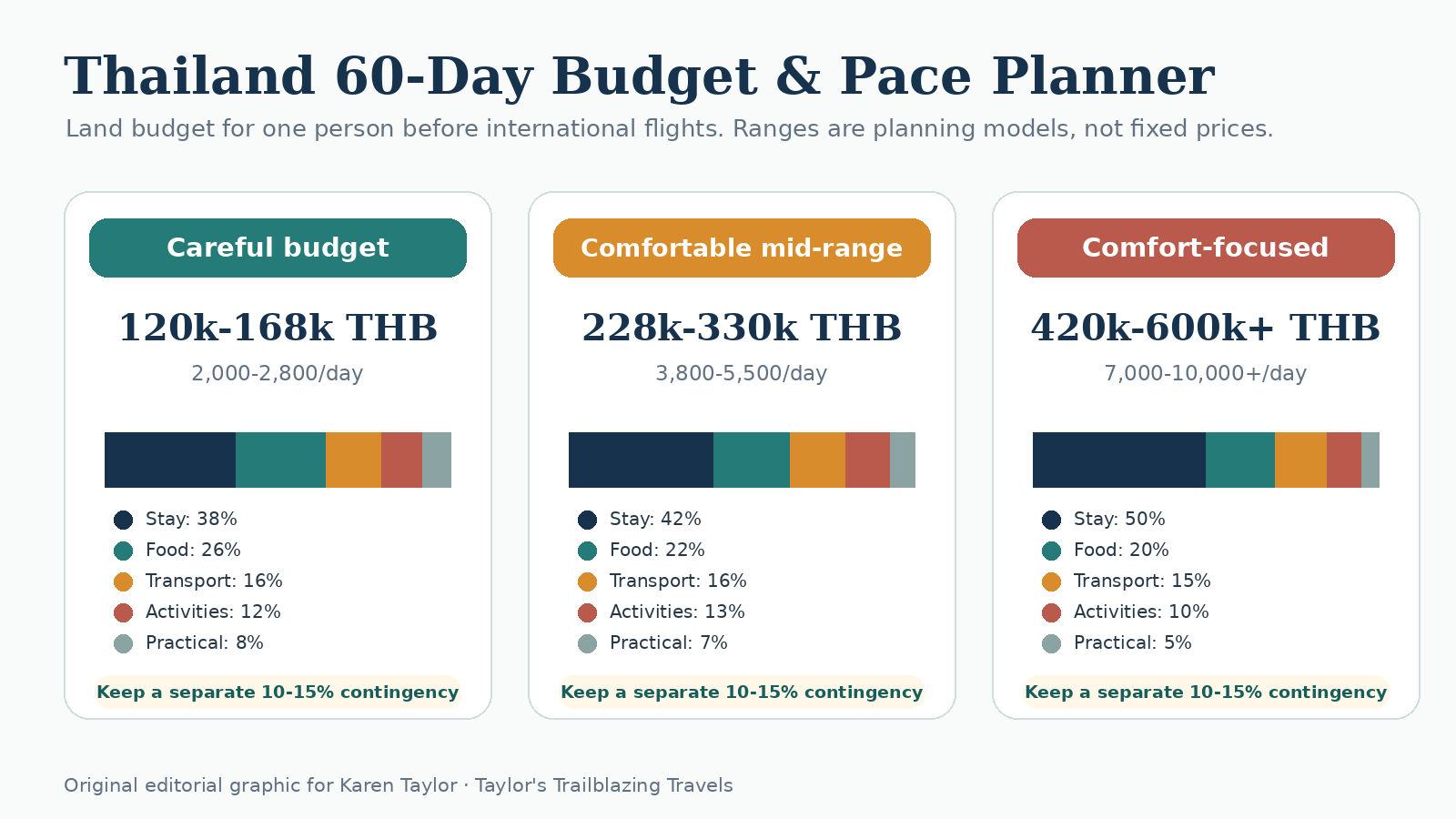
The figures below are land-budget models for one person and exclude international flights. They include accommodation, food, domestic transport, selected activities, laundry, mobile data and a contingency. Sharing rooms reduces the per-person accommodation cost for couples, while frequent private rooms make solo travel relatively more expensive.
| Travel style | Daily planning range | 60-day land budget | Typical choices | Main pressure point |
|---|---|---|---|---|
| Careful budget | 2,000-2,800 baht | 120,000-168,000 baht | Simple private rooms or hostels, local food, buses, limited tours | Single supplements, island prices and last-minute flights |
| Comfortable mid-range | 3,800-5,500 baht | 228,000-330,000 baht | Well-located hotels, selected flights, several guided experiences | Special stays, private transfers and peak dates |
| Comfort-focused | 7,000-10,000+ baht | 420,000-600,000+ baht | Higher-end rooms, regular private transport, frequent activities | Beach resorts and premium lake accommodation |
Mid-range budget breakdown
| Category | Planning range | What it covers | How to control it |
|---|---|---|---|
| Accommodation | 90,000-150,000 baht | Mostly comfortable private rooms, with some higher-cost nature or island nights | Use weekly rates and avoid moving for one small saving |
| Food and drink | 48,000-78,000 baht | Local meals, cafés and regular restaurant dinners | Balance destination dining with ordinary neighbourhood meals |
| Domestic transport | 30,000-55,000 baht | Long-distance tickets, baggage, local taxis, vans and ferries | Book scarce legs early and compare complete airport costs |
| Activities and entry fees | 30,000-60,000 baht | Selected tours, park fees, museums and classes | Choose fewer high-value experiences instead of daily tours |
| Laundry, SIM and practical costs | 10,000-18,000 baht | Mobile data, laundry, toiletries, storage and small replacement items | Use local laundries and avoid unnecessary airport purchases |
| Contingency | 20,000-35,000 baht | Weather changes, medical excesses, replacement transport or room upgrades | Keep it separate from the daily spending wallet |
Where travellers underestimate the cost
Island taxis, checked baggage, hotel-to-pier transfers and private national-park packages are common surprises. A remote beachfront room may also require every meal at the property. In the north, a low room rate can be offset by repeated ride-hailing journeys when the base is not walkable.
Where a long stay saves money
Weekly or monthly rates, fewer airport transfers, fewer check-in days and ordinary local routines all reduce cost. Ten nights in one Chiang Mai room can be cheaper than three shorter stays of similar quality, especially when cleaning fees, booking premiums and transport are added.
Use a three-wallet system
Separate the trip into fixed bookings, weekly living money and contingency. Pay accommodation and long-distance transport from the fixed budget. Transfer a realistic weekly amount for food and local travel. Leave the emergency fund untouched unless the route genuinely changes or an unexpected problem occurs.
Back to contents · Back to top
Accommodation strategy for a 60-day trip
A two-month itinerary needs different accommodation from a two-week holiday. Storage, desk space, laundry access, a usable fridge and a quiet night can matter more than an elaborate lobby. The room should support the purpose of the base.
Use three accommodation categories
| Stay type | Use it in | Priorities | Avoid |
|---|---|---|---|
| Functional city base | Bangkok reset and departure stays | Rail access, late check-in, luggage space and reliable staff | Paying for resort facilities you will not use |
| Long-stay home base | Chiang Mai and the main coast base | Quiet room, desk, fridge, laundry and walkable food | A dramatic but isolated setting with no daily convenience |
| Experience stay | Khao Sok lake, river property or special island resort | Clear inclusions, transfer instructions and realistic facilities | Assuming the photograph explains the bathroom, meals or access |
| Heritage stop | Ayutthaya and Sukhothai | Early site access, bicycle or local transport, secure luggage storage | Choosing a vague regional location far from the park |
| Arrival-night buffer | After a long flight, ferry or sleeper | Easy access, flexible reception and nearby food | A complicated transfer to a remote property |
Split a long base only for a clear reason
Changing from Old City to Nimman after five nights may make sense when you want two distinct Chiang Mai experiences. Moving two streets to save a small amount usually does not. Every hotel change has a hidden cost: checkout, storage, transport, waiting and another round of room inspection.
Check what “laundry” means
It may mean a paid hotel service, self-service machines, a nearby shop or only a sink. For a ten-night stay, ask about the nearest practical option before booking. Quick-dry clothes and a small amount of detergent reduce the risk that one rainy day disrupts the wardrobe.
Remote properties need a dinner plan
Before choosing a floating, jungle or isolated beach room, check whether meals are included, how late the kitchen operates, whether dietary needs can be met and what happens after the final transfer. A romantic location can become uncomfortable when the only restaurant is closed or inaccessible.
Read recent reviews for logistics, not only scores
Look for comments about noise, road access, stairs, building work, water pressure, Wi-Fi reliability and the accuracy of the map pin. A high overall score can conceal the exact issue that matters for a two-week base.
Back to contents · Back to top
Laundry, connectivity, money and long-stay practicalities
A successful two-month trip depends as much on ordinary systems as on attractions. Knowing when to wash clothes, how to access money, where confirmations are stored and how to contact a hotel during a delay prevents small problems from consuming entire days.
Pack for one week, not for two months
Take enough lightweight clothing for roughly seven to ten days and wash it regularly. Add one warmer layer for air-conditioned trains and cooler northern evenings, a light rain layer, comfortable walking footwear, sandals, swimwear and modest temple clothing. Specialist outdoor equipment should be added only when a real activity requires it.
Two months does not justify carrying every possible medicine, toiletry or beach item from home. It does justify keeping prescription medication, copies of prescriptions and essential health supplies in hand luggage. Check airline and Thai rules for controlled or restricted medication well before departure.
Use mobile data as a travel tool
Reliable data helps with hotel messages, map pins, ride-hailing, train changes and pier instructions. A local SIM can offer strong value for a long stay, while an eSIM is convenient when you want data active on arrival and your phone supports it. Keep screenshots of critical addresses because coverage or battery can fail.
Optional Thailand eSIM before departure
An eSIM can provide arrival-day data without queueing at the airport. Check that the phone is unlocked and eSIM-compatible, then confirm the live plan’s data allowance, validity, network, hotspot policy and activation instructions before buying.
Keep travel records in three places
Store the itinerary and confirmations in cloud storage, offline on the phone and in a separate emergency copy accessible to a trusted contact. Record the hotel name in Thai when possible, especially for taxis and remote pickups. A screenshot is often more useful than an email that requires a live login.
Use cash and cards deliberately
Thailand remains cash-friendly for markets, small transport and local shops. Carry enough baht for the current day, but avoid holding the entire trip budget in one wallet. Compare withdrawal fees, your bank’s foreign-exchange terms and the security of the ATM location. Decline dynamic currency conversion when it produces a poor rate and your own card provider offers the better conversion.
Plan an admin half-day every ten to fourteen days
Use it for laundry, budgeting, confirming the next transport, backing up photographs, checking weather and reviewing accommodation. This routine is why the route contains long bases and the Bangkok reset. Without it, small tasks accumulate until a beach day becomes a stressful office day.
Health, heat and road safety
Build outdoor days around heat and hydration. Start early, rest at midday and treat persistent symptoms seriously. Travel insurance should cover the activities actually planned, including riding only when licensed and insured. UK travel advice highlights significant road-safety risks in Thailand, particularly involving motorcycles. [20]
Do not rent a scooter because taxis feel expensive or because other travellers appear confident. Two months provides many chances to take unnecessary risks; it also provides enough time to choose safer transport without ruining the trip.
Work and remote access
Travellers working during the trip should choose a proper desk, quiet room and backup connection for the longest bases. Test a video call before committing to a full workday. Resort Wi-Fi can be strong in the lobby and weak in the room, while island power interruptions or storms can affect planned meetings.
Leave space in the luggage
Bangkok at the end is a better place to buy gifts than Bangkok at the beginning. Carrying shopping through every bus, train and ferry adds cost and inconvenience. A foldable spare bag can be useful, but confirm the final airline baggage rules before filling it.
Back to contents · Back to top
How to adapt the route for different travellers
The standard itinerary is a framework, not a test. Mobility, family needs, driving confidence, work commitments and previous Thailand experience should change the route. The best revision usually removes transfers rather than adding “easier” activities to an already crowded schedule.
For families with children
Reduce the heritage stops to one, lengthen Bangkok and use fewer coast bases. A strong family version could spend seven nights in Bangkok, three in Kanchanaburi, twelve in Chiang Mai, five in Chiang Rai, four in Khao Sok, twenty-two on one coast and the final three in Bangkok. Book direct transport, larger rooms and arrival transfers where they meaningfully reduce stress.
Keep pools, food access and bedtime logistics in view. A remote island room may be beautiful but impractical when every meal requires a boat or taxi. Avoid consecutive full-day tours and treat a hotel day as a legitimate family day.
For older travellers or limited mobility
Remove Pai unless the winding road and local access are comfortable. Use a private driver for selected temple and historic-park days, stay close to lifts or ground-floor rooms and verify stairs before booking. Replace bicycles with electric carts or vehicles where available.
Allow more time after overnight transport and avoid the most basic lake accommodation unless the access, bathroom and emergency arrangements are suitable. The route remains rewarding with fewer bases and better rooms.
For solo travellers
Choose central, walkable neighbourhoods and shared activities where they add social contact. Remote resorts can feel isolating and create high single-person transfer costs. Hostels are not required; small guesthouses, communal cafés and group day trips provide alternatives.
Keep transport arrival times sensible, especially in Pai, Sukhothai and on islands. Share live location or travel details with a trusted contact and avoid arriving at an unfamiliar remote property after the final public transport.
For couples
Use private transfers selectively where the per-person difference becomes modest and the journey is awkward. Balance atmospheric stays with practical bases. A secluded river or beach property works best for two or three nights when followed by somewhere walkable.
For remote workers
Turn Chiang Mai into fourteen nights and the main coast base into at least fourteen nights. Remove Pai or one heritage stop. Book accommodation by room layout and internet evidence, not only by destination. Keep meetings away from transfer days and build a local-data backup.
For repeat visitors
Replace Bangkok headline sights with neighbourhood stays, remove one famous northern base and use the saved week for Nan, Lampang, Isan, Trat or a longer island. The route’s pacing principles remain valid even when the destinations change.
For March and April travel
Use a smoke-season alternative instead of assuming the north will be acceptable. One option is Bangkok, Kanchanaburi, Ayutthaya, Sukhothai, a longer Khao Sok stay, the Gulf or Andaman branch selected by live conditions, and an eastern coast section. Heat remains a major planning factor everywhere.
For a beach-first trip
Keep Bangkok, one central heritage stop and Khao Sok, then allocate thirty or more days to a single southern region. A two-month trip does not have to prove variety. When swimming, diving or island life is the main purpose, design honestly around that priority.
| Traveller | Add time to | Reduce or remove | Key booking priority |
|---|---|---|---|
| Family | Bangkok, Chiang Mai and one beach base | Pai and one heritage stop | Connecting rooms, pools and direct transfers |
| Limited mobility | Accessible city bases | Remote islands and strenuous mountain days | Lift, bathroom access and vehicle arrangements |
| Solo traveller | Walkable central bases | Isolated resorts | Safe arrival time and social options |
| Remote worker | Chiang Mai and main coast base | Two or three short stops | Desk, quiet room and connection backup |
| Repeat visitor | One less-visited region | Headline Bangkok and major temple repeats | Regional transport and specialist stays |
| Smoke-season traveller | Central, eastern and southern Thailand | Chiang Mai, Pai and Chiang Rai when AQI is poor | Flexible northern cancellation |
Back to contents · Back to top
Common mistakes on a Thailand two-month itinerary
Planning thirty destinations because sixty days looks unlimited
Sixty days disappears quickly when every move consumes most of a day. Ten bases produce a fuller trip than twenty short stays because more mornings begin where you already know the streets, food and transport.
Using every overnight journey to “save time”
A sleeper can be efficient, but poor sleep may cost the next day. Consecutive night buses are not a slow-travel strategy. Use overnight transport where the class and timetable support rest, then protect the arrival morning.
Choosing both coasts without a strong reason
Crossing the peninsula adds another chain of vans, ferries or flights. Choose both only when island comparison is the main purpose and enough time is removed from the north or central route.
Ignoring northern air quality
A room discount does not compensate for unhealthy air or lost mountain views. Build a replacement region before departure, use flexible bookings and check current readings rather than relying on a fixed “smoke season” date.
Booking the cheapest room outside every town
Repeated taxis, limited food and isolation can cost more than a central room. Check the map at night-time scale: where is dinner, how will you return and what happens if it rains?
Assuming an island transfer ends at the hotel
Many tickets end at a pier, bus station or travel office. Add the final taxi, boat or hotel vehicle and confirm the latest check-in time.
Leaving no unscheduled time
A free afternoon absorbs rain, illness, laundry or a place that deserves longer. Without it, one delay creates a chain of missed bookings and frustration.
Treating entry permission as an approximate number
Immigration dates are exact. Check the permission granted and leave within it. Do not rely on a future extension, a social-media answer or a route article as legal authority.
Connecting an island directly to the international flight
This is the most expensive avoidable mistake in the route. Return to Bangkok early. The final buffer is part of the trip, not an admission that the schedule failed.
Trying to spend the same amount every day
Khao Sok and domestic-flight days may be expensive; Chiang Mai and a weekly beach stay may be cheaper. Control the complete trip total and maintain a contingency rather than forcing artificial daily equality.
Back to contents · Back to top
Pros and cons of this 60-day Thailand route
Main advantages
- Long enough to experience daily life in several bases
- Balances cities, heritage, mountains, rainforest and coast
- Includes honest transfer and recovery days
- Uses one season-appropriate coast
- Protects the international departure
Main compromises
- Several excellent regions are omitted
- The north-south distance still creates long travel days
- Weather and air quality may force substantial changes
- A solo traveller pays more per person for private rooms
- The route needs ongoing admin rather than one booking session
Who should change it
- Travellers visiting in severe northern smoke
- People who dislike winding roads or ferries
- Families wanting fewer hotel changes
- Remote workers needing longer fixed bases
- Beach-first travellers who want thirty coastal days
What makes the compromises worthwhile
The route does not promise that every day will be spectacular. It creates the conditions for the memorable days to feel good because they are not surrounded by constant packing. The ordinary days—laundry, coffee, a market meal, reading beside the pool—are what make two months feel like travel rather than a logistics project.
Back to contents · Back to top
Frequently asked questions
Is 60 days too long for a first trip to Thailand?
No, provided the route is slow enough. Two months is ideal for first-time visitors who want more than a highlight reel and are comfortable managing transport, laundry and changing weather. The mistake is using the extra time to add excessive destinations. Long bases, a contingency budget and flexible southern plans make the trip easier rather than harder.
How many places should I visit in two months?
Around eight to twelve bases is realistic for most travellers. This route uses ten broad stops, counting Bangkok’s three stays by function. More bases can work when they are close together and transport is simple, but every hotel change should add a genuinely different experience.
Can I stay in Thailand for exactly 60 days without a visa?
That depends on nationality and the rules in force on the travel date. When checked on 22 August 2026, UK government guidance said British citizen passport holders could receive 60 days for tourism, but other passports differ and the permission granted at entry controls. Check official Thai and home-government sources before booking.
Should I book the whole two months before arrival?
No. Book the legal and expensive dependencies first: international flights, scarce sleeper berths, special Khao Sok accommodation and high-demand holiday dates. Flexible city rooms can be reserved with cancellation, while the final coast should retain enough flexibility to respond to weather and personal preference.
What is the best month for this route?
November to January usually provides the simplest overall planning, although popular dates cost more and weather is never guaranteed. February can work well when the north is visited first and air quality remains acceptable. March and April need a northern replacement plan, while rainy-season travel benefits from a flexible Gulf or mainland strategy.
Should I choose the Andaman coast or the Gulf islands?
Choose according to travel month, live forecasts and the experience wanted. The Andaman branch suits Krabi, Koh Lanta and limestone scenery. The Gulf branch suits Samui, Phangan and Tao. Neither coast is permanently dry, so preserve weather buffers and check marine information before ferries and boat tours.
Can I include both coasts in 60 days?
Yes, but something else should be removed. A beach-focused version could cut Pai, Chiang Rai and one heritage stop, then divide roughly thirty days between the two coasts. Adding both to the standard route creates more transport and less beach time than the map suggests.
How much cash should I carry?
Carry enough baht for the current day and the next essential transfer, not the whole trip budget. Use a secure secondary store, separate cards and a contingency account. Small transport, markets and local businesses may prefer cash, while larger hotels and online bookings often accept cards.
Is the overnight train worth taking?
It is worthwhile when the railway experience appeals and the arrival time supports the next day. A lower second-class berth is a common comfort-value choice. The train is not automatically cheaper than a flight after transfers, and a poor sleeper should choose daytime transport or a flight.
Is Pai essential?
No. Skip Pai when winding roads, motion sickness, smoke, scooter culture or the town’s atmosphere do not suit you. Add the four nights to Chiang Mai, Lampang, Kanchanaburi or the coast. Removing a weak personal match improves the itinerary.
How should I handle northern smoke season?
Monitor official air-quality readings and health guidance, use flexible northern accommodation and create a replacement route before departure. When conditions are poor, move to a genuinely different region rather than another nearby northern town. Do not sacrifice health to protect prepaid sightseeing.
Do I need a scooter for this itinerary?
No. Central accommodation, shared transport, songthaews, taxis, drivers and tours can cover the route. A scooter adds risk and may not be covered by insurance without the correct licence and protective equipment. Do not learn on Pai’s mountain roads or an island because other travellers do it.
Can I travel with a large suitcase?
Yes, but a medium case or backpack is easier across vans, stairs, boats and simple guesthouses. Confirm airline baggage, van luggage space and pier handling. Store a larger case in Chiang Mai or Bangkok only when the property provides secure, documented storage.
How often should I schedule laundry?
Plan laundry roughly once a week and before the Khao Sok or island sections. Long bases make this easy. Keep one quick-dry outfit available and avoid sending every item to a laundry immediately before an early departure.
Do I need travel insurance for two months?
Travel insurance is strongly advisable. Check the maximum trip length, medical limits, exclusions, excess, pre-existing-condition rules and whether planned activities are covered. A policy suitable for a two-week beach holiday may not cover a sixty-day trip or motorcycling.
How far ahead should I book domestic flights?
Book schedule-critical or holiday-period flights once the route is stable. Ordinary dates can remain flexible, but last-minute fares and baggage costs may rise. Compare both Bangkok airports and the complete journey to and from each one.
What should I do if I become tired of moving?
Stop. Cancel a flexible short stay and add the nights to the current or next long base. The route is designed so the coast and Chiang Mai can absorb extra time. A two-month itinerary should adapt to the traveller, not force the traveller to serve the spreadsheet.
Can this route work without domestic flights?
Mostly, but the Bangkok-Khao Sok and coast-Bangkok legs become long. Trains, buses and vans can connect the route when enough time and sleep tolerance are available. Remove one short stop if overland travel is a core preference, because the additional journey time must come from somewhere.
Where should I spend extra days if I have 65 or 70 days?
Add days to long bases rather than adding many new stops. Chiang Mai, Kanchanaburi, Khao Sok and the chosen coast can all use extra time. A five-day extension could also support Lampang, Koh Yao Noi, Khao Lak or another focused stop without changing the whole route.
What is the single most important planning rule?
Protect the final international flight. Return from islands and remote areas early, keep separate tickets apart and sleep in Bangkok before departure. The cost of three buffer days is small compared with replacing a long-haul ticket.
Back to contents · Back to top
Karen’s practical recommendation
For a first two-month trip, I would use the exact 60-day structure in this guide but keep two decisions open. First, I would make the northern section refundable enough to respond to air quality. Second, I would choose the southern coast only after the broad seasonal pattern and current forecast agree.
I would not add another island, even when a ferry map makes it look easy. Instead, I would use the saved days to know one beach area, find reliable local food and experience weather without feeling that the holiday is failing. I would also keep the two-night Bangkok reset, because laundry, repacking and a quiet room are valuable after a month of movement.
My default transport mix would be ordinary road or rail to Kanchanaburi, a protected overnight sleeper from Ayutthaya to Chiang Mai, daytime vans in the north, a flight or efficient overland chain south, and a domestic flight back to Bangkok with two full nights before the international departure. The exact tickets can change; the risk-management logic should not.
The strongest version of this Thailand 2 month itinerary is not the one with the most pins. It is the one where the traveller still has energy, money and curiosity on Day 50. Long bases, honest transfer days and permission to change the plan are what make that possible.
Back to contents · Back to top
About the author
Back to contents · Back to top
Sources and methodology
Research was checked on 22 August 2026. Official government, railway, meteorological, tourism and UNESCO sources were prioritised for entry rules, weather, air quality, heritage status and safety. Current booking platforms were used for dated route examples and to verify that affiliate placements matched the reader’s task. Prices, timetables, operators, weather, park access and immigration rules can change, so recheck every critical detail for the exact travel date.
Entry and official arrival rules
- UK Foreign, Commonwealth & Development Office: Thailand entry requirements. Passport validity, 60-day visitor permission for British citizen passport holders, extension information, TDAC timing and overstay guidance checked 22 August 2026.
- Thailand Digital Arrival Card. Official TDAC submission portal; the official service does not charge a submission fee.
- Official Thai eVisa portal. Visa information and application route for travellers whose nationality or trip purpose requires a visa.
Weather, air quality and safety
- Thai Meteorological Department: Chiang Mai. Current conditions, warnings and forecast information for northern route planning.
- Thai Meteorological Department: Krabi. Current provincial and marine-weather planning for the Andaman option.
- Thai Meteorological Department: Surat Thani. Current conditions and marine-weather planning for Khao Sok and the Gulf connection.
- UK Foreign, Commonwealth & Development Office: Thailand safety and security. Road safety, driving and general travel-risk guidance.
- Pollution Control Department: Air4Thai. Official air-quality monitoring route for checking northern conditions close to travel.
Transport route checks
- State Railway of Thailand D-Ticket. Official booking platform and current eligible advance-reservation window.
- 12Go: Bangkok to Kanchanaburi live route results. Dated examples used to plan road and rail time, departure points and luggage considerations.
- 12Go: Ayutthaya to Chiang Mai live route results. Current train and bus examples checked for the overnight northbound leg.
- 12Go: Chiang Mai to Pai live route results. Current minivan journey and fare examples.
- 12Go: Chiang Rai to Sukhothai live route results. Current direct and connecting transport examples.
- 12Go: Bangkok to Khao Sok live route results. Current bus, rail and combined-route examples used for journey planning.
- 12Go: Khao Sok to Krabi live route results. Current van and transfer examples for the Andaman branch.
- 12Go: Khao Sok to Koh Samui live route results. Current joint road-and-ferry examples for the Gulf branch.
Heritage, destination and activity context
- UNESCO World Heritage Centre: Historic City of Ayutthaya. Heritage context for the central Thailand stop.
- UNESCO World Heritage Centre: Historic Town of Sukhothai and Associated Historic Towns. Heritage context for the lower-north stop.
- Tourism Authority of Thailand: Khao Sok National Park. Official destination context for the rainforest and lake section.
- GetYourGuide: Bangkok experiences. Current listings checked to confirm that the optional affiliate placement matched food, canal and cultural activities.
- GetYourGuide: Chiang Mai experiences. Current listings checked for relevant day-trip and activity categories.
Back to contents · Back to top
Image credits
Illustrations in this article were created for Taylor’s Trailblazing Travels. Third-party photographs, where used, are credited beside the image or in the source list.
Traveller experiences
Share your experienceYour first-hand knowledge can help another traveller plan with more confidence. Share what you experienced, including anything you would change.
These are traveller contributions, separate from Taylor’s Trailblazing Travels’ editorial research. Contributions are reviewed before publication; a first-hand confirmation is not independent verification.
Be the first to share what you learned.
No traveller experiences have been approved for this article yet. Tried a similar route? Tell us what worked and what you would change.
Your journey, someone else’s useful tipTried a similar route? Tell us what worked and what you would change.Share a first-hand experience · no account needed
Your itinerary experience
Practical details, balanced views and small discoveries are all welcome. Please describe your own trip and avoid sharing someone else’s personal information.
Spotted something that’s changed?Help us keep this guide accurate. Reports stay private.Private report
Report an update
Tell the editorial team what appears to have changed. Reports stay private and are reviewed before any editorial decision; sending a report does not change this article.