
A month for history, rainforest and a proper coastal stay.
A thirty-day calendar that treats travel, rest and entry permission as part of the itinerary.
A Thailand 1-Month Itinerary creates a different kind of planning problem. You have time for more than the classic city-and-beach pairing, yet it is still possible to waste that freedom on constant packing, avoidable flights and ambitious connections. The useful question is not how many places fit, but which extra stops earn their travel days.
This route adds two contrasting historic capitals and a rainforest chapter before slowing down on the Andaman coast. It finishes with two Bangkok nights rather than an island-to-international-flight sprint. You can follow the full version or remove an inland stop and keep the same total trip length.
Here, one month is a convenient travel label for thirty calendar days, not thirty nights or an automatic legal stay. The calendar, sample budget and suggested buffers are original planning work. Official sources support the entry and visitor details; no hotel, wildlife encounter or transport service is presented as personally tested.
Days are not nights
Thirty calendar days contain twenty-nine hotel nights.
Two historic capitals
Ayutthaya and Sukhothai serve different chapters.
Khao Sok, carefully
Village and lake stays involve different logistics.
Two Bangkok nights
Keep the international departure separate from island travel.
First, make one month mean the right number of days
A thirty-day itinerary is not permission to remain for thirty days. Read the permission granted on arrival and consider the shorter versions before booking the final flight. [1]
Thirty days and twenty-nine nights
This itinerary uses thirty consecutive calendar dates in Thailand, beginning with the arrival date and ending with departure on day thirty. There are twenty-nine intervening hotel nights. A booking for thirty nights normally extends into a thirty-first date, so it is not interchangeable with this plan. Count from the date you enter Thailand, not the date you leave home on an overnight flight.
The distinction matters particularly for visitors relying on visa exemption. As checked on 5 October 2026, the Royal Thai Embassy in London states that eligible British and Irish passport holders may enter for up to thirty days under the rules effective from 15 September 2026. Its guidance also restricts exemption entries to twice in a calendar year. Other passports and circumstances need their own checks. [2] [3]
Your immigration permission controls the trip
Read the permitted-until date stamped on arrival and resolve questions with the relevant authorities rather than assuming that the phrase one month settles them. The itinerary is not immigration advice or a guarantee of admission. Travellers seeking a longer stay should arrange the appropriate permission through official channels before relying on additional nights. [1]
Even when thirty days are permitted, departing on the final allowed date leaves little room for a delayed flight or a mistaken calendar calculation. The twenty-eight- and twenty-nine-day edits below retain a substantial holiday while providing more margin. A hotel checkout before noon does not turn a flight after midnight into a departure on the previous date.
The Thailand 1-Month Itinerary calendar
Seven destinations and a deliberate return to the gateway
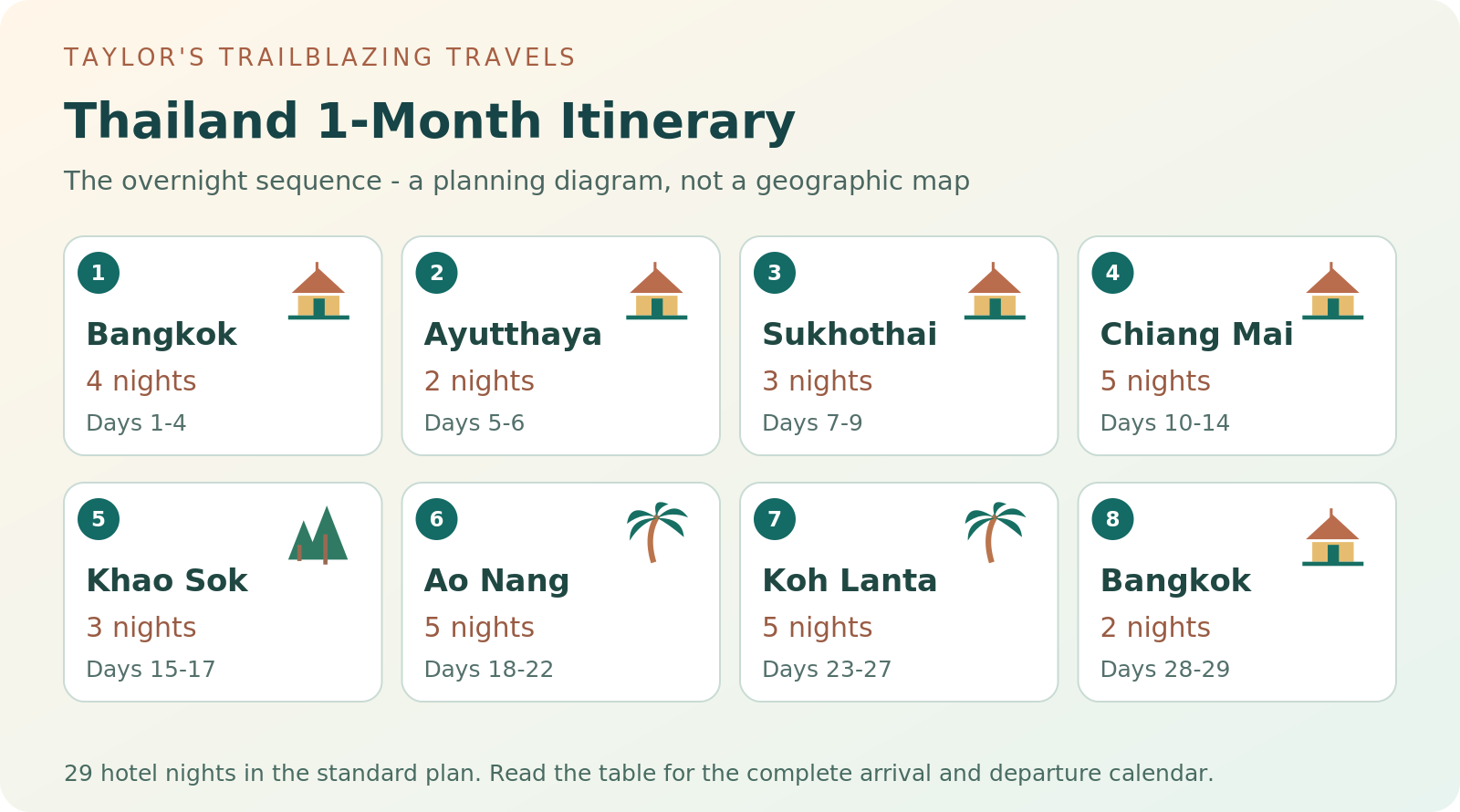
The route starts with Bangkok, then follows an inland sequence through Ayutthaya, Sukhothai and Chiang Mai. After the northern stay, it moves south to Khao Sok, Ao Nang and Koh Lanta. Two final Bangkok nights separate the island chapter from the international departure. The hotel blocks total twenty-nine nights: four, two, three, five, three, five, five and two.
These stops are selected for contrast and reasonable time at each base, not because every first-time visitor needs to include them. The two historic capitals particularly suit travellers interested in heritage. Khao Sok adds a nature chapter with its own transport and safety considerations. Remove a chapter when it does not match your interests rather than keeping it merely because a month appears long enough.
| Day(s) | Overnight base | Nights | Plan |
|---|---|---|---|
| 1-4 | Bangkok | 4 | Arrival, orientation and city days |
| 5-6 | Ayutthaya | 2 | Historic capital with an overnight stay |
| 7-9 | Sukhothai | 3 | Travel day and two heritage days |
| 10-14 | Chiang Mai | 5 | Northern base and genuine rest time |
| 15-17 | Khao Sok village | 3 | Travel south, forest and optional lake excursion |
| 18-22 | Ao Nang | 5 | Krabi base and flexible sea days |
| 23-27 | Koh Lanta | 5 | Slower coastal finish |
| 28-29 | Bangkok | 2 | Return and spare gateway day |
| 30 | Departure | 0 | Leave within the permission actually granted |
This is a proposed calendar, not a published transport timetable. Scroll within the table on a small screen.
The route is active, despite the longer stays
Changing base on days five, seven, ten, fifteen, eighteen, twenty-three and twenty-eight creates seven main transfer dates. That is manageable for many travellers, but it is not a minimal-movement holiday. The quieter versions later in the guide reduce the number of transfers without reducing the thirty-day duration. Choose the full plan only when the extra destinations justify those travel days to you.
Days 1-4: start with a city stay that absorbs the arrival
Day 1: reach the hotel without adding a deadline
Make the first date about arrival, room access and a local meal. The flight, immigration and airport transfer may already have used much of your energy. With four initial nights, there is no advantage in making an expensive attraction booking immediately after landing. Ask the hotel about early check-in and luggage storage before the trip, and distinguish a request from a confirmed room arrangement.
Compare Bangkok hotels using the transport you expect to use, not only a broad district label. A useful base for this opening chapter should make meals and the return from sightseeing straightforward. Quiet sleep and practical access deserve attention before decorative features that may be enjoyed only briefly.
Day 2: a main old-city visit
Choose the Grand Palace or Wat Pho as the morning's main attraction, leaving a second temple optional. Read the current official visitor instructions, including clothing rules and any closure notices. A longer trip lets you spend proper time at a place without immediately racing to the next ticketed stop. [4] [5]
After lunch, choose a short river journey or nearby neighbourhood rather than crossing the city repeatedly. The different boat services have their own stops and tickets, so confirm the service that actually reaches the desired pier. A river afternoon can be an enjoyable change of pace without becoming another full sightseeing circuit. [6]
Day 3: a different side of the capital
Use the next day for food, an indoor cultural visit or a neighbourhood with an easy route back to the hotel. Jim Thompson House is one option, with guided entry to the main house and stair access that needs considering beforehand. Do not assume an indoor attraction is necessarily step-free or something that can be completed at any pace you choose. [7]
Keep shopping focused on things you genuinely need for the coming month. Buying bulky souvenirs at the beginning creates luggage work at every later transfer. Small purchases, photographs of items to reconsider and a final Bangkok shopping window can be a more practical approach.
Day 4: make the extra city day useful
Leave the fourth date available for a postponed visit, a slower breakfast or practical errands. Check the next accommodation address and transport before the evening. A month-long trip needs ordinary maintenance: charging equipment, reorganising bags and checking bookings are easier when they are not squeezed into the final minutes before checkout.
Do not turn this date into a demanding return day trip to Ayutthaya. You are going there tomorrow with time to stay. The opening city chapter is meant to settle the trip into a sustainable rhythm rather than rehearse the next destination in a more hurried form.
Days 5-6: the first historic capital
Day 5: transfer and a selective first look
Compare Bangkok-to-Ayutthaya transport for the actual date and boarding point. Check the station or pickup location printed on the booking, then arrange the final ride to the hotel. Leave the main luggage before exploring. The arrival afternoon is best used for one limited area rather than an attempt to complete the historic visit before the first night.
Ayutthaya's UNESCO status reflects the importance of its surviving archaeological city. Here, the overnight stop is intended to give that history space rather than convert the monuments into a quick photo sequence. A visitor with little interest in ruins can reasonably remove this chapter and redistribute the nights. [8]
Day 6: choose the monuments that interest you
Select a coherent group of sites and a transport arrangement that suits the heat, distance and mobility of the group. Do not assume that every ruin marked on a city map is an easy walk from the next. A guide may add value through explanation and planning, while independent visitors may prefer fewer sites and a longer lunch.
Compare Ayutthaya accommodation with both the sightseeing and the next departure in mind. Check recent comments about room comfort, the immediate food options and whether the property can help organise a reliable pickup. For a two-night stay, practical access is more useful than saving a small amount at an inconvenient location.
Days 7-9: a second heritage chapter with a different purpose
Day 7: allow a proper travel day
Compare Ayutthaya-to-Sukhothai journeys and read the complete itinerary, including any change of vehicle and the final arrival point. A through-product can contain several stages. Do not build the afternoon around an admission time until the actual transfer plan is clear, and confirm how the last leg reaches the hotel rather than merely the town or a transport terminal.
Choose the accommodation location deliberately. The historic-park area and the modern town are different bases with different practical advantages. Check the hotel's map pin against the sights you want to visit, the food options and the next transport departure. A destination name on the booking is not enough to establish that you will be staying beside the ruins. [9]
Day 8: explore the historic park selectively
Give the main Sukhothai historic area a full, unhurried day with breaks. You do not need to visit every monument to appreciate the setting. Choose the means of moving around according to your ability and conditions, and confirm local rental or transport arrangements rather than assuming that a bicycle is compulsory.
Sukhothai belongs to a UNESCO property that also includes Si Satchanalai and Kamphaeng Phet. Those names do not describe three adjacent sections of a single compact park. Treat any visit to an associated town as a separate excursion requiring its own transport and time. [10]
Day 9: a second visit or a quieter heritage day
Use the second full date to revisit a favourite area, see an additional monument or arrange a more specialised excursion when the historical interest justifies it. Alternatively, enjoy a slower day near the hotel. The value of three nights is partly that a wet or very hot period does not have to compress the entire visit into one uncomfortable session.
Compare hotels around Sukhothai Historical Park and verify the exact room and access arrangements. Check tomorrow's departure time while there is still time to organise the pickup. A quiet final evening helps the next northern move remain a manageable transition rather than another rushed travel morning.
Days 10-14: five nights in the north
Day 10: travel to Chiang Mai and settle
Compare Sukhothai-to-Chiang Mai transport using the complete origin and destination. Check luggage handling, intermediate stops and where the service ends. Plan no fixed afternoon excursion after arrival. A local meal and an easy walk are enough while you establish the new base and recover from the journey.
Compare Chiang Mai accommodation with attention to everyday convenience over a five-night stay. Access to food, laundry and the city areas you intend to explore can reduce repeated paid rides. A room that is comfortable to spend time in is useful on a long trip, not a luxury that matters only during bad weather.
Day 11: old-city culture at a sustainable pace
Choose a compact walking area with a few selected temple visits and a proper lunch break. Chiang Mai has its own northern context, so allow time to notice it rather than treating the city as a holding point between distant excursions. Keep the afternoon adaptable to your energy and the conditions. [11]
You may prefer a guided introduction, a food activity or independent exploration. Pick one main format for the day instead of stacking all three. A month creates more opportunities to learn about a place, but that learning does not improve automatically when the schedule becomes denser.
Day 12: a northern outing chosen for genuine interest
Doi Suthep is one possible temple and mountain-setting visit. Check current weather and air quality first, and decide whether the temple itself would still appeal if the view is obscured. A landscape outing should not depend entirely on reproducing a clear-weather promotional photograph. [12] [13]
With an organised outing, examine the full route and the time spent at each stop. A tour listing that adds several villages, viewpoints and attractions may leave less time at the place you actually wanted. Choose a smaller programme when that gives the group a better experience.
Day 13: a learning day or local exploration
A cooking class, a cultural activity or another neighbourhood can provide a useful contrast to temples and mountain scenery. Check the class or venue location and its actual return time before booking an evening commitment. Activities marketed as being in Chiang Mai can still require a substantial drive outside the city.
This is also a good stage to review the southern bookings. Make sure the flight lands at an airport compatible with the Khao Sok transfer, not merely somewhere in southern Thailand. The long north-to-south move is the next major logistical decision and should not depend on a vague assumption about distance.
Day 14: laundry, rest and a properly prepared departure
Use the final northern day for laundry, rest or an activity postponed earlier. A month is long enough for fatigue to accumulate quietly. Keeping one date open can improve the rainforest and coastal chapters more than completing an additional long excursion on the last northern morning.
Check the baggage limit for the next flight separately from previous tickets. Pack anything needed during the transfer in a small accessible bag, save the accommodation address offline and confirm the pickup details. Then let the final evening remain local and easy to shorten.
Days 15-17: rainforest, with the geography understood
Day 15: travel south to the village base
Use the fifteenth date for the full move from Chiang Mai to Khao Sok. A flight to Surat Thani followed by a prearranged road transfer is one possible structure, but the airline routing must be checked for the actual date. Search pages can include connections; no daily nonstop service is assumed here. [14]
Compare the arrival airport and road transfer together before buying either component. A late landing can leave an awkward final journey and an arrival after the accommodation's normal reception arrangements. When the timings are poor, add an airport-area night by removing a night elsewhere, or simplify the route rather than pretending the extra stop is free.
The village and the lake are not the same booking
The standard calendar uses three nights near the Khao Sok village/park-headquarters area. A Cheow Lan or Ratchaprapha reservoir excursion is a separate journey, while a floating lake stay has different boat transfers and facilities. The national-park landscape includes forest and reservoir areas, but that does not make their visitor logistics interchangeable. [15] [16]
Compare Khao Sok village accommodation and confirm the exact address, road access, reception hours and tour pickup arrangements. A booking described simply as Khao Sok may be somewhere quite different from the base you imagined. Ask about steps, room cooling and the route from the drop-off point when comfort or mobility requirements matter.
Day 16: a suitable guided forest experience
Choose an activity based on the season, trail access, group ability and current local advice. Do not assume that caves, river activities or longer walks are safe because they appear in a general destination description. Heavy rain can change conditions, and a competent operator should be willing to alter or cancel the programme. [17] [18]
Ask about the duration, surface, necessary equipment and arrangements for returning early. Wildlife should be treated as a possibility rather than a guaranteed appointment. A forest experience can be worthwhile through its setting and interpretation without an operator promising a particular animal sighting.
Day 17: a lake excursion or another village-based day
Compare Cheow Lan Lake day trips that genuinely start from the area where you are staying. Confirm road transport to the pier, boat time, meals, park charges, the planned activities and return arrangements. Do not compare only the headline ticket price when one product includes transport and another expects you to reach the pier independently.
An overnight floating stay is an alternative, not an extra night hidden inside the same calendar. For example, keep the village on nights fifteen and seventeen and replace night sixteen with a lake stay. That preserves three nights but creates another packing and transfer sequence. Confirm luggage storage, power availability, bathrooms and the actual accommodation before deciding the experience suits you.
Days 18-22: a five-night Krabi base
Day 18: transfer to the coast
Arrange the Khao Sok-to-Ao Nang move as a complete hotel-to-hotel plan, including any changes of vehicle. Give the date enough space for collection, travel and check-in. A short list of places on a booking confirmation does not establish that the journey is non-stop, and the last ride from a terminal may need separate organisation.
Compare Ao Nang accommodation for the balance between food access, quiet evenings and the comfort of the room. After several inland stays, this hotel should provide an easy base rather than another set of daily logistics. Check recent reviews from a similar season and the actual walking route to the areas you intend to use.
Days 19-20: two interchangeable coastal outings
Use one date for the Railay/Phra Nang area and one for a carefully selected island trip, provided the conditions and boarding arrangements suit the group. Ao Nang serves as a practical launch point for the peninsula and nearby excursions. You can enjoy these settings without checking into a different island hotel after each visit. [19]
Decide which outing is the greater priority and give it the better available conditions. Read the inclusion list and national-park fee arrangements, and do not assume the most stops produce the best day. A shorter programme can leave more time for the scenery and less for repeated boarding.
Days 21-22: keep the coast from becoming another checklist
Reserve one date for a mainland activity or hotel time and the other for a weather swap, a favourite place or a slow day. These are deliberately not empty spaces waiting to be filled with tours. After nearly three weeks of travel, the option to repeat a pleasant morning may be more valuable than another major excursion.
Use the final Ao Nang evening to confirm the Lanta pickup, hotel address and drop-off conditions. Decide whether the selected service reaches the accommodation or finishes at a pier. This is a small transfer compared with the north-to-south flight, but it still deserves enough planning to avoid arriving tired and uncertain with luggage.

Days 23-27: five nights that are allowed to be quiet
Day 23: a measured change of coastal base
Compare Krabi-to-Koh Lanta transfers and inspect whether the journey uses a road/vehicle-ferry combination or a passenger boat. Availability and timings can change with date and conditions. Read the pickup area, luggage conditions and destination carefully, especially when the hotel is beyond the standard drop-off zone. [20]
Settle in without adding a major excursion. The point of the Lanta chapter is a slower finish, so it should not begin with the same pressure as an airport connection. Learn the nearby meal options, confirm how to organise local rides and leave the rest of the arrival date flexible.
Days 24-25: spend time in the place you selected
Give the first full day to the hotel's beach area and the second to one modest outing or another quiet day. You do not need a different beach for every sunrise. Familiarity has value on a longer trip: knowing where to eat and how to get home makes the days feel less like a continuous series of decisions.
Compare Koh Lanta hotels using exact location and practical access rather than a general island rating. Without a rental vehicle, nearby food and a straightforward evening return become especially useful. Ask the hotel about seasonal services and any building work instead of assuming that every facility shown in a photograph operates identically year-round.
Days 26-27: leave room for preference and preparation
Use one day for the activity you most enjoyed, or for a carefully planned local exploration. Keep the other available for rest, packing and reconfirming the Bangkok return. A month-long holiday does not need a dramatic final island activity to feel complete. Protecting the final travel sequence is a better use of attention than adding a last-minute long boat trip.
Check whether any laundry can be returned before checkout and keep essential documents separate from the main bag. Confirm the pickup time, vehicle capacity and airport code. The island stay ends on day twenty-eight; a booking through the night of day twenty-eight would conflict with the intended Bangkok hotel.
Days 28-30: return to Bangkok with a genuine spare day
Day 28: leave the island and reach the gateway
Arrange the Koh Lanta-to-Krabi Airport journey with margin for hotel collection, the crossing and the airline's check-in requirement. Then fly to Bangkok and settle into the final hotel. Keep the entire date free from essential sightseeing. The two-night gateway block is there to separate the island departure from the international flight, not to justify a dangerously tight domestic connection.
Check the domestic arrival and international departure airports independently. BKK and DMK are different airports, and a hotel convenient for one may not suit the other. Choose the final base around the international departure and your actual ground-transport plan. [21]
Day 29: use the spare day rather than borrowing it
This date can absorb a delay, provide a final city meal or allow modest shopping without carrying purchases through the rest of Thailand. Keep the activities easy to cancel. A prepaid all-day outing would reduce the practical value of the buffer you deliberately created.
Review the final flight, documents, baggage and departure time before the evening. Check the allowed-stay date again rather than leaving the calendar question until the airport. The extra Bangkok night offers transport resilience, but it does not extend immigration permission.
Day 30: depart on the date actually permitted
Leave with the major experiences already complete. Follow the airline's airport-arrival requirement and include the hotel journey separately. For a flight shortly after midnight, pay particular attention to which calendar date is printed on the ticket and when you need to leave the hotel. A familiar-looking date can be read incorrectly when the departure is at the beginning rather than the end of a day.
The twenty-eight- and twenty-nine-day versions
Keep the route, reduce the final island stay
For twenty-nine days and twenty-eight nights, reduce Lanta from five nights to four. The final Bangkok stay becomes nights twenty-seven and twenty-eight, followed by departure on day twenty-nine. All earlier blocks remain unchanged. This creates a clear one-day reduction without cutting the gateway margin.
For twenty-eight days and twenty-seven nights, use three Lanta nights. Return to Bangkok on day twenty-six, stay nights twenty-six and twenty-seven, and depart on day twenty-eight. The route still contains the same destinations, but the island finish is shorter. This is often the more comfortable legal-calendar choice for a traveller whose permission is limited to thirty days.
Shorten deliberately, not through an accidental missing night
Do not remove the last Bangkok night first simply because it appears less exciting than the beach stay. It has a different job. Likewise, an overnight flight does not always remove the need for the hotel night you expected to use before it; check when you will leave the room and when the aircraft actually departs.
Recount the nights after every change. A simple list of check-in and checkout dates is more reliable than remembering that a destination had about three days. The calendar should be unambiguous enough that another traveller could read it and identify where everyone is sleeping each night.
Fewer bases can make the same month feel richer
Remove one historic capital
Travellers who enjoy history casually rather than deeply can remove Ayutthaya and give one night to Bangkok and one to Chiang Mai. Alternatively, remove Sukhothai and allocate those three nights to the north and coast. These edits reduce a hotel change and a transfer without creating a need to fill the freed time with another distant excursion.
Choose the historic stop according to your interest and transport preferences. Ayutthaya is easier to combine with the Bangkok chapter, while Sukhothai earns its place through a more substantial inland heritage visit. The full route includes both for readers who genuinely want that depth, not as a test that every first trip should pass.
Remove the rainforest chapter when the logistics do not appeal
Khao Sok has different accommodation, transfer and activity considerations from the cities and coast. If those are unattractive, use its three nights to extend Chiang Mai and the southern hotel stays. The month can still offer substantial variety without an overnight lake or forest experience.
A more settled four-base alternative could use Bangkok, Chiang Mai, Ao Nang and Koh Lanta, with a final Bangkok return built into the same night total. That may be more suitable for families, access needs or travellers who want time for everyday routines. More available days do not create an obligation to travel farther.
Seasonal choices for a route spanning the country
Think in regions and activities
The main coastal sequence is on the Andaman side. Before using it, compare the season and likely conditions with the activities you care about, then check current forecasts close to travel. General climate information does not tell you whether a particular boat trip or forest route will operate safely on your date. [22] [17]
Northern outdoor plans also deserve an air-quality check. Use current readings and their timestamps rather than a fixed assumption that one month is always clear. If conditions make landscape excursions unattractive, change the activity or route before paying for an experience whose main purpose is the view. [13]
Do not use the Gulf as an automatic bad-weather escape
The southern east coast has a different rainfall pattern and can be wet during part of the cool season. A switch to Samui or another Gulf base should follow a regional comparison, not the belief that the opposite coast must be dry whenever Krabi is wet. [23]
For a Gulf version, replace the southern block rather than adding it after Lanta. Rebuild the flight, ferry and final Bangkok-return plan from the actual services. A month provides time for a thoughtful substitution, but crossing between coasts still consumes a travel day and can create additional weather-sensitive connections.
A month-long budget that separates assumptions from quotes
Model the twenty-nine nights explicitly
The planning examples below were prepared on 5 October 2026 for one adult sharing accommodation. They include thirty days, twenty-nine nights and an allowance for domestic transport, but exclude international flights, insurance, visas or extensions where applicable, and shopping. These are constructed spending models, not surveyed market averages or promises that the specified rooms and tickets are available at those amounts.
| Component / assumed allowance | Lean model | More-comfort model |
|---|---|---|
| Accommodation: 29 nights x THB 600 / 1,400 per person | THB 17,400 | THB 40,600 |
| Food: 30 days x THB 500 / 900 | THB 15,000 | THB 27,000 |
| Main intercity travel allowance | THB 14,000 | THB 23,000 |
| Local travel and everyday extras | THB 4,500 | THB 7,000 |
| Admissions and selected nature/cultural activities | THB 6,500 | THB 11,500 |
| Subtotal | THB 57,400 | THB 109,100 |
| 15% contingency | THB 8,610 | THB 16,365 |
| Illustrative total per adult | THB 66,010 | THB 125,465 |
Planning model dated 5 October 2026. Prices are assumptions, not checked bookable offers. International flights, insurance and shopping are excluded; read the section for route-specific exclusions. Scroll this table horizontally on small screens.
Replace the biggest assumptions before booking
Get actual quotations for the north-to-south flight, the rainforest arrangements and the coastal accommodation first. A lake overnight package may bundle transport, meals and activities that the village-based model treats separately. Remove any duplicated allowance when comparing it; otherwise, a package can appear more expensive simply because the same meal or ride has been counted twice.
Price rooms using the people who will actually occupy them. One adult in a private room cannot automatically use a sharing allowance, and a family may need bedding or occupancy arrangements that change the rate. Longer stays are an opportunity to choose sensibly, not proof that every property will offer a discount.
Keep ordinary life and the contingency visible
Include laundry, drinking water, short rides, replacement toiletries and meals on travel days. These are predictable categories even when the exact total is not. A daily allowance makes them easier to manage than treating each one as an unexpected extra that must come out of the sightseeing budget.
The contingency should remain accessible until the final journeys are complete. Rebooking a flight or changing a hotel can cost more than the small day-to-day savings that occupy most budget discussions. Do not use the reserve to fund optional upgrades at the start and then describe the later itinerary as fully buffered.
The small systems that make a month easier
Use a rolling confirmation check
At each new base, review the next move rather than waiting until the last night. Confirm the date, pickup location, luggage allowance and destination. Keep a short written record of the person or company responsible for each stage. A single itinerary document is useful, but the actual ticket and voucher remain the documents that control the journey.
Keep copies accessible offline and separate the most important personal items from the main luggage. A lost connection or dead phone should not leave you unable to identify the next hotel. For any personal medication or health requirement, check official travel guidance and relevant professional advice before departure rather than relying on a generic packing list.
Match mobile validity to the calendar
Compare Thailand eSIM plans through Airalo for the complete stay, including the final airport journey. Check the device, activation rule, data allowance and validity period. A plan sold for thirty days may start according to conditions different from the moment you first browse the internet, so read the provider's instructions rather than assuming the timing.
Longer trips also benefit from a modest laundry rhythm and a consistent place for documents. These habits reduce the number of small decisions needed at every checkout. The goal is not to organise every hour, but to keep predictable travel tasks from consuming the hours you intended to enjoy.
Recheck entry and regional advice when plans change
Use the official TDAC process for arrival and remember that it is not a visa. Check current regional travel advice before adding border-area detours or a side trip outside Thailand. Leaving and returning is not a harmless way to reset a calendar; it creates a new entry situation with its own rules. [24] [25] [3]
Review the route after the first week
Use what the trip has taught you
After the first several nights, you will have a better sense of your preferred pace, room comfort and appetite for organised activities. Use that information while later bookings can still be changed sensibly. Perhaps the group enjoys slower mornings more than expected, or the two historic stops provide enough heritage without an additional excursion. Adapt the optional days rather than feeling bound by every idea written down before departure.
Do not confuse this flexibility with leaving the critical transport unplanned. The important flights, the rainforest location and the final Bangkok return still need a coherent arrangement. The adaptable layer is the number and type of activities within each stay, followed by hotel-night changes only when the linked bookings can be reconciled.
Keep the later weeks from becoming a catch-up exercise
When an early activity is missed, it does not automatically need replacing somewhere else. Adding an extra temple visit, long drive or late evening to compensate can make the later route busier than intended. Ask whether the missed experience remains a genuine priority, then choose a practical replacement only when the answer is yes.
The same applies to spending. Review actual costs against the remaining allowance, including the transport and accommodation still to be paid. A favourable first week does not mean the coastal chapter will cost the same. This mid-trip review should support comfortable decisions for the rest of the month, not create a daily accounting task that overwhelms the holiday.
The strengths and limits of the full month route
What the longer calendar makes possible
The full route gives heritage, northern culture, rainforest and the coast meaningful space. Most stays are long enough to contain a local rest day or a weather alternative. Two final Bangkok nights reduce dependence on the last island transfer running perfectly, and the shorter versions preserve that safeguard instead of cutting it first.
What you still need to accept
Seven intercity moves require organisation and take time. The two-capital sequence will not suit everyone, and the rainforest chapter involves different logistics from a city hotel. A month also brings more ordinary spending and accumulated fatigue. Choose the full route for its particular interests, not because it is the maximum number of places the calendar can hold.
Month-long planning mistakes to avoid
Treating thirty nights as the same as thirty days
Write the actual arrival and departure dates and count the intervening nights. Then compare them with the entry permission for the actual passport and circumstances. A vague calendar-month label is not enough, especially when a late-night or just-after-midnight flight is involved.
Buying every local activity before travelling
The main flights and important accommodation deserve planning, but a month benefits from local decisions as interests and energy change. Fix the experiences that genuinely need advance booking and leave other dates adaptable. Otherwise, the extra time can become a long sequence of obligations rather than freedom.
Choosing remote accommodation without budgeting the consequences
A secluded property may be exactly right for a quiet chapter. However, confirm food access, transfer costs, reception hours and the ability to leave when needed. A lower room rate can be offset by repeated private rides, while a more convenient property can support a comfortable car-free stay.
Thailand one-month itinerary FAQs
Does this route mean a calendar month or thirty days?
It means thirty calendar days in Thailand and twenty-nine hotel nights. A calendar month can have a different length, so use the dates rather than the label when booking. Arrival is day one, and the standard departure is day thirty. The shorter versions explain how to leave on day twenty-eight or twenty-nine without removing the final gateway margin.
Can a British visitor currently stay thirty days without a visa?
The Thai Embassy guidance checked on 5 October 2026 describes up to thirty days for eligible British passport holders under the revised exemption scheme, subject to its conditions. Your actual immigration permission and circumstances control the stay. Recheck the official guidance before travel, especially after previous entries or when planning a longer visit. [3]
Is thirty days too long for a first visit?
Not when the route reflects your interests and includes quiet days. It can be too long for a tightly scheduled series of daily excursions, because fatigue and decision-making accumulate. Longer stays, familiar meal options and occasional unplanned afternoons help the trip feel like time in a country rather than a month of continuous transit.
Should I visit both Ayutthaya and Sukhothai?
Choose both when heritage is a substantial interest and you are comfortable with the extra inland move. Otherwise, select one and give the saved nights to Bangkok, Chiang Mai or the coast. The destinations should provide different, worthwhile experiences for you; the fact that both are historically important does not make both compulsory on every route.
Is a floating lake stay included in the standard plan?
No. The main calendar uses three village-area Khao Sok nights and an optional lake day trip. A floating stay can replace one of those nights, but its transfers, luggage storage and facilities need checking separately. Do not book it as an additional night without revising the rest of the twenty-nine-night calendar.
Can I manage the itinerary with a suitcase?
Yes, but choose transport and accommodation that can handle it comfortably and check each service's luggage terms. A smaller bag is easier when boarding boats or changing vehicles, yet the itinerary does not require an extreme minimalist packing style. Keep an overnight bag available if the rainforest booking asks you to leave the main luggage at a village hotel.
Which two days should I remove to create a safer departure margin?
The suggested twenty-eight-day version removes two Koh Lanta nights, keeping the final two Bangkok nights. This preserves the gateway buffer and leaves a three-night Lanta stay. Another traveller may prefer to remove an entire destination, but the revised calendar should always show the exact nights and the new departure date.
Is a cross-border side trip a simple addition?
No. It changes the route, transport, insurance and immigration position, and a return to Thailand is a new entry. The month-long plan does not depend on a border run or an assumed reset of permission. Check current official requirements before making any international side trip, rather than treating it as a casual fix for an overlong booking. [3]
Let the month create depth, not pressure
Use the full route when the two historic capitals, a northern city stay and the rainforest chapter genuinely appeal. Keep the local days selective, the travel dates realistic and the final Bangkok block intact. Price the important flights and confirm Khao Sok's exact location before committing to accommodation that cannot change.
For travellers relying on a thirty-day permission, the twenty-eight- or twenty-nine-day edit deserves serious consideration. For anyone who dislikes repeated moves, remove one or two bases and stay longer elsewhere. The best use of a month is enough time to enjoy your choices, not the largest possible collection of bookings.
Sources and fact-checking notes
What was checked, and what remains a planning choice
Source pages were reviewed on 5 October 2026. Official entry and attraction information supports the specific visitor details. Night allocations, suggested time margins, route comparisons and budget models are editorial planning judgements, not official itineraries, guaranteed schedules or personally tested bookings. Recheck operational notices and your actual ticket before travel.
- FCDO: Thailand entry requirements. Passport, entry permission and onward-travel requirements for British citizens. Reviewed 5 October 2026.
- Royal Thai Embassy: September 2026 revision. Announcement of the rules effective from 15 September 2026. Reviewed 5 October 2026.
- Royal Thai Embassy, London: visa exemption. Current exemption conditions; the permission stamped on arrival controls the stay. Reviewed 5 October 2026.
- Bureau of the Royal Household: Grand Palace visits. Official opening information, admission and clothing rules. Reviewed 5 October 2026.
- Wat Pho: plan a visit. Official visitor information and admission. Reviewed 5 October 2026.
- Chao Phraya Tourist Boat: operator information. River-boat stops and service information; check the dated timetable. Reviewed 5 October 2026.
- Jim Thompson House: visitor information. Guided entry, opening hours, luggage and stair access. Reviewed 5 October 2026.
- UNESCO: Historic City of Ayutthaya. Heritage status and historical context for the ruined capital. Reviewed 5 October 2026.
- Tourism Authority of Thailand: Sukhothai. Historic-park and provincial destination background. Reviewed 5 October 2026.
- UNESCO: Sukhothai and associated historic towns. Historical context and the distinction between the component sites. Reviewed 5 October 2026.
- Tourism Authority of Thailand: Chiang Mai. Destination context for the northern city. Reviewed 5 October 2026.
- Tourism Authority of Thailand: Wat Phra That Doi Suthep. Temple and destination background, not a promise of clear views. Reviewed 5 October 2026.
- Pollution Control Department: Air4Thai. Check current readings and their timestamps, especially before northern outdoor days. Reviewed 5 October 2026.
- 12Go: Chiang Mai-Surat Thani Airport route search. Compare actual flights and connections; no daily nonstop service is assumed. Reviewed 5 October 2026.
- Tourism Authority of Thailand: Khao Sok National Park. Rainforest, limestone and reservoir geography. Activity access must be reconfirmed. Reviewed 5 October 2026.
- EGAT: Ratchaprapha reservoir visitor information. Reservoir and floating-accommodation context; listed activities are not automatically recommended. Reviewed 5 October 2026.
- Thai Meteorological Department: forecasts and warnings. Check current provincial and marine forecasts close to travel. Reviewed 5 October 2026.
- FCDO: Thailand safety and security. Transport, sea-travel, local-law and seasonal safety advice. Reviewed 5 October 2026.
- Tourism Authority of Thailand: Krabi. Ao Nang as a base for the peninsula and offshore excursions. Reviewed 5 October 2026.
- 12Go: Krabi-Koh Lanta route search. Road/vehicle-ferry and passenger-boat options. A search page does not establish availability for every date. Reviewed 5 October 2026.
- Airports of Thailand: airport-transfer information. BKK and DMK are different airports. The page displays conflicting hours, so no exact shuttle timetable is relied on here. Reviewed 5 October 2026.
- Tourism Authority of Thailand: climate and weather. Seasonal background; not a forecast for an individual holiday. Reviewed 5 October 2026.
- Thai Meteorological Department: November-January climate normals. Only the clearly labelled 1991-2020 climate-normal discussion is used; the dated forecast is not treated as a 2026 forecast. Reviewed 5 October 2026.
- Thai Immigration: official arrival-card guidance. Official TDAC instructions, eligibility and submission window. Reviewed 5 October 2026.
- FCDO: regional risks in Thailand. Check the current advisory map before adding border regions. Reviewed 5 October 2026.
Illustrations in this article were created for Taylor’s Trailblazing Travels. Third-party photographs, where used, are credited beside the image or in the source list.