Langkawi Travel Guide: Beaches, Nature and Getting Around
Build an island holiday around a beach you will use, a few well-chosen outings and a workable transport plan.
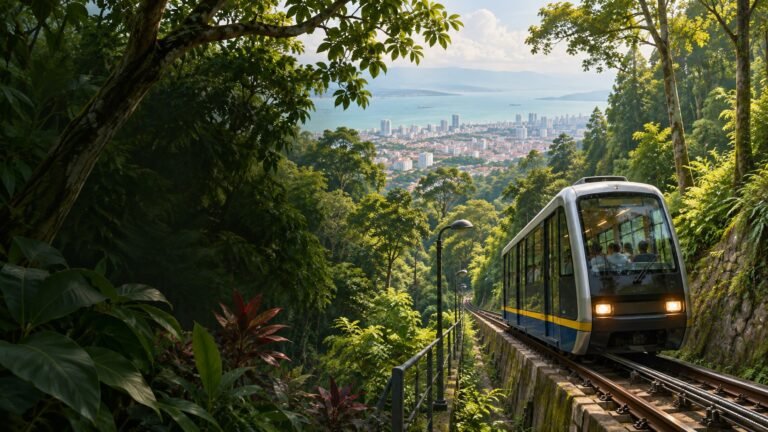
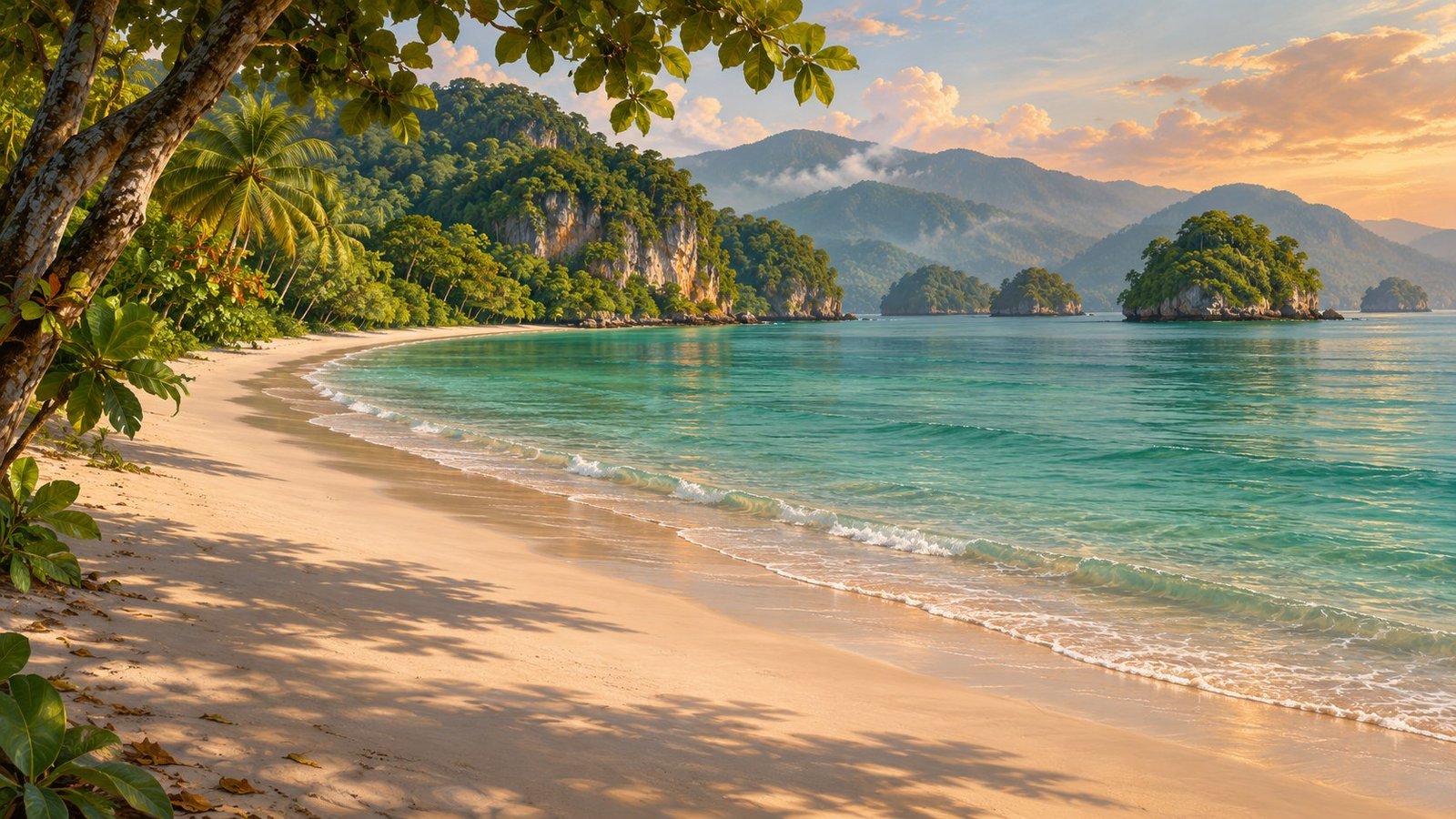
AI-generated editorial illustration inspired by Langkawi’s coast; it does not represent a verified exact beach, resort or viewpoint.
Langkawi offers several different holidays on the same island: lively beach evenings, quiet resort days, mountain viewpoints and mangrove waterways. Its UNESCO Global Geopark designation reflects an archipelago of forested peaks, limestone formations and coastal habitats, extending the appeal well beyond the sand.[1]
This Langkawi travel guide helps you decide which version suits you. Start with the location of your accommodation, then decide how often you want to leave it. A secluded beach can be an excellent choice, provided the dining and transport arrangements fit the way you travel.
Some links are affiliate links. Taylor’s Trailblazing Travels may earn a commission if you book or buy through them, at no extra cost to you.
Three full days with one major outdoor plan per day.
Check the exact walk from the room to meals and sand.
Match a rental, taxi or tour transfer to each outing.
Mountain visibility and boat conditions can change the order.
Choose a base for the evenings as well as the beach
Tourism Malaysia identifies Cenang as Langkawi’s most developed beach area, with accommodation, restaurants and watersports. Kuah is the principal port town in the southeast; Tanjung Rhu, Kok, Burau and Datai offer different coastal settings.[2] A room’s area determines how many journeys you make for dinner as well as sightseeing.
| Area | A good fit for | The decision to check |
|---|---|---|
| Pantai Cenang | Beach time with a choice of nearby meals and activities. | How much music, traffic or watersports activity is close to the room? |
| Pantai Tengah | A beach base with a calmer emphasis and access to the Cenang area. | Is your chosen restaurant genuinely walkable, including after dark? |
| Pantai Kok and Burau Bay | Resort time combined with the western mountain attractions. | Are you happy with the on-site food choices or the cost of trips out? |
| Tanjung Rhu or Datai Bay | A stay where the beach, setting and hotel are major attractions. | These are separate northern and northwestern areas; assess each hotel’s transfers and dining independently. |
| Kuah | Port access, town services and a stay that does not centre on a beach. | Will travelling to the beach each day undermine the saving or convenience? |
For three or four nights, use one base. A second hotel can consume much of a day once packing, checkout and room availability are included. A longer stay makes a beach-and-resort split more worthwhile if the two properties serve genuinely different purposes.
Compare complete room offers
Check breakfast, cancellation, occupancy, beach access and taxes or local levies in the final price. “Sea view” does not establish a direct route to usable sand; ask about the actual access. For a remote property, also price a normal evening meal and an airport transfer before deciding it is the cheaper stay.
Browse Langkawi accommodation on Agoda or compare Langkawi stays on Booking.com, using the map to narrow the results. Enter shortlisted offers in the Hotel Comparison Calculator in one currency, with the same room occupancy and cancellation assumptions.
Back to top ↑Make beach time a real part of the plan
Cenang suits a day with meals and activities close at hand. Tengah offers an alternative when a less busy beach setting matters; Tanjung Rhu is another option for a quieter coastal visit. Tourism Malaysia draws this distinction in its Langkawi travel tips.[3] Visit a second beach because its setting interests you, rather than spending every afternoon moving between stretches of sand.
Check local swimming advice and any flags on the day. Keep clear of boat and motorised watersports activity, and ask where swimming is appropriate. A beach photograph does not establish water conditions or lifeguard cover. If snorkelling is a priority, research the specific marine excursion instead of assuming that the beach outside your hotel offers it.
When to go, and what to keep movable
For northwestern Peninsular Malaysia, METMalaysia identifies January–February as the main rainfall minimum and October–November as the main maximum. Rain remains possible outside the wetter period, and a seasonal average does not predict a particular boat trip.[4] Use the official Langkawi district forecast close to travel, together with operator updates.
Keep the mountain outing movable when visibility matters, and protect an uncommitted afternoon for the beach. During a wetter spell, a hotel with a comfortable room, covered common spaces and appealing food can be more valuable than another attraction on the list. Three nights works for a beach and one main excursion; four gives a more forgiving balance. Add nights when relaxation is the purpose of the trip.
Back to top ↑Treat SkyCab and the western mountains as one outing
The Machinchang area lies in the northwest, and the geopark’s official description groups its mountain scenery with Telaga Tujuh waterfall. Kilim’s mangrove landscape lies in the east, so the two make separate sightseeing days.[5]
Understand the tickets before comparing prices
SkyCab is the cable-car experience; SkyBridge is the elevated pedestrian bridge. SkyGlide provides an alternative to the walking route between the upper station area and the bridge. The operator states that SkyGlide is sold separately from SkyCab, so a headline cable-car price does not establish that every part of the visit is included.[6]
Compare Langkawi cable-car ticket options on GetYourGuide alongside the operator’s own booking options. Read which admissions, queue arrangements and transfers are included. A ticket with several extra attractions is useful only if you want those visits.
Check the SkyCab operation calendar before fixing the day. The operator says that SkyBridge and SkyGlide also close when SkyCab closes, and that the schedule may change.[7] Keep time for boarding queues and the return journey rather than assigning the entire visit the duration of the cable-car ride.
Add a second stop only if it improves the day
Telaga Tujuh is a possible nearby addition, but its upper and lower areas involve steps, and the operator warns about wet rocks and water currents.[8] It is not a universally easy walk after a tiring mountain visit. Check conditions, footwear and the group’s mobility before committing; stay away from hazardous edges.
A relaxed lunch or a coastal stop around Pantai Kok is often enough for the afternoon. For anyone concerned about steps or heights, ask the attraction about the complete access route and current equipment before buying. The availability of SkyGlide alone does not establish that the whole outing meets a particular accessibility need.
Back to top ↑Choose the nature trip by how you want to move
Kilim: seated boat trip or guided kayak?
Kilim’s defining combination is mangrove forest and limestone formations.[5] A boat trip suits visitors who prefer less paddling; a guided kayak trip makes physical participation part of the experience. Compare actual routes and time on the water, because a broad “mangrove tour” label tells you little about stops, group size or pace.
Before booking, ask where you meet, whether your hotel is in the pickup area, how long transfers take and which facilities are available. State children’s ages and any mobility limitations. Request an appropriately sized lifejacket for everyone and ask about weather cancellation arrangements.
One relevant option is half-day mangrove kayaking by Xtreme Langkawi on Viator. Its listing describes an approximately four-hour outing, includes kayaking equipment and identifies a meeting point at Kilim Geoforest Park. It also specifies moderate fitness and states that it is not wheelchair accessible.[9] Check the current itinerary and transfer arrangements rather than assuming hotel collection.
Choose wildlife viewing without feeding
Ask operators to leave wildlife undisturbed and avoid feeding stops. Langkawi’s official travel brochure advises visitors not to feed, touch or disturb animals.[10] A listing’s use of “eco” is not enough to answer how a particular trip operates. Keep food secured and give animals space at land stops too.
When an offshore trip makes sense
Dayang Bunting, south of the main island, has a freshwater lake formed by a collapsed cave, within another of the geopark’s landscapes.[1] Choose an island trip if being on the water and visiting offshore scenery are central to your holiday. Read the landing, walking and swimming arrangements for that exact tour.
For a short stay, select either a second boat excursion or another beach day. Mangroves, island hopping and a sunset cruise can fill all the available leisure time. More departures do not necessarily make a better island holiday.
Back to top ↑Plan the arrival as a complete connection
Flight arrivals use Langkawi International Airport; the principal mainland passenger ferries arrive at Kuah’s jetty. The airport and port serve different parts of the island, so confirm the correct pickup point with your hotel or rental company.[2]
Flights and the Penang connection
Search using airport code LGK and include baggage, transfer costs and the check-in requirement in the comparison. AirAsia displayed a direct Penang–Langkawi route when checked on 6 November 2026; check flights for your actual date before treating that connection as available.[11] A short scheduled flight still takes a substantial part of a day once airport procedures and hotel transfers are included.
Do not rely on an old direct Penang–Langkawi ferry timetable. The former operator’s public notice says that service has ended and directs passengers towards Kuala Kedah or Kuala Perlis.[12] A mainland ferry alternative therefore needs its own overland transfer.
Ferries from Kuala Kedah and Kuala Perlis
Langkawi Ferry Line lists these two mainland routes. Its published instructions require passengers to be inside the terminal at least 60 minutes before departure, with additional time advised for customs checks when leaving Langkawi during busy periods.[13] Work backwards from that requirement when booking a road or rail connection.
Use the operator’s dated booking search, or compare Kuala Perlis–Langkawi departures on 12Go. Check the route, passenger category, baggage conditions and complete payable amount. The ferry operator’s homepage prominently labels some fares “Local Adult”; an international visitor should not assume that headline is their fare.[13]
Langkawi Ferry Line instructs passengers to print the full PDF boarding pass showing their name, seat number and barcode; keep a saved copy available too and recheck the instructions on your ticket.[13] A passenger ferry ticket does not arrange carriage of a vehicle. Avoid placing a boat excursion immediately before a fixed flight home, and leave a substantial contingency if the onward journey relies on a separate mainland connection.
Back to top ↑Compare a car with the rides your day really needs
Langkawi’s tourism authority lists taxis, Grab and rental cars among the ways to get around.[14] Plan independent sightseeing around those options or included tour transfers, rather than expecting a city-style public transport network. A local walk to dinner and a cross-island outing are different transport problems.
| Pattern | Option worth comparing | What changes the result |
|---|---|---|
| Beach day, one meal out | Walking plus an occasional taxi. | The real walking route and whether a return ride is needed. |
| One booked excursion | Tour pickup or a pre-arranged return transfer. | Pickup coverage, meeting time and the total for every traveller. |
| Several dispersed stops | Rental car or a driver for an agreed itinerary. | All fees, fuel, parking, waiting time and collection arrangements. |
| Remote resort evenings | Hotel-arranged transport or planned dining on site. | Return availability and late-evening arrangements. |
A simple break-even example
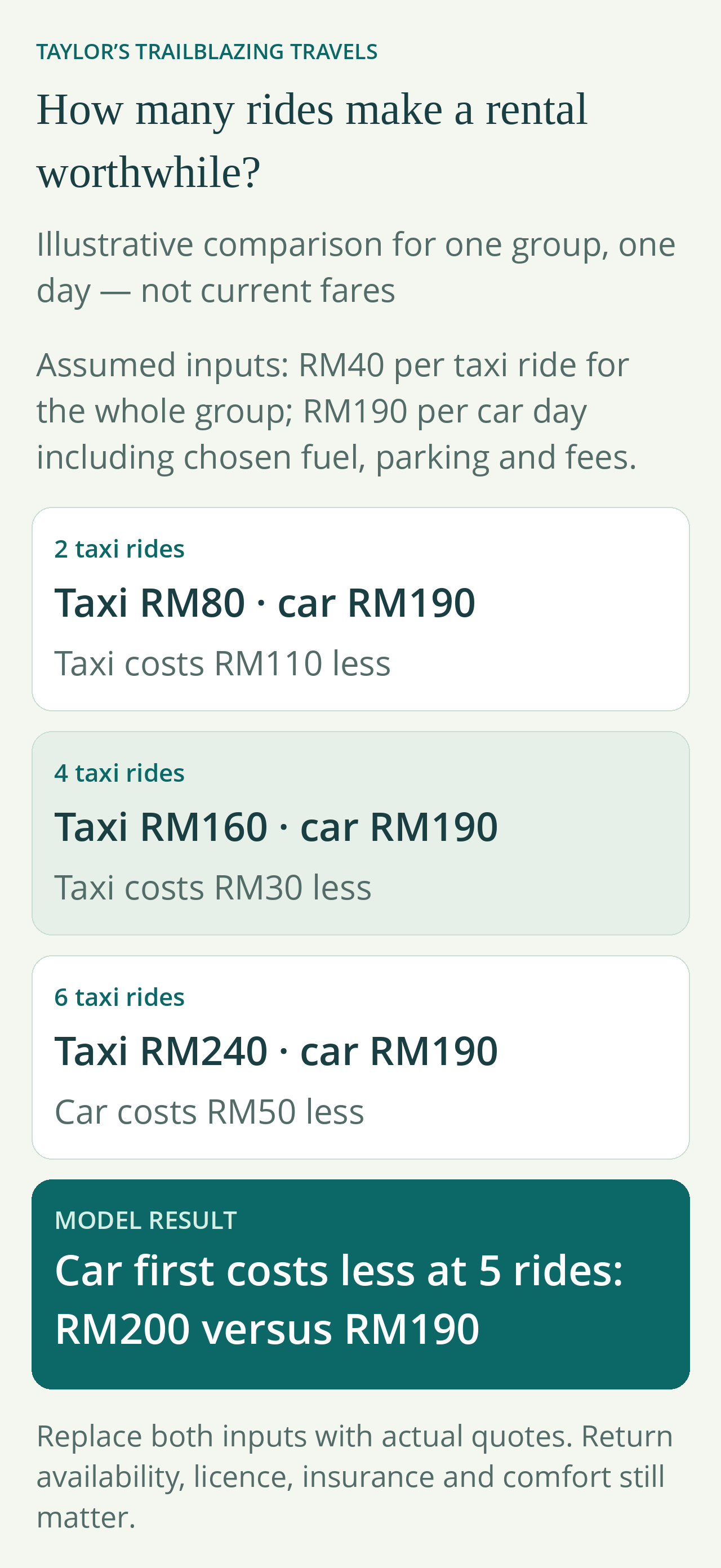
Suppose a rental costs RM190 for the day after your chosen fuel, parking and fee allowances, while each taxi journey would cost RM40 for the whole group. These are invented comparison inputs, not current Langkawi quotations. Two rides total RM80; four total RM160; six total RM240. The car becomes cheaper at the fifth ride in this example, because RM200 exceeds RM190.
Replace both inputs with quotes for your actual stops. Do not multiply the taxi fare by each passenger if it already covers the group. A reliable return transfer, suitable child seat or avoiding a drive after dinner may matter more than the arithmetic. Hiring a car only for exploration days can be more sensible than paying for one while it sits outside a beach hotel.
Before collecting a vehicle
Confirm the licence requirements for your nationality, permitted drivers, insurance excess, deposit and collection condition. For UK licence holders, current FCDO advice specifies a 1949 International Driving Permit alongside the UK licence. Its advice also covers helmet requirements for motorcycles and insurance for activities.[15] A scooter needs the correct licence and riding competence; a low rental price does not make it the default choice.
For an outlying stop, agree the return plan before the outbound journey. Having an app on the phone is not a guarantee that a driver will be nearby when you finish.
A four-night plan organised by side of the island
This original pacing model assumes one beach-area hotel, an afternoon arrival, three full days and departure on the fifth day. It allows one principal outdoor outing per day and treats extra stops as optional. It is a grouping plan, not a timetable or a promise that every attraction opens on the dates chosen.
| Day | Main plan | Keep flexible |
|---|---|---|
| Arrival | Settle in, find an easy meal and learn the route to your beach. | Leave prepaid activities for a full day. |
| First full day: west | SkyCab and the mountain area, followed by lunch. | Add Pantai Kok or Telaga Tujuh only if time, conditions and energy allow. |
| Second full day: northeast | A pre-booked Kilim mangrove outing. | Tanjung Rhu can follow if the tour finishes comfortably and transport is arranged. |
| Third full day: choose | Beach and rest, or an offshore island trip. | Keep the beach version as a weather or energy buffer. |
| Departure | Breakfast, checkout and the correct airport or jetty transfer. | Allow for vehicle return and the operator’s check-in requirements. |
The western and northeastern days can trade places. They should not be combined simply to free a day for more attractions: that puts two substantial outings and extra travel into the same window. If you only have two full days, pick your preferred nature experience and keep the other for the beach and one shorter visit.
Use the Trip Itinerary Planner to organise hotel nights, fixed tour reservations and departure times. Then confirm real opening hours, transfers and sailing or flight details separately. A calendar that looks tidy still needs workable connections.

Keep the budget tied to your hotel and outings
This example is for two adults sharing one room for four nights, with four days’ worth of meals and local transport spread across arrival, three full days and departure. Prepared on 6 November 2026, it uses chosen allowances, not live room rates or attraction quotes.
| Item | Assumption | Total |
|---|---|---|
| Shared room | RM320 × 4 nights | RM1,280 |
| Meals and ordinary drinks | RM80 × 2 people × 4 days | RM640 |
| Local transport | 2 exploration days × RM190; 2 lighter days × RM60 | RM500 |
| Activities allowance | RM250 × 2 people, to allocate between tickets and a tour | RM500 |
| Subtotal | Before a contingency | RM2,920 |
| Contingency | 15% of the subtotal | RM438 |
| Rounded planning pot | For both people together | RM3,360 |
Flights or mainland ferry connections, insurance, shopping and accommodation taxes or levies outside the room quote are excluded. The activities line is a ceiling to replace with real prices, not a claim that a particular bundle fits it. Deduct included tour meals or transfers before adding them again elsewhere.
A room costing RM150 more per night adds RM600 before contingency. That is a larger change than saving a little on one attraction. Conversely, the cheapest room may be poor value if every meal requires a paid journey. Compare the whole stay.
Before leaving home
Save hotel and meeting-point details offline, and compare roaming with a local SIM or eSIM for maps and pickups. If suitable for your phone, browse Airalo and select a Malaysia plan. Check device compatibility, activation, validity and whether the chosen package meets your calling needs.[16] Keep a payment fallback for small purchases and transfers.
Use the Malaysia travel hub when balancing these island nights with cities or highlands. The beach portion works best when it has enough time to feel different from the rest of the route.
Back to top ↑Your questions answered
Can I visit Langkawi comfortably without driving?
Yes. Choose accommodation with suitable meals and beach access nearby, use tours with confirmed pickup arrangements and book return transfers for more isolated stops. A quieter resort can also work without a car if you are happy with its dining and organised transport.
Should I change hotels halfway through a four-night stay?
Usually one well-chosen base is simpler. Consider a split only if you specifically want two different hotel experiences and accept the packing and transfer time. For four nights, a day visit to another coast often gives enough variety.
What should I do if the forecast looks wet?
Check the operator’s cancellation and closure arrangements before changing bookings. Move the mountain or boat day when possible, use covered meals or hotel time during heavy rain, and take shorter outdoor opportunities when conditions improve. Do not assume a shower symbol means every hour of the day is unusable.
Can the ferry booking include a mainland rental car?
Do not assume so. A passenger ticket does not establish a vehicle space or the rental company’s permission to take its car off the mainland. Confirm a suitable vehicle-carrying service, required documents and the rental agreement before planning that journey; hiring on the island is a separate option.
Choose your next step
For a first Langkawi stay, choose one beach base and four nights, then give the mountains and mangroves their own days. Keep the remaining day available for rest or a carefully selected island trip. The strongest plan is the one that matches your hotel, meals and transport, leaving enough uncommitted time to enjoy the coast you came for.
Sources and checks
Sources checked for this editorial review on 6 November 2026. Operator information supports the stated facts; suggested day groupings, spending allowances and decision frameworks are editorial planning judgements. Confirm time-sensitive details and actual booking terms before travelling.
- UNESCO — Langkawi UNESCO Global Geopark and its landscapes
- Tourism Malaysia — Langkawi beaches, areas and Kuah arrival point
- Tourism Malaysia — Langkawi: The Jewel of Kedah, beach-area travel tips
- METMalaysia — Malaysia’s climate and seasonal rainfall
- Langkawi UNESCO Global Geopark — Geoforest parks and their locations
- Panorama Langkawi — SkyGlide, the walking alternative and separate ticket
- Panorama Langkawi — SkyCab operation calendar and linked closures
- Panorama Langkawi — Telaga Tujuh visitor information
- Viator — Half-Day Mangrove Kayaking by Xtreme Langkawi, itinerary and access
- Langkawi Development Authority — Official travel brochure, visitor conduct
- AirAsia — Penang to Langkawi route search
- Langkawi Ferry Services — Direct Penang–Langkawi service notice
- Langkawi Ferry Line — Mainland routes, fares and boarding FAQ
- Langkawi Development Authority — Getting around: taxis, Grab and rental cars
- FCDO — Malaysia safety and security, road travel and activities
- Airalo — Malaysia eSIM plans and compatibility checks
Illustrations in this article were created for Taylor’s Trailblazing Travels. Third-party photographs, where used, are credited beside the image or in the source list.