Ipoh Travel Guide: Old Town, Cave Temples and Nearby Countryside
A compact city break with a wider limestone landscape: choose a central base, then give the countryside its own time.
AI-created illustration inspired by Ipoh’s shophouses and limestone setting; not a documentary photograph or an exact street view.
Ipoh rewards a change of pace: shophouse streets and white coffee in the centre, then limestone scenery and cave temples beyond it. Old Town provides the natural starting point, with the railway station, heritage buildings and small lanes forming a manageable first sightseeing block. [1]
This Ipoh travel guide helps you choose where to stay, which temples belong together and when a countryside excursion deserves another night. The central recommendation is two nights for the city and nearby caves, extended to three when an active Gopeng outing matters more than adding another café.
Some links are affiliate links. Taylor’s Trailblazing Travels may earn a commission if you book or buy through them, at no extra cost to you.
Arrival afternoon, one full outing day and a final morning.
Choose the actual address for easy meals and heritage exploring.
Visits are by appointment; fit the walk around your confirmed slot.
A wet-cave experience needs its own time and suitable conditions.
Where to stay in Ipoh: make the evening easy
Choose your base according to what you want to do after the sightseeing vehicle has gone. For a first visit built around food and heritage, a central room usually earns its keep through shorter journeys. For a resort-led break, the accommodation may be the main attraction. These are different trips, even when both properties advertise an Ipoh address.
| Base | Best fit | The trade-off | Check before paying |
|---|---|---|---|
| Old Town or its immediate edge | Heritage walks, café stops and a short first visit. | A character building may mean stairs, smaller rooms or street noise. | The precise entrance, soundproofing, lift access and distance to your dinner choices. |
| Central New Town | Travellers who prioritise a particular hotel or food shortlist. | You may cross between the two central areas several times. | The real walking route, shade and road crossings; proximity on a map is only a first check. |
| Outer Ipoh / Gunung Rapat side | A driver-based stay focused on limestone sights. | A central evening meal can add another return journey. | Parking, nearby food and how you will return after dinner. |
| Tambun-area resort stay | Families or couples choosing the property’s facilities first. | Old Town becomes a separate outing. | Which facilities and transfers the room price actually includes. |
Make a location saving concrete. In a hypothetical two-night comparison, a hotel that is RM60 cheaper per night saves RM120. Three extra return journeys budgeted at RM40 each also total RM120. Those figures are an arithmetic example, not quoted Ipoh fares: replace them with your own hotel and transport prices.
Start with Ipoh accommodation on Agoda and Ipoh accommodation on Booking.com. Both links open destination listings. Compare identical dates, occupancy and cancellation terms, then put your own rates into the Hotel Comparison Calculator, using one currency throughout and including the journeys the location creates.
Back to top ↑Old Town: a walk with one anchor booking
Begin with the railway-station area and nearby civic architecture, then move into the smaller heritage streets around Concubine Lane. Give the walk pauses for drinks and shade; the appeal lies as much in street details as in reaching individual pins. Tourism Perak identifies the railway station, Birch Memorial Clock Tower, murals and Concubine Lane among the area’s main draws. [1]
Use two to three hours as a personal planning allowance for a relaxed outdoor introduction, with a museum visit or long meal additional. It is enough to get oriented without turning the whole first day into a march. After a late arrival, reduce the plan to a short neighbourhood stroll and dinner; do the fuller walk next morning.
Book Han Chin Pet Soo before fixing the order
The former Hakka miners’ club is a particularly useful history stop because it gives context to the streets outside. Its operator admits visitors by appointment, accepts reservations up to 30 days ahead and asks visitors to bring their confirmation. Donations support the exhibition. A listing on a map does not mean there is a walk-in slot waiting. [4]
Book an available visit, then shape the surrounding walk around it. Leave time to arrive calmly rather than fitting the appointment between a late train and an ambitious lunch. If no slot is available, keep the heritage walk and café time; the city still works without treating every recommended interior as compulsory.
For photographs, work with the street as it is: stay clear of shop entrances, ask before photographing people at close range and avoid blocking a narrow lane for a long shoot. Heritage streets are also workplaces and neighbourhoods.
Back to top ↑Cave temples: choose a coherent Gunung Rapat outing
The Gunung Rapat area groups several limestone temples, including Sam Poh Tong and Kek Lok Tong. That makes it a more practical starting point than choosing scattered cave names independently and spending the day crossing the city. [2] Pick one main temple and a second stop that offers something different.
| Stop | Why choose it | Suggested allowance | Practical implication |
|---|---|---|---|
| Kek Lok Tong | A substantial cave interior followed by a garden setting. [3] | About 60–90 minutes if the garden is part of the visit. | Keep time for both spaces; confirm which areas are accessible on your date. |
| Sam Poh Tong | A second cave-temple visit within the Gunung Rapat cluster. [2] | About 45–60 minutes for an unhurried visit. | Choose it for interest in temple settings, rather than collecting another identical stop. |
| Tasik Cermin | A limestone-lake landscape rather than another temple. [8] | Allow a separate stop; ticket and boat options affect the time. | Check which lake and experience your ticket covers before paying. |
Kek Lok Tong’s cave opens towards landscaped grounds, making it a good choice when the group wants a mix of an interior and outdoor space. Tourism Malaysia describes the garden and lakes behind the cave; it also advises arranging road transport rather than relying on a direct public-transport connection. [3]
Tasik Cermin has distinct lake experiences, including a lake reached through a walking tunnel and a separate boat-based visit. That distinction matters when comparing a basic admission price with a package advertised as a “Mirror Lake tour”. Confirm the exact itinerary, and do not assume all boats or sections operate in every condition. [8]
Temples are active religious spaces. Wear respectful clothing, follow signs about shoes and photography, and let worshippers pass. Cave floors, stairs and outdoor paths can make a supposedly gentle outing tiring. If step-free access matters, ask about the precise route from vehicle to the part you want to see, rather than accepting a general “accessible” description.
Agree your return plan before leaving each vehicle. A one-way ride to an attraction is not evidence that another driver will be available immediately afterwards. For two temples and a lake, a driver waiting by arrangement may be more convenient than repeatedly requesting separate rides; obtain a total quote and a clear waiting allowance.
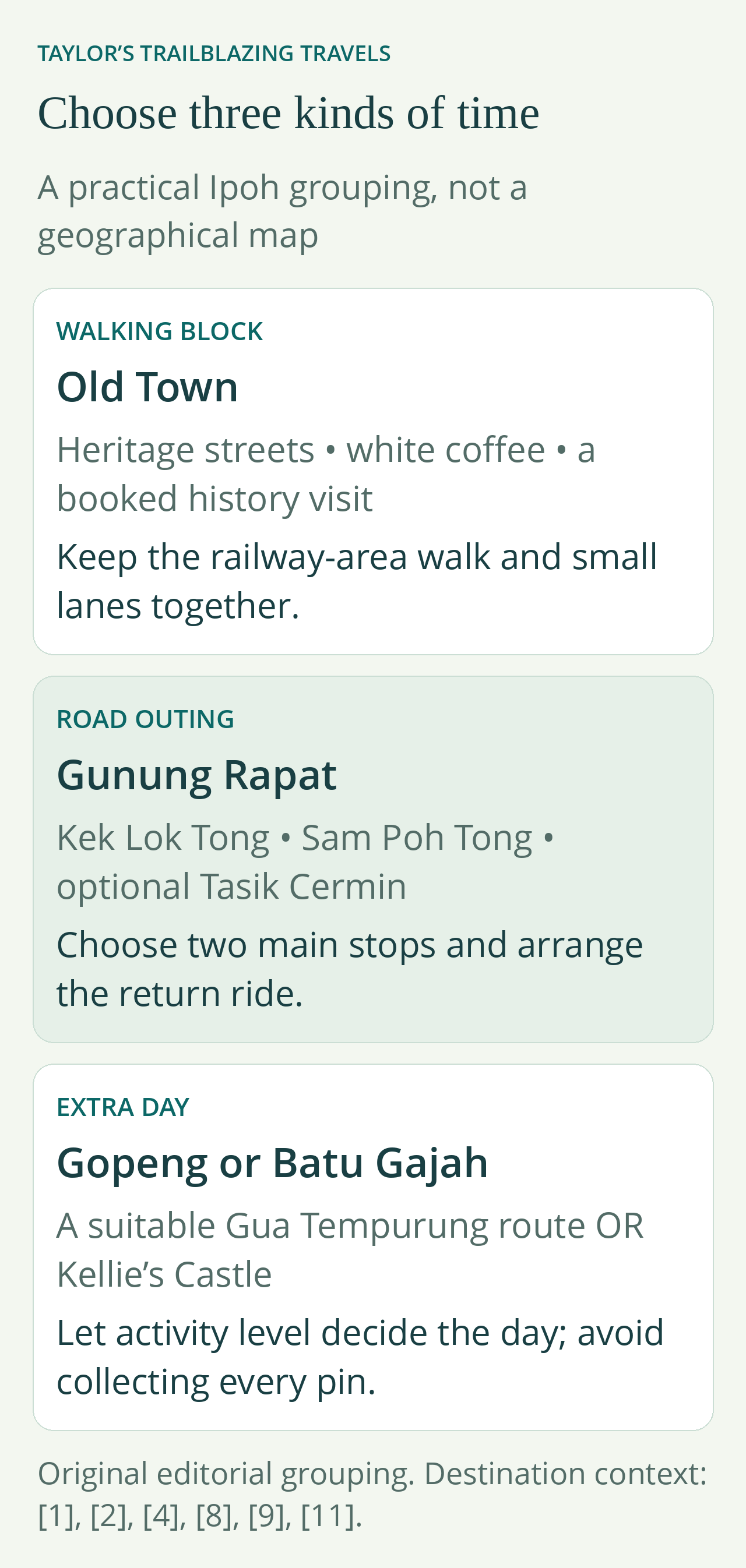
Nearby countryside: choose the kind of day you want
Gopeng and Batu Gajah broaden the visit beyond the city. The useful decision is whether you want physical activity or an easier architectural excursion. Start with that choice, then add one compatible stop if the timing works.
Gua Tempurung: match the cave route to the group
Gua Tempurung, near Gopeng, is a limestone cave attraction identified by Kampar District Council. Its appeal differs from a temple visit: the cave itself is the main experience. [9] Tourism Malaysia distinguishes dry routes involving walkways and stairs from wet adventures that can include wading, crawling and sliding. These are not interchangeable versions of the same gentle walk. [10]
Before booking, ask for the exact route, current availability, minimum age, footwear requirements and what happens after heavy rain. A short dry visit may fit a mixed sightseeing day. A wet route deserves its own substantial outing, time to change afterwards and a plan for belongings that must stay dry. Do not schedule a tight onward departure immediately after an activity whose duration depends on the group and conditions.
Kellie’s Castle: a different countryside emphasis
Near Batu Gajah, Kellie’s Castle is the unfinished mansion associated with Scottish planter William Kellie Smith. Choose it for the building and its setting, rather than expecting a complete furnished stately home. [11] It suits a day when architecture matters more than wet-cave activity. Check current admission and access directly; an old travel-blog price is not a dependable budget input.
The practical filter is simple: if the group is excited by crawling through a cave, add a night and build around that. If only one person is interested, choose the easier shared outing and leave serious caving for a different trip. A rushed compromise can consume a whole day without satisfying either preference.
When a guided outing earns its place
A driver or guide can remove the work of connecting dispersed sights. Compare the cave-temple and Kellie’s Castle tour from Ipoh on GetYourGuide if you want a broad countryside circuit; the listing includes multiple stops and treats attraction admissions separately. [14] For more emphasis on city history alongside cave temples, compare the private Ipoh heritage tour on Viator. [15] Read the actual stop list, pickup boundary, entrance exclusions and walking demands. A tour covering many places will have a different pace from the two-stop temple outing above.
Back to top ↑Getting to Ipoh and making the last connection
Rail is a strong option when your wider route follows the west-coast corridor. KTMB operates ETS services through Ipoh, including connections with Kuala Lumpur; check the train that suits your date through the operator. [5] The timetable effective 1 June 2026, consulted on 6 November 2026, gives one example of Kuala Lumpur Sentral 07:20 to Ipoh 09:44: 2 hours 24 minutes on the train. Other departures differ, and future timetables can change. [6]
That published train duration excludes getting to KL Sentral, boarding time and reaching your Ipoh hotel. Avoid presenting it as a door-to-door journey. Book the rail leg you actually need before making a timed museum reservation that depends on it.
Coach travellers should check the terminal carefully. Perak Transit lists services using Ipoh’s Terminal Amanjaya, including routes towards Kuala Lumpur and Cameron Highlands. [7] Do not assume a coach ticket arrives beside the Old Town railway station: arrange the hotel connection using the terminal shown on your booking.
For a comparison of bookable route options, use Kuala Lumpur–Ipoh services on 12Go, then inspect the selected service’s departure point, arrival point, luggage terms and final fare. The operator’s own booking channel is also worth comparing. An aggregator route page is useful for finding options, but its general overview should not replace the details on your actual ticket.
If Cameron Highlands is next, treat it as a separate stay with a road-transfer day. Perak Transit lists the connection, and Ipoh–Cameron Highlands options on 12Go can help compare the available services. [7] A city morning followed by the transfer is more comfortable than squeezing in a countryside excursion first.
Back to top ↑A two-night plan with room to enjoy the stops
| Day | Main block | Keep flexible |
|---|---|---|
| Day 1 — arrive and settle | Leave luggage, explore part of Old Town, and choose a relaxed dinner. | If the journey runs late, move the fuller heritage walk to the final morning. |
| Day 2 — limestone outing | Visit Kek Lok Tong, then choose Sam Poh Tong or Tasik Cermin. | Return for a hotel break before another meal in the centre; add a third stop only if the group still wants it. |
| Day 3 — history and departure | Use a confirmed Han Chin Pet Soo appointment or finish the heritage walk, then collect luggage. | Protect the departure buffer; do not add a distant attraction because the morning looks empty. |
This sequence deliberately separates arrival recovery, the road outing and the final travel day. If your museum appointment falls on Day 2, swap the city and cave blocks rather than forcing the original order. The full day is a flexible unit, not a requirement to start with temples.
With one night: choose Old Town and one main temple. With three nights: add a separate Gopeng or Batu Gajah day, keeping the city mornings intact. On a day trip: choose either a heritage-and-food visit or a pre-arranged driver circuit, accepting that both together will be more compressed.
For a wider Malaysia route, add the confirmed travel legs and overnight stops to the Trip Itinerary Planner. It can organise your sequence, but you still need to verify transport departures and the feasibility of each connection yourself.
Back to top ↑An editable two-night Ipoh budget
The following is a worked planning example for two adults sharing one room, two nights and three calendar days, prepared on 6 November 2026. Every input is an assumption chosen to make the arithmetic useful. These are not live room quotes, typical fares or a promise of what your trip will cost.
| Item | Assumed input | Total for two |
|---|---|---|
| Accommodation | RM220 per room × 2 nights | RM440 |
| Food and drinks | RM100 per pair × 3 days | RM300 |
| Local transport | An assumed allowance for a modest city-and-temple plan | RM100 |
| Admissions and donations | A placeholder for the sights you select | RM100 |
| Subtotal | 440 + 300 + 100 + 100 | RM940 |
| Contingency | 10% of RM940 | RM94 |
| Illustrative total | RM1,034 ÷ 2 adults | RM1,034 total / RM517 each |
International and intercity transport, shopping, any room charges outside your quoted total, and a private full-day countryside tour are excluded. If you choose a driver or organised tour, replace the transport and admission allowances with the actual package and its exclusions; do not assume RM100 covers an entire private touring day.
Location and pace can matter more than saving a small amount on one admission. A central stay with two carefully chosen cave stops is a different budget from a resort stay, repeated taxi trips and a private countryside circuit. Price the itinerary you intend to take.

Food, weather and the practical details
Use meals to structure the day without turning them into another rigid checklist. White coffee belongs naturally in an Old Town pause. For a different meal, Perak’s food repertoire includes nasi ganja, a rice-and-curry meal, and salt-baked chicken. Tourism Malaysia’s food guide explains both dishes. [1][12] Choose places that fit your route, and keep a second option in case a queue or closing time changes the plan.
For dietary requirements, ask the individual kitchen about ingredients and preparation. A dish name, a vegetarian-looking plate or a tourism listing does not establish halal certification or freedom from an allergen. If a particular meal matters, confirm its service day and time before travelling across town for it.
Malaysia’s official climate guidance describes a humid, rainy climate with regional seasonal differences. There is no sensible rain-free promise for an Ipoh visit. [13] Plan exposed walking earlier in the day where practical, carry water and rain protection, and leave indoor pauses available. Cave activities and open-air sightseeing still need a fresh weather check close to departure.
Keep your accommodation pin, ticket and return contact available offline. For mobile data, browse Airalo and select a Malaysia eSIM as one option alongside your own roaming plan or a local SIM. Check device compatibility, network lock, activation instructions and the package’s data allowance before purchase; Malaysia plans are offered, but that does not establish reception at every attraction. [16]
Back to top ↑Your questions answered
Is Ipoh worth visiting between Kuala Lumpur and Penang?
Yes, when you want a smaller-scale city stop with heritage streets, food and limestone sights. Two nights give the stop its own rhythm. If the wider trip is already crowded, a longer stay in fewer places may be more enjoyable than adding Ipoh only because it lies along the rail corridor.
Can Ipoh be visited without hiring a car?
A central stay works well without a rental car. Walk the heritage area in manageable blocks, then arrange road transport for the cave temples and countryside. Confirm the return journey and waiting arrangements before travelling out.
Which cave temple should a first-time visitor choose?
Kek Lok Tong is a useful first choice when both a cave interior and a garden interest the group. Sam Poh Tong can provide a second temple visit in the same broader area. Choose according to access, time and interest rather than trying to visit every cave temple.
Should Gua Tempurung be added to the temple day?
Only if the exact cave route, transport and remaining time make the combination comfortable. A wet-cave outing deserves its own substantial block and spare clothes. For a two-night first visit, it is often better to choose either that activity or the fuller temple outing.
Does a cheaper hotel outside the centre always save money?
No. Compare the complete stay, including the extra journeys for meals, sightseeing and the station or terminal. The RM120 break-even example above shows why a lower room price can disappear into transport; replace its assumptions with current quotes.
Choose your next step
For a first Ipoh visit, book two nights near the heritage centre, reserve Han Chin Pet Soo if it interests you, and build one calm outing around Kek Lok Tong plus a second contrasting stop. Add a third night when the countryside is a main reason for coming. The result is a trip with time for the streets, meals and landscape that made you choose Ipoh in the first place.
Use the Malaysia travel hub to place the stay within your wider route.
Sources and checks
Sources checked for this editorial review on 6 November 2026. Operator information supports the stated facts; suggested day groupings, spending allowances and decision frameworks are editorial planning judgements. Confirm time-sensitive details and actual booking terms before travelling.
- Tourism Perak — Ipoh Old Town
- Tourism Perak — Gunung Rapat
- Tourism Malaysia — Five cave temples in Ipoh
- IpohWorld — Han Chin Pet Soo visit reservations
- KTMB — Electric Train Service
- KTMB — ETS timetable effective 1 June 2026
- Perak Transit — Express routes
- Tourism Malaysia — Tasik Cermin
- Kampar District Council — Gua Tempurung
- Tourism Malaysia — Tempurung Cave
- Tourism Malaysia — Kellie’s Castle
- Tourism Malaysia — Local food in Perak
- MET Malaysia — Malaysia’s climate
- GetYourGuide — Limestone cave temples and Kellie’s Castle tour from Ipoh
- Viator — Private Ipoh heritage tour from Ipoh
- Airalo — Malaysia eSIM options and compatibility
Illustrations in this article were created for Taylor’s Trailblazing Travels. Third-party photographs, where used, are credited beside the image or in the source list.