Food Allergies in Malaysia: Restaurant Communication and Cross-Contact
A clear conversation, a verified preparation process and a backup plan matter more than a dish name.
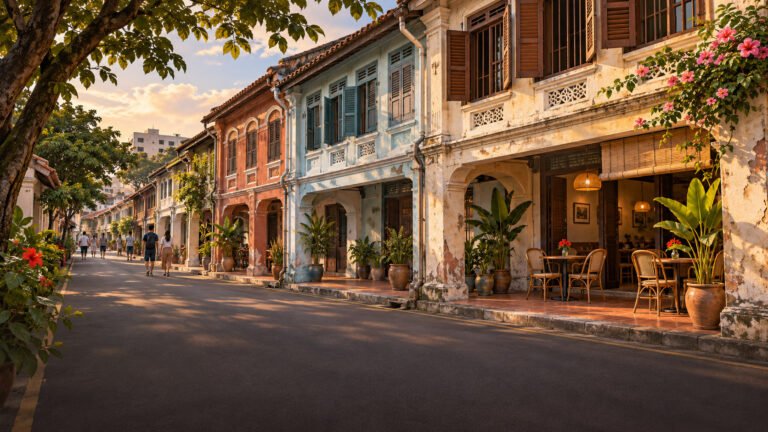
Conceptual restaurant illustration; no dish or venue is represented as allergy-safe.
Travelling with food allergies in Malaysia means checking both what goes into a meal and how it is prepared. A familiar dish name, a reassuring smile or removal of a garnish cannot answer both questions.
This is research-led travel-planning information, not personalised medical advice. Review the trip, medicines and your emergency action plan with your allergy clinician. No restaurant, dish, hotel or tour is described here as allergy-safe for everyone.
This article contains affiliate links. If you book or buy through them, Taylor’s Trailblazing Travels may earn a commission at no extra cost to you.
Name the actual allergens
A dietary preference or broad label is not enough.
Check the hidden ingredients
Sauce, stock, paste, oil and garnish each need attention.
Check the preparation
Shared equipment and serving utensils create separate questions.
Keep a way to decline
Backup food reduces pressure to accept an uncertain meal.
Know the emergency response before the first meal
Anaphylaxis can develop rapidly and may involve throat or tongue swelling, breathing difficulty, faintness or collapse; a rash is not always present. Follow your personal emergency plan and do not delay treatment while trying to identify the food. [1]
Suspected anaphylaxis: act immediately
Administer your prescribed adrenaline immediately, using the device as directed. Dial 999 for an ambulance and report suspected anaphylaxis. Stay lying down with your legs elevated; breathing problems may require lifting your shoulders or carefully sitting up. If pregnant, lie on your left side. Never get to your feet or walk. With no improvement at five minutes, administer the second prescribed injector. Get hospital assessment even if symptoms settle. Follow your personal action plan and emergency-service instructions. [1][2]
This box summarises emergency guidance; it is not a substitute for learning your own device and carrying your prescribed plan. Antihistamines must not delay adrenaline treatment for anaphylaxis. Always follow the instructions for the form of adrenaline prescribed to you. Tell companions where your medication is and how to summon help before the trip begins. [13]
Keep the accommodation’s exact address, your location and emergency contacts available offline. In a busy restaurant, give a companion a specific task—calling for help or meeting the ambulance—rather than asking the whole group to solve everything at once.
Prepare the trip with your allergy clinician
CDC advises a pre-travel consultation for severely allergic travellers, with a review of allergens, medication, anaphylaxis planning and access to care. Keep medicines immediately accessible in hand luggage and during activities, not in checked baggage or a hotel room when you are elsewhere. Discuss how much medication to carry, including disruption and remoteness, with your prescriber. [3]
If prescribed adrenaline auto-injectors, carry two with you at all times. Check expiry dates and follow the manufacturer’s storage instructions. [1] Ask your clinician or pharmacist how to protect the medicines from the conditions expected on the trip; do not assume a beach bag, parked vehicle or hotel minibar provides suitable storage.
Explain the actual itinerary to the clinician: a city hotel, an island reached by boat and a remote rainforest lodge do not offer the same access to help. Identify appropriate medical facilities and discuss any change that materially alters the emergency plan. FCDO advises checking local healthcare capability and insurance for treatment and evacuation. [2][3]
Keep the essential information together
Prepare a compact travel set containing your current action plan, prescription information where needed, exact allergen list, contact details and a communication card. Make it usable when your phone battery is flat. Companions should know where it is and what you want them to do in an emergency.
Insurance needs to reflect your allergy and the planned activities. Declare relevant conditions accurately and ask about exclusions, emergency treatment and evacuation rather than assuming a standard holiday policy answers every scenario.
Use a checked allergy card, then have a conversation
Allergy UK recommends clear, consistent communication and explains how translated cards can support travel. Allergy & Anaphylaxis Australia offers a Malay chef-card template and warns that some allergen terms do not have a direct local translation. Use a professionally checked resource that covers your exact allergens; do not rely on an improvised machine translation as your only safety measure. [4][5]
A card is the start of the exchange, not proof that the kitchen can accommodate you. Show it before ordering and ask staff to take it to the person who knows the recipe and preparation. Keep a second copy available if the first is being used in the kitchen.
A plain-English conversation to adapt
I have a food allergy to [specific allergen or allergens]. This is a medical requirement, not a preference. Please ask the cook to check every ingredient, including sauces, stocks, pastes and garnishes, and whether the equipment or oil is shared. Can you prepare this meal without those allergens and without cross-contact? Please tell me when you cannot confirm something; I will choose another option.
The brackets are for your real details, not a suggested diagnosis. This is an original English communication aid, not a medically validated translation card.
Use a short follow-up to check understanding: ask which ingredient or preparation step has been checked, who checked it and what will be done differently. A calm explanation is more informative than repeating “no allergy” or “no problem”.
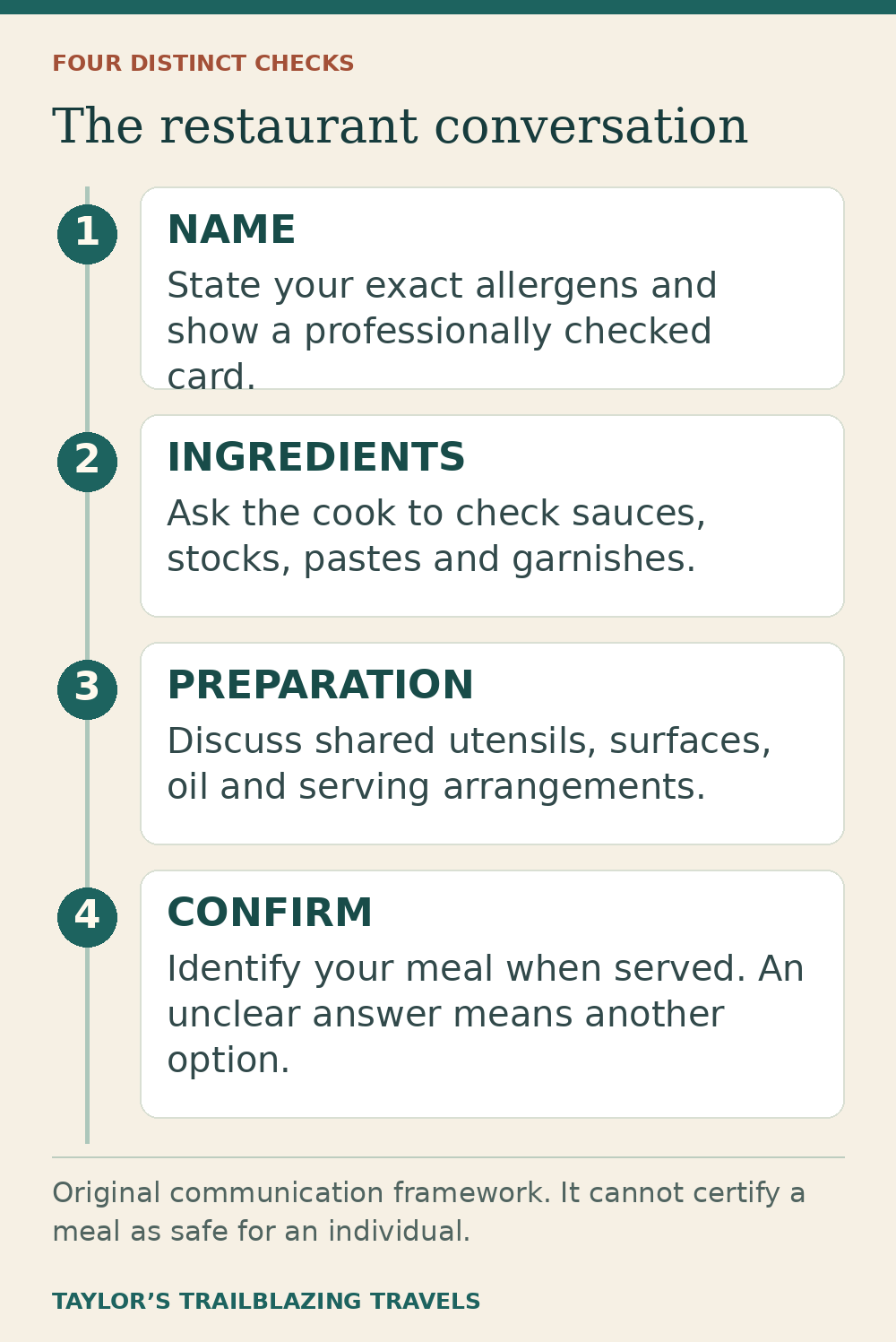
Ask the person serving the meal to identify which dish is yours and confirm that the agreed changes were made. Repeat the conversation at a new meal or with new staff; a previous successful visit does not establish the recipe or preparation today.
Look beyond the visible ingredients
Malaysian dishes vary by region, cook and recipe. Do not build a “safe dishes” list from a travel guide. Instead, use familiar examples to remember which parts of the meal need checking.
Belacan is a shrimp paste, as described by Tourism Melaka. Sarawak Tourism’s belacan bee hoon example includes a shrimp-paste gravy and other accompaniments. Tourism Malaysia describes dishes using peanut-based spice pastes, belacan and egg noodles. These are examples of ingredients that may be easy to miss when the dish is described only by its main protein or vegetable. [8][9][10]
| Part of the meal | Question to ask | Why the dish name is not enough |
|---|---|---|
| Sauce or sambal | What is in the complete sauce, including purchased components? | A paste can contain ingredients not visible on the plate |
| Soup or gravy | What stock, paste and seasoning is used? | A vegetable topping does not establish a vegetable-only broth |
| Noodles, bread or batter | Can the ingredient label or recipe be checked? | The main name does not describe every flour, egg or dairy ingredient |
| Garnish | What is added at plating, and with which utensils? | A late addition can change the meal |
| Drink or dessert | What milk, topping, powder or syrup is used? | The main flavour does not describe the whole recipe |
On smaller screens, scroll the table sideways.
The table is a questioning aid, not a claim that every version contains the same allergens. Ask about the actual recipe and supplier ingredients.
Labels such as halal, vegetarian, vegan, gluten-free or “no nuts” address different questions. None establishes that a dish is free from every allergen relevant to you or that shared preparation has been controlled. Do not substitute one label for your precise requirements.
For packaged food, read the complete label and seek help with unfamiliar language. Do not assume Malaysian labels or restaurant procedures follow UK rules, and do not use this article as a summary of Malaysian food-labelling law. If the information is insufficient for your needs, choose another food.
Cross-contact is a separate decision
Cross-contact means an allergen can reach a meal even when it is not an intended ingredient. Shared utensils, surfaces, hands, storage and cooking oil are relevant routes. The Food Standards Agency’s guidance explains these mechanisms and the need to tell customers when cross-contamination cannot be avoided. Those preparation principles are useful here; the guidance is not being presented as Malaysian law. [6]
Food Standards Scotland notes that cooking an allergen does not remove the risk. Picking off a garnish or reheating a meal is therefore not a reliable way to make it suitable. [7]
Ask how the kitchen will prepare the meal, not only whether it can leave something out. Can the cook check the complete ingredients? Is clean equipment available? Is the oil or cooking liquid shared? Will the dish be plated and served with the agreed controls? The relevant questions depend on your allergens and clinical advice.
A clear inability to accommodate is valuable information. It allows you to choose another meal without pretending the uncertainty has disappeared. Do not pressure a small kitchen into an answer it cannot support.
Hawker stalls, buffets and food tours
CDC’s allergy-travel guidance advises avoiding street food when ingredients cannot be reliably checked. Busy shared preparation and uncertain ingredient information are reasons not to use a meal as an experiment. That is a question of control and verification, not a claim that all local cooking is careless. [11]
For a buffet or food tour, ask who is responsible for each separate preparation and serving point. A guide knowing your allergy does not mean every vendor has received or understood the information. If the arrangement cannot meet your needs, select a different activity and eat separately.
Do not taste a small amount to test an uncertain dish. Use the alternative you planned instead.
Make accommodation and transport support your food plan
Accommodation can help by providing a known meal arrangement or facilities to prepare your own food, but neither a hotel star rating nor a kitchenette guarantees suitability. CDC recommends investigating self-meal preparation where practical. [3]
Ask a property what cooking equipment is provided, how it is cleaned, whether you can obtain suitable ingredients and whether refrigeration meets your needs. Discuss cross-contact with the actual kitchen team when relying on hotel meals. A reservation note is not a substitute for an operational answer.
Compare Kuala Lumpur accommodation options
Compare central Kuala Lumpur stays
These are general searches for a shortlist, not endorsements of allergy-safe accommodation. Confirm facilities and meal arrangements directly before booking.
Flights and other travel days
Ask the operating airline about its allergy policy, meal ingredients, special-meal limits and permission to carry suitable backup food. Repeat the information at check-in and boarding, and check the meal when served. Airline policies and the conduct of other passengers vary; a requested special meal does not establish an allergen-free cabin. [4]
Check food-import and security restrictions before carrying meals across borders. Allow for delays without relying on an unplanned airport or roadside meal. Keep prescribed emergency medication accessible throughout the journey. [3][4]
Connectivity helps communication, not emergency certainty
Save the card, addresses and important replies offline. A data connection can help contact a hotel or check a message, but it is not a substitute for a local calling plan, emergency contacts or staff assistance.
Airalo publishes Malaysia data plans; check device compatibility, coverage and plan terms. A data-only eSIM does not itself provide a conventional mobile voice service, so confirm how you will make necessary calls and do not rely on mobile data as the emergency plan. [12]
Use a meal decision process that allows you to walk away
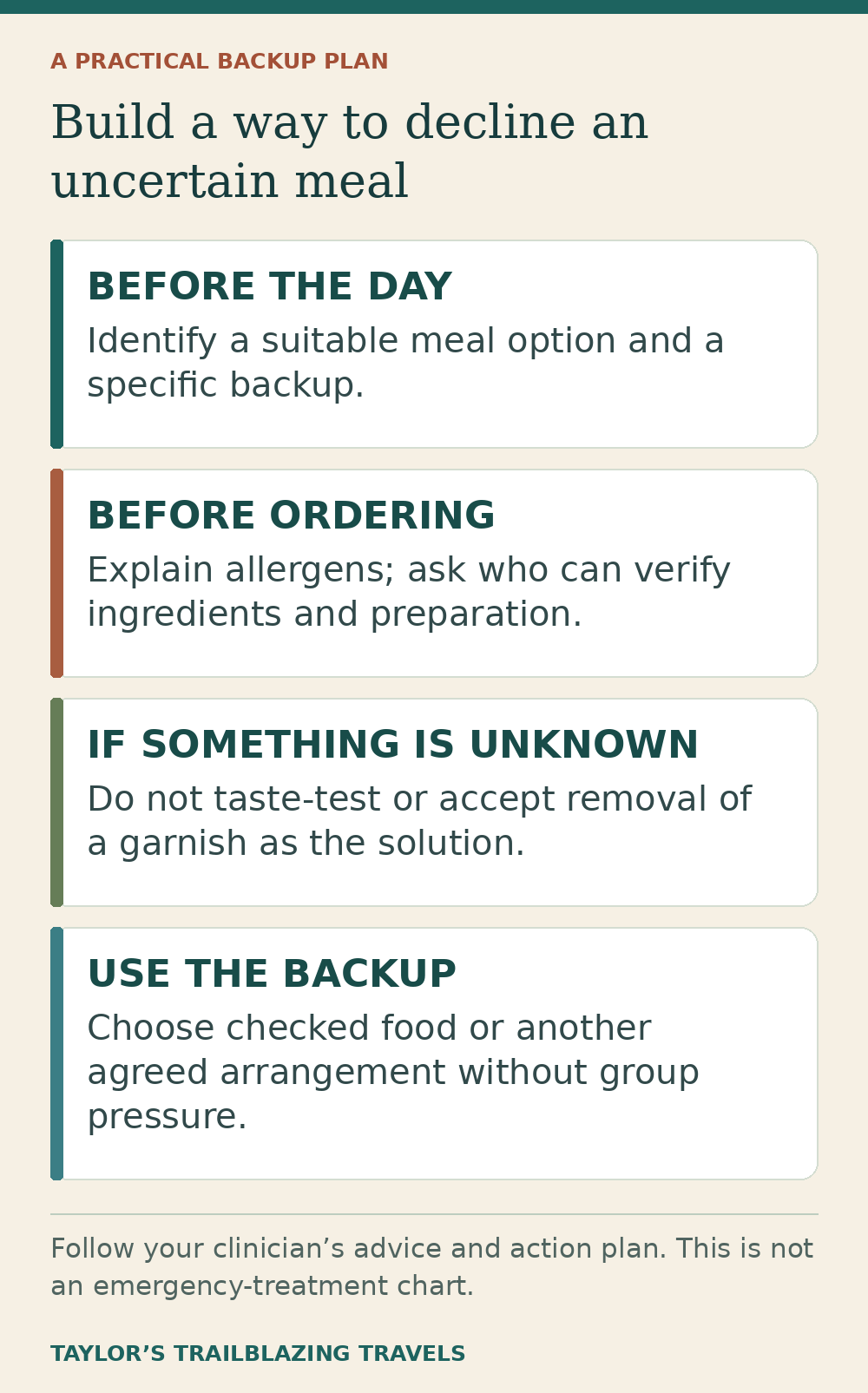
Before choosing a restaurant, decide what information you need and what your fallback is. That prevents hunger, a prepaid meal or group pressure from becoming the reason to accept an unresolved risk.
| Situation | Practical response |
|---|---|
| Staff understand the exact allergens and can investigate | Continue the ingredient and preparation conversation |
| The person taking the order does not know | Ask for the cook or manager; do not treat a guess as confirmation |
| One ingredient or shared process remains uncertain | Do not eat the uncertain meal; use another option |
| The agreed meal arrives with an unexpected garnish or sauce | Stop and ask for a new assessment, not removal at the table |
| The answer changes between staff members | Pause until the discrepancy is resolved |
On smaller screens, scroll the table sideways.
This is a communication process, not a scoring system that calculates a safe level of exposure. Your clinician’s advice and action plan remain the basis for your personal decisions.
A useful backup is specific: a suitable packaged meal or snack you have checked, another pre-contacted place, or access to agreed self-catering facilities. “We will find something” is less helpful at the end of a long transfer.
Tell travelling companions that declining food is an ordinary part of the plan. The person with the allergy should not have to defend the decision while hungry or under pressure.
Questions about eating with allergies in Malaysia
Is halal food suitable for someone with a food allergy?
Halal status does not answer your exact ingredient and cross-contact questions. Communicate the specific allergens and investigate the actual preparation.
Is a vegan meal automatically suitable for a milk allergy?
Do not assume that a label establishes the kitchen’s cross-contact controls. Ask about the actual ingredients and preparation in the same way you would for another meal.
Can a translation app replace a chef card?
Use professionally checked allergy resources for the essential message and your exact allergens. An app can support conversation, but an unverified translation should not be your only safety measure. [5]
Should I avoid Malaysia completely?
That is an individual decision based on your allergy, itinerary, support and access to suitable food and medical care. Discuss the real plan with your clinician rather than relying on a blanket reassurance or prohibition from a destination guide.
Does a previous mild reaction mean future exposure will be mild?
Do not use previous reaction severity to self-clear an uncertain meal. Follow your clinician’s advice and emergency plan; severe allergic reactions require immediate action. [1]
Can the guide recommend a guaranteed safe restaurant?
No such guarantee is made here. Recipes, staff and preparation arrangements change, and suitability is individual. Direct, specific communication is more important than a general review score.
Choose information, control and a credible fallback
The best meal plan is one that does not depend on a guess. Use a checked card, discuss the complete recipe and preparation, keep prescribed medicines with you, and make declining a meal a practical option.
Malaysia’s food culture offers variety, but variety is not a reason to relax a medical requirement. Build the trip around arrangements you can investigate and an emergency plan reviewed with your clinician.
Sources and editorial approach
Sources checked on 7 November 2026. This is a research-led guide, not a report of personal stays, tours or clinical assessment. Provider descriptions are identified as such; the decision frameworks and worked examples are editorial planning tools. Recheck changing access, operating conditions and travel advice before booking.
- NHS — Anaphylaxis.
- FCDO — Malaysia: health and emergency medical number.
- CDC Yellow Book — Severely Allergic Travelers.
- Allergy UK — Travelling Safely with Food Allergy.
- Allergy & Anaphylaxis Australia — Translated chef cards and phrases: Malay resources.
- Food Standards Agency — Allergen guidance: avoiding cross-contamination.
- Food Standards Scotland — Managing food allergies.
- Tourism Melaka — Cencaluk and Belacan.
- Sarawak Tourism Board — Belacan Bee Hoon.
- Tourism Malaysia — Lunch Like a True Malaysian.
- CDC Travelers’ Health — Allergies and Travel.
- Airalo — Malaysia eSIM: data-plan and compatibility information.
- Anaphylaxis UK — Adrenaline: when to give treatment.
Illustrations in this article were created for Taylor’s Trailblazing Travels. Third-party photographs, where used, are credited beside the image or in the source list.