Is Cambodia Safe to Visit? Practical Risks and Current Travel Advice
Make a decision about your actual route, transport and support needs—not a country-wide safety label.
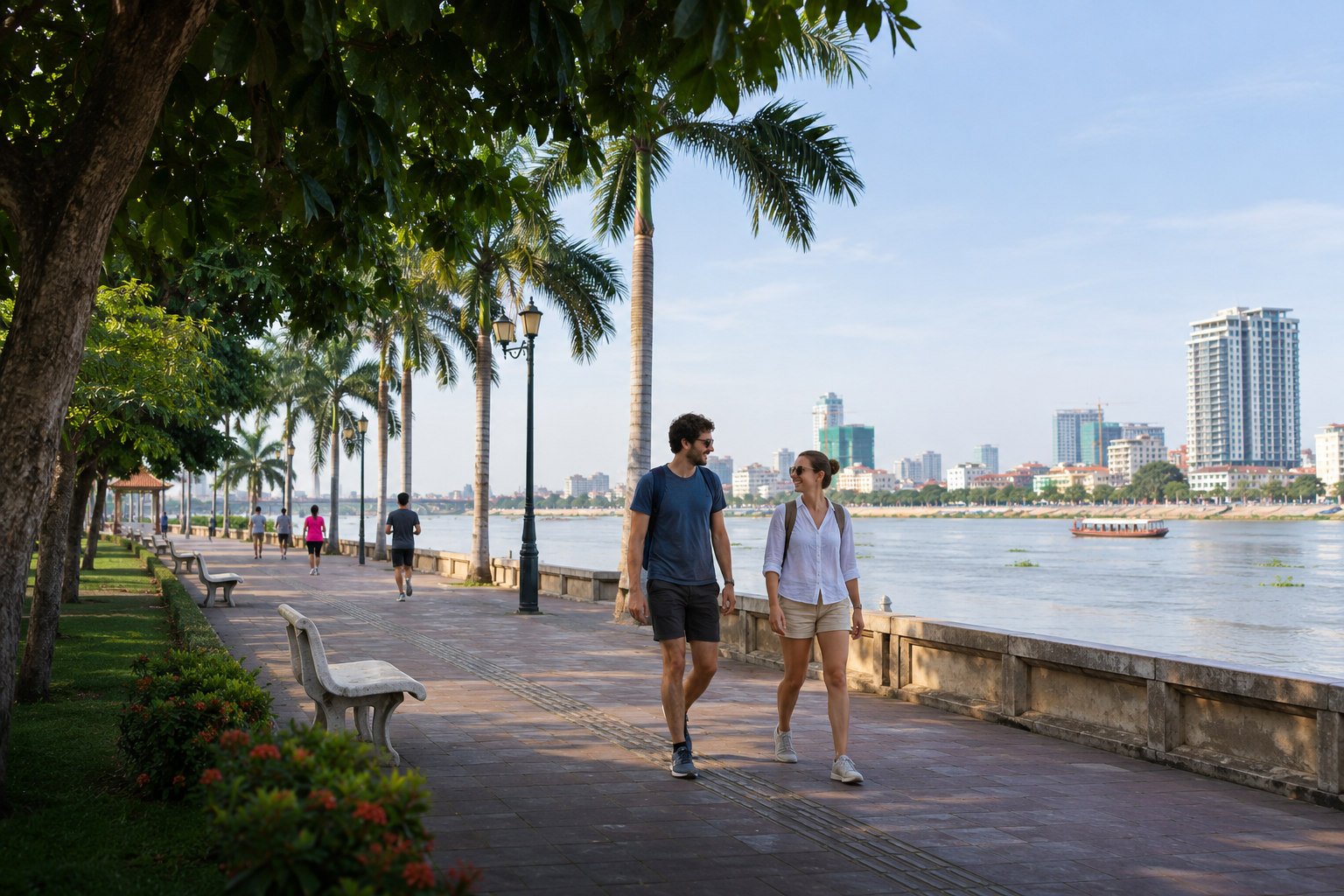
AI-generated everyday city scene; it is not evidence of current safety conditions.
“Is Cambodia safe to visit?” becomes a more useful question when you add where, how and with whom. A city stay with arranged transfers raises different decisions from remote trekking, island nightlife or a border crossing. The aim is to identify the parts of your plan that need changing before money is committed.
This guide combines current official advice with an original route-checking framework. It does not assign a safety score or imply that a popular destination, a good hotel or a group tour guarantees protection.
Affiliate disclosure: this guide contains affiliate links. If you book or buy through them, Taylor’s Trailblazing Travels may earn a commission at no extra cost to you.
Check the entire route against current official advice, including excursions and transfers.
Choose daylight journeys and assess the actual vehicle, driver and safety equipment.
Arrange travel-health advice and insurance that covers the itinerary and activities.
Save emergency contacts, accommodation details and insurer assistance offline.
Current Cambodia travel advice: start with the route
The UK warning concerns the zone within 20km of the Thailand land border. FCDO describes a tense situation following fighting in 2025 and the ceasefire of 27 December. It also identifies closed border temples and unexploded ordnance. Travel against FCDO advice can affect insurance validity.[1]
A country-wide headline can obscure two opposite mistakes: treating every Cambodian destination as subject to the same geographic warning, or assuming everything outside the boundary is safe. Neither follows from the advisory.
Check the actual road and excursion location, not only the name of the province or the hotel. Do not rely on an old itinerary that crosses from Thailand or includes a border temple. Replace that part of the route with an independently verified alternative; an advertised bus ticket or tour is not evidence that a border closure or advisory has ended.
Read the full FCDO Cambodia advice before paying, again before departure and during the trip if circumstances change. Check your airline and any transit-country advice too.
Is Cambodia safe to visit for your particular trip?
Use this three-outcome framework. It is an editorial planning tool, not a statistical risk rating. A “prepare” outcome means the issue needs a plan; it does not certify that the trip is safe.
Swipe or scroll the table to see every column.
| Question | If the answer is yes | Practical outcome |
|---|---|---|
| Does the route enter an area covered by advice against travel? | The proposed holiday includes an area covered by that advice | Stop and redesign that part |
| Does the journey depend on a closed border or an unconfirmed connection? | You cannot verify the route | Rework before booking |
| Would you need unfamiliar motorbike riding or an avoidable overnight road transfer? | The schedule creates an extra exposure | Change transport or reduce stops |
| Would an illness leave you far from suitable care? | Your health needs and location do not fit comfortably | Reconsider the base with clinical and insurer advice |
| Can you explain how to get help without a working phone? | You have an offline backup and someone knows the plan | Prepare and keep it current |
| Are the insurer’s exclusions unclear? | You do not know whether an activity is covered | Clarify before committing |
For a first visit, reducing the number of transfers can do more for a manageable trip than collecting every recommended attraction. For a traveller who needs reliable access to particular care, proximity to that care should lead the accommodation decision. For an experienced traveller, familiarity does not remove the need to check a changed border situation.
To reduce rushed moves, put your own transfer allowances into the Itinerary Pace Checker. Its score describes pacing, not the safety or legal status of a route.

Make transport choices before adding more stops
Australian government advice highlights dangerous road conditions, unsafe driving and greater risks at night outside major cities. It also recommends checking ride-hailing vehicle details and not handing over a passport as a motorcycle-rental deposit.[3] These are useful practical checks for UK visitors too; UK licence and insurance requirements must be checked separately.
For long journeys
- Prefer a daylight departure with time to reach accommodation without rushing.
- Ask about seatbelts, the vehicle used, luggage storage, stops and the actual pickup/drop-off points.
- Check recent feedback about driving behaviour, not only whether passengers liked the price.
- Leave enough flexibility to reject an unsuitable vehicle or an apparently impaired driver.
A booking platform can help compare departures, but its listing is not an independent safety inspection. Likewise, a private car is not automatically safer than a coach: the driver, vehicle and journey conditions still matter.
For scooters and motorcycles
Do not learn to ride in unfamiliar traffic simply because rental looks inexpensive. Confirm the required licence, permission to ride and insurance cover for both rider and passenger; wear a properly fitting helmet. An owner agreeing to rent you a bike does not establish that you are legally or adequately insured to use it.
For island and river boats
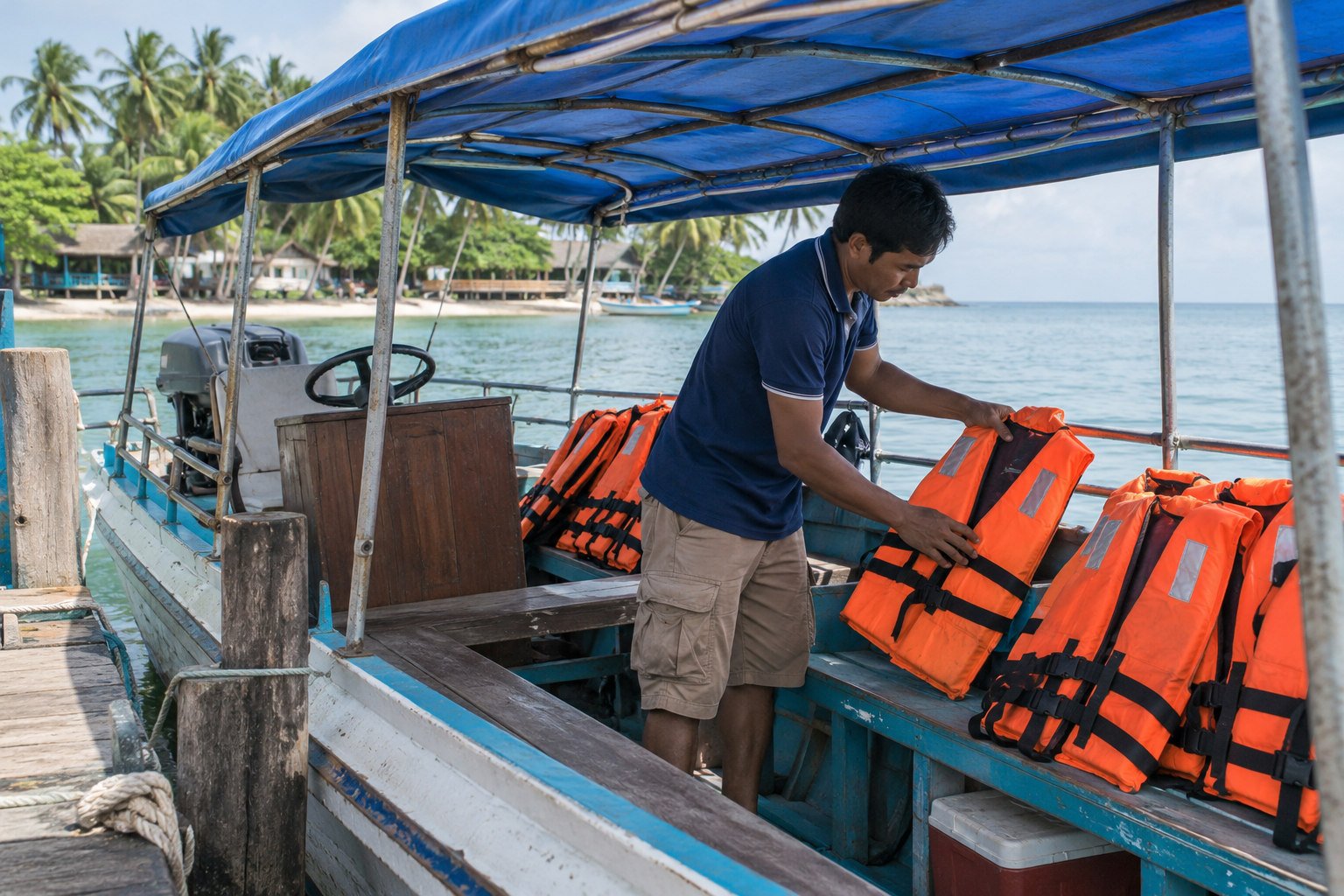
Check that there is an appropriate lifejacket for every person, including children, and that passenger limits and safety procedures are being followed. Government advice warns that modern-looking boats can still lack adequate equipment or be overcrowded.[3] Decline a departure that looks unsafe. Keep enough time in the itinerary to cope with a cancelled sailing rather than treating the last boat before an international flight as a certainty.

For a suitable main-route comparison, you can compare Phnom Penh–Siem Reap options on 12Go. Check the actual daytime departure and operator. The platform is a booking comparison service, not a safety certification.
Reduce theft exposure and recognise pressure tactics
FCDO highlights phone and bag snatching, including from pedestrians and people in open vehicles. It also reports sexual assaults in tourist areas and warns against quickly trusting strangers offering transport or invitations.[2]
Step away from the kerb before using a phone. Keep valuables within the vehicle rather than by an open edge, and carry only what you need for the outing. Separate a backup payment method from your everyday wallet. If confronted, prioritise your safety over trying to recover belongings. The US State Department also warns against resisting a robbery attempt.[12]
Agree the destination and fare or check the app booking before getting in. For a disputed charge, move the discussion to a staffed, public place where possible; a confrontation on an isolated street is a poor way to resolve a small payment.
For payments, use a secure ATM location, shield the keypad and monitor transactions. Smartraveller warns about card skimming and counterfeit notes.[3] Check change while still at the counter, particularly if a note has been exchanged out of sight.
High pay for vague work, pressure to surrender a passport, or an insistence that you travel immediately should stop the conversation. FCDO identifies employment scams that have led to trafficking and confinement.[2] A holiday acquaintance is not a substitute for independently verifying an employer.

Treat alcohol and the journey home as one decision
FCDO reports drink spiking and serious methanol poisoning in Cambodia.[2] For an evening out, decide how you will get home before drinking, keep your drink in sight and stay with people you trust.
Official Travel Aware guidance recommends avoiding unlabelled alcohol, free shots and suspiciously cheap spirits, and choosing sealed drinks from reputable, licensed premises. Methanol cannot be reliably detected by smell or taste; a drink tasting normal does not demonstrate that it is safe.[4]
Seek urgent medical help for suspected poisoning or spiking. Unusual illness after alcohol—especially blurred vision, breathing problems, severe abdominal pain or worsening symptoms—must not be dismissed as a hangover or left to “sleep off”.[4]
For solo travellers, a sociable accommodation base and pre-arranged transport can reduce decisions made while tired or affected by alcohol. This is a planning recommendation, not a claim that an organised party or particular venue has been inspected.
Back to contents ↑Prepare for illness, insects and limited access to care
Arrange a travel-health consultation before departure, ideally with time to complete any recommended protection. FCDO recommends starting health checks at least eight weeks before travel; late advice is still better than none.[5] Take the actual itinerary, activities and medical history to the appointment rather than asking for a single “Cambodia vaccination list”.
NaTHNaC identifies dengue and rabies risks and distinguishes malaria risk by area. The need for malaria tablets depends on an individual assessment; it should not be inferred solely from the country name.[6] Use the current TravelHealthPro Cambodia guidance with a qualified travel-health professional.
Use suitable insect repellent according to its label, cover exposed skin when practical and choose screened or air-conditioned accommodation where available. Bite prevention matters during the day as well as at night.[7] Avoid handling animals. After a possible rabies exposure, thoroughly wash the wound and obtain urgent medical assessment, even if the injury appears small or you had pre-travel vaccination.[6]
Choose food that is thoroughly cooked and served hot, use safe drinking water and pay attention to hand hygiene.[13] CDC guidance also recommends avoiding unsafe freshwater exposure and planning for heat and sun.[11] Build shaded breaks into sightseeing rather than making an ambitious walking schedule the priority.
Keep essential medicines in their original packaging and check Cambodian rules before travelling.[12] Consider whether a remote stay gives realistic access to the care you might need. FCDO specifically advises checking local healthcare capability and insurance for treatment or evacuation.[5]
Back to contents ↑Stay on established routes and respect local rules
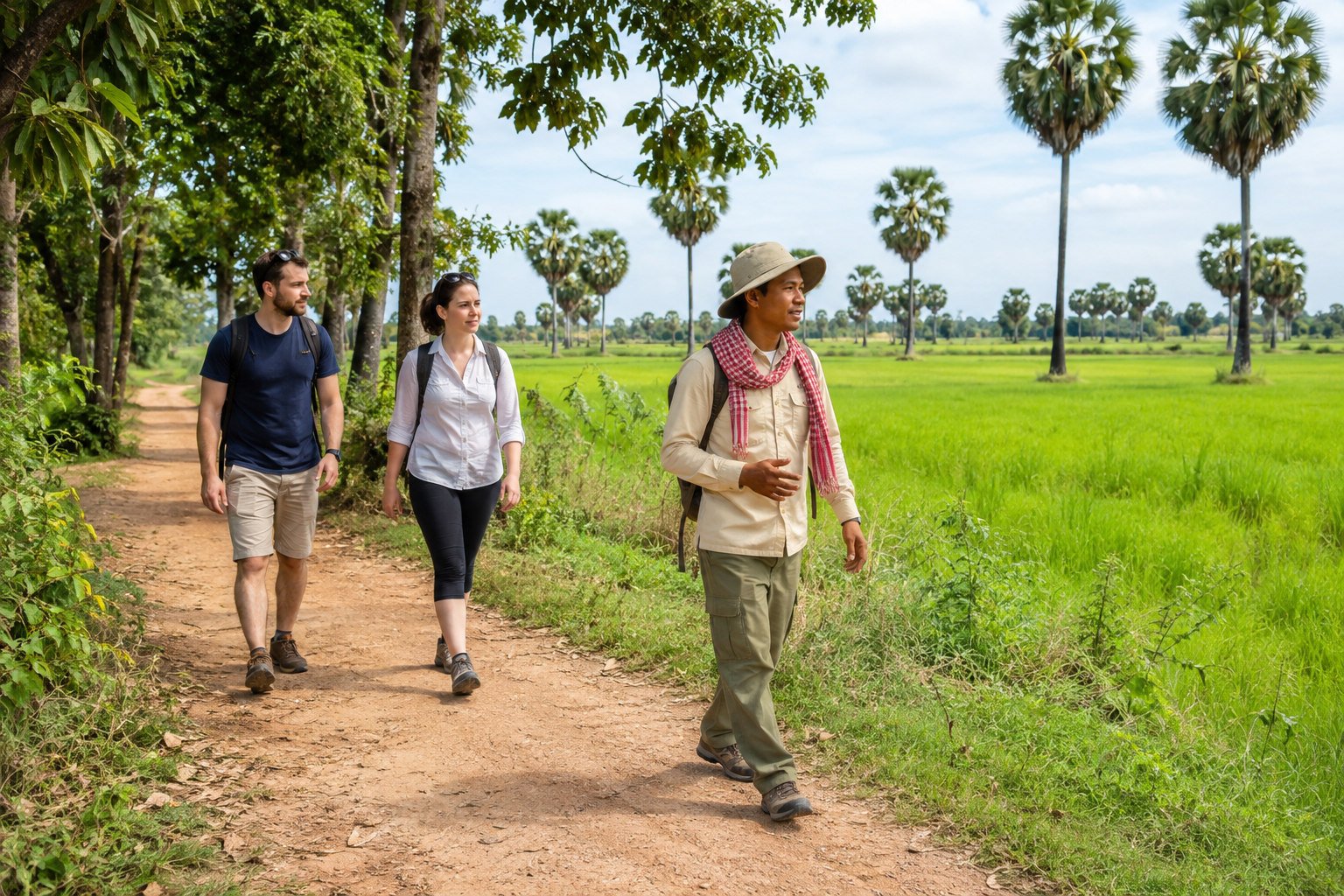
The US State Department warns of landmines and unexploded ordnance in remote parts of Cambodia. Keep to established routes with local guidance and leave unfamiliar metal objects untouched.[12] A shortcut for a photograph is not worth the uncertainty. Use established trails and a reputable local guide for remote activities.
For a boat trip, waterfall visit or trek, ask what would make the operator cancel and how an injured traveller would be helped. Treat heavy rain, rising water and official weather warnings as reasons to change the day’s plan. The absence of a barrier or warning sign should not be read as proof that swimming, climbing or entering a cave is appropriate. The US advice notes that dangerous areas and activities are not always signposted.[12]
Avoid demonstrations. Illegal drugs, including cannabis, can bring severe penalties in Cambodia; do not assume that the rules in a neighbouring country apply.[2] Do not carry items for someone else when you cannot verify their contents.
At temples, dress respectfully and follow site rules. For photography, ask before photographing people and keep away from military or other sensitive areas.[2] These decisions are also about avoiding preventable conflict with the people and authorities hosting your visit.
Make an emergency plan you can actually use
Check cover for the full journey, declared medical conditions, planned activities, medical treatment and evacuation. Read exclusions for alcohol, motorcycle use and travel against official advice. Keep the insurer’s assistance number and policy details accessible to a companion or someone at home.[8]
Swipe or scroll the table to see every column.
| Need | Contact | Backup action |
|---|---|---|
| Police | 117 | Ask accommodation staff for immediate local assistance or directions to the appropriate station |
| Fire | 118 | Move to a safe location and give a precise address |
| Ambulance | 119 | Ask local staff to help contact a suitable medical facility; alert your insurer |
| British consular help | British Embassy Phnom Penh | Use the official emergency contact route |
FCDO warns that local emergency and police responses may be limited, including unanswered calls. A police report should be free.[9] Save your accommodation’s name, address and phone number offline; ask staff which medical service they would contact before you urgently need one.
If a passport is lost or stolen, use the embassy’s official guidance for reporting it and obtaining replacement travel documentation. The embassy says a police report is required locally before an emergency travel document can be issued.[10] A phone photograph of a passport helps you identify it, but does not replace the travel document.
If mobile data would help with directions or contacting accommodation, you can compare Airalo eSIM options and select Cambodia after checking device compatibility and coverage. Do not rely on an eSIM for emergency access: a data-only plan may not support ordinary voice calls. Keep the offline numbers and local backup arrangements above.
Back to contents ↑A short safety check before every move
- Has official advice changed for the next destination or the route to it?
- Are the departure time, vehicle, pickup point and arrival address confirmed?
- Can the day be shortened if weather, illness or transport changes?
- Are money, essential documents and a backup payment method separated?
- Does someone know the plan and when to expect contact?
- Can you reach help if the phone battery or mobile data fails?
These checks are deliberately practical. They should lead to a changed booking or a workable backup when needed, rather than a reassuring list that nobody uses.
Back to contents ↑Useful questions
Does the Thailand border warning cover the whole of Cambodia?
The UK geographic warning is for the stated zone within 20km of the Thailand land border. Read the full advice and map for the journey you plan; being outside that zone does not remove ordinary travel risks.[1]
Is Cambodia suitable for a first solo trip?
It can be considered if the actual itinerary and support arrangements suit your experience and comfort level. A short route, staffed accommodation, daylight transfers and an organised activity can reduce unfamiliar decisions. Someone who needs extensive support or dependable specialist medical access should assess those needs before booking.
Is a group tour automatically safer?
No. It can help with organisation, but you still need to check the route, vehicle standards, activity arrangements, insurance and the operator’s response if something changes. Group size is not a safety certificate.
Should I avoid all street food?
Assess the handling of food and water, not simply the venue’s appearance. CDC recommends avoiding street vendors; if you choose street food, follow the same precautions as elsewhere, including food cooked and served steaming hot. Avoid raw or undercooked choices and use safe drinking water.[13]
What if advice changes after I book?
Read the new advice, contact the travel provider and insurer, and review the affected part of the route. Keep their responses and the applicable booking conditions. Do not assume that every change automatically creates a refund entitlement.[9]
Your next decision
A sensible Cambodia decision starts with an available route away from advised-against areas, then asks whether the transport, health support and contingency plans fit the traveller. If a border crossing, risky transfer or remote stay is the weak point, change that element before committing. If the necessary support cannot be arranged, choose a different route or postpone rather than relying on a broad claim that the country is safe.
Sources
Official information and provider details were reviewed on 14 November 2026. The route choices, time allowances and budget examples are editorial planning analysis, not live booking quotations. Check changing rules and services again before travelling.
- FCDO: Cambodia warnings and insurance — checked 14 November 2026.
- FCDO: Cambodia safety and security — checked 14 November 2026.
- Australian Government Smartraveller: Cambodia, transport and money precautions — checked 14 November 2026.
- UK Travel Aware: spiking and methanol poisoning — checked 14 November 2026.
- FCDO: Cambodia health — checked 14 November 2026.
- NaTHNaC TravelHealthPro: Cambodia health risks — checked 14 November 2026.
- NaTHNaC TravelHealthPro: insect and tick bite avoidance — checked 14 November 2026.
- FCDO: foreign travel insurance — checked 14 November 2026.
- FCDO: getting help in Cambodia — checked 14 November 2026.
- British Embassy Phnom Penh: assistance and emergency travel documents — checked 14 November 2026.
- US Centers for Disease Control and Prevention: Cambodia traveller health — checked 14 November 2026.
- US Department of State: Cambodia landmines, tourism safety and travel precautions — checked 14 November 2026.
- US Centers for Disease Control and Prevention: food and drink considerations — checked 14 November 2026.
Illustrations in this article were created for Taylor’s Trailblazing Travels. Third-party photographs, where used, are credited beside the image or in the source list.