Cambodia Travel Guide for First-Time Visitors: Plan a Practical Trip
Build a trip around the places you want to experience, with enough time left to enjoy them.
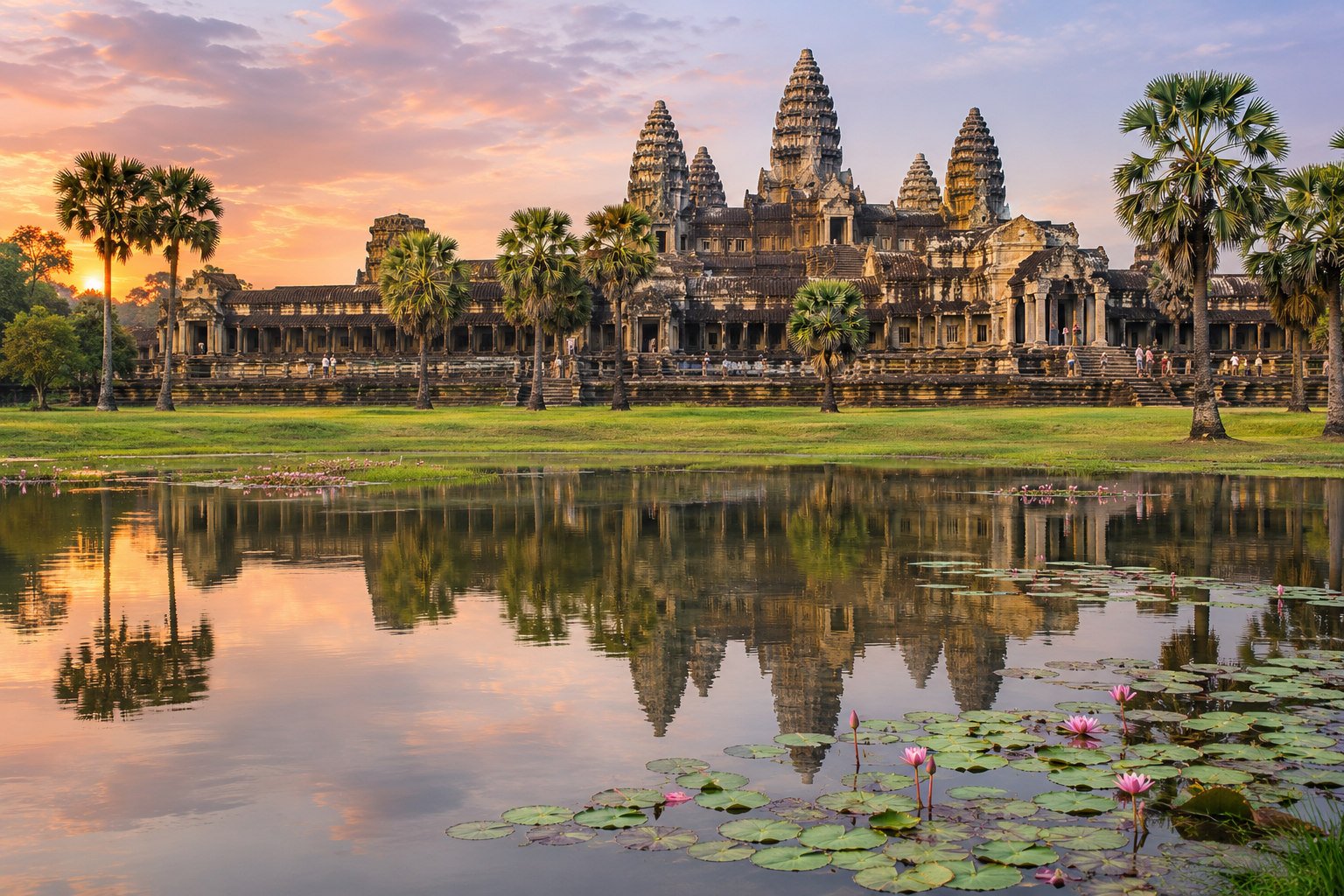
AI-generated illustration inspired by Angkor Wat; not an on-location photograph.
This Cambodia travel guide for first-time visitors starts with a decision that makes the rest easier: decide how much time belongs to Angkor, then decide whether another region earns the journey needed to reach it. A short list of places can make a richer holiday than a long list of transfers.
Siem Reap and Phnom Penh provide a workable first-trip backbone. Angkor is an extensive archaeological landscape, rather than one temple to tick off; the capital adds a different perspective on contemporary life and Cambodia’s history.[2] Add riverside Kampot or an island stay because that experience matters to you, not because a suggested route says you must.
Affiliate disclosure: this guide contains affiliate links. If you book or buy through them, Taylor’s Trailblazing Travels may earn a commission at no extra cost to you.
Siem Reap for Angkor; Phnom Penh for the capital and historical context.
A six-hour bus service needs a larger door-to-door allowance.
A calmer extra night can be worth more than another destination.
Use KTI for Techo and SAI for Siem Reap Angkor; confirm your ticket.
Three checks before you commit to a route
Check the journey, not just the destination
The Thailand border restriction matters even if the places you want to visit are elsewhere. An old Bangkok–Siem Reap bus itinerary, an advertised route page or an accepted visa category does not establish that a crossing is operating. Use the current FCDO map and official border information before planning any overland connection.[1]
For a first standalone trip, compare arrival in Siem Reap and departure from Phnom Penh with a return flight through one city. Judge the total cost and the extra travel day involved, rather than choosing solely by the headline airfare.
Separate the visa from the arrival declaration
For a full British-citizen passport, the FCDO specifies at least six months’ passport validity on arrival and a visitor visa. Air arrivals must also submit the free e-Arrival declaration within the seven days before arrival. Other passport types need their own check.[3] The official tourist e-visa currently advertises US$30, single entry, three months’ validity from issue and a one-month stay; those are different time limits.[4]
Use the current airport
Techo International Airport, code KTI, replaced the former Phnom Penh airport in September 2025.[5] The official e-visa portal also identifies Siem Reap Angkor International Airport as SAI.[4] Send your hotel the airport code, flight number and arrival date when arranging a pickup. An old transfer listing with the former airport name needs clarification.
Back to contents ↑Choose your Cambodia bases by the holiday you want
The following selector is an editorial planning framework, not a ranking of the country’s destinations. Its suggested stays assume that arrival, departure and travel between bases consume part of the holiday.
Swipe or scroll the table to see every column.
| Base | Choose it for | Starting allowance | The trade-off |
|---|---|---|---|
| Siem Reap | Angkor, guided interpretation and time between temple visits | 3–4 nights | Several temple days only make sense if you enjoy archaeological sites |
| Phnom Penh | City life, museums and historical context | 2–3 nights | Leave space after emotionally demanding visits |
| Kampot | A slower riverside base and countryside excursions | 2–3 nights | It adds another transfer and may require a return towards your departure airport |
| Koh Rong area | A deliberate beach break | 3–4 nights | Road and boat logistics, the correct island pier and weather all matter |
If Angkor is the main reason for travelling, keep the longer stay in Siem Reap and remove a marginal stop elsewhere. If temples have limited appeal, one carefully chosen day may be enough; give the remaining time to food, the capital or a slower base. UNESCO’s description of Angkor makes clear that the park contains multiple monuments and landscapes, so planning a focused selection is sensible.[2]

Do you actually want to visit the historical sites?
Tuol Sleng is a genocide memorial and museum, not a light sightseeing stop. Its own visitor information warns that exhibits may be unsuitable for children aged 14 and under.[9] Read the description before deciding, especially with children, and avoid scheduling an upbeat activity immediately afterwards simply to fill the day.
For a first trip, choose no more than one extension beyond the two main bases unless you have enough time to make the transfers feel worthwhile. A Kampot stay and an island stay solve different wishes; neither is compulsory.
A seven-day first trip that leaves room to look around
This original example assumes arrival in Siem Reap on day one and departure from Phnom Penh on day seven. It contains six hotel nights, one intercity travel day and four full days without a major move. It is a pacing model, not a checked flight combination or a promise of opening hours.
Swipe or scroll the table to see every column.
| Day | Overnight | A realistic main purpose |
|---|---|---|
| 1 | Siem Reap | Arrive, reach the hotel and settle in; keep sightseeing optional |
| 2 | Siem Reap | A focused Angkor visit with breaks and suitable transport |
| 3 | Siem Reap | Another temple selection or a non-temple day, according to interest |
| 4 | Phnom Penh | Intercity transfer; a relaxed evening if arrival permits |
| 5 | Phnom Penh | One substantial museum or historical visit, with time afterwards |
| 6 | Phnom Penh | City exploration, food, a market or another chosen attraction |
| 7 | — | Airport journey and departure; do not count on a full sightseeing day |

Giant Ibis advertises six hours for the Siem Reap–Phnom Penh route. Confirm the duration of your actual daytime departure. Add hotel-to-terminal travel, boarding, arrival transfer and a delay margin before putting it in your diary.[8] Reserving most of that day for the move is more useful than pretending it also contains a full sightseeing programme.
With ten days, first add breathing room where you will use it. You could deepen the two-base stay, or add one extension after calculating the extra journeys. With two weeks and a strong beach preference, protect several consecutive island nights and a mainland buffer before your international departure.
Enter your own overnight stops into the Trip Itinerary Planner, then use the Itinerary Pace Checker with realistic transfer hours. These tools organise your inputs; they do not verify departures, entry rules or route feasibility.
Back to contents ↑Choose a season you can plan around
Cambodia’s broad dry season runs from November to April. Rain can still affect a trip around the transition months; Canadian travel advice describes a rainy period extending from May into November and warns that heavy rain can disrupt roads and services.[6] Treat a seasonal label as background, not a forecast for your dates.
Swipe or scroll the table to see every column.
| Your priority | Planning response |
|---|---|
| Outdoor sightseeing with fewer weather decisions | Start by comparing dates in the dry season, then check conditions and the total booking cost |
| Travel during wetter months | Use fewer bases, retain cancellation flexibility and keep an indoor alternative |
| Heat-sensitive travellers | Schedule demanding outdoor visits early, choose effective cooling and preserve a long midday break |
| An island stay is essential | Ask about the actual boat route, weather policy and transfer arrangements before paying |
Check whether your dates coincide with a holiday or festival before deciding that an unusually expensive room is representative. If flexibility is limited, adapt the itinerary to the conditions rather than trying to complete the same packed schedule in every season.
Back to contents ↑Make the journeys work from door to door
Between Siem Reap and Phnom Penh
Compare a daytime coach, a properly arranged private transfer and a flight where an appropriate service is available. A flight’s short airborne time does not include airport travel or check-in. A private vehicle is most useful when its timing or stops solve a real need; agree the whole price and the vehicle arrangements.
For the main overland corridor, check the operator’s route information and compare Phnom Penh–Siem Reap options on 12Go. Compare the actual departure point, arrival point, luggage terms and final fare for your date; a route listing is not a reservation.
Within a base
Ask the hotel to explain the pickup point and the return arrangements for a tuk-tuk or car. Keep the address saved offline, and agree whether the price includes waiting. The FCDO highlights road risks and motorcycle-related bag snatching; keeping a phone or bag away from the open roadside is a practical habit.[10]
Before adding an island
Confirm the precise beach or pier your accommodation uses. Then match the boat to that location and check what happens if a departure changes. Keep the hotel and boat confirmation together; two bookings mentioning the same island are not necessarily a convenient connection.
Choose the location before the room upgrade
For a short Siem Reap stay, a well-located room with reliable cooling and a clear early-departure arrangement can be more useful than a larger room far from your plans. If nightlife noise would spoil your sleep, check recent comments about the exact building and room location.
In Phnom Penh, plot the activities you have actually selected. Compare access, traffic, noise and the ease of getting back in the evening. A riverside view and a convenient base for your particular itinerary are separate benefits.
Compare Siem Reap accommodation on Agoda with Siem Reap stays on Booking.com. For the capital, browse Phnom Penh options on Agoda or Phnom Penh stays on Booking.com. These are destination searches; enter your dates and compare the same room, taxes, breakfast and cancellation terms.
If stairs, uneven paths or a vehicle step are difficult, ask for specific photographs and dimensions relevant to your needs. A general accessibility label cannot tell you whether the particular room and journey will work.
Back to contents ↑Build the budget around the expensive days
Start with room nights, daily meals and transport, then add the items that do not fit neatly into a daily allowance: entry paperwork, Angkor, airport journeys, guides and intercity travel. A cheap meal does not make a day with a private transfer and several admissions cheap.
Swipe or scroll the table to see every column.
| Item | Advertised charge | What to allow separately |
|---|---|---|
| Tourist e-visa | US$30 per applicant | Payment costs, if applicable; use the official service |
| Angkor one-day pass | US$37 per eligible adult visitor | Transport, guide and meals |
| Angkor three-day pass | US$62, usable within seven days | The extra time and transport needed to use it |
The visa and Angkor figures are published official fees, not sampled accommodation or tour prices.[4][7] If you intend to enter Angkor on two separate days, the US$62 pass costs less than buying two US$37 day passes. If you only want one day, the larger pass is not a saving.
As a simple sensitivity check, an extra US$20 per room for six nights adds US$120 to a couple’s trip, or US$60 each. That makes the room upgrade easier to compare with a guide or an extra night. Use your own quotes rather than treating this illustration as a hotel price.
For rough GBP comparisons, this guide uses £1 = US$1.30, a rounded planning rate informed by KB PRASAC’s 13 November 2026 published GBP/USD rates. It is not a rate you are guaranteed to receive; US$62 is about £48 on that basis.[13]
The Travel Budget Calculator lets you combine rooms, people and spending days. Enter GBP throughout and replace the example figures. Add your flights, insurance, visa and intercity costs explicitly, then reserve a separate contingency.

Cambodian riel (KHR) and US dollars are both used. Check the currency before paying, keep dollar notes intact and carry a backup payment method rather than depending on one card. Canadian travel advice notes the importance of undamaged US banknotes.[6]
Back to contents ↑Small practical choices that improve the trip
At Angkor
Choose comfortable footwear with grip and clothing suitable for a religious and heritage site. Follow the visitor code, route signs and restrictions rather than climbing on stonework for a photograph. APSARA’s visitor information links the code to protecting the monuments and local culture.[14]
A guide is worthwhile if interpretation is what will make the temples meaningful to you. Compare Siem Reap activities on GetYourGuide with Siem Reap tours on Viator. Check guide language, group size, transport and whether the official Angkor pass is included; do not assume a tour price includes admission.
Food, water and health planning
Choose food handling you are comfortable with, explain any allergies clearly and carry drinking water appropriate for the day. Arrange destination-specific health advice before travelling. The FCDO recommends checking vaccinations and health risks and having insurance that covers treatment and evacuation; access to appropriate care needs planning.[11]
Build shade, cooling and breaks into the day instead of relying on willpower once you are hot and tired. Keep regular medication and key documents in your hand luggage, with a plan for delays.
Connectivity without relying on it for everything
Save hotel addresses, booking details and emergency contacts offline. If you want mobile data, check your device’s eSIM support and network-unlocked status first; Airalo’s compatibility guidance distinguishes these requirements.[12] You can compare Airalo eSIM options and select Cambodia. Check coverage, allowance, validity and whether voice calls are included before paying. Offline copies remain useful even with a data plan.
Back to contents ↑Book in the order that removes the biggest uncertainties
- Check your passport, entry route and the latest official travel advice.
- Choose international arrival and departure points and count the usable days.
- Reserve the main overnight bases with terms you understand.
- Confirm the long transfers and any boat connection that constrains the route.
- Choose the Angkor pass and guided visits around the days you genuinely want.
- Keep a final travel buffer and leave lower-priority activities flexible.
The common first-trip mistakes are connected: choosing an appealing extra place, undercounting the journey, then booking something non-refundable at the other end. Test the route before adding the activity. Also avoid confusing an e-Arrival confirmation with a visa, booking a pickup at the former airport, or treating an illustrated budget as a live quote.
If your Cambodia visit forms part of a wider journey, read the Vietnam–Cambodia border journey comparison for the particular crossing under consideration. It is a different planning problem from a simple flight-based visit.
Back to contents ↑Useful questions
Is Cambodia a sensible first independent trip in the region?
A focused route with pre-arranged first-night accommodation and researched transfers can reduce the planning burden. Decide whether you are comfortable managing heat, busy roads, changing transport arrangements and the distance to suitable medical care. A tour or private transfer can solve individual practical needs without requiring every day to be organised for you.
Must I visit both Siem Reap and Phnom Penh?
No. They are a useful starting framework, not a compulsory pair. A short Angkor-focused stay can work from Siem Reap alone. Choose Phnom Penh because the city and its historical context interest you or because it fits your travel arrangements, not merely to complete a checklist.
Should I book every activity before leaving home?
Fix the bookings that control the route first: flights, overnight bases, important transfers and anything with limited capacity that you particularly want. Keep ordinary sightseeing flexible where possible, especially after a long journey or during changeable weather.
Does a longer trip always mean more places?
No. Extra time can make the same route better through a rest day, another focused Angkor visit or a slower approach to the capital. Add a destination only when the experience is worth the transfer and the nights it takes away from somewhere else.
Your next decision
For a first Cambodia trip, build a strong two-base plan before extending it. Give Angkor the time your interest warrants, approach the capital’s history thoughtfully, and price every move in both money and holiday time. Once that plan works, add the coast or a riverside stay only if it improves the holiday you actually want.
Sources
Official information and provider details were reviewed on 14 November 2026. The route choices, time allowances and budget examples are editorial planning analysis, not live booking quotations. Check changing rules and services again before travelling.
- FCDO — Cambodia warnings and insurance — checked 14 November 2026.
- UNESCO World Heritage Centre — Angkor — checked 14 November 2026.
- FCDO — Cambodia entry requirements — checked 14 November 2026.
- Cambodian Ministry of Foreign Affairs — official e-visa information and entry ports — checked 14 November 2026.
- VINCI Airports — Techo International Airport — checked 14 November 2026.
- Government of Canada — Cambodia climate and seasonal travel risks — checked 14 November 2026.
- Angkor Enterprise — official ticket options and prices — checked 14 November 2026.
- Giant Ibis — Siem Reap to Phnom Penh route — checked 14 November 2026.
- Tuol Sleng Genocide Museum — visitor information — checked 14 November 2026.
- FCDO — Cambodia safety and security — checked 14 November 2026.
- FCDO — Cambodia health advice — checked 14 November 2026.
- Airalo — device and eSIM compatibility guidance — checked 14 November 2026.
- KB PRASAC Bank — foreign exchange rates dated 13 November 2026 — checked 14 November 2026.
- APSARA National Authority — visitor information and Angkor code of conduct — checked 14 November 2026.
Illustrations in this article were created for Taylor’s Trailblazing Travels. Third-party photographs, where used, are credited beside the image or in the source list.