Cambodia · Wildlife choices
Irrawaddy Dolphin Watching near Kratie: Ethical Tour Choices
Compare boat and kayak outings, understand the published costs and ask the questions that matter before heading onto the Mekong.
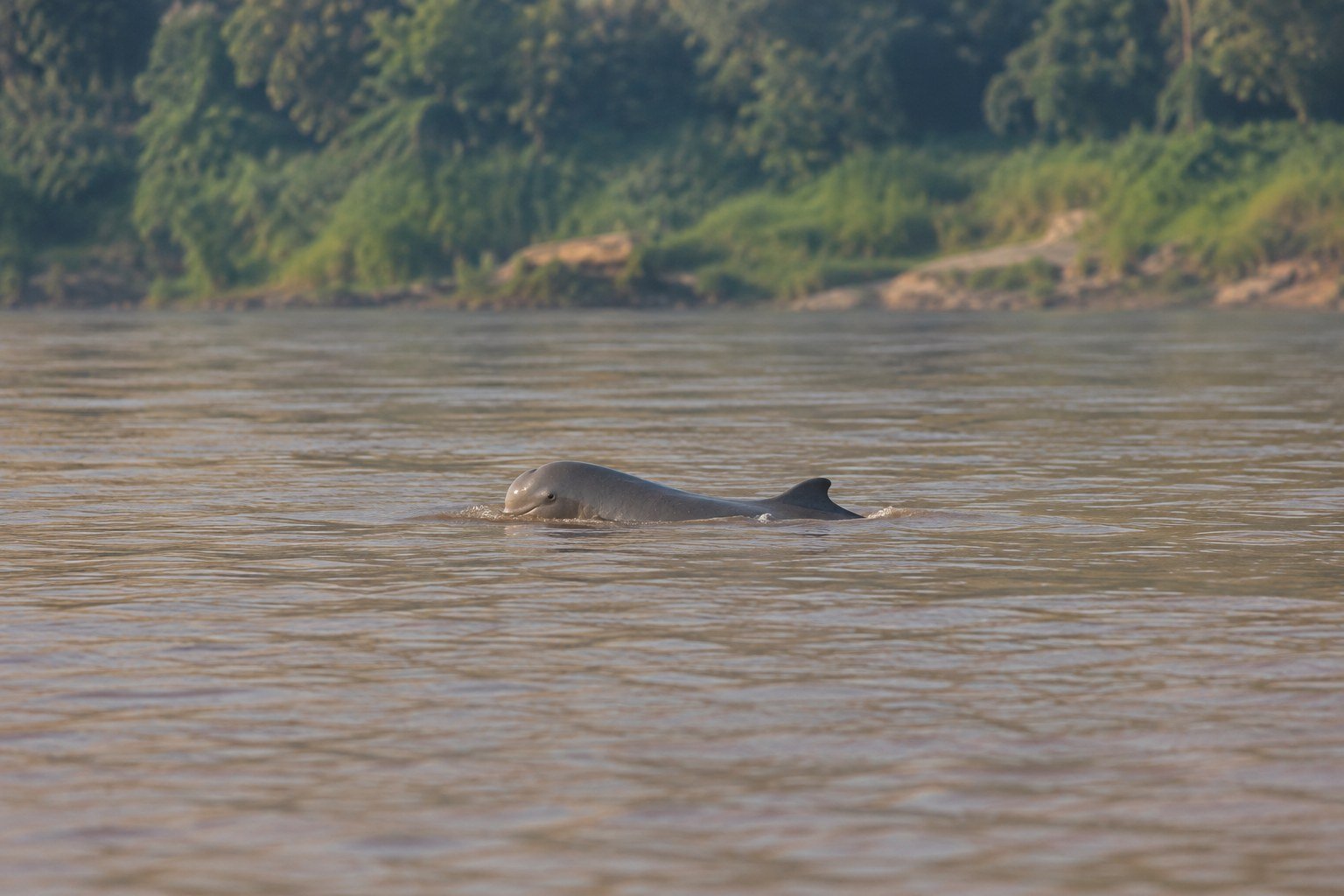
AI-generated illustration of an Irrawaddy dolphin; it does not represent a recorded sighting near Kratie.
Choose dolphin watching near Kratie by the way the trip is run, then by the activity you will enjoy. Ask how the guide follows local rules, avoids crowding and responds when the dolphins move away. Once those answers are clear, decide whether a passenger boat, a guided paddle or time on the bank suits your group.
This guide compares actual published outings and gives you a practical enquiry to use with any operator. It focuses on the wildlife decision, with just enough travel planning to reach the meeting point without a rush.
Some links in this guide are affiliate links. If you book or buy through them, Taylor’s Trailblazing Travels may earn a commission at no extra cost to you.
Set the expectation
A distant or brief sighting can be a good encounter.
Match the effort
A half-day kayak programme can involve a substantial paddle.
Name the operator
Know who will actually guide you on the water.
Choose a wildlife encounter you can enjoy patiently
At Kampi near Kratie, outings focus on wild Irrawaddy dolphins. These are rounded-headed river dolphins, without the long beak many visitors associate with dolphins. They are generally quiet at the surface, rather than acrobatic. The Mekong population is critically endangered.[1][6]
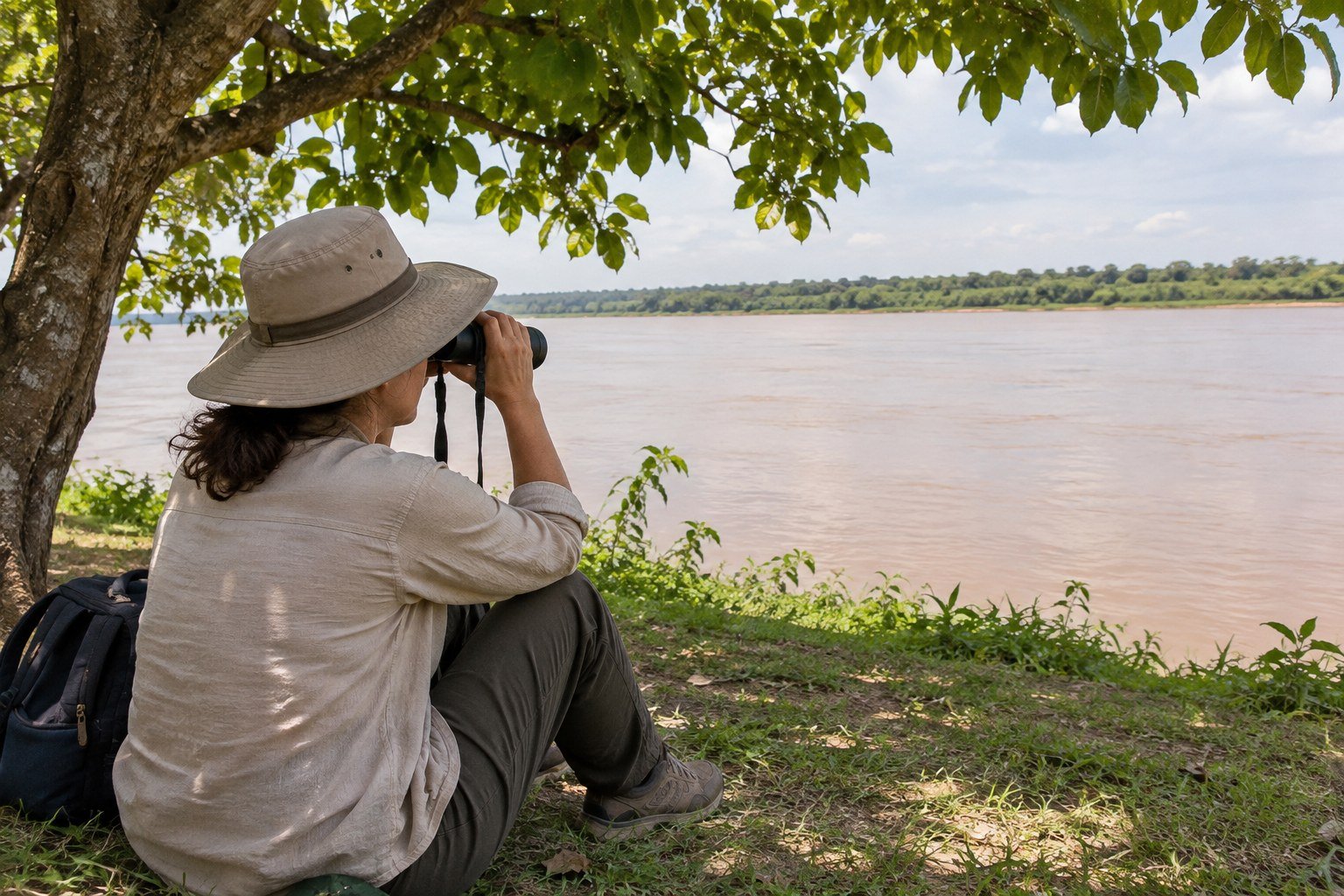
A worthwhile encounter may be a brief back, a small fin and a few seconds of a head above brown water. Take binoculars if you own them, and allow yourself to watch without a camera. A distant sighting can be memorable; it should not become a reason to ask the guide for a closer pass.
The International Whaling Commission’s guidance puts the animals’ behaviour at the centre of a responsible trip. Boats can add noise, interrupt feeding or resting, and create collision risks. More boats and longer encounters can add to that pressure.[2]
Start by deciding whether you want a river excursion or an active paddle. Then choose a guide who can explain the wildlife approach. A green logo, a small boat or an enthusiastic review does not answer that question. If an outing would feel wasted without a close photograph, adjust the expectation before buying it.
Back to top ↑Boat, kayak or bank: decide what suits your group
Scroll within the table on a small screen.
| Choice | Best fit | What to settle first |
|---|---|---|
| Passenger boat | You want to concentrate on watching, without paddling. | Boarding, seating, fitted lifejackets, boat numbers and how the crew handles an encounter. |
| Guided kayak | You would enjoy the river journey even with no dolphin sighting. | Distance, crossings, current, swimming ability, rescue arrangements and whether the whole group wants to paddle. |
| Time on the bank | You prefer to stay ashore or conditions make a water outing unsuitable. | A safe, permitted place to sit and realistic expectations; this is not a promised viewing platform. |
Land-based watching avoids putting another craft around the animals. Kayaks avoid engine noise, but can still disturb dolphins through their presence and approach. The IWC treats the platform and the way it is used as separate considerations; a non-motorised boat is not an automatic welfare guarantee.[3]
For a group with different interests, choose the day around the least comfortable participant. Someone who dislikes deep water or cannot sit low comfortably should not be persuaded into a paddle because everybody else wants photographs. A passenger boat may be the better shared choice, provided its boarding and seating actually work for that person.
Staying on the bank is a valid alternative, with the river itself as the attraction. Ask locally where public access is appropriate and remain on firm ground. Do not cross private land or move onto an unstable edge in pursuit of a view.
What two published Kratie outings actually involve
Sorya Kayaking publishes both a half-day kayak trip and a half-day boat excursion. They are useful concrete options to enquire about because the activity, inclusions and group-price structure are visible. Their published descriptions do not replace questions about the approach used on your departure.
Scroll within the table on a small screen.
| Published option | What is described | Decision to make |
|---|---|---|
| Sorya dolphin kayaking | An 11 km route on the main tours page; the detailed itinerary includes river crossings, islands and flooded forest. Equipment, guide, briefing, lifejackets, dry bags, water and the dolphin-area ticket are listed.[4][5] | Choose it for a substantial paddle. Ask about the day’s route and the help available if you tire. |
| Sorya boat excursion | Road and boat transport, guide, dolphin tickets, breakfast and snacks. The itinerary also visits a sticky-rice village and the hilltop temple at Sambok.[6] | Choose it if the wider excursion appeals. Ask whether the temple stairs can be omitted if climbing is unsuitable. |
On 15 November 2026, both pages listed US$60 per person for a final group of one, US$45 for two and US$33 for four. Confirm the final group size and total price for your date; these are published rates, not a promise of available places.[5][6]
A couple joining a two-person departure would therefore budget US$90 for the listed tour. Four people at the published four-person rate would pay US$132 together. The cheaper individual rate should never be a reason to accept a crowded boat or add more craft around the dolphins. Ask about actual passenger numbers separately from the price band.
Use the kayak itinerary or boat itinerary to start a direct enquiry. Compare any other offer against the same questions below. Use the answers about the actual departure to decide whether to book.
Ask for answers that describe the actual outing
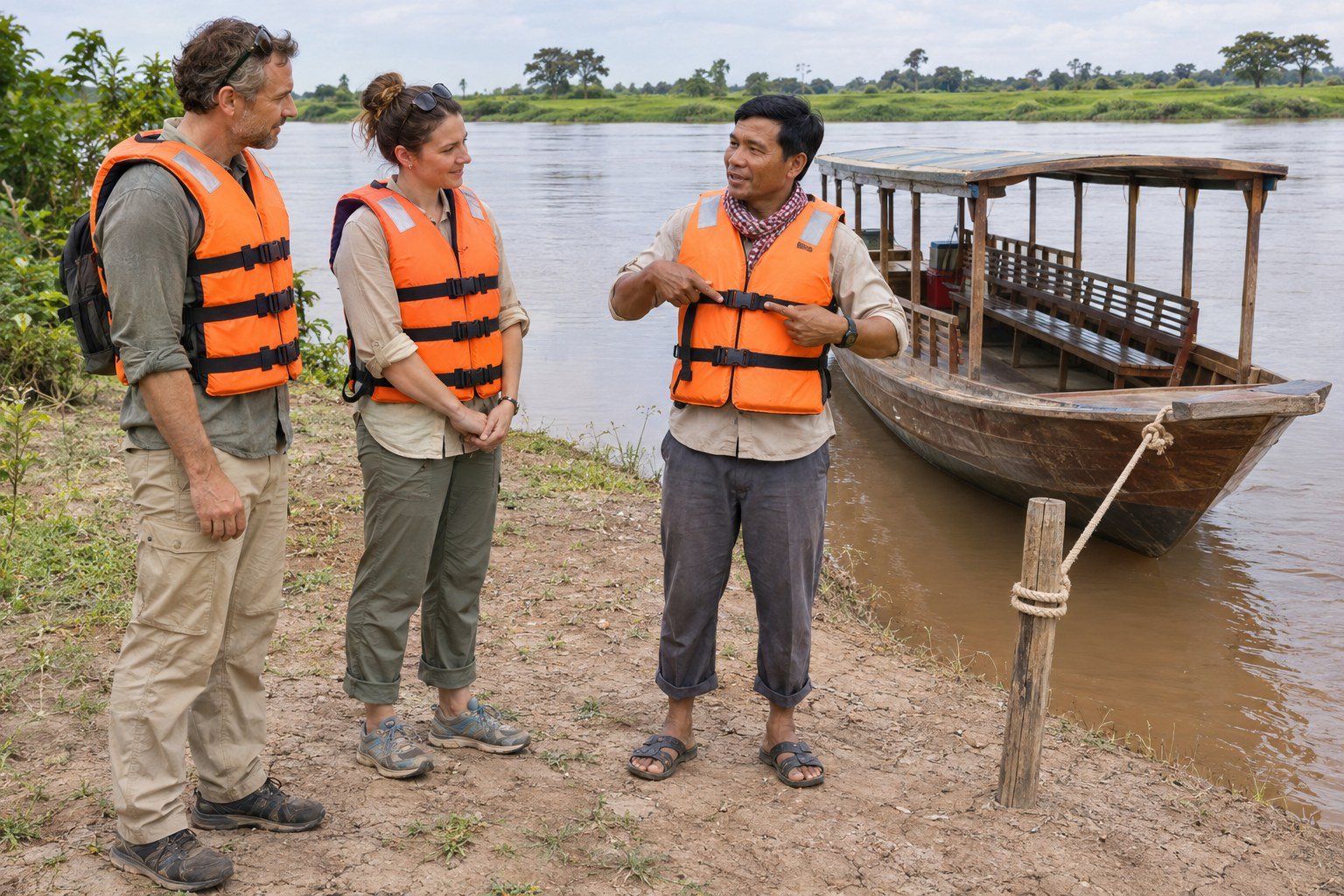
The IWC advises asking about local rules, approach distances, crowded encounters and the time spent with animals. A useful reply explains what the crew does, rather than simply saying that the trip is eco-friendly.[7]
Scroll within the table on a small screen.
| Ask | What a useful reply contains |
|---|---|
| Which local rules apply at Kampi on our date? | The current code or briefing, including approach distances and any restricted areas. Ask to see it. |
| What if several boats are already watching? | A plan to wait, keep clear or move on, rather than join a crowd. |
| What if the dolphins keep moving away? | Willingness to end the encounter, without repeated pursuit or a promise to force a closer view. |
| Who will guide us on the water? | The operator’s name, the boat or kayak arrangement and who gives the briefing. |
| What is the complete price? | Road transfers, waiting, area fees, equipment, guide, any other stops and cancellation terms. |
The IWC advice is general best practice. Ask the guide to show the current Kampi code, including any distance or access restrictions; do not apply a metre figure borrowed from another country.
A hotel can arrange the outing, but ask it to name the person or business providing it. Otherwise you may agree sensible conditions with a receptionist and reach a riverbank crew who has never heard them. Keep the written reply with the booking details.
Treat a guarantee of close contact, a refusal to explain the boat arrangement or an unclear extra charge as a reason to pause. An honest answer can include uncertainty about wildlife and weather. That uncertainty belongs in the booking conversation, not as a surprise after payment.
Back to top ↑Make your own expectations easy for the guide to follow
Tell the guide before departure that you are happy to watch at a distance and to leave if the animals move away. Do not ask for feeding, touching, pursuit or a swim with dolphins. The IWC warns that in-water encounters can disturb essential behaviour and bring risks to people and animals.[2][3]
During a sighting, stay seated where instructed and keep equipment within the boat. If another passenger asks to go closer, a calm “we’re happy to wait here” can remove some of the pressure. If you are uncomfortable with the approach, ask the guide to give the animals more room or end your encounter.
For photography, decide in advance to use the lens you have. Keep the animal small in the scene if necessary. River habitat, the distant bank and a brief surfacing tell a more truthful story than a photograph that required the crew to pursue an animal.
An island swim is separate from a dolphin encounter. Sorya lists a swimming break; ask about conditions and whether you can stay ashore. Never enter the water to approach dolphins.[5]
Leave a useful review afterwards: mention the briefing, space given to wildlife, any changes made for conditions and whether the quote was honoured. Avoid rewarding a trip only for how close the animals came.
Back to top ↑Check boarding and effort before paying
For a passenger boat, ask for a recent photograph of the boat and landing if steps or balance matter. Check how you get from the bank into the seat, whether you can sit comfortably for the proposed time and how much shade there is. A shorter outing may be preferable to a longer package with several extra stops.
For kayaking, describe your experience honestly. Ask how much of the route involves crossing the river, whether the craft is single or tandem, and what happens if you cannot continue. “Suitable for beginners” does not tell you the current, the distance or the guide’s ability to help more than one person at once.
With children, give the operator their ages and approximate sizes before booking. Ask about its minimum age, a properly fitting lifejacket and the seating arrangement. Do not assume an adult lifejacket or a child sitting on someone’s lap solves the problem. If the equipment or assistance is unsuitable, choose another activity.
Bring drinking water, sun protection and the footwear requested for entry and exit. Keep essential medicines and valuables protected from splashes; ask what the supplied dry bag is intended to protect. Check that your travel insurance covers the activity you have actually booked, especially if you add kayaking rather than a passenger-boat trip.
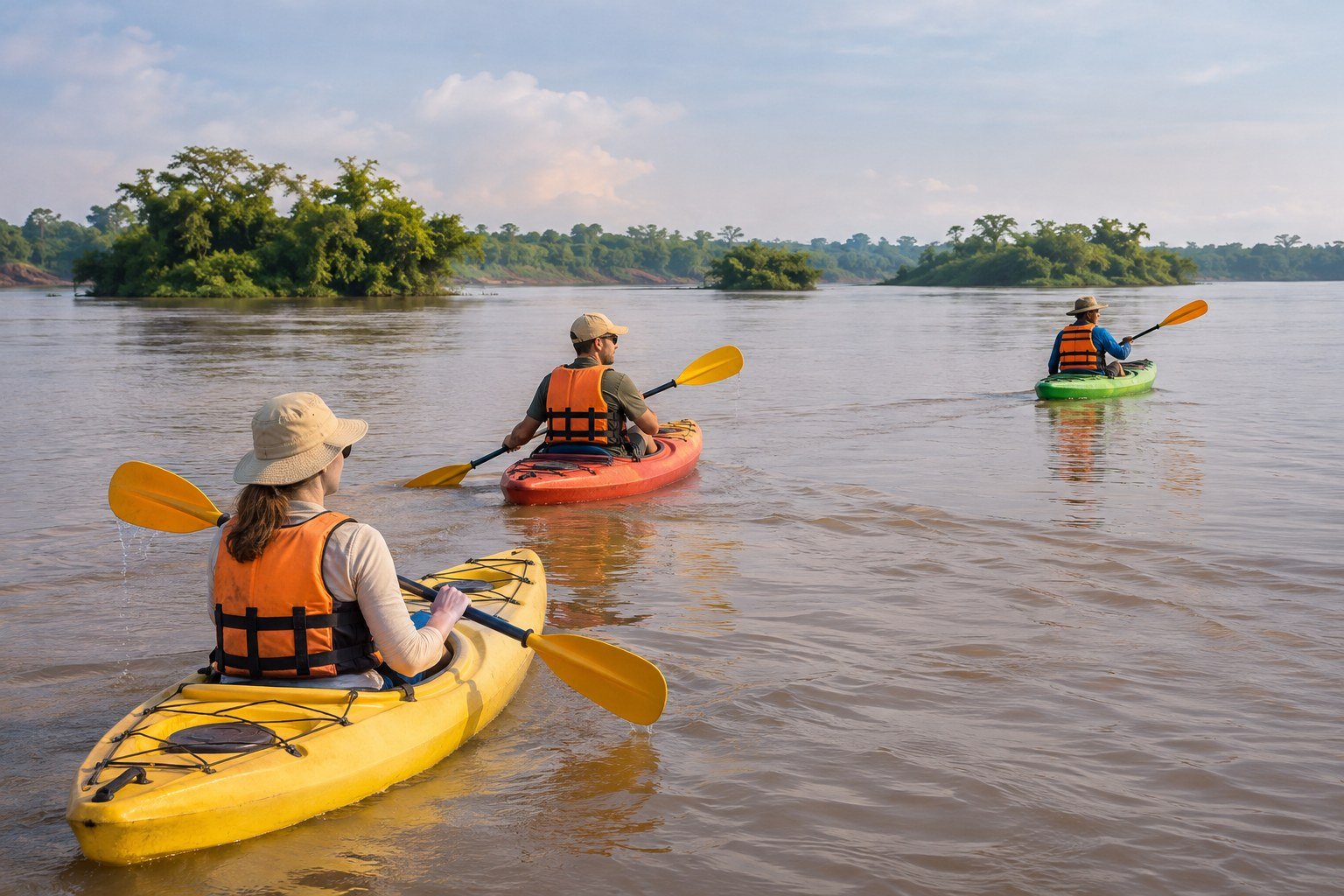
Pay for a clear service and ask who benefits
Dolphin watching supports work in riverside communities, but the conservation story is wider than a ticket sale. WWF identifies accidental capture in fishing gear as a major threat and describes work with local people on both fisheries and alternative livelihoods.[8]
Ask who operates the boat, who provides the guiding and whether any stated conservation contribution goes to a named organisation or community scheme. A claim that every booking helps wildlife is more useful when the seller can explain the mechanism. A local owner and careful wildlife practice are two worthwhile questions to check separately.
For a locally arranged outing, request one complete quote in one currency. Identify whether each amount is per person, per vehicle or per boat. Include the return road ride and any waiting time; keep unrelated temple or village stops optional if dolphins are your only priority.
Agree the financial plan within your own group too. For example, if four people share a US$36 return road ride, each pays US$9; if one person withdraws and the vehicle quote stays unchanged, the remaining three pay US$12 each. These are sample costs. Settle that possibility before one person pays on everybody’s behalf.
The Group Holiday Cost Splitter can record agreed shared expenses and who paid them. It does not collect money or check a seller’s quote. Keep individual tour tickets separate from shared vehicle costs so that the split remains fair.
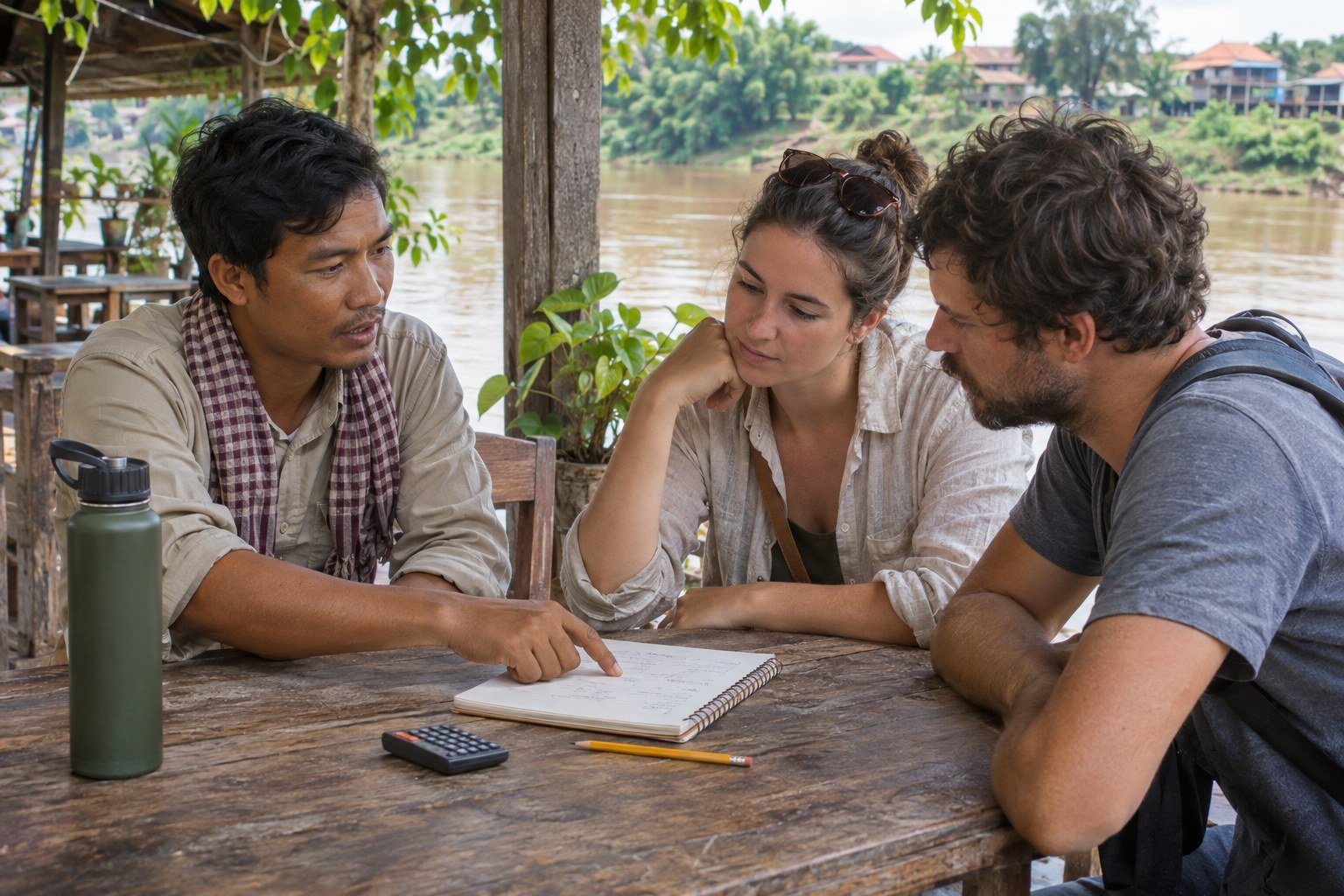
Book the wildlife day with room around it
For an early departure, aim to be in Kratie the previous evening. Make arrival, the wildlife outing and onward travel separate entries in your trip plan. A late vehicle or a tired arrival should not create pressure to rush the river briefing.
If arriving from Phnom Penh, compare the actual Phnom Penh–Kratie van services. Check the operator, boarding point, luggage allowance and arrival location for your date. A road ticket to town does not include getting to the wildlife meeting point.[9]
Choose accommodation around the confirmed meeting point and departure time. You can compare Kratie stays on Agoda and Kratie accommodation on Booking.com, then check the map, early access and cancellation terms. A room that requires an extra boat crossing needs a separately confirmed morning connection.
Before paying for the outing, ask what happens if river conditions cause a cancellation, whether a change of date is possible and how much notice the operator needs. Leave a spare session if dolphins are a major reason for the visit. Use it as flexibility, not as an obligation to make repeated approaches until a photograph appears.
Back to top ↑Questions before you go
Is morning better than afternoon?
Sorya publishes morning and afternoon kayak departures. Choose the session you can comfortably manage, then ask about conditions on your date. A timetable cannot predict a wild encounter.[5]
Is a kayak more ethical than a motorboat?
Not automatically. Your own ability, the guide’s handling and the space left around the dolphins matter. A boat crew that waits and keeps clear can be a better choice for your group than a paddle you cannot comfortably manage.
What if we see no dolphins?
That is a possible outcome of watching wild animals. Enjoy the river and the guide’s interpretation, and use the cancellation or repeat-trip terms you agreed rather than expecting the crew to chase animals to deliver a result.
Can we arrange everything on arrival?
Possibly, but early contact gives you time to compare answers and disclose equipment or access needs. A clear confirmation of the programme, final group price and meeting point is more valuable than arriving with only the name of a tour.
Back to top ↑Sources and checks
Conservation guidance and the named operators’ published details were checked for this guide. The comparisons, booking sequence and sample shared costs are editorial planning advice. No tour was taken or operator independently audited for this article.
- IWC — Irrawaddy dolphin
Species characteristics and Mekong conservation status. Checked 15 November 2026. - IWC — Responsible whale and dolphin watching
General disturbance and encounter principles, not Cambodian legal distances. Checked 15 November 2026. - IWC — Ways to watch whales and dolphins
Land, vessel, kayak and in-water considerations. Checked 15 November 2026. - Sorya Kayaking — Tours
Operator’s advertised 11 km kayaking route. Checked 15 November 2026. - Sorya Kayaking — Half-day dolphin kayaking
Published itinerary, inclusions and final-group prices. Checked 15 November 2026. - Sorya Kayaking — Half-day boat tour
Published itinerary, inclusions and final-group prices. Checked 15 November 2026. - IWC — Questions for operators
Questions about local rules and the handling of encounters. Checked 15 November 2026. - WWF — Irrawaddy dolphin
Community livelihoods and conservation pressures. Checked 15 November 2026. - 12Go — Phnom Penh to Kratie vans
The actual road-route comparison page; no departure or fare is guaranteed. Checked 15 November 2026.
Illustrations in this article were created for Taylor’s Trailblazing Travels. Third-party photographs, where used, are credited beside the image or in the source list.