
Cambodia Visa and e-Arrival Guide for UK Travellers
Separate the visa, arrival declaration and permission to stay—then prepare each at the right time.
AI-generated travel-preparation scene; no official document, approval or live form is shown.
For a short Cambodian holiday, getting the paperwork right means understanding three separate things: the visa you apply for, the arrival information you submit and the entry record immigration issues when you arrive. The names sound similar, but completing one does not automatically complete the others.
This Cambodia visa and e-Arrival guide is for ordinary tourism on a full British citizen passport. Other nationalities, British passport categories, work, study and long stays need their own checks. Cambodian authorities make the entry decision; use the official sources linked below when applying.[1]
Affiliate disclosure: this guide contains affiliate links. If you book or buy through them, Taylor’s Trailblazing Travels may earn a commission at no extra cost to you.
Apply for the visa ahead of travel; submit the arrival declaration in the final seven days.
Leave more than six months before expiry and check blank pages before applying.
An e-visa is accepted at specified ports, not every possible border crossing.
Check the admitted-until date on the entry record before leaving immigration.
Cambodia visa and e-Arrival: what each document does
Swipe or scroll the table to see every column.
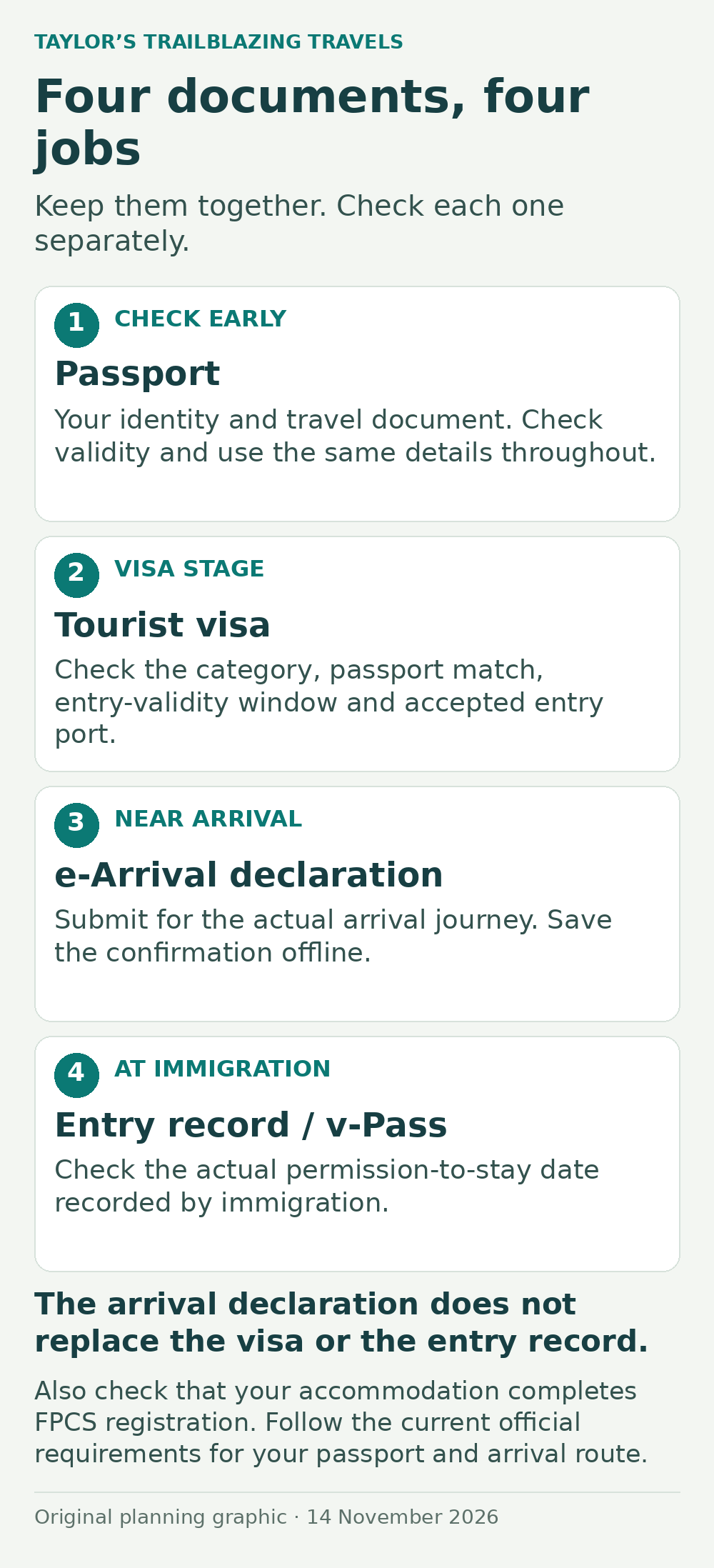
| Item | Its purpose | What to check |
|---|---|---|
| Tourist visa, class T | Your visa for a tourist entry | Passport details, entry validity, single-entry condition and approved entry port |
| e-Arrival declaration | Information submitted for the arrival process | Correct journey details and confirmation for this arrival |
| Entry record / v-Pass | The record issued through immigration | The actual date by which you must leave or obtain an approved extension |
| FPCS accommodation registration | Registration of where you are staying | That your accommodation manager has registered you |
The distinction follows the visa service, Immigration Department and UK entry guidance.[1][2][7][8] Keep the documents in one offline folder, but treat them as separate checklist items.
The “e” in e-visa means electronic. It does not mean you should select Visa E. For an ordinary sightseeing holiday, look for tourist Visa T; a different travel purpose needs advice on the appropriate category.

Check your passport before paying
FCDO states at least six months’ passport validity from arrival, and an undamaged, complete passport. The e-visa service uses “more than six months”, so leave a margin rather than planning to meet the requirement exactly.[1][2] The embassy’s tourist-visa page also specifies at least two blank pages.[3]
Compare the passport number, full name, nationality and date of birth against every application field before payment. A passport renewal after approval can change the document number: ask the e-visa office what to do rather than assuming approval transfers to the new passport.
Prepare a clear passport image and a recent digital passport-style photograph. Follow the live portal’s file requirements; do not send passport scans to an unverified “support” address. Keep the passport you will actually travel with beside you while applying.
Check any health certificate triggered by the route
Cambodia has no yellow-fever transmission risk, but an entry certificate can be required for travellers over one year old arriving from a risk country, including certain airport transits lasting more than 12 hours. A simple UK departure is therefore not the whole check: review every transit and recent destination with the current TravelHealthPro guidance.[9]
Back to contents ↑Choose the visa route that fits your journey
Tourist e-visa: usually the practical advance option
The published Visa T fee is US$30 and the stated processing time is three business days. Approval is valid for three months from issue and permits one entry.[2] Allow a buffer for weekends, holidays, rejected uploads and corrections. The UK advice says to apply at least four days ahead; treating that as a last-minute guarantee would leave little room for a problem.[1]
Use evisa.gov.kh, select the correct visa, complete the application and review it before paying. Save the receipt and application reference. Once approved, download the certificate, check every detail and carry a printed copy as a practical backup. A payment receipt alone should not be treated as approval.
Visa on arrival
FCDO says tourists can obtain a visa on arrival at airports and land border crossings, with a photograph and payment in US dollars.[1] Confirm the procedure and current fee for your actual port before travelling. This option does not make a closed border usable and does not remove the e-Arrival requirement for air passengers.
Embassy application
The London embassy accepts applications in person by appointment and by post. Its published processing periods are three working days in person and five by post, with additional time needed for delivery and return. Confirm fees and handling arrangements directly.[3] This is worth considering when the online route does not fit your circumstances, rather than repeatedly submitting uncertain applications.
For a return visit after leaving Cambodia, remember that the tourist visa is single entry. A trip that leaves for Vietnam and returns needs a fresh assessment of visa requirements for the second Cambodian arrival.
Back to contents ↑Check the actual airport or border crossing
The official e-visa service currently lists Techo International Airport (KTI), Siem Reap Angkor International Airport (SAI) and Sihanoukville International Airport (KOS), plus the land checkpoints at Bavet and Tropaeng Kreal. It lists Cham Yeam and Poipet as temporarily closed for e-visa entry.[4]
As checked on 14 November 2026, FCDO advises against all but essential travel within 20km of Cambodia’s land border with Thailand and says Thailand–Cambodia land crossings remain suspended. Do not build an itinerary around a Bangkok–Cambodia road crossing while that advice applies.[5]
Use the airport code on your actual ticket when completing forms. Old Phnom Penh and Siem Reap airport names still appear in older travel material. A city name alone is not a sufficient check.
For travel through Vietnam or Laos, confirm three separate points: the checkpoint is operating for your journey, your passport nationality can use it and the visa you hold is accepted there. Check the neighbouring country’s rules separately. A listed e-visa port does not promise a particular bus is operating.

If your entry is part of a longer overland trip, the Vietnam–Cambodia crossing comparison helps distinguish routes. Confirm the exact port’s current immigration rules before booking.
Back to contents ↑Complete the free arrival declaration
Use arrival.gov.kh or the official Cambodia e-Arrival app. Cambodia’s Immigration Department confirms that submission is free and can be made within seven days before arrival or on arrival; completing it in advance is the more manageable option.[6] UK guidance specifically requires it for the principal international air arrivals.[1]
- Have your travel passport, flight details, Cambodian accommodation address and contact details available.
- Enter the journey you are actually taking, including the correct arrival date. Check overnight flights carefully.
- Answer the immigration, health and customs questions accurately. Do not copy another traveller’s answers without checking.
- Complete the submission and save the confirmation or QR code shown by the official service.
- Make the confirmation available offline and keep a paper backup if that helps you travel confidently.
The Immigration Department warns that lookalike services are not official. There is no service charge for the declaration itself, although a visa payment is a separate matter.[7] If a payment screen appears, identify exactly what you are buying before continuing.
For a family, check each traveller’s passport details and the current system’s individual or group instructions. Do not assume one adult’s confirmation covers everyone. If dates or flights change, reopen the official service and check what needs updating.
An arrival form should not depend on airport Wi-Fi. Saving the actual confirmation is more useful than saving a link to an account you may struggle to log into after landing.
For maps and contacting accommodation after landing, you can compare Airalo eSIM options and select Cambodia. Check device compatibility, unlocked status and the plan’s current coverage. Buying mobile data is optional and does not replace keeping the arrival confirmation offline; a data-only plan may not provide a Cambodian phone number.
Back to contents ↑A five-stage document plan
This is an editorial checklist, not an extra government procedure. It separates tasks that can be completed early from the declaration that belongs near departure.
Swipe or scroll the table to see every column.
| When | Complete this | Your evidence |
|---|---|---|
| Once the route is settled | Check passport, entry port, visa category and current travel advice | Passport details and an itinerary that uses an available port |
| Well before departure | Apply within the visa’s entry-validity window, allowing processing and correction time | Approved certificate, not only a payment receipt |
| Final seven days | Submit e-Arrival for the actual arrival journey | Saved confirmation / QR code |
| At immigration | Check the entry record and permission-to-stay date | Stamp, digital v-Pass or the record immigration provides |
| At your accommodation | Check that the host completes your registration | Confirmation from the hotel, guesthouse or landlord |
Before leaving home, put the passport, approved visa, arrival confirmation, first accommodation address, onward journey and insurer’s emergency number in an accessible travel folder. Keep a separate protected backup in case a phone is lost. This is a preparedness list; it does not imply every item will be requested at every desk.
After landing: check the permission to stay
Do not assume that everyone receives a traditional ink stamp. Cambodia’s Immigration Department has continued a digital v-Pass pilot for travellers using international airports and seaports. The digital record can be retrieved through email, the e-Arrival website or its app.[8]
Check the recorded entry and permitted departure dates before leaving the immigration area. If a detail is missing or wrong, ask an officer to explain or correct it. Your three-month visa validity and your permitted stay are different clocks.
Ask the accommodation manager to complete the Foreigners Present in Cambodia System registration. FCDO says travellers staying with friends or family, or in their own property, need to self-register using a Cambodian phone number. Do not assume a data-only eSIM supplies that number. This self-registration requirement is separate from a hotel registering its guests. Missing registration can obstruct a visa extension.[1]
If you might stay longer, contact Cambodian immigration before your permission expires. Do not build an overstay fine into a holiday budget as an alternative to permission. Extensions and work permissions need their own approval; a tourist entry is not a work permit.

Avoid the errors that cause unnecessary problems
- Confusing a visa application receipt with the approved visa.
- Reading “three months” as the allowed holiday length rather than the entry-validity window.
- Choosing Visa E because the word e-visa sounds similar.
- Paying a third party for a free declaration without understanding the service.
- Using an old airport code or a closed land crossing from an earlier itinerary.
- Saving everything in an email account without offline access.
- Leaving the application until a weekend immediately before departure.
If something goes wrong, identify the correct service first. The London embassy explains that its consular staff do not operate the online e-visa system; e-visa enquiries belong with the e-visa office. Use contact details reached from the official website, not an unsolicited message.
[3]
Useful questions
Do I still need e-Arrival if I already have a visa?
Yes, for the air arrivals covered here. The official visa service directs visa holders to submit the separate arrival declaration; visa approval does not complete it for you.[4] For a land or sea arrival, check the current procedure for the actual port rather than assuming the airport process is identical.
Can I do e-Arrival before the final seven days?
Prepare the information early, then submit within the official seven-day window. This avoids confusing preparation with a valid declaration for the upcoming arrival.[6]
Do I need an agent for a straightforward tourist application?
You can use the official services yourself. If you choose assistance, check the business, the total charge and what it will do with your passport information. Assistance is not the same as official government status.
What if the e-visa site fails to load?
Try the current official service again in another browser, keep any application reference and avoid starting repeated paid applications without checking the first. Use the official support route if payment or approval is unclear; do not use a random sponsored search result as a substitute.
Should I count 30 days myself or follow the entry record?
Plan conservatively and verify the admitted-until date issued by immigration. If it is unclear, ask before leaving the airport or checkpoint. Do not rely on a booking calendar to settle an immigration question.
Your next decision
For a straightforward short holiday, settle the entry route first, check the passport, obtain the correct tourist visa with time to spare and submit e-Arrival in the final week. Then verify the actual permission-to-stay date when admitted. Keeping those steps separate is the simplest way to avoid the mistakes caused by similar document names.
Sources
Official information and provider details were reviewed on 14 November 2026. The route choices, time allowances and budget examples are editorial planning analysis, not live booking quotations. Check changing rules and services again before travelling.
- FCDO: Cambodia entry requirements — checked 14 November 2026.
- Cambodia official e-visa service: visa type information — checked 14 November 2026.
- Royal Embassy of Cambodia in London: tourist visa (T class) — checked 14 November 2026.
- Cambodia official e-visa service: entry ports and application sequence — checked 14 November 2026.
- FCDO: Cambodia warnings and insurance — checked 14 November 2026.
- General Department of Immigration: e-Arrival submission timing and fee — checked 14 November 2026.
- AKP / General Department of Immigration: official e-Arrival platforms and free submission — checked 14 November 2026.
- AKP / General Department of Immigration: continued digital v-Pass pilot — checked 14 November 2026.
- NaTHNaC TravelHealthPro: Cambodia certificate requirements — checked 14 November 2026.
Illustrations in this article were created for Taylor’s Trailblazing Travels. Third-party photographs, where used, are credited beside the image or in the source list.