A practical, door-to-door comparison of the winding mountain journey, including the official 2026 timetable, fares, luggage limits, airport connections, motion-sickness planning and the risks that matter more than the headline price.
This guide contains affiliate links. If you book through one of them, Taylor’s Trailblazing Travels may earn a commission at no extra cost to you. Commercial links appear only where they help with a relevant transport, accommodation, tour or travel-product decision.
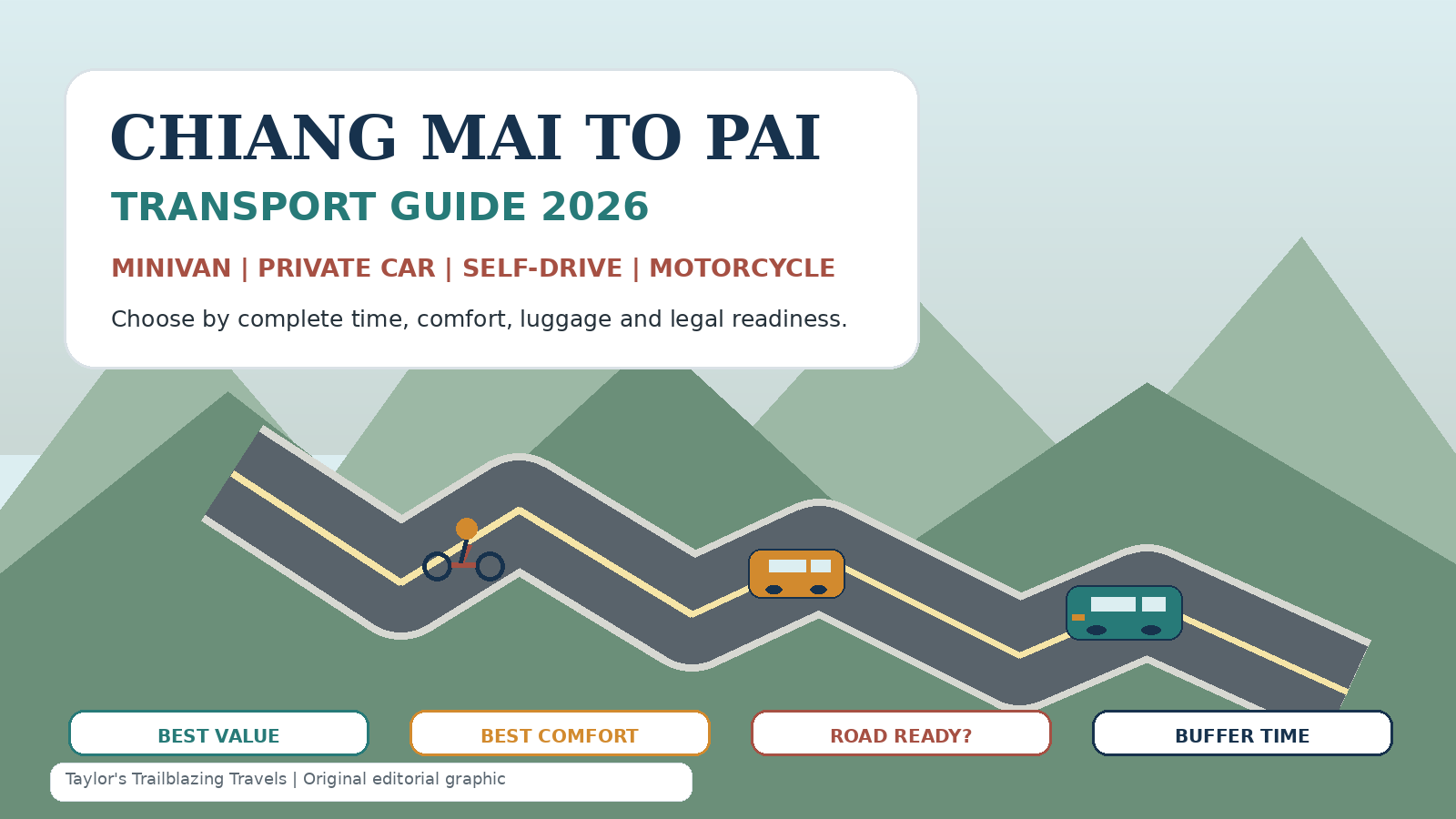
The road from Chiang Mai to Pai has a talent for turning a simple three-hour timetable entry into a surprisingly personal decision. One traveller sees a cheap scheduled minivan and an easy mountain transfer. Another sees three hours of repeated bends, a back-row seat and the prospect of losing the first evening in Pai to nausea.
That difference matters. For most visitors, the scheduled Prempracha service is still the sensible default: it is frequent, inexpensive and purpose-built around the route. However, a private transfer can be worth the extra cost for families, groups, passengers with significant luggage or anyone who already knows that winding roads make them unwell. Self-driving can work for a wider Mae Hong Son itinerary, although the driver takes on the legal, weather and fatigue burden. A scooter should be treated as a motorcycle journey through mountain terrain, not as a cheap backpacker shortcut.
This guide separates the operator’s published road time from the complete hotel-to-hotel day. It also uses current August 2026 operator information rather than repeating an old timetable or the famous, but not especially useful, claim that the route has exactly 762 bends.
What is the best way to travel from Chiang Mai to Pai?
For most travellers, the best Chiang Mai to Pai transport is the scheduled Prempracha van or minibus from Chiang Mai Arcade. The operator’s August 2026 timetable lists hourly departures from 06:30 to 17:30, an approximate three-hour journey, and one-way fares of THB 220 by van or THB 260 by minibus. Choose a private transfer for door-to-door comfort, children, bulky luggage or serious motion sickness. Drive yourself only with the correct licence, insurance and mountain-road confidence, and do not ride a scooter unless you are already an experienced, legally licensed motorcycle rider.
Quick answers
Best overall value
Prempracha scheduled van or minibus from Chiang Mai Arcade.
Official one-way fare
THB 220 by van or THB 260 by minibus in the timetable reviewed on 15 August 2026.
Published road time
About three hours, although a hotel-to-hotel plan should usually allow four to five hours.
Best for motion sickness
A private car with an agreed pace, front-seat request and safe rest-stop flexibility.
Best after a flight
An overnight in Chiang Mai or a pre-booked private transfer with flight details and delay terms.
Worst false economy
Hiring a scooter without the correct motorcycle experience, licence, insurance and protective gear.
In this guide
Chiang Mai to Pai transport comparison
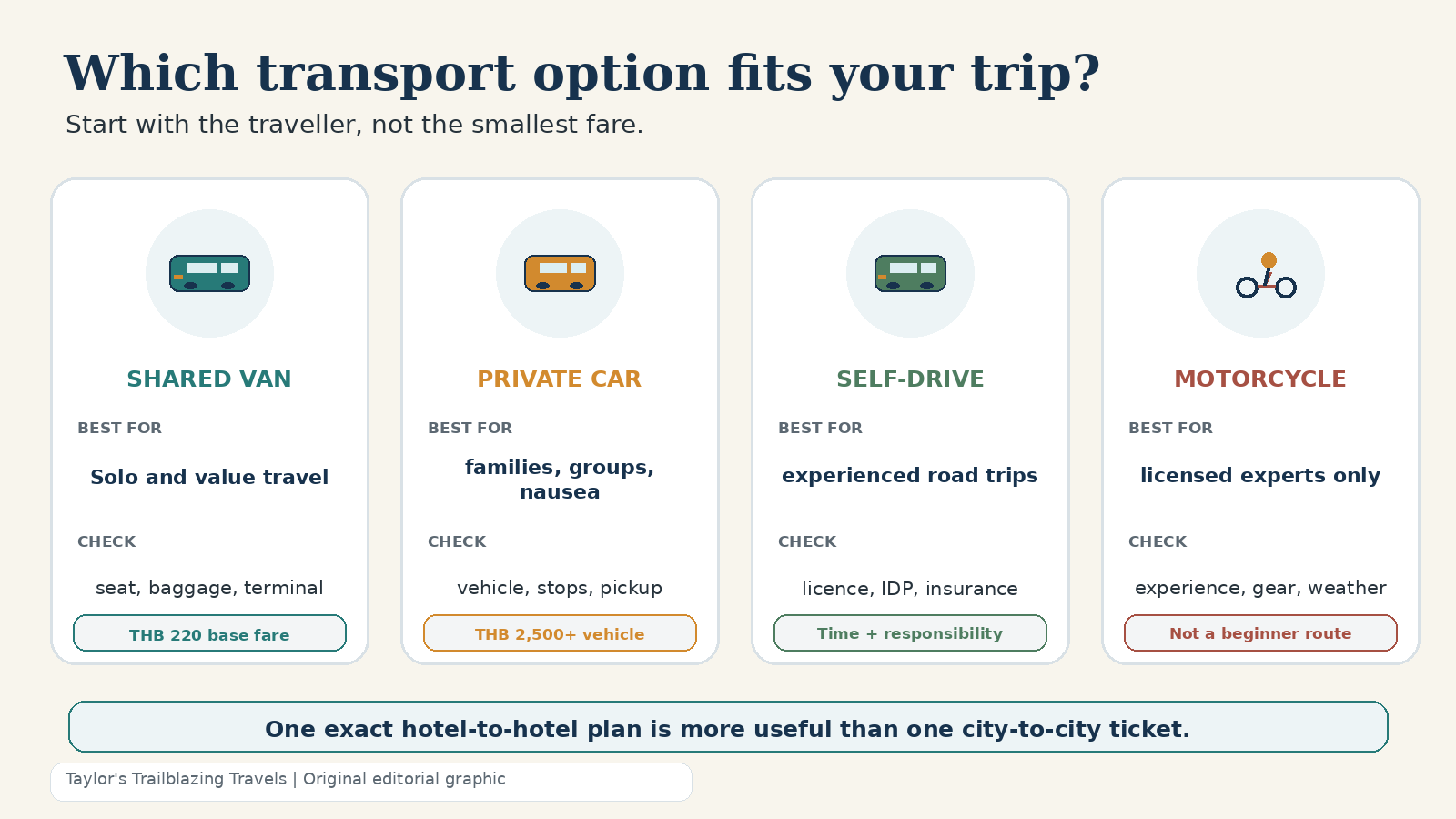
The fastest way to make a poor decision is to compare only the cheapest seat. A THB 220 ticket is excellent value when the passenger is comfortable in shared transport and can reach Arcade without stress. The same ticket may be a bad fit for a family with a baby seat, four large bags and a flight landing shortly before departure.
| Option | Road time to plan | Typical 2026 planning price | Best for | Main limitation |
|---|---|---|---|---|
| Prempracha van | About 3 hours on the official timetable; allow 4-5 hours hotel to hotel | THB 220 per seat before any booking fee | Solo travellers, couples and budget trips | Limited control over seat, stops and driving pace |
| Prempracha minibus | About 3 hours on the published route | THB 260 per seat before any booking fee | Travellers who prefer a larger scheduled vehicle when available | Vehicle assignment and availability should be reconfirmed |
| Private car or van | Roughly 2 hours 40 minutes to 4 hours in live listings, plus pickup | Often about THB 2,100-5,000+ per vehicle, depending on class and provider | Families, groups, luggage and motion-sensitive travellers | Higher total price and variable inclusions |
| Self-drive car | Allow 4-5 hours with careful stops | Rental, fuel, insurance, deposit and possible one-way charges | Experienced drivers continuing around Mae Hong Son | Driver fatigue, legal checks and full responsibility |
| Scooter or motorcycle | Allow at least half a day and more in poor weather | Rental, fuel, insurance and proper protective equipment | Experienced, correctly licensed motorcycle riders only | Highest exposure to road, weather and insurance risk |
| Private day tour | About 12 hours, with roughly seven hours in the car | Dynamic per vehicle or per person | Someone unable to stay overnight who accepts a very long day | Poor road-time-to-Pai-time ratio |
The official shared-service figures are the most stable numbers in the table. Prempracha’s timetable and fare page, reviewed on 15 August 2026, lists Route 612 van and minibus services, an approximate three-hour journey and the fares shown above. The operator also warns that times, stops, fares and conditions can change, so the ticket remains the final authority for a particular departure.[1]
Karen Taylor’s planning rule
I would use the scheduled service for a healthy solo traveller with one normal bag and no history of severe travel sickness. For two motion-sensitive adults, a family with children or a group carrying several cases, I would price a private vehicle before booking anything. The relevant comparison is the complete journey and the condition in which you arrive, not simply THB 220 versus a larger number.
Official Chiang Mai to Pai timetable and fares for 2026
Chiang Mai to Pai departures
Prempracha’s August 2026 timetable shows departures from Chiang Mai to Pai at 06:30 and then hourly through 17:30. The journey is listed as approximately three hours. That pattern is unusually easy to remember, although it should not be treated as a permanent promise for every date.
| Direction | Published departures | Approximate journey | Published fare |
|---|---|---|---|
| Chiang Mai to Pai | 06:30, then hourly to 17:30 | About 3 hours | THB 220 van; THB 260 minibus |
| Pai to Chiang Mai | 07:00, then hourly to 17:00 | About 3 hours | THB 220 van; THB 260 minibus |
There are twelve published Chiang Mai departures and eleven published return departures. However, an hourly pattern does not guarantee that every vehicle type operates at every hour, that seats remain available or that an online reseller displays the same label used by the operator. Confirm the actual departure, operator, vehicle and terminal on the final ticket.
Where the scheduled service boards
Prempracha identifies Chiang Mai Arcade, Pai, Pang Mapha and Mae Hong Son as boarding points on Route 612. In practical terms, that means travellers should look for the correct Arcade terminal and operator counter rather than assuming that every northern route leaves from Chang Phueak. Prempracha’s own FAQ specifically says the terminal depends on the route and tells passengers to check the booking.[2][3]
How early to arrive
Aim to reach the stated counter 30-45 minutes before departure. That margin allows time to find the correct building, show the booking, resolve a luggage question and use the toilet without turning a mountain-road morning into a sprint. During holidays and festivals, book earlier because the operator warns that services can fill.
Compare the live Chiang Mai to Pai schedule
12Go can be useful for comparing currently listed scheduled vehicles and private taxis in one place. Check the final operator, boarding point, luggage rules, vehicle class and booking fee before paying.
Shared van or minibus: the best choice for most travellers
Why the shared service remains the default
The scheduled route solves the biggest logistical problem at a very low price. It runs frequently, carries passengers who are making the same journey and arrives in Pai without the cost or responsibility of a private car. For one person, the price gap between a seat and a whole vehicle is substantial.
Moreover, a known operator timetable is easier to build into an itinerary than an informal street quote. A morning departure can place you in Pai around lunchtime or early afternoon, leaving enough daylight to reach an outlying hotel and recover before dinner.
What the ride actually feels like
The road becomes progressively more winding after the flatter section north of Chiang Mai. A minivan does not create those bends, although a shorter wheelbase, a rear seat and repeated changes of direction can make them feel more pronounced. Even travellers who are normally comfortable in cars should prepare for the possibility of nausea.
Seat comfort varies by vehicle. Legroom can be limited, large bags are stored separately and the passenger cannot control every stop. A rest break is common in live traveller reports, but it should not be treated as a guaranteed sightseeing stop or a chance to delay the whole vehicle.
Van versus minibus
The official fare table distinguishes a Route 612 van at THB 220 from a minibus at THB 260. A larger vehicle may feel less cramped to some passengers, yet the practical difference depends on the actual seat, suspension, passenger load and driver. Do not pay a premium based only on a generic website photograph. Confirm the vehicle type on the ticket and accept that operations can change.
Advantages
- Lowest reliable one-way price for most visitors.
- Frequent published departures in both directions.
- No driving, navigation or rental deposit.
- Suitable for a simple Chiang Mai-Pai-Chiang Mai trip.
- Central arrival is convenient for many Pai stays.
Disadvantages
- Least control over seat, pace and stops.
- Rear seats can feel particularly bumpy and confined.
- Large or unusual luggage needs advance confirmation.
- Tight airport connections are risky.
- Not the easiest choice for severe motion sickness.
Who should choose it
Choose the shared service when you are travelling alone or as a couple, carrying ordinary luggage, staying in Chiang Mai before departure and comfortable with shared road transport. It is also the rational option for a budget traveller who can keep the first Pai afternoon light.
Who should price an alternative
Compare private transport when a passenger needs a child restraint, has limited mobility, becomes seriously carsick, cannot reach the terminal easily or carries luggage that may breach the operator’s allowance. The same applies to groups: once several people are buying seats and separate taxis, the private-vehicle premium can narrow.
Private transfer: the comfort and control option
What a private transfer changes
A private vehicle removes the trip to the bus terminal and replaces a fixed shared departure with an agreed pickup. More importantly, it can provide a calmer seating arrangement, more luggage space and the ability to request a safe toilet or fresh-air stop. Those benefits are meaningful on this road.
Live 12Go taxi listings on 26 August 2026 showed a broad range of vehicle classes, quoted travel times from roughly 2 hours 40 minutes to four hours, and prices beginning around THB 2,185 for the searched date. The lowest result should not be treated as a universal fare. Vehicle size, provider, pickup point, date, passenger count and cancellation terms all change the total.[4]
Check the quote line by line
| Question | Why it matters | What to confirm in writing |
|---|---|---|
| Where is pickup? | City hotel, airport and outlying property pickups may have different terms. | Exact address, meeting point, included waiting time and driver-contact process. |
| What vehicle arrives? | A nominal three-passenger car may not suit three adults plus large cases. | Passenger capacity, luggage capacity, air-conditioning and vehicle class. |
| Are stops included? | A transfer is not automatically a sightseeing tour. | Whether one short comfort stop is allowed and whether extra stops cost more. |
| Is a child seat available? | Availability, type and price vary. | Child’s age and size, restraint type, installation and any add-on fee. |
| What happens after a flight delay? | The route is too long to improvise comfortably late at night. | Flight tracking, waiting allowance, contact method and no-show policy. |
| Is the price one way? | A return journey is normally separate. | One-way or round-trip scope, taxes, fuel, parking and additional charges. |
A useful live private-transfer example
One current GetYourGuide listing offers a one-way hotel-to-hotel transfer with an air-conditioned private vehicle and an advertised duration of about 3.5 hours. Its listing says vehicle size depends on the group, includes one large and one small bag per person, and offers airport pickup and a baby seat as paid add-ons. It also states that the standard transfer is not a sightseeing service, although a quick stop may be requested. Read the current listing rather than assuming those inclusions apply to every provider.[5]
Compare private transfer options
A private car is most useful when the booking solves a specific problem: a flight arrival, severe motion sensitivity, a child seat, several cases or a group that would otherwise buy multiple seats and taxis.
Advantages
- Door-to-door pickup and drop-off.
- Better control over luggage and seating.
- A short safe comfort stop may be possible.
- Per-person cost improves for a group.
- Can connect directly from the airport when correctly arranged.
Disadvantages
- Much more expensive for one traveller.
- Inclusions differ between providers.
- A private car does not remove the bends.
- Airport waiting and child seats may cost extra.
- Some drivers speak only enough English for basic logistics.
Self-driving from Chiang Mai to Pai
When a rental car makes sense
Self-driving becomes more logical when Pai is one stage of a wider northern road trip rather than the final destination. A car can carry luggage, protect passengers from rain and make later travel towards Pang Mapha or Mae Hong Son more practical. It also allows stops to be chosen around daylight, weather and genuine fatigue.
However, the person at the wheel exchanges a passenger’s discomfort for legal responsibility and sustained concentration. The driver cannot admire every view, recover from jet lag or take travel-sickness medication that causes drowsiness.
Legal and insurance checks
British visitors need their UK driving licence and a 1968 International Driving Permit to drive in Thailand, according to current GOV.UK guidance. Other nationalities should check their own government advice, Thai requirements and the rental company’s contract. The correct documents do not replace insurance, and the rental agreement can contain additional restrictions.[6]
- Confirm that the licence category covers the vehicle.
- Check the insurance excess, exclusions and roadside-assistance process.
- Photograph every side of the vehicle, wheels and fuel level at collection.
- Inspect tyres, lights, wipers and brakes before leaving the city.
- Save the rental contact and policy number offline.
- Do not assume a credit-card policy automatically covers a Thai rental.
Driving the mountain section sensibly
Leave after a proper night’s sleep and aim to finish before dark. Use a lower gear on descents rather than holding the brakes continuously. Keep a larger following distance than you would on a straight road, and avoid overtaking unless the view and road markings make it clearly safe. If a faster vehicle appears behind you, wait for a suitable place to let it pass instead of feeling pressured to drive beyond your comfort.
Rain changes the decision. Water, reduced visibility, fallen material and localised flooding can make a familiar-looking corner much less forgiving. The correct response is often a later departure, a longer stop or a different day, not an attempt to preserve the itinerary at all costs.
Advantages
- Full control over departure and safe stops.
- Easy luggage handling.
- Useful for a wider Mae Hong Son route.
- Protection from rain and heat.
- Can avoid repeated hotel transfers later.
Disadvantages
- The driver carries the stress and cannot rest.
- Rental, deposit and insurance checks take time.
- One-way return charges may apply.
- Night, rain and fatigue sharply reduce the appeal.
- A nervous driver can make the day worse for every passenger.
Should you ride a scooter or motorcycle from Chiang Mai to Pai?
This is not a beginner route
Do not learn to ride on the Chiang Mai-Pai road. A few hours on a rental scooter around a quiet resort does not provide the braking, cornering, hazard-reading or wet-road experience needed for a long mountain journey.
Why the route is frequently underestimated
Social media often turns the ride into a scenic rite of passage. The scenery is real, but so are buses, vans, pickups, blind bends, changing surfaces, heat, rain and fatigue. A rider also has less protection from another road user’s mistake.
Current UK travel advice states that Thailand has a high road-accident rate, especially involving motorcycles. It says helmets are compulsory, warns that some rental motorcycles are unregistered and advises riders to check that insurance covers the vehicle. Driving without a valid licence can invalidate travel insurance.[7]
A strict go or no-go test
| Question | Go only when the honest answer is yes |
|---|---|
| Do you already ride motorcycles? | You have substantial recent experience, including bends, gradients, braking and mixed traffic. |
| Are you legally licensed? | Your home licence includes the correct motorcycle category and you hold the required permit. |
| Does insurance cover this bike? | The policy explicitly covers the engine size, rider, rental and intended use. |
| Is the protective equipment adequate? | Rider and passenger have properly fitting helmets and suitable clothing, footwear and eye protection. |
| Can you cancel for rain or fatigue? | No essential booking forces you to ride in poor conditions or after dark. |
| Can you carry the luggage safely? | Nothing interferes with balance, controls, lights or the passenger. |
When the answer should be no
Take a van or car when you have only ridden automatic scooters on flat holiday roads, need to carry a large backpack on your body, plan to ride immediately after a flight, have taken sedating medication or feel pressure to complete the route because the accommodation is prepaid. None of those compromises becomes safe because the rental price is low.
A car licence is not a motorcycle licence. A shop agreeing to rent a bike is not evidence that the rider is legal, insured or competent. The money saved is trivial beside the financial and medical consequences of an uninsured crash.
How to travel from Chiang Mai Airport to Pai
There is no simple direct scheduled-airport van assumption
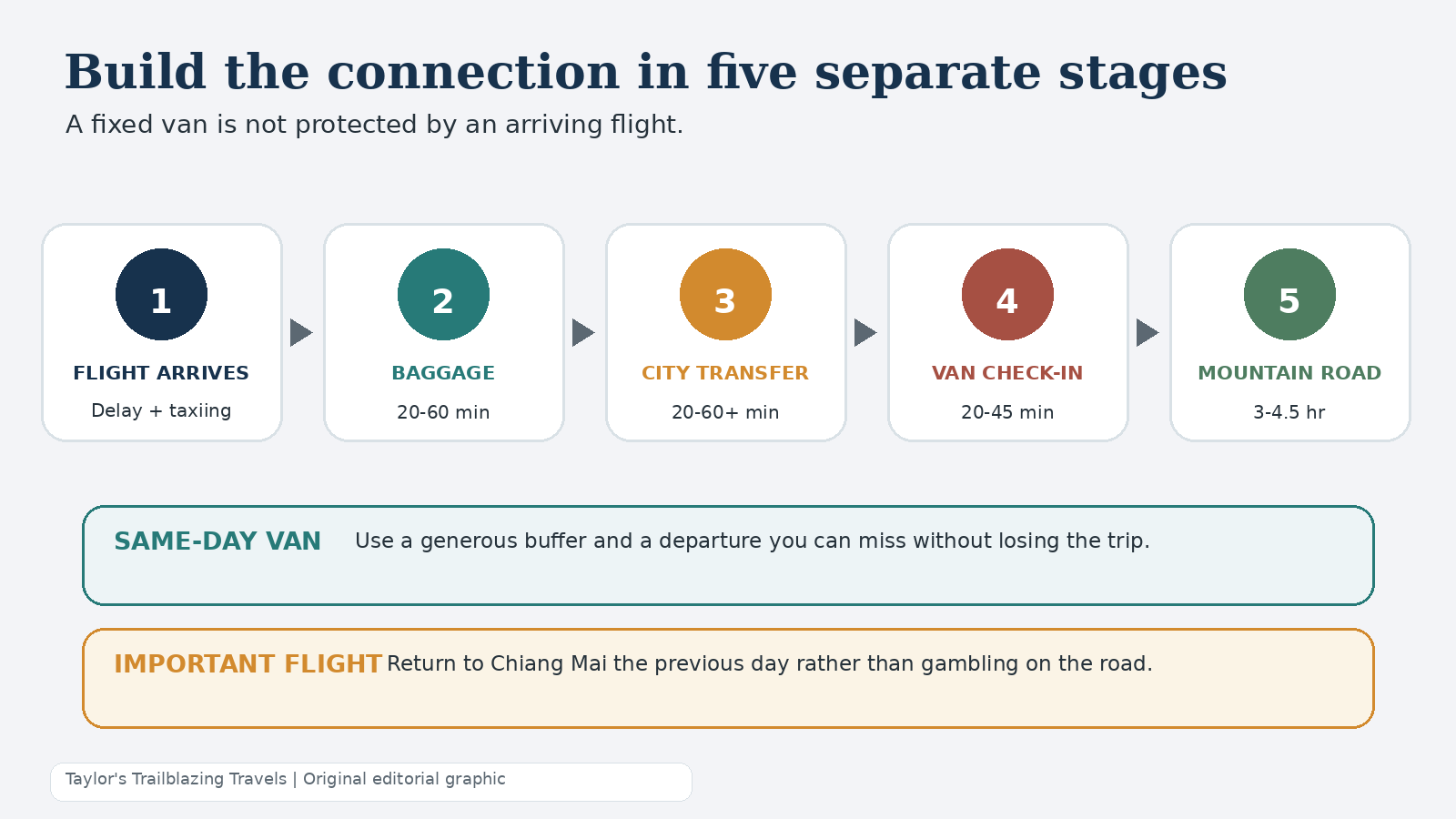
The standard scheduled route is built around Chiang Mai Arcade, not an automatic pickup from every arriving flight. Therefore, a traveller landing at Chiang Mai International Airport normally has three sensible choices: travel to Arcade for a protected later service, stay overnight and leave the next morning, or pre-book a private airport-to-Pai transfer.
Official airport transport into Chiang Mai
Airports of Thailand lists an airport taxi counter at Entrance 1 on the first floor, operating from 07:00 to midnight. It describes the service as flat-rate transport with transparent pricing. The airport also lists shuttle routes A1 and A2 at THB 40 and A3 at THB 60, but those city routes are not the same as a direct Pai connection and should not be assumed to stop at the precise bus counter you need.[8][9]
How much flight buffer is enough?
| Arrival situation | Safer plan | Reason |
|---|---|---|
| Domestic flight lands before 09:00 with hand luggage | Consider a service several hours later, not the next possible departure. | Aircraft delay, airport exit, taxi and terminal check-in still need margin. |
| International arrival | Stay in Chiang Mai and leave the following morning. | Immigration, baggage, fatigue and missed-connection consequences are larger. |
| Family with children or several cases | Price a private airport transfer with flight tracking and restraint details. | It removes the terminal change and protects luggage capacity. |
| Flight lands after mid-afternoon | Overnight in Chiang Mai unless a private transfer is deliberately arranged. | The final published scheduled departure is 17:30 and late mountain travel adds stress. |
| Same-day connection is essential | Use a flexible private booking and provide the full flight number. | The provider needs a clear waiting and no-show process. |
My conservative choice after a long-haul arrival would be a Chiang Mai hotel, a proper meal and a morning transfer. Pai will still be there the next day, while an exhausted mountain-road connection can spoil both the journey and the first night.
Useful accommodation near the connection
An overnight is often the cleanest solution after a late or international flight. Choose a Chiang Mai hotel by the next morning’s departure logistics rather than adding an unnecessary cross-city journey.
Pai to Chiang Mai: plan the return before leaving
The return timetable
The August 2026 operator timetable lists Pai departures from 07:00 and then hourly through 17:00. That creates useful flexibility, but popular dates can sell out and the final service is not an appropriate safety net for an important flight.
Do not connect the return van directly to an international flight
A three-hour published journey can become longer because of traffic, weather, an operational change or a slow road section. After reaching Arcade, you still need to travel across Chiang Mai, check in and clear airport procedures. For a long-haul or expensive flight, return to Chiang Mai the day before.
Morning flight from Chiang Mai
Stay in Chiang Mai the previous night. Leaving Pai in the afternoon provides more alternatives if the chosen vehicle changes, while an early morning flight leaves no credible recovery plan from Pai.
Compare the return journey
Book the return once the flight and Chiang Mai hotel are fixed. Check whether the ticket arrives at the same terminal you used on the outward journey.
How to reduce motion sickness on the Chiang Mai-Pai road
Prepare before the vehicle moves
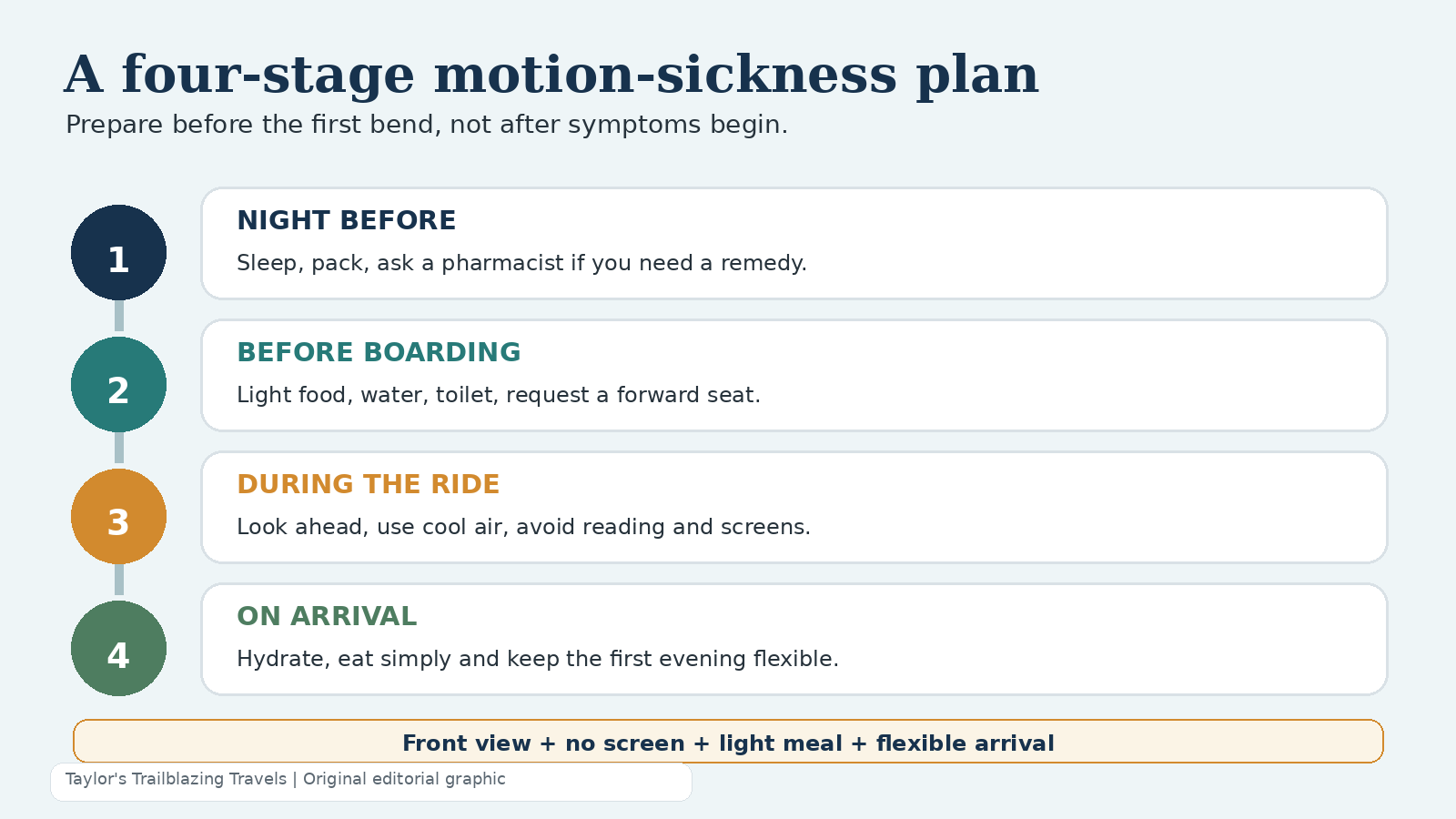
The NHS recommends sitting where motion is felt less, looking straight ahead at a fixed point such as the horizon, using fresh air, closing the eyes and breathing slowly, and taking breaks where possible. It also advises avoiding reading, screens, heavy meals and alcohol before or during travel. Ginger may help some people, while a pharmacist can recommend treatment when appropriate.[10]
Medication is not one-size-fits-all. Some travel-sickness products can cause drowsiness, blurred vision or other side effects. Ask a pharmacist or clinician what is suitable for you, read the instructions and never combine a sedating product with driving or riding.
Choose the seat strategically
Request a forward-facing seat near the front when the booking system allows it, but do not assume a reseller can guarantee the exact seat. Sit upright, use the seat belt, keep cool air moving and look through the windscreen rather than down at your lap. The back row generally creates the least appealing combination of movement, restricted view and limited legroom.
Build a small road kit
| Item | Useful because | Buying caution |
|---|---|---|
| Sealable sickness bags | They reduce panic and are easier to manage than an improvised plastic bag. | Choose leak-resistant bags and keep two within reach, not in stored luggage. |
| Water and tissues | Useful after nausea or a warm, dry cabin. | Drink steadily rather than finishing a large bottle immediately before departure. |
| Travel neck pillow | Can support a comfortable forward-facing posture. | A bulky pillow can be awkward in a tight van; compact support is better. |
| Acupressure wristbands | Some travellers like a non-drug option. | NHS guidance says they do not work for everyone; do not rely on them as the only plan. |
| Pharmacist-recommended medicine | May prevent or reduce symptoms when suitable. | Check timing, contraindications and drowsiness; never drive after a sedating dose. |
Practical road-day products
These items do not replace medical advice or a suitable vehicle, but they can make the journey easier to manage. Buy only what solves a known problem.
Protect the first afternoon
Do not book a demanding countryside tour immediately after the van. Check in, eat something simple, hydrate and see how you feel. A visitor who arrives well may still enjoy a sunset walk; someone who arrives nauseous has lost nothing by keeping the schedule open.
Luggage, seats and terminal details
The operator’s published luggage guidance
Prempracha’s FAQ says each passenger may bring no more than two pieces with a combined weight of no more than 15 kg and tells travellers to ask staff in advance about special luggage. That is more specific than the vague assumption that any backpack will be accepted.[3]
A large trekking pack, bicycle, instrument, folded wheelchair or multiple hard cases should be raised before payment. Do not arrive at the terminal expecting the driver to solve a capacity problem after every seat and luggage space has been allocated.
What stays with you
Keep your passport, wallet, medication, phone, power bank, glasses, water and sickness kit in a small cabin bag. Store nothing essential under the vehicle where it cannot be reached during the road section.
Seat selection
Direct and reseller systems may not offer the same seat-selection options. If a front seat is important, ask the actual seller what can be selected and what remains a request. Arrive early, remain polite and have a backup plan; no seat can make the road completely straight.
Keep the transfer bag organised
Packing cubes can separate the one small road bag from luggage stored elsewhere, while a charged power bank protects access to tickets, hotel messages and maps.
Rain, haze and the best time for the road
Wet-season decisions
Thailand’s northern rainy season is broadly associated with May to October, although individual days vary. Current FCDO guidance warns that heavy storms can cause flash floods and landslides, and it advises travellers to follow local weather information. The Thai Meteorological Department publishes daily and seven-day forecasts that should be checked close to departure.[7][11]
Rain does not automatically cancel every scheduled service. Nevertheless, a severe warning, flooding report or operator message should overrule an itinerary. Private drivers and self-drivers should avoid turning a weather delay into a race against darkness.
Cool-season demand
November through February is popular for cooler mornings and clearer walking weather. Consequently, vans and Pai rooms can fill around weekends and holidays. Book the transport and accommodation together so that a confirmed seat does not lead to a search for an unsuitable room far outside town.
Smoke and haze
Air quality in northern Thailand can deteriorate during the hot and burning-season period, often most noticeably from February into April, although timing and severity vary each year. Check live official monitoring rather than relying on a fixed annual statement. Thailand’s Pollution Control Department publishes Air4Thai readings for Chiang Mai stations.[12]
Haze may affect views and outdoor comfort even when the road remains open. A traveller with respiratory concerns should seek personal medical advice, monitor conditions and retain flexibility to change the route.
Rain protection for the transfer day
A lightweight jacket is more useful than a heavy coat when you need to move between a taxi, terminal and hotel in warm rain. It should pack small and dry quickly.
Can you visit Pai as a day trip from Chiang Mai?
Possible does not mean well balanced
A private day tour can physically cover the route and selected Pai sights. One current GetYourGuide listing advertises a 12-hour day with roughly 3.5 hours of driving each way. Its own information says participants spend about seven hours in the car and warns people prone to motion sickness to prepare.[13]
That is a poor trade for most visitors. Pai’s appeal is not only a list of roadside stops; it is the slower evening, walking street, morning atmosphere and ability to choose a countryside day without immediately turning back. Two nights is the practical minimum, while three nights gives weather and recovery room.
When a day tour can still make sense
Consider it only when you cannot stay overnight, have a strong reason to see a few highlights, tolerate winding roads well and accept that the day is primarily a long private drive. It is not a substitute for a relaxed Pai stay.
Organised alternatives to an independent overnight
A private day tour is the shortest format, while a two-day package gives Pai more breathing space. Compare the itinerary, road time, hotel standard, meals, cancellation terms and whether the product is private or shared.
Where to stay before and after the journey
Chiang Mai before departure
Staying near Arcade can simplify an early scheduled departure, although it may be less atmospheric than the Old City or Riverside. A traveller with a 10:30 or later service can stay more centrally and take a morning taxi. The correct answer depends on the departure time, luggage and whether the Chiang Mai stay is part of the holiday or merely a connection.
Pai after arrival
Central Pai is easiest for a short visit without a scooter. Walking Street, restaurants and the bus area are accessible, and a tired arrival does not need another long transfer. Outlying valley, riverside and countryside properties can be peaceful, but the hotel should confirm pickup, late-arrival arrangements and the cost of repeated trips into town.
| Stay type | Best for | Booking question |
|---|---|---|
| Central Pai | First visit, short stay, no scooter and evening food | Can you walk safely from the arrival point with your luggage? |
| Riverside near town | Atmosphere with reasonable access | Is the access road or bridge suitable after dark and in rain? |
| Outlying countryside resort | Views, quiet and a hotel-focused stay | Does the property provide pickup, and what does each town transfer cost? |
| Chiang Mai near Arcade | Early morning departure | Is reception open and is the correct terminal genuinely nearby? |
| Chiang Mai near airport | Flight before or after the Pai leg | How long will the cross-city journey to Arcade take at that hour? |
Compare Pai accommodation by exact map pin
Do not choose a Pai hotel from the town name alone. Check its distance from Walking Street, the arrival point and any pickup service, especially when you will not rent a scooter.
Connectivity for tickets and hotel messages
Keep ticket screenshots and accommodation details offline. Mobile data is still useful for driver contact, a hotel pickup message and maps, provided the route and device are supported. An eSIM should be installed before the travel day rather than while standing at the terminal.
Check Thailand eSIM options
Compare the data allowance, validity, device compatibility and activation instructions before buying. Coverage can vary in mountain areas, so an eSIM does not replace offline tickets and maps.
Realistic door-to-door cost examples
The operator fare is only one line in the budget. Add the taxi or songthaew to Arcade, booking fees, possible luggage costs and the transfer from Pai’s arrival point to the hotel. Conversely, compare a private vehicle by the whole group rather than by one seat.
| Traveller example | Likely choice | Illustrative one-way total | Why |
|---|---|---|---|
| Solo traveller from the Old City with one backpack | Scheduled van | Roughly THB 320-550 including local transport and possible booking fee | The private premium is difficult to justify without a health or timing need. |
| Couple with two normal cases | Scheduled service or private car | Roughly THB 540-900 shared; THB 2,100-4,500+ private | The decision rests on comfort, pickup and motion sensitivity. |
| Family of four with child-seat requirement | Private SUV or van | Often THB 3,000-5,500+ per vehicle | Door-to-door control and confirmed restraint matter more than the cheapest seats. |
| Three adults with several large bags | Private vehicle after capacity confirmation | Often THB 2,500-5,000+ per vehicle | A nominal three-seat car may not have enough luggage space. |
| Experienced driver continuing to Mae Hong Son | Rental car | Rental, fuel, insurance and deposit vary widely | The car serves a wider itinerary, not only the Chiang Mai-Pai leg. |
| Late international arrival | Chiang Mai hotel plus morning van | Hotel plus local transfers and THB 220-260 seat | It buys sleep and removes the risk of missing the last service. |
These are planning examples, not quotes. The private range reflects live marketplace inventory and can move sharply by date and vehicle. By contrast, the shared-service base fare is the operator’s published August 2026 figure, while reseller totals can include fees.
A practical booking sequence
Step 1: fix the nights, not the vehicle
Decide how many nights you actually have in Pai and whether the return must protect a flight. Two nights is the minimum useful visit; three nights is more forgiving. Return to Chiang Mai one day before an important international departure.
Step 2: choose the option around the travellers
List passenger count, luggage, child-seat needs, mobility, motion sensitivity and driving experience. Those facts usually identify the correct category before prices are compared.
Step 3: compare the complete trip
Add the Chiang Mai terminal transfer, check-in time and Pai hotel transfer to the shared ticket. For a private quote, confirm the exact pickup, luggage, waiting and stop terms. For a rental, add insurance, deposit, fuel and return logistics.
Step 4: book accommodation and transport together
A popular weekend can create the wrong combination: a confirmed late van and an outlying hotel with no evening pickup, or a perfect room with no suitable return seat. Resolve both before paying non-refundable rates.
Step 5: save evidence offline
- Ticket or voucher.
- Operator and sales-channel contact.
- Exact terminal or pickup address.
- Hotel address in English and Thai where available.
- Luggage and cancellation conditions.
- Flight details supplied to a private-transfer provider.
- Weather forecast and any operator message.
Step 6: reconfirm the day before
Check the departure time, terminal, pickup, weather and hotel arrival plan. A screenshot from months earlier is not enough when the operator explicitly says timetables and conditions can change.
Step 7: protect the road day
Eat lightly, keep the cabin bag organised and avoid a demanding first Pai activity. The booking is only successful when the traveller arrives safely and in a condition to enjoy the stay.
Common Chiang Mai to Pai transport mistakes
Comparing only the seat fare
A cheap seat plus two taxis, luggage uncertainty and a missed flight can cost more than the right vehicle chosen at the start. Compare door to door.
Using an old timetable
The hourly August 2026 schedule is helpful, but the operator still says times can change. Recheck the particular travel date.
Booking the next van after a flight
Airline delay, baggage and traffic do not respect a fixed road ticket. Build a large buffer or stay overnight.
Assuming every route leaves from the same terminal
Chiang Mai has multiple transport points. Read the booking and look for Route 612 information rather than following an outdated blog or an informal instruction.
Ignoring the 15 kg luggage guidance
Two bags are not unlimited bags. Raise special luggage with the operator before travel.
Eating heavily and scrolling through the bends
A large breakfast, alcohol, reading and phone use can make a difficult road much harder. Prepare for motion before departure.
Treating a private transfer as a tour
Door-to-door transport may allow a quick comfort stop, but it does not automatically include waterfalls, viewpoints or a guide. Buy the service you actually need.
Learning to ride on Route 1095
Rental availability is not proof of competence or insurance. Beginners should use a van or car.
Returning to Chiang Mai on flight day
A mountain road is not the place for a zero-margin airport connection. Return the previous day.
Planning a full Pai afternoon after the transfer
Keep arrival flexible. The road may take longer, and even an on-time trip can leave a passenger tired or nauseous.
Frequently asked questions
How long does Chiang Mai to Pai take?
Prempracha’s August 2026 timetable lists approximately three hours for the scheduled service. A realistic hotel-to-hotel plan is usually four to five hours after the Chiang Mai transfer, check-in, waiting and Pai hotel connection are included.
How much is the Chiang Mai to Pai minivan?
The operator’s reviewed August 2026 fare is THB 220 per person for the Route 612 van. The listed minibus fare is THB 260. Online booking fees or other sales-channel charges can increase the total.
What times do vans leave Chiang Mai for Pai?
The published schedule shows 06:30 and then hourly departures through 17:30. Reconfirm the exact date and vehicle because the operator says schedules can change.
Where does the Chiang Mai to Pai van leave?
Prempracha identifies Chiang Mai Arcade as the Route 612 boarding point. Check the exact terminal, operator counter and ticket rather than assuming a generic Chiang Mai bus station.
Can I book the van at the station?
Counter purchase may be possible when seats remain, but holidays, weekends and festivals can fill. Advance booking is safer when the Pai hotel or onward plan depends on a particular time.
Is the minivan dangerous?
Any road journey carries risk, and the route is winding. Use an established operator, wear the seat belt, avoid distracting the driver and allow the vehicle to travel at a safe pace. A private car can improve control but does not remove the mountain road.
Is there a direct train from Chiang Mai to Pai?
No. Pai has no passenger railway station, so the practical journey from Chiang Mai is by road.
Can I fly from Chiang Mai to Pai?
There is no normal practical scheduled flight alternative for this short transfer. Road transport is the standard option.
Is a private transfer worth it?
It can be worth it for a family, group, severe motion sickness, bulky luggage or an airport pickup. For one budget traveller staying in Chiang Mai before departure, the scheduled service is usually much better value.
What is the best seat for motion sickness?
A forward-facing seat near the front usually gives a better view of the road and may feel less bumpy. Seat requests are not always guaranteed, so combine the request with a light meal, fresh air, horizon focus and suitable pharmacist advice.
How many bags can I take?
Prempracha’s FAQ states no more than two pieces per passenger with a combined weight of no more than 15 kg. Ask in advance about unusual or oversized items.
Can I travel from Chiang Mai Airport straight to Pai?
Yes, by a deliberately pre-booked private transfer. A scheduled traveller normally needs to reach Arcade, and a late or international arrival is better followed by a night in Chiang Mai.
Is riding a scooter to Pai suitable for beginners?
No. The route requires real motorcycle experience, the correct licence and permit, explicit insurance cover, proper protective equipment and the freedom to cancel for poor weather or fatigue.
Is the road really 762 bends?
Although the figure is widely repeated as a route nickname and appears in commercial tour descriptions, it is not a useful operational guarantee or safety measure. The practical point is that the road contains sustained, repeated mountain bends for a large part of the journey.
Should I take travel-sickness medicine?
Ask a pharmacist or clinician what is appropriate for your health and other medication. Some products cause drowsiness, so they must not be combined with driving or riding.
What time should I leave Chiang Mai?
A morning departure is usually easiest. It leaves daylight on arrival, more alternatives if something changes and enough time to recover before dinner.
How many nights should I spend in Pai?
Two nights is the minimum useful stay. Three nights is more comfortable because it protects one full countryside day and leaves room for weather, motion-sickness recovery or a slow morning.
When should I return to Chiang Mai for a flight?
Return the day before an important international or early-morning flight. The published road time does not include the transfer from Arcade to the airport or disruption margin.
The simplest decision that works
Most travellers do not need to overcomplicate this route. Stay in Chiang Mai, book a morning Prempracha service, arrive early with ordinary luggage and keep the first Pai afternoon flexible. That plan is inexpensive, easy to understand and supported by a clear operator timetable.
Move up to a private transfer when it solves a real problem: children, several bags, airport pickup, limited mobility or significant travel sickness. Choose self-drive only when the car serves a wider itinerary and the driver is legally prepared, rested and confident. Leave the scooter to experienced motorcycle riders who meet every licence, insurance and equipment condition.
The best transport choice is not the one that produces the most dramatic photograph. It is the one that delivers every passenger safely, legally and calmly enough to enjoy Pai after the road ends.
Authoritative sources and research notes
Date-sensitive information was reviewed on 26 August 2026. Timetables, prices, vehicle types, weather and commercial availability can change, so readers should reconfirm the live details before travel.
- Prempracha Transport – Timetables and fares – August 2026 Chiang Mai-Pai departures, approximate journey time and Route 612 van/minibus fares.
- Prempracha Transport – Stations and boarding points – Route 612 boarding-point information.
- Prempracha Transport – Frequently asked questions – advance booking, terminal checking and two-piece/15 kg luggage guidance.
- 12Go – Chiang Mai to Pai taxi comparison – live August 2026 vehicle classes, indicative travel times and dynamic marketplace prices.
- GetYourGuide – Chiang Mai to/from Pai private transfer – example transfer duration, pickup, luggage and add-on terms.
- GOV.UK – International Driving Permits – 1968 IDP information for British drivers in Thailand.
- GOV.UK – Thailand safety and security – road, motorcycle, helmet, licence, insurance and severe-weather guidance.
- Airports of Thailand – Chiang Mai Airport taxi – official flat-rate taxi counter location and hours.
- Airports of Thailand – Chiang Mai Airport shuttle – A1, A2 and A3 city shuttle routes and published fares.
- NHS – Motion sickness – prevention, self-care and treatment guidance.
- Thai Meteorological Department – Daily forecast – live weather and heavy-rain planning.
- Pollution Control Department – Air4Thai – official air-quality monitoring for Chiang Mai and northern Thailand.
- GetYourGuide – Pai highlights day tour – example 12-hour itinerary and seven-hour road-time warning.
- Viator – Two-day Pai package – current organised overnight-tour example.
- Viator – Pai and Lod Cave private tour – current two-day private itinerary example.
- Tourism Authority of Thailand – Mae Hong Son – Pai and provincial visitor-planning context.
Image credits
All four graphics in this article are original editorial artwork created for Karen Taylor and Taylor’s Trailblazing Travels. No third-party photographer or stock-library attribution is required.