Northern Thailand / Airport transfers
Chiang Mai Airport to Old City and Nimman
A short airport journey, made simpler by choosing the right pickup and the right hotel entrance.
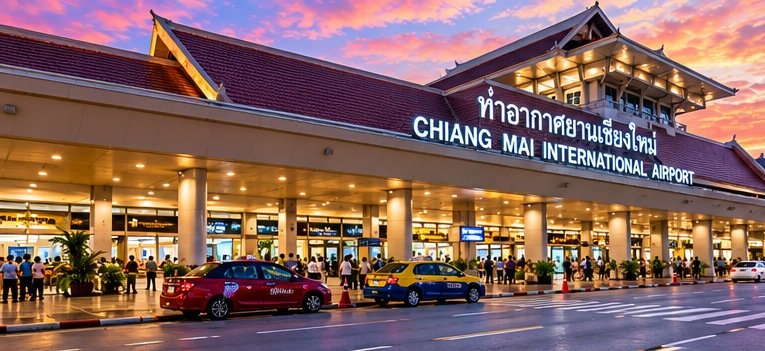
Artist's impression of a northern Thai airport arrival; follow current terminal signs.
Chiang Mai Airport to Old City and Nimman is a short journey with a surprisingly useful choice to make: pay for a direct hotel drop-off, or accept a wait and a final walk in exchange for a cheaper seat. The right answer depends less on the map distance than on your arrival time, bags and the actual entrance to your accommodation.
An Old City guesthouse beside a small lane, a Nimman hotel behind a busy junction and a property marketed as "Chiang Mai" beyond the centre are three different transfer jobs. Therefore, this guide starts with your address rather than treating every city ride as identical. It also separates a taxi quote for the vehicle from a bus fare charged to each passenger.
The recommendations below are research-led planning judgements, not accounts of rides personally taken. Airport information, the operator's booking instructions and recent reporting were checked for this guide; uncertain pickup details and variable fares are identified rather than presented as promises. Build the first evening around reaching your room comfortably, not around the fastest possible airport escape.
Easiest arrival
A confirmed hotel drop-off
Especially useful with checked bags or a late flight.
Budget option
RTC, when the route fits
Verify the current service and the last walk.
Location check
Entrance, not district
Old City and Nimman each contain very different addresses.
Return priority
Protect airline check-in
A short drive still needs a pickup and disruption margin.
Chiang Mai Airport to Old City and Nimman: choose the right ride
The sensible default
For a first visit with checked luggage, I would choose an authorised airport taxi or a properly confirmed private transfer. Both let you give the driver the complete address and avoid finding a hotel from a bus stop while carrying everything. However, a private booking is not automatically better value: compare the vehicle size, waiting terms and total price rather than the word "premium".
A bus is more attractive for a solo traveller arriving during its operating day, travelling light and staying near a confirmed stop. The saving becomes less compelling when several passengers each need a ticket and the hotel still requires another ride. Instead of choosing on price alone, ask which option removes a genuine difficulty from your particular arrival.
What has actually been checked
Chiang Mai Airport lists licensed taxis and designated Grab pickup arrangements. Separately, Bangkok Post reported RTC's return from a July suspension, with service restarting on 31 August 2026. That recent interruption is a reason to check the operator's current notice, not to assume an old route diagram is still reliable. [1] [2] [3]
| Option | Useful for | Door-to-door expectation | Main limitation |
|---|---|---|---|
| Airport taxi | Bags and a straightforward hotel arrival | Allow roughly 20-45 minutes after meeting the driver | Confirm the current fare at the desk |
| Pre-booked private car | Late flights, families, specific equipment | Similar road time; meeting process varies | Read the waiting and cancellation terms |
| Grab | Travellers already comfortable with the app | Road time plus driver and pickup-point wait | Quote and availability change |
| RTC city bus | Light luggage and a suitable daytime stop | Allow 45-90 minutes including possible waiting and walking | Reconfirm service and route direction |
| Songthaew by agreement | Travellers comfortable negotiating the exact ride | Depends on whether shared or private | No assumption of a standard airport fare |
Locate your hotel before choosing a vehicle
Old City is not one drop-off point
The Old City is the historic centre around the moat, but accommodation sits on both sides of its perimeter and throughout the lanes inside it. Ask your hotel for its map pin and a short address in Thai. A booking reference saying only "Old City" is not a useful instruction when the driver reaches a junction and needs to know which side of the road you need.
For an evening arrival, also ask whether a market or local event restricts vehicle access to your lane. The answer may be a nearby legal stopping place rather than the front door. That is manageable when you know beforehand, whereas discovering an unexpected walk with several suitcases makes a simple transfer feel much harder than it needs to be.
Nimman needs the exact soi
Nimman refers to the Nimmanhaemin area, not a single hotel strip with one convenient stopping point. A property near the main road can have its reception on a side street; another may share a similar name with accommodation elsewhere. Therefore, save both the written address and a screenshot showing the entrance, not merely a neighbourhood label. TAT identifies Nimmanhaemin as a distinct shopping and cultural area. [4]
Before paying for accommodation, compare the last part of the airport journey as well as the nightly rate. Old City accommodation searches is useful for checking Old City locations; Nimman accommodation searches lets you compare Nimman addresses separately. These are search starting points, not endorsements of every property returned. Confirm the actual hotel entrance directly with the property.
What happens after the aircraft arrives
Do the airport tasks in the right order
First collect your bags and complete the arrival formalities that apply to your flight. Then check that your phone connects and your driver or hotel has received any important delay update. Ordering a car while you are still waiting at the baggage belt can create unnecessary pressure, because the app's waiting clock is not the same thing as your aircraft's arrival time.
Keep the address, booking voucher and emergency contact accessible without opening a large suitcase. A screenshot is useful when mobile data has not yet started working. However, protect documents containing personal information: there is no need to display a passport photograph to everyone around the pickup area when the driver only needs a name and destination.
Follow the relevant pickup instruction
An airport taxi desk, a private-transfer representative and a Grab meeting point are separate systems. Use the signs and instructions for the service you actually bought. The airport's transport directory contains several entries with differing location descriptions, so this guide does not promise that one numbered door will be correct for every arrival. [1] [2]
When you cannot find the meeting point, stop in a staffed public area and contact the operator. Send the terminal or exit description shown beside you rather than repeatedly moving between doors. Consequently, the driver has one stable place to work from, and you are not trying to resolve directions while pulling luggage through a crowded forecourt.
Using an airport taxi without a price misunderstanding
Ask for the complete fare
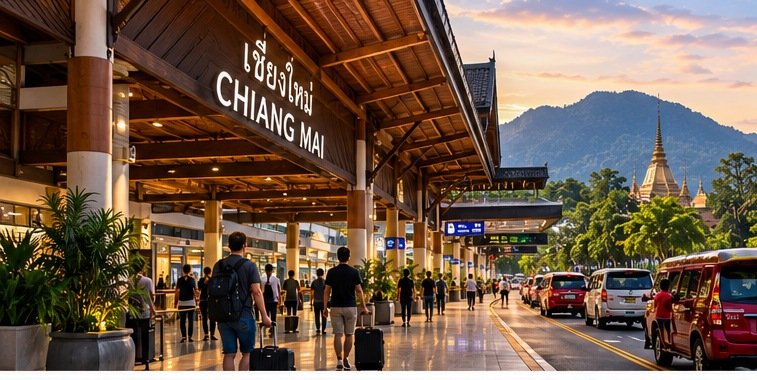
At the authorised desk, show the hotel address and ask whether the amount is fixed for that destination or calculated by a meter with additional charges. Confirm the number of passengers and bags before agreeing. A price that works for a compact car does not necessarily apply to a larger vehicle, and a central-city quote may not cover a hotel outside the normal area.
As an editorial budgeting allowance, set aside THB 200-400 for a straightforward central-city car journey, while recognising that this is not an official tariff or a live quote. Check the actual desk price before travelling. A late booking, larger vehicle or different hotel zone can fall outside that allowance; the written total is more useful than a remembered blog figure.Amounts dated 4 October 2026.
Keep the transaction easy to check
Ask where payment is made and retain the receipt or dispatch slip. Before the car moves, repeat the hotel name and look at the driver's destination screen where practical. If the location is wrong, correct it while you are still at the airport rather than after an avoidable drive around the moat.
Do not combine a transfer negotiation with an unplanned shopping stop or a same-day excursion purchase. You can decide about tours after settling in. Meanwhile, a driver offering another service does not change the agreement you made for the airport ride: keep the initial job clear, with one destination and an understood total.
When Grab is the better fit
Compare what the app actually offers
Grab's official airport help covers immediate and advance airport pickups in Chiang Mai. It also explains flight-linked bookings, although the conditions depend on the airport and product selected. Therefore, read the confirmation shown in your own app rather than assuming every advance reservation includes identical monitoring, waiting or cancellation arrangements. [5]
For an immediate ride, wait until you have your luggage and can reach the designated pickup point. Compare the total with an airport taxi quote, then decide whether any saving justifies the extra walk or wait. There is no dependable rule that an app will always be cheaper: the actual quoted journey matters more than the name of the service.
Use the platform's safety features
Check the registration plate, driver details and vehicle before boarding. Keep contact and payment within the booked arrangement instead of accepting an unexplained off-app switch. If the car does not match the details, ask for help through the platform or return to a staffed airport point rather than feeling obliged to leave with it.
A working data connection makes this process easier, but an eSIM is only one way to obtain it. Airalo eSIM options can be useful for comparing Thailand data packages; check your handset's compatibility, plan coverage and activation conditions first. Save the destination offline as well, because connectivity should support the transfer rather than be its only way of functioning.
Taking the RTC bus after its service restart
Check the latest operating notice
The August 2026 report described three airport-based loops, a THB 50 flat fare and an operating span of 07:00-18:30. Treat these as the reported restart arrangements, checked on 4 October 2026, not a promise about the day you land. The report also recorded the preceding suspension, which makes same-week verification particularly worthwhile. [3]
Ask for the current departure, the correct loop and the nearest useful stop for your hotel. A bus serving the right neighbourhood can still travel around its loop in an inconvenient direction. Therefore, show the exact map pin and ask how long the ride to that stop should take, rather than boarding solely because a familiar district appears on a route list.
Add the final walk to the decision
A low fare is valuable when the last few streets are easy with your bags. It is less attractive in heavy rain, after dark, with a pushchair or when you must cross a busy road. Check the pavement and hotel entrance in advance where possible. A five-minute map estimate can hide the very part of the journey you would least enjoy.
Keep enough flexibility to change your mind at the airport. If the next service is uncertain, choose another transfer instead of waiting indefinitely because the bus was your original plan. That is not a failed budget strategy; it is a practical limit on how much arrival time you are prepared to spend saving money.
Songthaews, walking and rental vehicles
Agree whether the ride is shared or private
A red songthaew can be part of a Chiang Mai trip, but an airport pickup should not be priced using an assumed inner-city shared fare. Ask whether you are buying a seat on a shared journey or hiring the vehicle for your party. Then agree the destination, total price and any additional stops before loading luggage.
This option suits travellers who are comfortable confirming details in a less standardised transaction. However, those arriving tired with large bags may prefer a conventional car. Seat belts, luggage protection and ease of boarding are practical considerations, not luxuries to dismiss simply because the journey looks short.
Do not turn the arrival into a driving test
Walking out towards roads outside the terminal merely to chase a cheaper pickup is not my default recommendation. It can add heat, rain exposure and awkward crossings without guaranteeing a better price. Likewise, hiring a scooter solely to avoid one airport transfer introduces licensing, insurance and luggage questions that a simple car journey does not create.
Rent a car because the wider trip genuinely needs one, not because it appears to solve every transport problem at once. Think through hotel parking and the next day's use first. For this specific airport-to-hotel journey, a booked seat or car is often the more straightforward tool, even when you later choose another way to explore.
Compare the total for your party
A seat price and a car price are different units
Suppose four adults are comparing the reported bus fare with a hypothetical car quote of THB 300. Four THB 50 bus tickets total THB 200 before any final transport. In that illustration, the direct car costs only THB 100 more for the group, although a different live quote could reverse the judgement. These are calculation examples prepared on 4 October 2026, not advertised package prices.
For one passenger, the same car is a much larger premium. That is why a sensible guide cannot nominate one cheapest option for everyone. Compare the number of paid seats, any children who need their own place, luggage charges where applicable and the cost of reaching the hotel after the advertised endpoint.
Price the service you need, not optional extras
A transfer may advertise a meet-and-greet sign, larger vehicle or free cancellation. Decide which features solve a problem before paying for them. A flight-linked pickup can be helpful on a late arrival, whereas a prestige vehicle contributes little to an uncomplicated daytime ride with one cabin bag.
Use GetYourGuide airport-transfer listings and Viator airport-transfer listings as alternative transfer searches when comparing inclusions. Read the individual product's destination zone, vehicle capacity and cancellation deadline; search results can mix private rides, shared services and unrelated experiences. A lower headline is not a saving when the final booking excludes the service you were trying to buy.
Private transfers: the details to confirm in writing
Put the flight and hotel on one booking
Enter the flight number, arrival date, passenger count and accommodation address carefully. The date is especially easy to mistype on an overnight journey from Europe, because the departure from home and arrival in Thailand may be on different calendar days. Confirm the pickup date rather than relying on the day printed most prominently on your first flight ticket.
Ask when included waiting begins and what happens after a delay. Some services use actual landing time; others rely on a stated meeting time or specific grace period. Therefore, keep the contact method and booking reference somewhere accessible. A vague promise that a driver "waits for flights" is less useful than a clear explanation of your own reservation.
Count bags as well as people
Four people do not automatically fit four large suitcases into every four-seat car. Send the number and approximate size of cases, then request written confirmation of the vehicle. The same applies to folded pushchairs, mobility equipment and sports bags. Otherwise, the first price comparison may be between services with different usable capacity.
For a larger party, larger-vehicle transfer listings provides another way to inspect private-transfer options. Select the relevant vehicle and review its luggage allowance rather than assuming the first displayed fare covers everyone. When two travellers arrive on different flights, ask whether the operator will wait for both or whether separate pickups are the cleaner arrangement.
Children, accessibility and a calmer arrival
Ask specific equipment questions
For a child who needs a suitable seat, describe the child's age and size and ask what restraint can actually be supplied. Do not treat a tick-box request as a guarantee of the correct equipment. A confirmed seat, enough luggage space and a clear meeting point can justify advance booking even when the road journey itself is short.
Build a little time for toilets, water and settling everyone before leaving the terminal. However, tell the driver when those minutes affect an agreed pickup. A calm message is better than disappearing from the meeting area while the operator assumes you have missed the booking.
Mobility requirements need more than "easy access"
Ask about the vehicle's step height, whether equipment must fold, available boot dimensions and help with luggage. If step-free boarding or staying seated in a wheelchair is necessary, confirm that explicitly with an appropriate provider before paying. The word "accessible" in a general listing is not enough to establish that the actual car suits your needs.
Check the hotel entrance at the same time. An easy airport pickup does not solve steep steps or a lane where the car cannot stop nearby. Therefore, treat the arrival as a continuous journey from terminal to reception. The best transfer is the one that works at both ends, not just the vehicle with the most reassuring description.
Late flights, rain and busy arrival periods
Have a nighttime fallback
A late flight makes a confirmed car more useful because daytime bus information may no longer apply. Tell the hotel your expected arrival and ask how check-in works after reception's usual hours. The transfer can go perfectly and still end awkwardly if nobody has explained how to enter the building.
If your flight slips substantially, update both the transport provider and accommodation. Do not assume they automatically share information simply because the same booking platform handled both purchases. A short written message with the revised flight details is usually more useful than trying to explain the entire journey while standing beside a waiting car.
Leave room for weather and events
Rain affects more than driving speed: you may need a covered meeting point, extra boarding time and a less exposed final drop-off. Check current TMD warnings before travelling rather than treating a seasonal average as the forecast for your arrival. This is particularly relevant when heavy rain or local disruption changes the practical route. [6]
For busy dates, ask the hotel about restricted access around nearby events. Then choose a legal meeting or drop-off point you can recognise. The goal is not to predict every closure months ahead; it is to remove obvious uncertainty the day before you travel, when the property and operator can give you usable instructions.
Plan the return to the airport separately
Work backwards from the airline's requirement
Start with the time your airline wants you at the airport, then add a realistic road allowance, pickup margin and time to load bags. Do not work backwards from the flight departure alone. A short drive cannot compensate for arriving after bag drop closes or for discovering that your booking uses a different departure terminal procedure.
For a normal central-city pickup, I would allow roughly 45-60 minutes for the road-and-collection part of the plan, increasing that for disruption or a difficult address. This is deliberately more generous than an empty-road drive estimate. The airline's own check-in and bag-drop instructions remain separate, and should be followed for your specific flight.
Confirm the pickup the evening before
Send the reception entrance or agreed meeting point and ask who to contact if the vehicle does not arrive. Keep enough payment flexibility to use a backup ride. A return transfer is a fresh booking decision, not a guarantee that the driver who brought you from the airport will still be available.
You can inspect Chiang Mai return-airport options before departure day, but check the actual pickup zone and notice period. For a very early flight, certainty is usually worth more than a small saving found at the last minute. Leave the hotel with water, documents and essentials already accessible, rather than stopping to rearrange the case outside reception.
Make the first afternoon work with the transfer
Do not confuse arrival with check-in
An early flight can leave you at the hotel before the room is ready. Ask whether luggage storage is available and whether early check-in needs to be arranged. However, do not pay for an elaborate airport detour simply to fill the gap unless the operator has clearly confirmed secure luggage arrangements and a sensible route.
A nearby meal or gentle walk is usually a better first activity than a fixed-time excursion. It allows the arrival to absorb delays without turning one late bag into several missed bookings. Keep the first useful hour for settling the practical things: room access, valuables, communications and a clear plan for dinner.
Carry only the arrival essentials
A small pouch for the voucher, local cash and charging cable reduces rummaging at the pickup point. simple zipped travel organisers is an optional way to compare simple travel organisers, not something you need to buy if an existing zipped pocket does the job. Choose organisation that makes the transfer easier rather than adding another bag to manage.
For the following day, the site's Chiang Mai four-day itinerary helps separate Old City time from the western neighbourhoods and a longer excursion. Meanwhile, Northern Thailand guide is more useful when the airport arrival begins a wider northern route. Keep those onward journeys distinct from this transfer so that an airport quote does not quietly expand into an unplanned multi-day arrangement.
A booking message that prevents avoidable confusion
Give the operator useful information in one place
A useful enquiry names the flight, Thai arrival date, hotel entrance, passenger count and bags, then asks for the complete price. For example, explain that you are travelling to an Old City guesthouse inside the moat with two adults and two medium cases, rather than asking only how much a ride to Chiang Mai costs. That lets the provider quote the actual job.
For Nimman, add the soi and property pin, particularly when the reception is not on the main road. Ask the hotel whether a car can reach the entrance at the expected hour. If a short walk is unavoidable, establish where it begins and whether staff can help with bags. These details are more useful than requesting a vaguely described luxury transfer.
Ask what happens if you are not ready
Make the waiting question specific: when does the clock start, who checks the flight and how do you contact the driver after landing? Then ask what happens if the bags take longer than expected. A clear answer gives you something actionable, while a general promise of good service does not explain the booking when an ordinary airport delay occurs.
Keep the final reply together with the receipt rather than relying on a sales-page description that may change. Also check the cancellation deadline in local time. A flexible-looking label can refer to a cutoff that falls while you are still flying from the UK, so settle any change before that point rather than discovering the condition after arrival.
Check the last few streets before paying for the room
Arrival convenience can justify a small location change
When choosing between two similar properties, compare how you would reach each after a flight. A room beside a straightforward legal stopping place may be easier than a cheaper-looking address behind several narrow turns. For a short Chiang Mai stay, that difference also affects the return pickup and the amount of luggage handling across the visit.
Look at recent property directions and ask reception about the normal vehicle entrance. Do not interpret a pedestrian route on a map as a promise that a taxi can follow it. Around the Old City, which side of a road you need can matter; in Nimman, an entrance on a quieter soi may be preferable to being dropped beside a busy junction.
Compare payment and check-in as well as location
Use Chiang Mai hotel payment and arrival conditions to compare another set of Chiang Mai accommodation listings when arrival time is the deciding factor. Then confirm late reception, luggage storage and any room-payment requirement with the chosen property. A transfer budget can be perfectly adequate while the arrival still becomes awkward because a room balance is unexpectedly due in cash.
Finally, send the hotel your likely arrival window rather than the aircraft's landing time. This gives reception a realistic expectation and allows it to explain anything unusual about access. Once the entrance, check-in and payment are clear, the transport choice becomes much simpler: choose the service that gets you to that arrangement without adding work you do not need.
Pros and cons of the main choices
Why a direct car earns its place
A direct car keeps the job simple: one meeting, one destination and fewer luggage movements. It is particularly useful for a family, a late arrival or a hotel behind a complicated final turn. In addition, a price for the whole vehicle can compare well with several individual tickets once the final walk or extra ride is included.
The compromise is paying more than a solo bus passenger would, and sometimes accepting advance-booking conditions that reduce flexibility. A polished advertisement does not remove the need to check luggage, waiting and cancellation rules. Choose the car for a clear practical reason rather than assuming it is the only respectable way to arrive.
Why the bus can still be the right answer
A working daytime service gives a light traveller a low-cost route into the city and avoids buying a whole vehicle for one person. Nevertheless, departure uncertainty, the loop direction and the final walk can make the total journey much longer than the drive. Verify those three points before treating the saving as worthwhile.
Neither choice needs to become a statement about how adventurous you are. Use the bus when it genuinely fits, and use a car when it removes a difficulty you would otherwise carry into the first day. The strongest plan is adaptable rather than loyal to one transport method.
Common mistakes to avoid
Booking the district instead of the entrance
A hotel name, a neighbourhood and a correct map pin should all point to the same place. Check that they do before booking. Also distinguish a hotel on the Old City edge from one with a similar name elsewhere. A few seconds of address checking can prevent a much longer argument about whether the original fare covers the new destination.
Another mistake is comparing a bus ticket with a private car as though both prices cover the same number of people. Add every paid seat and the last transfer before deciding. However, do not inflate a hypothetical saving into a reason to spend an hour waiting for a service whose current departure nobody can confirm.
Relying on old instructions
Historic RTC maps, airport door numbers and screenshots of app fares can all outlive the arrangements they describe. Use them as orientation, then confirm the current information. Finally, avoid sending the driver your flight's departure time from the previous city when the booking asks for arrival in Chiang Mai; these are different events on a potentially different date.
Frequently asked questions
Is the airport far from the Old City?
It is a short city transfer rather than a long intercity journey. However, the exact hotel and the route around the centre affect the drive. For planning, allow roughly 20-45 minutes after meeting a direct driver rather than treating a best-case map estimate as a promise. Airport formalities and waiting happen before that allowance begins.
Is Nimman easier to reach than the Old City?
Not automatically. Nimman can work well for a direct pickup, but the exact soi, traffic and hotel entrance matter. An Old City hotel with a straightforward drop-off may be easier than a Nimman property behind an awkward junction. Therefore, compare the real address rather than choosing a district purely to shorten the airport ride.
Is there a train from the airport into the centre?
Do not plan this arrival around an airport rail service. The practical options reviewed here are road transfers, app rides and the city bus when operating. Chiang Mai's railway station is a different place from the airport, so a booking to the station does not deliver you to an Old City or Nimman hotel. [1]
Can I take the bus after an evening arrival?
The reported restart schedule ended at 18:30, so it is not a sensible foundation for a late-night plan. Check the operator's current notice for your date, then keep a car alternative. Your aircraft landing before the last listed departure does not guarantee you will clear the airport and reach the stop in time. [3]
Should I book a return transfer now?
Book ahead when you need an early pickup, special equipment or a larger vehicle. Otherwise, you can compare closer to departure once the hotel address and flight details are settled. In either case, confirm the pickup the evening before and follow the airline's airport arrival requirements rather than relying on the short road distance.
Will a driver wait if my flight is delayed?
That depends on the product. Ask when waiting starts, how the operator monitors the flight and what happens beyond the included period. Grab describes flight-linked airport bookings, but conditions still need checking in your own confirmation. A standard immediate ride and a pre-booked flight-linked transfer should not be assumed to work identically. [5]
Is a shared ride best for three or four people?
Sometimes, but compare the group total first. Several individual tickets plus an extra hotel transfer can approach the cost of a direct car. On the other hand, a larger private vehicle may cost more if your luggage will not fit a standard car. Count people and bags before judging the price.
Can I pay every driver by card?
Do not assume so. Check payment at the taxi desk or in the booking, and carry enough local cash for the chosen ride and a modest fallback. An app-linked card can also need verification, so test access before travelling. A payment logo on an unrelated airport counter does not establish what your driver accepts.
What should I do when I cannot find my driver?
Stay at the agreed meeting point or move to a clearly identified staffed area, then contact the operator with your location and booking reference. Send a photo of the nearby sign if helpful, but avoid exposing private documents. Repeatedly changing doors without telling the driver usually makes the problem harder to solve.
Is it worth buying anything specifically for this transfer?
Usually not. A charged phone, an offline address, manageable luggage and a small amount of local cash do most of the work. An organiser can help when you already need one for the trip, but there is no special airport accessory requirement. Spend first on the transport arrangement that matches your real needs.
The transfer I would choose
For an uncomplicated first arrival, I would take an authorised taxi or a confirmed private car directly to the hotel's verified entrance. That is especially appealing with checked luggage or several passengers. However, I would happily use the RTC bus when its current departure, loop and final walk clearly fit a light daytime arrival.
The decision can be made in three questions: does the service operate when you will actually be ready, does its price cover your whole party and bags, and does it deliver you somewhere useful? Answer those before paying. Then keep the first evening flexible and use the time saved on a smooth arrival to enjoy the city rather than untangle the booking.
Sources and fact-checking notes
- AOT: Chiang Mai Airport Taxi
Official taxi-service listing; no universal fixed city fare inferred. Reviewed 4 October 2026.
- Grab: designated airport pickup zones
Primary provider description of the Chiang Mai and Phuket airport arrangements; use current in-app directions. Reviewed 4 October 2026.
- Bangkok Post: RTC service restart
21 August 2026 report of the announced 31 August restart, three loops, fare and operating span; verify the current service. Reviewed 4 October 2026.
- Tourism Authority of Thailand: Chiang Mai
Destination context; neighbourhood choice is an editorial judgement, not an operator guarantee. Reviewed 4 October 2026.
- Grab Help: advance bookings
Airport-pickup products, availability and product-specific conditions. Reviewed 4 October 2026.
- Thai Meteorological Department: current warnings
Use current warnings close to the date of travel, not a static weather promise. Reviewed 4 October 2026.
Illustrations in this article were created for Taylor’s Trailblazing Travels. Third-party photographs, where used, are credited beside the image or in the source list.