A practical first-timer’s route that balances west-coast sunsets, northern beaches, an east-coast nature day, flexible party or wellness options, and enough ferry buffer to keep the trip enjoyable.
This article contains affiliate links. If you book or buy through one of them, Taylor’s Trailblazing Travels may earn a commission at no extra cost to you. Recommendations are included only where they solve a genuine planning problem. Prices, timetables, weather, park access and event dates can change, so check the final details before paying.
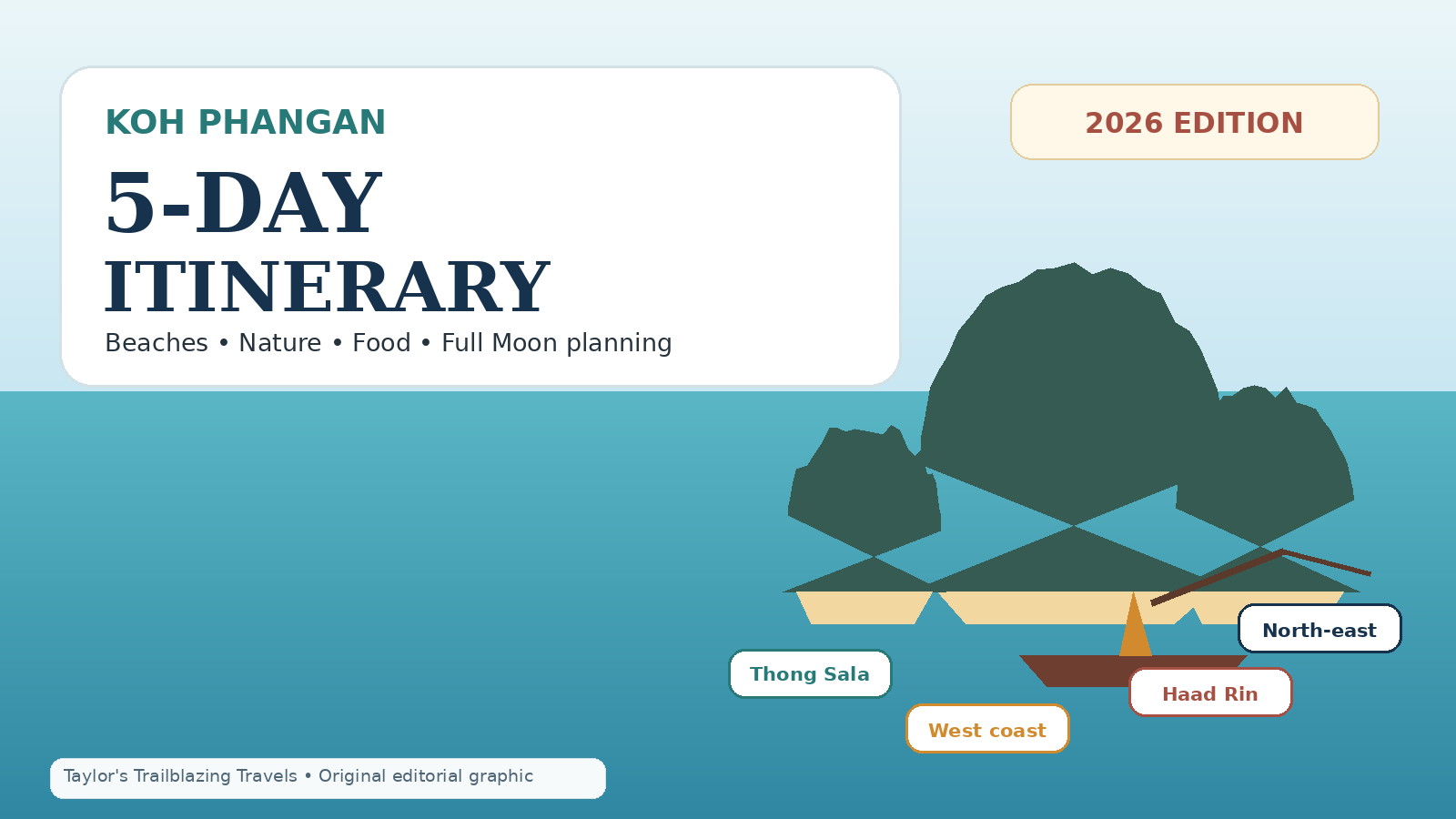
What is the best 5-day Koh Phangan itinerary?
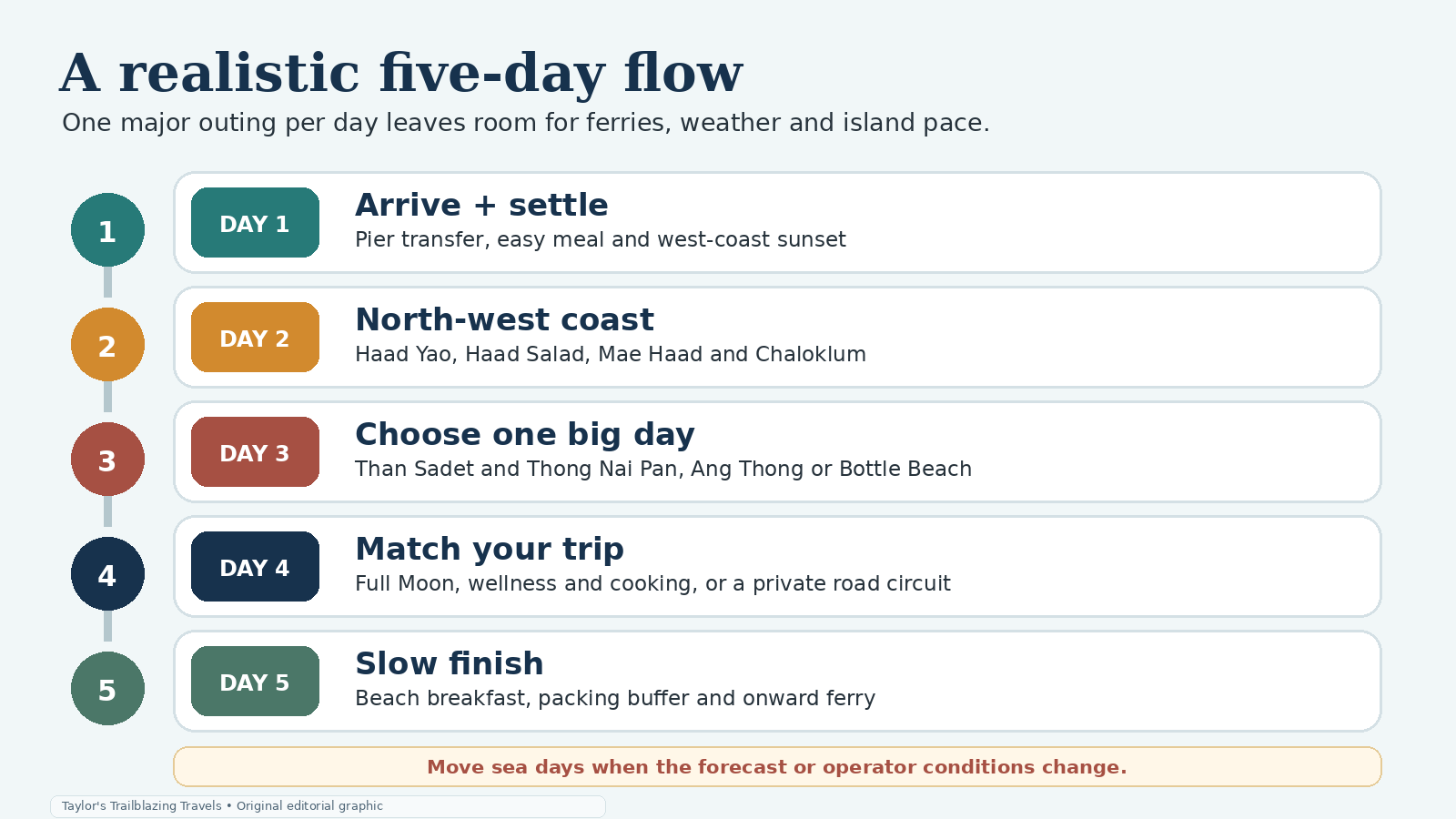
Spend day one arriving through Thong Sala and watching a west-coast sunset; use day two for Haad Yao, Haad Salad, Mae Haad and Chaloklum; choose one major nature or boat outing on day three; make day four your Full Moon Party, wellness, cooking-class or private-road-trip day; and protect day five for a slow beach morning and a well-buffered ferry departure.
Koh Phangan itinerary at a glance
Ideal first stay
Five nights gives you four useful activity days plus arrival and departure breathing room.
Best all-round base
Baan Tai or the Thong Sala side of the south-west coast works well for a mixed trip with transport, food and nightlife.
Best party base
Haad Rin is the practical choice when the Full Moon Party is central to the trip because you can walk back to your room.
Best quiet base
Haad Yao, Haad Salad, Chaloklum or Thong Nai Pan suit travellers who value beaches and slower evenings.
Book first
Secure the island ferry and accommodation before activities, especially around Full Moon and New Year dates.
Biggest planning mistake
Trying to cross the island repeatedly instead of grouping beaches and activities by coast.
Jump to a section
Why this Koh Phangan itinerary works
Koh Phangan looks compact on a map, yet the island does not behave like a walkable resort. Hills, winding roads, scattered bays and separate pier areas turn a short straight-line distance into a meaningful transfer. As a result, a plan that jumps from Haad Rin to Chaloklum, back to the west coast and then across to Thong Nai Pan can feel more like taxi administration than an island holiday.
This route groups places by geography. The first day stays close to the main arrival corridor. The second follows the north-west coast in one direction. Day three is reserved for the outing most likely to be affected by weather, boat availability or park conditions. Day four then becomes a flexible identity day: party, wellness, cooking, a private driver or a quieter road circuit. Finally, day five keeps the ferry connection protected.
It includes both sides of the island
The Tourism Authority of Thailand presents Koh Phangan as more than a party destination, highlighting beaches, waterfalls, mountains and quieter local life alongside Haad Rin.[1] A balanced first visit should therefore include at least one lively or convenient south-west base, one northern or north-western beach day, and one nature-focused east-coast or marine outing.
It does not pretend every activity is essential
Ang Thong Marine Park, Koh Tao and Nang Yuan, Bottle Beach, Than Sadet and a full island road tour are all legitimate choices. They are not sensible on consecutive days in a five-night stay. Pick one major outing, then keep the remaining days geographically simple. You will remember the beach, meal and sunset more clearly than a string of rushed pickup vans.
A useful planning rule
For a five-day island trip, schedule one high-effort day, two medium-effort days and two low-pressure days. Ferries, heat, late nights and tropical rain make that pattern more resilient than five packed sightseeing days.
Where to stay for this Koh Phangan itinerary
The best area is not simply the prettiest beach. It is the place that reduces the journeys you care about. Before booking, place the hotel pin on a map, identify the nearest practical beach and note how you will reach Thong Sala or Haad Rin after dark. A property can use a famous area name while sitting well beyond its walkable centre.
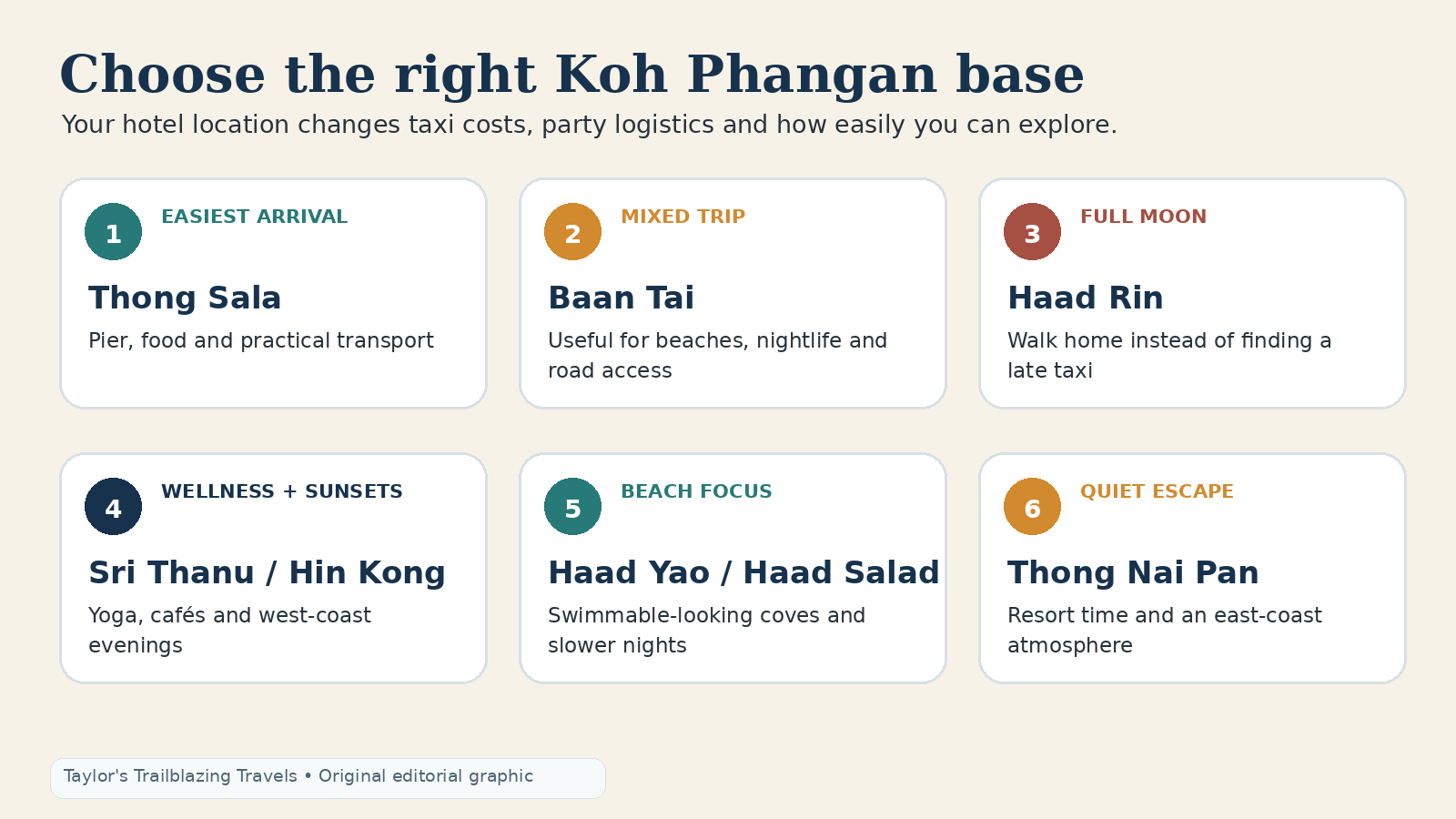
| Area | Best for | Main advantages | Trade-offs | Useful for this itinerary |
|---|---|---|---|---|
| Thong Sala | First or last night, food, onward ferries | Main pier, markets, cash machines and practical services | Town base rather than a classic beach escape | Easy arrival day and protected departure morning |
| Baan Tai | Mixed beach, nightlife and exploration trip | Central south-coast road position and access toward Haad Rin | Beach quality and walkability vary by exact property | Best overall compromise for this five-day route |
| Haad Rin | Full Moon Party and late-night convenience | Walk to the main event and avoid a difficult journey home | Busy, noisy and expensive around major party dates | Use when the party is a primary purpose, not a side thought |
| Sri Thanu / Hin Kong | Yoga, cafés, wellness and sunsets | Strong west-coast lifestyle scene and easy evening atmosphere | Some shorelines are shallow or tide-dependent | Excellent for the wellness version of day four |
| Haad Yao / Haad Salad | Beach time, couples and slower nights | Attractive coves and good access to the north-west route | More taxi planning for Haad Rin or early ferries | Ideal when beaches matter more than nightlife |
| Chaloklum | North-coast character and boat access | Fishing-village atmosphere and access toward Bottle Beach | Remote from party nights and main-pier logistics | Strong choice for a quiet, active trip |
| Thong Nai Pan | Resort time and an east-coast retreat | Scenic bays and a distinct away-from-it-all feel | Longer, hillier transfers to Thong Sala and Haad Rin | Best as a focused quiet stay or split stay |
Thong Sala: the practical choice
Thong Sala is rarely the romantic answer, but it solves real problems. Arriving late, leaving early, carrying heavy luggage or connecting to Koh Tao all become easier when the room is near the main pier. The town also provides the widest concentration of everyday services. For a short trip, one practical night can be more valuable than an extra sunset transfer.
Baan Tai: the most flexible first-timer base
Baan Tai stretches along the south coast rather than forming one compact centre. Consequently, check the property pin instead of trusting the area label. A well-positioned hotel gives straightforward road access to Thong Sala, Haad Rin and the west coast. It also lets mixed-interest groups split up without everyone relocating.
Haad Rin: the correct answer for a party-led trip
Staying elsewhere to save money can be false economy on Full Moon night. Shared transport becomes crowded, private fares rise, and the road home is the least enjoyable part of the evening. When the event is the reason for the visit, pay for a walkable room and move to another coast afterwards if you want quieter nights.
Sri Thanu, Haad Yao and Haad Salad: choose the west for lifestyle or beach time
Sri Thanu and Hin Kong lean toward cafés, yoga, longer stays and sunset routines. Haad Yao and Haad Salad feel more like conventional beach bases. Neither is automatically better. The first suits travellers who want a daily rhythm; the second suits those who want sand and swimming to dominate the schedule.
Thong Nai Pan: beautiful, but not a neutral base
Thong Nai Pan works when the journey is part of the commitment to a quieter stay. It is less suitable for travellers who expect to visit Thong Sala every evening or attend several south-coast events. A split stay of three nights in Baan Tai or the west and two nights in Thong Nai Pan is often more coherent than commuting across the island.
Compare accommodation only after choosing the coast
Use the island-wide search for an overview, then narrow the map to the area that matches your itinerary. Check cancellation terms, minimum stays around party dates, air-conditioning, road access and the distance from the nearest usable taxi pickup point.
Hotel prices and minimum-stay rules can move sharply around Full Moon and New Year periods. Recheck the final total, taxes and cancellation conditions before paying.
Koh Phangan five-day itinerary overview
| Day | Core plan | Typical active time | Weather sensitivity | Best evening |
|---|---|---|---|---|
| 1 | Arrive through Thong Sala, check in, easy west-coast sunset | 3-5 hours | Low | Thong Sala food or a quiet beach dinner |
| 2 | Haad Yao, Haad Salad, Mae Haad and Chaloklum | 6-8 hours | Medium | West-coast sunset |
| 3 | Choose Than Sadet and Thong Nai Pan, Ang Thong, Bottle Beach, or Koh Tao | 7-10 hours | High | Early meal and rest |
| 4 | Full Moon Party, wellness and cooking, or a private road circuit | 4-10 hours | Low to medium | Trip-specific |
| 5 | Slow beach morning, packing buffer and onward ferry | 2-5 hours | Medium | Onward destination |
Day 1: arrive through Thong Sala and let the island slow you down
Do not treat the ferry arrival as a minor detail
Every traveller reaches Koh Phangan by water. Lomprayah’s official 2026 timetable connects the island with Samui, Koh Tao and mainland transfer points, while Raja Ferry publishes a vehicle-ferry route between Donsak and Thong Sala.[2][3] Even so, the ticket time is not the hotel-arrival time. Add luggage collection, pier congestion and the final road transfer.
A traveller landing at Surat Thani Airport in the morning may still reach a west-coast hotel in the late afternoon. Someone flying into Koh Samui can make the sea crossing faster, yet a late flight may miss the most convenient ferry. Therefore, day one should contain only flexible plans.
Check in before chasing a beach
Leave the bags, confirm the hotel’s taxi arrangements and ask where the return pickup actually happens. On Koh Phangan, a lane that looks short on a map can be steep, unlit or unsuitable for rolling luggage. This is also the moment to photograph the hotel address in Thai or save the map pin offline.
Choose an easy first sunset
From Thong Sala or Baan Tai, head toward Hin Kong, Sri Thanu or another west-facing shoreline only if the transfer feels simple. Otherwise, stay near the hotel, eat early and reset. A rushed taxi to a famous viewpoint rarely improves an arrival day.
Use the evening for practical preparation
- Confirm the next day’s driver, taxi arrangement or scooter decision.
- Check the Thai Meteorological Department forecast and any marine warnings.
- Withdraw enough cash for small restaurants, shared taxis and beach facilities.
- Save the ferry booking, hotel contact, insurance assistance number and passport copy offline.
- Buy water and simple breakfast supplies if the hotel is remote.
Connectivity helps most on arrival and transfer days
An eSIM can be useful for ferry messages, map pins and hotel contact before you have time to visit a local mobile shop. Check phone compatibility, data allowance and activation instructions before travelling.
Day 2: build one north-west beach circuit
The north-west coast is ideal for a first full day because several distinct stops can be linked without crossing the island repeatedly. Start after breakfast, move north at a measured pace and finish where sunset suits the weather. Do not promise yourself four long swims; tide, heat and road time will decide how much fits naturally.
Morning: Haad Yao or Haad Salad
Choose one beach for the main morning stop. Haad Yao tends to provide more accommodation and dining options, while Haad Salad feels smaller and more enclosed. Conditions vary with tide, season and wind, so judge the water in front of you rather than relying on an old photograph.
Allow 90 minutes to three hours. A beach day becomes more enjoyable when you are not checking the clock every twenty minutes. If the water is shallow or choppy, use the time for breakfast, a walk and shade instead of forcing a swim.
Midday: Mae Haad and Koh Ma viewpoint
The sandbar toward Koh Ma is visually appealing, but its shape and walkability are tide-dependent. Wear footwear that handles hot sand, rock and wet surfaces. Snorkelling quality also changes with visibility and sea state. Avoid standing on coral, feeding fish or treating shallow reef as a pathway.
Lunch: Chaloklum
Continue to Chaloklum for a different island atmosphere. The north-coast village is useful for lunch, a harbour walk and boat enquiries. It also provides the starting point for some Bottle Beach long-tail trips. Before agreeing to a private boat, confirm the route, total price, waiting time, life jackets and what happens if the sea turns rough.
Afternoon choice: beach time or one viewpoint
After lunch, either return to the beach that looked best or add one modest viewpoint. The mistake is stacking a difficult hike onto a full beach circuit without accounting for heat. If you plan a demanding trail, start earlier and make it the day’s main activity rather than a final extra.
Why this day works
- The route follows one coast.
- Several stops can be shortened without ruining the day.
- Food and shade are easier to find than on a remote boat outing.
- A road-based plan can continue in light rain.
What can go wrong
- Trying to swim at every beach.
- Ignoring tide and sea conditions.
- Driving an unfamiliar scooter after dark.
- Leaving the return taxi unplanned.
Better than a checklist
Choose one beach for swimming, one place for lunch and one sunset stop. Treat everything else as a bonus. That simple structure usually produces a more memorable day than collecting six beach names.
Day 3: choose one major outing
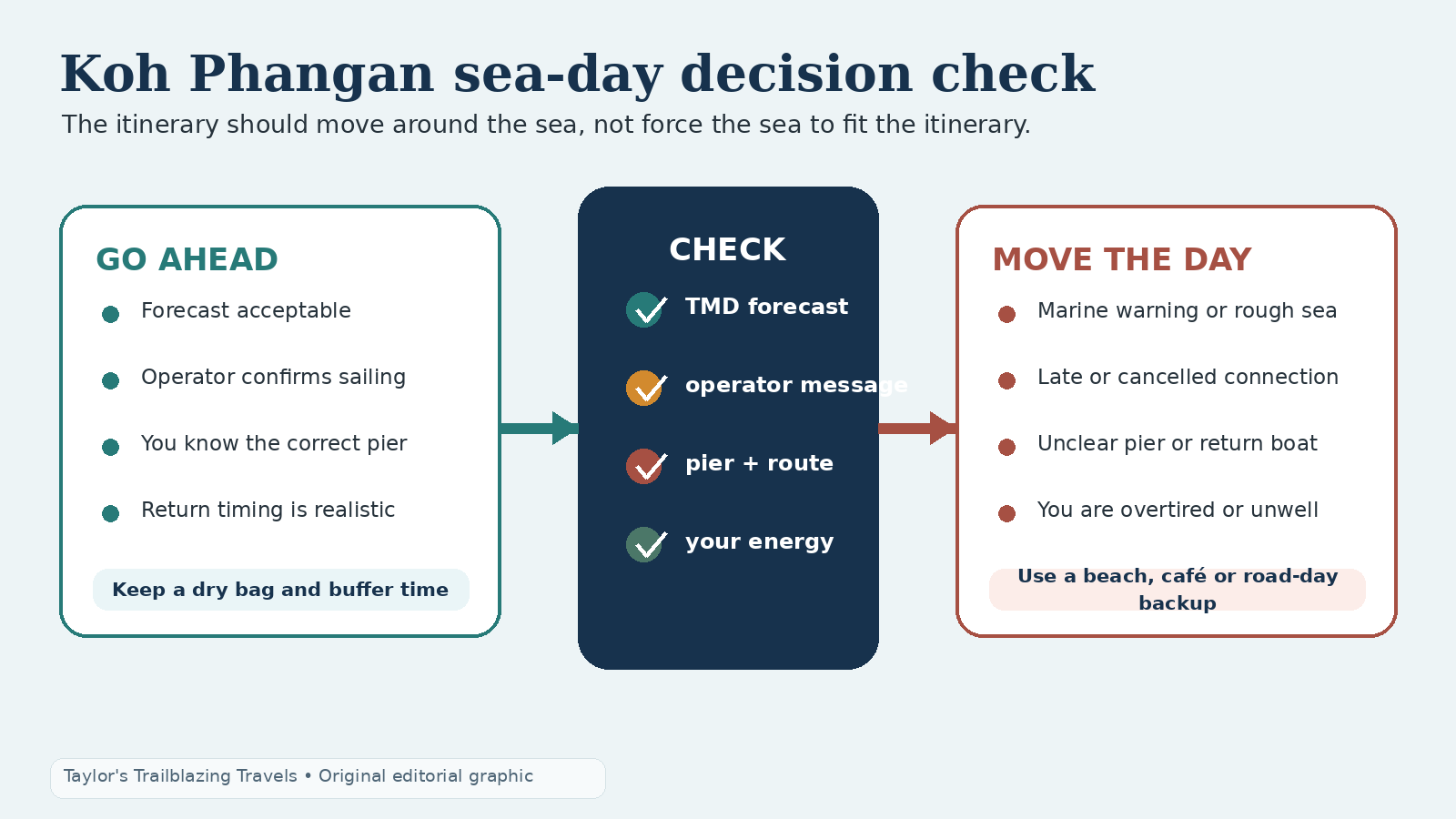
Day three should be the most ambitious part of the itinerary, but it should contain one ambition, not four. Check the forecast, operator message, pickup zone and cancellation terms the evening before. The Department of National Parks states that Mu Ko Ang Thong normally closes to tourism throughout November because monsoon conditions make travel unsafe.[5] Other boat routes can also change when the sea is unsuitable.
Option A: Than Sadet and Thong Nai Pan by road
This is the strongest all-weather-leaning choice for travellers who want scenery without committing to a full marine tour. Than Sadet combines forest, waterfall history and an east-coast setting, while Thong Nai Pan provides lunch, beach time and a resort-bay atmosphere. The TAT lists Than Sadet National Waterfall and Thong Nai Pan among the island’s recognised highlights.[1]
Access, water flow, road condition and fees can change. During dry periods, a waterfall may be far less dramatic than promotional photographs suggest. Conversely, heavy rain can make paths slippery. Wear proper footwear and let current conditions determine how far you go.
Option B: Ang Thong Marine Park
Ang Thong suits travellers who want a full boat day, limestone-island scenery, snorkelling, kayaking and a steep viewpoint option. The national park lies west of Koh Phangan and Samui and includes dozens of islands.[5] Tours commonly last most of the day, and the most famous viewpoint involves a strenuous climb.
Check whether the national-park fee, hotel pickup, kayaking equipment, lunch and snorkelling gear are included. More importantly, ask whether a less mobile traveller can remain comfortably on the boat or beach while others climb. A tour can be excellent without everyone completing every activity.
Ang Thong tour comparison
This full-day listing includes a mixture of boating, snorkelling, kayaking and viewpoint time. Read the fitness, pickup-zone, weather-cancellation and park-fee details rather than choosing only by the headline photo.
Option C: Bottle Beach by long-tail boat
Bottle Beach offers a shorter sea-based outing and can be combined with north-coast snorkelling stops. It is a useful compromise when Ang Thong feels too long. However, a long-tail boat is more exposed to spray and wave movement than a large ferry. Carry only what can get damp and obey the operator when conditions change.
Shorter boat-day option
The small-group long-tail itinerary leaves from the Chaloklum area and combines several north-coast stops with Bottle Beach. Confirm the meeting point, minimum passenger requirements and whether your hotel transfer is included.
Option D: Koh Tao and Koh Nang Yuan
Choose this only when snorkelling is a top priority and you accept a long, boat-heavy day. The reward can be clearer reef-focused time than a general island circuit. The cost is an early start, more time in transit and greater sensitivity to sea conditions. It also duplicates the route if Koh Tao is your next destination, so consider travelling there for two nights instead.
Koh Tao and Nang Yuan comparison
Review the boat type, transfer arrangement, snorkelling stops, marine or island fees, and cancellation policy. Travellers prone to seasickness should assess the forecast and medication advice before committing.
| Major outing | Typical duration | Best for | Main drawback | Bad-weather alternative |
|---|---|---|---|---|
| Than Sadet + Thong Nai Pan | 6-8 hours | Road scenery, nature and beach time | Long transfers from the west or south | Shorten to cafés, markets and a nearer beach |
| Ang Thong | 8-10 hours | Big scenery, kayaking and a full boat day | Weather sensitivity and steep viewpoint | Private road circuit or cooking class |
| Bottle Beach long-tail | 4-6 hours | North-coast boating and a shorter outing | Open-boat exposure and limited shade | Chaloklum lunch and west-coast beaches |
| Koh Tao + Nang Yuan | 9-11 hours | Snorkelling-led travellers | Longest day and most boat time | Move it to a Koh Tao overnight stay |
Day 4: choose the Koh Phangan that fits you
After the major outing, day four should reflect the reason you chose this island. A party-focused group, a yoga traveller, a family and a couple on a quiet beach break should not follow the same schedule. Choose one of the following branches and allow the other versions to remain someone else’s holiday.
Branch 1: Full Moon Party day
Sleep later, eat a substantial meal, hydrate and keep the afternoon light. If you are staying outside Haad Rin, arrange the outbound and return transport before drinking. The 2026 official event page lists the remaining dates as 28 August, 26 September, 27 October, 24 November, 24 December and the 31 December New Year countdown; it also explains that dates can move around major Buddhist observances.[7]
Wear closed footwear, carry limited cash, leave the passport in secure accommodation and agree a meeting point that does not depend on mobile reception. The FCDO warns that assaults are most common around Full Moon or similar parties and advises travellers not to leave drinks unattended or accept drinks from strangers.[9]
Branch 2: wellness and food day
Start with a yoga, breathwork or gentle movement class only if it suits your normal health and fitness. Follow it with a long breakfast, a massage from a reputable business, then a cooking class. A market or ingredient component adds more value than simply copying a recipe in a hotel kitchen.
Cooking-class option
This class focuses on three Thai dishes and includes a recipe book. Confirm the menu, dietary options, meeting point and whether the class is hands-on before booking.
Branch 3: private road circuit
A driver makes sense for families, non-riders and groups who want several viewpoints without negotiating separate taxis. Build the route around two or three priorities, not every attraction. A sensible circuit might include a temple, a north-coast lunch, a waterfall or nature stop, and sunset on the west coast.
Private road-tour comparisons
Both listings offer a customisable island day. Compare vehicle type, group size, pickup area, included entry fees and the ability to slow the itinerary for children or older travellers.
Branch 4: no-programme beach day
Sometimes the best day is the one without a pickup time. Return to the beach that looked best on day two, book lunch somewhere walkable and stay through sunset. This version is especially valuable after a late Full Moon night, a rough boat day or a long mainland journey.
Day 5: protect the ferry and finish slowly
Use the morning near your hotel
Have breakfast, swim only if conditions are suitable, and leave enough time to shower and repack. Do not make day five the only chance to see a distant beach. One road delay can turn a pleasant final morning into a missed ferry.
Build a real pier buffer
Check the operator, departure pier and check-in requirement. Thong Sala handles many services, but not every boat uses the same island or mainland pier. Arrive earlier around Full Moon, New Year and major Thai holidays. Keep the booking confirmation and passport accessible rather than at the bottom of a packed bag.
Consider travelling onward instead of day-tripping
If Koh Tao is the next destination, move there for two or three nights rather than taking a long return snorkelling tour. Similarly, an onward night on Koh Samui can protect a morning flight better than relying on an early same-day ferry connection.
Compare onward ferry options
Use a route search to compare operators and connection points, then verify the exact pier and baggage terms on the final ticket.
How to adapt the itinerary for three or seven days
Three days: choose one identity
With three nights, base yourself in one area. Spend the arrival evening nearby, use the only full day for either the north-west coast or one major outing, then protect the final ferry. A Full Moon-led three-day trip should stay in or near Haad Rin. A beach-led trip should stay on the west or north-west coast. Do not attempt both opposite sides and a marine-park tour.
Seven days: add recovery and a split stay
Seven nights allows one extra weather buffer and one genuine rest day. Consider four nights in Baan Tai, Sri Thanu or Haad Yao followed by three nights in Thong Nai Pan. Alternatively, remain in one base and add a cooking class, a private road circuit and a second quiet beach day.
| Trip length | Recommended pattern | What to skip |
|---|---|---|
| 3 nights | One base, one full outing, one easy coast day | Split stays and multiple boat tours |
| 5 nights | The core itinerary in this guide | Trying to include Ang Thong and Koh Tao |
| 7 nights | Add one rest day and one optional split stay | Moving hotels more than once |
| 10+ nights | Slow travel, wellness or work rhythm, several weather buffers | Booking every day before arrival |
Full Moon Party planning without letting it consume the trip
Confirm the date from the organiser-supported calendar
Do not calculate the party date from the lunar calendar alone. Thai religious observances can move the event. The Haad Rin business-supported schedule is the appropriate final check, and it specifically records the 2026 date adjustments.[7] Check again shortly before travelling because local decisions can still affect arrangements.
Arrive before the party day
A same-day ferry leaves no margin for delayed flights, full boats or rough conditions. Arrive at least one day earlier, and preferably two when travelling at a peak date. Accommodation near Haad Rin can require minimum stays, while transport across the island becomes busier and more expensive.
Stay close or pre-arrange the journey home
Walking back is the simplest option. Otherwise, agree the pickup point and price before the evening becomes crowded. Do not rely on finding an inexpensive private taxi at dawn. A sober driver, secure hotel and clear meeting plan matter more than saving a small amount on the room.
Treat the beach as a high-risk environment after drinking
The FCDO advises particular care with drink spiking, strong alcohol, methanol poisoning, sexual assault, theft and swimming during monsoon conditions.[9] Keep your drink in sight, buy from established venues, avoid unknown spirits, do not swim after drinking, and seek urgent medical help for symptoms that could indicate poisoning.
Full Moon essentials
- Closed footwear rather than bare feet or thin flip-flops.
- Limited cash and one payment method, not your full wallet.
- A screenshot of the hotel address and agreed meeting point.
- No passport deposit and no original passport carried on the beach.
- Pre-arranged return transport when the hotel is not walkable.
- Travel insurance that covers the activities and dates of the trip.
How to get to Koh Phangan in 2026
Koh Phangan has no airport. Every route ends with a ferry, and the key booking question is not merely the island name. It is the exact mainland or Samui pier, the Koh Phangan arrival pier, the connection window and whether the ticket is protected as one booking.
| Starting point | Typical route | Planning time | Planning price | Best for | Main check |
|---|---|---|---|---|---|
| Koh Samui Airport | Road transfer to a Samui pier, then ferry | 2-4 hours door to door | THB 700-1,600 | Fastest overall journey | Match flight arrival to the correct pier and final boat |
| Surat Thani Airport | Bus or van to Donsak, then ferry | 4-7 hours | THB 700-1,300 | Lower-cost flights | Buy an integrated transfer where possible |
| Surat Thani railway station | Van or bus to pier, then ferry | 4-6 hours after train arrival | THB 600-1,100 | Overnight-train travellers | Allow for train delay and station-to-pier distance |
| Bangkok | Flight via Samui or Surat Thani; or bus plus ferry | 5-18 hours | THB 1,100-6,000+ | Every budget | Compare total door-to-door time, not headline fare |
| Koh Tao | Direct ferry to Thong Sala | 1-2.5 hours | THB 500-900 | Island-hopping | Sea state and exact operator baggage rules |
| Donsak | Direct or via-Samui vehicle ferry to Thong Sala | About 2.5 hours direct | Operator-specific | Cars, motorbikes and mainland road trips | Vehicle booking and sailing schedule |
The price ranges above are planning estimates checked in August 2026, not fixed quotes. Peak dates, luggage, hotel transfers and operator class can change the total.
Fastest: fly to Koh Samui
This route minimises mainland driving, but the flight can be expensive. It works best when the arrival leaves a comfortable gap before the ferry. An apparently convenient late-afternoon flight may produce an unexpected Samui overnight if the final suitable boat has departed.
Value route: fly to Surat Thani and use a combined ticket
A combined airport-to-island booking reduces the risk of misunderstanding the Donsak transfer. Still, read the destination carefully. Some services include only Thong Sala, while others add a hotel van. The cheapest ticket may involve a long wait at the pier.
Overland: train or bus from Bangkok
The Transport Company lists Bangkok-Donsak-Koh Phangan among its southern routes in 2026.[4] Overnight bus and train options save a hotel night only when you can sleep well enough to use the arrival day. Otherwise, the first island day may become a recovery day.
Vehicle ferry: Donsak to Thong Sala
Raja Ferry states that the direct Donsak-Koh Phangan crossing takes about two and a half hours and also publishes via-Samui options.[3] Travelling with a rental car or motorbike requires explicit permission from the rental company and the correct vehicle ticket. Never assume a mainland rental may be taken onto the island.
Compare transport routes
Use route comparison for the planning stage, then verify the operator, pier, check-in time, connection protection and final drop-off on the ticket itself.
Getting around Koh Phangan safely
Shared taxis and songthaews
Shared pickup-style taxis are the simplest choice for many visitors. Prices are usually negotiated by route and can rise at night, around parties or for remote beaches. Ask whether the price is per person or for the vehicle. Also agree the precise pickup point; a hotel name alone may not be enough on a long coastal road.
Private driver
A private vehicle costs more but can be economical for three or four people. It is particularly useful for a road circuit, a family with children, a traveller with limited mobility or anyone avoiding scooter risk. Confirm waiting time, route flexibility and the total fare before leaving.
Scooter rental
Koh Phangan’s hills, sand, rain, potholes and inexperienced riders create a serious risk. The FCDO advises travellers to check licence and insurance requirements, wear a helmet and never hand over a passport as a rental deposit.[9] A scooter is not a holiday skill to learn on steep island roads.
Before renting, confirm that your UK or home licence covers the engine class, obtain the required International Driving Permit where applicable, photograph the vehicle, test the brakes and lights, and read the insurance exclusions. If any part is unclear, use taxis.
Walking
Walking works inside compact areas such as central Thong Sala or parts of Haad Rin. It does not connect the island’s main beaches safely. Roads may lack pavements and lighting, while steep gradients make a short map distance misleading. Carry a light after dark and face oncoming traffic where there is no pavement.
Best time for this itinerary and how to handle rain
January to April: popular dry-season pattern
These months often provide the most settled beach conditions, although no tropical month is guaranteed. Accommodation prices can be higher, and popular ferries may fill sooner. The sun can also make hikes and road days exhausting, so start early and use midday shade.
May to September: mixed sun and showers
Many days still contain useful beach weather, but short heavy showers and changing sea conditions are possible. The advantage is a less rigid itinerary and, outside major party dates, potentially better room value. Keep one road-based backup for every boat day.
October and November: the wettest planning period
The Gulf of Thailand has a different seasonal rhythm from Phuket or Krabi. Ang Thong’s published annual closure runs from 1 to 30 November, and the park attributes it to unsafe monsoon conditions.[5] That does not mean every island day is washed out, but it does mean sea-based promises should be avoided.
Use the forecast as a decision tool
The Thai Meteorological Department publishes daily and regional forecasts, including wave guidance for the southern east coast.[6] Check the current forecast, then ask the operator about the specific route. A general weather app can show sunshine while a marine crossing remains uncomfortable.
Red flags beat the itinerary
Follow beach warning flags and local instructions. The FCDO warns that strong riptides cause drownings and advises swimmers to obey red flags, especially during monsoon periods.[9] A photographed beach is never worth entering unsafe water.
Realistic Koh Phangan budget for five days
Koh Phangan can be inexpensive, but transport and event dates create sharp variation. The following ranges are planning figures in Thai baht per person, based on two people sharing where relevant. They exclude international flights and major shopping.
| Cost category | Budget style | Mid-range style | Comfort style | What changes the total |
|---|---|---|---|---|
| Room per night | THB 600-1,200 | THB 1,500-3,500 | THB 4,000-10,000+ | Full Moon, beach frontage, pool and cancellation terms |
| Food per day | THB 400-700 | THB 800-1,500 | THB 1,800+ | Local meals versus resort dining and alcohol |
| On-island transport per day | THB 200-500 | THB 500-1,200 | THB 1,500+ | Shared taxi, remote beach, party night or private driver |
| Major activity | THB 0-1,200 | THB 1,500-2,800 | THB 3,000+ | DIY road day, shared boat or private tour |
| Five-day island total | THB 6,000-11,000 | THB 14,000-27,000 | THB 35,000+ | Room standard, boat tours, taxis and party spending |
Budget travellers should protect transport money
A very cheap remote room can create expensive daily taxis. Compare the total of accommodation plus transport, not the room price alone. Staying near Thong Sala or Baan Tai may save more than moving to an isolated beach property.
Mid-range travellers should pay for flexibility
A refundable rate, sensible hotel location and one organised outing usually create more value than upgrading every meal. Book the ferry and room first, then wait for a clearer weather picture before fixing the boat day.
Comfort travellers should question private transfers
A private driver can be worthwhile for a group, but a private speedboat is not automatically safer or more comfortable in poor conditions. Vehicle, boat type, crew, weather policy and life-jacket standards matter more than the word private.
Where food fits into the itinerary
Thong Sala for variety
Use the arrival or departure day for Thong Sala’s markets, casual restaurants and practical food shopping. Try several small dishes rather than committing to one large tourist-menu meal. Carry cash and look for transparent pricing.
Chaloklum for a north-coast lunch
A meal in Chaloklum breaks up the beach circuit and adds context beyond resorts. Seafood availability and price vary, so ask how an item is priced before ordering, especially when the menu uses weight rather than a fixed portion.
Sri Thanu for cafés and dietary choice
The west-coast wellness area provides more vegetarian, vegan and café-style options than many remote bays. Travellers with allergies should still explain the ingredient rather than only the diet label, because sauces, stocks and shared cooking equipment can contain hidden allergens.
Resort areas for convenience, not always value
Thong Nai Pan and isolated beach hotels make dinner easy but reduce competition. Check whether breakfast is included and whether a nearby alternative is genuinely walkable after dark. A cheaper room can become an expensive half-board stay when every meal requires the hotel restaurant.
What to pack for this Koh Phangan itinerary
Pack for ferry spray, hot roads, sudden rain and simple beach days. The best products are the ones that reduce a predictable problem rather than adding weight.
| Item | Most useful for | Advantages | Limitations | Buying advice |
|---|---|---|---|---|
| 10-20 litre dry bag | Long-tail boats and exposed transfers | Protects clothing and documents from spray | Not every product is suitable for immersion | Choose a roll-top closure and test it before travel |
| Water shoes or secure sandals | Rocky entries, hot sand and wet piers | More grip and foot protection than flip-flops | Cheap soles can be slippery | Check drainage, heel security and wet-surface grip |
| Waterproof phone pouch | Boat days and sudden rain | Keeps the phone accessible | Seals can fail or affect camera quality | Paper-test the pouch at home before trusting it |
| Power bank | Long tours, maps and ferry days | Useful when transport runs late | Airline capacity rules apply | Choose a reputable model with marked capacity |
| Reusable earplugs | Party dates, road noise and shared rooms | Small and useful beyond the Full Moon Party | Fit varies by person | Try the shape before relying on it for sleep |
Practical gear comparisons
These searches are useful starting points rather than single-product endorsements. Compare size, material, recent reviews, returns and airline rules before ordering.
Clothing that earns its space
- Light, breathable clothes that dry quickly.
- Pack a modest temple layer covering shoulders and knees.
- Carry a lightweight rain shell or compact umbrella.
- Use a rash vest for sun protection during longer water days.
- Closed footwear for hikes and party nights.
- Swimwear that stays secure in waves and boat ladders.
Responsible travel on Koh Phangan
Keep coral under the water and under your feet only when it is sand
Do not stand on coral, remove shells, feed fish or chase wildlife for a photograph. Use a rash vest and shade to reduce sunscreen use in the water. When sunscreen is necessary, follow local park guidance and avoid assuming every marketing label proves reef safety.
Choose animal experiences by behaviour
Do not book an attraction merely because it uses the word sanctuary. Look for no riding, no forced bathing, limited crowd contact, space for animals to move away and transparent welfare policies. The same principle applies to marine wildlife: distance is more valuable than a close photograph.
Respect temples and villages
Cover shoulders and knees where requested, remove shoes, keep voices low and ask before photographing people. Chaloklum and other communities are not themed attractions. Spend locally, but do not block working areas or treat fishing equipment as a photo prop.
How different travellers should use this itinerary
Solo travellers
Base somewhere with evening food and reliable transport rather than saving a small amount in isolation. Join a reputable day tour for the major outing, share the itinerary with someone, and avoid returning alone on an unfamiliar road late at night.
Couples
Use one active base and one quiet finale when the trip lasts seven nights. For five nights, choose the coast that matters most and book one special experience, such as a private driver, cooking class or resort dinner, rather than moving hotels repeatedly.
Families
Reduce boat time, confirm child life jackets and ask about steep paths before booking. Baan Tai, a well-positioned west-coast resort or a family-friendly quiet bay can work better than Haad Rin. A private driver often provides more flexibility than a fixed group tour.
Party groups
Stay within walking distance of the event, agree a sober meeting plan and schedule nothing demanding the next morning. Split cash and room keys between trusted people. Most importantly, do not combine alcohol with scooter use or night swimming.
Common Koh Phangan itinerary mistakes
1. Booking the room before choosing the trip style
A bargain in Thong Nai Pan is not a bargain for a group attending several Haad Rin events. Decide whether the trip is party-led, beach-led, wellness-led or mixed before opening hotel filters.
2. Ignoring the ferry pier
Koh Samui, Donsak and Koh Phangan have multiple pier names across operators. Read the ticket from start to finish and calculate the road transfer on both sides.
3. Scheduling a boat tour on the departure day
Weather, late return and operator changes can make an onward ferry impossible. Keep the final day local.
4. Learning to ride a scooter on the island
Steep roads, wet surfaces and holiday traffic are a poor training environment. Use shared taxis, a private driver or a carefully located hotel.
5. Treating the Full Moon date as fixed by astronomy
Organisers can move the event around Buddhist holy days. Use the published local schedule and reconfirm close to travel.[7]
6. Booking Ang Thong in November
The national park publishes an annual closure from 1 to 30 November because of monsoon safety.[5] Choose road-based nature, cooking or wellness activities instead.
7. Packing the passport for a beach or rental day
Carry a copy when appropriate and keep the original secure. Never hand the passport to a scooter or jet-ski business as collateral.[9]
8. Believing every beach is perfect at every tide
Shallow water, wind, seaweed and seasonal sand movement change the experience. Plan by area, then respond to the conditions you find.
9. Underestimating recovery time
An overnight journey, rough ferry or late party can remove half a day. A realistic itinerary has slack rather than assuming perfect sleep and energy.
10. Buying every tour before arrival
Book only the high-demand essentials early. Keep the weather-sensitive outing movable unless the cancellation terms are strong.
Entry, insurance, emergency and drone checks
Entry requirements for British travellers
Current GOV.UK guidance says a British passport should expire at least six months after arrival and have at least one blank page. It also states that eligible British tourists can enter visa-free for up to 60 days, subject to the current rules.[8] Check the guidance again before travel because entry rules can change.
Thailand Digital Arrival Card
Foreign nationals must complete the Thailand Digital Arrival Card within the three days before arrival. Use the official Thai Immigration portal, which does not charge a submission fee, and save the confirmation offline.[10]
Travel insurance
Choose cover for the complete itinerary, ferries, planned activities, medical treatment and evacuation. Scooter use may be excluded unless licence, helmet and engine conditions are met. Likewise, alcohol, undeclared medical conditions and travelling against official advice can affect a claim.
Emergency contacts
Tourist Police can be reached on 1155. The Tourist Police site also lists 191 for police, 199 for fire or rescue and 1669 for emergency medical services.[11] Save these numbers before the trip and know where the nearest suitable clinic or hospital is relative to the hotel.
Drones
Do not assume a small recreational drone can be flown freely. Thailand requires relevant aircraft and pilot registration, and operating restrictions apply. The Civil Aviation Authority of Thailand directs users to its UAS Portal and official registration guidance.[12] National-park, local-event and privacy rules may add further limits.
Before leaving the hotel each day
- Check the weather and sea conditions.
- Carry water, charged phone and hotel address.
- Tell someone the route when travelling alone.
- Use a helmet and the correct licence if legally riding.
- Keep the passport secure and carry only necessary valuables.
- Know the return taxi or ferry plan before sunset.
Frequently asked questions
Is five days enough for Koh Phangan?
Yes. Five nights are enough for one coastal road day, one major outing, one flexible party or wellness day, and relaxed arrival and departure time. The island deserves longer when you want a split stay, diving, several wellness classes or substantial rest.
What is the best area to stay for a first visit?
Baan Tai is the most flexible mixed-trip base, while Thong Sala is the easiest for short transport-led stays. Choose Haad Rin for a Full Moon-led trip, Sri Thanu for wellness, Haad Yao or Haad Salad for beach time, and Thong Nai Pan for a quiet east-coast retreat.
Should I stay in Haad Rin for the Full Moon Party?
Yes, when the event is a central purpose and you can find a suitable walkable room. The higher accommodation price can be justified by avoiding late-night road transport. Book early and check minimum-stay and cancellation rules.
Can I visit Koh Phangan without attending the Full Moon Party?
Absolutely. The island has beaches, forest, waterfalls, wellness businesses, cooking classes, fishing communities and boat trips. Avoiding the event week can also make Haad Rin and the south coast quieter.
Do I need a scooter?
No. Choose a convenient base, use shared taxis, book a driver for the road day and join organised tours for remote outings. Renting a scooter only makes sense for a properly licensed, insured and experienced rider who is comfortable with steep tropical roads.
How do I get from Koh Samui Airport to Koh Phangan?
Transfer from the airport to the correct Samui pier, then take a ferry to Koh Phangan. The complete journey commonly takes two to four hours, depending on flight timing, pier, operator and connection. Avoid a late flight that leaves no suitable same-day boat.
Is there a direct ferry from the mainland?
Yes. Raja Ferry publishes a direct Donsak-Thong Sala vehicle-ferry route of about two and a half hours, along with via-Samui options.[3] Faster combined services may use different mainland piers, so verify the operator and route.
Can I do Ang Thong from Koh Phangan?
Yes, when the park is open and sea conditions allow. Expect a full day and check whether kayaking, lunch, hotel transfer and park fees are included. The park publishes an annual closure throughout November.[5]
Is Koh Tao worth a day trip?
It can be worthwhile for snorkelling-focused travellers, but it is a long day. When Koh Tao is already the next destination, move there for two or more nights instead of returning to Koh Phangan on the same day.
What happens if a boat trip is cancelled?
Move the outing to the next flexible day or use the private-road, cooking, wellness or local-beach version of day four. Read refund terms before booking. Never pressure an operator to sail against its safety judgement.
When is the rainiest period?
October and November usually require the greatest flexibility in the Gulf of Thailand. Nevertheless, tropical weather varies by year and by day. Use the current Thai Meteorological Department forecast rather than relying only on monthly averages.[6]
How much cash should I carry?
Carry enough for the day’s taxis, small meals and minor fees, but not the full trip budget. Keep a second payment method secure at the hotel. Around major party nights, withdraw cash earlier because machines and queues can become busy.
Is Koh Phangan suitable for families?
Yes, with the right base and pace. Choose a family-friendly beach or central road-access hotel, avoid party-centred accommodation, confirm child life jackets and replace steep hikes with shorter nature stops.
Can I work remotely from Koh Phangan?
Yes, especially around Sri Thanu, Hin Kong and parts of Thong Sala, but verify the specific hotel’s Wi-Fi and backup arrangements. Carry mobile data, choose accommodation with a proper desk, and do not schedule a crucial video meeting immediately after a ferry crossing.
Should I split my stay?
For five nights, one base is usually simpler. For seven or more, a west or south base followed by Thong Nai Pan can provide a useful change of pace. Move only when the second location offers a genuinely different experience.
What should I book first?
Book the island ferry and accommodation first, particularly around Full Moon and New Year dates. Next, secure any high-demand private driver or special class. Keep ordinary beach days and weather-sensitive boat trips as flexible as the cancellation terms permit.
A final way to think about Koh Phangan
The strongest Koh Phangan itinerary is not the one with the most pins. It is the one where the hotel location, ferry, party date and weather-sensitive outing fit together. Use the north-west coast for an easy road day, reserve one day for the sea or east-coast nature, and let day four express the trip you actually want.
Most importantly, keep the final ferry protected. Koh Phangan rewards travellers who leave room for a long lunch, changing tide, tropical shower or unexpectedly good beach. That space is not unused time; it is the part that makes the island feel like an island.
Official sources and research notes
Date-sensitive information was reviewed on 26 August 2026. Tour listings are included to document the commercial comparisons used in affiliate callouts; core entry, safety, weather, park and transport facts are based on official sources.
- Tourism Authority of Thailand: Ko Phangan – destination character, beaches, waterfalls and recognised attractions.
- Lomprayah: 2026 official timetable – current Gulf ferry network and timetable source.
- Raja Ferry Port: Donsak-Koh Phangan schedule – direct vehicle-ferry duration and published sailings.
- The Transport Company: 2026 route update – Bangkok-Donsak-Koh Phangan route confirmation.
- Department of National Parks: Mu Ko Ang Thong National Park – park geography and annual November closure.
- Thai Meteorological Department: Southern East Coast forecast – rain, wind and wave guidance.
- Official Full Moon Party: upcoming event dates – locally supported 2026 schedule and Buddhist-holiday changes.
- GOV.UK: Thailand entry requirements – British passport, visa and arrival requirements.
- GOV.UK: Thailand safety and security – party safety, drink spiking, road, rental and swimming guidance.
- Thai Immigration Bureau: Thailand Digital Arrival Card – official free submission portal.
- Tourist Police Bureau: contact details – 1155 hotline and emergency contacts.
- Civil Aviation Authority of Thailand UAS Portal – drone and pilot registration route.
- GetYourGuide: Ang Thong from Koh Phangan – commercial tour inclusions and fitness comparison.
- GetYourGuide: Bottle Beach long-tail tour – commercial route and duration comparison.
- GetYourGuide: private Koh Phangan road trip – commercial road-tour comparison.
- GetYourGuide: Koh Phangan cooking class – class format and dietary comparison.
- Viator: Koh Tao and Nang Yuan from Koh Phangan – commercial snorkelling-day comparison.
- Viator: private island road trip – second commercial road-tour comparison.
Image credits
All four graphics in this package are original editorial artwork created for Karen Taylor and Taylor’s Trailblazing Travels. No third-party stock-library or photographer attribution is required.