TIOMAN / CHOOSE YOUR WATER DAY
Diving and Snorkelling on Tioman: Sites, Conditions and Skill Levels
Start with your experience and the current conditions, then match the dive centre, village and onward travel to the activity.
An original illustration inspired by Tioman; not a verified dive site, operator vessel or navigation reference.
Tioman can be a snorkelling holiday, a first encounter with scuba or a trip built around dives. Those are different bookings. A reef name does not tell you whether the day’s current, visibility, entry and depth suit your experience, and a place on a boat is not a substitute for the right instruction.
Use this guide to choose an activity first, understand what the named sites imply, and position your accommodation and ferry around it. If you will scuba dive, plan the last dive and your next flight together before buying either.
This article contains affiliate links. Taylor’s Trailblazing Travels may earn a commission on qualifying bookings or purchases through those links, at no extra cost to you.
Choose the activity that matches your purpose and experience
| Your aim | Booking to discuss | What it does and does not provide |
|---|---|---|
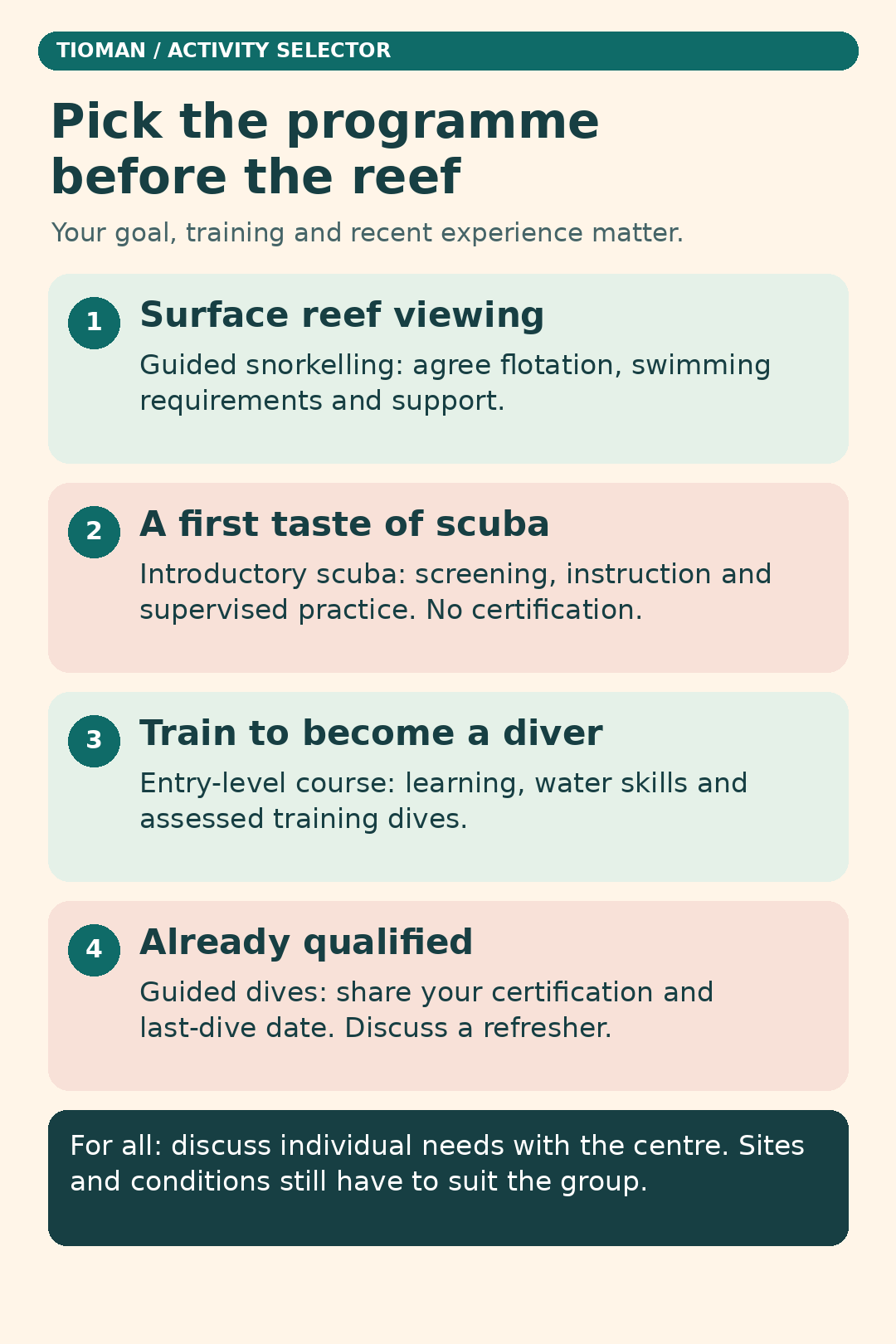
| See reefs from the surface | Guided snorkelling | Surface viewing with a mask and snorkel. Ask about flotation, assistance, boat entry and swimming requirements. |
| Try scuba without committing to a course | An introductory programme, such as PADI Discover Scuba Diving | Instruction and supervised practice; it is not a diver certification. Confirm whether an optional open-water dive is included. |
| Become a qualified recreational diver | An entry-level certification course | Knowledge development, confined-water skills and open-water training. Completion depends on meeting requirements, not simply paying for a set number of days. |
| Dive after qualifying | Guided dives for certified divers | Provide proof of certification and discuss recent experience. A refresher or check dive may be the sensible first session. |
PADI describes Discover Scuba Diving as an introduction in a pool or water with pool-like conditions; an optional open-water dive is a separate part of the experience. Its stated minimum age is 10. Participants should be comfortable in the water and able to maintain themselves at the surface. A centre can impose additional requirements for its programme and conditions. [1]
Complete the screening before the holiday depends on it
Ask the centre for the current medical questionnaire before paying for a course or introductory dive. PADI’s forms page explains that some answers require a physician’s evaluation; follow the current form and the centre’s requirements. General fitness, a previous holiday dive or confidence in a swimming pool does not replace that process. [3] This guide cannot assess whether an individual is medically suitable.
For certification, discuss the required swimming and water-skills assessment, classroom or eLearning work, training schedule, language of instruction and what happens if more time is needed. PADI’s certification information describes knowledge, confined-water and open-water components. [4] Avoid squeezing a course between a late ferry arrival and an early departure merely because the package says “three days”.
Qualified but out of practice? Be specific about when and where you last dived, rather than just naming your card. PADI’s ReActivate programme combines a knowledge refresher with optional in-water practice; discuss the actual practice you need with the centre. [5] A higher certification level does not erase a long break or unfamiliarity with current.
Back to guide contents ↑Use the site names to ask better questions
Tioman Dive Centre groups Renggis, Soyak and Pirate Reef as near-island sites used for training and less-experienced divers, and describes Chebeh, Labas and Tiger Reef as farther sites with deeper water and sometimes challenging currents. [2] That is useful orientation. It does not establish a universal depth, guaranteed visibility or an automatic right to join any particular dive.
| Site or group | Why it appears on a shortlist | Question for the centre |
|---|---|---|
| Renggis | A near-island reef appearing in both dive and snorkelling programmes. [2][6] | Which part of the reef and entry point are planned, and how will snorkellers and divers be supervised separately? |
| Soyak and Pirate Reef | Examples used by a local centre for training or less-experienced divers. [2] | Does today’s plan suit my recent experience, buoyancy and comfort in the water? |
| Chebeh and Labas | Offshore choices with potentially more demanding conditions; Labas is associated with large boulder formations. [2][7] | What current, depth and route are expected? Does the route include any confined space or passage I should avoid? |
| Tiger Reef | A submerged pinnacle between Labas and Sepoi, where currents can be strong. [8] | What experience is required today, and what is the alternative if the site or group is unsuitable? |
There is no useful single “beginner depth” for all of Tioman. The relevant limits come from your training, programme, instructor or guide’s assessment, dive plan and conditions. A site with a manageable section can also contain deeper or more exposed water. Do not choose a trip because an online table supplies one reassuring maximum depth.
Snorkellers need their own surface plan
A good scuba site is not automatically a good surface outing. Ask about chop, current, boat traffic, the distance to the exit and how much of the reef can be seen comfortably from the surface. Tioman Dive Buddy’s snorkelling programme names Renggis and Marine Park as planned stops, with the outing shaped around sea conditions, and asks new guests to explain their swimming confidence. [6]
For a wider snorkelling circuit, compare the Tioman Coral Island and island-hopping tour on Viator. It advertises Tekek hotel pickup and selected neighbouring jetties; confirm your precise village, in-water support and a no-feeding approach before booking. The main cancellation policy was non-refundable when checked on 6 November 2026. [21] Compare that commitment with your centre’s own outing, and treat the stops as weather-dependent possibilities.
Mixed groups can choose different activities from one base, but sharing a boat is useful only when both groups have appropriate supervision and schedules. A snorkeller should not be treated as an unattended passenger while the only guide goes underwater with the divers.
Back to guide contents ↑Give the activity enough time and keep the sites flexible
PADI’s Tioman destination guide identifies March to October as the usual diving-season window. MET Malaysia places the northeast monsoon broadly in November to March, with heavy rain on the east coast. [9][10] These overlap at the edges: the month alone cannot establish whether a centre, ferry or particular site will operate on your dates.
Ask your chosen centre for its actual opening dates and cancellation arrangements. Do not build a plan around a promise of a particular visibility distance or a turtle encounter. Water clarity, wind, surface conditions and currents vary, and the most sensible itinerary may change overnight.
| Purpose | Planning approach |
|---|---|
| One snorkelling outing | Two island nights can provide one full day. Three nights provide a second possible day if the operator can reschedule. |
| Introductory scuba | Get the session duration and prerequisites from the centre. Keep the arrival flexible and apply the relevant post-dive flying interval even after a first dive. |
| Certification course | Book the centre’s required training days plus realistic arrival and departure time. Ask how extra training or missed sessions are handled. |
| Several days of certified diving | Agree the first dive, final surfacing time and any refresher. Add a period without diving before a flight; calculate it in hours. |
Weather flexibility and a no-fly interval solve different problems. An extra island night may help with a moved dive, but moving the final dive later can consume the interval reserved before flying. Protect the departure plan rather than trying to recover every missed dive.
Back to guide contents ↑Choose the dive centre’s village before booking the room
For an activity-focused trip, the practical base is the one that lets you reach the centre reliably for briefings, equipment fitting and departures. Tioman Dive Centre lists its location at Papaya Resort in Tekek; Tioman Dive Buddy identifies its base in Kampung Genting. [2][11] Those are useful examples of why an island-wide hotel search needs a map check.
Cataferry’s route information shows mainland access through Mersing and Tanjung Gemok, with island piers including Genting, Paya, Tekek, Air Batang and Salang. [12] Ask which pier your specific service calls at and which one the centre wants you to use. A generic “Tioman” destination is insufficient if the room, dive centre and boat landing are in different villages.
Juara requires particular care. Juara Beach Resort describes an arrival via Tekek followed by a road transfer. [13] Confirm your own hotel’s arrangements and any direct boat service available on the date; do not assume a west-coast ticket includes delivery to an east-coast property.
Compare Tioman accommodation on Booking.com with Agoda’s Tioman Island stays, then check the actual village, walking route and dive meeting point. These are accommodation searches, not certified-diver packages. Ask whether the dive centre offers a combined stay that makes more sense than a room booked separately.
Convert all figures to one supported currency, such as pounds, then use the Hotel Comparison Calculator for complete quotes with the same room occupancy, meal basis and transfer assumptions. The cheapest room has little value if reaching the morning boat requires an extra transfer that is unavailable at the required time.
Book the ferry only after agreeing the activity schedule and landing. Check the operator’s current sailing and check-in requirements directly; Mersing timetables can vary with tides. [14] If your onward plan is Kuala Lumpur, compare Mersing–Kuala Lumpur road transport on 12Go, allowing a margin after the ferry. That link is for the mainland journey, not the Tioman crossing.
Back to guide contents ↑Check what “equipment included” and “from” actually mean
Ask for a written total covering the dives or course, accommodation, meal basis, equipment, marine-park charge, ferry, transfers and any remote-site or holiday supplements. For a course, also check learning materials, certification processing, required training sessions and the cost of extra time. The headline number rarely answers every one of those questions.
A published package, converted into a usable calculation
On 6 November 2026, Tioman Dive Buddy displayed a three-day/two-night certified-diver package with six guided boat dives and six meals from RM820 per person. Its TDB Resort twin option was RM1,030 per person when both places are filled. The page lists wetsuit, mask, fins and weights as included, but charges RM60 per rental day for a BCD and regulator. Ferry tickets and marine-park charges are separate; dates, rooms and holiday supplements affect the final price. [11]
| Input | Per person |
|---|---|
| Published TDB Resort twin package, full twin occupancy | RM1,030 |
| BCD and regulator, assuming three charged rental days | RM60 × 3 = RM180 |
| Non-MyKad adult conservation charge | RM30 |
| Subtotal before the exclusions below | RM1,240 |
The RM30 visitor charge is from the Department of Fisheries. Its separate RM150-per-month scuba fee applies to operators, not each visiting diver. [15] The three rental days above are an explicit calculation assumption: ask how many days your actual dive schedule incurs. Two charged days reduce the subtotal to RM1,180; bringing an accepted personal BCD and regulator changes it again.
At £1 = RM5.44, RM1,240 is approximately £228 per person, or RM2,480/£456 for two. The conversion rounds the GBP rate of RM5.4357 displayed by Bank Negara Malaysia for 6 November 2026 when checked, rather than predicting your payment rate. [16] Add ferry fares, mainland travel, any required supplements, insurance and extra meals. Confirm any compulsory accommodation charges in the final quote, and avoid paying twice for a room or meal already in the package.
This example is deliberately specific to one published option, not a claim that RM820 buys a private twin room or that every traveller can complete six dives in the available time. Agree the feasible schedule before paying. Use the Travel Budget Calculator after converting your full set of costs into pounds.
Back to guide contents ↑Plan the final dive and the next flight on one clock
For asymptomatic recreational divers, DAN recommends minimum preflight intervals of 12 hours after one no-decompression-stop dive and 18 hours after multiple dives in a day or diving over several days. Longer intervals reduce risk, without guaranteeing avoidance of decompression illness. [20]
For an ordinary recreational trip with repeated no-decompression-stop dives, reserving at least a full 24-hour period without diving before flying is a useful planning margin beyond the 18-hour minimum. It remains a planning choice, not individual medical clearance. Follow any longer applicable requirement from your training, dive computer, operator or dive-medicine advice. Profiles outside ordinary recreational no-decompression diving need their own advice.
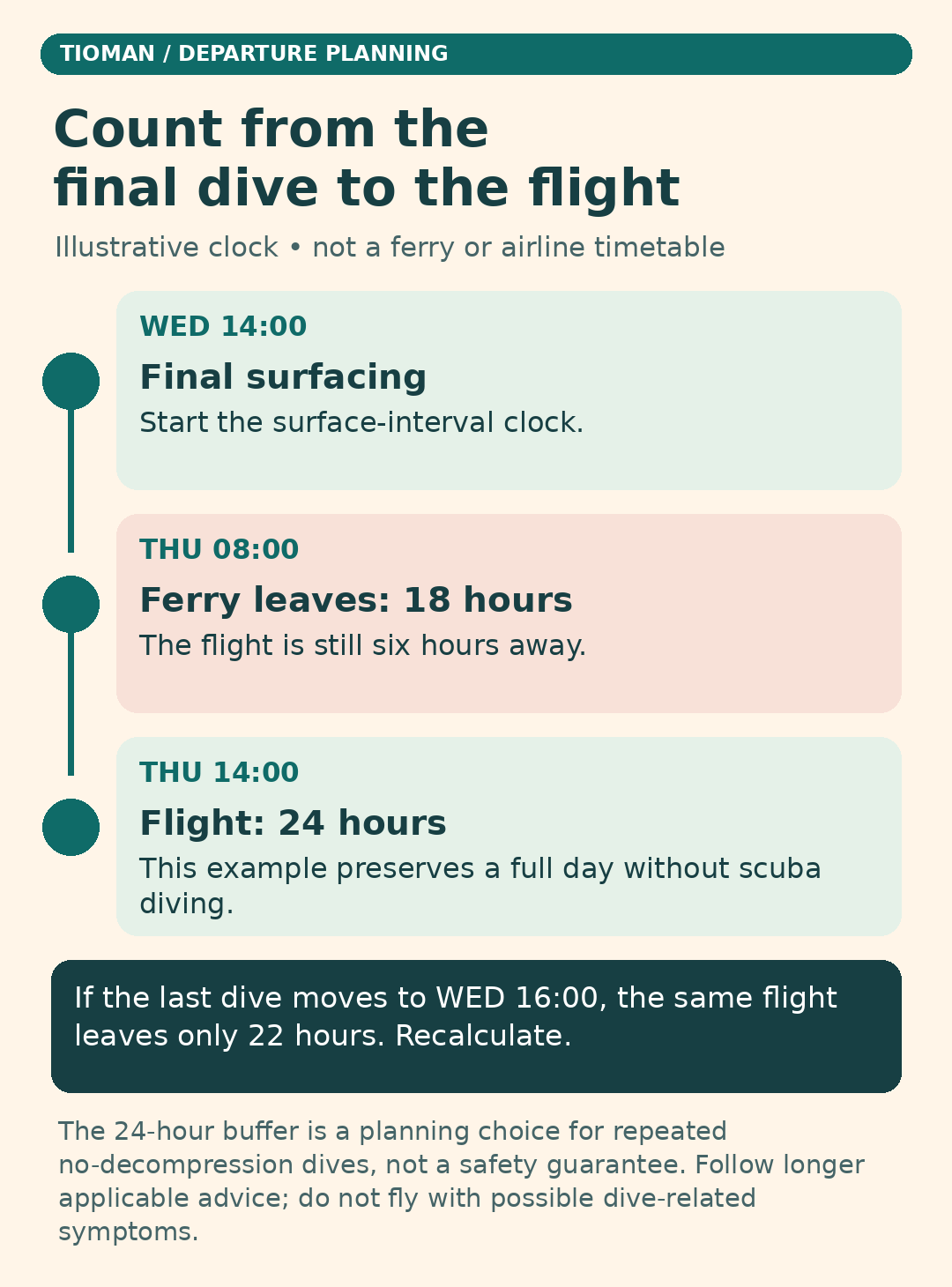
For example, surfacing from the last dive at 14:00 on Wednesday and flying at 14:00 on Thursday gives 24 hours. A Thursday 08:00 ferry does not change that calculation: it is not the flight. If the last dive slips to 16:00, the same flight gives only 22 hours; move the dive or the flight to preserve the planned margin.
DAN also warns about ascending to high altitude after diving, including by road. [17] Consider any onward highland journey, not just the airline ticket. Leaving Tioman by ferry does not make a later ascent irrelevant.
If you feel unwell after diving: tell the dive team and seek prompt medical advice. Avoid flying with possible dive-related symptoms, even after a completed waiting period. [20]
Keep a mainland night if it protects an important flight from ferry disruption as well as preserving time without diving. Reassess the clock whenever the dive schedule changes.
Back to guide contents ↑Book the support you need and protect the reef you came to see
Before paying, send the centre a short, useful description: which activity you want; swimming confidence; certification and recent dive history if applicable; equipment needs; any screening requirements; arrival boat; and next flight or high-altitude journey. Ask it to confirm the workable schedule and any conditions attached to accepting the booking.
- Instruction and supervision: confirm the programme, teaching language, group size, who accompanies you and how mixed skill levels are handled.
- Emergency arrangements: ask about trained staff, emergency oxygen for diving incidents, communications, evacuation planning and the procedure if the boat must return early.
- Cancellation and unfinished training: understand weather changes, your own cancellation, missed ferries and what happens if you need more practice.
- Insurance: check the policy wording for the actual activity, certification requirements, intended depths, rescue or evacuation and recompression treatment; do not infer cover from the phrase “water sports”.
Follow the marine authority’s designated areas and prohibitions on damaging or removing marine life, reef anchoring and littering. [18] Green Fins advises avoiding feeding, chasing and touching wildlife. [19] Maintain clearance from coral and, if you cannot control your position, tell the guide rather than holding onto the reef.
For snorkelling, ask about flotation and an entry that fits your needs. For diving, accept a suitable check dive or changed site when the centre considers it necessary. Paying for a remote reef should never become a reason to disregard the conditions or your limits.
Put the confirmed village, ferry, activity days and final-dive/flight times in the Trip Itinerary Planner. Save operator contacts and booking details offline. If you want data for mainland travel and operator messages, compare your roaming plan with a Malaysia option in Airalo’s eSIM store; check device compatibility and coverage. Offshore reception is not an emergency plan.
Use the Malaysia planning hub to connect Tioman with the rest of your route. For this part of the holiday, choose the activity and support first, then let the room and transport follow.
Back to guide contents ↑Useful questions
Does a Discover Scuba Diving session qualify me to join certified-diver trips?
No. It is an introductory experience, not a certification. If you want to become qualified, ask about an entry-level course and its assessment requirements. Do not book a package marked “certified divers” on the strength of a previous try dive. [1][4]
Can a non-diving partner stay with me on a dive package?
Ask for a specific non-diver quote and activity plan. Confirm the room-sharing basis, meals, any guided snorkelling and whether the partner can join a dive boat with appropriate surface supervision. A shared room does not establish that all boat activities are included.
Is an advanced certification enough for Tiger Reef?
The card is only part of the assessment. Tiger Reef can have strong current, and recent experience and the day’s conditions matter. Tell the centre what you have actually done and accept another site if appropriate. [8]
Do I need a scuba no-fly interval after ordinary surface snorkelling?
The scuba intervals discussed here concern breathing compressed gas underwater. Surface snorkelling alone is a different activity. If you add a scuba try dive, calculate the relevant interval; if you plan breath-hold diving or a combination of activities, seek qualified guidance for that plan rather than applying the surface-snorkelling assumption. [17]
Should I buy equipment before I arrive?
First ask what is supplied, what it costs, which sizes are available and whether familiar personal items can be used. A mask that fits and appropriate instruction matter more than buying a large kit for a first session. Qualified divers bringing equipment should confirm the centre’s acceptance and servicing requirements.
Back to guide contents ↑Match the water to your experience
Tioman works best when the centre understands your actual experience and your accommodation sits within a workable arrival plan. Choose snorkelling, introductory scuba, training or qualified-diver trips deliberately; let the day’s conditions determine the site; and preserve the time between the last dive and any flight or high-altitude journey. A well-matched programme is more valuable than collecting the most ambitious reef names.
Back to guide contents ↑Sources and checks
Official and primary sources consulted for the factual details below. Route allocations, checklists and worked planning models are editorial analysis. Recheck changing rules, prices and services before booking or travelling.
- PADI — Discover Scuba Diving FAQs. Checked 6 November 2026.
- Tioman Dive Centre — Tioman Dive Sites and Tekek location. Checked 6 November 2026.
- PADI — Downloadable forms and medical-screening information. Checked 6 November 2026.
- PADI — Scuba Diving Certification FAQ. Checked 6 November 2026.
- PADI — Refresh your scuba skills with ReActivate. Checked 6 November 2026.
- Tioman Dive Buddy — Tioman Snorkeling Packages and Island Trips. Checked 6 November 2026.
- Tourism Malaysia — Dive in Paradise: Pulau Tioman. Checked 6 November 2026.
- PADI — Tiger Reef dive-site description. Checked 6 November 2026.
- PADI — Diving in Tioman Island. Checked 6 November 2026.
- MET Malaysia — Weather Phenomena: monsoons. Checked 6 November 2026.
- Tioman Dive Buddy — Certified-diver package rates, room options and equipment inclusions. Checked 6 November 2026.
- Cataferry — Route Details. Checked 6 November 2026.
- Juara Beach Resort — Getting Here. Checked 6 November 2026.
- Tioman Dive Centre — How to Get to Tioman. Checked 6 November 2026.
- Department of Fisheries Malaysia — Conservation Charge & Fee Rates. Checked 6 November 2026.
- Bank Negara Malaysia — Exchange Rates, displayed 6 November 2026 row. Checked 6 November 2026.
- Divers Alert Network — Water-related injuries and preflight intervals. Checked 6 November 2026.
- Department of Fisheries Malaysia — Marine-park prohibited activities, page 2. Checked 6 November 2026.
- Green Fins — Environmental best practice for snorkellers. Checked 6 November 2026.
- DAN World — Flying After Diving: recreational guidance and symptoms. Checked 6 November 2026.
- Viator — Tioman Coral Island Snorkeling and Island Hopping Tour, product 391436P8. Checked 6 November 2026.
Illustrations in this article were created for Taylor’s Trailblazing Travels. Third-party photographs, where used, are credited beside the image or in the source list.