MALAYSIA / SABAH / MOUNTAIN PLANNING
Climbing Mount Kinabalu: Permits, Fitness and Safety Decisions
Know what you are buying, prepare for the descent and keep the decision to turn back open.
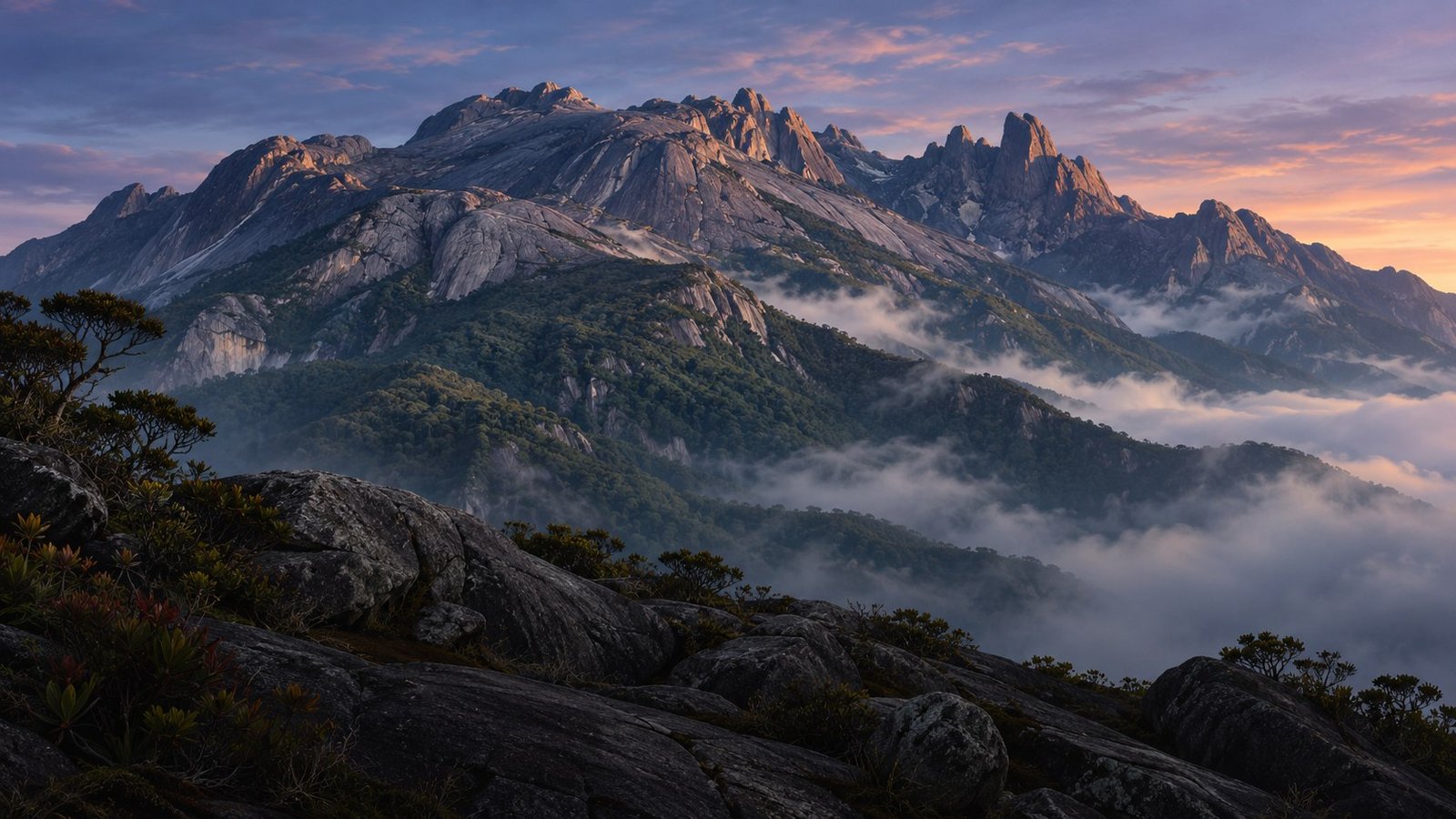
An original illustration inspired by Mount Kinabalu; not a route map, weather report or documentary summit photograph.
Mount Kinabalu rewards preparation long before anyone reaches the granite. The first task is deciding whether the climb fits your health, walking experience, budget and available days. Only then does it make sense to compare beds and permits.
This guide covers the standard guided summit attempt from Timpohon, including the overnight mountain stay. It separates official fees from package prices and shows why a two-day booking can demand more time in your wider Sabah itinerary.
This article contains affiliate links. Taylor’s Trailblazing Travels may earn a commission on qualifying bookings or purchases through those links, at no extra cost to you.
Decide whether the climb fits your trip
Use the following as an editorial decision framework, not a medical clearance test. Its purpose is to identify what needs resolving before you spend money.
| Your starting point | Sensible next step |
|---|---|
| You regularly walk long hills, manage steep descents and can keep several days flexible | Investigate permits and mountain accommodation, then review the altitude plan and insurance. |
| You are active but rarely walk downhill for hours with a pack | Build comparable walking experience first. A good gym routine alone does not answer the descent question. |
| You have unresolved medical concerns, previous serious altitude illness or an injury affecting safe walking | Discuss the actual itinerary with a qualified clinician before booking. Choose lower park activities while suitability remains uncertain. |
| You only have one free day or would be upset if the summit closed | A Kinabalu Park visit is a better fit than forcing a summit attempt into the available time. |
A useful question for companions is: “Would we still be glad we came if the guide turned us around?” If the answer depends on reaching the top at any cost, change the plan. Agree in advance how the group will respond if one person needs to descend; ask the organiser what guide arrangements make that possible.
The standard climb and a via ferrata package are different purchases. A via ferrata adds a separate protected climbing activity with its own briefing, equipment, timing and eligibility conditions. [13] Do not select it merely because the listing appears beside ordinary summit packages; ask for those additional requirements in writing.
Back to guide contents ↑Understand the work across both days
Sabah Parks identifies Timpohon as the access route and says the Mesilau route is closed. A registered mountain guide is compulsory. [1] The accommodation operator places Timpohon Gate at 1,866 metres and Laban Rata at 3,272 metres; its published estimate for the six-kilometre trek to Laban Rata is five to seven hours. These are orientation figures, not a promise of your walking time. [6][7]
The upper overnight area is commonly called Panalaban. Laban Rata is a particular resthouse there; a Panalaban Hostel booking does not necessarily put you in that building. Check the named hostel, room arrangement and meal venue on your confirmation. [2][6]
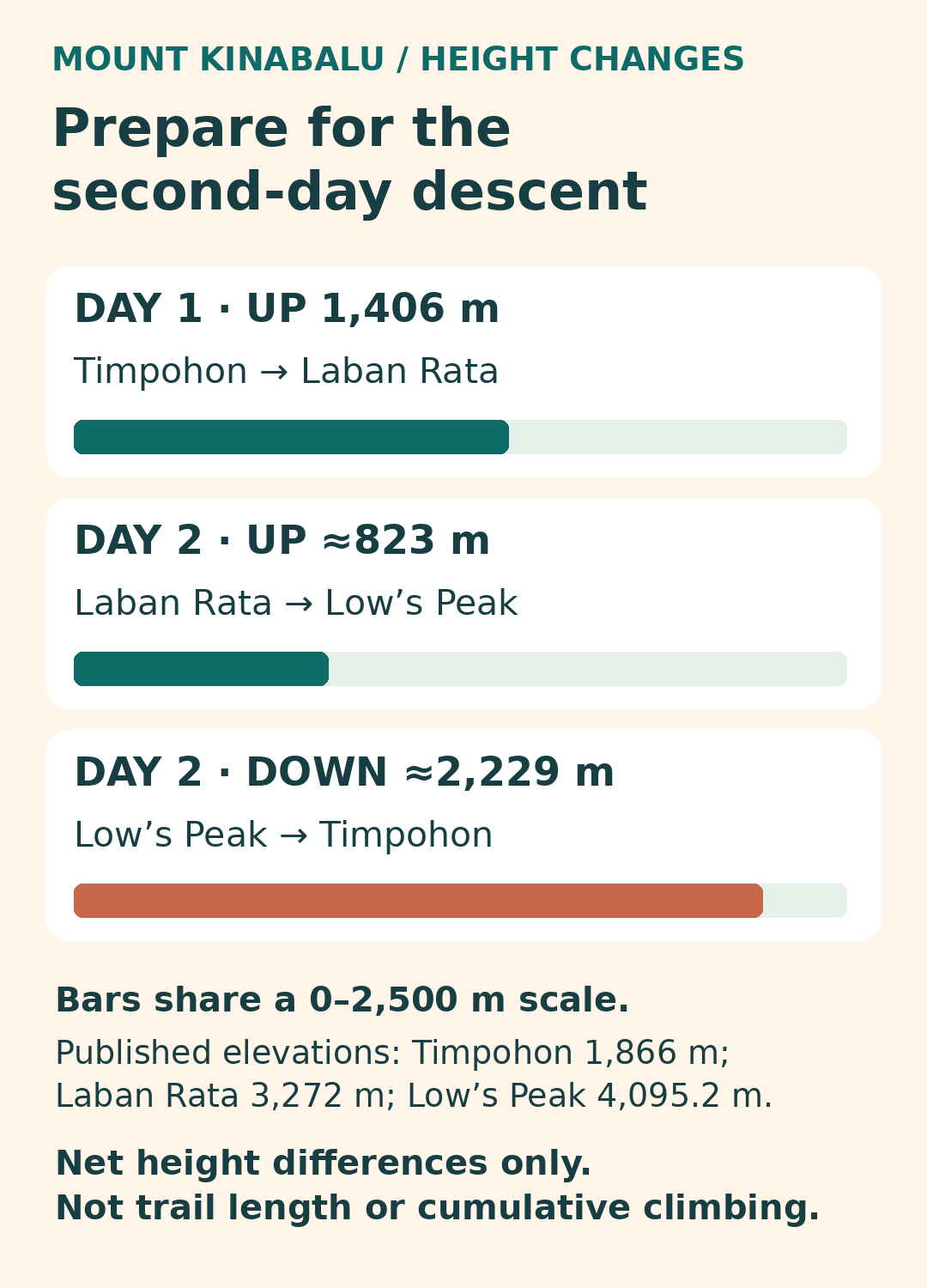
Our calculation: the difference between Timpohon and Laban Rata is 1,406 metres. From Laban Rata to Low’s Peak it is about 823 metres, but returning from the summit to Timpohon means roughly 2,229 metres of net descent. These are differences between published elevations, not measured cumulative ascent or a terrain profile. [1][6][7]
This explains a common planning error. The second morning has less uphill height to gain, yet the day also contains the return below the overnight stop. Training, food, spare clothing and onward travel need to account for that descent. A porter can reduce the load you carry; they do not remove the walking or altitude exposure.
Back to guide contents ↑Secure the permit and bed together
Start with the official Sabah Parks reservation service or a clearly identified organiser. The official Panalaban Hostel product, covering Mokodou and Kinotoki, accepts international climbers. Lemaing’s lower headline price is for a different eligibility group and is not the ordinary British visitor’s option. [2][4]
For direct bookings, enter names exactly as on passports, pay within the checkout deadline and retain the invoice and QR code. Online self-check-in opens five days before the climb. Bring the required identity documents, copies and completed forms. Name replacements are not allowed. [4]
An enquiry, a payment request or a hotel room near the park is not confirmation of a summit place. Ask for written confirmation of the climb date, each climber’s permit allocation and the actual mountain accommodation. An unopened future booking period also differs from a sold-out date; use the official reservation status rather than inferring availability from an advert. [5]
| Item to confirm | What the answer should identify |
|---|---|
| Permit and eligibility | Correct date, nationality and age category for each named person. |
| Mountain bed | Named hostel, shared or private arrangement and included meals. |
| Guide | Registered guide allocation, group size and the response if someone must descend. |
| Transfers | Hotel pickup area, park transfer and Timpohon shuttle stated separately. |
| Price and changes | Total payable, excluded charges, cancellation terms and weather treatment. |
When an organised package helps
An organiser can be useful if you want one party to coordinate the mountain booking and road travel. Compare the responsibilities it accepts, not just the number of inclusions listed. A package with a city pickup is a different proposition from one meeting you at the park.
For a hotel-transfer option, inspect TYH Borneo’s two-day Kinabalu climb on Viator. It lists a mountain bed, permit, guide, meals and hotel transport, but is non-refundable and subject to later availability confirmation. Its pickup supplements are inconsistent across the listing: obtain a written pickup location and total before paying. [11]
For a group meeting at the park, compare Travel Guide Sabah’s standard climb on GetYourGuide. The provider describes a minimum five-person group, asks for slot confirmation before booking and limits its stated transfer to the park–Timpohon section. Confirm group acceptance, the final cancellation terms and every inclusion for your selected departure. [12]
Build a price that does not count fees twice
The following model uses the official 2026 Panalaban package rates, checked on 6 November 2026. The published price update is 25 November 2025. It illustrates two international adults aged 18 or over, each buying the same hostel package and sharing one RM350 guide. It is not a live quote or confirmation that beds are available. [2][3][4]
| Core item | Two-adult calculation | Total MYR |
|---|---|---|
| Panalaban packages | 2 × RM1,043.25 | RM2,086.50 |
| One registered mountain guide | 1 × RM350 | RM350.00 |
| International adult conservation fees | 2 × RM50 | RM100.00 |
| Core cost for both adults | RM1,268.25 each | RM2,536.50 |
The RM1,043.25 package already includes accommodation and three meals, the RM400 adult permit, RM10 park insurance and a 7% service charge. Adding another permit or another RM10 insurance charge would inflate the comparison incorrectly. The component calculation is (RM565 + RM400 + RM10) × 1.07. [2]
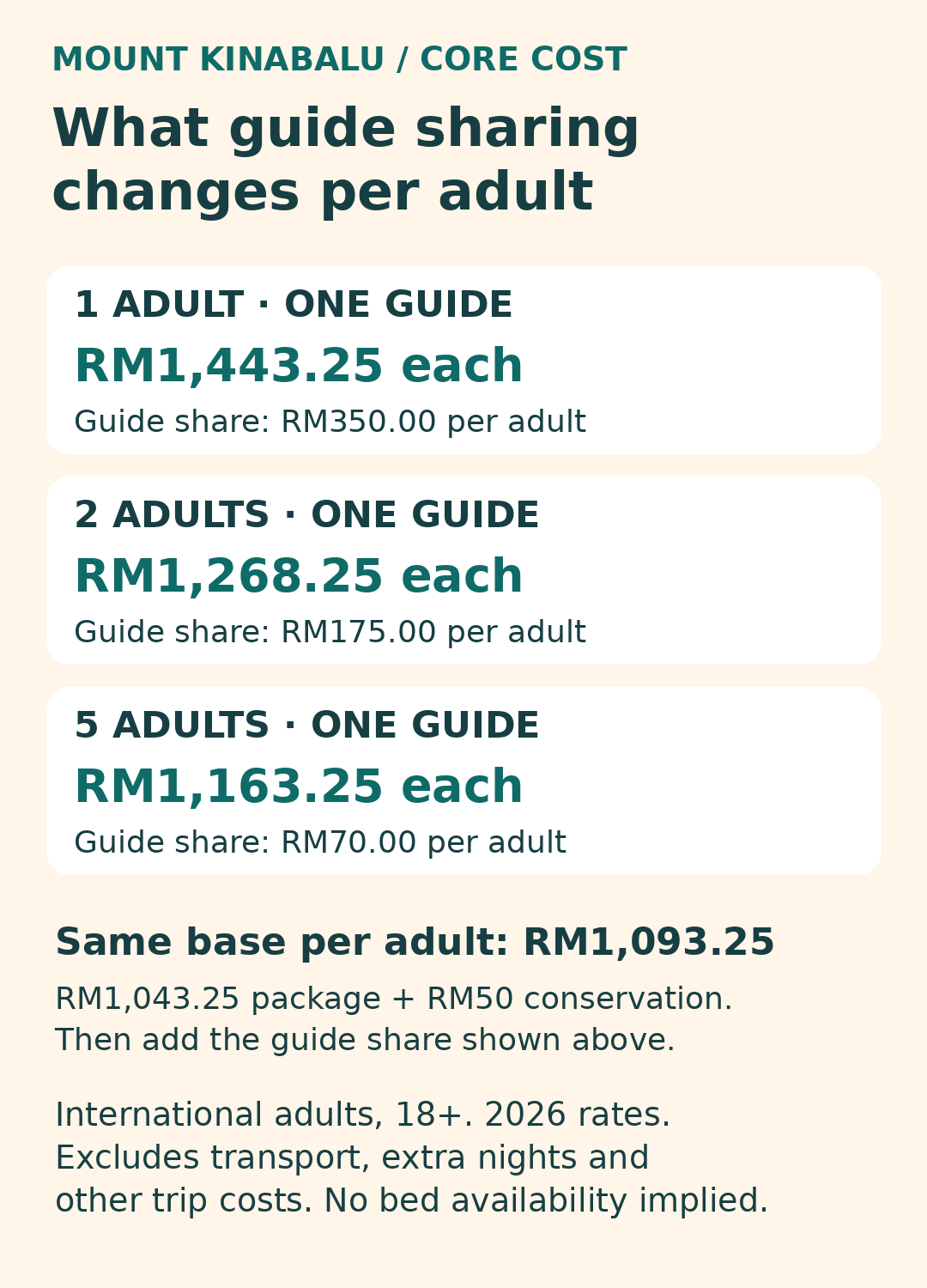
The guide fee is per guide for up to five adults, not automatically RM350 per person. Our one-, two- and five-adult comparison assumes one agreed group sharing that guide equally. Do not count on finding strangers to share after arrival. Children have different guide ratios, so a family cannot simply use the five-adult formula. [3]
Add the missing trip costs
Obtain separate figures for travel from Kota Kinabalu, the Timpohon transfer, accommodation before and after the climb, meals outside the package, any porter, equipment and suitable travel insurance. Optional activities and certificates also sit outside this core model. Recheck whether your organiser has already bundled any of these items.
A useful comparison is: confirmed package total + genuinely excluded items + your contingency. A cheaper first line can lose its advantage once transfers or extra beds are added. Conversely, do not pay twice for a service already included.
Use the Travel Budget Calculator for the wider holiday after converting every amount to GBP at your chosen rate; it does not convert currencies. Put a whole-group climb package in group extras once, then avoid counting its mountain night and included meals again in daily allowances.
The official fee table separates cashless conservation payments from cash for guides, local transport and porters. Arrange the required cash before arriving; confirm the amount with your provider. [3]
Back to guide contents ↑Prepare your legs and make a separate altitude plan
Practise the sort of walking you will actually do
Build time on your feet progressively, including uphill walking, sustained controlled descents and carrying the pack you intend to use. Practise in your walking shoes and rain layers. Stairs can help when hills are unavailable, but avoid turning preparation into a last-minute exhausting challenge.
A useful rehearsal asks whether you can keep a steady pace, eat and drink comfortably, manage your clothing and still walk carefully downhill when tired. It does not produce a pass mark for Kinabalu. If pain, balance problems or unusual breathlessness interrupt training, resolve that concern before committing to the mountain.
Fitness does not prevent altitude illness
The CDC says physical fitness does not reduce susceptibility, and there is no simple screening test that predicts who will become ill. Sleeping altitude and ascent rate matter. Its guidance advises avoiding a direct move from below 1,200 metres to a sleeping altitude above 2,750 metres in one day. A standard short Kinabalu itinerary therefore deserves a deliberate acclimatisation discussion, even for a strong walker. [8]
Speak to a GP or travel clinic if you have previous altitude illness or will ascend rapidly. Discuss your actual night-by-night elevations and relevant medical history. An extra night near park headquarters can ease the travel schedule, but should not be treated as equivalent to staged acclimatisation at higher elevations. Ask the booking team what longer arrangements are possible. [8][9]
Do not use a summit deadline or a paid package as a reason to conceal symptoms. Medication decisions belong with a qualified clinician; this guide does not prescribe a preventative drug or dose.
Back to guide contents ↑Give the mountain room in your Sabah itinerary
This four-day outline is an editorial scheduling example around a two-day climb, not a prescribed acclimatisation programme. Add further time if your clinician, guide, transport plan or physical recovery requires it.
| Day | Priority | Leave out |
|---|---|---|
| Before the climb | Reach your agreed base, check equipment and documents, confirm pickup and rest. | A late arrival with no margin for delayed bags or missed transport. |
| Climb day 1 | Registration, guide briefing, ascent to your allocated mountain bed and an early rest. | A separate sightseeing programme competing with registration. |
| Climb day 2 | Attempt the upper route only if permitted and well; descend with the guide and reach your recovery bed. | A flight or distant connection that makes safe pacing feel optional. |
| Following day | Rest or an undemanding onward move, adjusted to how you feel. | Another demanding activity booked on the assumption you will recover immediately. |
The published itinerary starts the upper ascent in the early hours and requires Sayat-Sayat checkpoint by 05:30. The park also publishes checkout and late-return charges. Confirm the day’s timings with your guide, but never rush or continue unsafely to avoid a fee. [4]
Choose your pre-climb bed around the actual pickup. A Kundasang room can simplify proximity to the park, but a booking name containing “Kinabalu” proves neither a park entrance location nor transport inclusion. Staying in Kota Kinabalu may suit an organiser’s city pickup; compare the extra road journey with the convenience of a single transfer arrangement.
Compare pre- or post-climb Kundasang rooms on Booking.com and Agoda. Enter your dates and check the exact location, cancellation terms and early pickup access. These are ordinary accommodation searches; they do not supply the required mountain bed or a climbing permit.
Put the confirmed climb dates and surrounding overnight stops into the Trip Itinerary Planner. Use its own-town option where needed. The planner helps organise nights; it cannot reserve a permit, evaluate altitude safety or confirm that a connection will work. For the wider route, return to the Malaysia planning hub.
Back to guide contents ↑Pack for the upper mountain and honour a turnaround
Choose dates with the help of the official Kinabalu climbing planner, then check current instructions near departure. Its own warning matters: the displayed park-area forecast is not a summit forecast, and its seasonal comparisons do not certify safe conditions or reserve a place. Guide and park decisions govern access. [10]
Sabah Parks’ packing guidance includes warm layers, a waterproof windbreaker, a head torch, grippy gloves, suitable hiking shoes, a whistle and food and drinks. [4] Check the condition of equipment you already own before buying replacements. A phone light is an awkward substitute when you need your hands free; practise using your torch with gloves and carry a suitable backup power supply.
Keep a dry layer protected inside your pack and ask your organiser about drinking-water arrangements, meal times and dietary needs. Check what a porter will carry, when you can access that bag and what must stay with you. Essential warmth, rain protection, light, personal medicines and drinking water should remain available when you need them.
Ask your insurer to confirm the named activity and maximum altitude, together with search, rescue, evacuation, medical treatment and repatriation terms. The RM10 park insurance entry in a package is not enough information to judge those protections. Take the policy details and assistance number offline, alongside your booking documents.
Before starting, tell the guide about concerns that affect safe progress and agree how to communicate during the walk. A closure, deteriorating weather, missed safety checkpoint or illness can end a summit attempt. The useful goal is a well-managed mountain visit with a safe return, including when the correct decision is to descend early.
Back to guide contents ↑Useful questions
Can I climb independently if I already hike regularly?
No. Sabah Parks requires a registered mountain guide. Hiking experience helps with preparation but does not replace the park’s permit, accommodation or guide arrangements. [1]
Does buying a Kinabalu Park entrance ticket allow a summit climb?
No. Conservation admission and the climbing permit are separate charges. A day-visit ticket does not allocate an overnight mountain bed or a guide. Confirm the complete climb booking. [2][3]
Can a solo traveller use the shared-guide price?
Only if a confirmed group arrangement actually shares the guide fee. In the illustration, a single adult paying for one guide has a core cost of RM1,443.25. An organised group may price things differently; check its minimum numbers and what happens if others cancel.
Is a cheaper child permit evidence that the climb suits my child?
No. A fee category is an administrative rule. Discuss the child’s experience, health, pace and the applicable guide allocation with the operator and an appropriate clinician. The official guide ratio is one guide for two climbers aged 15 or below. [3]
Back to guide contents ↑Book a climb you can safely abandon
Choose the climb when the walking demands, altitude plan, confirmed booking and total cost all work for you. Keep the day after descent flexible and agree that turning around is an acceptable outcome. If the summit is the only result that would make the trip worthwhile, or the preparation does not fit your circumstances, choose a lower Kinabalu Park visit and enjoy Sabah without that pressure.
Back to guide contents ↑Sources and checks
Official and primary sources consulted for the factual details below. Route allocations, checklists and worked planning models are editorial analysis. Recheck changing rules, prices and services before booking or travelling.
- Sabah Parks — Mount Kinabalu: access, summit height and guide requirement. Checked 6 November 2026.
- Sabah Parks reservations — Panalaban Hostel product and component fees. Checked 6 November 2026.
- Sabah Parks reservations — additional fees and guide ratios. Checked 6 November 2026.
- Sabah Parks — climbing and hostel booking guide; 2026 package rates. Checked 6 November 2026.
- Sabah Parks — booking and availability FAQs. Checked 6 November 2026.
- Sutera Horizon — Laban Rata location and trekking information. Checked 6 November 2026.
- Sutera Sanctuary Collection — Kinabalu Park and Timpohon Gate elevation. Checked 6 November 2026.
- CDC Yellow Book 2026 — high-altitude travel and altitude illness. Checked 6 November 2026.
- NHS — altitude sickness: symptoms, prevention and urgent action. Checked 6 November 2026.
- Sabah Parks — climbing planner and park-forecast limitations. Checked 6 November 2026.
- Viator / TYH Borneo — two-day Kinabalu climb listing, inclusions and cancellation. Checked 6 November 2026.
- GetYourGuide / Travel Guide Sabah — standard climb, group and meeting conditions. Checked 6 November 2026.
- Mountain Torq — preparation, compulsory briefing and participation conditions. Checked 6 November 2026.
Illustrations in this article were created for Taylor’s Trailblazing Travels. Third-party photographs, where used, are credited beside the image or in the source list.