Ipoh vs Melaka: Which Heritage City Fits Your Route?
Let the arrival point, onward route and one full day of exploring decide between these two heritage stops.
- Two-night heritage stop
- Rail or road gateway
- Route fit before rankings
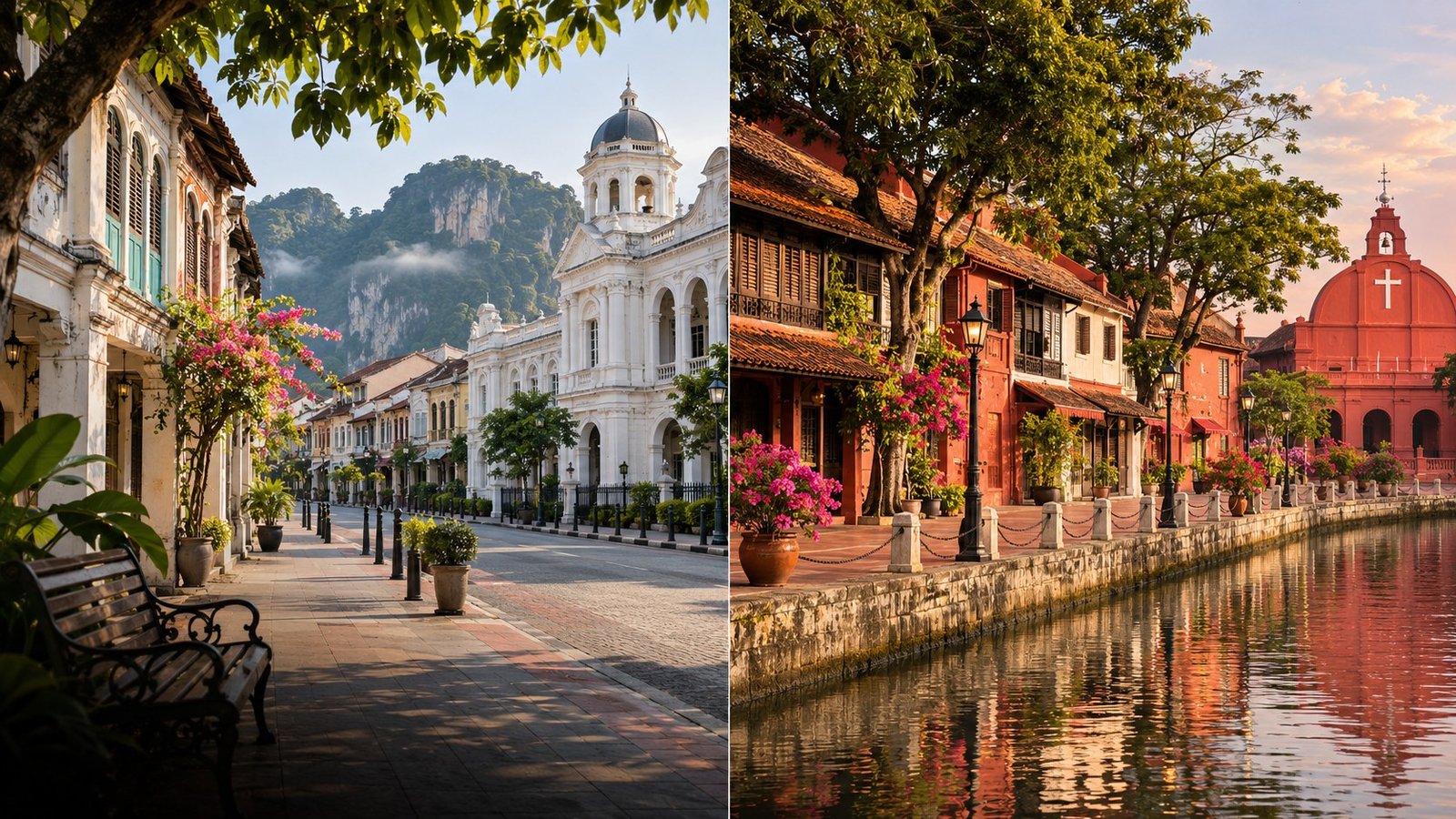
AI-generated comparison illustration: an Ipoh-inspired streetscape with a limestone backdrop beside a Melaka-inspired riverfront. These are separate imagined scenes, not documentary photographs of exact streets or verified buildings.
Choose Ipoh if your route runs north from Kuala Lumpur and you want a heritage stop that works well with rail. Choose Melaka if your plans head south by road, or if its trading-port history and riverside historic centre are the main attraction. For a short return break from Kuala Lumpur, both can work: the hotel location and the day’s opening hours matter more than a claim that one city is universally better.
This comparison is built around two nights. That gives you an arrival afternoon, one complete day and a departure morning—not three full sightseeing days. The aim is to keep the heritage stop enjoyable without making the rest of your Malaysia route unnecessarily complicated.
Ipoh and Melaka at a glance
These recommendations compare a central heritage stay, not every attraction in either city. Published operational details were checked on 7 November 2026; prices and services for your actual dates still need confirmation.
| Decision | Ipoh | Melaka |
|---|---|---|
| Strongest route fit | KL → Ipoh → the northern peninsula by rail; check a train that stops at your next station. [1] | KL → Melaka → Johor Bahru or another confirmed road connection. It is a city stop with a separate approach to the centre. [5] |
| Arrival advantage or drawback | Ipoh railway station is beside Old Town. An express-coach ticket may instead use Terminal Amanjaya. [2] [3] | Melaka Sentral is outside the historic core; the M100 feeder serves the Jonker Walk/Stadhuys area. [4] |
| Travel-time evidence | One current timetable example is KL Sentral 07:20 → Ipoh 09:44: 2h24 on the train, before access and waiting. [1] | Use the selected coach’s estimate, then add the terminal-to-hotel transfer and road-delay margin. A city-name arrival is not hotel arrival. |
| Heritage emphasis | A compact Old Town visit with a Hakka miners’ club museum as one useful historical lens. [6] | A trading-port townscape shaped by Malay, Asian and European connections, within the joint UNESCO World Heritage property with George Town. [7] |
| What two nights buy | One museum appointment, time around Old Town and an optional separate outing. | One museum visit, time around the river and historic streets, plus an evening without a same-day return. |
| Main booking constraint | Han Chin Pet Soo uses appointments, with booking up to 30 days ahead. [6] | Match the museum calendar and any desired Jonker market evening to your dates. [8] [9] |
The largest practical difference is where the long-distance journey ends. Ipoh has a particularly useful railway arrival for an Old Town stay. Melaka can still be straightforward without a car, provided you deliberately include its last transfer.
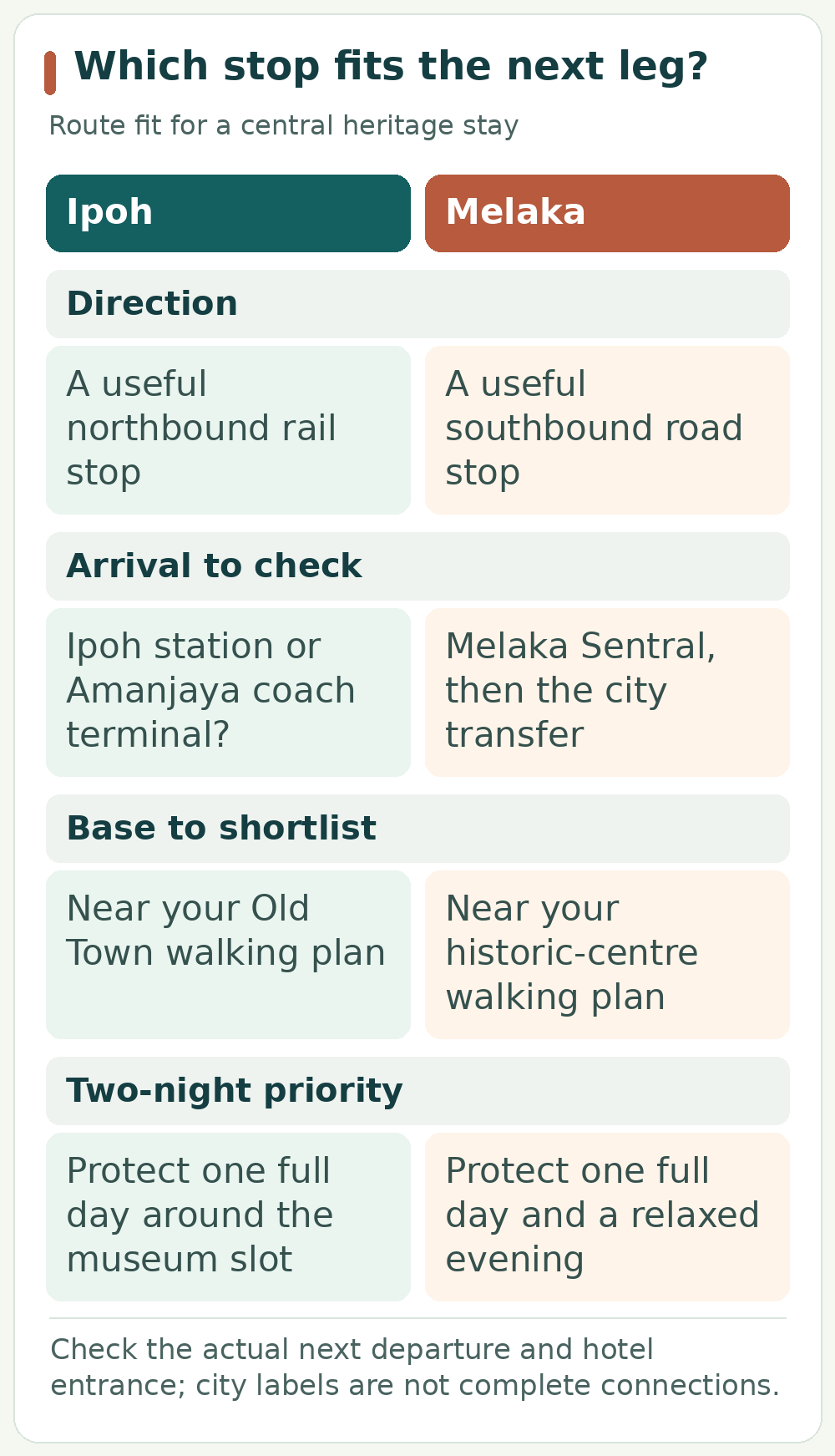
Start with the place before and after
For a northbound journey, Ipoh is a logical intermediate rail stop. Compare two separate tickets—into Ipoh and onwards—with the service you would otherwise have taken. KTMB’s timetable includes Ipoh and northern stations such as Butterworth, but not every train serves every station. A timetable establishes the route; the booking system establishes whether your chosen departure has seats. [1]
For a southbound road journey, Melaka is often the easier city to incorporate. Causeway Link advertises Melaka–Johor Bahru services, which can support a trip continuing south without returning to Kuala Lumpur. Select the actual JB terminal you need and plan the next connection separately. A bus to Johor Bahru does not by itself provide a completed border crossing into Singapore. [5]
If you want an all-rail journey, Ipoh has the simpler arrival for this comparison. Melaka is not a station beside its historic centre: reaching the city via Pulau Sebang/Tampin adds a separate road connection. The local operator publishes M20 services between the Pulau Sebang area and Melaka Sentral, but this is an additional leg to investigate, not an interchangeable substitute for a central rail stop. [12]
Ipoh can also fit alongside Cameron Highlands. Perak Transit lists Cameron services using Terminal Amanjaya. Build in the transfer between your Ipoh hotel or railway station and that coach terminal rather than assuming the mountain bus leaves beside the train. [3]
For a KL return break, there is no need to manufacture a geographical winner. Choose the experience you prefer and compare the total cost and door-to-door connections. A modest ticket saving is rarely persuasive if it leaves you with a poorly timed arrival or an inconvenient hotel.
Plan the last transfer before buying the first ticket
Ipoh: choose the station or terminal deliberately
The railway station’s Old Town location is useful, but your own hotel’s entrance and walking route still need checking. A short-looking map distance can be less attractive with luggage, rain or an awkward road crossing. Keep a small transfer allowance even if you expect to walk. Tourism Perak identifies the station in the heart of Old Town; that advantage should not be applied to every accommodation listing across the wider city. [2]
Book rail directly through KTMB’s booking service, or compare Kuala Lumpur–Ipoh options on 12Go. Read the mode, boarding point, arrival point and final charge. A coach to Amanjaya and a train to Ipoh station can have different last-transfer costs even if the search page calls both “Ipoh”.
Melaka: Sentral is the interchange, not the heritage district
For a coach arrival, the practical sequence is your KL hotel → the named departure terminal → Melaka Sentral → your hotel. You can compare Kuala Lumpur–Melaka coaches and other options on 12Go; check that the selected service uses the terminals you intend.
At Melaka Sentral, the current BAS.MY M100 city feeder includes a Jonker Walk/Stadhuys stop. The operator lists distance-based adult fares from RM0.90 to RM2.70, so do not assume every journey has one flat price. Check the stop sequence, the departure for your day and the walk from the stop to your hotel. With luggage, several travellers or a late arrival, a taxi or booked car may be worth the additional cost. [4]
For the return, work backwards from the intercity departure. Include time to reach Sentral, complete the ticket’s reporting or boarding-pass requirements and find the departure area. Do not put a prepaid museum appointment immediately after an uncertain arrival, or an onward flight immediately after a road journey with no recovery margin.
Save the actual terminal name and hotel address, not just a screenshot of the city name. This simple check is especially useful when a booking platform uses “Malacca” while local signs use “Melaka”.
Choose the historical experience you want
Ipoh: use one museum to give the streets context
Han Chin Pet Soo occupies the former Hakka miners’ club founded in 1893. Its exhibition provides a specific view into the city’s past; it should not be treated as a complete account of every community in Ipoh. Book an appointment, then use it as the anchor for a slower Old Town visit rather than adding it between several distant stops. [6]
The attraction of this plan is the combination of a focused historical visit with unallocated time: a drink, a shop you notice, a longer lunch or a return to a street you rushed through on arrival. If you also want limestone scenery, give that a separate block rather than expecting it on the same pedestrian circuit. Tourism Perak places the Gunung Rapat cave-temple area outside the Old Town cluster. Confirm the particular site’s current access and arrange the return journey. [10]
Melaka: connect the port history with a family house
UNESCO’s description places Melaka within a long history of trading and cultural exchange, including the Malay sultanate and Portuguese and Dutch periods. A worthwhile visit looks beyond the red façades and treats the district as a layered townscape rather than a single colonial-era attraction. [7]
The Baba & Nyonya Heritage Museum gives a more domestic perspective through a Peranakan family home near Jonker Walk, on Jalan Tun Tan Cheng Lock. That location makes it a useful anchor for a central stay. [14] Check the museum’s own ticket calendar, current total and access arrangements; a general list of museum opening hours is not enough to guarantee the visit. [8]
In either city, avoid reducing living cultural places to photo stops. Respect worship, private premises and requests about photography. An indoor historical visit and time on foot can be more rewarding than several paid attractions approached without context.
What to do with two nights
Use the following as a structure, not an appointment timetable. Move the museum block to its confirmed slot and leave arrival day flexible.
| Part of the stay | Ipoh | Melaka |
|---|---|---|
| Day1: arrival afternoon | Reach the Old Town base, leave luggage and explore nearby streets. Keep any early museum slot off this travel day. | Transfer from Sentral, settle in and get your bearings along the river and historic streets. |
| Day2: full day | Attend the booked museum visit; use the other half-day for Old Town or one confirmed outing towards the limestone area. | Take the booked house-museum visit, then explore the historic core with a substantial lunch/rest break. |
| Second evening | A relaxed dinner and time near the hotel; avoid a late distant excursion before an early train. | A riverfront evening, or Jonker’s market if its operation matches your date. |
| Day3: departure morning | Breakfast and one nearby stop only if it leaves the station or terminal margin intact. | Breakfast, luggage collection and the transfer back to Sentral or your chosen onward pickup. |
Melaka’s city council currently lists Jonker’s evening market on Fridays, Saturdays and Sundays, from 18:00 to midnight. Reconfirm special-date arrangements. Choose a stay covering one of those evenings if the market matters; choose quieter dates if it does not, rather than treating a busy market as compulsory. [9]
The extra-city test
Suppose an arrival afternoon, full day and departure morning give you four, eight and three discretionary hours respectively: 15 hours in total. Those are illustrative allowances after meals and basic arrival tasks, not measured opening times. Replacing the full day with a move to another city costing five complete hours leaves only three of that day’s eight hours before another check-in.
The lesson is to protect the complete middle day. If you only have two nights available, spending both in one city usually gives the heritage visit more substance than one night in each. If both cities are important, give each a real stay and include the connecting journey in the wider route.
Put the actual nights and transfers into the Itinerary Pace Checker. Its result uses your inputs; it does not confirm transport availability or museum opening times.
Spend the room budget on a useful location
For this Ipoh visit, shortlist a base that makes Old Town and your main museum appointment convenient. For Melaka, look around the historic centre and the part of the river you expect to explore. A room near the coach terminal may serve a late stopover, but it solves a different problem from a two-night heritage break.
Check the actual entrance and room details. A characterful older building may involve stairs, a room without a lift or sound from the street. If quiet sleep, step-free access or parking is important, ask the property directly rather than inferring it from “heritage”, “central” or a map pin.
You can compare Ipoh accommodation on Agoda and Melaka accommodation on Booking.com. Start with the map, then compare equivalent rooms and cancellation terms with other providers and the property’s own offer. A destination-wide result includes places well beyond the walking area described here.
A slightly dearer central room can remove several short car journeys. Add those journeys, breakfast and any compulsory room charges to the comparison before deciding that the lower nightly price wins.
A two-night budget that you can change
This example is for two adults sharing one room, spending two nights and three days away, with return travel from Kuala Lumpur. Every number is a chosen allowance, not a live quote, city average or promised admission fee. The room inputs are treated as including compulsory accommodation charges for this calculation; replace them with your actual final bills.
| Illustrative cost for the pair, in RM | Ipoh | Melaka |
|---|---|---|
| Intercity return: four one-way tickets; assumed rail RM70 / coach RM30 each | 280 | 120 |
| Local transfers and modest local travel, including KL access: chosen total | 80 | 120 |
| One room for two nights: assumed RM220 / RM240 per night | 440 | 480 |
| Meals: two adults × three days × assumed RM60 | 360 | 360 |
| Chosen allowance for donations or paid visits | 60 | 100 |
| Subtotal | 1,220 | 1,180 |
| Planning reserve: 10% | 122 | 118 |
| Calculated total for two | 1,342 | 1,298 |
| Per person sharing | 671 | 649 |
The RM44 difference is a result of these inputs, not evidence that Melaka is generally cheaper. Raise its room allowance by RM40 a night and the pair’s total increases by RM88 including the reserve, to RM1,386. That small change reverses the comparison. Hotel choice and local transport can easily matter more than the intercity fare.
The activities line is deliberately an allowance. Han Chin Pet Soo has no fixed public entry fee for scheduled tours and asks for a donation; its published RM10 figure applies to commercial tour companies, not an ordinary independent visitor’s ticket. Baba & Nyonya sells tickets directly, but use the total shown for your selected visit rather than treating this guide’s RM100 pair allowance as its admission price. [6] [8]
This model excludes travel to Malaysia, insurance, shopping, alcohol, additional attractions and a substantial private excursion. The local-transfer line may need increasing if you add a cave-temple outing or choose an outlying hotel. Solo travellers do not halve the shared room bill, and families need to check occupancy and age categories.
For an onward itinerary, replace the return-to-KL tickets with the actual next leg. Use the Hotel Comparison Calculator for the room shortlist, entering the same dates and one currency. It compares your figures and does not retrieve live prices.

Dates, weather and workable alternatives
Both cities require plans for heat and rain. METMalaysia describes high humidity and substantial rainfall, with differences across the peninsula; a national “dry season” label is not a dependable promise for either city. Plan outdoor exploration when conditions suit, keep water and a rain layer handy, and preserve an indoor visit or a longer meal as a flexible block. [11]
If Han Chin Pet Soo has no appointment on your date, decide whether Old Town on its own and a separately confirmed outing still justify Ipoh for you. Do not arrive expecting a guaranteed walk-in place. For Melaka, if the house museum is unavailable, rearrange around another museum with verified opening hours or spend more time on the historic district; do not substitute an unconfirmed ticket simply to keep the plan full.
If your train sells out, compare the coach’s entire journey including Amanjaya access. If a coach schedule becomes awkward, changing the departure day or taking a private transfer may be more sensible than arriving late and losing most of the first evening. Price that change before committing to a non-refundable room.
For drivers, choose accommodation with confirmed parking and check how you will reach it during busy periods or street events. A car can help with an outlying visit, but it does not automatically improve a central heritage day. For travellers with limited mobility, ask each attraction about steps, seating, toilets and the route from drop-off to entry.
The booking order I would use
- Write the previous and next overnight stops. Decide whether the visit is part of a through route or a return break.
- Check the outward and onward transport, including the exact station or terminal and the hotel transfer.
- Confirm the museum appointment or other experience that would most disappoint you to miss.
- Choose the hotel location around that plan, then compare the complete room cost and change terms.
- Leave the remaining half-day flexible and save the booking details offline.
For Han Chin Pet Soo, use the museum’s own reservation page and retain the confirmation it requests. For Baba & Nyonya, use its direct ticket page to check the visit date and conditions. [6] [8] Book the transport that anchors a busy travel day before filling the gaps with optional activities.
Questions worth asking before choosing
Which is easier without a car?
Ipoh has a convenient rail arrival for an Old Town stay. Melaka also works without driving if you include the transfer from Sentral and choose a central hotel. Trips outside either central area require a separate transport plan.
Is one night enough?
It can give you an evening and a short look around if arrival and departure are well timed. Two nights are more comfortable for a booked museum visit and a complete day without travel. Count usable hours, not just calendar dates.
Can I visit both without returning to Kuala Lumpur?
Potentially: Transnasional’s official booking site advertises an Ipoh–Melaka Sentral route. Verify your date, departure terminal and available service before building it into the itinerary. A direct route listing is not a guaranteed seat or a reason to squeeze both cities into two nights. [13]
Which is better if I am travelling towards Penang?
Ipoh is usually the more natural fit for a northbound rail route. Check the exact northern station and onward connection; a train to Butterworth does not finish at a George Town hotel.
Does Melaka require a weekend?
No. A weekend matters if Jonker’s evening market is part of your reason for going. Its historical streets and a museum visit can form a worthwhile stay on other days, subject to their own opening calendars.
Should a UNESCO label decide it?
It is useful context for Melaka’s historic townscape, not a measure of how well the city fits your route. Choose the experience you want and allow enough time to understand it.
My recommendation
For a first northbound rail journey, I would choose Ipoh and stay near the Old Town places I intend to explore. For a southbound road journey, I would choose Melaka and make its terminal transfer part of the plan from the beginning. For a KL return break, I would let the main museum visit, preferred streetscape and complete hotel cost decide.
Give the chosen city two nights if you can. A complete middle day makes room for context, rest and discoveries beyond the appointment list. That is a stronger heritage stop than adding another city while spending the most useful hours moving between them.
Sources and further checks
Research checked on 7 November 2026. Official destination, government and operator information and other supporting research are identified below. Prices, opening times, access requirements and operating conditions can change; confirm them for your travel dates.
- KTMB — ETS timetable effective 1 June 2026
- Tourism Perak — Perak Guide Book, transport and Ipoh geography
- Perak Transit — express bus routes
- BAS.MY Melaka / Causeway Link — M100 city feeder
- Causeway Link — Melaka Sentral and Johor Bahru service
- IpohWorld — Han Chin Pet Soo reservations and admission policy
- UNESCO — Melaka and George Town, Historic Cities of the Straits of Malacca
- Baba & Nyonya Heritage Museum — tickets and visitor information
- Melaka Historic City Council — Jonker Walk
- Tourism Perak — Gunung Rapat cave-temple area
- METMalaysia — Malaysia’s climate
- BAS.MY Melaka / Causeway Link — M20 Pulau Sebang connection
- Transnasional / Plusliner — official booking site and routes
- Baba & Nyonya Heritage Museum — getting here
Illustrations in this article were created for Taylor’s Trailblazing Travels. Third-party photographs, where used, are credited beside the image or in the source list.