
A practical, source-checked guide to Thailand’s passport rules, changing visa position, Thailand Digital Arrival Card, proof of funds, customs limits, medication permits and arrival-day documents.
Disclosure: This article contains a small number of carefully selected affiliate links. Taylor’s Trailblazing Travels may earn a commission if you book or buy through them, at no extra cost to you. Links appear only after the legal and entry information, where they support a genuine planning step.
Why Thailand entry requirements need a clear sequence
Thailand’s entry paperwork is not difficult when every document agrees. Problems usually begin when travellers treat the process as one vague task called “the visa” and overlook the smaller details: a passport that expires too soon, a hotel booked under a different surname, a TDAC submitted outside the permitted window, medication carried without the correct evidence, or an onward journey that cannot be shown without airport Wi-Fi.
There is an extra complication in 2026. Thailand’s Cabinet approved a replacement for the 60-day visa-exemption arrangement, but the official announcement said the related Ministry of Interior notices were still awaiting Royal Gazette publication and would take effect 15 days after publication. Meanwhile, current Ministry of Foreign Affairs and UK government guidance still describes the existing 60-day position for eligible British visitors. Therefore, an article that simply prints “60 days” or “30 days” without explaining the transition is incomplete. The safe approach is to verify the rule that is actually in force for your nationality shortly before travel.
This guide shows the order I would use to prepare a real trip. It starts with the passport and the legal basis for entry, then moves through the Thailand Digital Arrival Card, first-night address, onward evidence, proof of funds, customs, medicines and the copies worth keeping offline. The examples are especially useful for UK travellers, although most of the workflow applies more widely. Nationality, passport type, purpose and length of stay always decide the final answer.
For Thailand in 2026, check that your passport is valid for at least six months after arrival and has a blank page; confirm whether your nationality currently qualifies for visa exemption, Visa on Arrival or needs an e-Visa; book the first accommodation; keep onward travel and possible proof of funds accessible; and submit the free TDAC through the official Immigration Bureau portal within three days of arrival. Recheck the visa-exemption period before departure because an approved 30-day framework was awaiting formal commencement when this guide was fact-checked.
Thailand entry requirements: quick answers
Passport
For a British citizen passport, allow at least six months after the arrival date and keep at least one blank page. Other passports should follow the relevant Thai mission’s guidance.
Visa-free stay
Current UK guidance still states up to 60 days for qualifying visits, but an approved replacement framework may reduce many exemptions to 30 days once formally commenced.
TDAC
All non-Thai nationals entering by air, land or sea normally need a new TDAC for each entry. Submit it only through the official government portal.
Submission window
The Immigration Bureau says the TDAC should be submitted within three days before arrival, including the arrival date, and can be submitted up to 72 hours before entry.
Proof of funds
Immigration may request evidence. Published amounts vary by entry category, so keep accessible funds or documentary evidence and check the rule for your nationality and visa route.
Onward travel
Keep the return or onward booking available offline. Airlines and immigration officers may ask how and when you intend to leave Thailand.
Medication
Check the active ingredient, not only the brand. Controlled narcotic or psychotropic medicines may need a permit, medical letter, original packaging and declaration.
Customs
Published allowances include no more than 200 cigarettes or 250 g of tobacco products combined and no more than one litre of alcohol. Declare when uncertain.
In this guide
The seven-step Thailand entry checklist
Do the checks in sequence. A confirmed hotel or airport transfer does not compensate for the wrong entry permission, while an approved e-Visa does not remove the need for a TDAC. Each step solves a different part of the journey.
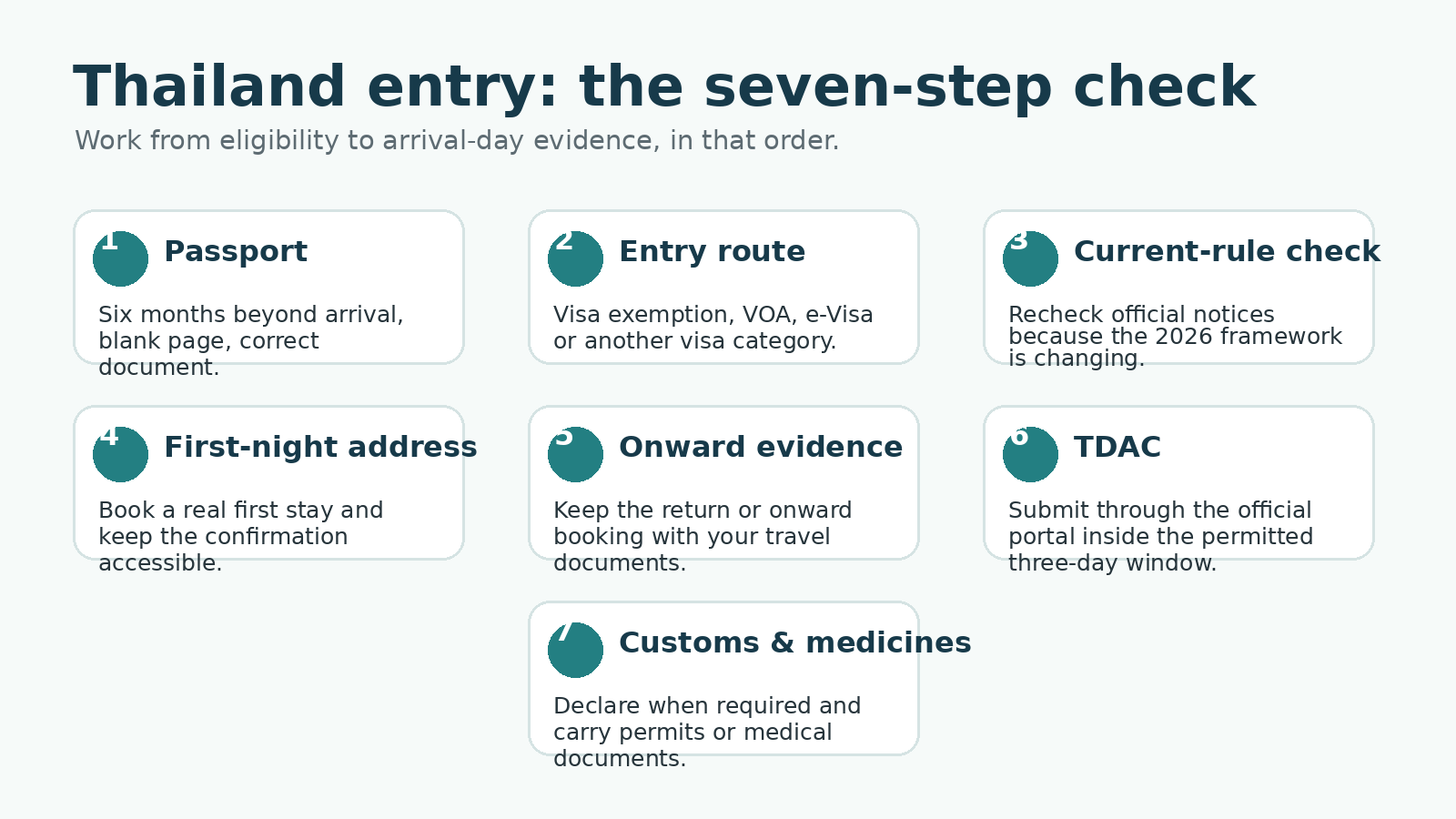
Check the passport’s arrival-day validity, blank pages, physical condition and exact name.
Identify the correct entry route for the traveller’s nationality, passport type, purpose and intended stay.
Recheck the official position shortly before departure because the 2026 visa-exemption framework is changing.
Book a genuine first-night address and save the confirmation with the property’s phone number.
Keep return or onward travel and possible proof of funds accessible without relying on live email.
Submit one TDAC per entry, including for children, inside the official three-day window.
Check customs, cash and medication rules, then choose the green or red channel honestly.
Practical planning rule
I would place the passport, visa or exemption evidence, TDAC QR code, first-night booking, onward ticket, insurance details and medicine documents in one offline folder on the phone. Then I would add a second copy to cloud storage and one paper sheet containing the essential references. The aim is not to carry a filing cabinet; it is to avoid searching six apps while an airline or immigration officer waits.
Thailand’s visa-exemption status in 2026
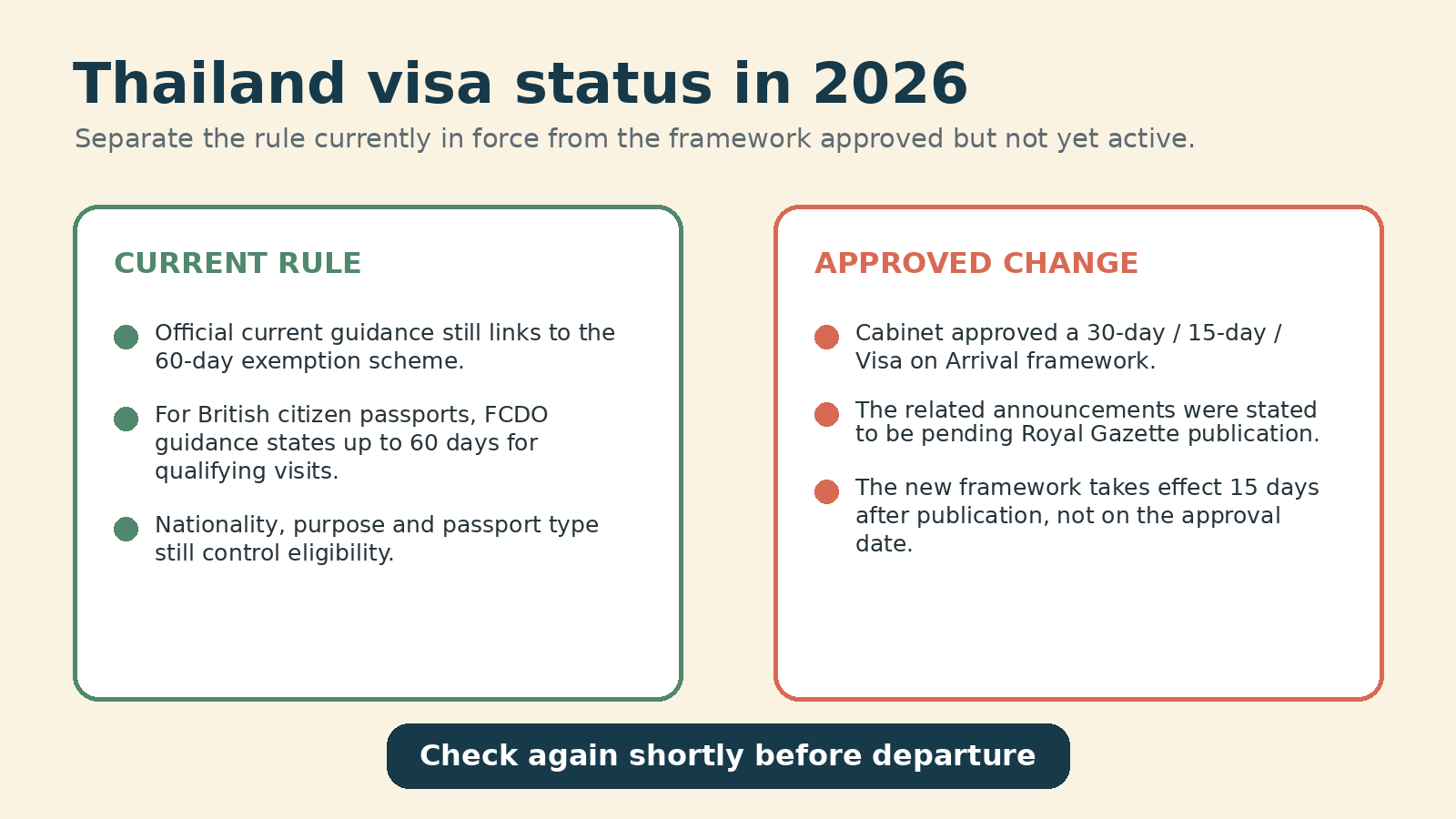
First, separate a political approval from a rule that has legally started. Thailand’s July 2026 government update said five related Ministry of Interior announcements were still pending Royal Gazette publication. It also said the new measures would take effect 15 days after that publication and that current entry conditions would remain until then.[1]
The approved framework assigns eligible countries and territories to one of three routes: a 30-day visa exemption, a 15-day visa exemption or Visa on Arrival. The announcement described 59 countries and territories in the proposed 30-day exemption group, Mauritius and Seychelles in the 15-day group, and Azerbaijan, Belarus and Serbia under Visa on Arrival. Separate bilateral arrangements may continue to provide different periods.[1]
What applies to a British citizen passport right now?
The UK government’s Thailand entry page, checked while preparing this article, says British citizens can visit for up to 60 days for tourism, business engagements and urgent or ad-hoc work, with a possible extension of up to 30 days. It also advises travellers to contact the Thai Embassy when unsure how the rules apply.[3] The Thai Ministry of Foreign Affairs page updated in March 2026 still links to the official list for the 60-day scheme.[2]
However, neither source is a promise that the same period will apply to a future arrival after the replacement framework begins. Therefore, a traveller booking several months ahead should build an itinerary that remains legal if the exemption changes before departure. A 14-night holiday is unaffected by the difference, whereas a planned 45-day stay needs a fresh check and possibly a visa.
How to check without getting lost in conflicting pages
- Start with the Thai Ministry of Foreign Affairs or the Royal Thai Embassy or Consulate responsible for your residence.
- Check the Thailand Immigration Bureau for operational notices.
- For UK travellers, compare the FCDO entry-requirements page, which is written for full British citizen passports.
- Look for an effective date, not merely a Cabinet approval date or press-release date.
- Save the current official page shortly before departure, especially for a long stay or an unusual purpose.
Why this article does not publish one universal stay length
Thailand’s entry period depends on nationality, passport type, purpose, bilateral arrangements and the rule in force on the date of entry. Immigration permission is granted at the border. This guide explains the workflow and the published examples; it does not replace a decision from the Thai authorities.
Passport validity, blank pages and matching details
For a full British citizen passport, FCDO guidance says the passport should expire at least six months after the date of arrival and contain at least one blank page.[3] Treat six months as a minimum, not a target. A passport that sits close to the line leaves no room for a delayed journey, changed departure or airline interpretation.
Count from the arrival date, not the day you book
Suppose the flight leaves London on 9 January but lands in Bangkok on 10 January. The Thai arrival date is 10 January, so the six-month calculation begins there. Likewise, a traveller entering Thailand for a second time after visiting Laos must check the passport against the second Thai arrival as well.
Inspect the physical document
A technically valid passport can still cause difficulty if the photo page is damaged, the cover is separating, pages are missing, or the document has been reported lost or stolen. The FCDO page warns that travellers can be denied entry without a valid travel document or when trying to use a passport reported lost or stolen.[3] Replace a doubtful passport before buying complicated non-refundable arrangements.
Make every booking match the passport
| Item | What should match | Common problem | Better approach |
|---|---|---|---|
| Flight ticket | Given names and surname used by the airline. | Nickname, missing surname element or old married name. | Follow the airline’s naming rules and use the passport as the source. |
| Visa or e-Visa | Passport number, nationality, date of birth and names. | Application made with a passport that is later renewed. | Ask the relevant Thai mission how to handle the new document. |
| TDAC | Name, passport number, nationality and date of birth. | Autofill inserts an old passport number. | Read the final page before submitting; submit a new form if a locked field is wrong. |
| Hotel | Lead guest name and a usable first-night address. | Booking sits under another traveller’s account with no accessible confirmation. | Save the confirmation and property contact details for the whole group. |
| Insurance | Traveller’s legal name and correct dates. | Policy begins after departure or excludes a planned activity. | Read the schedule and activity terms before paying. |
Dual nationals should use a consistent entry and exit passport
The FCDO recommends leaving Thailand on the same passport used to enter, which avoids problems with the immigration record.[3] A British dual national also needs the appropriate British passport or certificate of entitlement when returning to the UK. Keep each country’s requirements separate instead of assuming one passport solves every stage.
Visa exemption, Visa on Arrival or e-Visa?
The four terms are not interchangeable. Visa exemption means an eligible traveller arrives without obtaining a visa in advance. Visa on Arrival is a separate scheme for specified nationalities and normally involves an application at the border. An e-Visa is applied for before travel through the official portal. Other visa categories cover purposes such as study, employment, family, retirement or longer stays.
| Route | Who it suits | Timing | Main advantages | Main risks |
|---|---|---|---|---|
| Visa exemption | Eligible passports making a permitted short visit. | No visa application before travel, but current eligibility must be checked. | Simple and usually quick. | Stay period can change; it does not permit every type of work or long stay. |
| Visa on Arrival | Nationalities listed under the VOA scheme. | Application and fee at an eligible checkpoint. | Useful where exemption is unavailable. | Queues, document requirements and shorter permission may apply. |
| Tourist e-Visa | Travellers who need a tourist visa or want a route suited to a longer planned stay. | Apply before travel through the official e-Visa portal. | Decision obtained in advance. | Processing times vary; incomplete or inconsistent evidence causes delays. |
| Non-immigrant or specialist visa | Work, study, family, retirement, business or other defined purposes. | Apply before travel with category-specific evidence. | Matches the real purpose. | More documents, conditions and sometimes post-arrival reporting. |
Use purpose before convenience
A traveller should not select visa exemption merely because it avoids an application. Tourism, a conference, paid employment, volunteering, study and remote work can fall under different legal treatment. If the real purpose is not clearly covered by the short-visit permission, contact the Thai mission before travel.
Applying through the official e-Visa system
Thailand’s e-Visa system is available globally through 94 Royal Thai embassies and consulates via the official portal.[7] Government guidance lists examples such as a passport with at least six months’ validity, travel itinerary, accommodation details and a photograph. It also recommends preparing at least 15 days before travel, even though some straightforward applications may be processed faster.[8]
- Create the account only on the official Thai e-Visa portal.
- Select the embassy or consulate and visa category that apply to your residence and purpose.
- Upload clear, current evidence whose names, dates and passport number agree.
- Pay the fee shown for that application; do not copy an old fee from a blog.
- Monitor the account and email for requests, then keep the approval accessible during travel.
Allow time for questions
“Three to five working days” is not a sensible booking strategy for a complex application. Weekends, public holidays, extra-document requests and embassy workload can extend the process. Apply within the official permitted window and leave enough time to correct a rejected upload or supply further evidence.
Pros and cons of applying for a visa in advance
Advantages
A pre-travel decision can support a longer itinerary, clarify the permitted purpose and reduce uncertainty about eligibility. It also forces the traveller to organise the passport, accommodation and travel evidence early.
Trade-offs
The application costs money, requires documents and may tie the trip to dates or conditions. Approval does not guarantee admission, because entry remains subject to border checks.
Thailand Digital Arrival Card: step-by-step guide
The Thailand Digital Arrival Card, usually shortened to TDAC, is an online arrival form rather than a visa. Completing it does not create permission to enter, extend a stay or replace a visa application. Instead, it supplies the Immigration Bureau with arrival, accommodation and health-declaration information before the traveller reaches the checkpoint.
From 1 May 2025, foreign nationals entering Thailand by air, land or sea have generally been required to complete the TDAC. The official Immigration Bureau FAQ says it applies to all non-Thai nationals and is compatible with visa-exempt entry, Visa on Arrival and other visa types.[5]
Use only the official TDAC website
The official address is tdac.immigration.go.th. The Immigration Bureau’s own FAQ directs travellers to that domain.[4] Bookmark it rather than relying on a sponsored search result. The government form is free, so a payment page is a warning that you may be using a commercial intermediary rather than the official submission route.
When can you submit the TDAC?
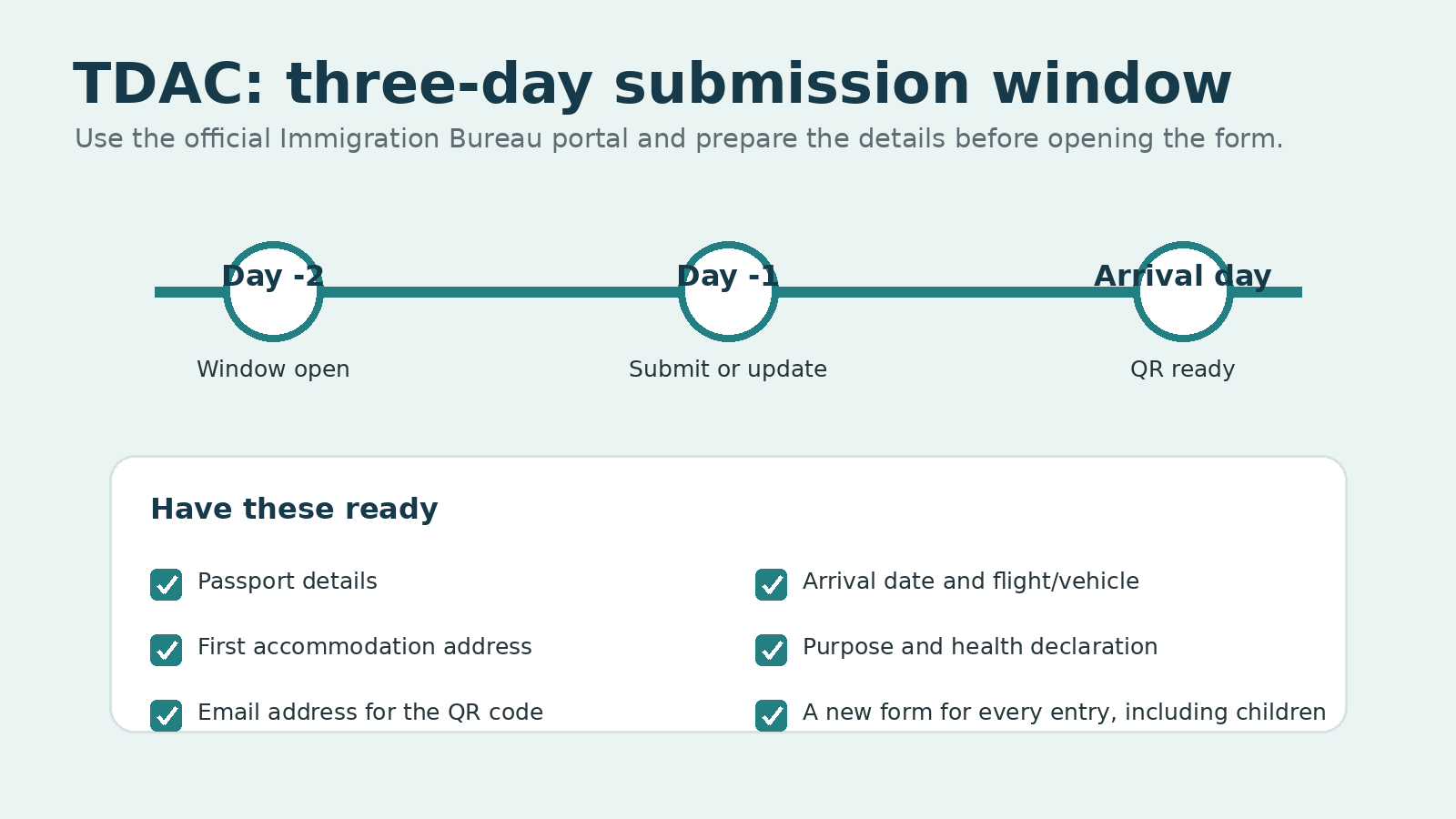
The Immigration Bureau says the card should be submitted within three days before arrival, including the arrival date, and describes the maximum advance period as 72 hours before entry.[5] Use the date options presented by the official portal instead of trying to outsmart the time calculation. An international flight may leave the UK a day before it lands in Thailand, and the Thai arrival date is the date that matters.
A simple timing example
For a flight landing in Bangkok on Friday, wait until the official portal allows Friday as the arrival date, then submit within the displayed window. Do not enter Thursday merely because the aircraft left Europe on Thursday. Likewise, a late schedule change may require an update before arrival.
Information to have ready
- Passport details, including the exact number and nationality.
- Arrival date, flight number or other vehicle information.
- Country where the journey began and relevant boarding information.
- The first accommodation address in Thailand.
- Travel purpose and occupation information requested by the form.
- Health-declaration details for countries visited in the relevant period.
- An email address that can receive the TDAC document and QR code.
The official FAQ estimates three to five minutes per person when the information is ready, but it also says the form cannot be saved and completed later.[5] Therefore, copy the hotel address into a note before you begin and have every passport beside you.
Who needs a TDAC?
| Traveller or journey | TDAC position | Practical point |
|---|---|---|
| Adult foreign visitor | Required for entry by air, land or sea. | Submit a new form for each entry. |
| Infant or child | Required. | A parent or authorised person can submit it. |
| Family or small group | Group submission is available for up to ten travellers. | Check every passport separately before final submission. |
| Airside transit without immigration | Not required according to the official FAQ. | Do not pass immigration or collect/recheck baggage. |
| Transit involving immigration or leaving the airport | Required. | A self-transfer may turn a transit into an entry. |
| Repeat entry after visiting another country | New TDAC required. | The previous QR code is one-time use for the expected entry. |
| Thai national | Not required under the foreign-national requirement. | Dual nationals should use the correct passport consistently. |
How to submit the TDAC
- Open the official portal and choose the individual or group submission route.
- Enter the passport identity fields manually and compare them with the photo page.
- Add the arrival journey, first accommodation, purpose and health information.
- Review every field, especially passport number, nationality and arrival date.
- Submit, download the document and save the QR code from the confirmation email.
- Store a phone copy and, if useful, a paper backup with the other arrival documents.
Correcting a TDAC mistake
The FAQ allows travellers to update many details, but the full name, passport number, nationality and date of birth cannot be changed through the update function. When one of those locked fields is wrong, submit a new form with the correct information. The system treats the most recent valid submission as the one to use.[5]
Hotel and flight changes should also be corrected before entry. A last-minute delay does not automatically invalidate every field, but the arrival date and journey details should describe the actual trip as accurately as possible.
Do you need to print the QR code?
No. The Immigration Bureau says the document can be shown on a phone or other device. Nevertheless, it suggests a printed copy as a sensible backup when a device may not be available.[5] A screenshot is useful, although keeping the complete downloaded document is better because it shows the associated details.
What happens if you arrive without a TDAC?
Do not plan to solve it after landing. The official FAQ says airport assistance, Wi-Fi and kiosks are available at certain airports, but arrival facilities are a fallback rather than a reason to delay. A low battery, email problem or queue can turn a three-minute form into a stressful start. Complete it before travelling and keep the QR code offline.
TDAC is not a visa and does not guarantee entry
Airlines may check it before boarding, and Thai immigration may use the information during border screening. However, entry remains subject to the traveller’s passport, visa or exemption, purpose, evidence and the officer’s decision.
Proof of funds, onward travel and first accommodation
Most straightforward holiday arrivals do not involve a long interview. Even so, travellers should be able to explain where they are staying, how they will support the trip and when they plan to leave. Thailand’s July 2026 official reminder says proof of funds is an established part of immigration screening rather than a new measure. It also confirms that the final entry decision rests with Immigration Bureau officers.[6]
Published proof-of-funds examples
| Entry category in the official reminder | Amount per person | Amount per family | Important qualification |
|---|---|---|---|
| Transit visa and certain visa-exempt cases | 10,000 baht | 20,000 baht | The reminder says certain cases; other official exemption guidance may state higher figures. |
| Visa on Arrival | 10,000 baht | 20,000 baht | Check the VOA requirements and accepted evidence for the traveller’s checkpoint. |
| Tourist visa | 20,000 baht | 40,000 baht | The funds should support the planned visit and may be assessed with other evidence. |
| Non-immigrant visa | 20,000 baht | 40,000 baht | Category-specific visa evidence still applies. |
The same official reminder says children under 12 are excluded from that proof-of-funds requirement and warns travellers using visa exemption to check current guidance because some official sources state 20,000 baht per person or 40,000 baht per family.[6] Consequently, a universal “carry 10,000 baht” instruction would be misleading.
What can count as evidence?
The government reminder refers to Thai baht, equivalent foreign currency or documents evidencing payment of an equivalent amount.[6] However, travellers should not assume every bank-app screenshot will satisfy every officer. Keep a practical mix: accessible money, a recent statement if appropriate, working cards and evidence that the main accommodation or transport has already been paid.
Do not create a cash-security problem
Proof of funds does not mean carrying the entire holiday budget in one visible envelope. I would keep enough accessible evidence to answer a genuine question, while dividing cash and cards securely. The exact form accepted at the checkpoint remains an immigration decision.
Onward or return travel
An airline may refuse boarding when it believes the passenger lacks the documents needed for the destination. Therefore, a one-way ticket can prompt questions even when the traveller intends to continue overland. Keep a confirmed return flight, onward air ticket or credible dated journey that fits inside the permitted stay. A vague plan to buy something later is weaker than an actual booking.
When the onward route depends on a land border, check that the crossing is open. For example, current FCDO advice says Thailand-Cambodia land borders and crossings remain suspended and advises against all but essential travel within 20 kilometres of that border.[13] A booking that assumes a closed border is not useful evidence.
First-night accommodation
The TDAC requests an address in Thailand, and the e-Visa process can also request accommodation evidence. Use the property where you genuinely expect to sleep first, not a random hotel copied from a map. Save:
- Property name and complete address.
- Booking reference and lead guest.
- Check-in date and cancellation terms.
- Phone number or messaging contact.
- Directions or transfer details for a late arrival.
A refundable first-night booking can be sensible while the wider itinerary remains flexible, provided it is real and still valid at entry. Cancelling it before arrival and forgetting to update the TDAC creates an avoidable mismatch.
Evidence should tell one coherent story
| Good evidence set | Why it works | Weak version |
|---|---|---|
| 14-night holiday | Return flight on Day 15, first hotel confirmation, realistic funds and tourism purpose. | One-way flight and no first address. |
| Six-week trip | Current permission verified, onward ticket within that period, funds and itinerary consistent with the stay. | Assuming a previous 60-day rule still applies without checking the 2026 change. |
| Regional trip | Flight or open crossing to the next country, accommodation for the Thai section and new TDAC for re-entry. | Bus ticket to a border currently closed. |
| Business visit | Purpose fits the permission or visa, invitation and itinerary agree, return is booked. | Describing paid work as tourism to avoid the correct visa. |
Entering Thailand by air, land, sea or in transit
The core requirements travel with the person, but the practical checks differ by arrival method. TDAC applies to foreign entries by air, land and sea, while an airside transit without immigration is treated differently.[5]
Arriving by air
Airlines often perform the first document check. Keep the passport, visa approval where relevant, TDAC, onward evidence and first accommodation available before reaching the desk. A codeshare can mean the operating airline, rather than the seller, carries out the assessment.
For a self-transfer in Bangkok, airport codes matter. Suvarnabhumi is BKK and Don Mueang is DMK. Collecting luggage, passing immigration and changing airports is an entry into Thailand, not an airside transit. Build enough time for the border process, road transfer and a second check-in deadline.
Arriving by land
Confirm that the exact crossing accepts the traveller’s passport and entry route and is open on the planned date. Border hours, local closures and regional security conditions can change faster than an old timetable. The current Cambodia-border suspension is a strong example of why a generic “Thailand overland” article is not enough.[13]
Land entry still requires a TDAC. Save it before leaving mobile coverage and keep the address and onward evidence accessible. Additionally, do not assume a visa or exemption grants unlimited repeated entries; immigration can assess travel patterns and the purpose of each arrival.
Arriving by sea
Cruise passengers and private-boat travellers should follow the operator’s instructions without assuming the ship handles every personal requirement. The TDAC requirement covers sea arrivals, while port immigration and customs procedures still apply.[5] Ask the operator whether you will formally enter Thailand at each port or remain in transit.
Transit without entering Thailand
The official TDAC FAQ says travellers do not need the form when they remain in transit and do not pass through immigration. Once a traveller leaves the airport, collects baggage that requires immigration, or completes a self-transfer landside, a TDAC is required.[5]
The baggage test
When two tickets are separate, ask the first airline whether baggage is checked through and whether the next boarding pass can be issued airside. If either answer is no, plan as though you may need to enter Thailand, complete TDAC and meet the entry requirements.
Thailand customs rules, currency, vapes and cannabis
Immigration decides whether a person may enter; Customs deals with goods, money and restricted items. Passing immigration does not mean every item in the luggage is lawful. When unsure, use the red channel and ask before presenting the bag as “nothing to declare.”
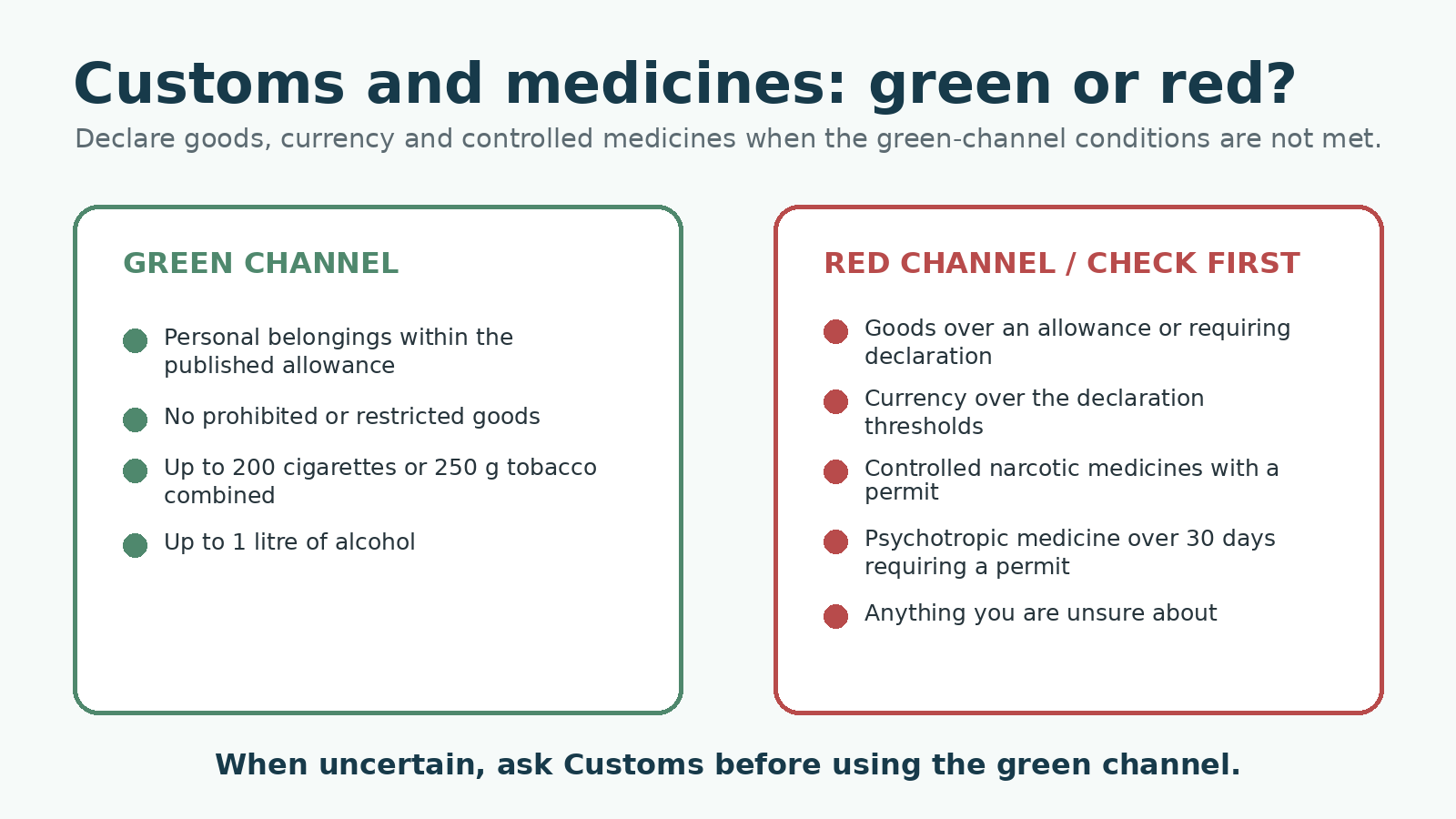
Published passenger allowances
Thai Customs lists no more than 200 cigarettes or 250 grams of tobacco, or 250 grams of all types combined, and no more than one litre of alcoholic beverage. It also describes personal belongings in reasonable quantity worth no more than 20,000 baht in total for the nothing-to-declare channel, excluding prohibited or restricted goods and food.[9]
| Item | Published allowance or rule | Common misunderstanding |
|---|---|---|
| Cigarettes | No more than 200. | The limit is per person, not per suitcase or duty-free bag. |
| Tobacco products | 250 g, or 250 g of all types combined. | Mixing products does not multiply the total allowance. |
| Alcohol | No more than one litre. | Airport duty-free purchase does not override the destination allowance. |
| Personal belongings | Reasonable quantity, published total value no more than 20,000 baht for the green-channel exemption. | New high-value goods may not be treated like ordinary used luggage. |
| Restricted goods | Declare and produce any required permission. | Personal use is not automatically an exemption. |
The Customs page says excess tobacco or alcohol should be left in the boxes provided or prosecution may follow.[9] The FCDO also warns that more than 200 cigarettes can lead to confiscation and a fine calculated at ten times the value.[3]
Currency declaration thresholds
The Thai Customs Currency Declaration System says travellers entering or leaving Thailand must declare Thai currency or relevant bearer instruments over 450,000 baht, foreign currency or relevant bearer instruments over US$15,000 equivalent, and combinations exceeding 450,000 baht equivalent. Failure to declare or making a false declaration can be a criminal offence.[10]
Those are declaration thresholds, not ordinary holiday-budget recommendations. A traveller carrying a large amount for a legitimate reason should use the official declaration system, keep evidence of the source and purpose, and ask Customs when unsure.
Do not bring a vape or e-cigarette
Current FCDO safety advice says it is illegal to possess or use a vape, e-cigarette, pod, e-liquid or heat-not-burn device in Thailand. It states that there is no tourist or personal-use exception and that consequences can include confiscation, fines, detention and court proceedings.[14] Leave the device and refills at home rather than assuming a sealed item in checked luggage is acceptable.
Cannabis is not a casual souvenir
FCDO guidance says cannabis use is restricted to medical purposes under a Thai-issued prescription, recreational use remains illegal, and taking cannabis out of Thailand without export permission is unlawful.[14] Do not carry cannabis, edibles, oils or related products into Thailand based on a shop advertisement, and do not take them to an airport for departure or transit.
Food, plants, animals and wildlife products
Food and agricultural items may be controlled by agencies beyond Customs. Likewise, wildlife products, protected species and some souvenirs require permission or are prohibited. When an item involves seeds, fresh food, meat, plants, animal parts or traditional remedies, check the relevant Thai authority before packing it.
When the red channel is the safer choice
Use it when you exceed an allowance, carry controlled medicine requiring declaration, transport high-value goods, hold currency over a threshold or simply cannot establish that an item is permitted. Asking before inspection is safer than relying on a shopkeeper, forum or “everyone does it” claim.
Taking medication into Thailand
Medication rules depend on the active ingredient, controlled-drug schedule, quantity and documents. A familiar UK brand name does not determine the Thai classification, and a medicine available over the counter in one country may be controlled in another. Check every active ingredient through the Thai Food and Drug Administration before travel.
Start with the active ingredient
Write down the generic drug name, strength, dosage and total quantity. Then search the official Thai FDA traveller-permit system or contact the Narcotics Control Division when the classification is unclear.[11] Do not rely on a pharmacy receipt, a travel forum or the fact that a doctor prescribed it in the UK.
Thai FDA rules for controlled narcotic medicines
The Thai FDA’s published guidance allows travellers under treatment to carry prescribed medicines containing narcotic drugs in Schedules II and III for personal use up to a 90-day supply, subject to the rules. It requires a Form IC-2 permit and says the online application should be made at least 15 days before arrival. Once a complete application is received, the guidance describes processing in approximately three working days.[12]
The permit process asks for a passport copy and a medical prescription or signed document containing the patient’s identity and address, diagnosis, medicine names and strengths, directions, reason for treatment, dosage, total amount and the prescriber’s details. The traveller should keep the originals during the trip.[12]
Thai FDA rules for psychotropic medicines
For psychotropic substances in Schedules II, III and IV, the Thai FDA guidance distinguishes between a supply not exceeding 30 days and a supply of 31 to 90 days. Up to 30 days may be carried for personal use with the required certificate or prescription. A 31-to-90-day supply requires the Form IC-2 permit applied for at least 15 days before travel.[12]
| Medication situation | Published Thai FDA position | What to carry | Arrival action |
|---|---|---|---|
| Schedule II or III narcotic medicine | Up to 90-day prescribed supply, with permit required. | Form IC-2, prescription/medical letter, passport evidence and original labelled medicine. | Be ready to present medicine, permit and documents at the red channel. |
| Schedule II, III or IV psychotropic medicine, up to 30 days | Permitted for personal use with the specified medical certificate or prescription; permit not normally required under the guidance. | Original labelled medicine and compliant medical certificate or prescription. | Keep evidence throughout the stay; confirm the exact substance classification. |
| Schedule II, III or IV psychotropic medicine, 31 to 90 days | Permit required. | Form IC-2 and the same supporting medical evidence. | Follow the permit and declaration instructions. |
| Other ordinary prescription medicine | Personal-use rules may apply, but classification still needs checking. | Original packaging, prescription copy and a medical letter for anything unusual. | Ask Thai FDA or Customs when uncertain. |
| Substance in a prohibited schedule | Import may be prohibited even when prescribed elsewhere. | Do not travel with it unless the Thai authority confirms a lawful route. | Discuss an alternative with the prescriber before departure. |
Examples that deserve an early check
The Thai FDA guidance lists examples including codeine, morphine, oxycodone and methadone among narcotic schedules, and alprazolam, methylphenidate, diazepam, lorazepam and zolpidem among psychotropic schedules. It also lists examples of prohibited Schedule I substances.[12] The examples are not a complete self-diagnosis tool. Formulations and classifications matter, so use the official search and obtain written advice when necessary.
How to prepare the medical letter
- Ask the prescriber to use the generic and brand names.
- Include strength, dosage, total quantity and treatment duration.
- State the medical condition and why the medicine is needed.
- Include the patient’s name and address exactly as required.
- Add the clinician’s name, address, professional details and signature.
- Keep the letter recent, legible and in English or accompanied by an accepted translation where needed.
Original packaging matters
The Thai FDA advises keeping medicines in original prescription bottles with clear labels and retaining the documents during the trip.[12] A weekly pill organiser may be useful after arrival, but carrying all controlled tablets loose through Customs removes the clearest link between the medicine, prescription and traveller.
Use the correct customs channel
The guidance says travellers carrying the controlled narcotic medicines or psychotropic medicines that require a permit should present the medicines and documents at the Customs red channel on request. It also explains that certain psychotropic medicines for personal use up to 30 days, accompanied by the specified medical evidence, do not need red-channel declaration under that guidance.[12] When the facts do not fit the simple case, ask Customs.
Health and vaccination evidence
For British travellers, FCDO guidance says a yellow fever vaccination certificate is required when arriving from a country listed as a transmission risk.[3] The rule can depend on travel history, not merely nationality or the country where the holiday began. Check TravelHealthPro and the Thai requirements for every transit or recent visit, particularly when travelling through affected regions.[15]
Medication timing is one of the earliest tasks
A hotel can be changed in an evening. A controlled-medicine permit, prescriber letter and alternative treatment plan may take weeks. Therefore, I would check medicine before buying a rigid itinerary, especially when the trip is longer than 30 days or the prescription includes pain relief, ADHD, anxiety, sleep or opioid-substitution medication.
Thailand entry requirements for children and families
Children are not simply added to an adult’s permission. Each child needs a valid travel document and, where required, the correct visa or exemption. The official TDAC FAQ says infants and children require their own TDAC entry, although a parent or authorised person can submit on their behalf.[5]
Family TDAC submissions
The official system allows up to ten travellers in one group submission.[5] That is convenient, but it increases the risk of copying the wrong passport number into the wrong child. Place the passports in order, complete one traveller at a time and check the final summary against each photo page.
Travelling with one parent or another adult
Thailand’s routine entry pages do not replace the departure and safeguarding rules of the country the child leaves. A consent letter, birth certificate copy or evidence of parental responsibility may be useful where names differ or one parent is absent. Airlines and border authorities may ask questions even when no single universal form exists.
Family evidence folder
- Passport and visa/exemption evidence for every traveller.
- TDAC document or QR code for every foreign traveller.
- Travel insurance showing each child’s name.
- Accommodation booking suitable for the full group.
- Onward tickets for the family.
- Medication letters, permits and prescriptions for the child concerned.
- Consent and relationship documents when the travel circumstances make them relevant.
Proof of funds and children
The July 2026 official reminder says the published proof-of-funds requirement does not apply to children under 12.[6] However, a family should still demonstrate a credible, funded trip. A room for two adults that omits two children, or a return booking that excludes one traveller, creates questions unrelated to the cash threshold.
Work, study, volunteering and longer stays
A short-visit permission should not be stretched to fit a different purpose. The UK entry page says travellers need a visa before travel for work, study or other reasons outside the stated visit category.[3] Meanwhile, the exact treatment of business meetings, urgent work and paid employment can differ. Ask the Thai mission for the category that covers the real activity.
Remote work needs a legal check
Working online from a hotel does not automatically become lawful because the client or employer is outside Thailand. Tax, immigration and employment rules are separate questions. Travellers planning a workation, repeated long stays or income-generating activity should obtain current professional or official guidance rather than treating a tourist entry as a general remote-work licence.
Volunteering can count as work
Unpaid activity may still require the correct visa or work authorisation, particularly when it replaces a role or forms part of an organisation’s operations. Animal projects, schools, charities and retreat centres should be asked for the legal arrangement, not merely whether previous visitors “had no problem.”
Long stays require a margin
Do not build the itinerary to end on the last lawful day. Flight cancellations, illness, weather and calculation errors happen. The FCDO says overstaying can lead to a fine of 500 baht per day up to 20,000 baht, as well as detention, deportation and a ban of up to ten years.[3] Keep a buffer and confirm the stamped permission before leaving the immigration desk.
Read the entry stamp
After the passport is returned, check the admitted-until date while still close to the checkpoint. If it appears wrong or unclear, ask immediately. A planned stay length, an airline ticket and a visa approval do not override the date granted by immigration.
Travel insurance and regional warnings
Entry permission and travel insurance are separate, but they influence each other. The FCDO warns that insurance may be invalidated when a traveller goes against its advice and says a policy should cover the itinerary, planned activities and emergency expenses.[13]
Check the map, not just the country name
Current UK advice warns against all but essential travel to specified southern provinces and districts near the Malaysia border, as well as areas within 20 kilometres of the Cambodia land border. It also states that Thailand-Cambodia land crossings remain suspended.[13] A national policy labelled “Thailand” may still exclude those areas.
Activities need explicit cover
Scooter riding, scuba diving, trekking, climbing and boat trips can carry licence, depth, equipment or operator conditions. A policy may cover ordinary tourism but reject a claim when the traveller lacks the correct motorcycle licence or ignores a marine warning. Read the activity wording before paying for the activity.
Carry the assistance route
Save the insurer’s emergency number, policy number and medical-assistance process offline. A certificate in an inbox is less useful during a hospital admission when the phone has no signal. Likewise, tell a travel companion where the information is stored.
Thailand entry preparation timeline
The timeline separates tasks that need weeks from forms that must wait until the last three days. Doing everything in one evening either makes the TDAC too early or makes the medication and visa work dangerously late.
| When | Entry tasks | Why this timing works |
|---|---|---|
| Before booking | Check passport validity, purpose, likely visa route, medicine classification and major travel-warning areas. | These findings can change the destination, duration or route. |
| 8-12 weeks before | Renew a weak passport; begin specialist visa research; ask the prescriber for medicine evidence; review insurance. | Appointments, new documents and medical alternatives take time. |
| 4-8 weeks before | Submit a visa application within the official window; apply for a Thai FDA permit at least 15 days before arrival; book the first stay and core transport. | Leaves time for additional-document requests and corrections. |
| 1-2 weeks before | Recheck visa-exemption commencement, border status, travel advice, airline requirements, accommodation and onward evidence. | Time-sensitive changes are more likely to be visible. |
| Within three days of arrival | Submit TDAC through the official portal, download the QR code and update changed details. | This is the Immigration Bureau’s permitted submission window. |
| Day before travel | Charge devices, save offline copies, place controlled medicine and documents in hand luggage where permitted, and verify the first address. | Reduces dependency on airport internet and checked baggage. |
| At check-in | Show the passport, visa/evidence, TDAC and onward details when requested. | The airline may assess destination-document compliance. |
| At arrival | Use immigration, check the entry stamp, collect baggage and choose the correct customs channel. | Each agency handles a different decision. |
Final 24-hour checklist
Passport and any visa approval are in hand luggage.
TDAC QR code is saved offline for every foreign traveller.
First-night address, onward ticket and funds evidence are accessible.
Medication is in original packaging with permit and medical documents where required.
Insurance details and emergency numbers are stored offline.
No vape, e-liquid, cannabis or uncertain restricted item is in the luggage.
Every name, passport number and travel date has been cross-checked.
How to store Thailand travel documents
A well-organised document set should survive a flat battery, lost phone or unavailable email account. At the same time, it should not expose every passport and card number when one device or sheet is lost.
Use three layers
| Layer | Contents | Security approach |
|---|---|---|
| Immediate offline folder | TDAC, first hotel, onward ticket, insurance contact, visa approval and medicine permit. | Use device security and avoid placing full card details in the same folder. |
| Cloud backup | Encrypted or access-controlled copies of the same documents. | Enable strong password and multi-factor authentication before travel. |
| Paper essentials | Key reference numbers, hotel address, emergency contact and any document specifically better in print. | Carry separately from the passport and do not print unnecessary financial details. |
Give files names that work under pressure
Use names such as `01_Passport_Copy_Karen.pdf`, `02_TDAC_Karen.pdf`, `03_First_Hotel.pdf` and `04_Onward_Flight.pdf`. A gallery full of unnamed screenshots forces the traveller to open each image while standing at the desk. Clear names are a small improvement that becomes valuable at exactly the right moment.
Protect the original passport
FCDO safety advice says police may ask to see a passport and that a copy of the photo page is usually sufficient when the original is not carried, although a traveller can be asked to produce the passport within 24 hours.[14] Do not hand the original to a motorcycle or jet-ski business as a deposit.
After the paperwork: first hotel, onward transport and connectivity
Affiliate links belong here rather than inside the legal explanation. Once the entry route is confirmed, the first address, onward journey and phone access can make the arrival smoother. Compare the final price and cancellation terms rather than clicking the first option.
What to compare in a first-night hotel
- Reception hours and late-arrival instructions.
- Transfer time from the actual airport code.
- Refundability if the flight schedule changes.
- Whether the full address appears clearly in the booking.
- Breakfast and check-out timing for the next journey.
- Room occupancy for every adult and child.
Phone access for digital documents
Save the important files offline even when buying an eSIM. Connectivity is helpful for flight changes, hotel messages and maps, but it should not be the only route to the TDAC or visa approval.
Useful travel products, without overpacking
A document organiser can keep paper evidence together, while a power bank helps preserve access to digital files. However, keep controlled medicine in original packaging rather than decanting it into a generic travel case.
Continue planning the trip
- Build a realistic Thailand two-week itinerary.[17]
- Estimate daily and two-week Thailand costs.[19]
- Use the Thailand packing list for temples, islands and rain.[18]
- Compare Thailand’s weather month by month.[20]
Common Thailand entry mistakes
Assuming the approved 30-day framework has already started
The Cabinet approval and legal commencement are different events. Check the effective date and the rule for the arrival date, not the headline date.[1]
Assuming the old 60-day scheme will still apply months later
The opposite mistake is equally risky. A current 60-day page does not promise that a future traveller will receive 60 days after the new framework begins. Recheck before departure.
Submitting TDAC too early
The official system uses a three-day window. A form completed weeks ahead through another website is not the official TDAC submission.[5]
Using the departure date instead of the Thai arrival date
Long-haul flights cross dates. The TDAC and passport calculation should use the date the traveller enters Thailand.
Copying an old passport number
Browser autofill and saved traveller profiles can insert a cancelled number. The TDAC’s identity fields cannot all be edited, so a wrong locked field requires a new submission.
Keeping every document inside live email
Airport Wi-Fi, roaming and password resets fail. Save the files offline and use clear filenames.
Booking onward travel through a closed border
A bus-search result does not prove a border is operational. Check current official and government travel advice for the exact crossing.[13]
Confusing a TDAC with a visa
The arrival card does not create permission to work, extend a stay or enter under an ineligible passport. It complements the visa or exemption.
Carrying medicine by brand name alone
Thai classification follows the substance. Check the active ingredient, quantity and schedule, then secure the permit or medical evidence early.[12]
Packing a vape because it is for personal use
Current FCDO guidance says there is no tourist or personal-use exception.[14]
Ignoring the entry stamp
The stamp or electronic record shows the permission actually granted. Check it before leaving the area and retain enough time to depart lawfully.
Using affiliate bookings as a substitute for official checks
A hotel, tour or transport platform can help organise the trip, but it cannot confirm visa eligibility, medicine legality or border permission. Official sources decide those questions.
Pros and cons of Thailand’s digital entry process
What works well
The TDAC removes a paper arrival card, group submission helps families, e-Visa is available online, and most evidence can be stored digitally. A prepared visitor can move through the process with a compact document set.
Where travellers get caught
Rules are spread across immigration, foreign affairs, customs, health and national travel-advice pages. The changing 2026 visa framework adds timing risk, while commercial TDAC sites can look official.
The practical verdict
Thailand is not unusually difficult to enter for a straightforward, eligible holiday. However, it rewards travellers who distinguish current law from proposed change, use government portals, and prepare evidence before reaching the airport. The process becomes risky when convenience is mistaken for permission.
Frequently asked questions
Do British citizens need a visa for Thailand in 2026?
Current FCDO guidance says qualifying visits on a full British citizen passport can be visa-free for up to 60 days. However, Thailand approved a replacement framework that would put many countries in a 30-day exemption category once the related announcements are published and the commencement period passes. Check the Thai authorities and FCDO again shortly before travel.[1][3]
Has Thailand already reduced the visa exemption from 60 to 30 days?
The latest official TAT update located for this guide described the new framework as approved but pending Royal Gazette publication and said current conditions would remain until it takes effect 15 days after publication.[1] Travellers need the effective rule for their arrival date.
How long must my passport be valid for Thailand?
For a British citizen passport, the FCDO says the expiry date should be at least six months after arrival and the passport should contain at least one blank page.[3] Other nationalities should check the relevant Thai mission.
Is TDAC free?
The official Thailand Digital Arrival Card is completed through the Immigration Bureau portal. Use the government domain directly; a site demanding a service fee is not the free official submission route.
When should I complete TDAC?
The Immigration Bureau says it should be submitted within three days before arrival, including the arrival date, and may be submitted up to 72 hours before entry.[5]
Does every child need a TDAC?
Yes. The official FAQ says infants and children need a TDAC. A parent or authorised person can submit for them, and a group application can contain up to ten travellers.[5]
Do I need TDAC for an airside connection?
Not when you remain in transit and do not pass immigration, according to the official FAQ. When you leave the airport, collect baggage through immigration or make a landside self-transfer, TDAC is required.[5]
Can I edit a TDAC after submission?
Many details can be updated, but full name, passport number, nationality and date of birth cannot. For a mistake in one of those fields, submit a new correct form; the system uses the most recent valid submission.[5]
Do I need to print the TDAC?
No. The official FAQ says it can be shown on a phone or other device, although a printed backup can be useful when the device is unavailable.[5]
Will immigration ask for proof of funds?
It may. Thailand’s official reminder lists amounts by entry category and confirms that officers may assess evidence during entry screening. Because guidance for visa exemption can vary, check the amount and acceptable evidence for your nationality and entry route.[6]
Do I need an onward ticket?
Travellers should be ready to show evidence of onward travel where required. Airlines can also ask before boarding. Keep a genuine booking that fits within the permitted stay and does not depend on a closed border.[6]
Can I bring prescription medicine to Thailand?
Often yes, but controlled narcotic and psychotropic substances have specific quantity, permit, document and declaration rules. Check the active ingredient through the Thai FDA, apply at least 15 days ahead when a permit is required, and keep original packaging.[11][12]
Can I take codeine to Thailand?
Codeine appears in the Thai FDA guidance as an example of a controlled narcotic substance. The exact formulation and quantity need checking, and a permit may be required. Do not travel based only on the UK prescription label.[12]
Can I bring a vape to Thailand?
Current FCDO guidance says possession or use of vapes, e-cigarettes, pods, e-liquids and heat-not-burn devices is illegal and has no personal-use exception.[14]
How much alcohol and tobacco can I bring?
Thai Customs publishes limits of no more than one litre of alcohol and no more than 200 cigarettes or 250 grams of tobacco, or 250 grams of all tobacco types combined.[9]
Do I have to declare cash?
Thai Customs says foreign currency or relevant bearer instruments over US$15,000 equivalent must be declared, as must Thai currency or relevant instruments over 450,000 baht and certain combined amounts above the published threshold.[10]
Can I enter Thailand overland from Cambodia?
Do not assume so. Current FCDO advice says Thailand-Cambodia land borders and crossings remain suspended and warns against all but essential travel within 20 kilometres of the border.[13] Check again for your dates.
What happens if I overstay?
FCDO guidance states a fine of 500 baht per day up to 20,000 baht, with possible detention, deportation and a re-entry ban of up to ten years.[3] Plan a buffer and verify the admitted-until date.
The safest way to prepare for Thailand entry
Begin with the arrival date and work outwards. Check the passport, establish the legal entry route, and confirm the visa-exemption period that is actually in force. Next, secure a genuine first-night address and onward plan, then organise funds evidence, insurance and any medication permit. Only inside the official three-day window should you complete the TDAC.
The changing 2026 visa position makes one habit especially valuable: record the source and date of the final check rather than remembering a number from a previous holiday. A 60-day entitlement, 30-day proposal, visa approval and TDAC are different pieces of information. When each document tells the same story, arrival is usually straightforward.
Before leaving for the airport, open every saved file in flight mode. Check the passport number one final time, confirm the first hotel still exists in the booking, and make sure the onward journey remains usable. Then keep the originals secure, answer questions honestly and use the red customs channel whenever an item or medicine is uncertain.
Written and researched for Taylor’s Trailblazing Travels by Karen Taylor.
Image credits
All five editorial graphics in this article were created specifically for Taylor’s Trailblazing Travels. They are original illustrations and do not require third-party photographer attribution.
Official sources and fact-checking notes
Entry rules are time-sensitive. The visa-transition status and linked official pages were checked on 24 August 2026. Always recheck the Thai Ministry of Foreign Affairs, Immigration Bureau, Thai Embassy or Consulate and your own government’s travel advice shortly before departure.
Thai entry, immigration and customs sources
- Thai Cabinet approves updated visa measures pending Royal Gazette publication — Thailand.go.th / Tourism Authority of Thailand. Approved 30-day/15-day/VOA framework, pending publication and commencement wording.
- Countries and territories eligible for visa exemption and Visa on Arrival — Department of Consular Affairs, Ministry of Foreign Affairs. Current Ministry of Foreign Affairs links to the 60-day visa-exemption list and related arrangements.
- Thailand entry requirements — UK Foreign, Commonwealth & Development Office. British-passport validity, current visa-free period, TDAC, overstay, yellow fever and customs reminders.
- Thailand Digital Arrival Card official portal — Thailand Immigration Bureau. Only official TDAC submission portal used in this guide.
- Thailand Digital Arrival Card FAQ and user guidance — Thailand Immigration Bureau. Submission window, required information, children, transit, group entries, updates and QR-code guidance.
- Thailand entry reminder on proof of funds for foreign visitors — Thailand.go.th / Tourism Authority of Thailand. Proof-of-funds categories, amounts, discretion and onward/accommodation evidence reminder.
- Thai e-Visa official portal — Ministry of Foreign Affairs, Thailand. Official online visa application portal.
- How to use Thai e-Visa — Thailand.go.th / Department of Consular Affairs. Document examples and official advice to prepare well before travel.
- Passenger customs procedures and duty-free allowances — Thai Customs Department. Green/red channels, personal belongings, tobacco and alcohol limits.
- Currency Declaration System — Thai Customs Department. Thai and foreign currency declaration thresholds and criminal-offence warning.
Medicines, safety, health and related planning sources
- Permit for travellers carrying controlled medicines — Thai Food and Drug Administration. Official permit portal and controlled-substance search.
- Guidance for travellers carrying narcotic or psychotropic medicines into Thailand — Thai Food and Drug Administration. Permit timing, quantities, medical documents, red-channel declaration and prohibited schedules.
- Thailand warnings and insurance — UK Foreign, Commonwealth & Development Office. Regional warnings, Cambodia border status and insurance implications.
- Thailand safety and security — UK Foreign, Commonwealth & Development Office. Vape/e-cigarette prohibition and current cannabis warning.
- Thailand country information — TravelHealthPro. Health-risk and vaccination planning for travellers from the UK.
- Thailand Immigration Bureau — Immigration Bureau, Royal Thai Police. Immigration notices and official contact channel; call centre 1178.
- Two-Week Thailand Itinerary 2026 — Taylor’s Trailblazing Travels. Internal route-planning guide.
- Packing List for Thailand — Taylor’s Trailblazing Travels. Internal packing guide.
- Travel Budget for Thailand — Taylor’s Trailblazing Travels. Internal budget-planning guide.
- Best Time to Visit Thailand — Taylor’s Trailblazing Travels. Internal season and weather guide.