Kuala Lumpur Heritage Walk: Merdeka Square, Museums and Old Streets
A walk from the river meeting point to civic buildings, collections and working streets, with one museum and time to sit down.
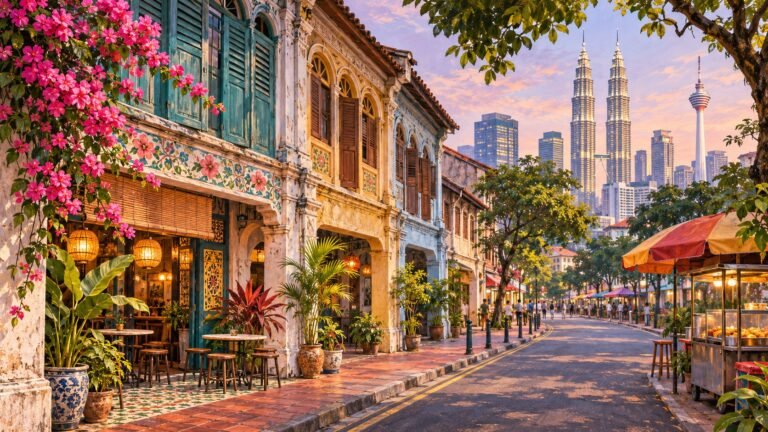
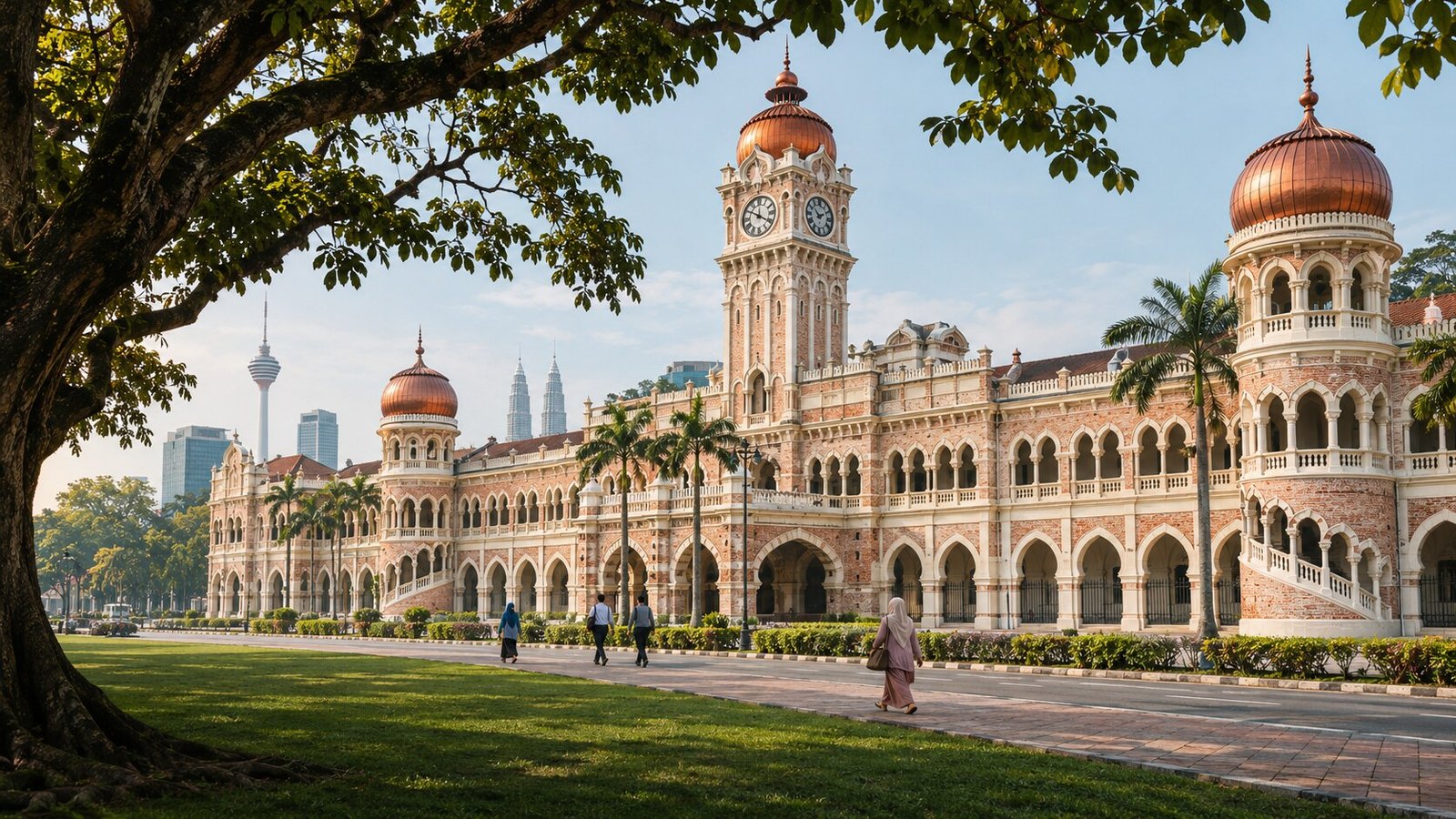
Original editorial illustration of Kuala Lumpur’s civic heritage setting; it is not a photograph or a map of open interiors.
Affiliate disclosure: Taylor’s Trailblazing Travels may earn a commission if you book or buy through links in this guide, at no extra cost to you. Recommendations are selected for their usefulness to the trip.
This Kuala Lumpur heritage walk begins beside Masjid Jamek, crosses to Merdeka Square and the Sultan Abdul Samad Building, then continues through a museum, Central Market and Chinatown. The sequence gives the city’s official landmarks and its everyday streets room to tell different stories.
Allow about four and a half hours, including a seated break. Choose one main collection: Kuala Lumpur City Gallery for the city’s development, or the National Textile Museum for clothing, materials and craft. The current KL City Gallery is inside Bangunan Sultan Abdul Samad, a detail that matters when using older walking guides. [4]
Core plan
4½ hours, including one museum and a seated break; an illustrative allowance.
Shorter finish
Leave after Central Market: about 3 hours 35 minutes in the same model.
Main choice
City history at KL City Gallery, or material culture at the National Textile Museum.
Access rule
A view of a historic building does not imply public access to its interior.
The route and a realistic half-day timetable
Use a current street map for the actual crossings. The diagram accompanying this guide shows the order of stops; it is a schematic rather than a navigational map. The two stations give you clear starting and finishing points.
| Time | What to do | Allowance |
|---|---|---|
| 09:45–10:00 | Arrive at Masjid Jamek LRT, orient yourself and approach the mosque visitor entrance. | 15 minutes |
| 10:00–10:30 | Visit the mosque if admitted; otherwise enjoy the exterior and river setting. | 30 minutes |
| 10:30–11:10 | Walk to Jalan Raja; look around Merdeka Square and the Sultan Abdul Samad frontage. | 40 minutes |
| 11:10–12:10 | Visit one chosen museum or gallery, including local movement and ticketing. | 60 minutes |
| 12:10–12:25 | Head towards Central Market via the Lebuh Pasar Besar bridge and river view. | 15 minutes |
| 12:25–13:05 | Browse Central Market and sit down for food or a drink. | 40 minutes |
| 13:05–14:00 | Walk the old-street loop through Petaling Street, Jalan Sultan and Jalan Tun H.S. Lee. | 55 minutes |
| 14:00–14:15 | Reach Pasar Seni station and find the correct rail line. | 15 minutes |
The arithmetic is 15 + 30 + 40 + 60 + 15 + 40 + 55 + 15 = 270 minutes. All eight allocations are editorial assumptions. They include modest pauses, but no long museum queue, extended guided visit, substantial shopping or weather delay. Your hotel journeys are additional. An hour in a collection is a selective visit; stay longer if it holds your attention and shorten the street loop.
Download the area map and save both stations before setting out. Keep the afternoon flexible rather than placing a timed attraction immediately after the estimated finish.

Masjid Jamek: begin with a working mosque
Masjid Jamek stands where the Klang and Gombak rivers meet. The mosque dates from 1909 and remains a place of worship, so admission follows its religious life rather than your sightseeing schedule. Its river setting is part of the visit even when you stay outside. [1]
At street level, find the visitor entrance and ask which areas are open. Arrive with shoulders and legs covered, and bring a head covering if needed. Remove footwear where directed, keep voices low and ask before photographing anyone. Permission to enter the grounds does not mean every prayer area is open to visitors.
The schedule reserves 30 minutes. If a staff member offers a longer explanation and you want to stay, take that time from later browsing. Avoid treating a religious conversation as something to rush through to keep a stopwatch on schedule.
For Friday or an unexpected restriction, keep an exterior stop. Do not wait indefinitely for admission or try another gate. Continue towards Jalan Raja and use the saved time for the museum or a longer break.
For the next leg, return towards Jalan Tun Perak, cross the Gombak River using the pedestrian route, and continue towards Jalan Raja and the square. Road barriers and events can change the practical crossing, so follow current signs. [12]
Back to top ↑Merdeka Square and the restored Sultan Abdul Samad complex
At Merdeka Square, stop long enough to compare the open lawn with the formal building frontage opposite. This was the setting for the flag-lowering and flag-raising ceremony at independence in 1957. [2] The Sultan Abdul Samad Building was completed in 1897 for colonial administration. [3] The square and building make more sense together than as separate photo stops.
Look first at the whole composition, then at the clock tower, repeated arches and brickwork. Consider who the buildings originally served and how their public role has changed. The museum stop that follows gives you a chance to test those questions against a fuller account of the city.
Restoration has changed the visitor experience. Warisan KL records the reopening of the main building’s first block on 2 February 2026 and completion of the former General Post Office phase in May 2026. Those milestones concern specific parts of a larger conservation programme; they do not establish unrestricted access to every historic building nearby. [2]
The BSAS operator lists overall complex hours of 08:00–22:00 and free admission to the Royal Selangor Gallery. The paid KL City Gallery has its own shorter visiting day. Check the entrance for the collection you intend to visit, and treat surrounding administrative buildings, clubs and places of worship as exterior views unless a public entrance is clearly offered. [3]
Back to top ↑Choose one museum, then return to the street
The core half-day has room for one substantial collection. Decide according to what you want to understand, rather than trying to complete both by reading every label at speed.
| Choose | Best reason | Published access |
|---|---|---|
| KL City Gallery, inside Bangunan Sultan Abdul Samad | The city’s growth, historical images, timelines and models. A useful first visit if you want a broad city narrative. [4] | Daily 09:00–18:00; last admission 17:00. A paid ticket covers four first-floor galleries. Select the correct nationality and age category when checking the price. [5] |
| National Textile Museum, Jalan Sultan Hishamuddin | Textile techniques, batik, songket, clothing and adornment across different communities. Particularly useful before browsing textiles at Central Market. | JMM lists daily 09:00–17:00, last ticket 16:30. Non-Malaysian adult admissionRM 5; Malaysian adultRM 2. Festival closures apply. [6] |
| Royal Selangor Gallery at BSAS | A shorter craft-focused alternative if you want more time outside or a lower admission budget. | The BSAS operator lists free admission. Use the entrance’s current gallery hours. [3] |
KL City Gallery’s paid galleries accept debit cards, credit cards and e-wallets, but no cash; re-entry to a gallery is not permitted. Keep your ticket and finish each space before leaving it. Its ground-floor visitor centre can help with current access; do not confuse the building’s opening hours with gallery admission hours. [5]
For the Textile Museum, check its latest notice before travelling, particularly around Hari Raya or restoration work; the department lists contact numbers 03-2694 3457 or 03-2694 3461. The address in this plan is the museum beside the civic precinct. [6]
If both collections are priorities, add another 60-minute allowance and accept a longer day. If one is closed, use the other or the free gallery rather than replacing it with a distant museum and an unplanned transfer.
Back to top ↑Cross the river for Central Market and a seated break
From the civic precinct, work towards the Lebuh Pasar Besar bridge, then Jalan Hang Kasturi and Central Market. Pause at the bridge for a view towards the river meeting point and mosque, without blocking the pavement. This puts the confluence into the wider street scene before you leave the civic area. [12]
Central Market traces its origins to an 1888 wet market and now concentrates on arts, crafts and shopping. Its operator currently publishes daily 10:00–22:00 hours. Individual stalls, food outlets and activities need their own opening check. [7]
Use the 40-minute allowance deliberately: choose a small area to browse, then sit down. After the Textile Museum, compare the materials and techniques you noticed with what sellers describe. Ask who made an item and where, rather than assuming every souvenir represents a local craft tradition.
Buy lunch here if you are hungry. A sit-down meal with a queue may take longer than the allowance; preserving the rest break matters more than finishing the street loop. From this point, you can head to Pasar Seni and end the walk early.
Back to top ↑Petaling Street, Jalan Sultan and the temple street
For a coherent final loop, leave Central Market towards Lebuh Pudu and the northern end of the covered Petaling Street market. Walk south along Petaling Street to Jalan Sultan, then turn towards Jalan Tun H.S. Lee for the temple frontages. Return towards Pasar Seni after this short temple-street detour; you do not need to retrace the whole route to Masjid Jamek. [12]
Petaling Street developed as a commercial centre for the city’s Chinese community. The wider precinct includes shophouses with decorative plasterwork, shutters and sheltered five-foot ways, together with later Art Deco buildings and contemporary businesses. Look above the stalls and along the side streets to see those different layers. [8]
On Jalan Tun H.S. Lee, look for Guan Di Temple and Sri Maha Mariamman Temple. The latter’s sculpted gopuram, or entrance tower, offers a different architectural focus from the civic buildings earlier in the walk. [9] Make temple interiors optional: check the current visitor notice, ask permission when uncertain and follow each place’s rules on footwear and photography. This route does not assume a continuous midday opening window.
There is enough interest in a slow observation of shopfronts, religious buildings and ordinary trade. Let people work, keep doorways clear and ask before taking close photographs. You can use part of the 55-minute allowance for a temple visit if welcome, but avoid adding several extra lanes simply because they appear nearby on a map.
If you want a different street emphasis, Warisan KL identifies Jalan Sang Guna as a restored pedestrian link between Jalan Tun H.S. Lee and Petaling Street. Treat it as a substitution within this loop, not another compulsory stop. [8]
Back to top ↑Adjust the pace before the walk becomes a chore
| Version | What changes | Modelled total |
|---|---|---|
| Finish after Central Market | Omit the 55-minute old-street loop; retain 15 minutes to reach Pasar Seni. | 215 minutes / 3 hours 35 minutes; finish 13:20. |
| Core heritage walk | One museum, a seated break and the old-street loop. | 270 minutes / 4 hours 30 minutes; finish 14:15. |
| Add a second museum | Add 60 minutes including its local movement and admission; retain the rest of the route. | 330 minutes / 5 hours 30 minutes; finish 15:15. |
In strong sun, take the museum and seated break seriously. Carry water, wear familiar shoes with grip, and keep rain protection accessible. During a storm, pause indoors or end the walk; do not make the riverbank or exposed square a place to wait out lightning.
For children or anyone who tires easily, choose a few things to look for: an arch, a textile technique and an unusual shopfront. Finish after Central Market if that feels sufficient. Cutting an optional stop is more useful than making every stop hurried.
This is not a verified step-free route. Check the chosen museum’s entrance, lift and toilet arrangements directly, and ask station staff about operational lifts. MRT Corp lists lifts, ramp access and accessible toilets at Pasar Seni, but those facilities do not establish accessibility for the street route or historic interiors. [10] A smaller BSAS-and-Central-Market visit with agreed vehicle drop-offs may suit better than the complete walk.

Independent, guided or food-led?
Walk independently when you want control over museum time, spending and breaks. A guide becomes useful when you want interpretation, help discussing local food or a route adjusted around your interests. Compare the actual service and meeting point before comparing prices.
| Approach | Choose it for | Confirm before committing |
|---|---|---|
| Self-guided route in this article | Flexible museum time and the freedom to shorten the walk. | Current openings, admission category, rail journeys and your preferred lunch budget. |
| Private custom walking tour | A route brief agreed around civic history, one collection and your walking pace. | Guide expertise, exact duration, interior visits, meeting location and every extra charge. |
| Heritage walk with food tastings | Food and neighbourhood interpretation as the main experience. | Dietary suitability, age rules, group size, walking requirements and which landmarks the itinerary actually includes. |
Agree a private heritage route
For a flexible guided option, compare GetYourGuide’s private custom Kuala Lumpur walking tour. The listing offers duration choices from 2 to 8 hours and asks you to arrange museum visits in advance. Send a specific brief: Merdeka Square, the restored BSAS complex, one chosen collection and a seated break. Obtain agreement on that plan and clarify attraction tickets, food and transport costs before booking; a custom city walk does not automatically include this article’s itinerary. [13]
Make food the focus
For food as the focus, check Viator’s Kuala Lumpur Heritage Walk. Its published four-hour itinerary includes Central Market, Chinatown, temples and food tastings. The listing requires a minimum of two people per booking, sets a minimum age of 11 and says it is not wheelchair accessible. Its meeting point is on the mezzanine of the Central Market Annexe, so read the staircase directions carefully. Confirm dietary requirements with the operator. [14]
These are alternatives to the core self-guided plan. The food walk’s published stops do not promise an interior visit to either museum, and a guided route may run in a different order. Compare date-specific totals and cancellation terms without assuming that a higher price buys more museum time.
Back to top ↑Rail exits and the checks worth making before you leave
Masjid Jamek is the starting station for the Kelana Jaya, Ampang and Sri Petaling LRT lines. [11] Finish at Pasar Seni for the Kajang MRT or Kelana Jaya LRT. Choose the line that serves your next destination; an MRT platform and an LRT platform are not interchangeable. [10]
Use Masjid Jamek again if you abandon the route around the mosque or square. Once you reach Central Market or Chinatown, Pasar Seni is the useful exit. If you choose a taxi or ride-hailing car, agree a legal, reachable pickup point and check the vehicle before boarding. Pedestrianised spaces and event barriers can make the nearest-looking pin impractical.
- Check the mosque visitor notice, your museum’s latest opening information and any event affecting the square.
- Save the correct museum location: the KL City Gallery described here is inside BSAS.
- Carry the payment method your chosen gallery accepts, plus enough for food and the journey back.
- Choose one museum priority and one optional street stop that can be dropped.
- Keep your next appointment far enough away in time to allow for a slow lunch, weather or a longer collection visit.
Questions travellers ask
How long does the Kuala Lumpur heritage walk take?
The core planning model takes 4 hours 30 minutes from arrival at Masjid Jamek station to reaching Pasar Seni. It includes one museum and a seated break. It is an estimate, not a measured route time; add hotel journeys and any extra time you want inside a collection.
Can this walk work on Friday?
Yes, with Masjid Jamek as an exterior stop. Warisan KL excludes Friday from its tourist visiting sessions. Choose another day if going inside is important, and check on-site instructions before entering. [1]
Is the Sultan Abdul Samad Building free to enter?
Which museum should a first-time visitor choose?
Choose KL City Gallery if your main question is how the city developed. Choose the National Textile Museum if clothing, craft and materials interest you more. Both can be worthwhile, but one thoughtful visit fits this half-day better than two rushed ones.
Can the walk be shortened without losing its main idea?
Yes. Keep the mosque exterior or permitted visit, the square, one collection and Central Market, then leave from Pasar Seni. Removing the old-street loop saves 55 minutes in this model and gives a 3-hour 35-minute outing.
Your next decision
For a first heritage morning in Kuala Lumpur, choose one museum and keep the route moving from river and civic landmarks to market and old streets. Start with the mosque’s visitor window if admission matters, protect the seated break and finish at Pasar Seni. The route is most rewarding when there is room to notice a building detail, read a label or ask a thoughtful question.
Sources and editorial checks
This guide was researched against venue, government, transport and booking-platform information checked on 6 November 2026. Published opening windows and admission rules are distinguished from the editorial timing model. The route order was checked against the KL City Gallery walking map; no precise walking distance or continuous accessible route has been measured. Venue access and transport operation should be checked again before travel. Tour comparisons describe published offerings, not personal experience of taking them.
- Warisan KL — Sultan Abdul Samad Jamek MosqueChecked 6 November 2026
- Warisan KL — Sultan Abdul Samad Building and Merdeka SquareChecked 6 November 2026
- Bangunan Sultan Abdul Samad — official complex and galleriesChecked 6 November 2026
- KL City Gallery — current location and exhibitionsChecked 6 November 2026
- KL City Gallery — admission and visitor FAQChecked 6 November 2026
- Department of Museums Malaysia — National Textile MuseumChecked 6 November 2026
- Central Market — official visitor informationChecked 6 November 2026
- Warisan KL — Petaling Street and Jalan Sang GunaChecked 6 November 2026
- Prasarana — Sri Maha Mariamman TempleChecked 6 November 2026
- MRT Corp — Pasar Seni stationChecked 6 November 2026
- Ministry of Transport Malaysia — rail servicesChecked 6 November 2026
- KL City Gallery — Kuala Lumpur Walks and Tours mapChecked 6 November 2026
- GetYourGuide — private custom Kuala Lumpur walking tourChecked 6 November 2026
- Viator — Kuala Lumpur Heritage WalkChecked 6 November 2026
Illustrations in this article were created for Taylor’s Trailblazing Travels. Third-party photographs, where used, are credited beside the image or in the source list.