Batu Caves Visitor Guide: Timing, Stairs, Dress and Respectful Access
Make room for the climb and the return journey, and approach a working temple with care.
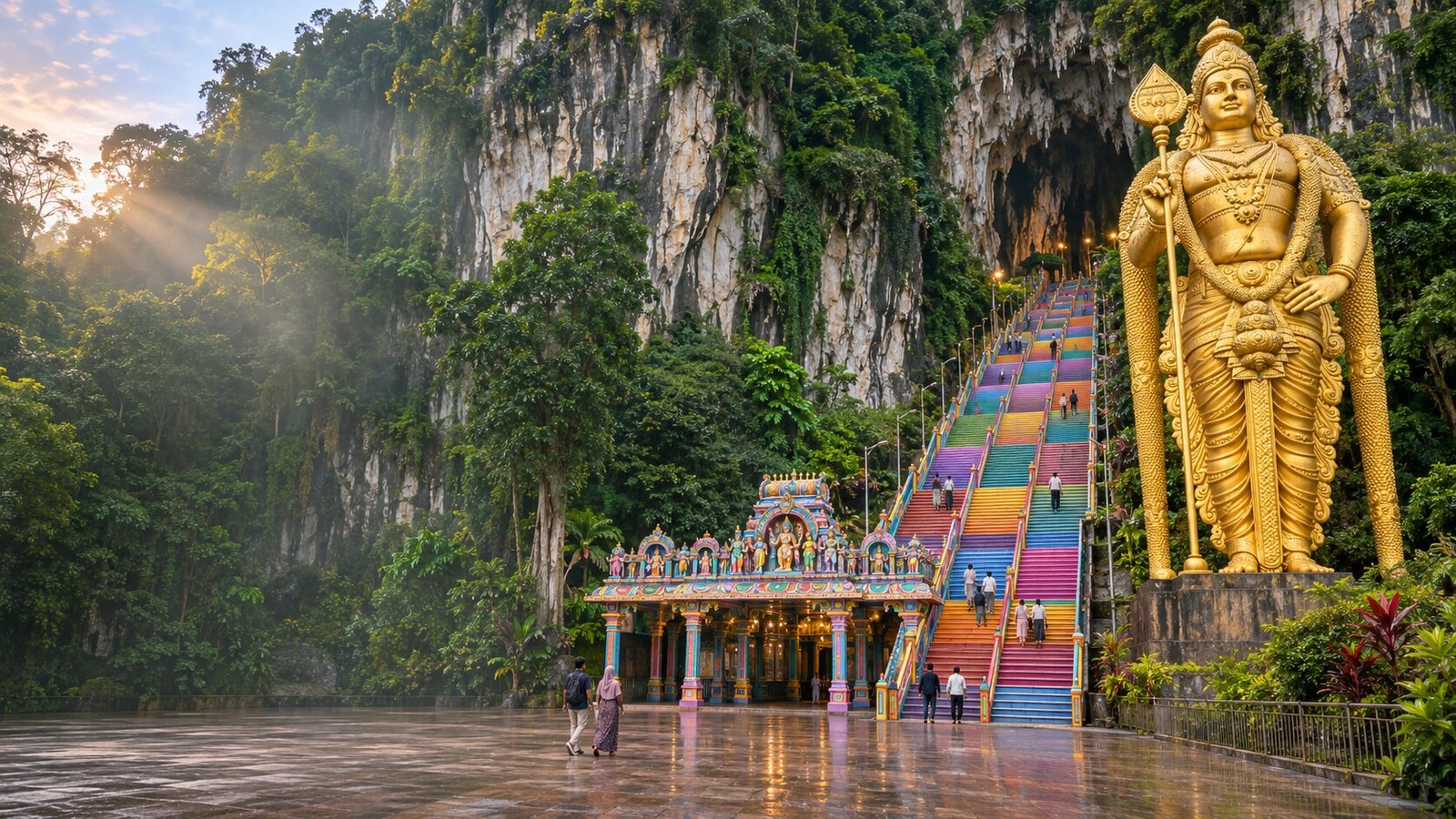
Original editorial illustration inspired by Batu Caves; it is not a photograph or evidence of current visitor access.
Affiliate disclosure: Taylor’s Trailblazing Travels may earn a commission if you book or buy through links in this guide, at no extra cost to you. Recommendations are selected for their usefulness to the trip.
Batu Caves combines a limestone setting, a large statue of Lord Murugan and a working Hindu temple complex. Its famous staircase has 272 steps, and the site has particular religious importance during Thaipusam. [1] The photograph at the bottom is only one version of a visit: climbing to the main Temple Cave asks more of your time, energy and attention.
Choose the version that suits the people travelling with you. A full climb can be rewarding for someone interested in the shrines and cave setting; a ground-level visit may be the right choice for someone who mainly wants to see the complex or cannot comfortably manage the stairs. In either case, dress before arrival, allow for the journey back to Kuala Lumpur and give worshippers space.
Choose the scale
Main-cave climb or ground-level stop: agree the plan before the group separates.
Dress for worship
Bring clothing that covers shoulders and knees and still allows an easy step up.
Leave room to return
A short time at the attraction is only one part of the door-to-door outing.
Batu Caves: choose a climb or a ground-level visit
The staircase is the main practical filter. Tourism Selangor describes 272 steps to the temple entrance. [1] Going up and returning down means negotiating that flight twice: 544 step movements, before allowing for any other steps or walking. That arithmetic is a planning aid, not a fitness test or a complete count of every step within the complex.
| Your group’s priority | A sensible plan | Resolve before committing |
|---|---|---|
| Temple and cave interest; comfortable on sustained stairs | Climb with pauses and time inside | Energy for the descent and a flexible return |
| Exterior architecture and photographs | Keep a ground-level visit as a complete option | Public access on the day and where to wait comfortably |
| Limited mobility or a wheelchair | Discuss the exact ground route with the temple or transport provider | Any alternative ascent, kerbs, surfaces, toilets and vehicle drop-off |
| Young children or a mixed-energy group | Allow a slower visit or split into accompanied groups | Who can help on the return and where everyone reunites |
| Interest in Thaipusam | Plan around the religious event and its current arrangements | Crowds, access and transport for the actual date |
If you need step-free access to the main cave, obtain a clear answer about the current route before travelling. A description of the forecourt, a photograph of a ramp or an announcement about future works does not establish a usable ascent. Ask specific questions about the assistance and facilities you need.
For a mixed group, agree a meeting place and a generous time window before anyone climbs. Ensure those remaining below have a suitable place to wait and a way to contact the others. Children should stay with a responsible adult. Turning back is a reasonable decision if someone becomes uncomfortable; a schedule should not make the descent feel like a race.

A four-hour example, including the journey back
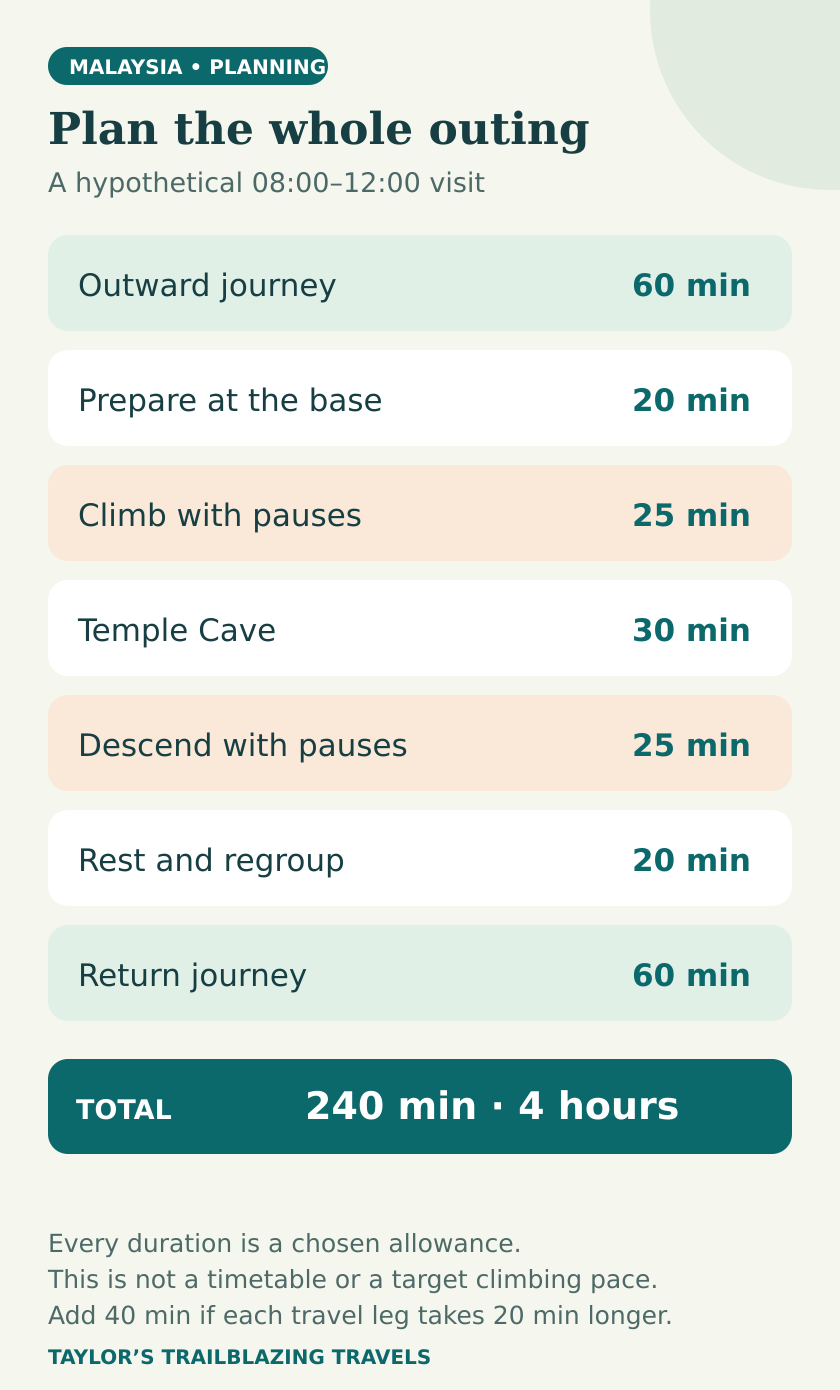
This illustrative independent visit allows two hours on site and one hour each way for travel, walking and waiting. It is deliberately a door-to-door calculation. None of the durations below is a published train journey time, a promised queue length or a target climbing pace.
| Stage | Allowance | Example clock |
|---|---|---|
| Hotel to the complex | 60 minutes | 08:00–09:00 |
| Orientate, prepare and decide on the climb | 20 minutes | 09:00–09:20 |
| Ascent with pauses | 25 minutes | 09:20–09:45 |
| Temple Cave visit | 30 minutes | 09:45–10:15 |
| Descent with pauses | 25 minutes | 10:15–10:40 |
| Rest and regroup | 20 minutes | 10:40–11:00 |
| Return to hotel | 60 minutes | 11:00–12:00 |
The total is 240 minutes, or four hours. If each travel leg takes 20 minutes longer, it becomes 280 minutes: four hours 40 minutes. If your group needs longer on the stairs, change that input too. A ground-level visit uses a different on-site allowance rather than requiring you to fill the same two hours.
This model assumes the site is accessible during the illustrated visit and excludes a sit-down meal and additional attractions. Confirm opening and access before using the clock. Keep the afternoon flexible until you know your outward and return transport; an ambitious second appointment can undermine an otherwise comfortable morning.
Timing: daylight, weather and religious events
My planning preference for an ordinary sightseeing visit is the earlier part of the day, once opening and stair access have been confirmed. It gives the climb a fresh portion of your energy and leaves more room to adjust the rest of the day. Early does not guarantee an empty staircase, and a weekday does not remove worship, school groups or organised tours.
Check access to the main cave and staircase for your actual date, especially for a very early or late visit. Treat a map listing that says the wider complex is open as insufficient evidence that every shrine, cave or facility is available. For a tour, ask the operator what is accessible at the time it plans to bring you.
Look at the forecast before departure and reassess at the bottom if the steps are wet or conditions deteriorate. METMalaysia recommends postponing outdoor activity when thunderstorms are expected and sheltering in a substantial building or enclosed vehicle during a storm. [7] A raincoat does not resolve a lightning risk, and rushing down wet steps to meet a driver is a poor fallback.
Thaipusam is a different kind of visit
Batu Caves is a major destination for Hindu worshippers during Thaipusam. [1] Decide whether you want to witness that religious gathering or whether you want a simpler first look at the temple and cave. Those are different aims, with different expectations about space, movement and time.
If attending during the festival period, check the temple’s current announcements and the transport operators’ event arrangements. Use the date for that particular year, not the date in an old article. Allow for processions and instructions on the ground, and avoid putting a normal sightseeing timetable around a religious event. Photographing people taking part should never take priority over their dignity or passage.
Back to top ↑Dress for the temple before leaving your accommodation
Cover shoulders and knees, and choose clothing in which you can step up comfortably. This is a practical, respectful default for the visit. FCDO advises modest dress at Malaysian places of worship and checking entrance signs; the checked Batu Caves tour also expressly prohibits shorts and sleeveless tops for its temple visit. [3] [5]
Light trousers, a loose top with sleeves or another suitably covering outfit avoid needing an adjustment at the stairs. If using a wrap or shawl, make sure it stays secure and does not trail underfoot. Do not build your plan around an assumed free loan garment or a particular sarong-rental price: arrive appropriately dressed.
Wear secure footwear with grip for the climb. Follow the signs and staff directions about removing shoes before entering sacred areas; the tour’s instructions specifically require shoe removal for the temple. [5] That should not be interpreted as an instruction to undertake the entire outdoor staircase barefoot. Keep footwear together and return it neatly when you leave a shoe-removal area.
Be a considerate guest
Pause at a shrine entrance to understand what is happening before walking in. Keep a quiet voice, leave space around people praying and do not reach across offerings for a photograph. If an area is restricted or a ceremony is taking place, follow the directions given rather than treating the absence of a physical barrier as permission.
Ask before close photographs of worshippers, religious attendants or ceremonies, and accept a refusal without argument. Keep group portraits away from the busiest passage and stairs. The colourful staircase can be part of your memory without becoming a long photo shoot that other visitors must negotiate.
If you are interested in a ritual or an offering, ask an appropriate person what participation involves. There is no need to imitate something you do not understand to appreciate the place. Respectful observation and a willingness to step aside are useful habits throughout the visit.
Back to top ↑Independent travel: check the train in both directions
Tourism Selangor identifies KTM Komuter’s Batu Caves station as the rail arrival point, with a walk to the main entrance. [1] Use the official KTM Komuter timetable page to plan the connection from your starting station and the return journey. Select the Batu Caves–Pulau Sebang route and the correct direction, day type and effective date. [4]
Checked 6 November 2026: KTM’s page already lists new Batu Caves timetables effective 10 November for weekdays and 14 November for weekends/public holidays. A file labelled “new” may therefore be for a future date; match the timetable to your travel day. [4]
A train’s running time is only one input. Add the journey from your accommodation to the station, ticketing, any interchange, platform waiting and the final walk. Keep the return departures available offline, and give yourself enough time to descend and reach the platform without hurrying.
A car or ride-hailing journey may suit a group whose main priority is a direct connection. Compare the total fare shown for your actual trip, the number of people and luggage, and the flexibility of the return. Agree a legal, identifiable pickup point with the driver; do not assume that the exact place you were dropped off will be usable later.
If rain, tiredness or a missed train changes the plan, revisit the whole journey. Paying for a direct return can be a reasonable use of the day’s budget, but check availability and price before relying on it. A pre-arranged driver should know whether the group may remain at ground level or need extra time.
Back to top ↑What is free, and when a tour earns its cost
Tourism Malaysia’s published fee table, dated May 2026 and checked for this guide on 6 November, lists the main Temple Cave as free. It treats other attractions separately. [2] A tour price can therefore be paying for transport, coordination and interpretation rather than admission to the main cave.
Keep optional cave attractions separate from the core plan. Before adding Ramayana Cave or another attraction, confirm that it is operating, its current fee, opening arrangements and the extra time required. In particular, do not book around a Dark Cave visit merely because an older guide describes tours there. This guide does not verify current access to those additional attractions.
| Option | Potential benefit | Check carefully |
|---|---|---|
| Independent visit | Control your arrival, breaks and time on site | Return transport, current access and how much cultural explanation you want |
| GetYourGuide: Batu Caves half-day tour with pickup option | The listing combines a batik workshop, transport and an introduction before exploring the caves independently. [5] | The selected pickup or meeting option, workshop stop and actual time at Batu Caves |
| Viator: Batu Caves tour from Kuala Lumpur | The listing describes a private vehicle with an English-speaking driver, accommodation pickup and additional cultural/craft stops. [6] | Which stops run that day, time at the cave, child seating and any requested changes |
A tour is most useful when its organisation solves a real problem for you. A comfortable vehicle and a clear meeting arrangement can matter more than saving a small amount on transport. Conversely, a fixed circuit with shopping or craft stops may be a poor fit if the main cave is your only priority.
Ask whether the person accompanying you guides inside the temple or gives an introduction before independent exploration. Ask how long you have at Batu Caves, rather than reading the total excursion duration as time at the attraction. If the wording does not answer that question, obtain confirmation before paying.
The checked GetYourGuide product is not suitable for wheelchair users and states that child seats are unavailable; the Viator product also says it is not wheelchair accessible. [5] [6] A private booking does not automatically solve access or child-restraint needs. Those arrangements need an explicit answer for the actual vehicle and visit.
Back to top ↑Monkeys, children and what to carry
Monkeys are part of the environment described by Tourism Selangor. [1] Keep food out of sight, close your bag and give animals space. General macaque guidance from Singapore’s NParks advises staying calm, backing away slowly, avoiding direct eye contact and not feeding, touching, chasing or cornering them. [8] These are animal-encounter precautions, not a statement about Singapore law applying in Malaysia.
Do not hand food to a child for a monkey photograph or try to retrieve an item through a confrontation. Move away and seek help from staff. If bitten or scratched, get medical help promptly while still abroad; NHS guidance says not to wait until returning home, including if you have previously been vaccinated against rabies. [9]
Take a manageable bag, water for appropriate breaks, sun protection and clothing that suits both the weather and temple. Choose footwear you already know is comfortable; the outing does not require buying specialist hiking equipment. Keep one hand available for support where possible and put the phone away when negotiating crowded or awkward steps.
For children, plan the return while everyone still has energy. Avoid assuming that carrying a tired child down a crowded staircase will be easy. If a buggy is part of your day, resolve where it can go or wait before starting the climb. Keep the group’s pace aligned with the person who needs the most care, not the person ready for the next photograph.
Back to top ↑Questions travellers ask
Do I need to climb to make the visit worthwhile?
No. A ground-level stop can be worthwhile if your interest is the exterior setting and the statue, or if a stair climb would make the outing uncomfortable. It offers a different experience from entering the main cave. Check the ground route and facilities you need rather than assuming the whole forecourt is step-free.
Should I book a guide just to enter the main Temple Cave?
An organised tour is a choice about transport and explanation. Tourism Malaysia lists the main Temple Cave as free in its published fee table; that does not make every extra attraction or service free. [2] If you choose a tour, assess the actual itinerary, time on site and guide involvement before deciding whether it helps your visit.
Can I combine Batu Caves with a fixed Petronas booking?
Yes, if the confirmed times leave enough room for the return journey, food, changing plans and the other attraction’s early check-in. Use a door-to-door model, not the time spent at the cave alone. A same-morning combination becomes less attractive when anyone needs a slower stair pace or you have not checked the return transport.
Can a tour guarantee a quiet visit or unrestricted temple access?
Treat such promises cautiously. Ask what the operator controls: vehicle size, departure time and itinerary are different from the conduct of worship or access instructions on the day. Choose the visit for its actual arrangements and retain some flexibility.
Your next decision
Batu Caves works best as a temple visit with a realistic physical and transport plan. Decide whether you want the main cave or a ground-level stop, arrive appropriately dressed and leave room for the descent and return. Choose a tour when its pickup, explanation or organisation makes your day easier; choose independent travel when control over your pace matters more. Let the needs of your group and the activity of the temple determine how much you do.
Sources and editorial checks
Research checked on 6 November 2026 using Tourism Selangor and Tourism Malaysia information, KTM’s timetable selector, FCDO cultural guidance, METMalaysia weather precautions and the named tour listings. NParks and NHS provide general animal-encounter and medical guidance; they are not evidence of temple rules. The time budget and visit-selection framework are original planning models. Exact current opening hours, alternative stair-free ascent and additional-cave availability were not independently confirmed, so none is promised here. This is researched guidance, not a first-hand visit account.
- Tourism Selangor — Batu CavesChecked 6 November 2026
- Tourism Malaysia — Cultural experiences in SelangorChecked 6 November 2026
- FCDO — Malaysia safety and cultural guidanceChecked 6 November 2026
- KTMB — Official train timetable selectorChecked 6 November 2026
- GetYourGuide — Batu Caves Half-Day Tour with Pick-Up OptionChecked 6 November 2026
- Viator — Batu Caves Tour From Kuala Lumpur (3.5Hrs)Checked 6 November 2026
- METMalaysia — Weather phenomena and thunderstorm precautionsChecked 6 November 2026
- NParks Animal & Veterinary Service — MacaquesChecked 6 November 2026
- NHS — Rabies: getting medical help abroadChecked 6 November 2026
Illustrations in this article were created for Taylor’s Trailblazing Travels. Third-party photographs, where used, are credited beside the image or in the source list.