

Indonesia Travel Insurance and Health Preparation: Questions to Check
Separate the policy questions, clinical advice and practical access to help.
AI-generated preparation scene; documents and equipment are illustrative, not evidence of insurance or medical advice.
A reassuring policy headline and a well-stocked medical pouch cannot answer every question raised by an Indonesia itinerary. This guide separates what to ask an insurer, what belongs in a travel-health consultation and what to confirm with the people organising your stay. It is designed to help you prepare those conversations, not to replace them.
Some links in this guide are affiliate links. Taylor's Trailblazing Travels may earn a commission when you book or buy through them, at no extra cost to you.
Describe the whole trip
Include remote legs and likely activities.
Ask for the relevant wording
A headline benefit is not the full contract.
Prepare a clinical discussion
Take the itinerary, medicines and records.
Make contact details usable
Keep offline copies and a calling plan.
Indonesia travel insurance: check the trip before comparing premiums
Indonesia travel insurance should be compared against the journey you intend to take, not simply the country name on a quotation form. A resort holiday, a multi-island trip, a diving course and a remote trek raise different questions. The cheapest premium is not a useful comparison until those questions have been answered.
Insurance benefits and exclusions differ substantially between policies. Emergency medical treatment, cancellation, belongings and disruption may sit in different sections, with separate conditions and limits. A summary page is a starting point, not a replacement for the wording that applies to the policy you buy. [1]
This guide supplies planning questions, not a personal medical assessment or a recommendation of a particular insurance contract. A qualified travel-health professional should assess your health needs; the insurer must confirm what your chosen policy covers.
Make a one-page trip specification
Write down each island or region, travel dates, length of the longest trip, accommodation style, major transport legs and planned activities. Include a possible activity when it is genuinely likely, rather than waiting until the morning you decide to do it.
Then add the relevant personal details: all travellers and ages, existing conditions and ongoing investigations requested by the insurer, regular medicines, equipment needs and any assistance required. Keep this factual. You are not trying to decide which details ‘probably do not matter’; you are preparing accurate answers to the provider’s questions.
A useful final line is the plan’s most difficult scenario: for example, needing treatment while staying somewhere reached by boat, or being unable to continue a multi-stop itinerary. This does not predict an emergency. It makes the consequences of the route visible before you compare cover.
Ask about treatment, evacuation and the people travelling with you
FCDO notes that medical facilities can be limited, particularly in remote areas, and that evacuation can be expensive. Appropriate insurance and accessible funds matter because the availability of treatment is not the same as the ability to pay for or reach it. [2]
Use the table as a list of questions to resolve, not as a description of benefits automatically included in a policy.
| Question to put to the insurer | Why the answer matters | Record before booking |
|---|---|---|
| Does the policy cover every destination and the full continuous trip length? | An annual policy can still have a maximum length for each trip. | Applicable region, dates and trip-duration limit. |
| What emergency treatment and medical evacuation are covered? | Local care, transfer to another facility and travel home are different practical needs. | Limits, approval process and relevant exclusions. |
| How do I obtain urgent assistance and arrange payment? | You may need to contact the assistance team and understand any payment requirements. | Telephone number, alternative contact route and instructions. |
| What happens to a travelling companion or dependent child? | A medical incident affects more than the patient. | Applicable arrangements and any conditions. |
| Is search or rescue included where our activities could require it? | Do not assume it is identical to medical evacuation. | The exact wording and any activity-specific restrictions. |
| What excesses and sub-limits apply? | A headline limit alone does not describe what you may pay. | Amounts, whether per person or section, and relevant limits. |
Scroll within the table to see all columns.
The questions are an original checklist built around the practical differences within a trip. They should be answered from the particular contract, not from a generic reassurance that it is ‘comprehensive’. General government guidance also recommends checking medical, repatriation and activity cover carefully. [4]
For a remote stay, ask the accommodation or operator what help can actually be arranged. Save the answer separately from the insurance confirmation. An insurer’s willingness to pay does not create a nearby hospital, and a hotel saying it can call a doctor does not establish the level of care available.
Declare health information accurately, including unresolved questions
Read the insurer’s screening questions as written. Existing conditions, symptoms under investigation, pending tests or planned treatment may be relevant to the questions asked; do not exclude them merely because there is not yet a diagnosis. MoneyHelper explains that providers differ in how they define and assess pre-existing conditions. [3]
If an online form does not clearly accommodate your situation, ask the insurer rather than choosing an approximate answer. Keep the written response with the policy documents. Also ask what you must report if something changes after purchase and before departure.
A doctor’s view that someone is fit to travel and an insurer’s agreement to cover a condition answer different questions. Obtain whichever confirmations your circumstances and policy require; one is not a substitute for the other.
Compare acceptance as well as price
Two quotes are not equivalent if one accepts the relevant condition and the other excludes it. Put the treatment of the condition beside the premium in your comparison, along with the excess and the activities covered. A lower price is not a saving when it removes protection you need.
If mainstream providers cannot offer appropriate cover, MoneyHelper’s medical-condition guidance links to a directory of specialist providers. That is a useful research route, not a guarantee of acceptance or the best price. [3] There is no insurance affiliate recommendation in this guide.
Name activities precisely: scooters, diving and volcanoes
Ask about the actual activity, not just ‘adventure travel’. For a trek, describe the route and maximum altitude when known, whether a guide is involved and any specialist equipment. For diving, specify whether you are learning or already qualified, the planned depth and the type of diving. For motorised transport, distinguish driving from travelling as a passenger.
FCDO advises checking the appropriate licence and insurance before driving or riding in Indonesia, and warns about road conditions and motorbike accidents. A rental company handing over a vehicle does not confirm that your documents or insurance satisfy the relevant requirements. [5] Do not treat an impulsive scooter hire as an insignificant change to the trip.
Diving also needs an operator check alongside the policy check. Ask about credentials, emergency equipment and how an injured diver would reach suitable treatment. FCDO specifically highlights these questions for Indonesian diving. [5] A booking platform’s customer rating does not answer them.
| Planned choice | Useful wording for the question | Unresolved answer that should pause the booking |
|---|---|---|
| Guided volcano walk | ‘Is this named route, altitude and activity covered, subject to current access rules?’ | The activity category or permitted conditions remain unclear. |
| Diving | ‘Is our qualification level, planned depth and type of dive included?’ | The policy and operator describe different limits. |
| Scooter or motorbike | ‘Are driver and passenger arrangements covered, and under which licence and equipment conditions?’ | Cover is being assumed from the hire agreement. |
| Remote marine stay | ‘What evacuation and assistance arrangements apply at this location?’ | No clear explanation of how assistance would be organised. |
Scroll within the table to see all columns.
Local access restrictions remain decisive even with insurance. FCDO describes changing volcanic exclusion zones and directs travellers to local authorities. Do not interpret the absence of a particular FCDO warning, or the continued sale of a tour, as permission to enter a closed area. [5][13]
Separate cancellation, disruption and an inconvenient itinerary
A flight delay, a cancelled ferry, a volcanic event and deciding you no longer wish to travel are not interchangeable insurance claims. Ask which events trigger the relevant section, what evidence is required, and whether independent connections or consequential accommodation losses are included. Do not assume that ‘travel disruption’ means reimbursement for every affected booking. [1][4]
Work through one concrete example from your route: the boat cannot run and you cannot reach the next prepaid hotel. Who has an obligation under the transport or accommodation booking? What loss remains? Which insurance section, if any, applies to that remaining loss? Write down questions rather than assuming that someone will cover the entire chain.
Cancellation cover should be considered when you begin taking on non-refundable costs, not only shortly before departure. Check when each part of the cover starts. An annual policy chosen to begin on the departure date may leave a different pre-departure position from the one you intended. [1]
For a cost check, list the amounts that would actually be at risk at the same time. Distinguish refundable payments from non-refundable costs, and check whether a limit is per person or for the policy as a whole. Do not add an optimistic expected refund until the booking terms support it.
This is also an itinerary-design issue. Appropriate buffers and flexible bookings can reduce dependence on insurance. A policy is not a practical reason to place a fragile inter-island connection immediately before a long-haul flight.
Prepare for the health appointment with the whole route
Begin planning early. NHS guidance recommends seeking travel-vaccination advice at least four to six weeks before travel, while FCDO’s Indonesia page suggests checking recommendations at least eight weeks ahead. Starting around eight weeks gives useful room for arranging advice; a late booking is still a reason to seek advice promptly, not to abandon the check. [6][2]
Bring vaccination records where available, medicines, the dates and each destination. Mention rural or remote stays, animal contact, outdoor activities and any pregnancy or pregnancy plans. Ask which recommendations apply to you rather than purchasing a standard ‘Indonesia package’ without an assessment.
TravelHealthPro’s country guidance distinguishes routine vaccinations, other recommendations and certificate requirements. It also identifies different malaria advice within Indonesia and discusses Zika risk. Those are reasons for an itinerary-specific consultation, not instructions to choose medicines or vaccines from this article. [7]
Three questions for the clinician
First: does any part of this route change the recommended prevention plan? Second: what should we do if someone becomes unwell during the remote part? Third: which symptoms or exposures require prompt medical attention during or after the trip? Take written instructions appropriate to your circumstances.
For children, pregnancy, reduced immunity or a complex condition, raise the suitability of the itinerary itself, not only the contents of the medical kit. It can be more sensible to change the destination or shorten a remote segment than to assume additional supplies will solve limited access to care.
Plan for medicines, bites, drinking water and urgent help
For regular medicines, check the rules for Indonesia and transit countries, documentation and storage requirements before departure. Original packaging and a prescriber’s letter or prescription copy can be important, but they do not override a country’s restrictions. Ask the relevant embassy or authority when the legal position needs clarification. [9]
Pack an appropriate personal first-aid kit after advice from a pharmacist or clinician. Know what it contains and how to use it. Its role is to support minor problems and your agreed plan, not to delay treatment for worrying symptoms. TravelHealthPro recommends tailoring the kit to the individual and itinerary. [10]
Use appropriate mosquito-bite precautions and follow professional advice on any additional prevention. For drinking water, FCDO states that tap water is not safe to drink in Indonesia. [2][11] Plan how you will obtain safe drinking water during transfers and remote stays rather than assuming a refill point makes water safe.
Rabies exposure requires prompt action. After a bite, scratch or relevant saliva exposure from an animal, wash the affected area with soap and water and seek medical help immediately. Do not wait until returning to the UK or assume previous vaccination removes the need for assessment. [8]
FCDO lists 118 for an ambulance in Indonesia. Save the insurer’s assistance number and the accommodation’s contact details too; arrange urgent care first rather than delaying an emergency to resolve a claim query. Contact the insurer as soon as practicable. [2] Before a remote stay, establish how help is requested locally and whether communications are reliable.
For everyday internet access, browse Airalo and select Indonesia as one possible data option. Check the device and package carefully. The Indonesia page includes data-only plans, so internet access must not be treated as a guaranteed ordinary telephone service or emergency communications system. [12] Keep essential contact details offline and maintain another practical way to call for help.
Use four decision gates before committing
This original framework is an administrative check, not a medical-risk score. ‘Ready’ means you have the relevant answer recorded; it does not mean the trip is risk-free.
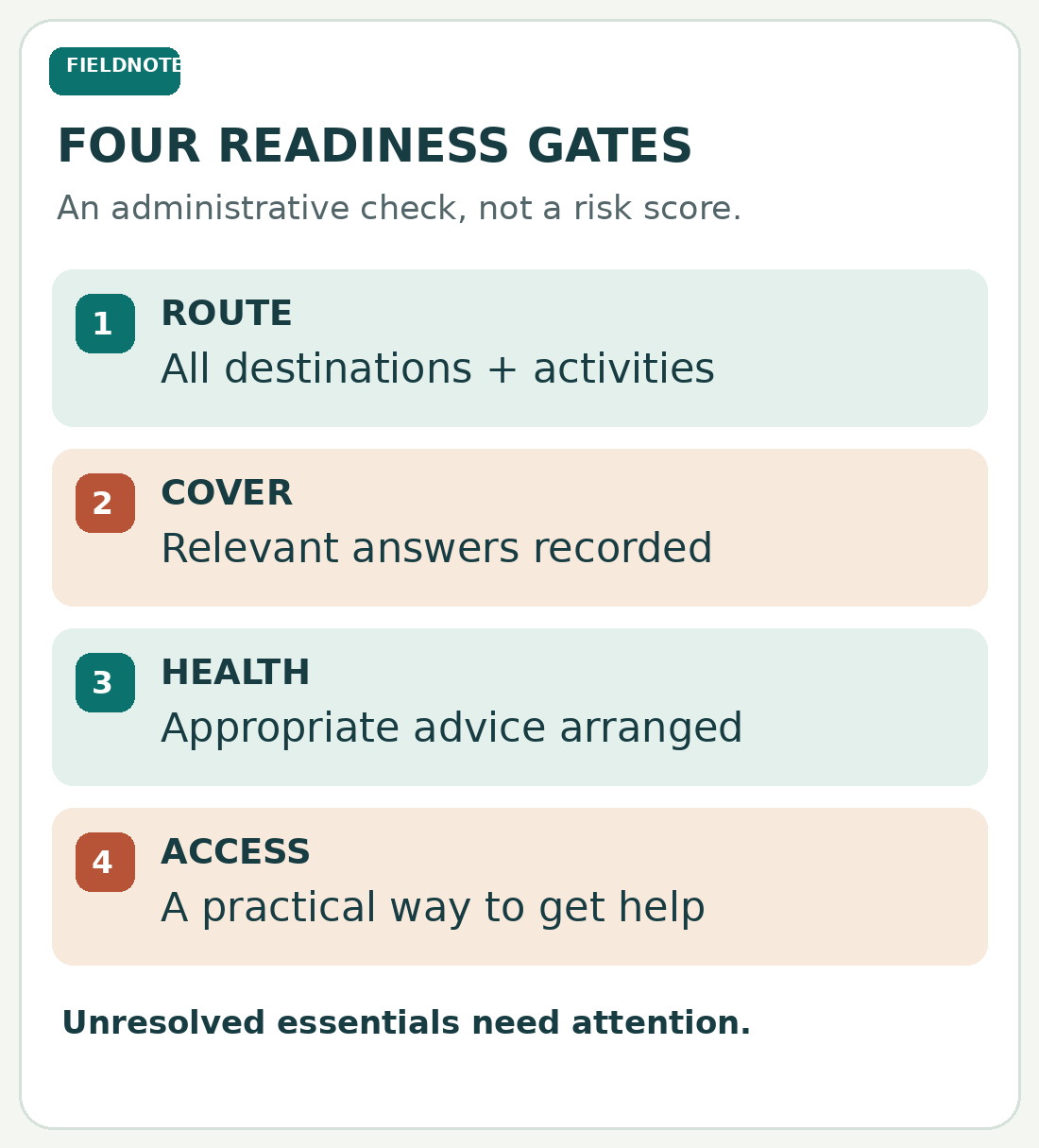
| Gate | Ready when | Pause when |
|---|---|---|
| Route | Destinations, dates and activities are described accurately. | A remote leg or major activity has been left out of the enquiries. |
| Cover | The relevant policy sections and any written confirmations answer the questions. | Acceptance, exclusions or activity limits remain ambiguous. |
| Health | Appropriate professional advice and any agreed preparation are arranged. | A material health or medicine question remains unresolved. |
| Access | Help, communications and a workable contingency have been considered. | The plan relies on assistance that nobody has confirmed is available. |
Scroll within the table to see all columns.
A simple message to adapt for the insurer is: ‘We plan to visit these places on these dates and undertake these activities. Please confirm the relevant cover, exclusions and any additional requirements, including emergency treatment and evacuation. Please also explain what we must report if our health or itinerary changes before departure.’ Add the actual details; do not send only the generic wording.
Keep a separate clinician note, because insurance correspondence is not medical advice. Put the route, prescriptions and questions in that note, and take it to the appointment. Separating the two conversations makes gaps easier to spot.
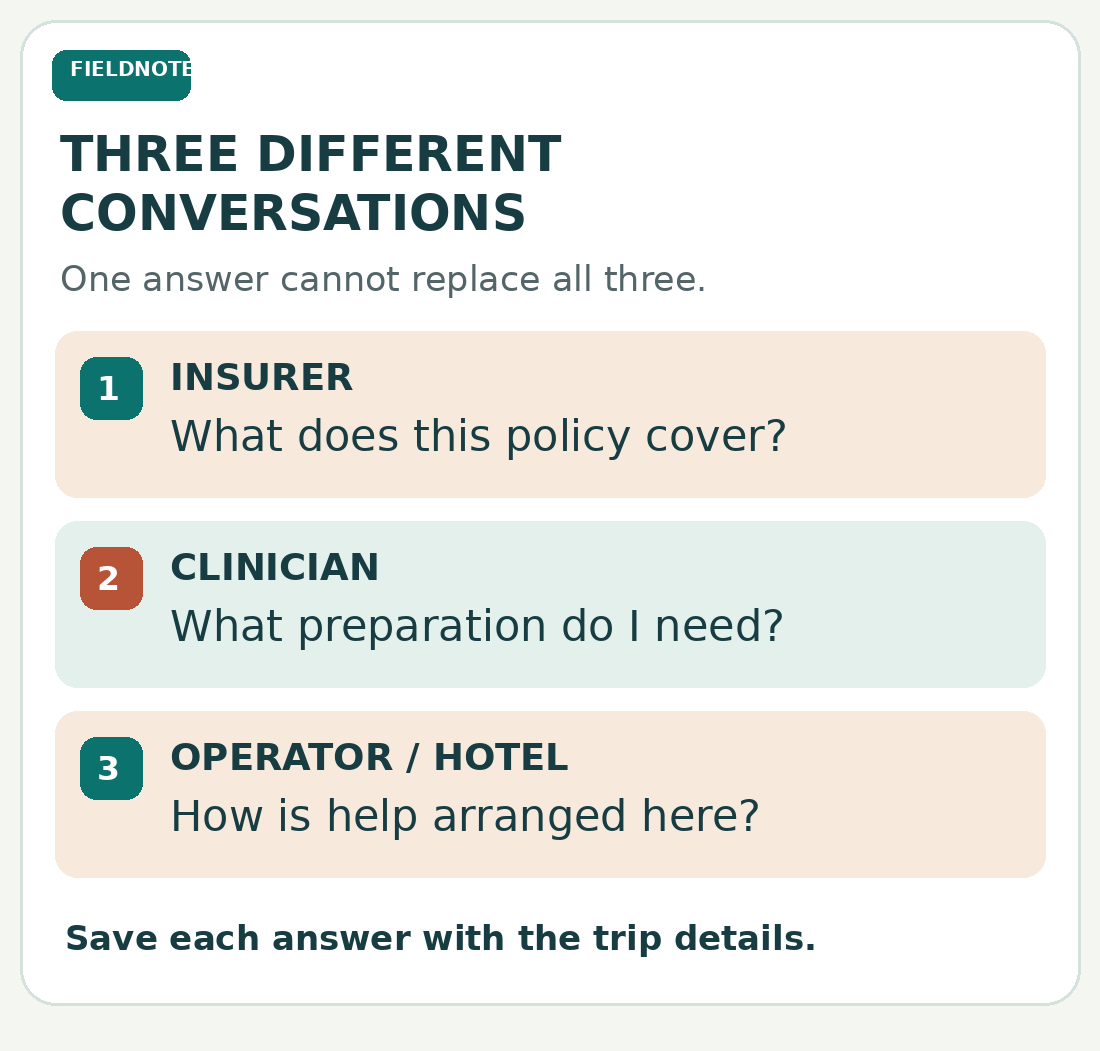
Before departure, recheck current official advice, save the final documents and tell a trusted contact where to find essential information. When travelling with another adult, make sure access does not depend on only one person’s phone or password.
Questions worth settling before you leave
Does ‘worldwide cover’ settle the question?
No. Check the geographical definition, dates, maximum trip length, activity conditions and relevant exclusions in that policy. The label does not answer whether the particular journey and traveller have been accepted. [1][4]
Is a fit-to-travel letter the same as insurance acceptance?
No. Clinical advice and the insurer’s contractual decision have different purposes. Ask each party the questions within its role, and keep any required confirmation. Do not assume that one document automatically resolves the other conversation.
Should I choose a policy by its medical limit alone?
No. Consider relevant exclusions, accepted conditions, assistance, evacuation and activity terms as well as limits and excesses. A large headline number does not make an excluded activity covered. [1][4]
What matters after returning home?
Seek medical advice for concerning symptoms and tell the clinician where you travelled, when and what happened. Do not omit a remote excursion or an animal exposure because it was a small part of the holiday. TravelHealthPro notes that some travel-related illnesses can become apparent after returning. [11]
The final preparation check
Choose the policy only after the route and personal circumstances have been described accurately. Arrange appropriate clinical advice, resolve medicine questions and keep practical access to help in view. The aim is not a folder full of reassuring documents; it is a set of clear answers that still makes sense when the holiday does not go exactly to plan.
Sources & further checks
Selected official and safety sources independently rechecked on 2 November 2026. Confirm rules, airline requirements and provider terms for your dates; search pages do not establish availability.
- MoneyHelper: What is travel insurance?.
- FCDO: Indonesia health advice.
- MoneyHelper: Travel insurance with a medical condition.
- FCDO: Foreign travel insurance.
- FCDO: Indonesia safety and security.
- NHS: Travel vaccinations.
- TravelHealthPro: Indonesia country health advice.
- NHS: Rabies, prevention and urgent treatment.
- TravelHealthPro: Medicines and travel.
- TravelHealthPro: First aid kits.
- TravelHealthPro: Insect and tick bite avoidance.
- Airalo: Indonesia eSIM options and compatibility information.
- FCDO: Indonesia warnings and insurance.
Illustrations in this article were created for Taylor’s Trailblazing Travels. Third-party photographs, where used, are credited beside the image or in the source list.