
How Much Does a Trip to Indonesia Cost? A UK Traveller's Budget Planner
A useful budget starts with rooms, nights and travel days, not an unexplained daily average.
Original budget-planning illustration; the pictured objects are illustrative, not currency or product reproductions.
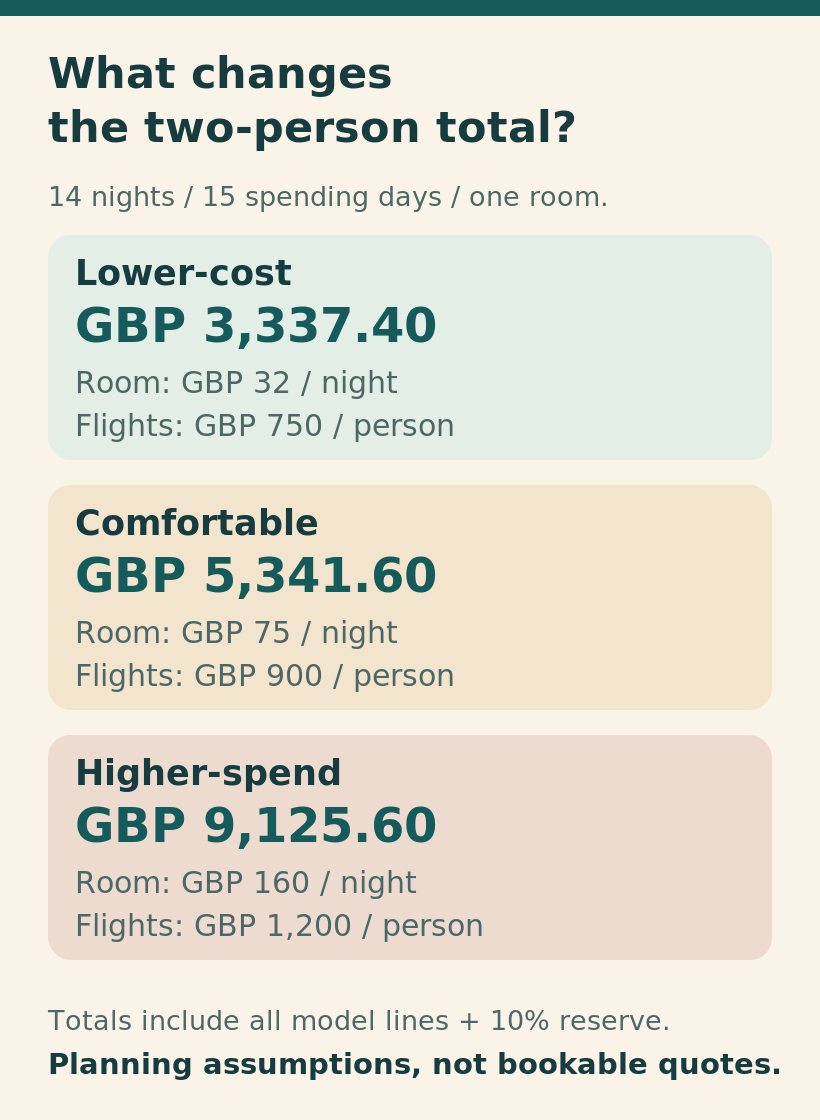
How much does a trip to Indonesia cost? In the worked examples below, a 14-night holiday for two adults comes to around £3,340, £5,340 or £9,130 in total, including assumed economy flights and a 10% reserve. These are constructed planning scenarios, not surveyed averages or bookable offers.
The difference is mainly the room budget, daily choices and flight allowance. The method is more useful than any headline figure: count shared rooms once, count food per person, and budget separately for journeys that change your base. Use the examples to find the assumptions that would change your own answer.
This article contains affiliate links. Taylor’s Trailblazing Travels may earn a commission from qualifying bookings or purchases, at no extra cost to you.
A double-room price is shared, not charged twice.
14 nights normally span 15 local calendar days.
Domestic flights and boats are not local daily transport.
10% is the model input, not a guarantee against disruption.
How much does a trip to Indonesia cost in these examples?
Each scenario assumes two adults, one shared double room, 14 hotel nights and 15 days with local spending. It is aimed at a Bali-focused holiday or a similarly limited route, not a liveaboard diving expedition or a journey through many remote islands. All amounts below are in GBP. Model reviewed 2 November 2026.
The labels describe spending choices, not star ratings. The lower-cost example needs disciplined room and activity choices; the comfortable example allows more flexibility; the higher-spend example is not an upper limit on luxury travel. International flight allowances are per person for a return economy journey from the UK, including whatever baggage you need to include in your actual quote.
| Budget line | Lower-cost | Comfortable | Higher-spend |
|---|---|---|---|
| Room / night, for both adults | £32 | £75 | £160 |
| Meals / person / spending day | £12 | £22 | £40 |
| Local transport / person / day | £6 | £10 | £18 |
| Activities / person / day | £8 | £18 | £35 |
| Inter-base travel / person / trip | £75 | £150 | £300 |
| Visa + Bali levy allowance / person | £28 | £28 | £28 |
| Data / person / trip | £10 | £15 | £20 |
| Insurance / person / trip | £40 | £60 | £85 |
| UK economy flights / person | £750 | £900 | £1,200 |
| Subtotal / couple | £3,034 | £4,856 | £8,296 |
| Reserve: 10% of subtotal | £303.40 | £485.60 | £829.60 |
| Calculated total / couple | £3,337.40 | £5,341.60 | £9,125.60 |
| Calculated total / person | £1,668.70 | £2,670.80 | £4,562.80 |
The fee allowance uses the official Rp500,000 B1 base fee and Rp150,000 Bali levy, rounded upwards in sterling. Everything else in the input rows is an explicit editorial allowance to replace, not a verified charge for a named service. [1][2]
Accommodation: the location and the room count drive the bill
In the comfortable model, £75 × 14 nights is £1,050 for the room, or £525 each when shared equally. Charging £75 to each adult would double the accommodation line without buying another room. Conversely, two people who need separate rooms cannot divide one room price between them.
Set a maximum total stay cost, then compare the same occupancy and terms. Breakfast, taxes, service charges, airport transfers, refund conditions and payment currency can make two headline rates poor comparisons. A low rate is not automatically useful when the location adds an extra car journey every day.
Use Agoda’s Bali accommodation search alongside Booking.com’s Bali stay options to gather quotes for your dates. Both are island-wide searches. The example model is not based on their undated headline prices, and neither link guarantees rooms at the allowances shown. [3][4]
Put the actual totals into the Hotel Comparison Calculator when meal plans and extra charges differ. It compares the figures you enter rather than fetching a live quotation. [5]
| Change | Effect before reserve | Effect with this model’s 10% reserve |
|---|---|---|
| Room rises by £25 per night | +£350 per couple | +£385 per couple |
| Room falls by £15 per night | -£210 per couple | -£231 per couple |
| One person pays the comfortable room alone | Room share rises from £525 to £1,050 | +£577.50 on that person’s model |
Food, local transport and activities need different assumptions
The comfortable daily spending allowance is £50 per person: £22 food and drinks, £10 local transport and £18 activities. Over 15 days that is £750 each. These amounts are a spending plan; no claim is made that every destination or travel style can be bought for them.
For food, decide what breakfast includes and what evenings should look like. A plan built around modest local meals is different from one involving hotel restaurants and cocktails. Put those preferences into the model rather than describing both travellers as mid-range.
For local transport, distinguish a short ride from a full-day private car. When a tour includes collection, avoid adding the same transfer again. On the other hand, a low activity price may exclude your hotel’s pickup area or the return journey.
For activities, use a trip total if daily averages feel artificial. Fifteen days at £18 becomes a £270 activity pot per person: that could be spread unevenly across the holiday. Compare Bali experiences and their inclusions for the days that matter, then check which admissions, meals and transfers are additional. Do not allocate the whole pot to headline tour prices before reading the details.
Keep completely free days in the itinerary when they suit you, not as a budgeting punishment. A slower afternoon at your chosen base can be the reason to book that base in the first place.
Flights and island changes belong outside the daily rate
The model’s £750, £900 and £1,200 international flight figures are sensitivity inputs, not current fare observations. Replace them with the complete return or multi-city fare for your UK airport, travel dates, baggage and acceptable connection time. A price that requires an extra airport hotel must include that hotel in the comparison.
The inter-base allowance is separate from local taxis. It covers the journeys that change where you sleep, such as a domestic flight, ferry or car between areas. Add baggage, terminal transfers, booking charges and an overnight stop when the actual connection needs them.
For a Bali side trip, compare Sanur-to-Nusa-Lembongan transport using the correct pier and pickup details. 12Go lists several kinds of transfer combinations; do not treat the cheapest search result as a complete hotel-to-hotel package. [6]
A useful comparison is the all-in cost of keeping one more destination versus staying put. Suppose a proposed side trip adds £120 each in transport and £60 for an extra shared hotel night. That adds £300 to the couple’s subtotal, or £330 including a 10% reserve. This hypothetical test makes the trade-off visible without pretending those are current fares.
Look at the holiday time lost as well as the cash. A cheaper overnight service is not necessarily a saving for a traveller who then needs to recover in the next hotel.
Use rupiah for the fee and sterling for the planning comparison
This article uses £1 = Rp24,000 as a rounded planning conversion, informed by Wise’s historical display for 30 October 2026 and reviewed on 2 November 2026. It is not a cash-counter, card or guaranteed transaction rate; a provider’s spread or charge can change the sterling cost. Divide a rupiah amount by 24,000 to reproduce the illustrative sterling figures. [7]
| Item | Published rupiah amount | Illustrative GBP | Status |
|---|---|---|---|
| B1 visa, per person | Rp500,000 | £20.83 | Base official charge [1] |
| Bali levy, per person | Rp150,000 | £6.25 | Separate provincial charge [2] |
| Combined, one eligible adult visiting Bali | Rp650,000 | £27.08 | Rounded to £28 in the model |
| Combined, two such adults | Rp1,300,000 | £54.17 | Rounded to £56 in the model |
| All Indonesia declaration | Rp0 | £0 | Official declaration is free [8] |
The rounded £28 line is an allowance, not an extra official fee. Actual card conversion and service charges can differ. Travellers not visiting Bali should not blindly include its levy; those using a different visa or an exemption should replace the whole relevant line.
Use the same exchange-rate assumption throughout a comparison. Mixing an old exchange rate for hotels with today’s rate for transport makes the arithmetic look precise while changing the basis underneath it. When payment is due later, keep a separate currency buffer rather than assuming today’s conversion will still apply.
From an attractive daily number to the whole-trip total
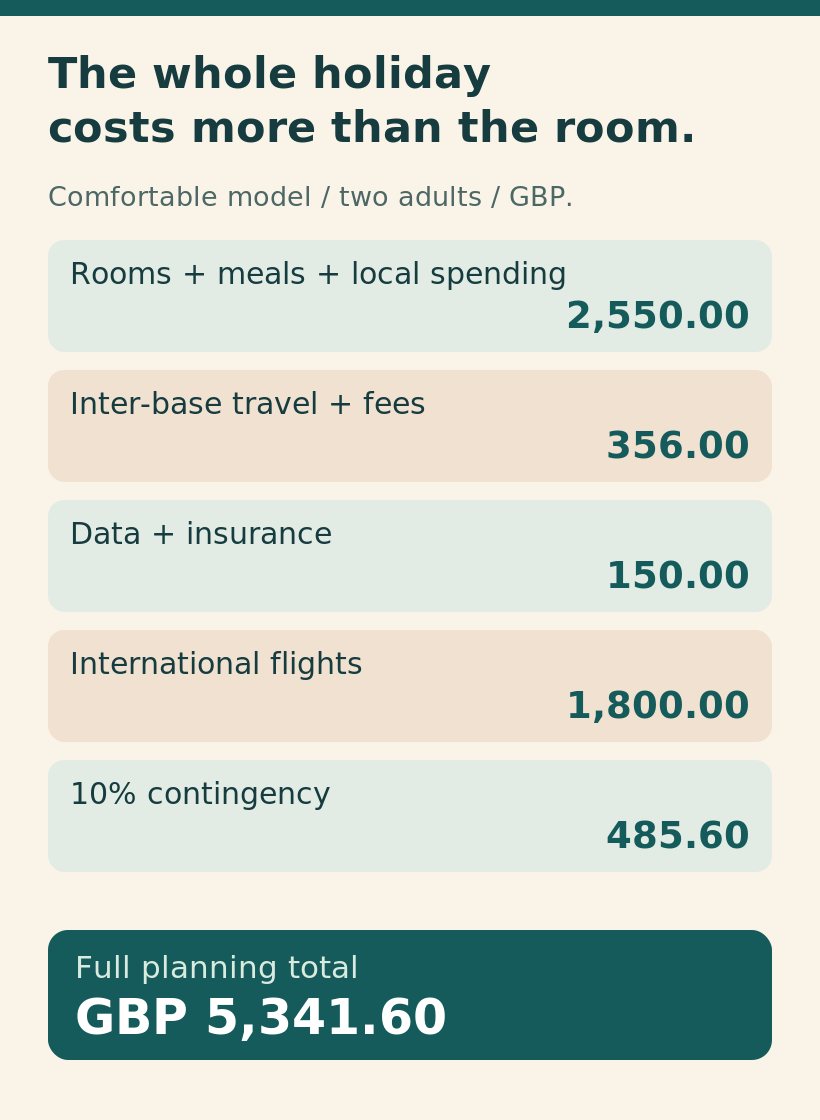
A daily figure is useful only when its denominator and inclusions are clear. The comfortable example has £1,050 accommodation, £660 meals, £300 local transport and £540 activities for the couple. Those routine local costs total £2,550, or £170 for the couple per local spending day.
That £170 is not the whole holiday. Add £300 inter-base travel, £56 fees, £30 data and £120 insurance. The pre-flight subtotal becomes £3,056. Add £1,800 international flights and the subtotal reaches £4,856; a 10% reserve takes it to £5,341.60.
A solo traveller keeping the same room and individual allowances would have a £2,953 subtotal and a £3,248.30 total after the 10% reserve. This is not a universal solo-travel premium: it isolates the effect of paying for the same room alone. Dorms, a smaller room or shared transport could change the answer.
For a family, do not simply multiply the adult total by the number of people. Room occupancy, extra beds, children’s tickets, car capacity and meal preferences may change at different rates. Build the room and transport quantities first, then add each traveller’s applicable costs.
Save where the cut does not undermine the reason for travelling
The most powerful changes in this model are not tiny savings on water or snacks. They are room cost, flight price, the number of moves and the shape of the activity budget. Remove a low-priority island before removing the experience that made you choose Indonesia.
| Decision | Change including 10% reserve | What it means |
|---|---|---|
| Find flights £150 cheaper per person | -£330 | Check baggage, airports and connections are still comparable |
| Spend £10 more per person per day | +£330 | Small daily upgrades accumulate over 15 days |
| Save £25 per room per night | -£385 | Compare location and conditions before celebrating |
| Increase reserve from 10% to 15% | +£242.80 | More available headroom; not an extra booking charge |
Currency risk is another lever. If the rupiah received per pound falls by 10%, the sterling cost of an unchanged rupiah bill rises by about 11.1%, not 10%. For a locally priced bill worth £1,000 at the original rate, the new requirement would be about £1,111. This does not automatically affect flights already paid for in sterling.
Keep insurance fitted to the actual activities and destinations rather than using the cheapest premium as a target. FCDO warns that treatment and evacuation can be expensive and that remote care may be limited. [9]
For mobile data, compare existing roaming with an eSIM and avoid buying duplicate coverage for no purpose. Explore Airalo and choose an appropriate Indonesia plan after checking device support, validity and the package’s activation rules. The model’s data line is not a quote for a specific plan. [10]
Build the budget you will actually use
Open the Travel Budget Calculator with your quotes beside it. Use two travellers, one room, 14 accommodation nights and 15 local spending days to recreate the worked example. Enter all figures in pounds; the tool does not convert currencies. [11]
Keep a short note explaining each uncertain input: a flight still being compared, a room awaiting confirmation, or an excursion whose park admission is extra. A budget with visible uncertainties is more useful than a polished total that hides them.
Review the subtotal before adding a reserve. A contingency is for uncertainty, not a way to conceal a missing transport leg. Where disruption would be especially expensive, consider extra available emergency funds and the insurance excess separately from spending money.
Can Indonesia cost less than the lowest example?
Yes. The example is a constructed shared-room holiday, not a minimum. Cheaper flights, dorm accommodation, fewer paid activities or a different route can lower the result. Replace those inputs rather than claiming that the same trip is guaranteed for less.
Why does the model use 15 spending days for 14 nights?
Fourteen overnight stays normally occupy parts of 15 local calendar days. Arrival and departure spending may be lower, but entering 15 full allowances is a simple conservative starting point. Adjust partial days when your flight times are known.
Are the hotel and flight amounts checked prices?
No. They are labelled planning inputs. The visa and levy amounts are official base charges checked on 2 November 2026; the exchange rate is explicitly rounded. Accommodation and flights need quotes for your dates.
Is 10% enough contingency?
It is the comparison assumption, not a guarantee. Use a larger margin or additional accessible funds when the itinerary has expensive independent connections, remote travel or little flexibility. Review what insurance would and would not cover.
Sources & Editorial Method
Research-led guidance drawing on the named official, destination and transport sources. Recheck time-sensitive requirements and operator details directly. Routes, allowances and decision models are editorial analysis, not first-hand reports or live booking quotations. Government requirements and operator arrangements can change.
- Central Jakarta Immigration – B1 visitor visa rules and fees
- UK FCDO – visitor visa and Bali tourist levy (British travellers)
- Agoda – Bali accommodation and area search
- Booking.com – Bali accommodation search
- Taylor's Trailblazing Travels – Hotel Comparison Calculator
- 12Go – Sanur to Nusa Lembongan route listings
- Wise – GBP / IDR historical display for 30 October 2026
- Batam Immigration – integrated, free All Indonesia arrival declaration
- UK FCDO – Indonesia health advice
- Airalo – Indonesia eSIM options
- Taylor's Trailblazing Travels – Travel Budget Calculator
Illustrations in this article were created for Taylor’s Trailblazing Travels. Third-party photographs, where used, are credited beside the image or in the source list.