
Best Time to Visit Indonesia: Weather Differences by Island
Choose your season around the island and the experience, not a single country-wide calendar.
An original conceptual illustration of Indonesia's contrasting island weather; not a photograph of a particular location.
The best time to visit Indonesia depends on what would disappoint you most: a washed-out walking day, a cancelled boat, or a beach stay that feels too busy. Those are different problems, and a national rainfall average will not resolve them.
Use this guide to choose a regional shortlist, then test it against your activities and flexibility. It separates long-term seasonal tendencies from the local forecasts and marine warnings that matter close to departure.
This guide contains affiliate links. A qualifying booking or purchase may earn a commission at no additional cost to you. Recommendations are selected for their usefulness to this trip.
Southern route
Start with May-September, then refine by coast and activity.
Raja Ampat
Investigate October-April; check boat exposure.
Fixed dates
Change the region before forcing an unsuitable activity.
Final check
A climate chart cannot clear a boat departure.
Best time to visit Indonesia: start with the region
| Region or route | Useful starting point | What can change the decision |
|---|---|---|
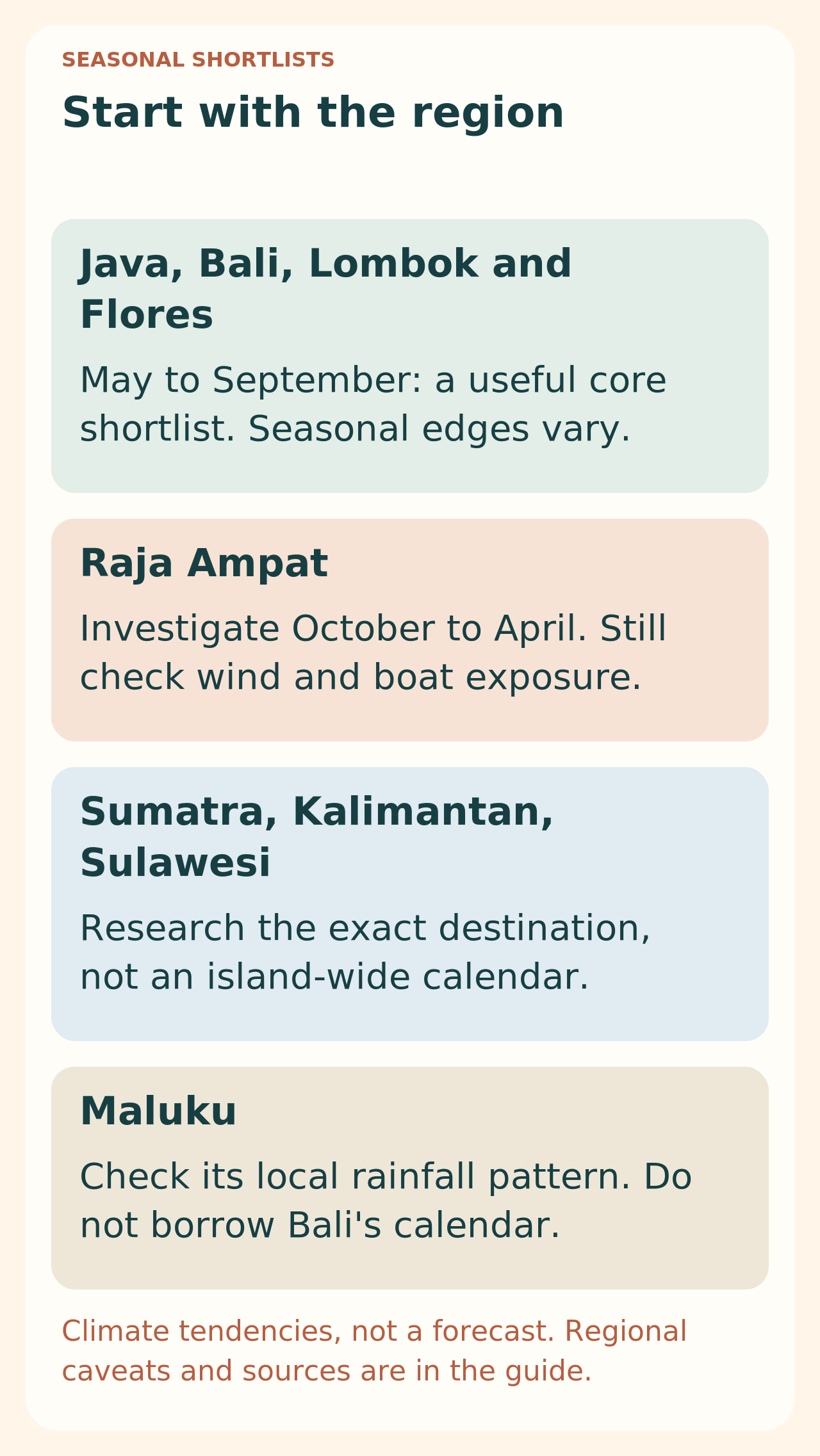
| Java and Bali | May-September is a practical core shortlist; the official broad dry season extends roughly April-October. [1] | Highlands, exposed coasts and individual days still differ. |
| Lombok and nearby small islands | Investigate the drier May-October period. [2] | A drier land forecast does not establish safe boat conditions. |
| Flores and Komodo trips | The broad drier period runs approximately mid-April to mid-October. [3] | Marine exposure and the operator’s route matter as much as rainfall. |
| Raja Ampat | Start with October-April; local guidance flags stronger winds particularly around mid-June to mid-September. [4] | Rain remains possible, with substantial differences between islands. |
| Sumatra, Kalimantan and Sulawesi | Research the particular coast, forest area or highland base. | Use a local climate source and the planned activity, not an island-wide promise. |
| Maluku | Check the local seasonal pattern separately. [5] | Some rainfall patterns differ from the familiar southern-island cycle. |
This is a route-selection table, not a ranking of perfect months. A flexible city-and-culture holiday can tolerate more uncertain weather than a short visit built entirely around a remote boat excursion. Consequently, the same month can be a sensible choice for one traveller and a poor fit for another.
Begin with your least replaceable experience. When that experience is a particular marine area, choose its season first and fit the rest of the holiday around it. When your main wish is simply a warm, varied break, there is more scope to choose a convenient region and leave the details open.
Why one Indonesian weather calendar is misleading
BMKG, Indonesia’s meteorological agency, distinguishes monsoonal, equatorial and local rainfall patterns. Seasonal zones do not necessarily match administrative boundaries: even one district can contain more than one. Its Central Sulawesi examples include markedly different seasonal structures. [6]
Separate rainfall, temperature and sea conditions
A warm temperature symbol tells you little about whether an exposed crossing will be comfortable. Similarly, a rainy-day icon does not tell you that every hour will be wet. Treat the land forecast and the maritime forecast as two separate checks, particularly when the first or last leg of your holiday involves a small boat. BMKG publishes both local forecasts and dedicated marine information. [7] [8]
Altitude also changes the feel of a trip. Bali’s highland areas are not interchangeable with its coastal beach bases. Choose clothing and accommodation for the actual overnight location rather than the temperature attached to the island name. [9]
Dry season does not mean no rain
BMKG explicitly explains that rain during the dry season is normal. A seasonal label describes a tendency, not an entitlement to uninterrupted sunshine. [10]
The practical response is not to abandon advance planning. It is to avoid making a whole holiday depend on a single exposed activity on one unchangeable day. Place an important excursion early enough in a stay to leave a possible alternative day, while recognising that a second attempt is not guaranteed.
Choose a regional shortlist when your dates are fixed
January to March
For a marine-focused holiday, investigate Raja Ampat rather than assuming Indonesia is uniformly in its least suitable season. Local guidance offers a broadly favourable October-April starting window, although it does not promise dry days. [4]
A Bali holiday can still be worth considering when the hotel, food, cultural visits and relaxed pace are the main attractions. However, a visitor whose only acceptable outcome is daily outdoor beach time should recognise the wet-season trade-off. This is a preference decision, not a claim that rain makes the island unvisitable.
April to June
For southern-island routes, treat April as a transition to investigate rather than a switch that flips on a fixed date. May and June make useful shortlist months for a mixed Java-Bali trip. Check the year’s local outlook before turning that broad planning choice into a detailed outdoor programme.
A sensible compromise is to reserve the necessary hotels but leave some excursions movable. Flexibility has little value when all the enjoyable parts of the trip are already assigned to non-changeable dates.
July to September
These months fit the core southern-island shortlist, but do not transfer that judgement automatically to Raja Ampat or Maluku. A traveller choosing between Bali and a remote eastern marine trip should compare the appropriate regional evidence, not just a national sunshine chart.
For a school-holiday trip, compare the actual room configuration, cancellation deadline and transport availability before declaring a destination good value. A lower advertised room rate is not helpful when the family needs two rooms instead of one.
October to December
October can be a useful transition candidate for southern islands, while Raja Ampat becomes a stronger starting point for marine research. By November and December, build southern-island plans with meaningful wet-weather alternatives rather than promising a mostly outdoor schedule.
There is no need to combine the two regions merely to chase sunshine. Often, choosing one coherent regional route produces a better holiday than adding distant flights to compensate for seasonal uncertainty.
Use the anchor, exposure and fallback test
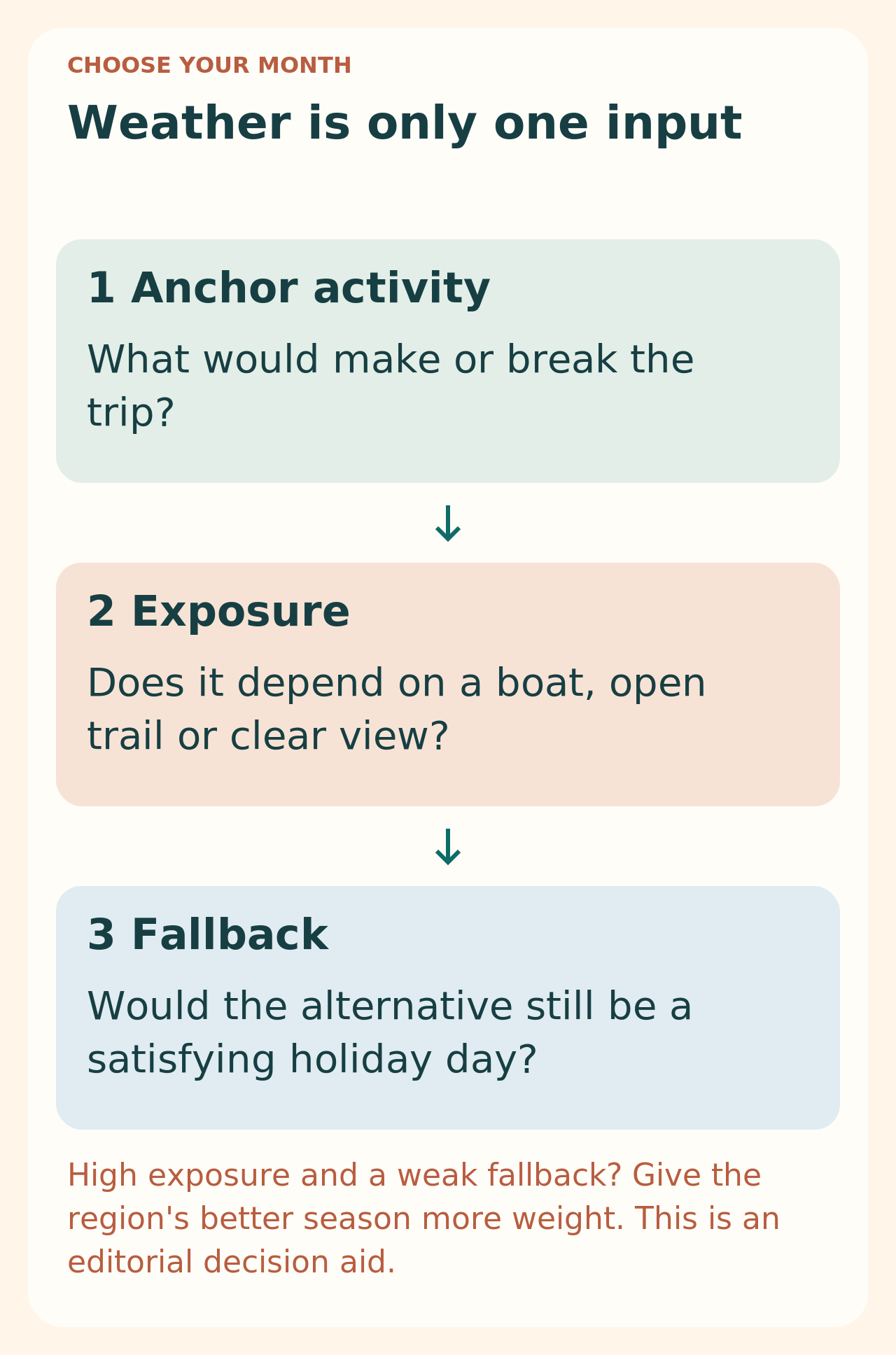
This original decision framework does not assign invented rain probabilities. It asks three questions that reveal which weather uncertainty matters to your holiday.
- Identify the anchor: the experience you would be most disappointed to lose.
- Identify exposure: does it depend on a crossing, clear views, an open trail or prolonged outdoor time?
- Identify the fallback: would the available alternative still feel like a worthwhile holiday day?
Give the seasonal conditions most weight when exposure is high and the fallback is weak. Give your budget, preferred pace and available dates more weight when the anchor is flexible and a wet day still has a satisfying alternative.
Three traveller scenarios
For a family dividing time between a comfortable Bali hotel and cultural outings, the fallback might be genuinely useful. Choose a well-located base and avoid a programme requiring long daily drives. Rain then changes the day’s order rather than destroying its purpose.
For a couple taking a short, boat-led Komodo visit, the marine element is the holiday, not an optional extra. Research the operating conditions, vessel and cancellation terms before paying for a tightly connected onward flight. A spare day is helpful but does not turn an unsafe departure into an acceptable one.
For a traveller considering both Raja Ampat and Bali, write down which region is the main reason for going. Optimise that region first. The secondary stay can be a deliberately different kind of holiday, rather than an attempt to make both places deliver their ideal conditions simultaneously.
When a wetter-season trip is a reasonable choice
A wetter-season trip makes most sense when it has attractions that do not all fail together. A good room, interesting nearby food and flexible cultural visits provide different kinds of value. By contrast, three paid boat trips do not provide three independent alternatives: similar conditions may affect them all.
Choose the base for the days you might actually have
Check whether there are enjoyable options close to the accommodation, whether access depends on exposed transport, and what happens if an excursion is cancelled. Ask a hotel about the room category and practical access rather than relying on a dramatic pool photograph.
For a Bali stay, compare accommodation areas on Agoda and check Bali stays on Booking.com. Both are broad destination searches: inspect the map, full terms and exact room before booking. Neither link establishes availability for your dates.
Compare the same stay length and refund conditions. A cheaper non-refundable room may be the right choice for a settled plan, but it is not directly equivalent to a room you can cancel while deciding your route. Compare your actual hotel offers when fees, breakfast or transfer costs make the totals hard to judge.
Who should be more cautious?
A short holiday with one remote must-do excursion has less room for disruption. So does a trip with a fixed international departure immediately after a sea crossing. Travellers who find repeated plan changes stressful may prefer a more forgiving seasonal window even when the initial booking costs more.
What to check before booking boats and special dates
Do not interpret a booking platform’s available departure as an assessment of sea safety. BlueWater Express’s published terms and schedules explain that operations can be affected by weather and that its service does not protect separate onward connections. Other operators’ arrangements need their own check. [11] [12]
For a Bali-Gili Air plan, compare the listed Bali to Gili Air options. Check the actual departure harbour, arrival point, luggage conditions and whether a land transfer is included. The place name alone is not enough to establish a workable door-to-door journey.
The editorial recommendation is to return to the international-departure island before the final day when an independent sea crossing is involved. Choose a larger buffer for an infrequent or essential connection. This is a planning safeguard, not an operator guarantee or a universal minimum.
Festivals and closures need their own calendar
On Bali, Nyepi affects travel, with the tourism authority describing the annual airport shutdown. Confirm the specific year’s airport and operator announcements before booking; do not reuse last year’s dates. [9]
Religious holidays and school-break periods also deserve a separate availability check. Instead of applying an assumed national price uplift, price your actual route and see which scarce room or departure needs attention first.
Save booking confirmations and maps offline. When mobile data would help you check messages and forecasts, browse Airalo and select an Indonesia data plan. Check an unlocked, compatible device and the individual plan’s coverage and activation rules; a data plan is not a promise of reception at every remote stop. [13]
A sensible weather-check routine
At the route-planning stage, use regional climate information to choose the broad shape of the trip. Before committing to an exposed activity, ask the actual operator how it handles cancellation, alternative routes and refunds.
Closer to travel, use the BMKG local forecasts for the named destination and BMKG marine information for relevant sea areas. Follow current warnings and the responsible operator’s decision rather than trying to overrule a cancellation with a favourable weather-app icon. [7] [8]
Check the FCDO’s current Indonesia advice too. Weather is only one source of disruption, and volcanic activity or other regional risks can affect an otherwise well-chosen season. [14]
The common mistakes are choosing an island from a national average, treating dry weather as calm seas, assuming every rain shower follows a convenient afternoon timetable, and putting a vulnerable transfer immediately before the flight home. Each mistake creates avoidable rigidity rather than simply bad luck.
Questions that change the decision
Is there one best month for all of Indonesia?
No single month is the right answer for every region and activity. Choose a geographical shortlist first, then compare the most weather-sensitive parts of your proposed trip. A compromise across distant regions should be deliberate.
Should a rainy forecast make me cancel the whole holiday?
A symbol on a long-range app forecast is not enough to make that decision. Consider official warnings, the affected activity, cancellation terms and realistic alternatives. A safety warning requires a different response from an ordinary possibility of showers.
Are shoulder months always cheaper?
Do not assume so. Compare like-for-like live offers for the exact dates, room and baggage conditions you need. A seasonal label cannot establish the total price of your holiday.
Can I solve the weather problem by adding more islands?
Not automatically. Extra transfers may consume the flexibility you hoped to gain. A better-located base with alternative activities can be more useful than a hurried additional flight.
The practical choice
For a first southern-island holiday, start your search with May to September and refine it around your actual bases and activities. For a trip centred on Raja Ampat, investigate its different seasonal window. Elsewhere, resist the urge to apply either shortcut without local evidence.
Then protect the part of the holiday that matters most. Choose a suitable season for a hard-to-replace outdoor experience, a forgiving base for uncertain days, and sufficient separation between vulnerable transfers and the flight home. That combination is more valuable than calling one month Indonesia’s universal best.
Sources and editorial method
Last editorial review: 2 November 2026. Official authorities and transport or activity operators inform the factual statements. Suggested routes, lead times and decision frameworks are editorial judgements, not personally tested itineraries. Illustrative calculations are labelled; live fares, room availability and future operating conditions are not guaranteed. Recheck changing rules and travel notices before booking.
- Wonderful Indonesia – weather, climate and seasons
- Wonderful Indonesia – Lombok activities and seasonal planning
- Wonderful Indonesia – first-timer guide to Komodo National Park
- Stay Raja Ampat – local weather and climate guidance
- BMKG Maluku – local seasonal zones and regional differences
- BMKG Lore Lindu Bariri – Zona Musim
- BMKG – local weather forecasts
- BMKG – maritime weather and warnings
- Wonderful Indonesia – Bali destination guide
- BMKG – rain during the dry season
- BlueWater Express – terms and conditions
- BlueWater Express – schedules and travel notices
- Airalo – Indonesia eSIM plans and compatibility information
- UK FCDO – Indonesia safety and security
Illustrations in this article were created for Taylor’s Trailblazing Travels. Third-party photographs, where used, are credited beside the image or in the source list.