Bali Waterfalls Compared: Which Are Worth the Journey?
Six contrasting waterfalls, realistic journey trade-offs and a clearer way to choose your day out.
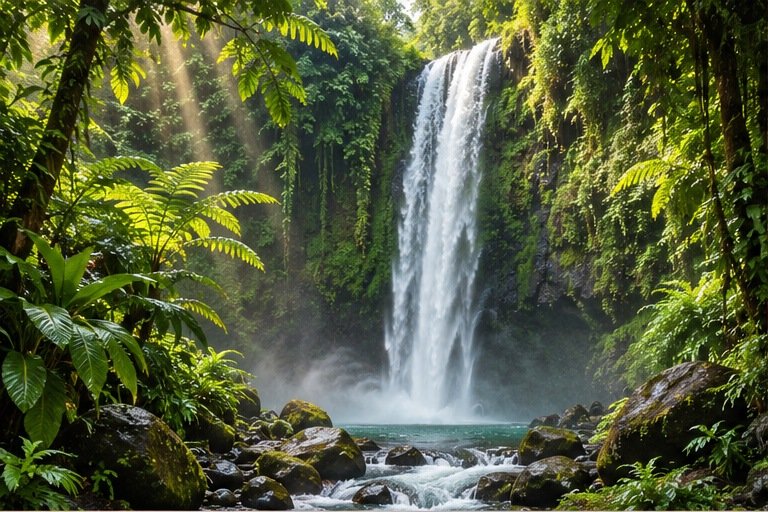
Original editorial illustration of a Bali waterfall setting; not a documentary photograph of a named site.
Bali waterfalls can look deceptively interchangeable in photographs. The useful differences are the journey, the descent, the setting and what your group can comfortably manage. This guide compares six options and separates a worthwhile outing from a long drive for a short stop.
Some links in this guide are affiliate links. Taylor’s Trailblazing Travels may earn a commission when you book or buy through them, at no extra cost to you.
Start near your base
A closer waterfall can make a better day.
Budget the return climb
Getting down is only half the access question.
One region, fewer stops
Choose contrasting experiences rather than a tally.
Keep a weather alternative
A closed route is a reason to change the plan.
Bali waterfalls: choose by journey, not just the photograph
For a first waterfall outing from Ubud, shortlist Tibumana or Tegenungan before committing to a much longer northern drive. Tukad Cepung offers a different kind of visit: the attraction is the enclosed rock setting as much as the falling water. Sekumpul makes more sense when waterfalls are the main event or you already have nights in north Bali. Banyumala belongs on a highland itinerary rather than an already crowded southern sightseeing day. These are editorial choices based on the locations and approaches described by the tourism authorities, not a ranking of measured beauty. [1][2][3][4][5]
The comparison below separates the reason to visit from the reason to leave somewhere out. A short walk is not the same as step-free access, and a pool shown in photographs is not permission to swim.
| Waterfall | Strongest reason to choose it | Main compromise | Best planning fit |
|---|---|---|---|
| Tibumana | A forest setting and a relatively compact visit | A walking approach still needs checking | One principal waterfall from an Ubud base |
| Tegenungan | A well-established waterfall near the Ubud area | Do not choose it expecting remote solitude | A convenient addition to a central-Bali day |
| Tukad Cepung | A distinctive rock-corridor setting | Confined terrain makes conditions especially important | A photography-led outing with flexible expectations |
| Kanto Lampo | Water flowing over stepped rock formations | The photogenic rocks are not a reason to climb | A central-Bali circuit with an agreed safe viewing point |
| Sekumpul | A much bigger northern landscape experience | Steep access, river conditions and a longer journey | A dedicated outing with local guiding |
| Banyumala | A forest-and-waterfall stop in the Wanagiri highlands | Trails and the onward drive both need allowance | A Bedugul or Munduk-area stay |
Location and landscape descriptions are supported by the sources below; the planning fit is this guide’s assessment. Kanto Lampo’s terraced rock formation is described in the activity listing used for comparison. [1][2][3][4][5][6]
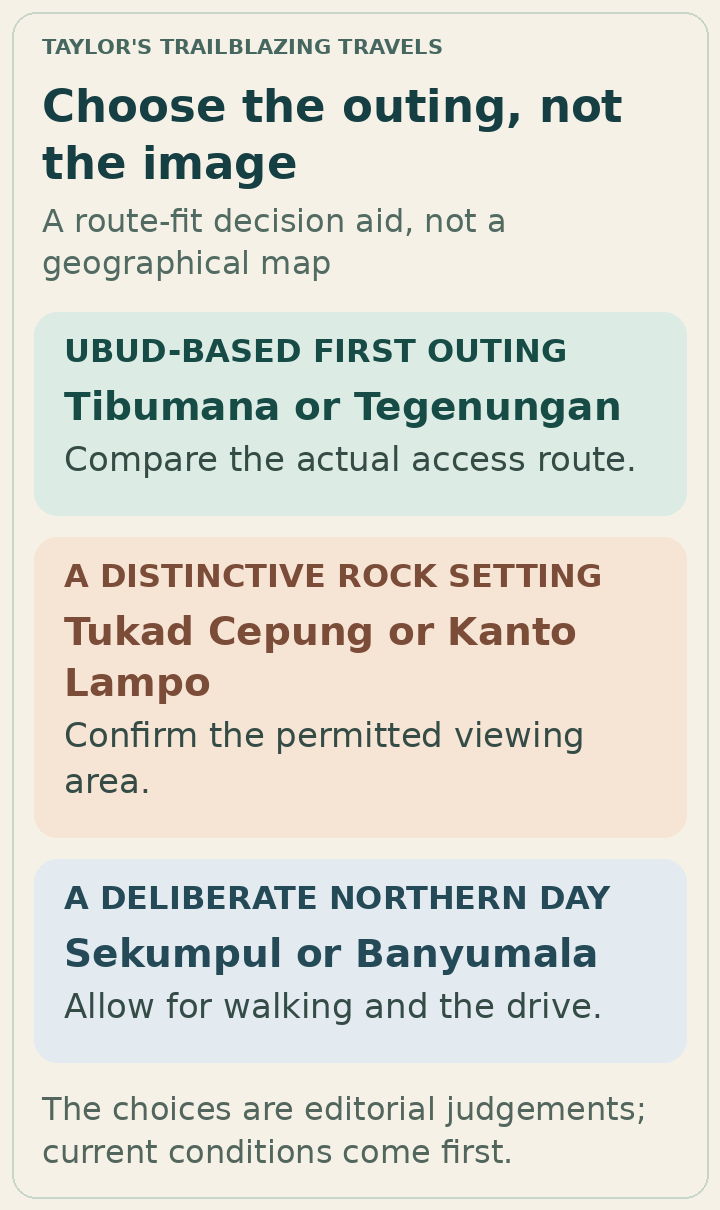
The central-Bali choices and their different strengths
Tibumana: a sensible starting shortlist
Indonesia’s tourism ministry describes Tibumana as a curtain-like fall approached on a short forest walk. That makes it a reasonable first option for somebody who wants one nature stop, rather than an ambitious collection of falls. It does not establish that the route will be easy for every visitor or usable after heavy rain. [2]
The useful question is not whether Tibumana is the most dramatic waterfall on the island. It is whether the outing gives you enough forest time without consuming the rest of your day. Ask your driver for the current journey from your actual accommodation, not from a generic Ubud meeting point. A hotel outside the centre can change the arithmetic substantially.
Tegenungan: convenience can be a genuine advantage
Bali’s provincial tourism service places Tegenungan in Sukawati, Gianyar, roughly 10 kilometres outside Ubud. That is a location reference, not a ten-minute drive or a promise of an uncomplicated descent. [1]
It belongs on the shortlist when you would rather spend the afternoon elsewhere than cross the island for one photograph. Before paying, clarify which entrance and viewing area the visit covers. For travellers who struggle with steps, the existence of a viewpoint is useful only after someone confirms the complete route to it, including the return to the vehicle.
Tukad Cepung: choose the setting, not a guaranteed sunbeam
The national tourism description identifies Tukad Cepung in Tembuku, Bangli, and describes the waterfall within rock walls with light entering from above. That enclosed setting is its distinguishing feature. [3]
However, do not book around a promise of an exact shaft of sunlight. Cloud, your arrival time and conditions in the gorge can change the photograph. Choose the visit because you would enjoy the rock setting even without the familiar social-media composition. A provider should also explain whether the approach involves walking through water, how it assesses conditions and what happens when access is unsuitable.
Kanto Lampo: a cascade, not a climbing challenge
Kanto Lampo provides a useful visual contrast to a single vertical drop: the tour description shows water spreading over terraced rocks. [6] Treat those rocks as part of the scenery unless staff explicitly identify a permitted, suitable route. Following a queue of people onto a wet surface is not a safety assessment.
This is a good place to decide what you actually want from a waterfall visit. Someone interested in the setting may be content with a short, safe observation stop. Someone expecting a carefully posed portrait should allow for waiting without making the entire day’s timetable depend on it.
When north Bali is worth the extra commitment
Sekumpul: make the walk the purpose of the day
The Buleleng tourism authority describes Sekumpul’s approach as a substantial descent with steps and a river crossing. Ask the site team how rain affects those steps and the river crossing. This is stronger evidence of the physical commitment than the reassuring word “waterfall” in a tour title. [4]
For a keen walker, that can be the attraction. For a mixed-ability family, it may be the decisive reason to choose differently. Ask the local operator to distinguish a viewpoint visit from a trek to the base. Request the actual route, guide arrangement and river-crossing decision before agreeing a price. The two experiences should not be treated as interchangeable tickets.
A long southern round trip is worthwhile only when the landscape matters enough to justify it. Otherwise, save Sekumpul for a northern stay and enjoy a closer waterfall properly now.
Banyumala: combine with a highland base
Buleleng’s tourism listing places Banyumala in Wanagiri, Sukasada, and describes a forest-path approach to a waterfall pool. [5] Its appeal for this comparison is geographical: it gives a highland holiday a natural outdoor focus without requiring every outing to start on the south coast.
Do not turn that into an assumption of effortless access. Confirm current trail conditions and what assistance, if any, is available. Nor does a pool description settle whether bathing is permitted or sensible on your day. A successful visit can be entirely about the walk and view.
For an overnight highland plan, compare the map locations in Booking.com’s Munduk accommodation search and Agoda’s Munduk-area options. These are area searches, not recommendations that every result is near Banyumala or suitable for Sekumpul. Check the actual road journey before booking.
Work out whether the journey earns its place
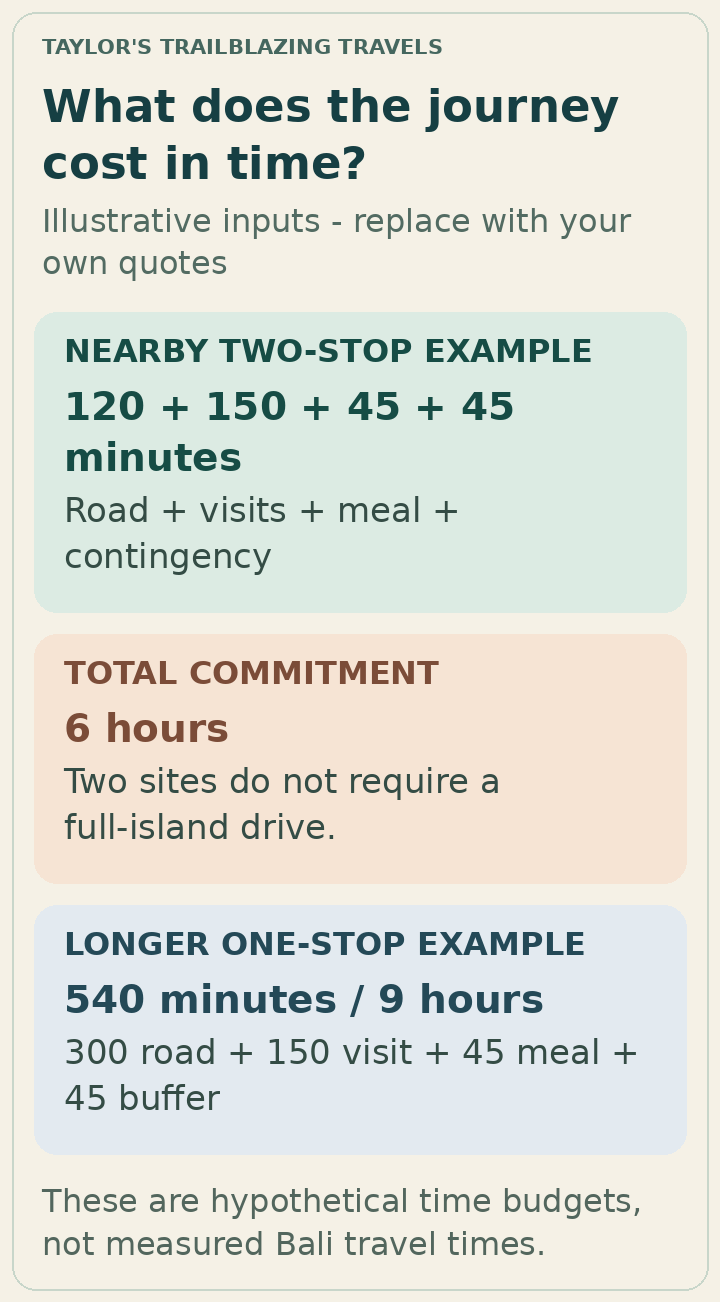
A useful waterfall day needs more than enough time to reach the car park. It needs walking time in both directions, a comfortable stop, food and space for changes. Use this original time-budget model before deciding how many falls to add.
| Part of the day | Nearby two-stop example | Longer one-stop example |
|---|---|---|
| All driving combined | 120 minutes | 300 minutes |
| Walking, viewing and resting at the sites | 150 minutes | 150 minutes |
| Meal break | 45 minutes | 45 minutes |
| Contingency allowance | 45 minutes | 45 minutes |
| Total commitment | 360 minutes: 6 hours | 540 minutes: 9 hours |
These are deliberately hypothetical inputs, not measured Bali journey times or tour schedules. Replace driving with a current door-to-door estimate, then change the walking allowance for your group. A tour’s advertised duration can provide a useful cross-check, but cannot guarantee traffic or access.
The second example spends five hours travelling for two and a half hours at the attraction. That may be a good exchange for a waterfall enthusiast. It is less convincing for someone who merely wants a pleasant break from their hotel. The calculation exposes the trade-off without pretending that every traveller should value it equally.
For a holiday that includes an overnight move north, the site’s Itinerary Pace Checker can help compare nights and the transfer estimates you enter. It assesses an overnight route, not the safety or timing of a waterfall trail.
Guides, entrance arrangements and the real cost
Bali’s published tourist code calls for foreign visitors to be accompanied by a licensed guide at tourist attractions. Arrange that with a recognised provider and check the local site’s requirements; a car and driver should not automatically be assumed to include a licensed walking guide. [7]
Ask for a written breakdown covering the vehicle, the exact stops, entrance charges, local guiding, parking, meals and return to your hotel. For Sekumpul, make the permitted route explicit. For every waterfall, ask what happens when the intended path is closed or the group decides not to continue.
Compare the same outing rather than the lowest headline
The four-waterfall tour on GetYourGuide is a full-day comparison option covering Tukad Cepung, Tibumana, Kanto Lampo and Tegenungan. It is not the relaxed two-stop plan above. The listing makes entrance-fee inclusion dependent on the selected option, so check the option rather than relying on the main heading. [6]
Do not use an old entrance-fee list as a guaranteed cash budget. Different access points, local packages and optional services can make two quoted prices describe different visits. This guide does not present unconfirmed gate prices as current tariffs.
As an illustrative budgeting exercise only, a Rp650,000 vehicle-and-driver quote, Rp200,000 total for two people’s site charges and Rp150,000 for their food would total Rp1,000,000, or Rp500,000 each. Those figures are assumptions, not researched market prices; guiding or other exclusions would increase the total. Enter your actual quotes into the Travel Budget Calculator rather than copying the example into a booking budget.
Rain, water and the decision to turn back
A clear sky at your hotel does not resolve conditions upstream. Check the BMKG Bali warnings, ask the site team about the approach and follow any closure. Indonesia’s travel advice identifies flooding and landslides as real hazards, including in Bali. [8][9]
A gorge, river crossing and exposed viewing area create different problems. Instead of asking only “Is the waterfall open?”, ask whether the exact route you booked is operating and whether the return path could become difficult. Do not enter a closed gorge, cross rising water or bypass a barrier to reach a photo position.
Swimming is a separate decision. Check permission and current local advice; never assume that a swim seen online is allowed, supervised or safe now. The four-waterfall listing itself contains inconsistent swimming language between its description and restrictions, which is a reason to obtain clarification rather than sell bathing as an inclusion. [6]
Choose an outing you would still enjoy without entering the water. That makes it easier to accept a conservative decision without feeling that the whole purchase has failed.
Footwear, mobility and a manageable day bag
Bring footwear appropriate to a wet, uneven approach, plus drinking water, sun protection and a way to keep your essentials dry. Keep both hands available on difficult sections rather than carrying a phone in one hand and a drink in the other. Ask the guide about the surface and any water crossing before deciding what to wear.
For limited mobility, request a recent description or video of the complete route: surface, slopes, steps, handrails, resting places, toilets and return climb. “Suitable for families” does not answer those questions. A shorter destination can still be unsuitable for someone with balance difficulties, and a viewpoint may not be step-free.
Store the meeting point and driver’s contact offline. Mobile data is useful for changes while you have coverage, but is not a rescue plan. Travellers who need a compatible eSIM can browse Airalo and select an Indonesia plan; check device compatibility and the plan’s conditions before purchase. Indonesia plans are offered, but coverage at an individual waterfall is not established by that fact. [10]
Questions that change the choice
Is three or four waterfalls better value than one?
Only when the extra stops add an experience you genuinely want. Count the walking and waiting at each one, not just the entrance charges. Two contrasting falls can be a better day than four hurried descents followed by a tiring drive.
Which is the best waterfall for a short Ubud stay?
Start by comparing Tibumana with Tegenungan using your hotel’s actual location and the current access information. Neither is automatically the right choice for someone who cannot manage an uneven walking route. Keep the northern options for a trip with more space.
Can a non-swimmer enjoy a waterfall day?
Yes, by choosing an outing built around viewing and an appropriate walking route rather than bathing. Tell the operator that you will not enter the water and ask whether the route itself involves a river crossing. A viewing-only preference does not remove the need to check that crossing.
Should we book the waterfall trip for our final day?
Prefer a day with room to move it when conditions matter to the chosen route. Avoid relying on a remote outing to return in time for a flight or a non-refundable evening commitment. That is especially valuable when several people need to agree on turning back.
The worthwhile choice is the one that fits your holiday
Choose Tibumana or Tegenungan for a first shortlist near Ubud; Tukad Cepung when its rock setting is the particular draw; and Kanto Lampo when a cascade adds a worthwhile contrast. Make Sekumpul a considered trekking outing, not an impulsive extra. Use Banyumala to enrich a northern or highland stay rather than stretching an already full southern day.
The common mistakes are choosing by a cropped photograph, treating the descent as the whole walk, assuming swimming is included and paying for more stops than the group can enjoy. A written route, realistic time budget and acceptable bad-weather alternative solve more of those problems than another top-ten list.
Sources and fact-checking notes
This is a research-led comparison, not a report of personal visits. The selection balances landscape, access demands and itinerary fit. Journey and budget models are explicitly hypothetical. Buleleng descriptions were available in indexed official-source extracts; direct page access was intermittent. Gate charges, water access and guiding arrangements need confirmation for the visit.
Last editorial review: 2 November 2026. Recheck prices, rules, access and booking conditions before travel.
- Bali Provincial Tourism Service: Tegenungan Waterfall.
- Indonesia Travel: Tibumana Waterfall.
- Indonesia Travel: Tukad Cepung in its waterfall guide.
- Buleleng Tourism: Sekumpul Waterfall.
- Buleleng Tourism: Banyumala Waterfall.
- GetYourGuide: four-waterfall tour and option conditions.
- Bali Governor: Circular 07 of 2025, tourist code.
- BMKG: Bali short-term weather warnings.
- UK FCDO: Indonesia safety and security.
- Airalo: Indonesia eSIM information.
Illustrations in this article were created for Taylor’s Trailblazing Travels. Third-party photographs, where used, are credited beside the image or in the source list.