
Best Beginner Surf Beaches in Bali: Choosing a Lesson Location
Start with a suitable lesson and a responsible coach, rather than the island's most famous wave.
Original editorial illustration of a supervised learning scene; not evidence of a particular school or live beach conditions.
The best beginner surf beaches in Bali are not a fixed list of safe places to paddle out. A useful recommendation matches your experience to a responsible school, a precise teaching zone and the conditions on the day. This guide helps you make that booking decision.
Some links in this guide are affiliate links. Taylor’s Trailblazing Travels may earn a commission when you book or buy through them, at no extra cost to you.
Start with your ability
Explain swimming confidence and previous experience.
Confirm the real venue
A school address may not be the teaching beach.
Keep timing flexible
Tide, current and surf can change the lesson.
Compare coaching value
Water time and supervision matter more than photos.
Beginner surf beaches in Bali: the first shortlist
For a first-ever lesson, start with an established school teaching on an appropriate part of Kuta or Legian. Seminyak can work when the coach selects suitable conditions. Jimbaran Bay is a conditional alternative, particularly when a southern school chooses it for a manageable lesson. Batu Bolong deserves a more careful discussion of ability, the exact wave and congestion rather than an automatic “beginners welcome” recommendation. [1][2][3]
This shortlist is about lesson locations, not places to hire a board and paddle out alone. The instructor’s assessment on the day matters more than the beach’s reputation. A sandy beach break can still have strong currents or waves that are unsuitable for a novice. [1][4]
| Location | Best starting use | What can change the decision | Verdict for a complete beginner |
|---|---|---|---|
| Kuta | A first supervised whitewater lesson | Crowd, current, tide and the chosen stretch | First shortlist, with a responsible school |
| Legian | Similar learning goals from a convenient nearby base | Different sections can behave differently | A strong alternative to central Kuta |
| Seminyak | A lesson near your existing accommodation | Shorebreak and conditions may be less forgiving | Suitable only after the coach’s assessment |
| Jimbaran Bay | A school-selected southern alternative | There may not be appropriate learning waves | Useful when the school chooses it, not a guaranteed daily option |
| Batu Bolong, Canggu | Carefully assessed progression or a selected beginner session | Exact bottom, wave size, other surfers and entry route | Do not choose solely because it is famous |
The Kuta, Legian and Seminyak descriptions draw on a local school’s break guide; Jimbaran’s use comes from a southern school’s lesson information. The final-column judgements are this article’s assessment, not a guarantee of safe conditions. [1][2]
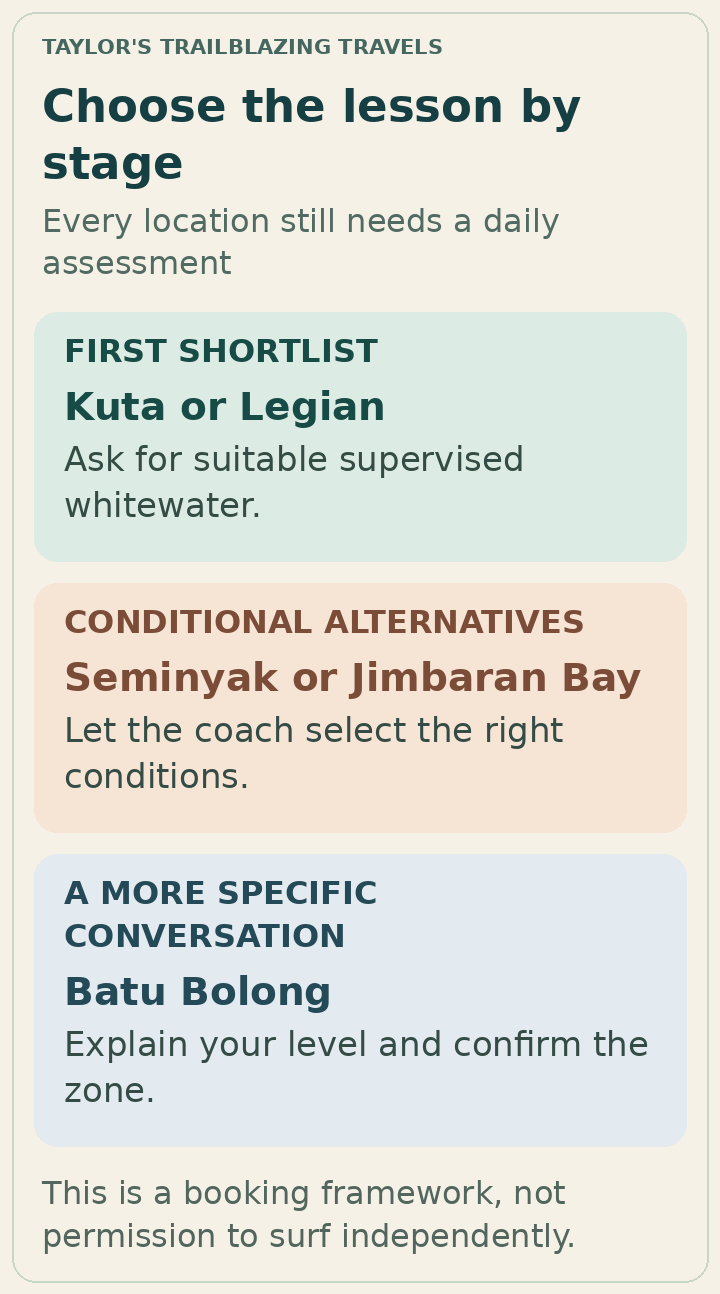
Kuta and Legian: choose the coach and meeting point
Kuta: a practical first place to compare schools
Kuta’s long beach and established beginner teaching options make it a useful place to start the search. UP2U’s break guide classifies Kuta as a beach break used by beginners, while its beginner programme explains that instruction begins on the beach before moving into the water. [1][5]
For a first lesson, look for controlled practice in suitable broken waves, often called whitewater. The immediate goal is learning to handle the board, follow instructions and finish a ride safely, not reaching the outside line-up or proving that you can stand for a photograph.
A good booking conversation names the meeting point and explains why the selected part of the beach fits your ability that day. “Kuta Beach” is not precise enough for a pickup or a safety plan. Ask how the instructor will identify the group, where belongings are kept and whether the school can change the session if conditions deteriorate.
Legian: an equally useful logistical choice
Legian can be a sensible base when the school and accommodation are close together. UP2U gives a meeting location on Jalan Pantai Kuta in Legian, opposite the Pullman hotel area, illustrating why business names and neighbourhood labels do not always identify the exact strip of sand. [6]
Compare the complete journey from your room to the lesson. A slightly more expensive school within an easy walk may be preferable to crossing town twice for a small saving. However, proximity should not make you accept unsuitable conditions. The school still needs an alternative when the nearest section is wrong for the group.
Seminyak, Jimbaran and Batu Bolong need a more conditional choice
Seminyak: convenient does not mean gentle
UP2U groups Legian and Seminyak as beach breaks used by less experienced surfers while warning about strong rips along the coast. [1] That combination matters: a beginner label and a current warning can both be true.
Staying in Seminyak is a reason to ask a local school about a suitable lesson, not a reason to insist that the session takes place directly in front of your hotel. Ask whether the lesson can move to another stretch and whether the price includes that transport. Be willing to change the time or location rather than treating the booking as a fixed appointment with the sea.
Jimbaran Bay: an alternative selected by the school
Dawn Patrol describes using Jimbaran Bay’s sandy beach break for some children’s lessons, depending on conditions. [2] That supports including it as an option to discuss with a southern school. It does not establish that every part of the bay offers learnable waves every day or that the venue is automatically suitable for all children.
This option can be attractive when you are already staying in the south and do not want to choose a dramatic reef wave merely because it is nearby. Give the school your actual ability and let it identify an appropriate site. The flexibility is the advantage, not a promise of a particular beach.
Batu Bolong: popularity is not a safety category
Canggu schools advertise lessons for beginners and more experienced surfers, including at Batu Bolong. [3] Before accepting a beginner booking, ask the coach to identify the exact lesson zone, bottom conditions, entry and exit, and how the group will be kept clear of more experienced surfers.
The title “beginner” can cover very different people: somebody who has never held a board, somebody learning to stand in whitewater, or somebody already catching small unbroken waves. Explain which one describes you. For the first category, Kuta or Legian is the simpler initial shortlist unless a responsible coach gives a convincing location-specific reason to choose otherwise.
Do not assume that a surf school’s address is the beach where it will teach. A school based near a more demanding break may transport novices elsewhere; confirm the actual lesson venue before paying.
Match the session to your real starting level
Tell the school how confidently you swim, whether you have surfed before, your comfort in moving water and any relevant physical limitations. A claim that a lesson is suitable for non-swimmers should not be treated as proof that the sea is safe for you. Ask how the school assesses suitability, where the session takes place and what rescue arrangements exist.
RNLI advice recommends lessons for beginners, awareness of local conditions, suitable equipment and staying within your ability. It also stresses the risk of collisions and the importance of understanding rips. [4] Use those principles without assuming that UK beach-flag arrangements apply identically in Bali.
A supervised lesson is not equivalent to a lifeguarded beach. Ask the instructor to explain local flags, the designated activity area and how to signal for assistance. When a beach is closed or staff advise against entering, choose another time rather than negotiating an exception.
Children and nervous beginners
Ask for the actual in-water instructor-to-student ratio, not the total number of staff employed by the business. A child-specific lesson should explain supervision, equipment fit, age requirements and how the session ends if the child becomes uncomfortable.
For a nervous adult, a smaller group may be worth more than photographs or an advertised extra half-hour. Speak to the instructor beforehand about what you need. The objective is a controlled introduction, not a guarantee that everyone stands up on the first visit.
Ask these questions before selecting a school
A useful reply should identify the lesson’s actual location, the expected water conditions, the instructor ratio, the equipment, the time in the water and the cancellation or relocation policy. It should also explain whether transfers, storage, showers and photographs are included or cost extra.
UP2U’s published beginner lesson is one transparent comparison example: it lists a 1:3 coach-to-guest ratio, a two-hour beach lesson, online theory beforehand and no included transport. Its advertised one-lesson price was Rp200,000 per person when checked on 1 November 2026. These are that provider’s published terms, not an island-wide standard or a live quote for your date. [5]
To compare a private-format alternative, review this Kuta beginner and intermediate lesson listing on GetYourGuide. Make sure the selected option matches a complete beginner, and verify the actual meeting point, in-water ratio and current conditions with the provider. [7]
Do not infer rescue training from a cheerful photograph or a high rating. Ask what relevant instructor and water-safety qualifications the person teaching you holds and how an incident would be handled. A professional answer can be specific without promising that any ocean activity is risk-free.
Compare active learning time, not just the advertised duration
A two-hour appointment may include changing, briefing, beach practice, breaks and returning equipment. That is not inherently poor value: preparation is part of learning. However, two lessons with identical advertised durations may offer quite different amounts of coached water time.
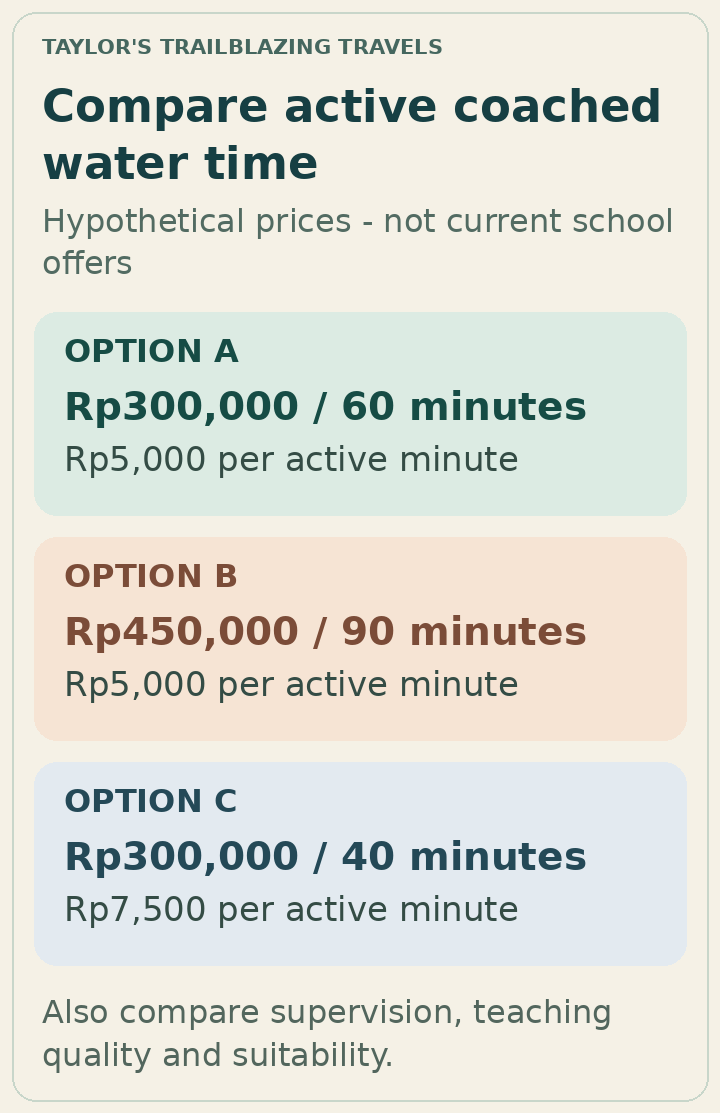
This original cost model illustrates the distinction. It does not use current school prices and should not be confused with the dated UP2U example above.
| Hypothetical lesson quote | Total price | Assumed active coached water time | Price per active minute |
|---|---|---|---|
| Option A | Rp300,000 | 60 minutes | Rp5,000 |
| Option B | Rp450,000 | 90 minutes | Rp5,000 |
| Option C | Rp300,000 | 40 minutes | Rp7,500 |
Calculate price divided by realistic active minutes, then compare group size, instruction quality and suitability separately. The most minutes are not automatically best: a tired beginner may learn more from a shorter, better-supported session. Safety and useful feedback are conditions of value, not optional extras to trade away for a cheap rate.
For two or three sessions, include the transfer cost each time. A Rp100,000 saving on lessons disappears when it creates more than Rp100,000 of additional transport. Add your actual lesson and journey quotes to the Travel Budget Calculator, using one currency and checking whether equipment is already included.
Tide, weather and why the lesson time can move
The best session is not necessarily at sunrise, at high tide or at the same time every day. UP2U explicitly warns that its lesson times may shift by around an hour according to the surf. [6] That is a useful reminder to keep the surrounding schedule flexible.
Ask the school to confirm the time again close to the lesson. Give it a reachable contact number, save the meeting point offline and do not place a non-refundable excursion immediately afterwards. A school willing to relocate or postpone a session may be making a better decision than one that insists the original arrangement is always suitable.
BMKG publishes marine warnings for Bali’s waters. Those regional forecasts provide context, but offshore wave heights are not a description of the individual wave that will break at your feet. Use the warning service alongside a qualified local assessment, not as a do-it-yourself permission slip. [8]
After heavy rain, follow current advice about water quality and access; a smaller wave does not necessarily mean acceptable water conditions. Leave the decision open until the instructor has assessed the actual location.
Choose a base that supports repeated practice
For a single taster lesson, it may be simplest to book from your existing base and accept a suitable transfer. For several sessions, staying near the confirmed teaching location reduces repeated journeys and makes changing times easier.
Compare Kuta accommodation on Booking.com and Legian-area stays on Agoda. Use the map to check the walking route to the school; these searches do not establish that every property is near a suitable surf zone.
Before buying a multi-day package, take the first lesson and assess whether the school communicates clearly and the arrangement suits you. Read the package’s change and refund terms. Progress does not have to mean entering a harder wave after a fixed number of lessons.
The Hotel Comparison Calculator can help compare room offers with your estimated lesson-transfer costs. It uses your inputs rather than fetching live rates or assessing beaches.
What to bring, and mistakes worth avoiding
Confirm whether the board, leash and suitable sun-protective clothing are provided before buying equipment. Bring water, a towel, secure swimwear or suitable surf clothing, sun protection and only the valuables you can store safely. Ask about equipment fit and condition rather than choosing by brand alone.
Follow the instructor’s briefing on board control, falling clear and signalling for help. Do not continue practising alone simply because the paid lesson has ended. A successful first session does not demonstrate the judgement needed to choose conditions independently. [4]
The common mistakes are booking by photographs of large waves, confusing board hire with coaching, hiding weak swimming ability, choosing a fixed time because it fits lunch and comparing only the headline price. Each can be avoided before you reach the beach.
First-lesson questions
Is Kuta always suitable for beginners?
No beach is suitable in all conditions. Kuta is a useful place to look for beginner teaching, but the selected stretch, tide, waves and currents still need assessment on the day. [1]
Is Batu Bolong a bad choice for every beginner?
No. The problem is treating a broad label as enough information. Discuss the precise learning zone and your level with a qualified coach. A first-time visitor should not assume that a famous surf beach is interchangeable with supervised whitewater practice elsewhere.
Can I book a lesson without being a confident swimmer?
Tell the school honestly before paying and obtain an individual suitability assessment. Do not let a marketing label or the presence of a surfboard substitute for a clear explanation of the conditions, supervision and rescue plan. A land-based introduction or postponing ocean practice may be the better choice.
Do I need to buy reef shoes before a first lesson?
Ask about the actual teaching location and equipment. Do not buy shoes as a way to make an unsuitable rocky or shallow site acceptable. A beginner lesson should be selected around your ability first.
How many lessons will it take to surf independently?
There is no responsible fixed number. Board control, swimming confidence, recognising hazards and choosing suitable conditions matter alongside standing up. Ask the instructor what you can safely practise next and what still needs supervision.
The best first location is a suitable lesson, not a famous wave
Begin with Kuta or Legian and compare responsible schools. Consider Seminyak for convenience only when the conditions fit; accept Jimbaran when a competent southern school selects it; and discuss Batu Bolong in terms of the exact wave and your actual ability.
Book one well-explained session, leave room for the time or location to change, and judge the result by understanding and controlled practice rather than a single standing photograph. That creates a more useful start than chasing the island’s most recognisable surf spot.
Sources and fact-checking notes
This is a research-led lesson-location comparison, not a personal test of schools or a live surf forecast. Provider descriptions establish what they advertise, not independently verified rescue competence. The active-water-time cost model uses hypothetical figures; the UP2U price is separately labelled as a dated provider example. Local conditions and instructor assessment determine suitability.
Sources reviewed on 1 November 2026. Recheck prices, rules, access and booking conditions before travel.
- UP2U Surf School: Bali break descriptions.
- Dawn Patrol Bali: beginner and children's lesson locations.
- Matahari Surf School: Batu Bolong lesson descriptions.
- RNLI: surfing safety principles.
- UP2U Surf School: beginner programme and published prices.
- UP2U Surf School: lesson-time changes and meeting location.
- GetYourGuide: Kuta private lesson option.
- BMKG: marine warning service.
Illustrations in this article were created for Taylor’s Trailblazing Travels. Third-party photographs, where used, are credited beside the image or in the source list.