Nagasaki Travel Guide: History, Views and City Transport
Plan the city by its historical areas, with room for remembrance and a clear-weather view.
- First visit · Two full city days
- Route logic · Three historical areas
- Evening view · Keep it flexible
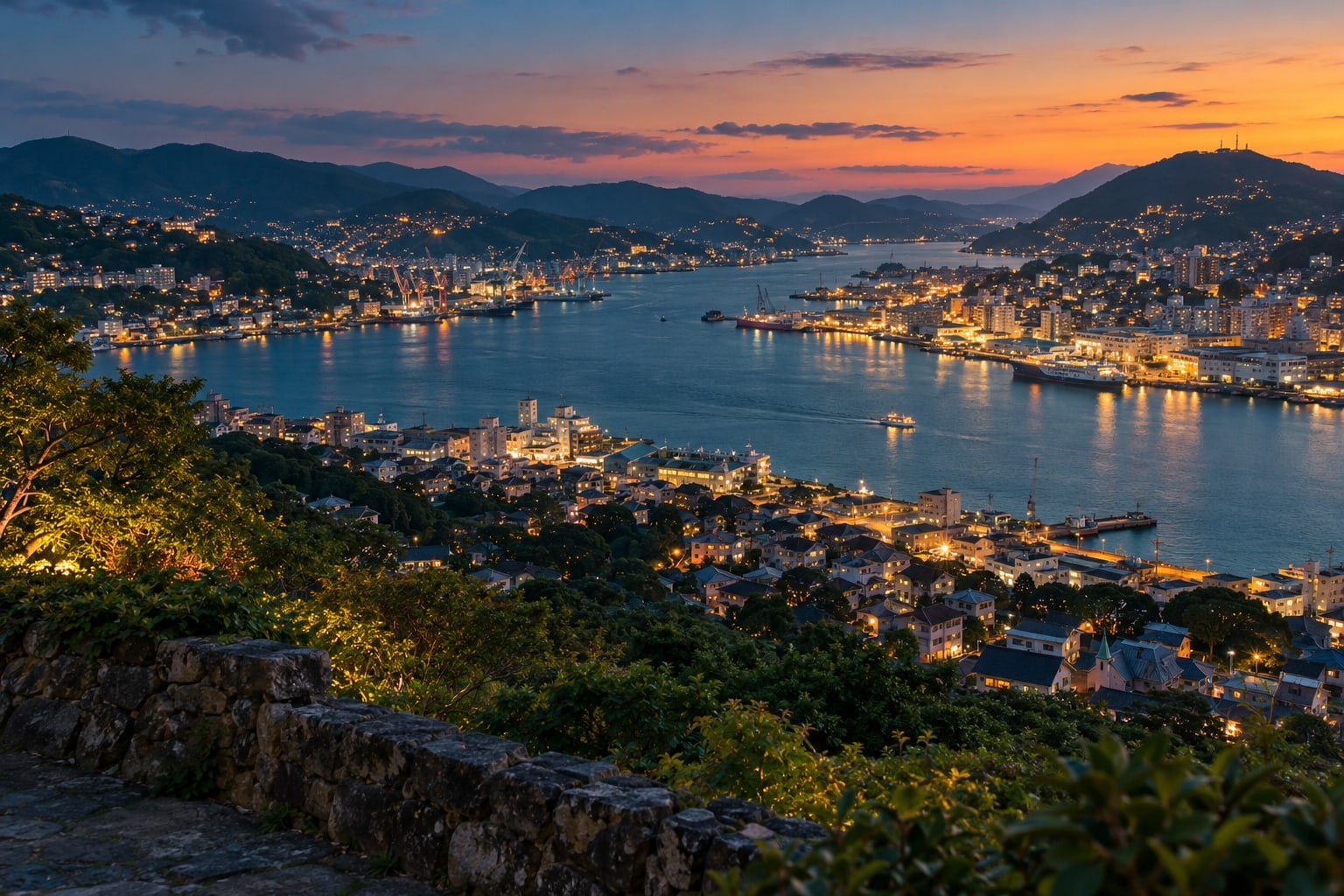
AI-generated editorial illustration inspired by Nagasaki’s harbour and hillside cityscape; an imagined viewpoint, not a documentary photograph.
Nagasaki becomes easier to understand when you treat its geography as part of the history. Urakami holds the principal atomic-bomb remembrance sites; the old port contains Dejima and Chinatown; the southern slopes lead towards Oura Church and the former foreign settlement. The hills are part of the visit, rather than a detail to discover after booking a hotel.[1]
This Nagasaki travel guide gives those areas separate time. It also explains the tram ticket calculation, the train change from Fukuoka and the practical difference between reaching a viewpoint and simply seeing a promising sunset forecast.
This guide contains affiliate links. If you book or buy through them, Taylor’s Trailblazing may earn a commission at no extra cost to you.
Only one day?
Choose two historical areas. An unhurried museum visit and one coherent walk are a complete day without adding every viewpoint.
Buying a tram pass?
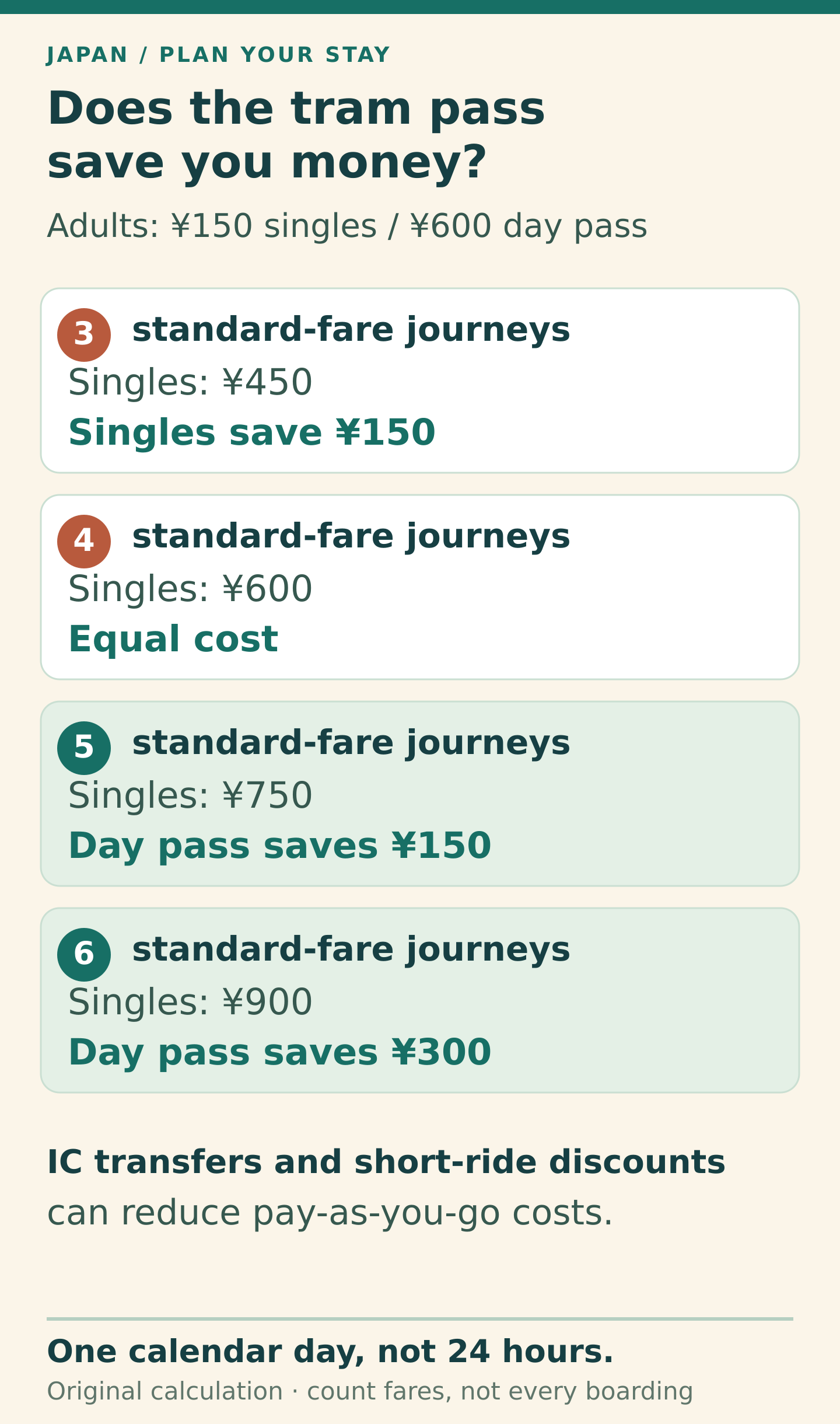
At the standard adult fare, four chargeable journeys equal the ¥600 day pass. Eligible transfers and shorter fares can change the calculation.
Choosing a hotel?
Use the station for trains, the old-port centre for sightseeing, or the hillside for its setting after checking the climb.
Booking a sea excursion?
Give it its own flexible block. Landing on Hashima depends on conditions and is never guaranteed by a reservation.
Understand the city before drawing the route
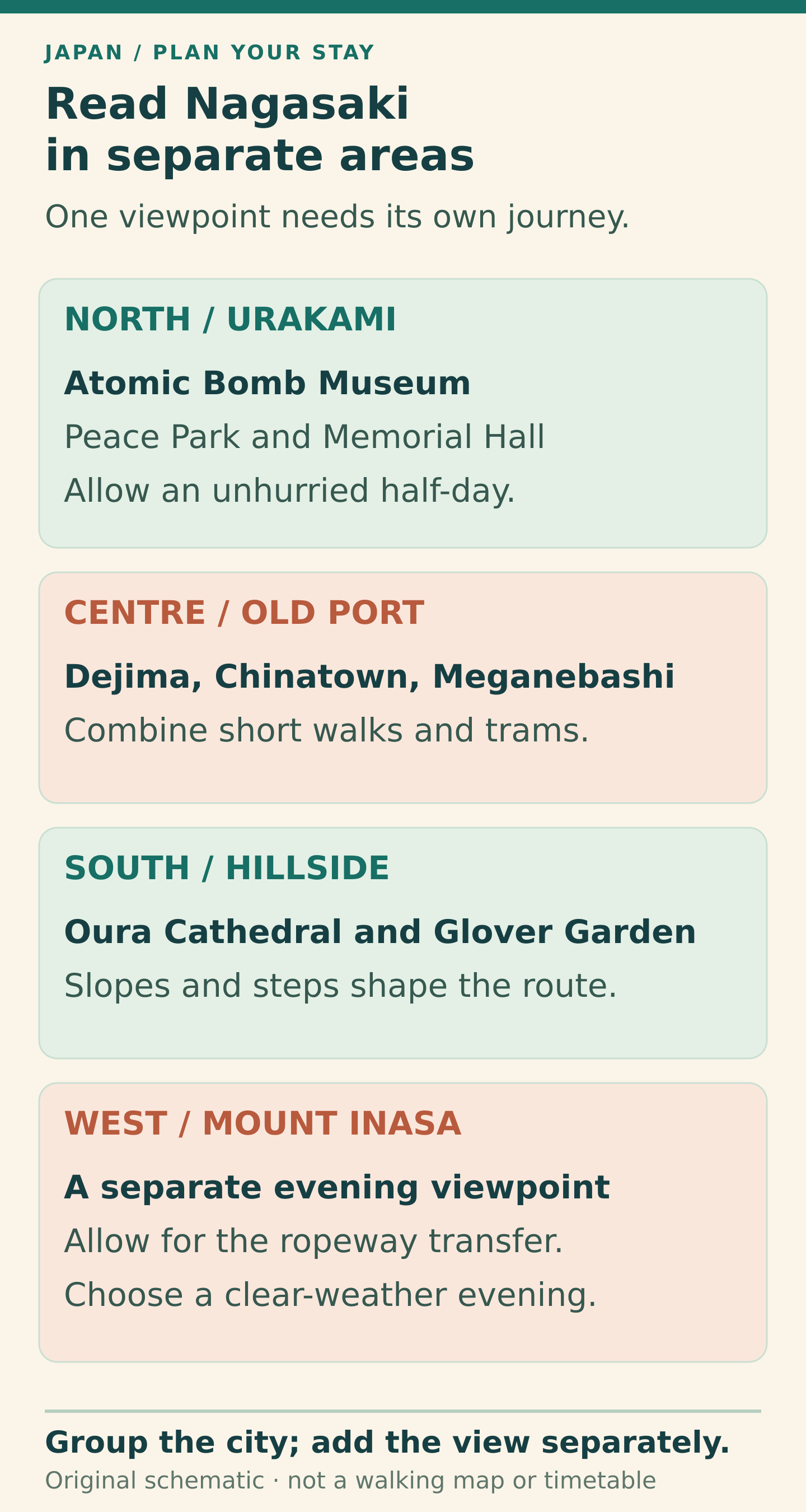
The most useful planning map has three historical areas and one separate viewpoint. This is our itinerary framework, based on the city’s visitor geography; it is not a scale map or a promise that everything in an area is a short, level walk.[1]
| Area | Main focus | Planning consequence |
|---|---|---|
| North: Urakami | Atomic Bomb Museum, Peace Park and the National Peace Memorial Hall | Give remembrance an unhurried half-day |
| Centre: the old port | Dejima, Shinchi Chinatown and Meganebashi | Combine chosen walks with the tram; avoid repeated crossings |
| South: the hillside | Oura Church, Glover Garden and the former foreign settlement | Plan for slopes, steps and the correct entrance |
| Separate western outing | Mount Inasa and its harbour view | Check visibility and allow a separate transfer to the ascent |
The half-day allowance and grouping are editorial. If mobility, heat or fatigue makes multiple transfers difficult, reduce the number of areas before adding transport. A shorter day with a reliable way back to the hotel is usually more useful than a dense route that depends on keeping pace.
A two-day Nagasaki plan, with useful alternatives
Two full days let you give the museum proper attention and still see the older port city. Count usable hours rather than hotel nights: a late arrival and an early departure can turn two nights into only one sightseeing day.
Day one: remembrance, then a quieter city afternoon
Start with the Atomic Bomb Museum, the nearby memorial hall and the peace sites. Pause for lunch before deciding what follows. A walk around Meganebashi or a central café gives the afternoon room to change with your response to the morning. Mount Inasa is an optional evening if visibility, energy and the return journey all work.
Day two: Dejima and the southern slopes
Visit Dejima, then move towards Oura and Glover Garden. Choose one as the principal afternoon stop and add the other only if its subject interests you and the pace feels comfortable. Leave time for a meal near the harbour or Chinatown. This sequence is a planning recommendation, not a requirement to buy every admission.
With one full day, choose two areas from the table and let your interests decide which. With three, slow the same plan down or give an island excursion its own block. Our guide to how many days to spend in Japan helps weigh that extra day against the rest of your itinerary.
Urakami: give the history time and attention
The Atomic Bomb Museum examines the bombing of 9 August 1945, its human effects and the continuing nuclear question. Allow time to read and listen rather than treating the exhibits as a brief stop before the Peace Park. Admission does not require an advance individual reservation; organised groups are asked to submit arrival information.[2]
Ordinary adult admission is ¥200.[33] The museum opens at 08:30, normally closing at 17:30 in April and September–March, and 18:30 in May–August; last entry is 30 minutes earlier. It closes on 29–31 December, with special extended hours around the August commemoration. Check the calendar for your date.[2]
Exhibition works are staged through March 2027. The museum’s notice plans work in room C from 24 November 2026, part of room B from late December, and film room D from January 2027. Areas outside the work zones remain open. Read the current notice before a winter visit rather than assuming either complete closure or a fully unchanged display.[4]
The nearby Nagasaki National Peace Memorial Hall for the Atomic Bomb Victims is a separate, free institution. Its remembrance spaces and recorded testimony offer a quieter way to continue; the hall also closes on 29–31 December. Accessible entrances and lifts are described in its visitor guide.[3] Leave space for the park and memorials without scheduling every minute. These are places of mourning as well as public history.
Dejima, Chinatown and the southern hillside
Dejima: understand what changed over time
Dejima was completed in 1636 to house Portuguese traders. After their expulsion in 1639, the Dutch trading post moved here from Hirado in 1641. That sequence matters: the site’s history is about changing restrictions and relationships, not a timeless European enclave.[5]
The visitor site costs ¥1,100 for an ordinary adult ticket and normally opens 08:00–21:00, with final entry at 20:40. Give it a deliberate visit if trade and everyday contact interest you; late opening can also help rearrange a day around another attraction’s closure.[6]
Shinchi and Meganebashi: leave time between admissions
Shinchi’s Chinatown grew from the port’s Chinese trading connections.[1] Pair a meal here with a chosen stretch of the centre. Meganebashi, the stone arch bridge completed in 1634, gives a different view of the city along the Nakashima River.[11] You can enjoy the bridge from street level without making the lower riverside steps part of the route.
Oura and Glover Garden: different subjects on the same hillside
Oura Church introduces the history of Christianity and the community of Hidden Christians. Treat the church as a place of prayer; interior photography is prohibited. Adult admission is ¥1,000 and includes the associated Christian museum.[1][7]
Glover Garden focuses on the former foreign settlement and its historic residences, with views across the harbour. Adult admission is ¥1,300. Standard opening is 08:00–18:00, but later closing varies by date; use the current calendar rather than assuming an evening visit is always possible.[8]
Glover Garden remains open during restoration, but the Former Alt Residence is scheduled to reopen in March 2027. The Former Jiyutei is also closed, with reopening planned during 2027. The works notice should guide which interiors you expect to enter.[9]
For a route that reduces the initial climb, consider the free Glover Skyroad near Ishibashi tram stop and approach the garden’s upper entrance. This does not remove every slope or uneven path inside. The second entrance does not accept card payments, so carry cash if using it.[10][8]
If you want help connecting these histories or choosing fewer stops, the Nagasaki private custom walking tour with a licensed guide on Viator lets you discuss a personal route. Check the selected duration, meeting point and additional admission or transport costs. Its walking format still requires an honest discussion of how far you want to walk.[30]
Tram fares: count journeys before buying a pass
Nagasaki’s tram is useful between the main sightseeing areas, with walking completing the route. Current service matters: route 4 has been suspended since 18 February 2026, and other services were revised. Check the current operator map and departure information instead of relying on an older four-route diagram.[14]
Board at the rear and leave at the front. For cash, pay when you leave; the change machine accepts coins and ¥1,000 notes, so a large note is unhelpful when you reach the driver. With a supported transport IC card, tap at both boarding and alighting.[15]
The ordinary fare and transfer rules
The standard adult fare is ¥150. Eligible short journeys paid with a qualifying card can cost ¥110. Specified transfers can count as one fare when made within 30 minutes, using the same eligible card and the permitted route and direction combinations at the designated stops. An ordinary cash transfer does not qualify. Follow the operator’s rules rather than counting every boarding as a new standard fare.[12]
The adult tram day pass is ¥600 and lasts for one calendar date. A separate ¥700 mobile ticket lasts 24 hours from activation. Both are tram products, not passes for city buses or the Mount Inasa ropeway; the mobile option uses the specified ticket app.[13]
| Chargeable journeys | At ¥150 each | Compared with a ¥600 day pass |
|---|---|---|
| Three | ¥450 | Single fares cost ¥150 less |
| Four | ¥600 | Equal cost |
| Five | ¥750 | Day pass costs ¥150 less |
| Six | ¥900 | Day pass costs ¥300 less |
This arithmetic uses chargeable journeys after any qualifying transfer, not the number of vehicles boarded. Short-distance fares can reduce the pay-as-you-go total. Count your planned travel first; do not assume an ordinary IC card automatically applies the day-pass price.[12][13] A 24-hour ticket may suit rides spread over two dates, but compare its ¥700 cost with that actual pattern.
For a driven alternative, compare Nagasaki tour options on GetYourGuide, then open individual listings to find options that explicitly include a vehicle. Compare the choices available for your dates, pickup arrangements and walking still required at each sight. Discuss any access requirements with the operator before booking.[31]
Save your hotel address and a current route map before setting out. For live navigation and service notices, compare your existing roaming with a local data option. You can open Airalo and select Japan; check an unlocked, eSIM-compatible phone, Japan coverage, plan validity and activation terms before purchase.[32]
Mount Inasa: plan the ascent as well as the view
Keep the harbour panorama as a flexible evening choice. The ropeway rises from Fuchi Shrine station to Inasadake in about five minutes, but reaching the lower station is a separate journey. Adult return travel costs ¥1,900. Normal ropeway hours are 09:00–22:00, with the last ascent at 21:00; bad weather can interrupt operation.[16]
A free evening shuttle links selected city stops with the ropeway’s lower station. Departures begin at 19:00, so arrange another connection if you want an earlier sunset.[16] Reservations open at noon on the day of travel, and the paid ropeway fare remains separate. Check the actual outward and return departures you intend to use.[17]
The Inasayama Slope Car is a different approach: it links the mid-mountain car park and the summit, rather than starting from the same city-side station. Its adult return ticket is ¥1,000. Compare the cost and practicality of reaching that boarding point before treating it as a cheaper substitute for the ropeway.[18]
For a sunset visit, work backwards from that day’s sunset and choose an earlier connection when needed. Give yourself time at the top, confirm the last return and accept that cloud may hide the view. A clear daytime visit is a useful alternative if your evenings are full or the forecast changes.
Arriving by train, airport bus or intercity coach
From Fukuoka: one connected rail journey with a train change
From Hakata, the usual rail connection uses Relay Kamome and the Nishi Kyushu Shinkansen Kamome, changing at Takeo-Onsen. JR describes this as a transfer to the opposite side of the same platform. Book the complete Hakata–Nagasaki journey and follow the train and seat details for both parts.[19]
Representative published connections take roughly 1½–1¾ hours station to station; add local journeys and boarding time. The exact train matters, so use the timetable for your travel date.[20] A Northern Kyushu rail pass can cover eligible services on this route, but its purchase only makes sense after comparing all your planned journeys, consecutive-day validity and eligibility. It does not replace a city tram ticket.[22]
For a coach comparison, compare Fukuoka–Nagasaki transport on 12Go alongside the operator’s options. Its route search includes buses. Compare departure and arrival stops as well as price, baggage and cancellation conditions; the local trip to a Tenjin bus departure differs from reaching Hakata Station.[23]
From Nagasaki Airport
The airport’s listed adult bus fare to central Nagasaki is ¥1,400. Routes serve different central stops: the Dejima Road route and the Showamachi route are not interchangeable for every hotel. Check whether you need Shinchi, Nagasaki Station or an Urakami-area stop before boarding, and allow for road conditions.[21]
Where to stay: convenience, evening streets or a hillside setting?
Choose accommodation around the part of the city you expect to use repeatedly. These are editorial base recommendations using the city’s geography; individual properties can differ sharply even within the same district.[1]
| Base | Useful for | Check before booking |
|---|---|---|
| Nagasaki Station | Rail arrivals, early departures and onward travel | The hotel entrance, station exit and walk to the tram |
| Dejima / Ohato | The old port, harbour walks and central tram links | The particular street and late-evening food options |
| Shinchi / Hamamachi | Meals, shopping streets and the southern sightseeing route | Evening noise and the exact stop for your airport bus |
| Minamiyamate | A stay centred on the historic hillside | Gradients, steps, luggage access and a practical taxi entrance |
Once the area is settled, search Nagasaki accommodation on Agoda and compare Nagasaki hotels on Booking.com. These are city searches, so narrow the map and compare the same occupancy, beds, cancellation deadline and final total. Ask the property about the actual approach if stairs or steep streets would affect your stay.[24][25]
Build the budget from the visits you choose
For a transparent adult example, two ¥600 tram day passes, the Atomic Bomb Museum, Dejima and Glover Garden total ¥3,800: ¥1,200 + ¥200 + ¥1,100 + ¥1,300. This is our arithmetic for that selected plan, before accommodation, meals, arrival transport or any other activity. Fewer tram journeys or fewer paid sights will change it.[13][33][6][8]
Adding Oura costs ¥1,000; a return ropeway trip adds ¥1,900. Choose those for their interest to you, then put the actual tickets into the budget.[7][16] Our Japan trip-cost guide for UK travellers helps connect these city expenses with the wider holiday.
Accommodation tax changes in April 2027
Nagasaki charges accommodation tax per person per night, based on the taxable accommodation charge. Revised rates for stays from 1 April 2027 were confirmed in 2026. Verify the room-price threshold and whether tax is payable at check-in. Check the travel date and whether the property collects the amount separately from your booking payment.[26]
| Taxable accommodation charge | Through 31 March 2027 | From 1 April 2027 |
|---|---|---|
| Below ¥6,000 | ¥100 | ¥100 |
| ¥6,000 to below ¥10,000 | ¥100 | ¥300 |
| ¥10,000 to below ¥20,000 | ¥200 | ¥300 |
| ¥20,000 or more | ¥500 | ¥500 |
The bands apply to each person’s nightly charge, not the total for a multi-person booking.[26]
Food, an optional island trip and space for the weather
Give meals a place in the route
Nagasaki’s food reflects its overseas connections. Champon brings noodles, vegetables and other ingredients together in a substantial bowl; sara udon is another local noodle choice. Castella developed from Portuguese confectionery into a Japanese speciality. Chinatown is a useful place to explore the food, without making one famous restaurant essential to the day.[27]
Check broths, sauces and mixed toppings if you have dietary requirements. After an emotionally demanding museum morning, a calm lunch and an unscheduled interval may be more welcome than another tightly timed admission.
Hashima: a separate decision, with no guaranteed landing
A cruise to Hashima, also called Gunkanjima, can add an industrial-history focus. Give it its own block and read the actual operator’s departure port, duration and cancellation terms. A booked sailing does not guarantee landing: the decision depends on safety conditions, including the sea state, even when the sky looks clear.[28]
The permitted visit follows a controlled route. Suitable footwear matters, there are no island toilets or shops for visitors, and rainwear is more useful than an umbrella under the landing rules. Check the operator’s requirements before choosing a sailing, especially if balance or mobility would make boarding and uneven surfaces difficult.[28]
The industrial story also includes forced labour. UNESCO records Japan’s acknowledgement that Koreans and others were compelled to work in harsh conditions at some of the listed industrial sites during the 1940s. Read that wider history alongside accounts of the island’s engineering and everyday life.[29]
Keep a city alternative for a cancelled sea trip or a hidden hilltop view. You can give Dejima more time, choose an open exhibition or enjoy a longer meal. Moving the same interests to a workable part of the day is often better than adding a distant replacement merely to fill the space.
Your Nagasaki questions answered
Can I visit Nagasaki as a day trip from Fukuoka?
Yes, but the representative rail journey is roughly 1½–1¾ hours each way before local travel. Choose two historical areas for that day. Staying overnight gives you more room for remembrance, meals and a weather-dependent view without the last return train shaping everything.[20]
Is the Nagasaki Atomic Bomb Museum closed for renovation?
The museum plans staged exhibition work through March 2027, with areas outside the work zones open. Room C work is scheduled from 24 November 2026, part of B from late December and D from January. Check the current notice for the exhibits affected on your date.[4]
Is the tram day pass worth buying?
At the standard adult ¥150 fare, four chargeable journeys equal the ¥600 day pass and five make it cheaper. Qualifying transfers and short-distance fares can reduce the pay-as-you-go total. The ¥700 mobile 24-hour ticket is a separate option for a different travel pattern.[12][13]
Is Nagasaki manageable if I want to avoid steep walking?
You can build a visit around tram connections and selected central or remembrance sites, then check individual entrances. The free Glover Skyroad reduces the initial hillside climb but does not remove all uneven garden paths. Ask your hotel and any tour provider about the exact steps, gradients and walking involved.[3][10][8]
Should I book Mount Inasa for a particular evening?
Keep the choice flexible when possible because visibility and ropeway operation depend on conditions. Confirm the ascent and return arrangements, especially if using the reservation-only evening shuttle. The ropeway and the mid-mountain Slope Car have different boarding points.[16][17][18]
Choose the plan that fits your trip
Choose the historical areas that matter most, give remembrance its own time and use transport to connect a manageable number of stops. With two usable city days and a flexible view or island outing, Nagasaki can offer a considered visit without turning its hills and histories into a race.
How this guide was researched
This guide was researched from official tourism, attraction and transport information checked on 17 October 2026. Booking pages were checked for the experiences and destinations described. This guide does not claim a personal visit or product test. The area grouping, stay length, suggested routes and fare examples are original planning tools, with their assumptions stated. Prices, works and transport arrangements should be checked again for the actual travel date.
Sources and checks
Official, operator and relevant booking information checked on 17 October 2026. Opening arrangements, fares and availability can change; recheck the linked source for your travel dates.
- Nagasaki Prefecture — first-time visitor guide
- Nagasaki Atomic Bomb Museum — official visitor information
- Nagasaki National Peace Memorial Hall — visitor guide
- Nagasaki Atomic Bomb Museum — staged exhibition work notice
- Dejima — official history
- Dejima — visitor information
- Oura Church — English visitor guide
- Glover Garden — admission and visitor guide
- Glover Garden — restoration and closed buildings
- Glover Garden — access and Glover Skyroad
- Nagasaki Prefecture — Meganebashi
- Nagasaki Electric Tramway — fare and transfer rules, effective 1 October 2025
- Jorudan / Nagasaki Electric Tramway — official mobile tickets
- Nagasaki City official tourism — tram service changes
- Nagasaki Electric Tramway — English riding instructions
- Inasayama Park — Nagasaki Ropeway official information
- Nagasaki Ropeway — evening shuttle reservations
- Inasayama Park — Slope Car official information
- JR Kyushu — Relay Kamome connection
- JR Kyushu — timetable, 14 March 2026 to 28 February 2027
- Nagasaki Airport — official bus access
- JR Kyushu — regional pass terms
- 12Go — Fukuoka to Nagasaki transport search
- Booking.com — Nagasaki accommodation search
- Agoda — Nagasaki accommodation search
- Nagasaki City — existing accommodation tax bands; JR Kyushu Hotel Nagasaki — October 2026 notice confirming April 2027 rates
- Nagasaki Prefecture — city food guide
- Nagasaki Prefecture — Gunkanjima landing tour guide
- UNESCO World Heritage Centre — 2021 mission report on Japan’s industrial heritage sites
- Viator — Nagasaki private custom tour with licensed guide
- GetYourGuide — Nagasaki tours destination listing
- Airalo — how its eSIM marketplace works
- Nagasaki City — Atomic Bomb Museum fees
Illustrations in this article were created for Taylor’s Trailblazing Travels. Third-party photographs, where used, are credited beside the image or in the source list.