How to Plan a Multi-City Japan Route Without Backtracking
Put airports, overnight bases and worthwhile detours in the right order—without turning the holiday into a race.
- 13-night worked comparison
- Door-to-door planning
- Open-jaw vs return flights
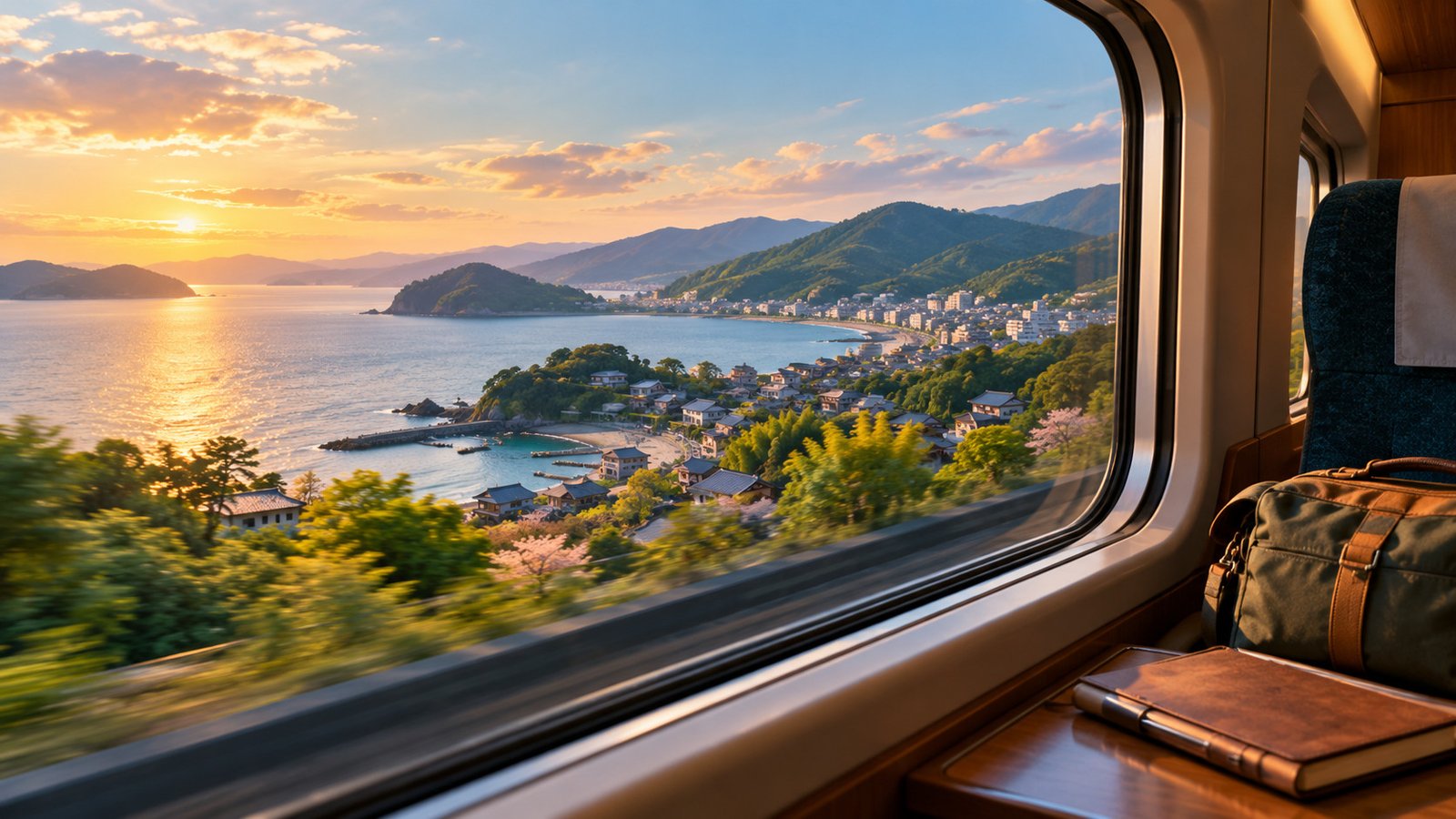
Original AI-generated editorial illustration of an imagined coastal train journey; it does not depict or verify a particular Japanese railway route.
A multi-city Japan route becomes wasteful when the bookings pull in different directions: a Tokyo arrival, an early Osaka hotel, Kyoto afterwards, then another long journey to the departure airport. The answer is not simply to draw the shortest line on a map. It is to make the journey connect the experiences you actually want, in an order that fits the transport network and your flight dates.
Start with the places already on your shortlist. This guide shows how to order them, decide which need an overnight stay and recognise the occasional return journey that genuinely earns its place. The worked examples are planning models, not live timetables or accommodation offers.
Start and finish
Compare airport combinations before committing to the middle of the trip.
Overnight bases
A city visit does not always need a new hotel.
Real connections
Check stations, changes and the final journey to the hotel.
Useful retracing
Keep a return leg when it protects a flight or improves the holiday.
Fix the two ends before the middle
Write the airport codes beside the first and last overnight bases. “Tokyo” is not precise enough for the final travel day, and neither is “Osaka”. Work backwards from the actual departure terminal and the airline’s check-in deadline rather than assuming that a train into the city completes the journey.
Compare a return ticket to one airport with a multi-city flight search that arrives in one part of Japan and leaves from another. This is often called an open-jaw arrangement. An arrival in Tokyo and departure from Kansai can fit a westbound holiday, but it is a comparison to run—not a promise of a cheaper fare or a particular nonstop flight.
Look at the full difference: the airfare, baggage conditions, journey to your UK airport, any unavoidable overnight stay, and the Japanese transport needed to close the route. Paying more for the flights can make sense when it removes a costly final return; a sizeable fare saving can also justify some retracing.
Keep the departure day separate from sightseeing
The final hotel should make the airport journey manageable. A rail journey across a large part of Japan followed by an international flight creates more dependence on everything running to plan. A useful planning default is to finish near the departure region the previous day when the alternative is a long, unprotected same-day connection. That is a risk-management choice, not an airline rule.
Draw a transport corridor, not just a geographical line
For a main-island trip, the Tokaido/Sanyo Shinkansen corridor connects Tokyo, Kyoto, Shin-Osaka and Hiroshima through a sequence of major stops. Use the actual station names in searches: the intercity train calls at Shin-Osaka, which is not the same station as Osaka.[2]
A northern detour needs a different check. Kanazawa can be part of a Tokyo–Hokuriku–Kansai route, but the connection towards Kyoto or Osaka involves the Hokuriku Shinkansen and the THUNDERBIRD service via Tsuruga. Do not copy an old direct-THUNDERBIRD-to-Kanazawa assumption into a new itinerary.[3]
| Shape | Possible order | Why it can work | What to verify |
|---|---|---|---|
| Linear | Tokyo → Kyoto → Osaka | A small number of bases follows the main corridor. | Arrival/departure airport and whether both Kansai hotels add value. |
| Linear with a western return | Tokyo → Kyoto → Hiroshima → Osaka | A wanted Hiroshima stay fits before finishing for Kansai Airport. | The Hiroshima–Osaka return and the onward airport journey. |
| Hokuriku variation | Tokyo → Kanazawa → Kyoto → Osaka | A distinct northern cultural stop replaces, rather than merely adds to, another detour. | The Tsuruga interchange, complete journey and available nights. |
For an island, remote valley or mountain town, investigate the access route before deciding that it is “on the way”. A short straight-line distance can conceal a bus connection, a different railway or an infrequent final leg. If the connection is awkward, an out-and-back day visit from a well-connected base may be simpler than carrying the luggage through.
Separate the places you visit from the places you sleep
Make two lists. One contains the experiences and cities you want to visit; the other contains the hotels you actually need. Add a new overnight base when it provides useful mornings or evenings, makes the next journey easier, or serves a place too far away for a comfortable outing. Do not add one merely to tick a city off.
A single Kansai base may cover the particular Kyoto, Osaka and Nara visits you have selected. A split stay may be better when you want early Kyoto starts and late Osaka meals without repeated return journeys. Neither is universally right: compare your hotel door with the actual places on each day, not just the two main railway stations.
A two-night stay normally gives you one intervening day without checking in or out. Whether that becomes a full sightseeing day depends on your arrival, departure and chosen activities. For a special one-night ryokan stay, the stay itself can be the point; for an ordinary city hotel, a single night needs a stronger logistical reason.
Remove an unnecessary stop: a 13-night comparison
Suppose Tokyo, Kyoto, Hiroshima and Osaka are already the chosen places, and the trip ends at Kansai Airport. Both plans below provide 13 nights in Japan. The only change is consolidating Osaka’s three nights rather than splitting them around other stays.
| Plan | Overnight sequence | Hotel changes | What changes |
|---|---|---|---|
| Fragmented | Tokyo 4 → Osaka 1 → Kyoto 4 → Hiroshima 2 → Osaka 2 | 4 | Osaka is entered as an overnight base twice. |
| Consolidated | Tokyo 4 → Kyoto 4 → Hiroshima 2 → Osaka 3 | 3 | The first Osaka stay disappears; its night moves to the final stay. |
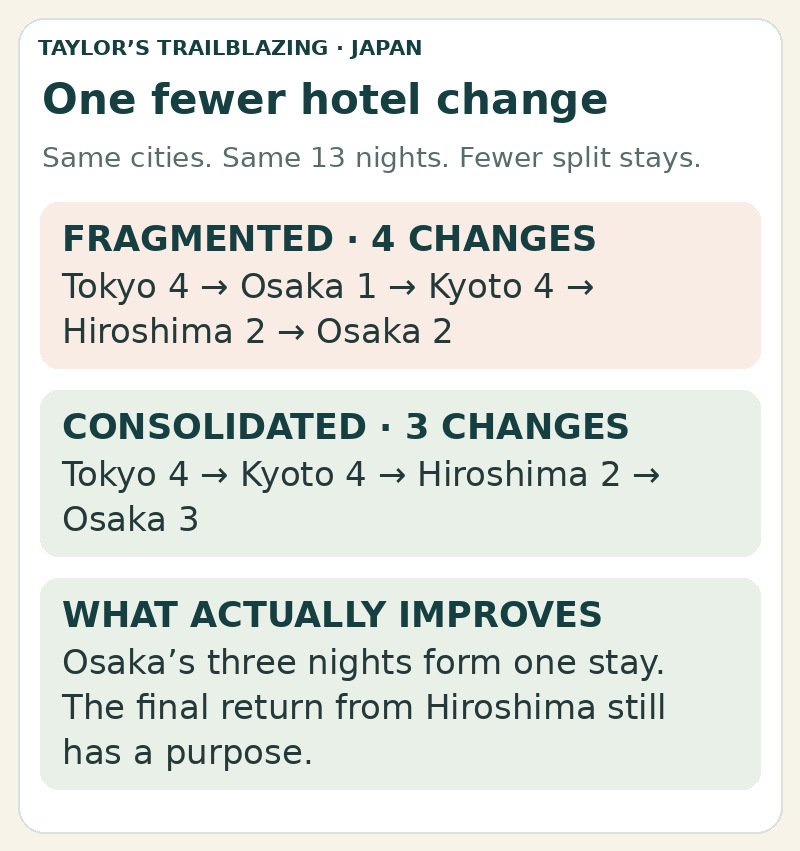
The consolidated version still travels east from Hiroshima to Osaka. That is deliberate: it places the last stay in the departure region. It also passes through the Osaka area on the way west. “Without backtracking” should therefore mean avoiding wasted overnight and travel decisions, not insisting that no train ever crosses the same piece of track twice.
This arrangement does not establish the best route for every reader. A fixed event in Osaka, a booked appointment or an arrival at Kansai could change the order. Keep a date-specific commitment when it is genuinely important, then arrange the rest of the route around it.
Give every hotel change a visible time cost
Headline train times omit packing, check-out, reaching the departure station, navigating the arrival and getting settled again. Put those tasks into the route worksheet separately so that a short rail leg does not look like a nearly free move.
| Task | Assumed time |
|---|---|
| Packing and check-out | 40 minutes |
| Hotel to departure station | 30 minutes |
| Arrival station to next hotel | 40 minutes |
| Check-in, luggage and settling in | 40 minutes |
| Total before the intercity ride | 150 minutes |
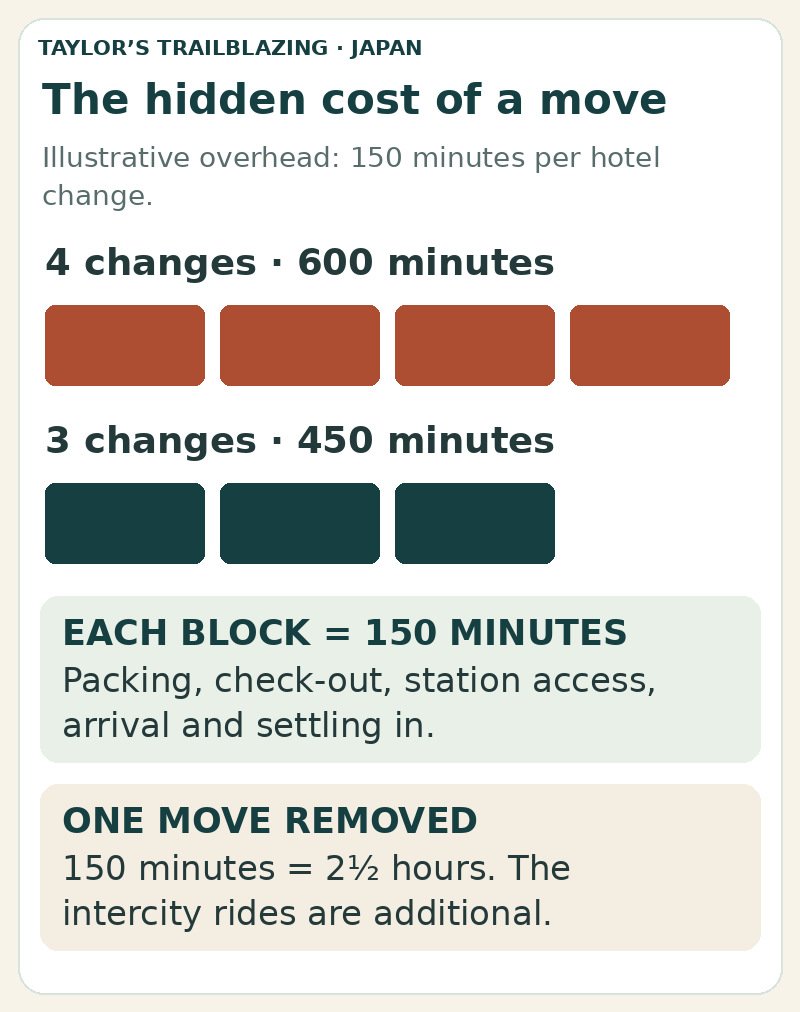
Using that assumption, four changes consume 600 minutes—10 hours—outside the intercity rides. Three consume 450 minutes, or 7½ hours. The saved move releases 150 minutes, or 2½ hours. Replace every input with your own hotel locations, luggage arrangements and working pace; this is an arithmetic illustration, not a claim that every move takes that long.
Now add the actual train or bus journey, any interchange, waiting time and a sensible allowance before the next commitment. Do not schedule a prepaid experience immediately after the train’s advertised arrival merely because the venue looks nearby. A delayed journey is much easier to absorb when the arrival afternoon is flexible.
Test the journeys before making the bookings irreversible
Search every intercity leg in the correct direction, on the likely day and around the time you would actually leave the hotel. Record the stations, number of changes, operator, ticket type and last realistic connection. Check the entire leg rather than treating a search engine’s first result as proof that the whole route is easy.
Check luggage and reservation conditions before choosing a train. SmartEX publishes separate instructions for oversized-baggage seating; a normal reserved seat does not automatically include the relevant storage arrangement.[5]
A rail pass should be evaluated against the finished route, not used as a reason to invent more journeys. In particular, the nationwide Japan Rail Pass does not by itself cover Nozomi or Mizuho use; the applicable additional special ticket is required.[6]
During Golden Week, Obon and New Year, confirm the operator’s peak-period rules and your room requirements early. Holiday congestion changes how replaceable a journey is; it does not make an arbitrary “book everything six months ahead” rule useful.[4]
Keep the detours that earn their place
Retain an apparently inefficient leg when you can name its benefit. It might avoid a very early airport transfer, fit a limited opening day, reach the only suitable accessible room, or make an important visit possible. The cost of an extra journey can be acceptable when it buys something you value.
Cut a stop when you cannot name that benefit. The usual warning signs are a one-night hotel that serves no evening or morning plans, a long detour added because there is a spare pass day, or a repeated city visit that only exists because hotels were booked before the route was considered.
Useful questions before you decide
Should Tokyo always be the first city?
No. Compare flight combinations and fixed-date plans first. Reversing a sensible route can work just as well; the advantage depends on the actual arrival and departure times, not on a rule that every first visit starts in Tokyo.
Can I put every city visit into one rail-pass period?
You can test that option, but do not compress enjoyable stays just to fit a pass. Compare the resulting itinerary, individual tickets and relevant pass coverage, including any additional-ticket requirements.[6]
Does luggage forwarding remove the cost of a hotel change?
It may reduce what you carry, but you still need to check delivery timing, hotel acceptance, essential overnight items and the forwarding charge. Packing, leaving one base and reaching another do not disappear.
What should be fixed before booking accommodation?
At least the airport endpoints, intended overnight bases, essential date-specific commitments and feasible intercity links. Keep rate terms flexible where an unresolved reservation could still alter the plan.
The practical decision
Choose the route that makes each overnight stay useful and each journey explainable. Consolidate nearby visits, compare airport endpoints and count the hidden work of changing hotels. A small amount of purposeful retracing is better than a technically linear itinerary that makes the holiday harder.
Research and planning notes
The route sequences, 13-night allocation and 150-minute hotel-change model are original planning examples. Transport descriptions were checked against the named official sources on 17 October 2026. No flight, room or seat inventory was checked for a traveller’s dates; confirm the final itinerary with the relevant providers.
Sources
Source links and selected high-impact claims independently reviewed on 18 October 2026. Booking rules, operating notices and availability can change; use the current source before making a purchase or fixing a journey.
- Kansai International Airport — access questions Official onward transport information.
- JR Central — Tokaido/Sanyo Shinkansen major stops and peak-period guidance Use the operator’s current dates and train-specific information.
- JR-West — Hokuriku One-way Ticket route information THUNDERBIRD and Hokuriku Shinkansen connections; not a recommendation to buy a pass.
- JNTO — business hours and holiday travel Major holiday periods and operating-hour checks.
- SmartEX — taking baggage onboard Check the applicable oversized-baggage reservation requirements.
- Japan Rail Pass — Nozomi and Mizuho special tickets Additional-ticket requirements for those services.
- 12Go — Tokyo to Osaka comparison page Commercial route listing; no travel-date inventory or price quoted.
Illustrations in this article were created for Taylor’s Trailblazing Travels. Third-party photographs, where used, are credited beside the image or in the source list.