Haneda Airport to Tokyo: Best Transfer for Your Hotel Area
Start with your hotel’s nearest useful exit, then choose the train, coach or car that makes the whole arrival easier.
- Hotel-area selector
- Rail, bus & private car
- Late-arrival plan
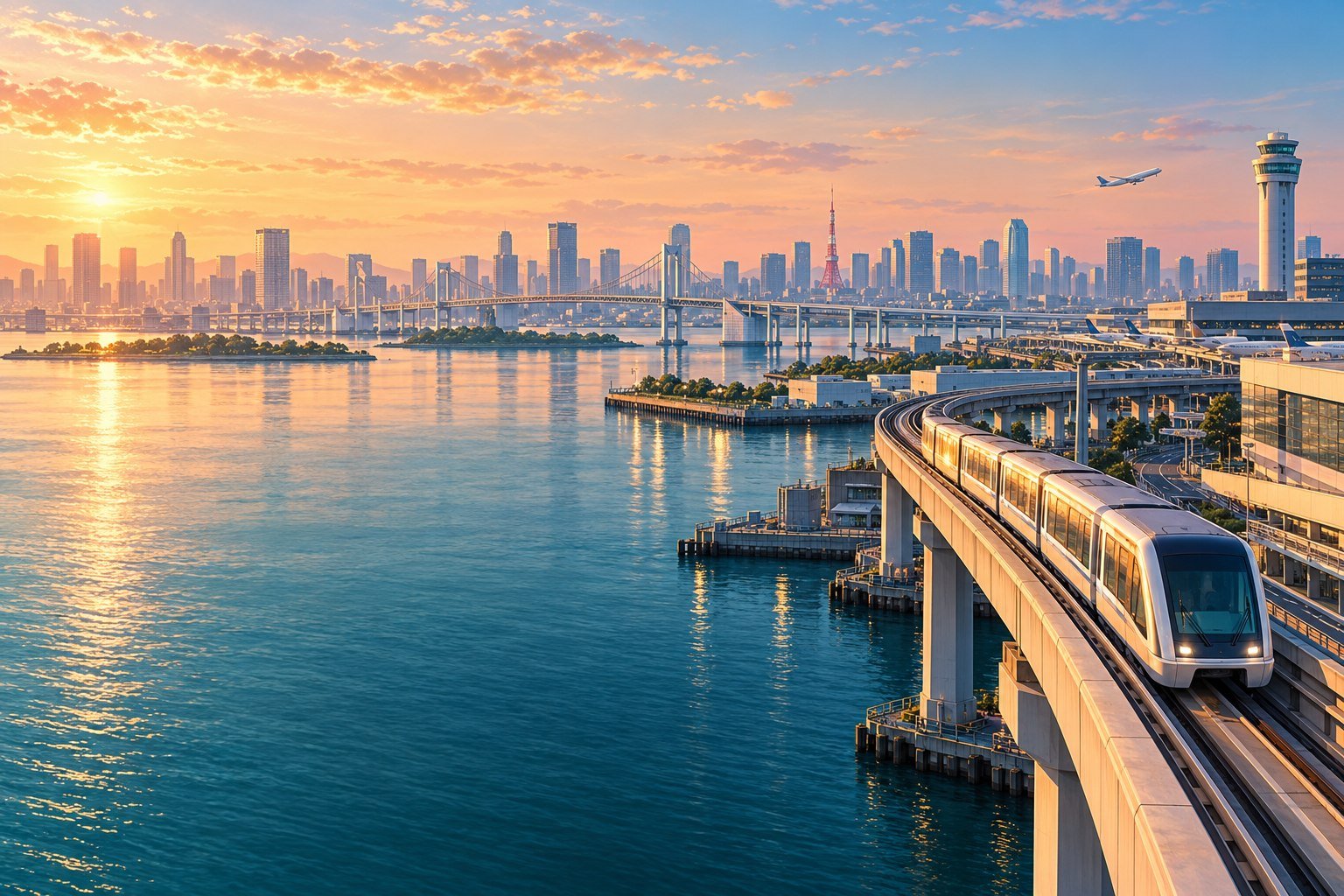
AI-generated editorial illustration inspired by Haneda’s waterfront approach to Tokyo; the train and setting are illustrative, not a verified station view.
The best transfer from Haneda Airport to Tokyo depends on where you will finish the journey. A hotel beside Shinagawa makes Keikyu an obvious starting point. A Hamamatsucho address favours the monorail. For a hotel near a stop on the Toei Asakusa Line, a suitable Keikyu through train can save a change altogether. [4] [7] [10]
Look up the hotel entrance and station exit before buying anything. This guide uses that final walk, the number of changes and your arrival time to choose a practical route. Fares and operating information were checked on 18 October 2026; times are station or bus-stop comparisons, with airport formalities and the hotel’s final approach considered separately.
Some links in this guide are affiliate links. If you book or buy through them, Taylor’s Trailblazing Travels may earn a commission at no extra cost to you.
Keikyu reaches the station directly; check which exit serves the hotel.
The right through train can remove a change; its stopping pattern matters.
Pay more when the actual hotel stop meaningfully reduces walking and baggage handling.
The airport’s last train is useful only if the rest of your journey still works.
Haneda Airport to Tokyo: compare the useful options
Compare the same end point. A ¥330 ticket to Shinagawa does not include an onward JR journey, and a bus advertised for “Shinjuku” may finish on a different side of the district from your hotel.
| Option and end point | Fare | Journey and frequency | Main trade-off |
|---|---|---|---|
| Keikyu to Shinagawa | ¥330 paper; ¥327 IC | As little as 11 minutes; the airport’s general estimate is about 15. Frequent mixed services: check the destination. | Direct for station-area hotels; pay separately for onward JR travel. [1] [2] [4] |
| Keikyu through to Higashi-ginza | ¥550 paper; ¥547 IC in the operator’s route example | Allow around 30 minutes as an initial station-to-station planning guide; the chosen departure may take longer. | Some trains run through; others require a change or skip the stop. [7] [20] |
| Monorail to Hamamatsucho | ¥520 paper; ¥519 IC | Haneda Express as little as 13 minutes; allow about 20 generally. Operator quotes an average five-minute frequency. | Separate onward JR fare unless using an applicable combined ticket or pass. [1] [3] [10] |
| Airport Limousine to Shinjuku | ¥1,400 daytime | About 55 minutes to the station in many daytime T3 services. Area departures roughly every 10–30 minutes; individual hotel stops are less frequent. | Fewer luggage changes; traffic and the precise hotel stop matter. [5] [12] |
| Airport bus to Shibuya | ¥1,300 | Tokyu advertises approximately 45–80 minutes and 22 airport departures a day across this service. | Check whether your departure serves FUKURAS, Cerulean Tower or Mark City. [6] |
| Taxi or booked private car | Quote for your address; Tokyo MK’s Shinjuku daytime base fare is ¥9,000, before extras | Road conditions and your hotel determine the journey. A reservation has its own meeting arrangements. | Door-to-door convenience, with vehicle size and total charges checked in advance. [15] [16] |
These fares are not interchangeable ticket products. The price on a reseller’s selected-date booking screen can differ from the operator’s basic fare, so compare the final total and cancellation terms.
Match the transfer to the hotel entrance
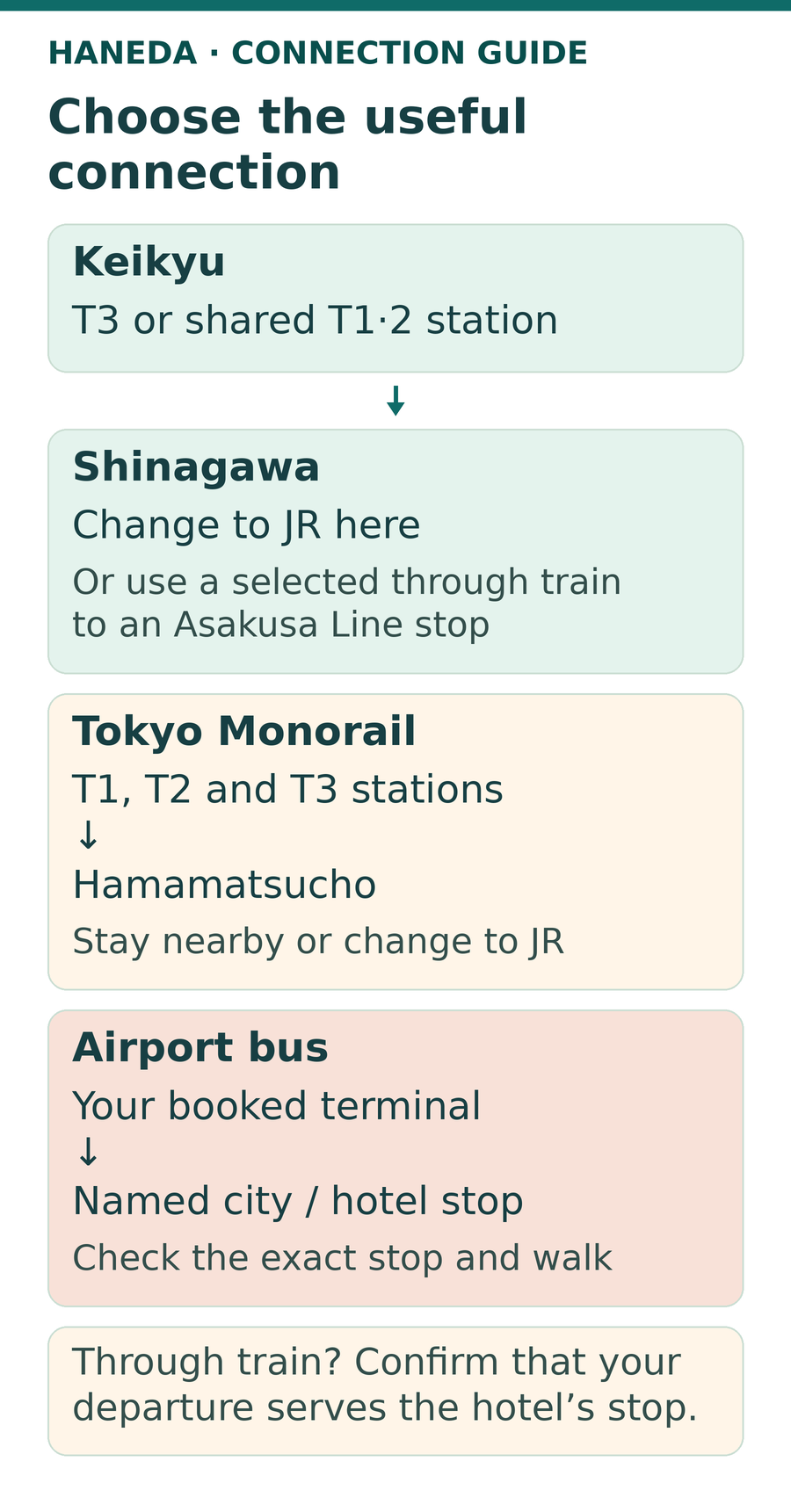
The selector below prioritises three things in order: a station or stop close to the hotel entrance, fewer changes of vehicle, then price. It assumes daytime travel, normal services and luggage you can move yourself. A confirmed hotel bus or an accessibility requirement can change the result.
| Hotel location | Start by comparing | What could change the choice? |
|---|---|---|
| Beside Shinagawa Station | Keikyu directly to Shinagawa | A hotel described as “Shinagawa” may be elsewhere in the ward. Verify its station and exit. |
| Hamamatsucho or Daimon | Monorail to Hamamatsucho; a suitable Keikyu/Toei train to Daimon | Choose the station exit closest to the entrance, especially with heavy cases. |
| Shimbashi, eastern Ginza or Nihombashi | Keikyu through to the relevant Asakusa Line station | Higashi-ginza is a different stop from Ginza. Verify the walk and that the train calls there. |
| Asakusa, Kuramae or Oshiage | A suitable Keikyu through service | Check the exact station and stopping pattern. An “Asakusa” hotel can still leave a substantial final walk. |
| Tokyo Station, Ueno or Akihabara | Monorail plus JR at Hamamatsucho; Keikyu plus JR at Shinagawa | Compare the departure available now and the hotel’s station exit, rather than choosing on the airport leg alone. |
| Shinjuku, Shibuya or Ikebukuro | Keikyu plus JR; monorail plus JR; an exact hotel/area bus | A useful bus stop can outweigh a lower rail fare. A generic district stop may offer little benefit. |
| Roppongi, Akasaka or the waterfront | The hotel’s own access directions and a specific bus route, then the best rail connection | These areas do not share one convenient arrival station. Match the actual address before booking. |
The rail-network relationships come from the airport and railway operators; the hotel-first priorities are this guide’s planning judgement. [1] [4] [7] [10]
Apply a final-walk override
Suppose two hotels cost the same: one is a five-minute walk from a direct rail stop, while the other requires another train and a fifteen-minute walk. The first has the easier arrival even if both advertise the same district. Those walking times are illustrative assumptions: replace them with the hotel’s directions, including the exit with a lift.
If you are still choosing a base, compare Tokyo hotels on Agoda and check Tokyo accommodation on Booking.com. Both links open a Tokyo city search. Use the map and the property’s access information to shortlist hotels; a district filter alone does not establish an easy airport transfer.
Keikyu and monorail: the details that prevent wrong turns
Keikyu: a line-name change may mean staying seated
Some Keikyu trains continue onto the Toei Asakusa Line at Sengakuji. If the route result shows a through service to your station, the change of railway company does not require you to leave the train. Its final destination may be well beyond central Tokyo, so match the service and stopping list rather than looking only for “Tokyo”. [7] [9]
The stopping pattern matters particularly around Ginza and Kuramae. Airport Limited Express services can pass Higashi-ginza, Ningyocho, Asakusabashi and Kuramae. A through train heading in the correct general direction is therefore not automatically the right train for your hotel. Check the platform display or show staff your destination before boarding. [19]
Use the route search for your actual date and terminal. If it specifies a change at Keikyu Kamata or Sengakuji, follow that instruction; do not assume every airport train runs directly through. Ordinary Keikyu/Asakusa Line services do not need a separate limited-express supplement. [7]
Monorail: straightforward to Hamamatsucho, with a real JR change
The monorail serves Terminal 3, Terminal 1 and Terminal 2 separately. Haneda Express and Local use the same basic fare, but make different stops. At Hamamatsucho, follow JR signs if continuing: the monorail does not become a Yamanote Line train. [10]
On eligible days, the ¥590 Monorail and Yamanote Line Discount Ticket covers one airport-to-Yamanote-area journey via Hamamatsucho. It is sold at airport monorail ticket machines on the day of use, with no stopovers. The current calendar includes weekends and holidays through March 2027 and additional specified dates. Simply tapping an IC card does not buy this special ticket. [8]
What are you paying to avoid a change in Shinjuku?
A bus is easiest to justify when it removes both the Hamamatsucho or Shinagawa change and a difficult station-to-hotel walk. Use the actual stop, not the words “Shinjuku area”, to judge that benefit.
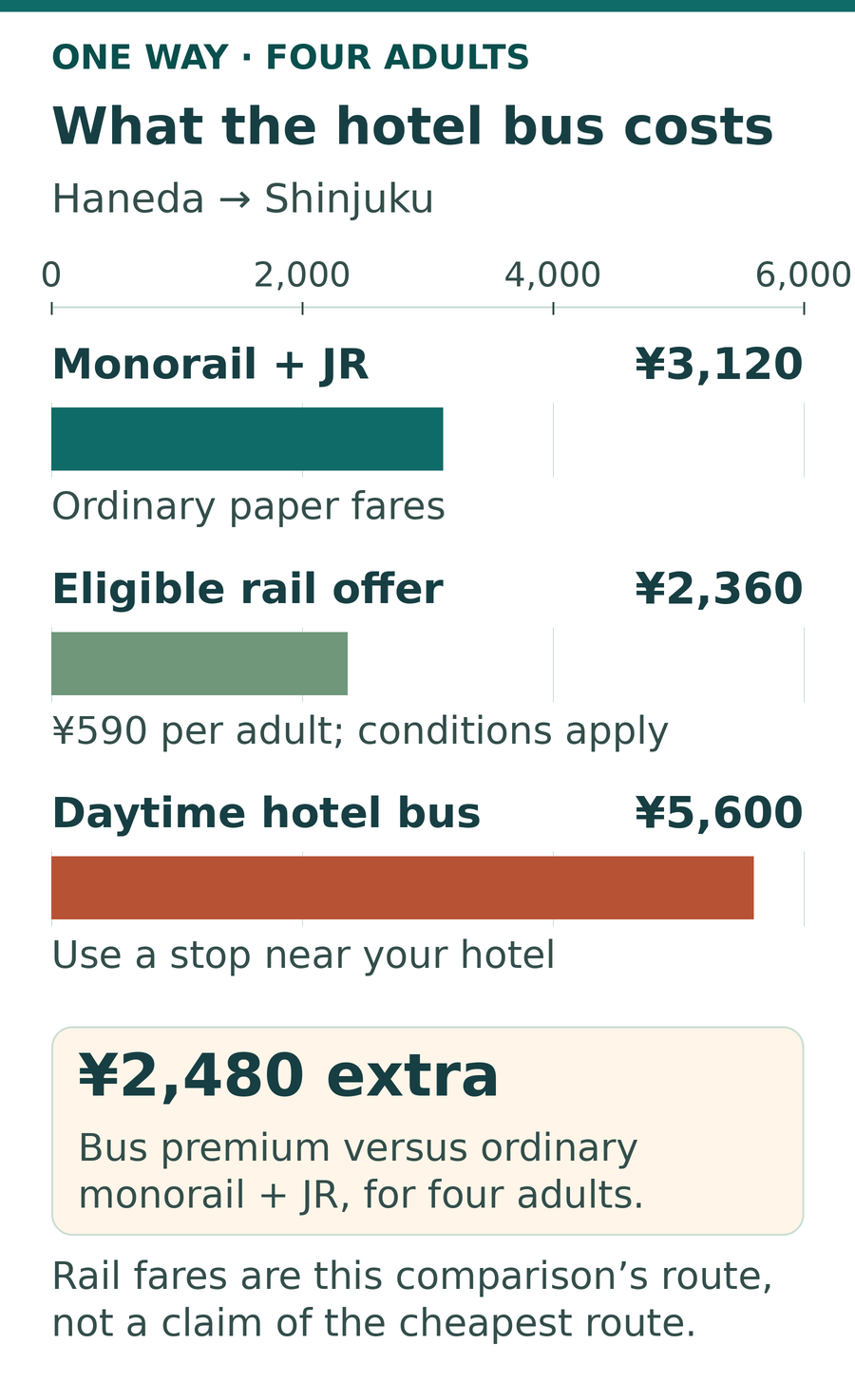
This original cost comparison uses the published ¥780 ordinary paper-ticket total for monorail plus JR to Shinjuku, against the ¥1,400 daytime bus. It assumes adults paying individually, one journey, no existing rail pass and no taxi after arrival. It is a comparison with that rail route, not a claim that the monorail is the cheapest train option. [8] [5]
| Adults | Monorail + JR, ordinary fare | Daytime bus | Extra for the bus |
|---|---|---|---|
| 1 | ¥780 | ¥1,400 | ¥620 |
| 2 | ¥1,560 | ¥2,800 | ¥1,240 |
| 4 | ¥3,120 | ¥5,600 | ¥2,480 |
For four adults, the question is whether removing that change and walk is worth ¥2,480 to the group. With four ¥590 eligible-date tickets, rail becomes ¥2,360 and the bus premium rises to ¥3,240. If your hotel is a short walk from the station, rail keeps more money for the trip. If everyone has a large case and the bus stops at the hotel, the extra spend buys a concrete convenience.
Then check waiting time. The October timetable has many Shinjuku-area buses, but fewer departures call at each individual hotel. Waiting for one hotel service can erase a nominal road-time advantage; a bus is not guaranteed to be quicker. [12]
Compare Haneda–Shinjuku bus options on 12Go alongside the official timetable. Check the airport terminal, exact drop-off, total fare and whether the booking confirms a particular departure or requires a further exchange.
From the arrival hall to your hotel
- Confirm the arrival terminal on your flight information. Some international services use Terminal 2, so “international arrival” does not automatically mean Terminal 3. [23]
- Complete immigration, baggage collection and customs before treating a departure as catchable. Allow for these separately; the train times above begin much later in the arrival process.
- Open a route to the hotel’s useful station or bus stop. Save the Japanese hotel name, full address and entrance directions so you can still navigate if mobile data fails.
- For Terminal 3 rail, use the city-bound Keikyu gates at the second-floor arrival lobby, or the monorail gates on that level. For Terminals 1 and 2, follow the B1 rail signs. Keikyu has a shared Terminal 1·2 station; the monorail has separate terminal stations. [1] [10]
- For ordinary rail, buy a ticket for the intended destination or use a suitable transport IC card. With Keikyu, confirm the train’s stopping pattern. With a bus, select the correct airport terminal, confirm the destination stop and follow the boarding instructions on the ticket. [7]
- At the city stop, check the hotel-side exit before going upstairs or crossing the station. If the lift route is longer, follow it deliberately rather than struggling with stairs.
For maps and messages after leaving the terminal, check Airalo’s eSIM options and select Japan. Check your phone’s eSIM compatibility and the chosen plan’s activation rules before buying; install it with a stable connection. Keep the address and transfer instructions saved offline as well. [18]
Once the arrival route is settled, organise your Tokyo stay and onward nights in the trip itinerary planner. Allow for the airport journey separately, and avoid scheduling a timed activity immediately after the earliest possible station arrival.
Late landings: check the last complete journey
Keikyu’s published last Terminal 3 departure for Shinagawa is 00:08, arriving 00:20; its first morning departure is 05:26. These are the operator’s currently displayed times, checked on 18 October 2026, with a December 2025 timetable note. They do not promise an onward connection to Shinjuku, Asakusa or your hotel. [11]
For an evening flight, search to the final station with the late-night arrival time you could realistically reach after formalities. Check every connection. Getting partway across Tokyo and then needing a taxi may be less useful than arranging the whole journey from Haneda.
Shinjuku and Ikebukuro have a limited overnight bus option
The checked timetable lists Terminal 3 departures at 00:20, 01:00, 01:40 and 02:20, with an adult fare of ¥2,800. These serve specified Shinjuku/Ikebukuro stops, not the usual full hotel circuit. The 00:20 service has a different terminal boarding sequence from the later Terminal-3-only departures. Confirm the exact stop and calendar date when booking after midnight. [5] [12]
This is a useful fallback only if its final stop leaves a manageable route to the hotel. Four adult overnight bus tickets total ¥11,200, so a group should also request a complete car quote for its address. Do not assume a standard taxi accommodates four people plus four large cases.
If no suitable public-transport journey remains, use the official taxi rank, a correctly arranged private transfer or a confirmed airport-area hotel. Tell your Tokyo hotel about a delayed arrival and check its overnight reception arrangements before travelling.
Luggage, accessibility and the case for a private car
Compare the whole physical journey
For rail, count what you must move through the terminal, at any interchange and along the final street. Being able to lift a suitcase once is different from comfortably managing it while also supervising a child. At Terminal 3, Keikyu’s access guide identifies a lift down to the platforms; ask station staff about assistance and the destination’s step-free exit. [23]
Airport Limousine permits up to two checked suitcases per person, each within 50 × 60 × 120 cm and 30 kg. Keep passports, valuables and power banks with you rather than in the luggage hold. Check separately for unusual luggage or equipment. These are this operator’s rules, not a blanket allowance for every Tokyo bus. [13]
A luggage-friendly coach is not automatically wheelchair accessible. Ordinary coaches require boarding steps and transferring to a seat. Selected Shinjuku Expressway Bus Terminal–Haneda and T-CAT–Terminal 3 services offer wheelchair facilities; confirm a suitable vehicle and reservation rather than relying on the route name. [14]
Ask for an all-in quote before comparing cars
Use the hotel’s complete address, flight number, terminal, number of people and number and size of bags. Ask whether the price includes tolls, parking, waiting, a child seat and the required meeting service. Establish when the waiting allowance starts and what happens after a flight delay.
For scale, Tokyo MK publishes a Shinjuku taxi base fare of ¥9,000 by day and ¥10,700 under its late-night rules. Tolls and applicable booking or optional service charges are extra. A packaged private transfer can have a different price structure, so compare complete quotes rather than that base fare alone. [16]
Check the Tokyo private airport transfer on GetYourGuide if you want to arrange the airport-to-hotel journey in advance; select Haneda and the arrival direction. For an alternative, compare the Haneda arrival transfer on Viator. The Viator listing states that it is not wheelchair accessible. Anyone needing to remain seated in a wheelchair should confirm the vehicle and boarding method with an appropriate provider before booking. [21] [22]
For a taxi on arrival, follow airport signs to the official rank. A booked or app-dispatched car may use a different collection point: use the booking instructions rather than assuming your driver will be at the public taxi queue. [15]
Questions before you travel
Does a Japan Rail Pass make the monorail the best choice?
An already valid nationwide JAPAN RAIL PASS covers Tokyo Monorail and eligible JR trains. That can make the monorail route attractive, but it does not shorten a difficult final walk. Avoid using a valuable pass day solely for an inexpensive airport transfer unless it fits your wider itinerary. [17]
Should I go to Tokyo Station first if my hotel is elsewhere?
Only when it makes the onward route useful. Shinagawa, Hamamatsucho or a direct Asakusa Line stop may fit your address better. Put the hotel’s actual station into the route search; “Tokyo” is both a city and a particular station.
Can I use the same transfer plan when flying home?
Use the same route as a starting point, then search the return direction for the exact departure terminal and required airport arrival time. Bus boarding points and reservation arrangements may differ by direction. Add the airline’s check-in allowance separately from ground travel. [6]
What if my hotel is near Ginza rather than Higashi-ginza?
Check its entrance on a map before deciding to change trains. Walking from Higashi-ginza may be convenient, but it depends on the address. Also confirm the chosen through service stops there: Airport Limited Express services can pass it. [19]
Can I reserve a monorail seat or arrange wheelchair assistance?
Monorail seats cannot be reserved. For a wheelchair journey, the operator says station staff help with boarding and alighting, and coordinate with JR staff for a transfer. Ask for that assistance and confirm the route through your destination station as part of planning the journey. [24]
Make your transfer choice
For a straightforward daytime arrival, choose the rail route that finishes closest to your hotel with the fewest useful changes. Pay for the bus when its precise stop removes a difficult walk or interchange. Choose a suitably sized private car when luggage, mobility needs or a late arrival make public transport impractical. Before you buy, settle three details: the terminal, the hotel entrance and the last connection you actually need.
Continue planning with the Japan travel hub and its Japan transport section.
Sources and editorial method
Editorial review: 18 October 2026. Core fares and routes have been cross-checked against official transport information. Timetables, ticket eligibility and commercial listing terms can change; confirm your travel date, terminal and selected option before paying.
Hotel-area recommendations are editorial judgements. The route selector and cost comparison are original planning tools, with their inputs and assumptions stated beside them; they are not observed or guaranteed journeys. Private-transfer terms describe the named listing and option, rather than every car service.
- Haneda Airport: train access and terminal ticket gates
- Keikyu: fares from Haneda Airport Terminal 3
- Tokyo Monorail: regular and IC fares
- Keikyu: journey times and through services
- Airport Limousine: Haneda to Shinjuku timetable and fares
- Tokyu Bus: Haneda services to Shibuya
- Toei Transportation: airport access
- Tokyo Monorail: Monorail and Yamanote Line Discount Ticket
- Keikyu: train types and destination displays
- Tokyo Monorail: Hamamatsucho access and train types
- Keikyu: first and last airport trains
- Airport Limousine: timetable revision from 1 October 2026
- Airport Limousine: baggage guidance
- Airport Limousine: customers with disabilities
- Haneda Airport: taxis and reserved pick-ups
- Tokyo MK: published airport taxi fares
- JAPAN RAIL PASS: conditions for use
- Airalo: Japan eSIMs
- Keisei: through-train stopping-pattern example
- Keikyu: Higashi-ginza fare example
- GetYourGuide: Tokyo private airport transfer
- Viator: Haneda arrival transfer to central Tokyo
- Keikyu: from the terminal to the station
- Tokyo Monorail: seating and wheelchair assistance
Illustrations in this article were created for Taylor’s Trailblazing Travels. Third-party photographs, where used, are credited beside the image or in the source list.