Fukuoka Travel Guide: City Sights and Kyushu Connections
Give the city two days, then choose the Kyushu journeys that deserve your time.
- City time · Two full days
- Base choice · Hakata or Tenjin
- Beyond the city · One excursion at a time
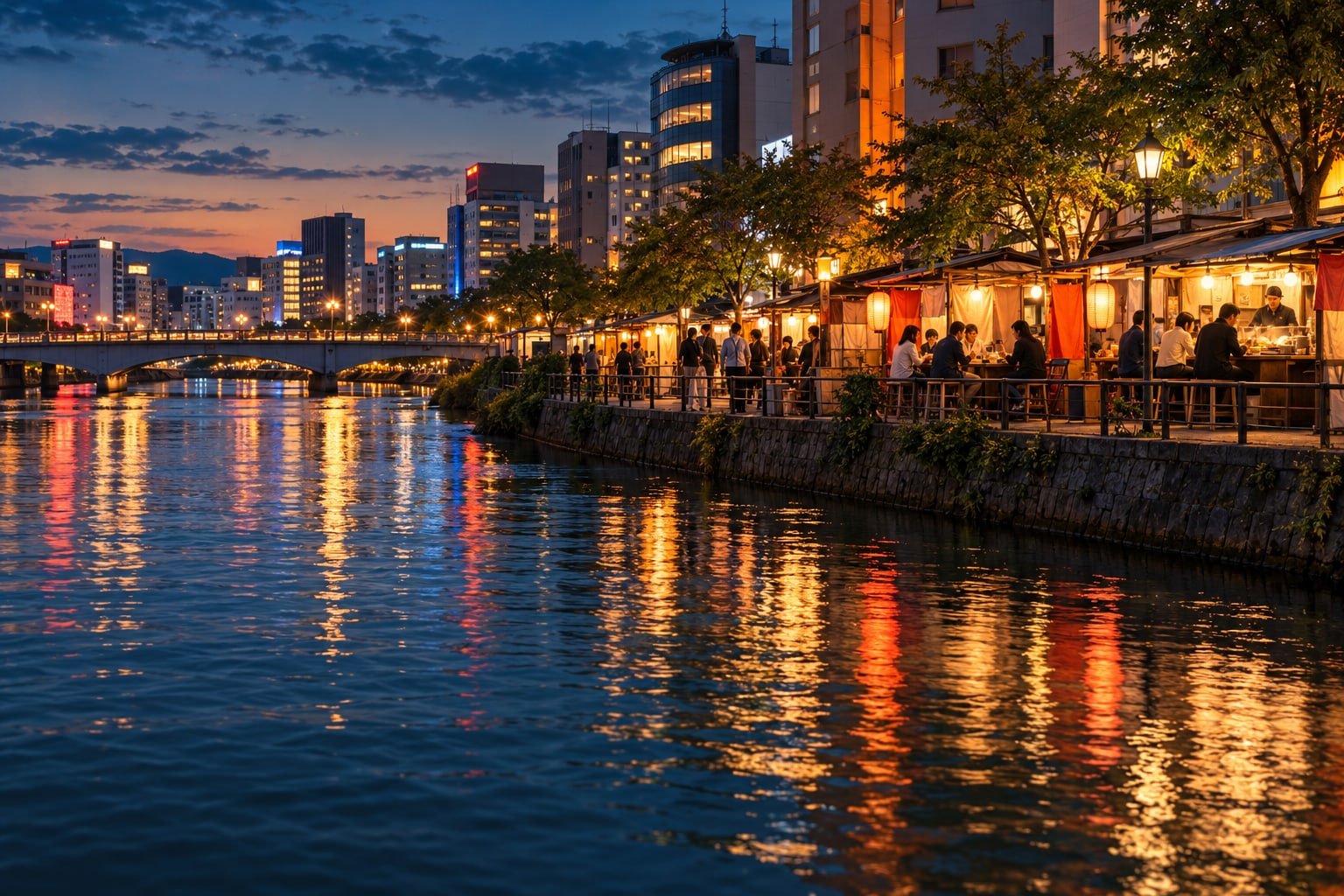
AI-generated editorial illustration inspired by Fukuoka’s riverside food culture; an imagined composition, not a photograph of a verified stall or venue.
Fukuoka works particularly well when you give the city a purpose before using it as a gateway. Hakata’s temples and merchant history, the shopping streets around Tenjin, Ohori Park and the waterfront offer different sorts of days within one stay.[1] Food can shape the evenings without making every meal a queue for the same bowl of ramen.
This Fukuoka travel guide starts with two city days, then tests the wider Kyushu possibilities against the time they consume. A fast train creates an option; it does not automatically make returning to the same hotel the best choice.
This guide contains affiliate links. If you book or buy through them, Taylor’s Trailblazing may earn a commission at no extra cost to you.
Only one full day?
Choose Hakata Old Town, a city meal and either Tenjin or Ohori Park. Give the distant excursion to another trip.
Several JR departures?
Hakata reduces the repeated local journey to the intercity station. Check the actual hotel entrance and station exit.
A third day to spend?
Choose Dazaifu, one rail day trip or a move to the next base. These are alternatives, not a single-day circuit.
Considering a rail pass?
Price the journeys you will really take on consecutive days, then compare the correct pass area and purchase channel.
How many days does Fukuoka need?
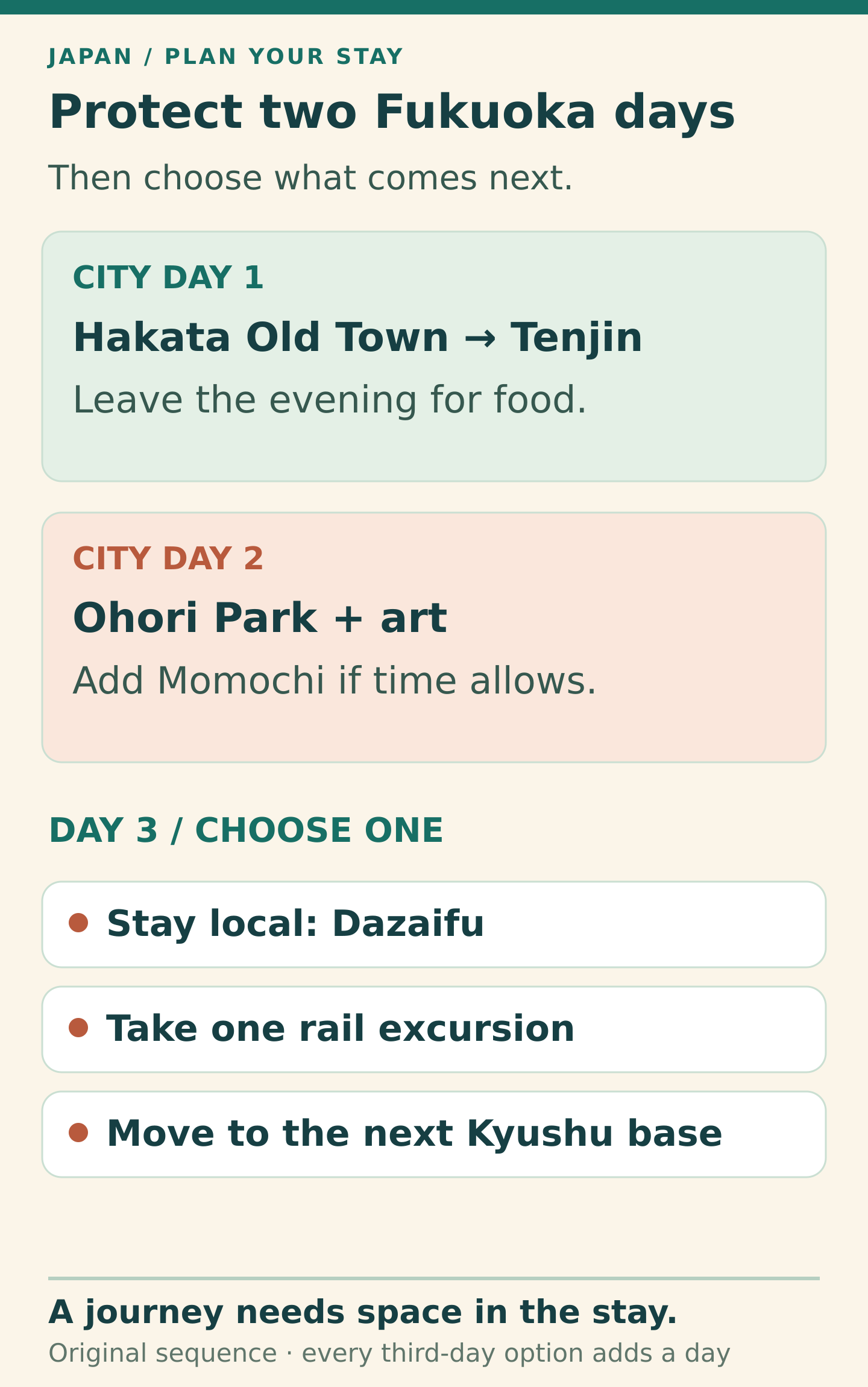
Two full city days are the most useful starting point for a first visit. This is an editorial allowance for ordinary walking, meals and some flexibility, rather than an attraction operator’s minimum. Two nights work if an arrival or departure day gives you substantial sightseeing time; a late arrival followed by an early departure usually calls for three nights.
| Usable time | Suggested focus | Decision to make |
|---|---|---|
| One day | Hakata Old Town, lunch, then Tenjin or Ohori Park | Choose shops and food or a park and museum afternoon |
| Two days | Day one: old Hakata and a central evening. Day two: Ohori, art and optional Momochi | Keep the coast optional if the weather or your energy changes |
| Three days | The two city days plus one excursion | Choose a nearby outing, a rail day trip or an onward move |
The named city areas follow Fukuoka’s official visitor geography; the sequence above is our planning recommendation.[1] If this is part of a longer national itinerary, use the guide to how many days to spend in Japan before taking days away from your other stops.
Hakata, Tenjin or another neighbourhood?
Choose a base by the journey you will repeat most often. The centre has several useful districts, but a station name on a listing is less helpful than the walk from the platform, the entrance you will use and the route back after dinner.
| Area | Best reason to choose it | Trade-off |
|---|---|---|
| Hakata Station | JR arrivals, early departures and repeated Kyushu rail trips | You will travel across the centre for some Tenjin evenings |
| Tenjin / Daimyo | Shopping, restaurants and Nishitetsu departures | Allow a local transfer before a train from Hakata |
| Nakasu-Kawabata | A central position near the river and old Hakata | Check the exact street and room location if evening noise matters |
| Ohori / Akasaka | A park-oriented stay with time for slower mornings | Less convenient for repeated intercity departures |
The transport hubs and area character are sourced; the suitability judgements are editorial.[1]
Once you have chosen an area, search Fukuoka accommodation on Agoda and compare Fukuoka hotels on Booking.com. Both links open city searches. Compare the same room occupancy, bed arrangement, cancellation deadline and final payable total; then check the map yourself. A lower headline price may be less useful if it adds a transfer to every excursion.[22][23]
The city sights that work well together
Hakata Old Town: temples, craft and merchant history
Start around the temple streets east of the central river. Tochoji, Kushida Shrine and the Hakata Machiya Folk Museum give you different ways into old Hakata: religious life, festival traditions and everyday history. The folk museum introduces local life in the late nineteenth and early twentieth centuries.[2]
Pick two or three stops and leave time between them. Temples and shrines are working religious places; follow the rules at each entrance and treat photography permission as specific to that space. A short, attentive visit is more useful than collecting names without understanding what you are seeing.
Ohori Park, Maizuru and the art museum
Ohori’s large pond and paths provide a natural change of pace.[3] The neighbouring Maizuru area contains Fukuoka Castle ruins, so expect stonework, grounds and viewpoints rather than an intact castle tower.[28] You can make the park the whole afternoon or add one indoor visit.
Fukuoka Art Museum’s collection admission is ¥200 for an ordinary adult ticket; major special exhibitions are priced separately. It normally closes on Mondays, or the following weekday when Monday is a national holiday. Standard hours are 09:30–17:30, with later Friday and Saturday opening from July to October. Check the exhibition calendar before making it the centre of a rainy day.[4]
Tenjin and Daimyo: leave room for an ordinary city evening
Tenjin suits browsing, department stores and dinner, with Daimyo adding smaller streets and independent shops.[1] Keep this part loose. A useful city visit can include an hour in a bookshop or a café; it does not need another ticketed sight to justify the time.
Momochi: add the coast when it improves the day
Momochi pairs a beach-side walk with Fukuoka Tower’s observation deck. The observation level is 123 metres above ground, distinct from the tower’s overall height.[5] Go for the outlook when visibility is good; compare the final local journey before adding it after a long museum visit.
Fukuoka City Museum planning note: the previously proposed full closure around October 2026–March 2029 has been withdrawn from its renovation schedule after the tender was cancelled. The future closure period is under review. Separate forecourt works affect access, so check the museum’s current notice before visiting Momochi; do not assume that older closure dates still apply.[6]
Eat beyond ramen, and approach yatai as small restaurants
Hakata-style tonkotsu ramen is a good introduction, but Fukuoka’s food identity also includes udon, yakitori and motsunabe, an offal hotpot. Build meals around what you actually enjoy: a noodle lunch leaves a different appetite from a substantial evening hotpot.[7] If you have dietary restrictions, check the broth and sauces as carefully as the visible toppings.
Yatai are compact food stalls, with many opening around 18:00. Weather and individual working days affect which stalls appear. Expect limited seats, choose from the displayed menu and prices, and order modestly before deciding whether you want more. Carry cash and keep a restaurant alternative in mind. Fukuoka’s official yatai guidance encourages sharing limited seating considerately and avoiding long stays after eating.[8]
Going independently is straightforward if you are comfortable choosing a stall and asking about the menu. If language or unfamiliar dishes would otherwise stop you trying it, the Nakasu food-stall guided tour on GetYourGuide offers a guided option. Its listing describes a ¥1,000 food-and-drink allowance per stall; check exactly what is included and what you would pay beyond that allowance. A guide buys interpretation and help with ordering, not a guarantee of a particular stall or an empty counter.[9]
Airport access and getting around Fukuoka
The airport is unusually close to the centre, but the terminal distinction matters. The airport operator gives roughly five minutes by subway between the domestic terminal and Hakata, and around ten to Tenjin. These are train times, not the time from aircraft seat to hotel.[10]
The subway station connects directly to the domestic terminal. International arrivals using the subway first take the free inter-terminal shuttle to the domestic side. Add immigration, baggage, the shuttle and waiting time to your plan; a direct bus may be more useful for some destinations. Check the actual airport access page for your terminal and hotel.[11]
For city sightseeing, combine the subway with walking. The adult subway one-day pass costs ¥640 and covers the three municipal subway lines. A ticket bought from a station machine is for the day of purchase; it does not include ordinary buses, Nishitetsu trains or JR journeys.[12]
Eligible contactless bank-card travel also has a ¥640 daily subway ceiling. Use the same payment medium at every entry and exit: the physical card and its phone-wallet version are not interchangeable for this calculation. This is different from assuming that any transport IC card automatically becomes a day pass.[13] If you only plan a couple of rides, compare the actual single fares first.
Save your hotel address and planned routes offline. For live maps and onward searches, compare your existing roaming allowance with a local data option. You can open Airalo and select Japan; check eSIM compatibility, that the phone is unlocked, Japan coverage, plan duration and the activation rules before buying.[24]
Dazaifu: a useful first excursion
Dazaifu Tenmangu is a manageable choice when you want a different setting without committing the whole day to long-distance travel. From Nishitetsu Fukuoka (Tenjin), the shrine’s official directions use the Tenjin-Omuta Line with a change at Nishitetsu-Futsukaichi for Dazaifu. The rail journey is about 30 minutes, followed by the approach to the shrine.[14]
Worship in front of the main hall resumed on 19 September 2026. At the time of checking, the shrine’s grounds guide described the temporary hall as being dismantled. Check current approaches and any ceremonial arrangements before visiting.[26][27]
Allow a half-day as an editorial starting point, adding time for a museum, a longer meal or a slower pace. A morning out and a Fukuoka evening can fit well. Do not apply a JR pass to this Nishitetsu journey; it is a different operator.[18]
Yanagawa makes this a fuller day rather than a quick extra stop. If you want both places with the connections organised, compare the Dazaifu and Yanagawa guided train-and-boat day on Viator. The product is a guided rail-and-canal outing, so read the selected option’s train and boat inclusions, meeting point, lunch arrangements and cancellation terms. Independent travel remains a reasonable choice when you want to spend longer at just one place.[15]
Kyushu connections: day trip or a new base?
Hakata is the useful JR station name for Fukuoka. Start with the destinations you care about, then examine both directions of the journey. The approximate times below are station-to-station planning ranges from JR Kyushu’s published timetable; the individual train and date matter.[16]
| Destination | Rail pattern and approximate time | Our planning judgement |
|---|---|---|
| Kumamoto | Kyushu Shinkansen; around 40–50 minutes on faster services | A plausible focused day trip; add the local journey beyond the station |
| Nagasaki | Limited express plus Kamome at Takeo-Onsen; roughly 1½–1¾ hours | Possible in a day, more satisfying overnight for history and an evening |
| Beppu | Sonic limited express; roughly 2–2½ hours | Consider staying, especially when the hot-spring experience matters |
| Kagoshima-Chuo | Kyushu Shinkansen; roughly 1½ hours on faster services | A useful onward base; the station journey is only part of a wider visit |
These ranges exclude hotel access, boarding margins and destination travel.[16] The Nagasaki journey requires a train change: JR describes the connection at Takeo-Onsen as opposite sides of the same platform. Buy a ticket covering the complete rail journey.[17]
A ten-hour day-trip test
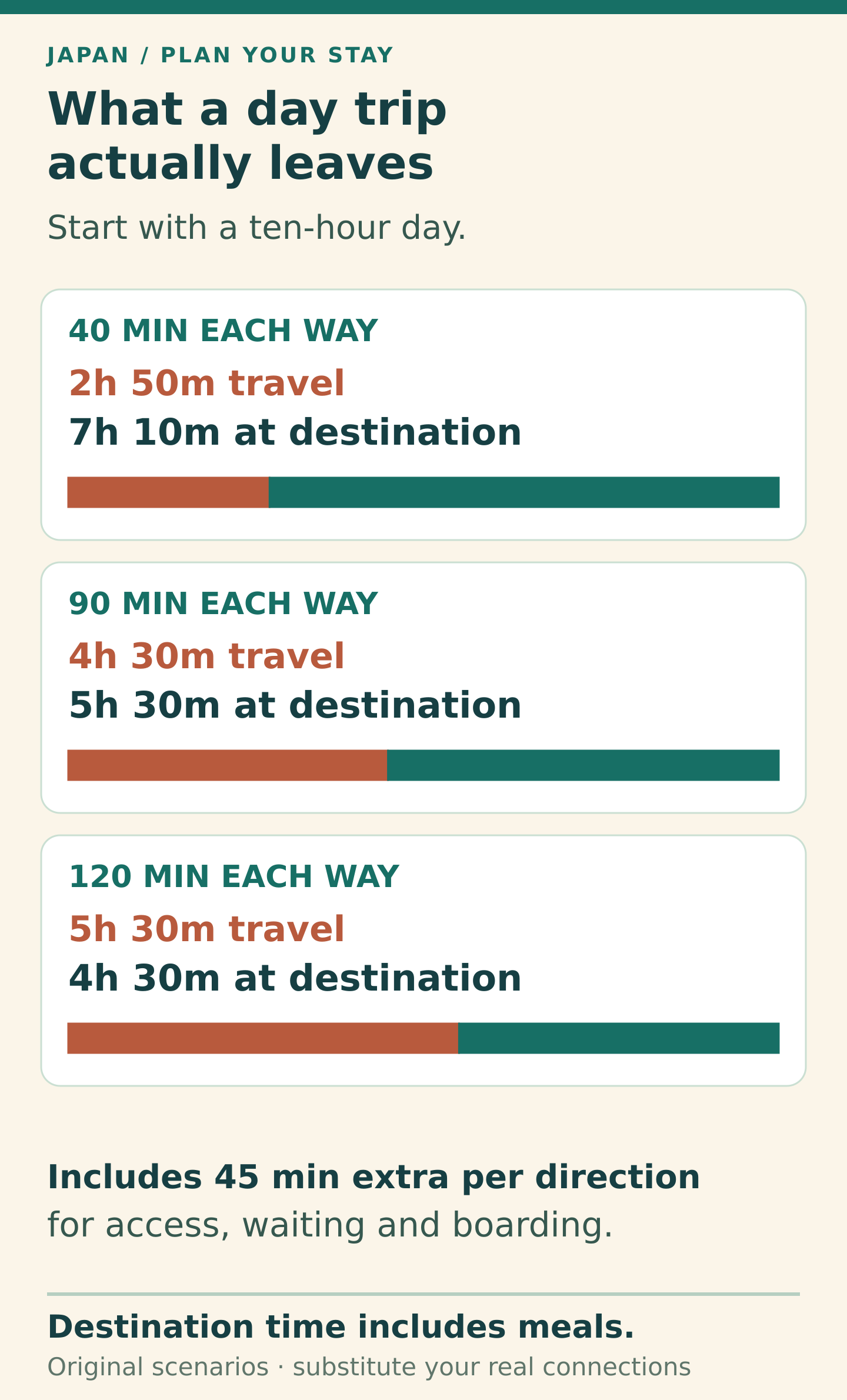
Use this original model before booking repeated returns: start with ten hours away from the hotel, add your actual train time in each direction, then allow 45 minutes per direction for local access, waiting and boarding. With a 40-minute train, that leaves seven hours ten minutes at the destination. With 90 minutes on the train it leaves five hours thirty minutes; with two hours it leaves four hours thirty minutes.
The remaining time includes meals, queues and sightseeing. These are illustrative scenarios, not promises for the cities in the table. Increase the allowance for a distant attraction or unfamiliar transfer. If the experience you want already fills the remainder, an overnight stay gives you more flexibility than an earlier alarm and a later return.
For the Nagasaki leg, compare Fukuoka–Nagasaki transport on 12Go alongside the operator’s own options. The route page includes bus services as well as other transport searches. Compare the precise departure point, arrival point, luggage allowance and ticket conditions; a bus departure from Tenjin and a rail departure from Hakata are different local journeys.[20]
Rail passes, city spending and accommodation tax
Buy a regional pass for a priced itinerary
A JR Kyushu pass is unnecessary for a city-only stay. For eligible overseas visitors, the Northern Kyushu three-day pass is ¥14,000 through JR Kyushu’s own online booking site, compared with the ¥15,000 standard price through other listed sales channels. Check the current channel and conditions rather than assuming every seller has the same price.[19]
Its days are consecutive and its area has limits. It covers eligible JR routes in northern Kyushu, including the relevant Nagasaki and Kumamoto services, but not the Sanyo Shinkansen between Hakata and Kokura. Local subway, Nishitetsu and ordinary bus journeys are also outside it. Eligibility requires the stated overseas-passport and Temporary Visitor conditions.[18]
Write down the exact journeys, check date-specific individual tickets, and compare the total. A pass can offer flexibility even when savings are small, but spending an extra day on a train to justify a pass rarely improves a city break. Our Japan trip-cost guide for UK travellers helps place these transport choices within the whole holiday budget.
A transparent city-day example
A subway-pass day plus Fukuoka Art Museum’s collection ticket totals ¥840 before food, accommodation and other admissions: ¥640 + ¥200. Add your own meal allowance instead of treating one published average as your likely bill.[12][4] A park-and-neighbourhood day can be cheaper; a special exhibition, observation deck or guided food evening adds its own cost.
Fukuoka City’s accommodation tax is ¥200 per person per night when the taxable accommodation charge is below ¥20,000, or ¥500 when it is ¥20,000 or more. Those amounts already include the prefectural component; do not add it again. Check whether your booking total includes the tax and how the property will collect it.[21]
Choose dates, then keep a weather alternative
Spring flowers and autumn colour give the parks an extra reason to feature in the plan. The city’s seasonal guide places typical cherry viewing around late March to early April and autumn leaves in November, but actual conditions vary. Hakata Dontaku in May, Yamakasa in July and the November sumo tournament can also shape a visit; confirm the particular year’s event dates before booking around them.[25]
For a walking-focused first visit, spring or autumn is a sensible preference. In warmer months, leave indoor breaks and watch transport notices if heavy weather is forecast. Winter still works for food, art and city neighbourhoods, but Fukuoka is not reliably warm simply because it is on Kyushu.[25]
Use one practical substitution rule: if visibility is poor, replace the tower and coast with an open museum or shopping district; if a yatai evening falls through, choose a restaurant near your base. On a museum closure day, swap the two city days rather than forcing a long excursion you did not want.
Your Fukuoka questions answered
Is Fukuoka worth visiting without travelling around Kyushu?
Yes, especially for a short city break centred on food, old Hakata, parks and shopping. Two full days give these interests room without requiring a distant day trip. Whether it belongs in your wider Japan itinerary depends on what you would give up elsewhere.
Is Hakata a different city from Fukuoka?
For travel planning, Hakata is the district and major JR station you will use within Fukuoka City. Look for Hakata when booking intercity rail; use Fukuoka for the destination and airport.[1][17]
Can I use Fukuoka as my only base for Kyushu?
You can make selected rail day trips, but several distant returns can consume much of the stay. Compare hotel-to-hotel time, not just the fastest train. Move base when you want evenings, early starts or substantial activities beyond the destination station.
Choose the plan that fits your trip
Start with a hotel that suits your repeated journeys and two usable city days. Then choose one extra direction for the time you have left. Fukuoka is easier to enjoy when the park afternoon, the meal and the onward train each have enough space in the plan.
How this guide was researched
This guide was researched from official tourism, attraction and operator information checked on 17 October 2026, with merchant pages used only to verify the described booking destinations. It does not claim a personal visit or product test. Stay lengths, neighbourhood recommendations and the ten-hour excursion model are editorial planning tools; their assumptions are stated where they appear. Prices and operating arrangements can change, so confirm the linked source for your travel date.
Sources and checks
Official, operator and relevant booking information checked on 17 October 2026 and 18 October 2026. Opening arrangements, fares and availability can change; recheck the linked source for your travel dates.
- Fukuoka City — area guide
- Fukuoka City — history and heritage in Hakata Old Town
- Ohori Park — official visitor information
- Fukuoka Art Museum — hours and admission
- Fukuoka City — Fukuoka Tower
- Fukuoka City Museum — renovation notices
- Fukuoka City — food guide
- Fukuoka City — yatai visitor guidance
- GetYourGuide — Nakasu food-stall guided tour
- Fukuoka Airport — first-time airport use
- Fukuoka Airport — subway access
- Fukuoka City Subway — one-day pass
- Fukuoka City — contactless subway payment
- Dazaifu Tenmangu — official access
- Viator — Dazaifu and Yanagawa guided train-and-boat day
- JR Kyushu — timetable, 14 March 2026 to 28 February 2027
- JR Kyushu — Relay Kamome and transfers
- JR Kyushu — regional rail pass terms and coverage
- JR Kyushu — online pass prices and sales-channel comparison
- 12Go — Fukuoka to Nagasaki route search
- Fukuoka City — accommodation tax
- Booking.com — Fukuoka city accommodation search
- Agoda — Fukuoka city accommodation search
- Airalo — how its eSIM marketplace works
- Fukuoka City — seasonal highlights
- Dazaifu Tenmangu — main-hall approach notice, 19 September 2026
- Dazaifu Tenmangu — temporary hall and grounds information
- Fukuoka City — Fukuoka Castle and Korokan area
Illustrations in this article were created for Taylor’s Trailblazing Travels. Third-party photographs, where used, are credited beside the image or in the source list.