7 Days in Japan: A Tokyo and Kyoto First-Timer Itinerary
Two contrasting cities, one intercity journey and a week that leaves room to enjoy both.
- 7 calendar days · 6 nights
- Tokyo 3 · Kyoto 3
- Arrive Tokyo · depart Kansai
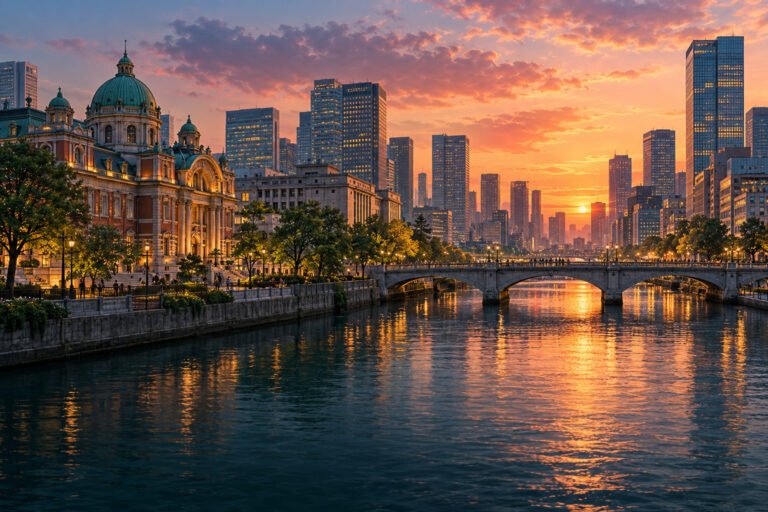
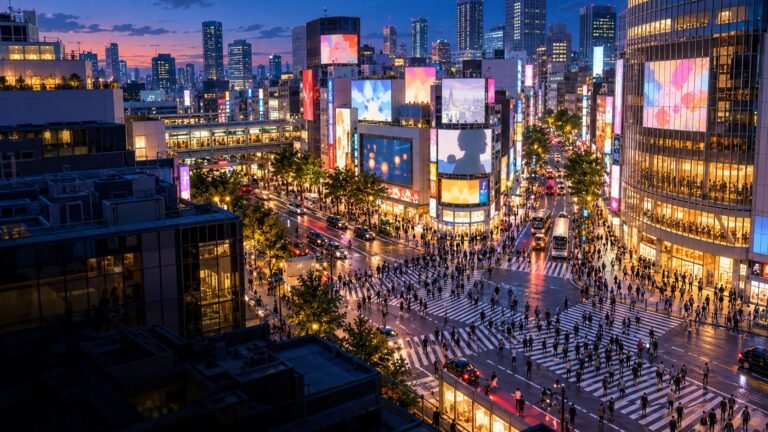
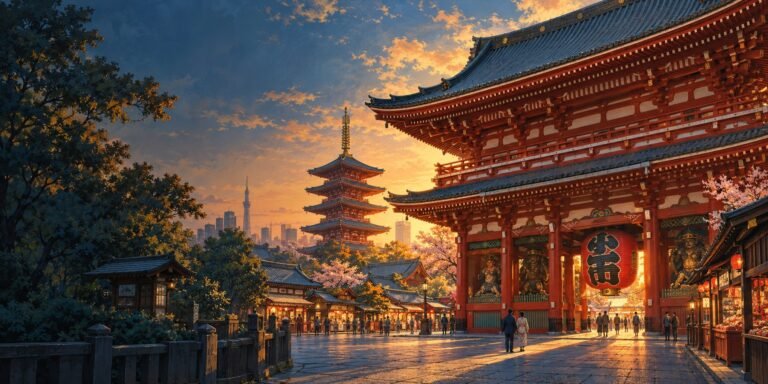
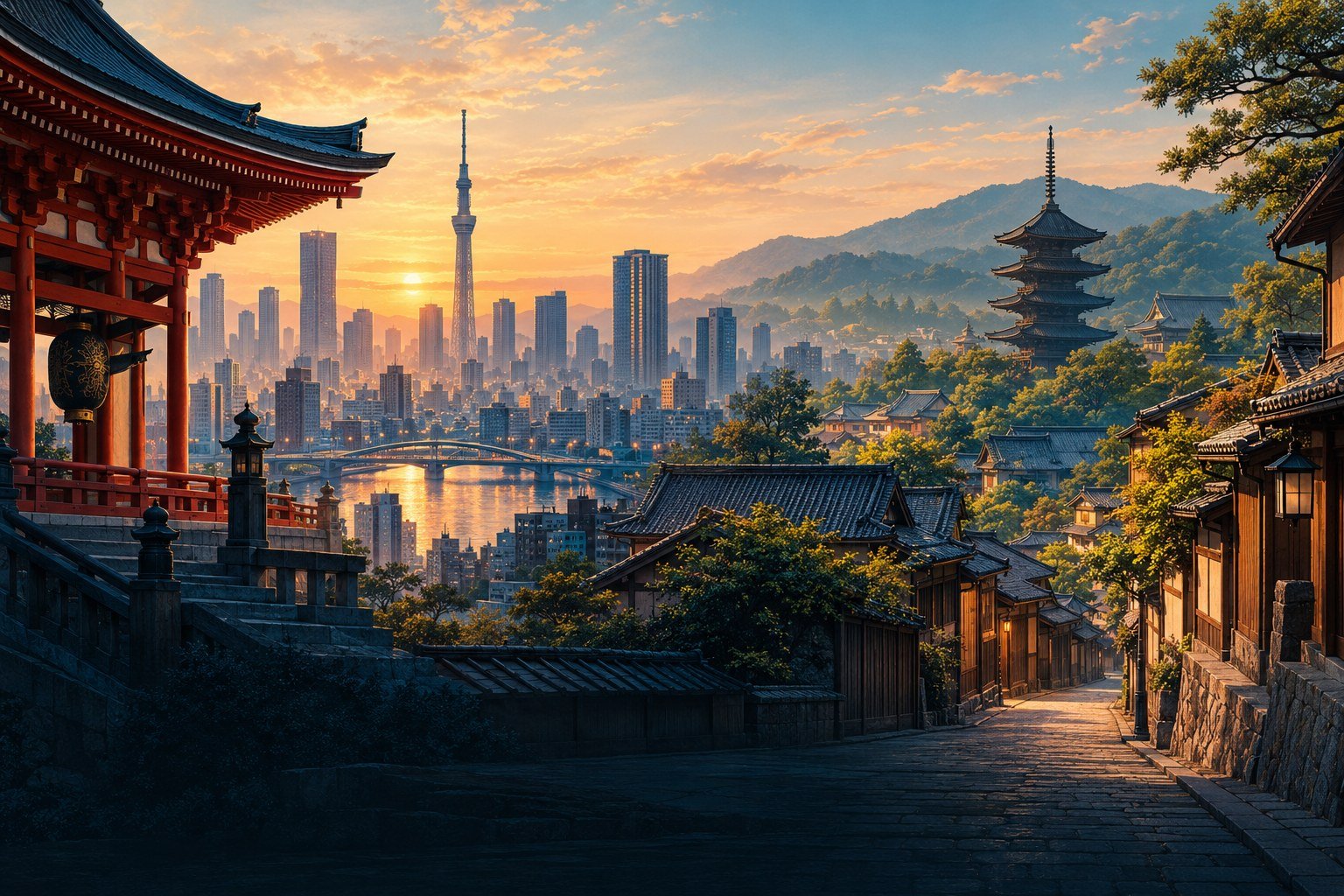
AI-generated editorial montage inspired by Tokyo and Kyoto; the two cities are combined imaginatively, not shown as one real view.
For 7 days in Japan, Tokyo and Kyoto make a sensible first pairing: metropolitan neighbourhoods at the start, then temples, gardens and older streets. The useful constraint is time. Seven days including your arrival and flight home leave four full sightseeing days and part of a transfer day, so every extra overnight stop takes a sizeable bite out of the trip.
This route gives Tokyo three nights and Kyoto three nights. It suits a first visit centred on city life, food and cultural sights, with enough walking breaks to keep the week enjoyable. Start with the wider Japan travel hub if you are still choosing your destinations.
One hotel change protects a short trip. Hakone, Osaka and Hiroshima need time taken from these cities.
Tokyo arrival and Kansai departure avoid a return rail journey. Check both airports before reserving hotels.
Allow roughly four hours from Tokyo hotel to Kyoto hotel, then make only one light sightseeing plan.
A room near the right station can be more valuable than a cheaper room with a long daily approach.
How to divide 7 days in Japan
The day numbers below are days on the ground in Japan, not days since leaving the UK. Day 1 is arrival day and Day 7 is departure day; the flight out may leave Britain the previous calendar day. The main route assumes arrival at Haneda or Narita and a flight home from Kansai International Airport, potentially with an onward connection.
| Day | Main plan | Sleep |
|---|---|---|
| 1 | Arrive, check in and eat near your hotel | Tokyo · night 1 |
| 2 | Asakusa, then Ueno or the Sumida riverside | Tokyo · night 2 |
| 3 | Meiji Jingu, Harajuku and Shibuya | Tokyo · night 3 |
| 4 | Train to Kyoto; optional lower Fushimi Inari visit | Kyoto · night 1 |
| 5 | Kiyomizu-dera and southern Higashiyama | Kyoto · night 2 |
| 6 | Arashiyama, then a free afternoon | Kyoto · night 3 |
| 7 | Kyoto to Kansai Airport; depart | No hotel night included |
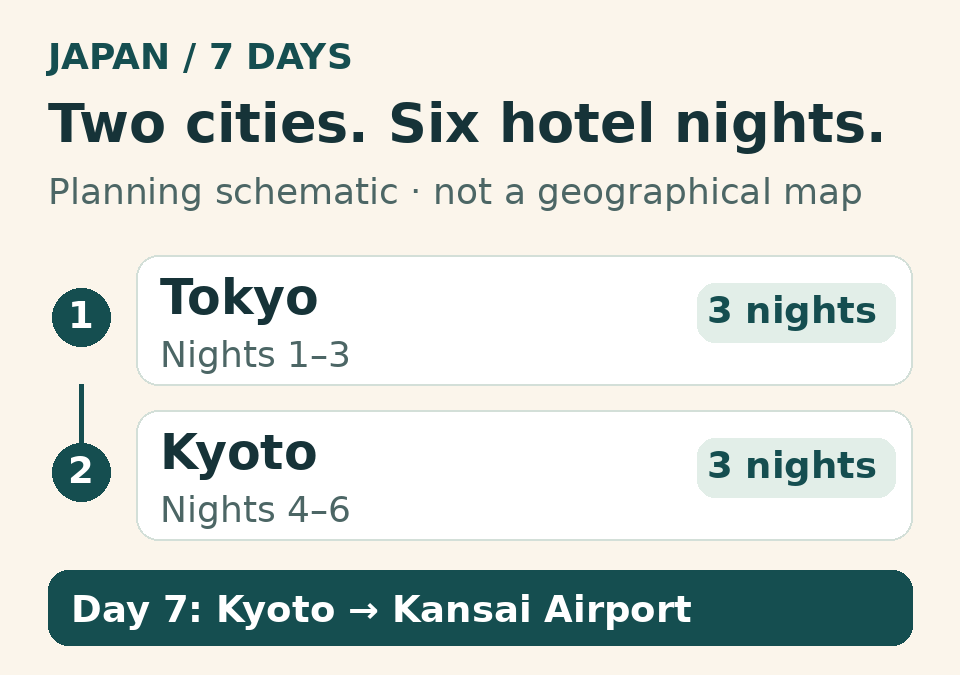
Choose this plan if a focused introduction matters more than collecting cities. It is less suitable for a trip built around theme parks, extensive shopping or several long hikes. A full theme-park day can work, but it must replace one of the two full Tokyo days. If you need frequent rest days or arrive very late after a tiring journey, using a single city as your base is also a reasonable choice.
Put the two stops and six nights into the Trip Itinerary Planner before booking. Add the actual flight dates yourself and leave the transfer day visibly lighter.
Days 1–3: a manageable introduction to Tokyo
Day 1: make arriving the main task
Choose your airport-to-hotel route before flying, then save the hotel name and address offline. Once you have cleared the airport and reached your neighbourhood, aim for check-in, a short orientation walk and an uncomplicated dinner. Do not tie the first evening to a prepaid show or a restaurant with a strict cancellation charge.
If you land in the morning, ask whether the hotel can store your bags; an early room is a separate arrangement. An extra hour of wandering near the hotel is a bonus. Arrival formalities, airport travel and fatigue are too variable to make Day 1 a dependable sightseeing day.
Day 2: Asakusa with one eastern-Tokyo extension
Give the morning to Senso-ji and the surrounding Asakusa streets. The main temple approach and nearby shops create a useful introduction without requiring repeated cross-city journeys. After lunch, choose Ueno for a museum or market walk, or remain around Asakusa and the Sumida riverside. These neighbourhood groupings follow the geography described by Tokyo’s official tourism guide. [2]
For the Ueno version, allow a short rail journey between areas, then select one museum or a walk through the park and Ameyoko. Trying to add all three produces a long afternoon. The Tokyo National Museum is a useful indoor option for Japanese art and material culture; check its opening calendar, since regular closing days and exhibition arrangements affect a visit. [9]
A practical day has one morning anchor, lunch and one afternoon choice. Leave dinner close to your hotel, particularly if jet lag catches up in the late afternoon.
Day 3: the west-side contrast
Start around Meiji Jingu, then move into Harajuku for shops or a café. Continue towards Shibuya later in the day for the crossing, dinner and a different view of Tokyo. Meiji Jingu, Harajuku and Shibuya form a coherent west-side group; walking between everything is optional, with rail available when your energy drops. [2]
Keep a generous lunch break and decide whether you want shopping time or an observation deck. If the deck is a priority, book its official timed entry and shape the afternoon around that slot. A skyline view is an optional paid addition; it is not essential to experiencing the area.
Day 4: Tokyo to Kyoto without losing the whole day
Reserve a morning Tokaido Shinkansen from Tokyo or Shinagawa to Kyoto. The Kyoto tourism board gives approximately 130 minutes for the Nozomi journey from Tokyo Station, but that is only time on the train. [1]
| Part of the move | Planning allowance |
|---|---|
| Hotel checkout and journey to the departure station | 40 minutes |
| Find the platform, buy food and board | 30 minutes |
| Nozomi to Kyoto | About 130 minutes |
| Leave Kyoto Station and reach your hotel or bag store | 40 minutes |
| Total before a proper lunch or room check-in | About 240 minutes · four hours |
This worked example assumes hotels with straightforward station access. Add time for a remote hotel, ticket collection, step-free routes or luggage queues. A departure around mid-morning should still leave room for lunch and one modest Kyoto outing; it does not justify a tightly booked afternoon.
JR Central’s official reservation page is the starting point for direct booking. You can also compare Tokyo–Kyoto transport on 12Go, which lists this route. Choose the actual train and stations you need, and compare the final charge, seat arrangements, ticket delivery and cancellation terms. A cheaper overnight bus would change both the hotel count and the pace of this itinerary. [12]
After leaving your bags, visit the lower part of Fushimi Inari if you feel fresh. From Kyoto Station, the city recommends the JR Nara Line to Inari; use a service that stops there. [4] The main precinct and an initial stretch of torii make a sufficient first visit. A full mountain circuit is an additional walk with steps, not a compulsory extension. If the transfer runs late, have dinner near the hotel and move this visit to Day 6’s free afternoon only if your energy allows.
Days 5–6: eastern Kyoto, then Arashiyama
Day 5: Kiyomizu-dera and Higashiyama
Make Kiyomizu-dera the morning anchor. The temple opens at 06:00, while closing times vary with the season and special openings. An early start can put the temple before the busiest part of the day, although nearby shops will not necessarily be open at the same time. [3]
Work downhill through the southern Higashiyama streets, stopping for lunch rather than filling the day with another list of temples. Allow time for Sannenzaka and Ninenzaka, then decide between a longer café stop and a short onward walk towards Gion. The slopes and steps make this a more demanding walk than the map suggests.
A short cultural session fits better here than an excursion across the city. Sakaguchian’s tea ceremony near Kiyomizu-dera on GetYourGuide is listed as a 45-minute session in the Sannenzaka area. It can replace some shopping time and add context to a pause over matcha. Check the exact session, child admission rules, seating and access before paying; large bags are not permitted. Availability for your dates has to be checked separately. [13]
Gion is a working residential and cultural district. Keep to permitted streets, respect signs, avoid blocking narrow routes and do not follow or photograph geiko or maiko without permission. A glimpse of someone going to work is not an attraction to pursue. [6]
Day 6: keep Arashiyama in its own half-day
Travel to the Saga–Arashiyama area in the morning and group the bamboo grove with the riverside around Togetsukyo Bridge. The city’s official area guide places these highlights together and also warns that their popularity brings crowds. [5] Budget a half-day for the journey, a measured walk, stops and lunch; the photograph alone is not the whole visit.
Choose one additional garden or temple if that interests you, then return towards your hotel. Avoid bolting on the scenic train, riverboat and monkey park as if they were quick stops. Each introduces more time, tickets or walking, and this is your last full day.
The remaining afternoon is deliberately unallocated. Use it for the missed Fushimi Inari visit, quiet shopping, laundry or simply an early dinner. Retain enough energy to pack and check tomorrow’s airport journey. A free afternoon is also the place to absorb bad weather or a slower-than-expected temple morning.
Day 7: leave from Kansai, or adapt a Tokyo return
From Kyoto Station, HARUKA provides a direct rail link with Kansai Airport. The official Kyoto access guide describes this journey as approximately 80–100 minutes. Treat that as station-to-station guidance and check the exact departure for your date. [1]
Work backwards from your airline’s required airport arrival time. Add the train, getting to Kyoto Station, a service-disruption margin and reaching the correct terminal. The main plan suits a flight whose timing permits an unhurried morning transfer. For a very early departure, change the last hotel night to an airport-area stay and accept the reduced Kyoto time.
If changing flights is still possible, compare the whole cost of the alternative, including the extra rail fare and hotel location. A lower airfare can be poor value when it consumes a substantial part of a six-night holiday.
Choose practical hotel areas and the right tickets
Where to sleep
| Base | Good starting point | Trade-off |
|---|---|---|
| Tokyo · 3 nights | Tokyo Station or nearby central rail connections for the Kyoto departure; Ueno for an east-side base; Shinjuku if evening dining matters most | The nearest station entrance and airport route matter more than a broad neighbourhood label. |
| Kyoto · 3 nights | Kyoto Station for uncomplicated arrival, Fushimi Inari access and the airport train; Shijo/Karasuma for a more central evening base | Station convenience means travelling to historic districts; a central Kyoto room still needs an airport-station transfer. |
Use the map on Booking.com’s Tokyo hotel search to check a room against your airport and Shinkansen stations. For the second base, compare Kyoto accommodation on Agoda after deciding between station access and a central evening location. These are city searches, not recommendations for a particular property or a claim that a room is available.
Check the walking route from the specific station exit, bed arrangement, room size, lift access and cancellation deadline. Accommodation tax may be payable separately even when a headline room price looks final.
Individual tickets are the starting point
This route has one substantial intercity rail journey. Price that ticket plus your real local journeys before considering a national pass. On 18 October 2026, the adult Ordinary seven-day Japan Rail Pass was ¥50,000 through the official online purchase route and ¥53,000 through overseas JR-designated agencies. Nozomi use also needs a separate pass-holder ticket. [8] Against this itinerary’s modest rail use, a national pass is difficult to justify; do not add journeys solely to make a pass worthwhile.
For city travel, a rechargeable transport IC card can simplify suitable local journeys; it is a payment method, not unlimited travel. For Kyoto, favour a useful rail approach and a shorter walk over automatically joining a crowded bus route. [2] [14]
Measure your luggage before reserving seats
On the Tokaido Shinkansen, luggage with combined length, width and height over 160 cm and up to 250 cm needs a seat reservation with an oversized baggage area. The current trial use of some deck storage areas does not remove that requirement for oversized cases. Book the correct seat rather than assuming the space behind the last row is available. [7]
A transparent six-night budget
The following is an original planning model checked on 18 October 2026, in Japanese yen per adult. It assumes two adults sharing one private room, ordinary reserved rail travel, casual meals and a small selection of paid sights. Hotel and spending inputs are allowances, not sampled hotel quotes or guaranteed fares. Replace them with your actual dates before booking.
| Item | Calculation or allowance | JPY |
|---|---|---|
| Tokyo room share | 3 nights × ¥18,000 per room ÷ 2 | 27,000 |
| Kyoto room share | 3 nights × ¥20,000 per room ÷ 2 | 30,000 |
| Meals and non-alcoholic drinks | 7 days × ¥4,500 | 31,500 |
| Tokyo–Kyoto rail | Planning allowance; check your train and date | 15,000 |
| Local transport | 7 days × ¥900 | 6,300 |
| Both airport transfers | Combined allowance | 6,000 |
| Admissions | Ordinary sights, not premium experiences | 6,000 |
| Local accommodation taxes | Separate allowance | 2,000 |
| Mobile data | Allowance | 2,000 |
| Subtotal | All items above | 125,800 |
| Contingency | 10% of subtotal | 12,580 |
| Total | Round to about ¥140,000 for planning | 138,380 |
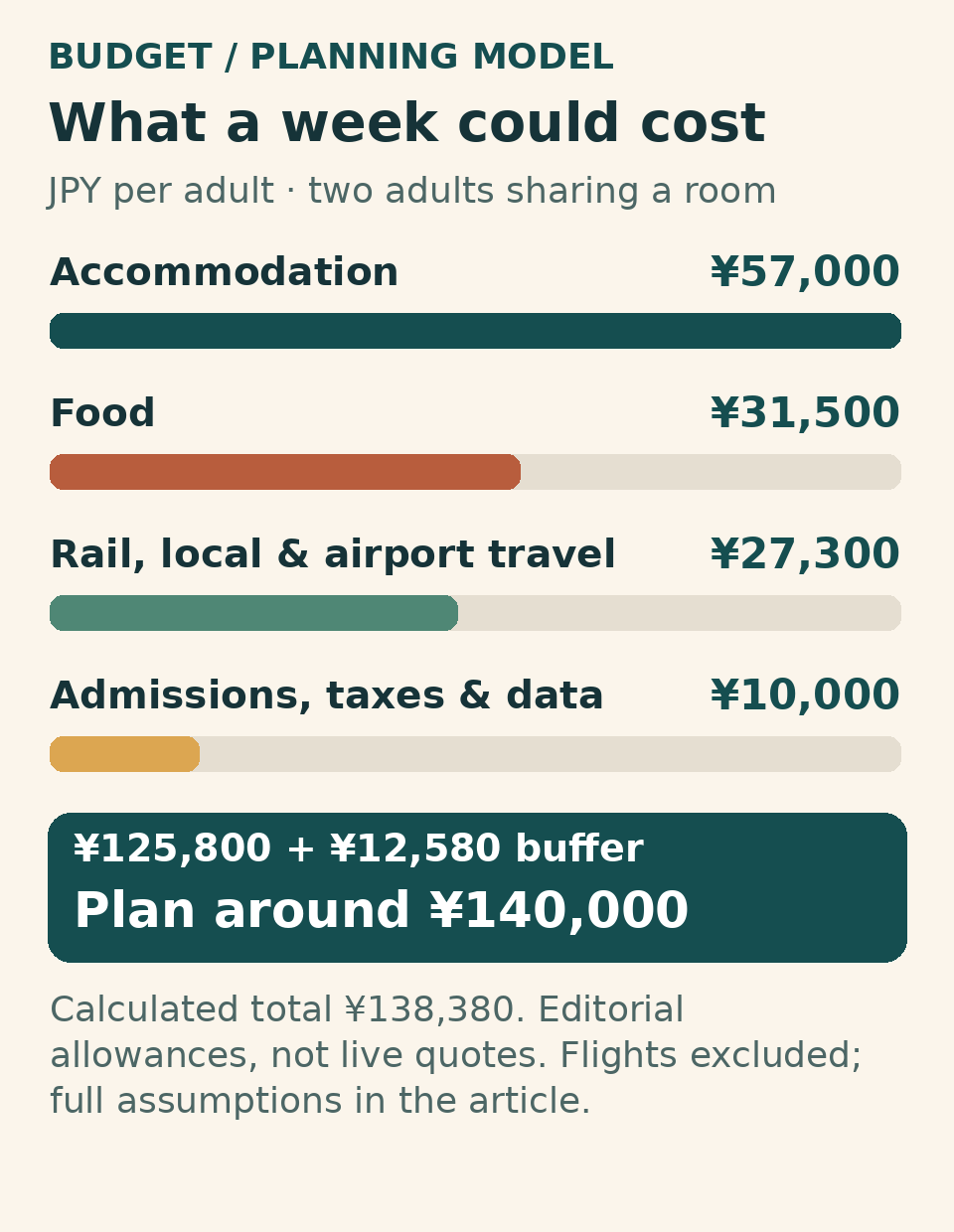
The exact model totals ¥276,760 for two adults; rounding both shares gives a working pot of about ¥280,000. International flights, insurance, shopping, alcohol, guided experiences and extra luggage services are excluded. A booked tea ceremony or premium viewing deck should be added at its actual price rather than assumed to fit the admissions allowance.
Kyoto’s accommodation tax changed on 1 March 2026. A taxable room share of ¥10,000 per person per night falls in the ¥400 band, so the model’s three Kyoto nights imply ¥1,200 per adult before any taxes elsewhere. Confirm the hotel’s taxable amount and whether the charge is already included, then replace the broader ¥2,000 reserve with the real total. [11]
The most useful sensitivity check is accommodation. Increasing every room night by ¥5,000 adds ¥15,000 per adult before contingency: six nights × ¥5,000 ÷ two people. A solo traveller keeping these same rooms would add ¥57,000 to the subtotal, while a smaller single room could reduce that difference. Peak-date room quotes should replace the model, not be hidden within its 10% buffer.
Weather, access and the bookings that matter
Swap days before adding destinations
Keep Days 2 and 3 interchangeable until you have a firm timed booking. In heavy rain, make the Tokyo National Museum your main eastern-Tokyo activity, checking its calendar first. In Kyoto, replace the Arashiyama half-day with the Kyoto Railway Museum if that suits your interests. The museum normally closes on Wednesdays, with exceptions listed on its calendar. [9] [10]
In hot weather, move outdoor walking earlier and preserve an indoor midday break. In crowded periods, remove a secondary stop instead of trying to recover time by hurrying. A second Kyoto district is not a reliable fallback when all you need is a rest.
For reduced mobility, plan station lifts and the exact approach to each site in advance. Kiyomizu-dera publishes a dedicated wheelchair route and describes access via the emergency-road entrance at the top of Chawan-zaka. That does not make the surrounding historic street walk step-free: use the temple’s access guidance rather than assuming the standard walking route will work. [3] Arrange any required help with the relevant operator and allow more transfer time.
Book in this order
- Fix arrival and departure airports, counting six hotel nights against your flight dates.
- Reserve suitable rooms with terms you understand, and save the hotel addresses.
- Book the Tokyo–Kyoto train, including any necessary baggage or assistance arrangements.
- Add the one or two experiences you would be disappointed to miss, leaving the rest flexible.
- Check venue calendars and airport transport shortly before travel.
For the paperwork and countrywide practicalities, read the Japan entry guide for British travellers and the first-time Japan travel guide alongside the current official rules.
For navigation away from hotel Wi-Fi, compare your existing roaming allowance with a Japan data plan. Browse Airalo and select Japan if an eSIM suits you; the link opens the provider, so choose the country and a validity period covering the whole visit. Your handset must support eSIM and be unlocked, and you should check activation rules, data limits and whether calls are included before buying. [15] [16] Save hotel details and key tickets offline as well.
Questions before you book
Can this seven-day plan include a Mount Fuji day trip?
Only by replacing a full sightseeing day. With arrival, departure and the Kyoto transfer already counted, a Fuji excursion would leave less time in Tokyo or Kyoto. If seeing Fuji is the main purpose of the trip, design the route around that priority and accept a weather-dependent outing rather than treating it as an easy extra.
Should Kyoto have four nights and Tokyo two?
That can suit a trip strongly focused on temples, gardens and traditional crafts, but it leaves only one full Tokyo day after arrival. Keep the three-and-three split for a balanced introduction; move a night to Kyoto only when you can name the extra Kyoto activity you would value more than that Tokyo day.
What if the available flight arrives in Osaka instead?
Reverse the order if you can depart through Tokyo: three Kyoto nights followed by three Tokyo nights, with the rail transfer on Day 4. On arrival, allow time to reach Kyoto from Kansai Airport. If both flights use Kansai, preserve a final night with an appropriate airport connection and account for the return intercity journey.
Make the itinerary your own
For a first week, the strongest decision is to protect the two-city shape. Three Tokyo nights, three Kyoto nights and a Kansai departure give each place a clear role while keeping the number of transfers down. Book the flight pattern and practical hotels first; let weather, energy and one or two personal interests decide the optional details.
Sources and research
Research checked on 18 October 2026. The route and pacing choices are editorial planning recommendations. Journey estimates and cost allowances are identified where used; check current operators before booking.
- Kyoto Travel — Getting to Kyoto: Tokyo, Osaka and Kansai Airport connections.
- GO TOKYO — How to See the Best of Tokyo in 3 Days.
- Kiyomizu-dera — Official FAQ, opening and wheelchair access.
- Kyoto Travel — Comfortable access to Fushimi Inari Taisha.
- Kyoto Travel — Saga and Arashiyama.
- Kyoto Travel — Four Guidelines to Follow When Visiting Kyoto.
- JR Central — Current Shinkansen luggage information.
- Japan Rail Pass — Official types and prices.
- Tokyo National Museum — Visitor information and opening calendar.
- Kyoto Railway Museum — Official visitor information.
- Kyoto Travel — Accommodation-tax changes from March 2026.
- 12Go — Tokyo to Kyoto route comparison.
- GetYourGuide / Sakaguchian — Tea ceremony near Kiyomizu-dera.
- Kyoto Online Tourist Information — Alternatives to crowded buses.
- Airalo — Device compatibility and network restrictions.
- Airalo — Japan eSIM plan information.
Illustrations in this article were created for Taylor’s Trailblazing Travels. Third-party photographs, where used, are credited beside the image or in the source list.