Thailand itineraries / spend with purpose
Thailand Budget Itinerary: 2 Weeks
A culture-first route that saves through fewer moves, sensible accommodation and selective paid experiences.
A Thailand Budget Itinerary works best when the savings come from the shape of the trip, not from making every day uncomfortable. Fewer long-distance moves, a room near ordinary food and transport, and a small number of chosen paid experiences can keep spending under control without turning the holiday into a daily exercise in saying no.
This two-week route concentrates on Bangkok, Ayutthaya and Chiang Mai. It deliberately leaves out the islands, uses two sleeper nights and includes a proper Bangkok hotel night before the international flight home. The result is a culture-first holiday with eleven accommodation nights and two nights on trains, rather than an attempt to fit the entire country into a limited budget.
Here, the figures are constructed planning allowances, not current fare quotations or a promise that every reader can travel for the same amount. The worked solo total is THB 23,700, including a twenty per cent reserve, designed on 05 October 2026. Your actual costs depend on dates, rooms, transport availability and the activities you decide are worth paying for.
Main saving
Fewer regions
Leave the islands for a longer or coast-focused trip.
Accommodation
11 nights on land
Two separate sleeper nights are counted in transport.
Spending method
Protect the essentials
Cut optional taxis and tours, not safe accommodation.
Worked example
THB 23,700 solo
Illustrative model dated 05 October 2026; not a price promise.
The Thailand Budget Itinerary in one table
Keep the country small for this trip
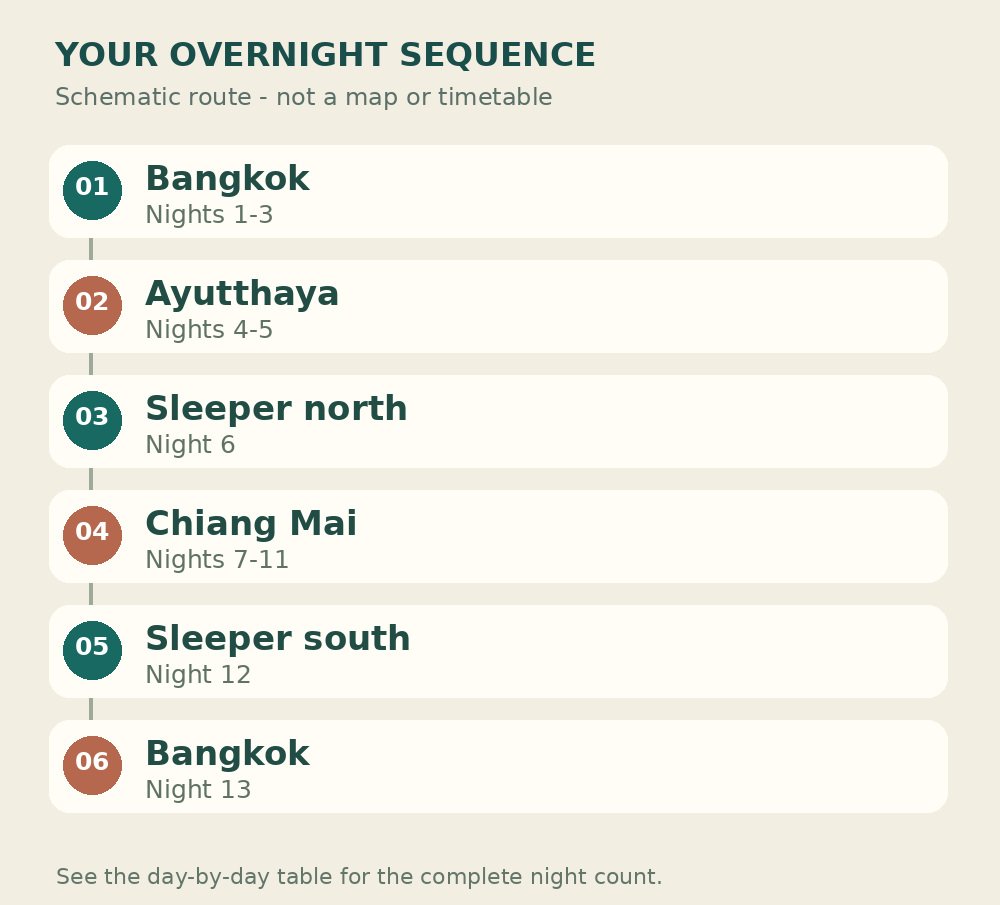
Begin with three Bangkok nights, spend two in Ayutthaya and take the northbound sleeper on night 6. Stay in Chiang Mai on nights 7 to 11, return by sleeper on night 12 and sleep in Bangkok on night 13. Day 14 is departure, not a final day to travel across the country and hope everything connects.
The route saves by avoiding an additional region and its associated airports, station transfers and accommodation changes. It still offers contrasting settings: a large modern capital, an historic former capital and a northern city. That is the selection method behind the route, rather than a claim that these are the three cheapest places in Thailand.
| Days / night | Base | Nights | What happens |
|---|---|---|---|
| 1-3 | Bangkok | 3 | Arrival and two city days. |
| 4-5 | Ayutthaya | 2 | Historic city at a manageable pace. |
| 6 | Sleeper to Chiang Mai | 1 | A light day before the train. |
| 7-11 | Chiang Mai | 5 | Arrival, culture, one optional class and local days. |
| 12 | Sleeper to Bangkok | 1 | Return overnight. |
| 13 | Bangkok | 1 | Recovery and departure preparation. |
| 14 | Departure | 0 | International flight home. |
Be honest about the missing beach
There is no beach stop in the default plan. Adding one requires removing something else or increasing the transport budget and pace. If the coast is the main reason for your holiday, choose a Bangkok-and-coast route instead of using this cultural itinerary and trying to attach an island at the end.
A useful test is to name the experience you would regret missing. If it is swimming, the route should change. If it is northern food, heritage and a few city experiences, this version is a stronger fit. Budget planning is easier once you stop paying to include things mainly because an itinerary is expected to contain them.
Check the conditions before buying the cheapest deal
Flexibility has a value
A low non-refundable rate is only attractive when the dates and route are dependable enough for you to use it. Compare cancellation terms alongside the price, especially around long-distance transport and weather-sensitive travel. Sometimes a slightly higher room rate protects more money than it costs because it prevents a small change from stranding several bookings.
Check current conditions in Bangkok and Chiang Mai separately. Northern outdoor plans may need to change with weather or poor air quality, while city access can be affected by heavy rain. A budget route should have alternatives that do not depend on buying an expensive replacement journey at the last minute.
Entry requirements belong in the budget too
Use the Thai authorities' current guidance for your passport and purpose of travel. Do not assume that an older visa-free allowance or a previous admission applies again. Complete the official arrival-card process separately where required and keep the first accommodation address available. These are entry tasks, not optional extras to leave until a budget calculation is finished. [2] [3]
Travel insurance, any necessary visa and essential health preparation sit outside the illustrative local-spending model below. Add them before deciding whether the holiday is affordable. A small local daily allowance does not describe the complete cost of leaving home and travelling responsibly.
A worked solo budget with nothing hidden in the headings
The accommodation calculation uses eleven nights
Two nights are spent on trains, so the accommodation line contains eleven paid nights. The sleeper berths appear in transport instead. This prevents the common mistake of either paying for unused hotel nights or claiming that an overnight train is free because it replaces accommodation.
The model was designed on 05 October 2026. It assumes modest accommodation, ordinary meals, selective admissions and one relatively modest paid experience. It excludes international flights, insurance, entry-document costs, substantial shopping, alcohol-heavy evenings and specialist activities. Treat the reserve as available protection, not as another spending category to exhaust before departure.
| Item | Calculation or allowance | THB |
|---|---|---|
| Accommodation | 11 nights x 650; no hotel on sleeper nights | 7,150 |
| Food and non-alcoholic drinks | 14 days x 400 | 5,600 |
| Transport | Both berths, regional and local journeys | 4,000 |
| Activities | Selective admissions and one modest experience | 1,800 |
| Data, laundry and small extras | Allowance | 1,200 |
| Subtotal | Before reserve | 19,750 |
| Reserve | 20% | 3,950 |
| Worked total | One adult; international flights excluded | 23,700 |
Replace assumptions with decisions
Before booking, enter the actual accommodation total and the price of issued transport into your own calculation. Then decide how much remains for optional experiences. Do not reverse the process by committing to several tours and hoping that a very low daily food allowance will make the numbers balance.
For two people sharing a room, some accommodation costs may be lower per person, but rail berths, meals and admissions generally remain individual costs. A shared room is also not automatically cheaper than two hostel beds on every date. Compare actual options with equivalent conditions instead of applying a blanket percentage reduction.
Turn the food allowance into an ordinary day
The illustrative THB 400 daily food-and-drink allowance, designed on 05 October 2026, can be divided before you travel: for example, THB 80 for breakfast, THB 110 for lunch, THB 140 for dinner and THB 70 for water or another drink. These are spending allocations, not checked menu prices. The purpose is to show what the total asks you to do, then decide whether it suits your appetite and preferences.
If your actual breakfast costs more, adjust another meal or increase the daily line consciously. Do not quietly remove drinking water or an appropriate meal to defend an unrealistic target. A budget you can follow comfortably is more useful than a lower number that leads to frequent unrecorded exceptions. Review it after the first two days and revise the remaining trip while there is still time to make meaningful choices.
Choose a cheap room that does not create expensive days
Location is part of the nightly cost
Look for a base that supports your ordinary movements: a practical station or transit link, accessible food and a manageable route back in the evening. A cheaper room far from everything can produce repeated fares and more time in traffic. Add those expected journeys before deciding it is the better deal.
Read recent reviews for sleep, cleanliness, working air conditioning where needed, security and staff availability. A rooftop, pool or long list of amenities is less useful if you cannot sleep reliably. In a dormitory, understand the locker arrangement and check-in process; in a guesthouse, confirm whether late arrival is possible without a staffed reception.
Compare the actual payment conditions
Check whether the displayed amount includes taxes, compulsory charges and the full length of the stay. Note deposits, payment currency, cancellation deadlines and any additional charge for the room arrangement you need. A nightly figure is not the final comparison until these details match.
Also ask about luggage storage around sleeper journeys. A modest charge for a reliable place to leave a pack can be worthwhile, but it should be known in advance. Avoid arranging a whole checkout day around an assumption that the accommodation will store bags indefinitely or provide a shower after the room has been released.
Day 1: arrive without a chain of small overspends
Keep the first journey simple
Work out the airport-to-accommodation route before travelling, including the final walk or local ride. Public transport can be useful when it fits your arrival time and luggage, while a clearly priced taxi may be the more sensible choice when you are exhausted or travelling in a small group. The aim is a manageable journey, not winning the cheapest-transfer contest.
Have the accommodation address saved in a form you can show the driver or staff. Keep enough accessible money for the immediate arrival costs without opening every bag. Once you have checked in, find an ordinary meal nearby and let the rest of the day remain flexible.
Do not buy the whole holiday at the first desk
A hotel or hostel may offer convenient tours and onward tickets, but there is no need to book every remaining journey while tired. Compare the key sleeper options after you have rested and understand what is being sold. Ask whether a document is an issued ticket, a booking request or simply a payment receipt.
For the first evening, walk only as far as feels comfortable and return before the day becomes a search for somewhere to sit. A calm start reduces the likelihood of solving fatigue with several unplanned taxis, expensive drinks and a late meal chosen solely because it is still open.
Days 2 and 3: pay for what interests you
Day 2: one major cultural choice
Choose a principal sight and organise the day around its area rather than visiting several distant attractions. For the Grand Palace, consult the official visitor information for current access and dress requirements. Decide whether it is a genuine priority before buying a larger tour package that includes it among many brief stops. [4]
Leave room for an ordinary lunch and a slow return through the neighbourhood. The value of a paid admission improves when you have time and energy to understand what you are seeing. Two carefully selected visits across the Bangkok stay can be more satisfying than a rushed day with several entrance fees.
Day 3: make food and ordinary streets the focus
Use the second full day for a compact neighbourhood walk, a market area or a modest indoor attraction that matches your interests. Museum Siam is one research option for a culture-focused indoor visit, with interactive interpretation rather than a conventional collection of objects. Check its current programme and opening arrangements before going. [5]
A guided food walk can be worthwhile when the included tastings and explanation appeal. Compare the whole programme against an independent evening, including transport and whether the food replaces a meal. It is an optional purchase, not something required to make a budget trip feel legitimate.
Keep a clear low-cost rhythm
A useful pattern is one main outing, an ordinary meal and a period with no paid commitment. Carry water and take breaks before you become so tired that the only acceptable solution is an expensive taxi across the city. This is not about avoiding every convenience; it is about using convenience when it genuinely solves a problem.
At the end of day 3, confirm the next departure point and pack for a short move to Ayutthaya. There is no need for a very late final Bangkok night if it makes the next morning difficult. The itinerary contains another Bangkok stay at the end, so unfinished interests do not all need to be forced into this visit.
Day 4: take the short move seriously enough
Check the station, not just the city name
Travel to Ayutthaya by a suitable train or road service, with the exact departure station checked on the booking. Leave enough time to reach it with your bag and understand the platform or pickup point. A cheap ticket loses some of its appeal if a mistaken station requires a hurried replacement transfer.
After arrival, account for the journey to the accommodation. The historic sites and railway station are not a single location, so consider the final ride or walk before choosing the bed. Check in, have lunch and use the rest of the day for a modest orientation rather than trying to cover the whole historic city immediately.
Use the overnight stay to avoid rushing
Two nights provide a full heritage day and a gentler arrival afternoon. That can be more useful than buying a long day trip from Bangkok and spending much of it watching the clock. However, the overnight version only saves effort when you resist filling both days with long excursions.
Ask locally about practical ways to reach the sites you have selected and compare the complete arrangement. A bicycle may suit a confident rider in suitable conditions, while a small group sharing a local vehicle may prefer that option. Choose the method that lets you enjoy the visit rather than treating physical discomfort as part of travelling cheaply.
Day 5: a smaller heritage circuit with time to look
Understand the city before selecting the stops
Ayutthaya's UNESCO status reflects the significance of the historic former capital. Read a little background, then select a manageable group of monuments rather than treating every entrance as compulsory. Several sites deserve unhurried attention, but their combined value does not depend on seeing them all within one hot day. [6]
Plan a break with food and shade before the afternoon. If you are losing interest or becoming tired, stop rather than paying for another admission simply to complete a list. Budget travel becomes more rewarding when money follows attention: spend where you are engaged and leave room to return on another trip.

Do not turn every local interaction into bargaining
Agree fares and inclusions clearly before a journey, but keep the discussion proportionate and respectful. The aim is to understand the price and service, not to win a negotiation over every small purchase. A clear, fair arrangement can save more frustration than a tiny reduction secured through a long argument.
Use the evening to prepare for the following day's sleeper. Check where you can leave the bag after checkout, when you need to be at the station and how the accommodation handles luggage collection. A practical plan for those hours prevents you from carrying the entire pack through another full day of sightseeing.
Day 6: a light day before the sleeper to Chiang Mai
Confirm that the train actually stops where you board
The northbound booking must be for Ayutthaya to Chiang Mai on the correct date, not a ticket starting in Bangkok with an assumed later boarding arrangement. Check the train, station, berth and ticket conditions carefully. Use the State Railway's official D-Ticket search or a clearly identified agent, then retain the final issued travel document. [7]
Do not leave the desired berth until the last moment during busy periods. At the same time, avoid presenting a general advance-booking window as proof that every journey is available on the same schedule. Search the actual segment and date, and ask about the specific booking process when availability is unclear.
Pack for one night, not for rummaging through the whole bag
Keep documents, valuables, medication, toiletries and a light layer in a smaller accessible bag. Have a straightforward meal before boarding and bring suitable food for the journey without assuming a particular onboard service. The main pack should be organised so it can be handled independently and placed without blocking other travellers.
A sleeper can replace an accommodation night, but it is still a paid journey and may not provide perfect sleep. Therefore, day 7 is designed as an arrival day rather than the first of several ambitious northern excursions. The saving is most useful when the itinerary acknowledges the recovery needed afterwards.
Day 7: arrive, wash and get comfortable
Do not book a demanding morning after the train
Reach the accommodation according to its check-in arrangements and use any agreed luggage storage or early access. Have breakfast or lunch, take a shower when available and keep the day close to the room. A long city circuit immediately after the sleeper can turn an economical transport choice into an exhausting start to the northern stay.
Five nights give you four complete days after arrival. That is enough time to alternate cultural interests, one optional paid experience and ordinary local days. Unpack what you need rather than living entirely from the top of the bag, and find a convenient laundry option early in the stay.
Choose the location for walking, not for a brochure image
An old-city or nearby base can support short independent outings and easy meals. A more distant property may have a lower rate but add transport to every day. Chiang Mai's official destination information highlights cultural sights and different areas, so use it to identify what matters to you before selecting the accommodation. [8]
For sleep, investigate current reports rather than assuming every guesthouse is quiet or every hostel is noisy. If you need a private room to rest properly, build it into the budget and reduce another optional expense. Repeated poor sleep is rarely a sensible foundation for a low-cost holiday.
Day 8: learn a small part of the city
Keep the first full day local
Choose a compact old-city walk with one or two cultural stops and a proper break. Religious sites require respectful clothing and behaviour regardless of whether admission is charged. Do not assume that a free entry means a place is merely a backdrop for photographs; it may also be an active place of worship.
Give yourself a small focus, such as architecture, everyday food or a particular craft. That can make a modest day more engaging than a large circuit. Afterwards, return to the same area for dinner if you enjoyed it. Familiarity can improve a trip without adding a new transport fare every evening.
Keep the mountain visit optional
Doi Suthep is among the attractions highlighted in Chiang Mai's official destination information, but it should be a deliberate excursion rather than an automatic addition to a city walk. Consider conditions, transport and your interest before allocating the money and time. A city-focused day is not incomplete simply because you did not include a hillside temple. [8]
For any out-of-town outing, calculate the full return journey and agree the arrangement in advance. A low outward fare can be misleading if you have no straightforward way back. The useful question is what the complete, comfortable day costs, not the smallest number shown for its first leg.
Day 9: choose one experience worth paying for
A cooking class can replace another paid day
A small-group cooking class can provide a clear activity, a meal and conversation with other travellers. Compare the menu, class size, transfer and length before choosing. A longer description is not necessarily a better experience, particularly when much of the extra time is spent collecting people from different hotels.
Put the class inside the activity allowance rather than adding it automatically on top of several other tours. If the available class exceeds the model budget, either raise the activity line consciously or choose a different experience. The budget is a decision tool, not a rule that requires pretending an actual booking costs less than it does.
An independent alternative is equally valid
You could instead organise a food-focused day with ordinary meals and a market visit, paying only for what interests you. That lacks a formal lesson but offers more control over pace. Choose based on whether you want instruction, company and a planned programme, rather than whether a paid experience seems more respectable.
Leave the evening light after a substantial class or outing. A relaxed return, laundry collection and dinner nearby can make the day feel complete. There is no need to spend again merely because several hours remain before bed.
Days 10 and 11: make the inexpensive days good days
Day 10: an interest-led outing
Use one day for an interest not yet covered, such as a small cultural visit, a neighbourhood or a short guided activity chosen for a specific reason. Where a weekend market fits the actual calendar, it can be considered, but do not rearrange the whole route around an assumed nightly schedule. Check local operating information first.
If wildlife is part of your interest, investigate welfare rather than buying the cheapest available animal encounter. Observation-led criteria are a better starting point than a sanctuary label. A low-cost trip does not require supporting riding or direct-contact entertainment merely because the alternative costs more; choosing no wildlife visit is also a valid decision. [9]
Day 11: repeat a favourite and prepare the return
Keep the final full day available for a favourite meal, a modest walk or anything displaced by weather. Collect laundry, check the southbound ticket and confirm the final Bangkok accommodation. These tasks are easier when spread through an ordinary day than when attempted immediately before boarding the train.
Avoid a late, expensive farewell evening driven mainly by the feeling that the trip is ending. There is still a journey and a recovery day ahead. A controlled final day protects both the remaining money and the energy needed to leave comfortably.
Day 12: return overnight without gambling on the flight
Keep the Bangkok hotel night
Take the booked sleeper to Bangkok on night 12 and keep night 13 in a hotel or guesthouse. Do not move the international flight to the morning the train is due merely to remove that final accommodation cost. The value of the buffer is connected to the consequences of missing the flight, not only the price of the room.
Verify the arrival station and the journey to the final accommodation. If the international departure uses another part of Bangkok, choose the room with that final move in mind. A slightly different neighbourhood may be more practical than automatically returning to the first hostel because you already know it.
When the sleeper is sold out
Compare alternatives as complete journeys. A daytime coach needs an accommodation night; a flight needs airport transfers and may involve baggage charges; another sleeper date changes the preceding hotel booking. Do not compare only the transport headline price and ignore the nights around it.
Make the adjustment early enough to preserve the final Bangkok buffer. If a reliable alternative costs more, use the reserve for the problem it was designed to solve. Cutting essential rest or accepting a fragile same-day connection solely to keep the spreadsheet unchanged defeats the purpose of having a budget.
Days 13 and 14: a calm, inexpensive finish
Day 13 is for recovery and practical jobs
After the train, reach the accommodation and follow the agreed check-in plan. Use the day for a meal, a shower and a short local outing if you feel like it. Keep shopping within both the remaining budget and baggage allowance. A final bag that needs a paid upgrade can erase several careful savings from earlier in the trip.
Confirm the airport transfer in the afternoon rather than leaving the decision until an early morning. Save the flight details and terminal information offline, then check the airline's actual check-in requirement. The right departure time comes from that calculation and the hotel location, not from a generic statement that Bangkok airport journeys are quick.
Day 14: do not add another distant attraction
For a later flight, arrange luggage storage and a nearby place to spend the remaining hours. A long excursion before departure adds uncertainty and may create expensive last-minute transport. A modest meal and a comfortable wait are often the better use of the final day.
Keep enough money accessible for the last transfer and ordinary airport needs. The holiday budget is not finished when you check out of the final room. A small protected departure allowance avoids turning the last journey into a search for the cheapest possible solution under time pressure.
Manage food, cash and data without making them a project
Choose ordinary meals rather than a daily challenge
Local meals can support a controlled budget, but the right choice still depends on hygiene, dietary needs and what you will enjoy. Do not order something unsuitable solely because it is the cheapest item. A simple rice or noodle meal, drinking water and an occasional treat can form a practical pattern without requiring every meal to be identical.
Check prices before ordering, especially when dishes are charged by weight or the menu leaves important details unclear. Keep the conversation polite and direct. The aim is to avoid surprises, not to assume that every vendor is trying to overcharge you. Build a small amount of variety into the food allowance so the plan remains enjoyable.
Avoid repeated small conversion surprises
Review card and ATM charges with your own provider before travel, and read currency-conversion choices carefully when paying or withdrawing. Keep a second way to access money separate from the first. Do not hold the entire holiday's cash in one obvious place simply to avoid another transaction fee.
For mobile data, compare the validity period and quantity with your actual needs. Download maps and tickets for offline use, especially before sleeper journeys. A plan that fits the trip is more useful than a large headline data allowance that expires too early or does not work with the handset.
Make the largest sensible savings first
Change the route before cutting the essentials
Removing an extra destination can reduce fares, local transfers and the time lost to moving. Choosing a useful room location can then reduce everyday transport. These changes often protect the experience better than trying to reduce every meal, admission and comfort item by a small amount.
The comparison below ranks decisions by how little they need to damage the trip, not by a promised saving. The right order for you depends on priorities. Keep the experience you care about most, then simplify around it rather than spreading the money so thinly that nothing is done comfortably.
| Change | Likely effect | Do not sacrifice |
|---|---|---|
| Remove an extra destination | Fewer fares, transfers and lost sightseeing hours. | The destination you care about most. |
| Choose a walkable base | Less routine taxi spending. | Safe late-night access and reliable sleep. |
| Select one paid experience | Avoids a daily tour bill. | A priority interest that makes the trip worthwhile. |
| Eat ordinary local meals | More choice within a controlled meal budget. | Allergy communication and food hygiene. |
Do not use unsafe transport as a budget strategy
A cheap scooter rental is not a substitute for the correct licence, experience, protective equipment and insurance. Likewise, an unclear overnight transfer or accommodation with serious safety concerns should not be accepted just because it helps meet the model. Current official safety guidance is a useful starting point for understanding the risks. [10]
Arrange suitable health preparation and insurance outside the local-spending calculation, then include them in the complete holiday cost. Consult individual travel-health advice where relevant. The cheapest workable holiday is not the same as the smallest number that can be written beside a route. [11]
What this budget route protects
The advantages
You get three contrasting destinations, several full days in Chiang Mai and a proper departure buffer. Two sleeper nights reduce the number of accommodation nights while providing long-distance transport. The route also leaves room for ordinary, low-cost days instead of depending on a paid programme from morning to evening.
The compromises
There is no beach, and two train nights may be tiring for some travellers. A sold-out berth or a busy-period room can raise the total, while the worked solo allowance will not suit every travel style. Someone who values private rooms, many tours or frequent nightlife should increase the budget rather than describe this model as universally sufficient.
Budget mistakes that make the holiday cost more
Do not save on the headline and pay elsewhere
A distant cheap room, an awkward arrival time or a flight without needed luggage can create extra costs outside the original comparison. Price the whole decision. Similarly, check whether a tour includes admission and meals before assuming it is better value than independent travel.
Avoid withdrawing the entire reserve from the plan because the first few days seem inexpensive. The money is there for changes later, including a replacement journey or an extra night. A reserve that has already become shopping money cannot solve the transport problem it was meant to cover.
Do not measure value only by how much you do
Several paid attractions in a day can provide less enjoyment than one chosen carefully. Leave time for food, rest and ordinary streets. Finally, remember the cost of getting home: keep the final Bangkok night, the airport journey and enough time for the airline's requirements rather than making departure the most fragile part of the holiday.
Thailand budget itinerary FAQs
Is THB 23,700 a guaranteed two-week cost?
No. It is a worked solo model designed on 05 October 2026, including a twenty per cent reserve and excluding international flights and several personal costs. Replace the room and transport allowances with actual bookings. Busy dates, private-room preferences and additional tours can make the trip more expensive.
Can I add Phuket or an island to this route?
Not without a trade-off. You would need to remove northern nights, increase transport spending or accept a faster pace. When the beach is a main priority, a Bangkok-and-coast itinerary is usually a more coherent choice than attaching an island to a culture-focused route designed to keep long-distance moves down.
Are sleeper trains always cheaper than flying?
No. Compare the complete trip, including the accommodation night, baggage, airport or station transfers and the usefulness of the arrival time. A sleeper can be good value, but a sold-out preferred berth or an awkward date can change the comparison. The route uses sleepers because they fit the plan, not because they always win on price.
Can two people share this budget?
The model is for one adult, so it cannot simply be used unchanged for two. Sharing a room may reduce accommodation cost per person, but meals, train berths and admissions remain additional. Build a two-person calculation from actual choices rather than doubling or halving the total without examining its components.
What is the first thing to cut when the budget is tight?
Start with an optional destination or paid outing, then review room location and routine taxi use. Keep safe accommodation, suitable insurance and the departure buffer. Cutting every meal and necessary transfer can make the holiday harder while saving less than removing one poorly chosen extra excursion.
Is this suitable for a first visit to Thailand?
It can be, particularly for someone interested in culture and comfortable arranging trains and accommodation. The route explains the overnight sequence and leaves recovery time. Travellers who strongly dislike overnight trains can replace them with suitable daytime travel, but should add the corresponding accommodation nights and rework the budget.
Spend on the trip you actually want
Keep the route focused: Bangkok, Ayutthaya and Chiang Mai, with two carefully booked sleepers and a final Bangkok night. Use the spending model to make decisions rather than to prove that you can travel for the smallest possible amount. Pay for reliable sleep, workable transport and a few experiences that genuinely interest you.
The strongest saving is the destination you do not add just to make the itinerary look complete. Leave the islands for a coast-focused holiday, protect the reserve and enjoy the ordinary days between the paid ones. That creates a budget trip with a clear purpose rather than a more expensive journey disguised by optimistic daily figures.
Sources and fact-checking
This is a research-led route, not a report of personal stays or visits. Official sources support the factual checks; the route order, pace, trade-offs and budget models are editorial planning judgements. Transport searches are not confirmations of availability. Recheck access, entry rules, conditions and prices for your own travel dates.
- FCDO: Thailand warnings and insurance. Current disruption and regional advice; review again before travel. Reviewed 05 October 2026.
- Royal Thai Embassy London: visa exemption rules. Entry eligibility, the September 2026 change and admission-stamp checks. Reviewed 05 October 2026.
- Thai Immigration Bureau: digital arrival card. Official arrival-card instructions; this form is not a visa. Reviewed 05 October 2026.
- The Grand Palace: practical visitor information. Official visit planning and dress requirements. Reviewed 05 October 2026.
- Tourism Authority of Thailand: Museum Siam. Interactive culture-focused museum context; confirm current programme and access. Reviewed 05 October 2026.
- UNESCO: Historic City of Ayutthaya. The heritage site and its historical context. Reviewed 05 October 2026.
- State Railway of Thailand: D-Ticket. Official train search and booking; dates, stations and availability must be checked live. Reviewed 05 October 2026.
- Tourism Authority of Thailand: Chiang Mai. Northern destination context and attractions. Reviewed 05 October 2026.
- World Animal Protection: elephant-friendly tourist guide. Observation-led selection criteria and current venue guidance. Reviewed 05 October 2026.
- FCDO: safety and security in Thailand. Road, water and severe-weather precautions. Reviewed 05 October 2026.
- NaTHNaC TravelHealthPro: Thailand. Destination health information and pre-travel consultation. Reviewed 05 October 2026.
Illustrations in this article were created for Taylor’s Trailblazing Travels. Third-party photographs, where used, are credited beside the image or in the source list.