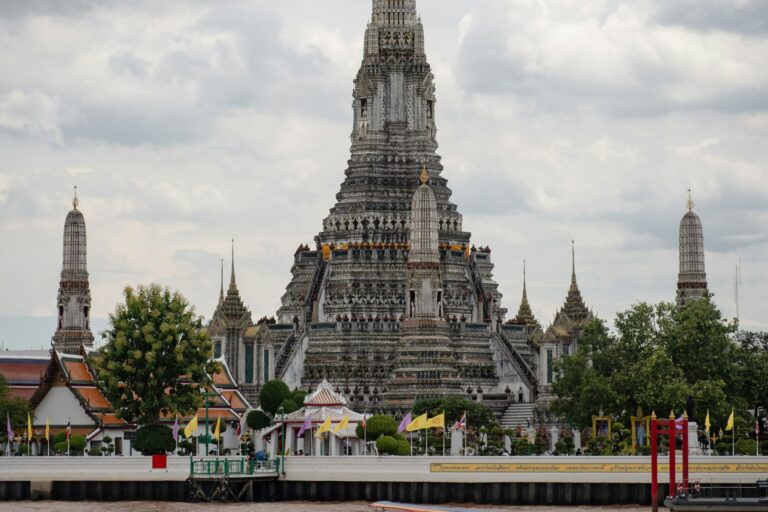
Thailand Train Itinerary: 2 Weeks
Thailand Train Itinerary: 2 Weeks
A measured journey north, with smaller-city stops and a sleeper home.
A Thailand train itinerary works best when the railway determines the shape of the holiday. Rather than rushing between the north and the islands, this two-week route follows one corridor from Bangkok through Ayutthaya, Phitsanulok and Lampang to Chiang Mai. You return on a sleeper, then spend the last night in Bangkok instead of gambling an international flight on an overnight train arriving punctually.
The reward is not simply time looking out of a window. Two-night stops let you unpack, understand a smaller city and travel onwards without immediately repacking. Meanwhile, the northern section makes the train itself part of the experience. This is a rail-led holiday, not a claim that every temple, hotel or historical park has its own station.
The plan below is research-led rather than an account of a journey I personally made. Stops were selected for their position on the Northern Line, useful overnight breaks and contrasting experiences. Suggested sightseeing blocks and connection margins are editorial planning choices; published train availability must still be checked for your travel date. [1]
This article contains affiliate links. If you book or buy through them, Taylor’s Trailblazing Travels may earn a commission at no extra cost to you. The route recommendations are based on the planning considerations explained in the guide.
Bangkok to Chiang Mai
Five hotel bases, then a sleeper south.
Travel north in daylight
Reserve window time, not just a transfer.
Sukhothai needs a road leg
The historical park is not a railway stop.
One final Bangkok night
Keep the sleeper separate from flight day.
Thailand train itinerary: the complete 14-day route
Count nights before comparing train tickets
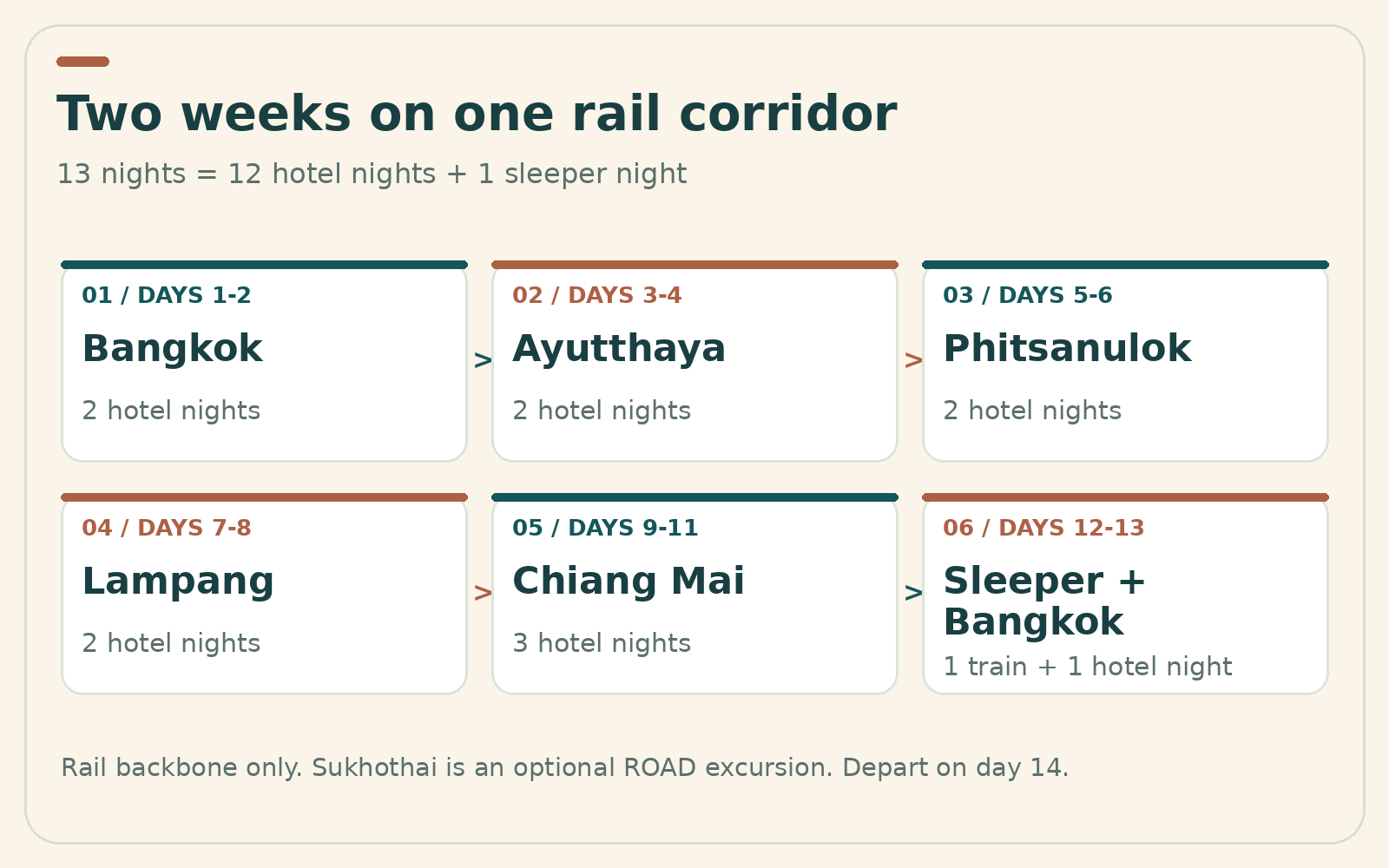
The apparently small difference between a day and a night causes expensive itinerary mistakes. Arriving on day one and leaving on day fourteen gives thirteen nights to allocate. In this plan, the sleeper occupies night twelve. Therefore, you need twelve nights of accommodation, not thirteen hotel nights plus a train reservation.
Bangkok appears twice for different reasons. The opening stay gives you time to recover and learn the transport system; the final stay protects the journey home. Although returning to the same hotel can simplify luggage storage, ask permission before assuming it will hold belongings while you travel north. A confirmed arrangement is more useful than an optimistic note in your itinerary.
| Days | Overnight base | Nights | Main plan |
|---|---|---|---|
| 1-2 | Bangkok | 2 hotel nights | Arrival, one focused city day and rail preparation. |
| 3-4 | Ayutthaya | 2 hotel nights | Rail north; one full historical day. |
| 5-6 | Phitsanulok | 2 hotel nights | Rail north; local day or a Sukhothai road excursion. |
| 7-8 | Lampang | 2 hotel nights | Rail north; temple, old streets and a slower afternoon. |
| 9-11 | Chiang Mai | 3 hotel nights | Daylight rail arrival and two full northern days. |
| 12 | Southbound train | 1 sleeper night | A reserved berth on the overnight return. |
| 13 | Bangkok | 1 hotel night | Protected final night after the sleeper. |
| 14 | Departure | No overnight stay | Transfer to the correct Bangkok airport. |
Allocation: 12 hotel nights + 1 sleeper night = 13 nights. Sightseeing and transfer blocks are planning choices, not a timetable.
Why these stops earn their place
Ayutthaya provides a compact first rail journey and a substantial historical contrast with Bangkok. Phitsanulok breaks the longer northbound stretch and offers access to Sukhothai by road. Lampang adds a smaller-city stay before Chiang Mai, rather than becoming a station name you only glimpse through the window. The order follows the rail corridor; it is not a league table of Thailand's best destinations. [1]
Five hotel bases may sound busy, but the repeated two-night rhythm is deliberate. Nevertheless, anyone who dislikes frequent check-ins should remove Phitsanulok and distribute those nights between Lampang and Chiang Mai. Adding more destinations would undermine the main advantage of travelling this way.
Days 1-2: make Bangkok an easy starting point
Day 1: arrive without a rail connection hanging over you
Book your first night in Bangkok rather than a same-evening sleeper. Immigration, luggage collection, a delayed arrival and the transfer into town can consume the margin that looked generous at home. After checking in, aim for a nearby meal and an uncomplicated walk. The first day does not need to demonstrate that you are already travelling efficiently.
Choose accommodation for the journeys you will actually make. A hotel beside a convenient urban rail station can be more helpful than a distant property advertised as near Bangkok's railway network. However, a hotel beside the intercity departure station is not automatically the nicest base for two days of sightseeing. Compare the whole stay, not just departure morning.
Day 2: one neighbourhood, then practical preparation
Use the second day for a focused old-city or riverside visit, allowing a proper indoor break during the hottest part of your outing. Keep the route modest enough to finish without exhaustion. You will have another Bangkok day after the north, so there is no need to complete an entire capital-city checklist immediately.
Later, confirm tomorrow's departure station from the actual ticket. Bangkok's long-distance and local trains do not all share one departure point. The official booking system distinguishes Krung Thep Aphiwat from Bangkok's Hua Lamphong station; the service you choose determines where you board. Do not replace that information with the vague instruction 'go to Bangkok station'. [2]
Save the ticket and hotel address offline, place tomorrow's clothes near the top of the bag and buy a simple journey snack. These small tasks leave departure morning for finding the correct platform rather than troubleshooting passwords and mobile data.
Days 3-4: give Ayutthaya an overnight stay
Day 3: the first rail leg should feel manageable
Select a Bangkok-Ayutthaya service that leaves enough daylight after check-in for a gentle introduction. The objective is not necessarily the cheapest possible departure: an awkward early start can waste more enjoyment than it saves money. For planning, keep the morning available for checking out, reaching the station, travelling and getting to your next hotel.
On arrival, arrange transport to the accommodation before tackling the ruins. Station proximity and proximity to the historical sights are different things, so look at the address rather than a broad city label. Ask the hotel about luggage storage when your room will not be ready. Then take a short orientation outing instead of carrying everything between attractions.
Day 4: understand the old capital rather than collecting ruins
Ayutthaya's historical significance is the reason to stay, not an excuse to race through every surviving structure. UNESCO describes a former Siamese capital that flourished as an international trading and diplomatic centre before its destruction in 1767. Choose a small group of sites and spend time noticing their scale, layout and surviving details. [3]
A guided visit can supply context that isolated information boards do not. Alternatively, choose one central cluster independently and add a riverside stop later. Cycling is an option only when you are comfortable with local traffic and conditions; hiring a driver is a legitimate way to conserve energy, not a failure to travel independently.
Protect the middle of the day for lunch and rest. Meanwhile, confirm the next train's departure time and whether it is already reserved. A relaxed second evening is one of the benefits you would lose by treating Ayutthaya solely as a day trip from Bangkok.
Days 5-6: Phitsanulok and the Sukhothai decision
Day 5: use the journey as the day's main activity
The Ayutthaya-Phitsanulok leg is a substantial intercity journey, not a quick suburban hop. Published services differ in duration and class; use roughly four to six hours aboard as a broad planning envelope, then add local transfers and boarding time. Check the selected service rather than applying one route-page minimum to every departure. [4]
Arriving, finding the hotel and eating somewhere nearby is a sufficient plan. A short riverside walk may fit afterwards, but avoid paying for a timed attraction on this day. The purpose of the stop is to break the northbound journey and create options, not to generate another evening of rushing.
Day 6: choose Phitsanulok or a road excursion
Sukhothai is not a stop on this passenger rail itinerary. Reaching the historical park from Phitsanulok requires road travel, and the old historical area is separate from modern Sukhothai town. Confirm exactly which place a transfer serves before comparing its duration or price. A vehicle reaching the town's bus station does not automatically deliver you to the park gates. [5]
For the excursion, agree a complete return plan, including your preferred park entrance, waiting time and pickup point. Allow the outing most of the day. A private transfer may simplify the logistics, while independent bus travel demands more attention to local connections. Neither makes this an entirely rail-only holiday, and there is no reason to disguise that distinction.
The alternative is a deliberately slower Phitsanulok day: visit the riverside temple area, find lunch and rest before the next long train. Travellers interested in a deeper Sukhothai visit should use a culture-focused itinerary with nights near the historical park, rather than forcing extensive sightseeing into this single excursion. [6]
Days 7-8: stop in Lampang instead of passing through
Day 7: make the arrival practical
Phitsanulok-Lampang is another journey for which the timetable shapes your day. Different trains have different calling patterns, so compare daytime arrival as carefully as departure. A broad four-to-six-hour allowance aboard is useful at the planning stage, but it is not a promise for a specific train. [7]
Reserve accommodation with a clear arrival arrangement and a realistic way to get there from the station. Smaller-city hotels may not offer the same round-the-clock transport choices as the capital. However, a straightforward message containing the train number and expected arrival can remove much of the uncertainty.
Day 8: combine heritage with an unhurried afternoon
Wat Phra That Lampang Luang is in the Ko Kha area outside central Lampang, so include road transport in the outing. The Tourism Authority of Thailand identifies it as a significant historic temple with distinctive architecture. Treat it as a purposeful half-day visit, not as something you can casually reach on foot from a city-centre railway hotel. [8]
Back in town, the old commercial streets around Kat Kong Ta offer a different kind of heritage. TAT describes the riverside district's mixture of trading influences and historic buildings. The organised walking market is associated with weekend evenings; on other days, visit for the streets themselves rather than expecting every stall to be operating. [9]
This is a good point to do laundry, replace any supplies you need and simplify the bag. By now you will know which items were genuinely useful on the earlier trains. Leave room for purchases instead of accumulating extra carrier bags that make the final sleeper harder to manage.
Days 9-11: let Chiang Mai be more than the terminus
Day 9: enjoy the northern rail section
Choose a daytime Lampang-Chiang Mai train when the scenery matters to you. A journey made entirely after dark cannot deliver the window views that attracted you to a rail holiday. Published listings commonly put this leg within a few hours; a two-to-three-hour planning allowance aboard is more useful than assuming the fastest displayed departure will be available. [10]
Once in Chiang Mai, transfer to your accommodation and keep the first outing nearby. Do not add a distant mountain excursion merely because the rail leg is shorter than yesterday's. This afternoon is your chance to settle into the final northern base rather than start another transport project.
Day 10: old-city time without temple fatigue
Give the morning to a small old-city route with one or two temple visits, then make lunch the day's other substantial activity. The exact sequence should follow the hotel location and your interests. Reading about one place beforehand generally adds more than visiting three extra sites without understanding them.
Later, choose a market, a craft-focused visit or a quiet afternoon rather than another compulsory attraction. This route already includes historical landscapes and train travel; variation helps the experiences remain distinct. A rest is especially useful for anyone who sleeps poorly away from home and wants to enjoy the sleeper rather than merely survive it.
Day 11: one planned excursion, not an entire province
Doi Suthep is a reasonable single-focus outing from Chiang Mai, with road transport required to reach the mountain temple. TAT describes both the stair approach and an assisted ascent option, but confirm current operation and accessibility directly rather than assuming that the presence of a lift removes every step. [11]
Alternatively, stay in the city for a cooking class or neighbourhood walk. There is no requirement to add Chiang Rai, Pai or an all-day circuit before departure. Those are separate destinations with their own travel demands, not convenient small additions to the end of a rail route.
Days 12-14: sleeper south, then a protected departure
Day 12: prepare for the night train
Check out, leave luggage with the hotel by arrangement and plan a low-stakes day. A shower or paid late checkout can improve the overnight experience, but confirm availability rather than counting on it. Eat before boarding or carry appropriate food; do not make an unverified onboard catering service responsible for dinner.
Book the sleeper class and berth you actually want. A generic result described as a train ticket does not guarantee a sleeping berth, air-conditioning, adjacent places or a private compartment. Review the issued confirmation for the train, carriage, berth, travel date and passenger names. [2]
Day 13: arrive in Bangkok with no flight deadline
Southbound Chiang Mai-Bangkok sleeper journeys can occupy much of a night and part of the following morning. Listings vary by train; roughly twelve to fifteen hours is a sensible initial envelope, not an on-time guarantee. More importantly, this itinerary does not connect the sleeper directly to an international departure. [12]
After arrival, store your bag or check in when permitted. Use the remainder of the day for something close to the hotel: a missed neighbourhood, a final meal or simply recovery. Resist treating the protected day as an opportunity to book a non-refundable excursion far outside Bangkok.
Day 14: leave from the airport on your ticket
Confirm whether the flight uses Suvarnabhumi or Don Mueang, then plan the hotel-to-airport journey around that actual airport. A note saying 'Bangkok airport' is insufficient. Follow the airline's check-in guidance and allow for city traffic or transport disruption; the buffer hotel night protects the rail connection, not every possible problem on departure day. [13]
Booking the trains in the right order
Start with the constrained leg
An SRT notice published on 24 April 2026 reduced the maximum advance-booking period for reserved trains from 180 to 90 days, with the applicable window still depending on the journey distance. Older official pages and booking terms can still mention 180 days. For planning checked on 5 October 2026, use the newer notice and test your exact origin, destination and date in D-Ticket rather than assuming every segment opens ninety days ahead. [14] [2]
Compare the official channel and an agency sensibly
The official railway system is the direct starting point. An agency can be convenient when you prefer its payment process or support, but compare the final total and ticket-issuance instructions. A booking request or payment receipt should not be mistaken for a fully issued travel document. Save the support contact and any collection requirement before leaving reliable internet access.
The route links in this guide are comparison tools, not endorsements of every train class or supplier shown. Confirm that the result is rail rather than a bus alternative, and check refund conditions before choosing the cheapest fare. An inexpensive restrictive ticket may be the wrong match for an itinerary that is still changing.
Keep a usable document set
Use the traveller's passport details consistently. Download the issued ticket, save a screenshot of the key journey information and follow the railway's current instructions on presenting or printing it. Keep the original passport accessible as required for travel, but do not leave it loose on an overnight berth or in an unattended bag. [2]
Berths, bags and station changes
Choose comfort according to your own sleep
A lower berth can be easier to enter; an upper berth may involve climbing and a different amount of usable space. Availability and layouts vary, so inspect the offered carriage rather than imagining a hotel room. Two seats bought together do not necessarily produce the sleeping arrangement you have in mind.
For light sleepers, the sensible question is whether one rail night is enjoyable enough to justify broken sleep. This route includes only one. Travellers who know they cannot sleep on trains can take a daytime return and move a Chiang Mai night to Bangkok, accepting that a long day will be spent aboard.
Pack for the berth, not just the suitcase
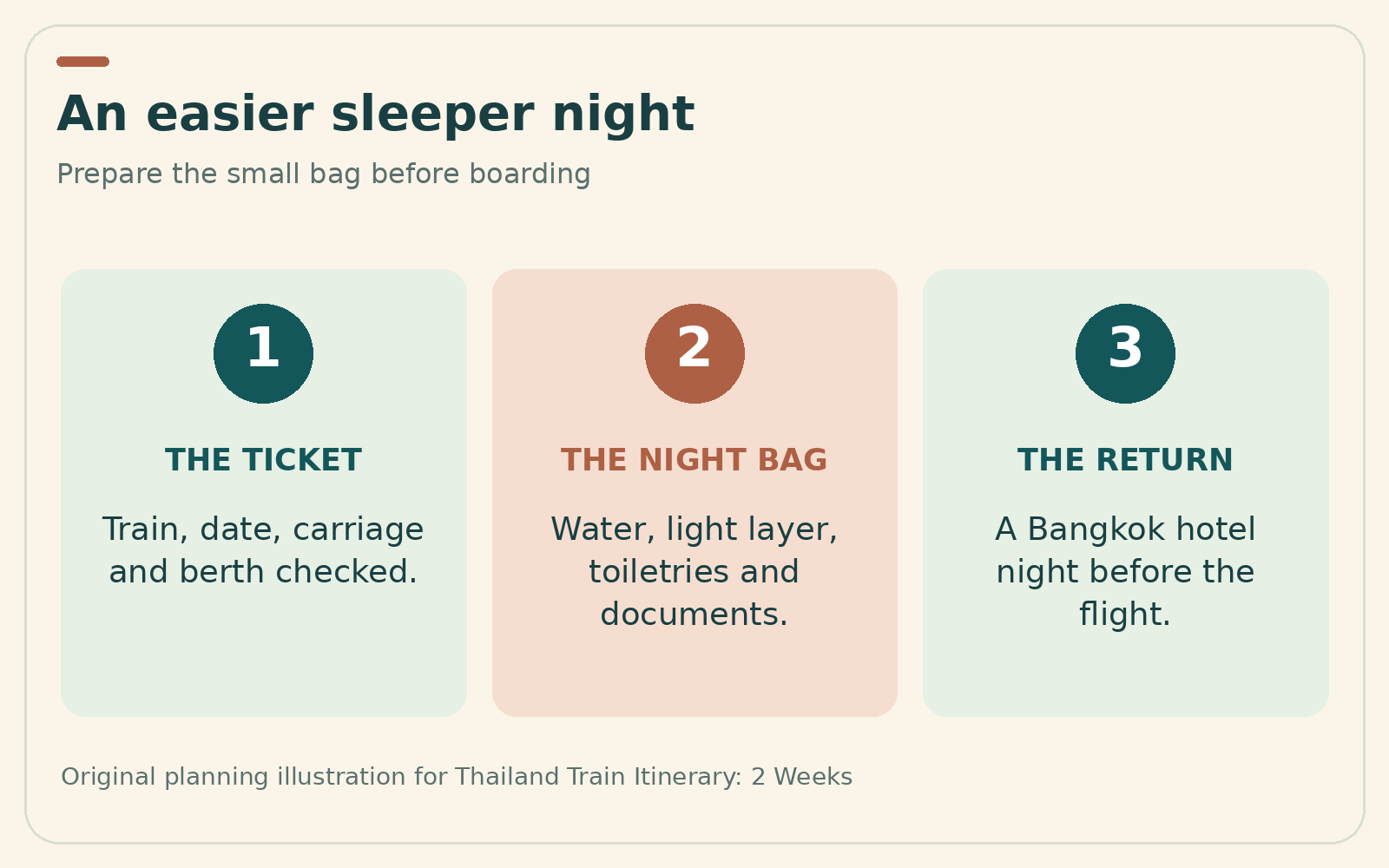
Put overnight essentials in one small pouch before boarding: a light layer, toiletries, drinking water, earplugs, an eye mask and the documents you need. Then the main bag can remain closed. Repeatedly opening a large suitcase in a narrow shared aisle is awkward for you and for the people trying to pass.
Use a bag you can move and lift safely without assuming staff will carry it. Platforms, carriage steps and storage layouts vary. Travellers who need boarding assistance should contact the operator in advance with specific requirements; an online accessibility symbol is not a complete description of the journey. [1]
A station stop is not an invitation to wander
Unless railway staff confirm otherwise, remain aboard during intermediate stops. The length of a halt can change, and a train need not wait while you finish buying food. Keep children together, know which berth each person occupies and agree where important documents will be kept during the night.
Budget, weather and sensible alternatives
A transparent example rather than a promised price
For two adults sharing rooms, an illustrative mid-range model allocates THB 24,000 to twelve hotel nights, THB 8,000 to both travellers' rail tickets, THB 14,000 to food and everyday drinks, and THB 8,000 to local transport and sightseeing. That is THB 54,000 before a separate contingency. These are editorial allowances prepared on 5 October 2026, not checked supplier quotations; international flights and insurance are excluded.
| Budget line | Assumption | Allowance |
|---|---|---|
| Accommodation | 12 shared-room nights at THB 2,000 | THB 24,000 |
| Rail travel | All planned intercity tickets for two | THB 8,000 |
| Meals and drinks | Everyday food and non-alcoholic drinks | THB 14,000 |
| Local travel and visits | Transfers, admissions and selected outings | THB 8,000 |
| Total before contingency | International flights and insurance excluded | THB 54,000 |
These are editorial planning allowances, not live fares or hotel quotations. Reprice your dates and add a separate reserve.
Spend more on the parts that remove a specific problem: a suitable berth, a convenient final hotel or a pre-arranged transfer after a late arrival. Conversely, do not upgrade every train automatically. A short daytime leg may not justify paying for a class whose main benefit you will barely use.
Change the route before conditions change it for you
Thailand's broad seasonal pattern is not an individual-day forecast. The Thai Meteorological Department describes a generally wetter period from around May to October and a cooler northern period later in the year. Check forecasts and railway notices close to departure, particularly during heavy rain. [15]
Northern air quality also deserves attention rather than a simple promise that dry-season weather is ideal. Check official advice and local conditions before locking in outdoor-heavy days. At the 5 October 2026 review, UK travel advice also carried a severe-flooding notice, making a current route check especially relevant for imminent travel. [16] [13]
Adjusting the route without breaking it
A slower version with fewer hotel changes
For travellers who prefer to unpack properly, replace the two Phitsanulok nights with an additional night in Lampang and an additional night in Chiang Mai. The resulting allocation is Bangkok two, Ayutthaya two, Lampang three, Chiang Mai four, sleeper one and Bangkok one. It still totals thirteen nights, although the Ayutthaya-Lampang journey becomes a much larger travel day. Check a suitable through-service before committing to that version.
This change removes the Sukhothai excursion rather than pretending it still fits. In return, Lampang gains a genuine spare day and Chiang Mai becomes more relaxed. The trade-off suits a traveller who enjoys neighbourhood walks and dislikes arranging a new hotel every second day. However, it is less attractive to someone who finds a very long seated journey uncomfortable.
A history-focused adjustment
When Sukhothai is essential, change the two Phitsanulok nights into two nights near the historical park, using Phitsanulok as the rail-to-road interchange on both sides. You will need a clear transfer arrangement on day five and enough time to return to the railway on day seven. This is more involved than the main version, but it gives the ruins a fuller day without a same-day round trip. [5]
Ask the accommodation to quote the complete station transfer rather than only transport from modern Sukhothai town. Also confirm whether the driver will monitor a delayed train and how late-arrival charges work. These practical details determine whether the adjusted itinerary feels comfortable or becomes a succession of negotiations at unfamiliar stations.
A rail enthusiast's version of the short leg
The Lampang-Chiang Mai day is the place to prioritise daylight and a window seat rather than the shortest possible journey. Compare the actual service available, then keep the remainder of the day free. A later hotel arrival is a reasonable trade when the journey itself is your planned activity. By contrast, taking a very late train and then complaining that the scenery was invisible is avoidable.
Do not lean out of doors or windows to photograph the railway. A picture through the glass is a better choice than putting yourself near trackside objects. Likewise, do not walk along tracks or enter restricted railway areas to obtain a photograph at a station. The practical experience matters more than recreating a promotional image.
What to do when a train is disrupted
First establish whether the train is delayed, rescheduled or cancelled; these are different situations with different remedies. Contact the railway or the issuing agent before buying a replacement. Keep the original confirmation and ask whether it remains valid. A social-media comment from another traveller may describe a different departure or a different section of the line. [1]
Next, protect the most consequential booking. Early in the route, that may mean dropping an afternoon visit and keeping the next hotel. Near the end, the priority is reaching Bangkok before the international departure, with the protected night providing some room to respond. A refund alone does not solve the onward journey, so confirm alternative availability rather than simply cancelling everything at once.
The station-to-hotel details worth sorting early
Write addresses for the person driving
Save each hotel name, full address and map pin, preferably with the property's own local-language version. A hotel name that is easy to recognise on a booking website may be less useful when pronounced differently at a taxi rank. Check that the pin identifies the entrance rather than the middle of a large building or the opposite side of a divided road.
For a pre-arranged pickup, ask whether the driver meets you at the platform exit, station forecourt or a nearby road. Include the train number and a contact method that works without relying on receiving an international text message. Meanwhile, retain the hotel's telephone number separately from the booking application's messaging screen.
Ask about luggage before the longer stops
Some travellers find it convenient to leave a larger bag in Bangkok and take a smaller one north. That works only when the hotel agrees to store it for the full absence and explains any charge or restriction. Keep valuables, medicine and essential documents with you. Also label the stored bag and obtain whatever receipt or reference the property uses.
Alternatively, take one manageable case throughout and book laundry midway. The point is not to meet an arbitrary minimalist packing target. It is to avoid carrying more than you can handle when a platform has no convenient lift or the carriage entrance is higher than expected. Ask about current boarding assistance rather than assuming an online photograph describes your service.
A realistic station morning
Work backwards from departure rather than from the moment you want to leave the hotel. Include checking out, waiting for transport, reaching the correct station entrance, finding the platform and handling a last-minute change. Arriving early enough to do those things calmly is more valuable than squeezing in another breakfast stop on the other side of town.
For example, a train leaving in late morning does not necessarily leave the whole morning free. A hotel checkout queue and a slow road transfer can use much of that apparent space. Pack the night before and choose breakfast nearby. Once at the station, use the train number and destination together when checking the departure board; a familiar city name by itself can point to more than one service.
Keep a small amount of local cash accessible for practical purchases without unpacking your main bag. Before boarding, take a final look at your seat or berth allocation and the luggage you are responsible for. This routine is deliberately simple: it reduces avoidable confusion without turning a holiday into a rigid minute-by-minute schedule.
Agree a group plan before boarding
For two adults travelling with children, decide who manages tickets, who boards first and who watches the bags while everyone finds their places. When berths are separated, know the allocated carriage and number for each passenger before the train leaves. Any requested change should go through railway staff rather than an assumption that other passengers will move.
Solo travellers can make the same process simpler by keeping everything needed overnight in one small bag. Before sleeping, put the phone, ticket and documents in a secure, consistent place. In the morning, allow time to repack before arrival instead of trying to find loose items while other passengers are already moving towards the exit.
Pros and cons of this rail-led holiday
What you gain
You get a coherent direction of travel, time in smaller cities and a northern stay long enough to do more than recover from transport. The sleeper adds a memorable travel experience without making every night dependent on sleeping aboard. Meanwhile, the last Bangkok night gives the return journey a sensible safety margin.
The route also makes it easy to simplify. Removing a stop creates breathing room without breaking the overall geography. Travellers can spend more time somewhere they enjoy rather than chase a second region simply because it appears on a standard Thailand checklist.
What you give up
This is not a beach holiday, and several days contain substantial time in transit. Local taxis or transfers remain necessary, especially for Sukhothai and out-of-town temples. In addition, a reserved rail service is less flexible than leaving whenever you feel ready in a private car.
A sleeper does not guarantee good rest, and the best berth for your group may sell out. Therefore, choose the rail experience because it interests you, not because you assume it is always the fastest, cheapest or easiest way to connect every Thai destination.
Common mistakes that weaken the route
Booking an arrival-day sleeper too tightly
The international arrival and the domestic train are usually separate arrangements. Leaving a narrow connection between them transfers the risk to you. Instead, keep the opening Bangkok stay and book an earlier northern departure only when your actual arrival pattern supports it.
Treating Sukhothai as a railway station stop
A ticket to Phitsanulok still leaves a road journey to the historical park. Booking a hotel in the wrong part of Sukhothai can add another transfer. Decide whether you want a day excursion or an overnight cultural stay before reserving accommodation, then choose the itinerary that genuinely supports that decision.
Trying to rescue every delay with another booking
When a late arrival removes a sightseeing slot, dropping the activity is often better than moving everything into the next day. Protect the onward train and sleep. Rebuilding the entire route around one missed temple usually makes the following days worse rather than recovering the holiday.
Frequently asked questions
Can I follow this itinerary without flying inside Thailand?
Yes. The main intercity legs in the proposed route are by train, including the return to Bangkok. Local journeys still use walking, urban transport or road vehicles. The optional Sukhothai excursion is specifically a road transfer, so the accurate description is no domestic flights, not exclusively rail transport.
Is two weeks enough for the north and southern beaches by train?
It can be arranged, but this version deliberately avoids that trade-off. Adding the south would require more long-distance travel or removing several northern stops. For a first rail holiday, one corridor provides a clearer route and more usable time. Choose a separate beach itinerary when time by the sea is the priority.
Must I stay overnight in every town listed?
No. The two-night pattern is a suggested pace rather than a rule. Skipping Phitsanulok is the simplest reduction when Sukhothai does not interest you. However, recheck the resulting longer rail leg and available departure times before transferring its hotel nights somewhere else.
Should I book a sleeper northbound as well?
Not for this itinerary. Doing so would bypass the daytime sequence that gives Ayutthaya, Phitsanulok and Lampang their place. A northbound sleeper suits a different plan centred mostly on Bangkok and Chiang Mai. It is not a straightforward substitute without changing the route's purpose.
What happens when my preferred sleeper is sold out?
Look at a different train, berth category or adjacent date through the operator's available options. Another possibility is a daytime return with an extra Bangkok night. Do not assume that an agency can supply inventory that the railway has not released or that an unconfirmed request is a reservation.
Is this suitable for children or limited mobility?
The two-night stops can work well, but suitability depends on boarding steps, berth access, the child's sleep and the assistance needed. Ask the operator and hotels specific questions before booking. Travellers who cannot manage an upper berth should not rely on an informal swap after boarding.
Can I fly home immediately after the sleeper arrives?
This guide recommends against planning that connection on separate tickets. A final Bangkok hotel night is already included for exactly this reason. It cannot eliminate every disruption, but it separates a potentially late train from the fixed deadline of an international flight.
Are the quoted journey times guaranteed?
No. They are broad planning envelopes based on the route listings reviewed, not a timetable for a particular travel date. The selected train's published schedule, current operating notices and the issued ticket take precedence. Add station access and hotel transfers when estimating the whole travel day.
Final recommendation: keep the railway as the backbone
Choose this two-week route when you enjoy the journey as well as the destinations. Book the sleeper first, preserve the two-night rhythm and retain the last Bangkok night. Those three choices do more for the holiday than adding another distant attraction.
Most importantly, treat the plan as a sequence of workable days rather than a test of how many provinces you can reach. Bangkok, Ayutthaya, Phitsanulok, Lampang and Chiang Mai already provide plenty of contrast. A few quiet afternoons are what make the train windows, old streets and final northern stay worth remembering.
Sources and fact-checking notes
- State Railway of ThailandRailway service notices and official operator information. Reviewed 5 October 2026.
- SRT D-Ticket: reservations and conditionsCheck exact stations, travel dates, train category and issued-ticket instructions. Older terms are not treated as overriding the dated booking-window notice. Reviewed 5 October 2026.
- UNESCO: Historic City of AyutthayaHistorical significance and context, not current visitor-ticket information. Reviewed 5 October 2026.
- 12Go: Ayutthaya-Phitsanulok train listingsService examples only; dates, times, classes and inventory must be checked again. Reviewed 5 October 2026.
- TAT: Sukhothai Historical ParkPark location, visitor context and published zone admissions. Check current access locally. Reviewed 5 October 2026.
- UNESCO: Historic Town of Sukhothai and Associated Historic TownsThe heritage property and its associated historical towns. Reviewed 5 October 2026.
- 12Go: Phitsanulok-Lampang train listingsIllustrative rail services, not a promise of availability. Reviewed 5 October 2026.
- TAT: Wat Phra That Lampang LuangTemple setting outside central Lampang. Reviewed 5 October 2026.
- TAT: Kat Kong Ta Walking StreetHistoric trading district and walking-market context. Reviewed 5 October 2026.
- 12Go: Lampang-Chiang Mai train listingsDaylight-service and journey-duration context. Reviewed 5 October 2026.
- TAT: Wat Phra That Doi SuthepTemple location and approaches. Confirm present access arrangements directly. Reviewed 5 October 2026.
- 12Go: Chiang Mai-Bangkok train listingsOvernight-service examples; no onward flight connection is guaranteed. Reviewed 5 October 2026.
- UK Foreign, Commonwealth & Development Office: Thailand travel adviceCurrent travel notices, including the flooding notice visible at editorial review. Recheck before travel. Reviewed 5 October 2026.
- SRT: revised 90-day advance-booking notice, 24 April 2026Newer booking-window notice; older official pages may still show the superseded 180-day maximum. Reviewed 5 October 2026.
- Thai Meteorological Department: seasons of ThailandBroad monsoon and seasonal context, not a forecast for an individual holiday. Reviewed 5 October 2026.
- FCDO: Thailand health guidanceTravel-health preparation and environmental health considerations. Reviewed 5 October 2026.
Illustrations in this article were created for Taylor’s Trailblazing Travels. Third-party photographs, where used, are credited beside the image or in the source list.