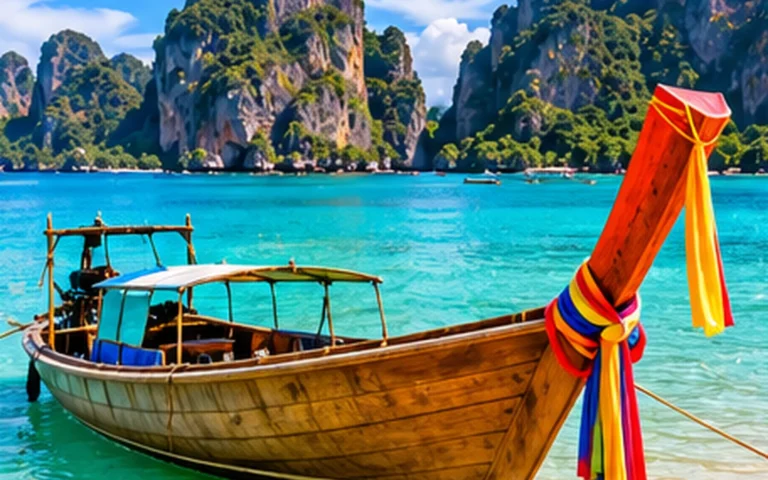
Thailand itineraries / considered luxury
Thailand Luxury Itinerary: 2 Weeks
A polished city opening, a northern retreat and six coastal nights with no essential ferry connection.
A Thailand Luxury Itinerary should buy you a better experience of time, not merely a more expensive version of a hurried route. A well-chosen room, a reliable arrival, a guide who understands your interests and several uncommitted afternoons can matter more than moving between famous hotels. Two weeks are enough for a varied journey, provided the hotels are places to enjoy rather than boxes to tick.
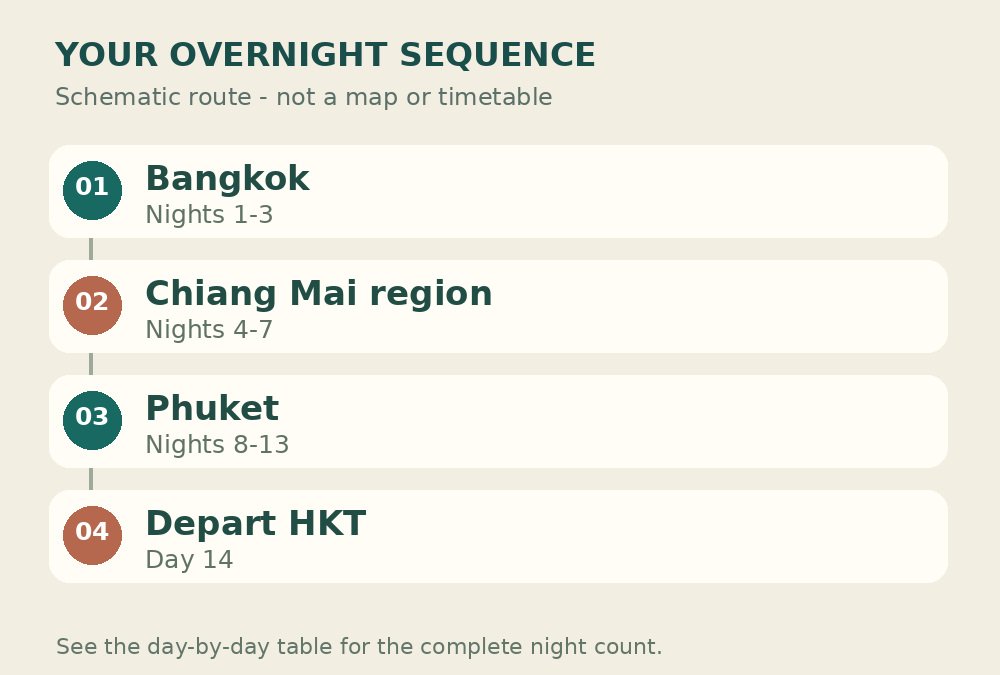
This plan uses three nights in Bangkok, four in the Chiang Mai region and six on Phuket, with arrival in Bangkok and an international departure from Phuket. It combines a city opening, a northern retreat and a coastal finish without making an essential ferry transfer part of the final journey. The thirteen-night allocation includes the arrival day and ends with departure on day 14.
The property examples are research-led reference points, not personally tested hotel reviews or a ranked list. Mandarin Oriental Bangkok, Four Seasons Resort Chiang Mai and Amanpuri illustrate three different settings and holiday roles. However, their inclusion does not mean a room is available, that a quoted package exists or that the same accommodation category will suit every traveller.
Best use of money
The right room
Privacy, aspect and access before a bigger category name.
Best time saving
Private road transfers
Confirm the named vehicle and service inclusions.
The route
Three substantial stays
No one-night luxury hotel collecting.
Cost control
One written total
Ask for taxes, meals, baggage and transfers on the same sheet.
A Thailand Luxury Itinerary that leaves time to stay
Three substantial stays instead of a hotel circuit
Begin with Bangkok while you are adjusting to the time difference, then move north for a quieter change of setting. Finish with the longest stay on Phuket so the coastal hotel can become a real base. As a result, that order gives the trip a natural reduction in pace instead of placing the most logistically demanding section immediately before departure.
The route assumes an open-jaw international ticket: into Bangkok and out of Phuket. Compare its total cost with returning through Bangkok, including the extra domestic flight, transfer and final hotel night that a separate-ticket return may require. An apparently cheaper international fare can become less attractive once those additional pieces are included.
| Days | Base | Nights | Design choice |
|---|---|---|---|
| 1-3 | Bangkok | 3 | River-oriented city stay and selected cultural experiences. |
| 4-7 | Chiang Mai region | 4 | A northern resort retreat with one or two outings. |
| 8-13 | Phuket | 6 | Long coastal stay; no essential smaller-island boat transfer. |
| 14 | Depart HKT | 0 | Road transfer to the international airport. |
Define what luxury means to you
Before selecting hotels, identify three priorities. They might be privacy, food and a view; or cultural access, good sleep and uncomplicated transport. For instance, a large villa is not automatically the right choice for someone who will spend most days exploring, while a central city room may be more useful than a distant retreat with a longer list of facilities.
Then use those priorities to evaluate each upgrade. Ask what changes in the actual experience: more usable outdoor space, a better aspect, a guaranteed room configuration or a shorter transfer. If the benefit is mainly a more impressive category name, keep the money for something you will notice during the stay.
Fit the region and the service to the dates
A premium booking still has weather exposure
Phuket's Andaman setting makes the season relevant to beach and boat plans. Northern conditions also need separate attention, including weather and air quality around Chiang Mai. Do not assume that a high room rate can compensate for conditions that do not suit the activities you value. Use seasonal patterns to choose dates, then check actual warnings nearer travel. [1] [2]
A coastal hotel can still be enjoyable when swimming is not advisable, provided its room, dining and land-based options appeal in their own right. Conversely, booking an isolated property solely for a particular excursion creates a narrow definition of success. Keep the accommodation choice broad enough to support a satisfying day without leaving the grounds.
Check the calendar beyond the weather
Also ask hotels about major private events, maintenance, restaurant closures and any changes to facilities that matter to your stay. A property may remain open while the particular restaurant, pool or wing you expected is unavailable. Request the answer for your dates, not a general description of what the resort usually offers.
For special dinners or treatments, book selectively after the travel dates are secure. Leave flexibility around arrival and departure days, when delays are most likely to affect plans. A carefully spaced programme can feel more personal than a heavily scheduled package because there is time to enjoy each experience without watching the next appointment.
Compare three reference properties by role
The shortlist is deliberately not a ranking
Mandarin Oriental Bangkok provides an established riverside city-hotel reference. Four Seasons Resort Chiang Mai is a different proposition, with its Mae Rim setting, rice-field landscape and pavilion or villa accommodation. Amanpuri provides the coastal resort reference on Phuket. Compare these differences before comparing room categories or headline nightly rates. [4] [5] [6]
The selection is based on how each property illustrates a useful role in the route, not on a claim that they are the three best hotels in Thailand. Equally suitable alternatives may fit your preferred neighbourhood, accessibility needs, loyalty programme or budget more closely. Use the examples to sharpen your questions rather than to replace them.
| Reference property | Useful fit | Trade-off to investigate |
|---|---|---|
| Mandarin Oriental Bangkok | Established riverside city-hotel setting. | Exact wing, room aspect, river crossing and restaurant plans. |
| Four Seasons Resort Chiang Mai | Rice-field and garden setting in Mae Rim. | Distance from the old city; pavilion versus private-pool villa. |
| Amanpuri, Phuket | Coastal resort stay with pavilions and villas. | Exact accommodation, slopes/steps and the full date-specific quotation. |
Compare the whole proposal
Before paying, request a date-specific written proposal covering the exact room category, occupancy, meals, cancellation terms and all compulsory charges. Then compare a platform listing against the same specification. A room with breakfast and flexible cancellation is not directly comparable with a prepaid room-only rate, even when both use a similar photograph.
Also ask about airport transfers, early arrival, late departure and any meaningful benefits attached to the booking channel. These details can matter, but only when confirmed. Do not assume a preferred-partner benefit, upgrade or late checkout is guaranteed because another traveller received it on a different date.
Choose the Bangkok room for how you will use the city
River setting versus daily convenience
A riverside stay can provide a strong sense of place, but examine where your planned activities begin and how you will reach them. Confirm the hotel's river transport arrangements where relevant, and consider road access when conditions are disrupted. The value of the setting should be weighed alongside the ordinary journeys to guides, restaurants and the airport.
For the room, ask about aspect, floor, wing and any features that could affect sleep or mobility. A category called river view may offer a different experience from the particular photograph you have in mind. A precise question about the booked category is more useful than asking whether the room has a good view.
Decide whether to pay for immediate access
An early international arrival can justify guaranteed room access, particularly after an overnight journey. Compare the cost of booking the previous night with any confirmed early-arrival arrangement. Merely adding a request to the reservation does not ensure that a room will be ready before the normal check-in time.
For a shorter three-night city stay, arrival comfort may be a better use of money than an upgrade you barely experience. The same principle applies to departure: a reliable transfer and a place to freshen up can be worth more than an elaborate final meal that leaves you rushing to the airport.
Day 1: make the arrival genuinely straightforward
Agree who is responsible for each handover
Before departure, confirm the airport meeting point, contact number, waiting allowance and vehicle capacity. Ask how the provider handles a delayed flight and whether waiting begins at landing or at the scheduled meeting time. A premium transfer should have a clear process, not simply a photograph of an attractive vehicle.
At the hotel, keep the first day focused on settling in. A short walk, an uncomplicated lunch and time in the room are enough. Do not schedule a major tasting menu or lengthy treatment against an uncertain arrival. The first night's sleep has more influence on the next day than squeezing an extra experience into the afternoon.
Use the concierge as a planning partner
Share a concise description of your interests and pace instead of asking for everything worth doing. For example, explain that you want one cultural morning, a food-focused experience and quiet evenings. This gives the team something useful to work with and reduces the chance of receiving a standard programme with more stops than you want.
Also keep a copy of arrangements outside a single messaging thread. Names, times, inclusions and cancellation conditions should be easy to find. Good service can handle changes more effectively when both sides understand what was actually agreed, particularly when several providers are involved across the trip.
Day 2: a private cultural morning with a clear finish
Buy interpretation rather than queue-shaped efficiency
A good guide can add context, answer questions and adapt the pace. For a Grand Palace visit, check the official visitor information and agree the focus in advance. However, paying for a private visit does not remove dress requirements, security procedures or closures. Avoid any promise that sounds like unrestricted access to an ordinary public attraction. [7]
Then choose a realistic finish time and leave the afternoon open. A shorter visit that holds your attention can be more satisfying than a long circuit designed to prove value through the number of stops. Explain whether you prefer architecture, religious context, history or everyday life so the guide can prioritise accordingly.
Keep the afternoon separate from the morning
Return for lunch, rest or a quiet period at the hotel. If you want a treatment, place it far enough from the outing that a modest delay does not turn the day into a sequence of hurried arrivals. Similarly, allow time to change and travel before dinner instead of assuming every restaurant is just downstairs.
For the evening, choose the style of meal you enjoy rather than treating a famous restaurant as mandatory. A relaxed meal can be the better first full-night choice when you are still adapting to the time difference. The itinerary should serve your appetite and energy, not the other way around.
Day 3: food, neighbourhoods and a lighter evening
Make a food experience specific
For example, a private food walk can work well when you discuss dietary needs, walking tolerance and the kind of food you want to explore. Ask whether tastings replace lunch or are small samples, and clarify how much driving is involved. A programme described as private may still use a fixed route, so confirm what can genuinely change.
If a formal food tour does not appeal, build a smaller day around one neighbourhood and a reserved meal. The point is to experience something different from the previous cultural morning. Avoid turning the day into a competition between famous venues, with successive meals booked so close together that none can be enjoyed comfortably.

Prepare for the northern flight
Before leaving, confirm the Bangkok airport, the operated flight and the transfer time. Check cabin and baggage conditions on the actual ticket rather than relying on the label shown by a comparison site. A business or premium-looking search result is not enough to establish what seat, lounge access or baggage allowance you will receive.
Pack the essentials for the first northern evening separately, especially when the resort is outside the city. A delayed bag is less disruptive when medication, suitable clothes and chargers remain with you. Settle the hotel account or review charges before the departure morning so any questions can be resolved without pressure.
Day 4: travel to the northern retreat
Leave room around the airport journey
Fly to Chiang Mai and continue to the chosen resort. The default is a full transfer day with no fixed sightseeing after arrival. Even a straightforward flight occupies more than the airborne time once checkout, transfers and baggage are included. Choose the service that supports a comfortable day rather than maximising theoretical hours at the destination.
For a Mae Rim stay, remember that the resort setting is outside the old city. This is part of its appeal when you want a retreat, but it also affects every city outing. Ask the property to explain the practical transfer and arrange a vehicle that suits your luggage and any accessibility requirements. [5]
Settle into the accommodation before adding appointments
On arrival, inspect the room and understand the available spaces. Identify where breakfast is served, how to reach the facilities you will use and how to request transport. A quiet first afternoon lets you decide whether the next few days should be more resort-focused or include an additional city visit.
With four nights, you have three full days after arrival. That is enough for a cultural outing, a hands-on experience and a less structured day. Resist booking the entire programme before you have considered how much time you actually want to spend at a resort selected for its atmosphere.
Know the difference between a pavilion and a private retreat
Space, privacy and access are separate questions
At a resort with several accommodation types, compare how each space is arranged rather than assuming the largest category is the most private. Ask about neighbouring sightlines, outdoor areas, paths used by staff and guests, and the distance to dining. A beautiful terrace may not provide the seclusion you imagined from a tightly framed photograph.
Also, for a private-pool category, establish whether it is genuinely private to the room and whether the pool dimensions suit your intended use. A plunge pool for cooling down is different from one suitable for meaningful swimming. Also ask about shade, steps and access, especially if the view is achieved through a hillside location.
Avoid an upgrade that changes the holiday in the wrong way
A large villa can encourage more time in the room, which may be exactly what you want. However, someone travelling for local culture might prefer a simpler room and more spending on a guide or an unhurried meal. Choose the accommodation in relation to the days you intend to have, not the category you feel a luxury trip ought to include.
Keep accessibility questions concrete. Ask about the complete route from vehicle to room, room to breakfast and room to pool. A property can have accessible features without every room or path being suitable. Written answers to those specific questions are more useful than a general assurance that assistance is available.
Day 5: choose a focused Chiang Mai visit
Make the drive worthwhile without extending the checklist
A city-focused morning can provide contrast with a Mae Rim resort stay. Agree a small number of interests with the guide, such as temple architecture, a particular craft or northern food. Chiang Mai's official destination information provides broad context, but the actual programme should be built around what you want to understand. [8]
Plan a comfortable lunch and a return that leaves useful time at the resort. Do not add another distant stop simply because it appears to be on the way. The extra hour may be better spent enjoying the setting you chose for four nights, especially when the following day already contains another organised experience.
Private does not always mean personalised
Ask how the provider adapts to your interests and what happens if you want to finish early. A private vehicle can still deliver a rigid group-style programme. Useful personalisation includes adjusting walking, choosing relevant stops and allowing conversation, not merely removing other passengers from the same schedule.
Likewise, clarify which admissions and refreshments are included, and whether the guide accompanies you throughout. A clear agreement reduces small payment interruptions during the day. It also lets you compare providers fairly instead of treating two very different service descriptions as equivalent because both use the word private.
Day 6: choose one experience with substance
Cooking can connect the setting to the meal
A thoughtfully chosen cooking experience can be more memorable than another sightseeing circuit. Ask about the kitchen setting, class size, menu, dietary adaptation and the time spent travelling. A private class is useful when you want detailed attention or a specific menu, while a small shared class can be enjoyable when conversation is part of the attraction.
Treat the class as the day's main event. If it includes a market visit and a meal, leave the surrounding hours light. There is little benefit in paying for an immersive experience and then leaving early because a second booking begins across town. The relaxed pace is part of what the premium should provide.
Nature and wildlife require their own judgement
A nature-focused alternative should be chosen around current conditions and responsible practice, not a promise of an exclusive photograph. For elephant-related experiences, favour observation-led approaches and examine the actual programme. Do not assume that a private visit, a luxury operator or a sanctuary label establishes good welfare by itself. [9]
If the available option does not suit your interests or standards, spend the day at the resort. A long lunch, a walk within suitable grounds or time with a book can be a legitimate use of a high-quality stay. There is no need to justify the room rate by leaving for another paid activity.
Day 7: use the resort as a destination
Leave a complete morning unbooked
Allow the final northern day to begin without an appointment. Have breakfast slowly, use the facilities you selected the resort for and decide how much activity appeals once you are there. This is the part of the itinerary that is easiest to remove during planning and often most valuable during the holiday.
A treatment, gentle class or other hotel experience can fit, but read the description carefully. Do not interpret wellness marketing as a medical promise. Choose services for relaxation or enjoyment and discuss any relevant health concerns with an appropriate professional rather than assuming a hotel programme is suitable for everybody.
Confirm the southbound routing
For Chiang Mai to Phuket, look for a suitable nonstop service on the actual travel date. Airline network information is a starting point, not a guarantee that a particular direct flight operates when you need it. If a connection is required, compare the complete journey and whether it is protected on one booking. [10]
Avoid a very early departure merely to reach the coast before lunch unless that timing genuinely matters. A later, straightforward journey can preserve the final resort morning and reduce fatigue. The six-night Phuket stay is long enough that arriving calmly is more valuable than squeezing a short additional beach period from the transfer day.
Day 8: arrive on Phuket without an essential boat connection
Keep the final region simple
Fly to Phuket and take a prearranged road transfer to the coastal hotel. The route deliberately stays on Phuket rather than adding a smaller island as an essential final base. That does not eliminate traffic or weather problems, but it removes one layer of boat scheduling from the core itinerary.
At arrival, keep the evening local and avoid a prepaid excursion. Confirm dining options before travel if the hotel is secluded, so you are not relying on an uncertain late arrival at a particular restaurant. A simple meal and an early night can be the best introduction to the longest stay of the trip.
A smaller-island substitution changes more than scenery
Koh Yao Noi can be considered as a different style of stay, but it adds road-and-boat logistics. Official resort transfer information illustrates the additional coordination and weather dependence involved. Do not swap the island name into the route without rebuilding the arrival, departure and final-night arrangements. [11]
For someone seeking fewer moving parts, the Phuket version is the stronger default. It leaves optional boat outings optional and keeps the international departure accessible by road. The choice is about the holiday you want, not a claim that one island is universally more luxurious than another.
Select the coastal room as carefully as the resort
Ask what the category really includes
Amanpuri offers a coastal resort reference with pavilion and villa accommodation, but the exact category should be assessed individually. Ask about setting, privacy, steps, outdoor space and the facilities included in your particular booking. Official property information helps establish the broad offer; a written date-specific proposal establishes what you are actually buying. [6]
Similarly, for alternative resorts, apply the same questions rather than comparing star labels. A beachfront description may not explain the walking route from your room or the amount of shade available. Similarly, a sea-view category does not guarantee a private outlook. Also ask for an honest description of the room's strengths and compromises.
Check the cost of staying rather than only sleeping
A secluded hotel changes how often you eat on site, use arranged transport and purchase hotel experiences. Those choices may be exactly what you want, but they belong in the budget. Compare the total expected stay, including ordinary meals and transfers, rather than congratulating yourself on a room-rate saving that disappears elsewhere.
Also confirm any compulsory meal or event charges attached to the dates. Review service charges, taxes and cancellation deadlines in the written proposal. A clear all-in comparison is more useful than a low headline number followed by several qualifications discovered only at payment.
Days 9 to 11: alternate privacy and discovery
Day 9: enjoy the place you chose
Use the first full coastal day to settle into the room, grounds and dining rhythm. Locate the spaces you find most comfortable and see how the property works in practice. A beach morning, a slow lunch and an unstructured afternoon can be an excellent day without an external booking.
Swimming decisions should follow local advice and conditions, not the resort's reputation. A beautiful beach can be unsuitable at a particular time, and a private pool requires ordinary care as well. Keep the day enjoyable without making access to the sea a condition of success. [12]
Day 10: a limited Old Town outing
A private Old Town visit can bring a different perspective to a resort-heavy stay. Choose a focused walk and meal rather than a full-island circuit. Discuss how much time you want outside, which interests matter and whether you prefer a guide-led explanation or simply comfortable transport with independent time.
Return early enough to enjoy the afternoon at the hotel. Instead, the outing should complement the coastal stay, not replace a whole day with road travel. For food-focused programmes, confirm dietary arrangements and the amount of eating involved so dinner can be planned sensibly rather than booked by habit.
Day 11: leave one decision until the morning
Keep this day adjustable for weather, energy and anything you particularly enjoyed. It can hold a moved outing, a treatment or no formal activity. Because it is not tied to a transfer, the decision can be made on the basis of what would be pleasant rather than what is necessary to keep the route functioning.
A private boat excursion should be evaluated separately, including conditions, operator credentials, equipment and cancellation arrangements. Higher cost does not remove marine risk. Choose the programme because it suits your interests and the day, not because a private boat seems like an obligatory feature of a luxury holiday.
Days 12 and 13: finish without accelerating
Day 12: repeat the best part
By the fifth coastal day, you should know what you most enjoy about the stay. Repeat it. A favourite breakfast table, a quiet pool period or a familiar walk can be more satisfying than a final attempt to collect another attraction. The long stay earns its place when you stop continually comparing it with somewhere else.
For a special dinner, choose a time and style that suit the evening rather than treating it as a performance. Confirm dietary details and any deposit or cancellation conditions. Keep enough space beforehand to change and arrive comfortably, especially when the restaurant is away from the hotel.
Day 13: prepare a calm departure
With an international departure from Phuket, use the final full day for a light programme and practical preparation. Check the room account, luggage and transfer. Where the international ticket departs Bangkok separately, replace the sixth Phuket night with a Bangkok hotel night and fly back today; that means five Phuket nights plus the final city night.
Do not use a same-day separately ticketed domestic flight as the default connection to a valuable international journey. The correct buffer depends on the tickets and consequences, but an overnight return is the more conservative version presented here. Review airport changes as well, since Bangkok's airports are not interchangeable.
Day 14: protect the last handover
Set the pickup from the airline requirement
Ask the hotel or transfer provider to calculate the pickup around the actual flight, check-in requirement, road journey and a sensible margin. A generic airport-transfer duration is not enough. Keep the driver's contact and vehicle details accessible, and confirm the luggage capacity if the amount has changed since arrival.
For a late flight, arrange a suitable place to spend the post-checkout hours. Confirmed late checkout, a booked day room or agreed facilities access may be useful. However, do not treat availability-dependent benefits as guaranteed. Therefore, settle the plan early enough that the final afternoon remains comfortable even if the hotel is full.
Put a complete figure beside the experience
Use a hypothetical model, then replace it with quotes
The model below was designed on 05 October 2026 for two adults. It is not a quotation for the three reference properties, and their actual room categories or dates could cost substantially more. The accommodation figure is an assumed average across thirteen nights, intended to make the calculation transparent rather than establish a market rate.
International flights, insurance, visas where required, major shopping and unusually expensive private charters are excluded. The activity allowance is selective, not a promise of unlimited guides or treatments. Replace each line with written proposals and retain the reserve for changes rather than quietly spending it on upgrades during the booking process.
| Item | Planning assumption | THB |
|---|---|---|
| Accommodation | 13 nights x 30,000 average room allowance | 390,000 |
| Meals and drinks | 14 days x 5,000 for two | 70,000 |
| Domestic flights and transfers | Allowance, not an airfare quote | 42,000 |
| Guides, activities and treatments | Selective programme allowance | 45,000 |
| Subtotal | Before contingency | 547,000 |
| Reserve | 15% of subtotal | 82,050 |
| Worked total | Two adults; international flights excluded | 629,050 |
Spend more where the benefit is clear
A guaranteed suitable room, a carefully chosen guide or a reliable transfer can make a tangible difference. Repeated one-night hotel changes often do the opposite, even when each property is excellent. Instead, compare upgrades by how much of the holiday they improve rather than by how dramatic they sound in the confirmation email.
For a lower total, keep the route and reduce the room category or the number of private activities. Removing every quiet day to fit more prepaid experiences is not a meaningful improvement. A thoughtful luxury trip can be less scheduled than a budget one because comfort and service allow you to stop organising every hour yourself.
Read the cancellation terms as one combined holiday
A hotel, guide and domestic flight can each have reasonable terms individually while creating a difficult combined booking. Then put their payment dates and cancellation deadlines on one calendar. Then identify the moment when a regional change would leave you committed to several non-refundable items at once. This is especially useful when a resort requests a larger deposit or a particular dinner requires prepayment well before travel.
Ask what happens to the other arrangements if one essential service changes. A hotel may be able to move dates while a separately booked flight cannot, or a guide may have a different deadline from the room. Do not assume providers will treat independent reservations as a package. A clear understanding of those boundaries is part of buying a well-organised holiday, even when a professional has helped assemble it.
The details that make service feel effortless
Keep one shared travel brief
Create a short document with flight numbers, hotel addresses, transfer contacts, dietary requirements and confirmed arrangements. Give relevant providers the parts they need, while keeping passport scans and payment details secure. Both travellers should be able to find the next pickup without relying on one person's phone battery or memory.
Mobile data can support that system, but a data-only plan may not provide the local voice service you expect. Check device compatibility, coverage and plan validity before purchase. Save the crucial information offline as well, especially when a transfer depends on finding a representative at a busy airport.
Do not delegate away the final responsibility
A concierge or travel organiser can coordinate much of the trip, but review the dates, names and inclusions yourself. Confirm that each ticket uses the correct passenger details and that any separate bookings have workable connections. However, good service reduces effort; it does not make contradictory reservations compatible.
Check entry requirements for your passports with the Thai authorities and complete the official arrival-card process separately where required. Keep suitable insurance for the itinerary and planned activities. None of those tasks should be assumed to have been handled merely because the accommodation or transport is expensive. [13] [14]
Who this luxury route suits
Its strongest qualities
Three substantial stays allow you to enjoy the accommodation and build a rhythm in each region. The final six nights make the coast feel like a holiday rather than a brief add-on. A Phuket departure also keeps the essential final domestic transfer on the road, while selected private services can reduce everyday coordination.
Its compromises
Two domestic flights still take time, and a northern resort outside Chiang Mai adds driving for city visits. The three reference properties may not fit every budget, mobility requirement or preferred style. Moreover, seasonal conditions remain relevant, so the itinerary should be adapted rather than treated as an all-weather promise.
Luxury planning mistakes that waste the premium
Do not buy every possible upgrade
An upgrade is worthwhile when it improves something you value. Paying more for extra space, a butler-style service or a dramatic view without understanding how you will use it can leave less budget for experiences you actually enjoy. Ask what the category changes in practical terms, then make the decision deliberately.
Another mistake is confusing a private transfer with a private excursion, or a private excursion with a personalised one. Read the programme and inclusions. A chauffeured car cannot make an overlong, irrelevant itinerary interesting simply by removing other passengers.
Do not schedule away the reason for staying
Filling each resort day with a distant outing means you experience the hotel mainly at breakfast and bedtime. Likewise, several long tasting menus on consecutive evenings can become an obligation rather than a pleasure. Preserve unbooked periods, especially after flights, and leave the final day focused on departure rather than on one last expensive appointment.
Thailand luxury itinerary FAQs
Are these the best luxury hotels in Thailand?
They are reference examples chosen for their different roles in this route, not a ranked or personally inspected top-three list. Other properties may suit your location, room, accessibility or dining priorities better. Compare the precise accommodation and complete quotation rather than relying on brand recognition alone.
Does the budget buy this exact hotel combination?
No. The THB 629,050 two-adult model, designed on 05 October 2026, uses hypothetical allowances and includes a reserve. It is not an offer or a checked rate for the named properties. Obtain date-specific quotations and replace each line before deciding whether the route fits your budget.
Should we include a private pool at every stop?
Only when you will use it and the exact pool arrangement suits you. A city stay may benefit more from location or guaranteed early room access. On the coast, compare privacy, shade and pool size carefully. A category name alone does not establish the experience you are imagining.
Is a private guide necessary in every destination?
No. Use one where interpretation, access planning or a tailored pace adds value. Several independent or hotel-focused days can fit a luxury trip perfectly well. The route works best with selected services rather than a guide waiting outside every morning regardless of what you feel like doing.
Can we replace Phuket with Koh Yao Noi?
Yes, as a different itinerary choice, but rebuild the transfers and departure buffer. The smaller island adds a boat-dependent component that needs current confirmation. Do not connect an essential island departure tightly to a separate international flight. The Phuket version is the simpler default for travellers prioritising fewer moving parts.
Can the trip end in Bangkok instead?
Yes. Use five Phuket nights, fly to Bangkok on day 13 and stay there before departing on day 14. The total remains thirteen nights. Compare that extra flight, transfer and room against the open-jaw international ticket, and check whether the domestic and international flights use the same Bangkok airport.
Buy the comfort you will actually notice
Finally, keep the three-plus-four-plus-six-night structure, select the room categories carefully and request complete written proposals. Use private services where they make the day clearer or more meaningful, then leave enough time to enjoy the places you are staying. The most successful upgrade may be an afternoon without a booking.
This route works when luxury means attention, comfort and a considered pace rather than constant movement. Choose the hotels around those priorities, maintain realistic buffers and adapt the regions to your dates. That produces a two-week journey with a coherent rhythm instead of thirteen expensive nights spent preparing for the next departure.
Sources and fact-checking
This is a research-led route, not a report of personal stays or visits. Official sources support the factual checks; the route order, pace, trade-offs and budget models are editorial planning judgements. Transport searches are not confirmations of availability. Recheck access, entry rules, conditions and prices for your own travel dates.
- Thai Meteorological Department: seasons of Thailand. Seasonal pattern, including later rain on the southern east coast; not a trip-date forecast. Reviewed 05 October 2026.
- Thai Meteorological Department: forecasts and warnings. Check the local forecast and warnings close to each travel day. Reviewed 05 October 2026.
- FCDO: Thailand warnings and insurance. Current disruption and regional advice; review again before travel. Reviewed 05 October 2026.
- Mandarin Oriental Bangkok: official hotel information. Property setting and facilities; room recommendations are research-led, not a review of a stay. Reviewed 05 October 2026.
- Four Seasons Resort Chiang Mai: official information. Mae Rim location, pavilions, villas and resort facilities. Reviewed 05 October 2026.
- Amanpuri: official resort information. Phuket resort setting and accommodation; obtain a date-specific quotation. Reviewed 05 October 2026.
- The Grand Palace: practical visitor information. Official visit planning and dress requirements. Reviewed 05 October 2026.
- Tourism Authority of Thailand: Chiang Mai. Northern destination context and attractions. Reviewed 05 October 2026.
- World Animal Protection: elephant-friendly tourist guide. Observation-led selection criteria and current venue guidance. Reviewed 05 October 2026.
- Bangkok Airways: route network. Network reference, not a guarantee of a nonstop service on any particular date. Reviewed 05 October 2026.
- Six Senses Yao Noi: official transfer information. Example of the extra road-and-boat logistics involved in a smaller-island substitution. Reviewed 05 October 2026.
- FCDO: safety and security in Thailand. Road, water and severe-weather precautions. Reviewed 05 October 2026.
- Royal Thai Embassy London: visa exemption rules. Entry eligibility, the September 2026 change and admission-stamp checks. Reviewed 05 October 2026.
- Thai Immigration Bureau: digital arrival card. Official arrival-card instructions; this form is not a visa. Reviewed 05 October 2026.
Illustrations in this article were created for Taylor’s Trailblazing Travels. Third-party photographs, where used, are credited beside the image or in the source list.