Thailand itineraries / rail and road
Thailand Without Flying: 2-Week Itinerary
A compact central-Thailand journey with heritage, railway history and a mainland coast instead of airport hopping.
Thailand Without Flying is entirely possible as a two-week holiday when you choose a compact route rather than attempting to connect every famous region. Bangkok, Ayutthaya, Kanchanaburi and Hua Hin provide a useful combination of city life, heritage, railway history and a mainland coast. The important compromise is that trains will not conveniently handle every leg.
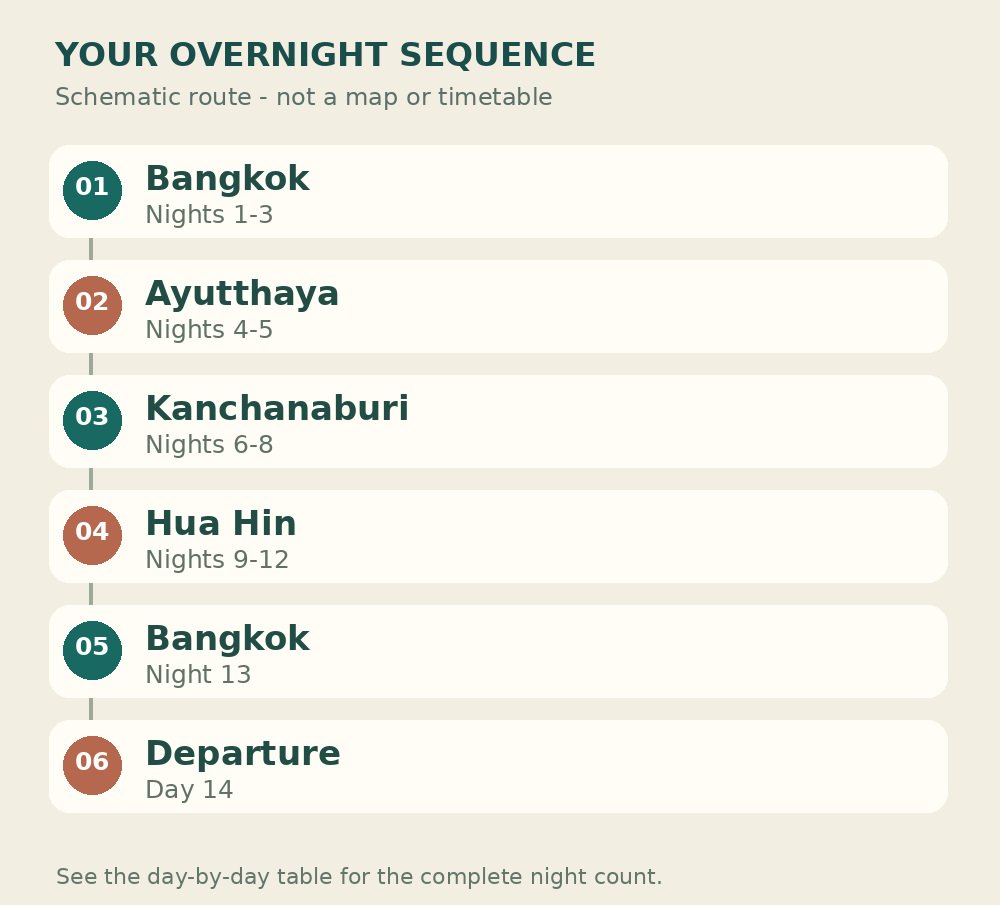
This itinerary uses rail where it makes sense and road transport for the awkward cross-country moves. It includes thirteen nights on land, no required overnight train and no essential island ferry. After three Bangkok nights, two in Ayutthaya, three in Kanchanaburi and four in Hua Hin, you return to Bangkok for the final night before leaving on day 14.
The scope is specific: there are no domestic flights after arriving in Thailand. Your international journey is separate, so this is not a proposed overland route from Britain. The advice is research-led and explains the practical connections, where a private car can help, how to keep the budget honest and when a simpler itinerary is the better choice.
The scope
No domestic flights
Your international arrival and departure are outside the route.
Best rail legs
Bangkok links
Check the station on each specific ticket.
Main compromise
Two road moves
There is no convenient direct train between every base.
Coastal finish
Four Hua Hin nights
No island-ferry dependency before returning to Bangkok.
Thailand Without Flying: the route and its limits
Four destinations, with Bangkok used twice
Start in Bangkok to recover from the international journey and explore a small part of the city. Move to Ayutthaya for an overnight heritage stay, continue west to Kanchanaburi, then turn south towards Hua Hin. The final Bangkok night separates the coastal return from the international departure.
The selection is based on geographical concentration, different experiences and the ability to travel without domestic airports or essential boats. It is not a claim that these are Thailand's best destinations for every traveller. Someone whose main interest is northern culture or remote islands should choose a different no-flight route rather than force those interests into this one.
| Days | Base | Nights | Transfer / purpose |
|---|---|---|---|
| 1-3 | Bangkok | 3 | Arrive; river and cultural neighbourhoods. |
| 4-5 | Ayutthaya | 2 | Rail or road from Bangkok; heritage day. |
| 6-8 | Kanchanaburi | 3 | Day 6 road-based cross-country move; railway history. |
| 9-12 | Hua Hin | 4 | Day 9 road transfer; mainland coast. |
| 13 | Bangkok | 1 | Return by train or road, then sleep before departure. |
| 14 | Departure | 0 | International travel, outside the domestic route. |
No flying does not mean trains everywhere
Bangkok links work well as the starting point for investigating rail travel, while road transport is more useful between Ayutthaya, Kanchanaburi and Hua Hin. A prearranged car provides door-to-door simplicity. However, the Kanchanaburi-to-Hua Hin leg also has direct shared-van listings, so do not assume a private car or a return through Bangkok is the only option. Confirm the current service and luggage arrangements. [1]
Be clear about that choice before booking the hotels. A route advertised as train travel can become frustrating when two of its most important journeys require complicated station changes or a return through Bangkok. Here, those limitations are part of the plan from the outset rather than a surprise after the rail tickets have been bought.
Check the route against current conditions
The plan is not an operating guarantee
At the editorial review on 05 October 2026, FCDO advice reported severe flooding affecting Bangkok and surrounding provinces. That matters to this route because Bangkok appears at both ends and some regional journeys may be affected by local disruption. Confirm access with the accommodation and operators before travelling, and follow current official instructions. [2]
Do not interpret a booking engine accepting payment as an independent all-clear for every road or attraction. Ask how the service handles disruption, whether the hotel remains practically accessible and what cancellation options apply. A compact route is easier to change than a nationwide one, but only when you know which bookings can move.
Leave outdoor excursions conditional
Kanchanaburi's wider region includes nature attractions, but waterfalls, caves and trails should not be treated as guaranteed day trips during unsettled weather. The default programme can work with town-based history and a flexible day instead. Check the current position with the relevant attraction before adding an outing that involves substantial driving.
Hua Hin also needs ordinary weather and swimming checks. A mainland coast removes ferry dependence; it does not provide guaranteed sunshine or safe water. Choose accommodation and a daily rhythm that remain enjoyable when the beach is mainly for walking, looking at the sea or sitting somewhere shaded rather than swimming.
Understand the four important transfers
Compare door-to-door journeys
A train duration does not include reaching the station, waiting, disembarking and travelling to the next hotel. Similarly, a private car quotation may assume a particular pickup point and no extended stops. Compare the complete day, especially when you are carrying luggage or need regular breaks.
The allowances below are editorial planning ranges reviewed on 05 October 2026, not published timetables or measured promises. They are deliberately broader than an optimistic vehicle-only estimate. During disruption, journeys can take longer or need to be changed entirely, so obtain a current operator-specific plan before booking dependent activities.
| Leg | Practical choice | Planning allowance | Key check |
|---|---|---|---|
| Bangkok – Ayutthaya | Train plus local transfers, or car | About 2-4 hours overall | Exact Bangkok station and onward ride. |
| Ayutthaya – Kanchanaburi | Prearranged car; public transport with changes | About 4-6 hours by car; a full day by public transport | Do not assume a direct train exists. |
| Kanchanaburi – Hua Hin | Direct shared van when available, or private car | Allow roughly 4-6 hours door to door; connections may take longer | Actual pickup/drop-off, luggage and current departure. |
| Hua Hin – Bangkok | Train or road service | About 4-6 hours door to door | Final hotel location and Bangkok arrival point. |
The two road moves are the key decision
A private car can make the western and southbound cross-country legs considerably clearer: one collection, one destination and agreed stops. However, it costs more than public or shared transport, and the vehicle must suit the number of people and bags. Ask about seat belts, child restraints where needed, waiting and the driver's plan for breaks.
For public transport, first distinguish a direct shared service from an itinerary with changes. Direct Kanchanaburi-to-Hua Hin vans can be a useful middle option between a private car and a complicated connection. Read the actual operating details, luggage conditions and final stop, then add the journeys between your hotels and the pickup or drop-off points. [1]
Choose the first Bangkok stay for everyday movement
A useful station matters more than a fashionable district
Pick a hotel with an understandable route to the areas you want to explore and a practical pickup point. Being described as near public transport is not enough: identify the actual station, walking distance, crossings and any stairs that matter to you. A well-located modest hotel can make this route easier than a more impressive room with awkward access.
Because the onward destination is Ayutthaya, check potential departure stations before assuming the most familiar Bangkok railway terminal is the right one. Different services can use different stations. Let the actual booking determine the journey rather than choosing transport entirely from the location of the hotel.
Plan for arrival without a room immediately available
An early international landing does not guarantee early hotel access. Agree luggage storage or a confirmed early-arrival arrangement where needed, then keep the first day light. A shower and proper rest may be more valuable than a busy introduction to Bangkok after a long journey.
Use the first stay to organise the essentials for overland travel: a manageable bag, offline addresses, accessible tickets and a small day pack. The route is not physically demanding by design, but repeated loading, short walks and station access are easier when the luggage is under your control rather than dependent on someone helping at every stage.
Days 1 to 3: a city stay that does not exhaust the route
Day 1: settle in and find the ordinary things
After reaching the hotel, identify nearby food, a useful shop and the route back from the main street or station. Keep the afternoon open and choose a straightforward dinner. There is no need to attach a fixed excursion to an uncertain international arrival, especially when current traffic or weather conditions may complicate the transfer.
Charge devices, save the next booking details and agree where important documents will be kept. These small routines become useful throughout a rail-and-road trip. A calm first evening is not lost sightseeing time; it helps the next two days begin with enough energy to enjoy them.
Day 2: one cultural area
Choose a principal cultural visit and organise lunch and any additional short walk around the same part of the city. The Grand Palace's official visitor information is the right reference for its current entry arrangements and clothing rules. Avoid building a day from several distant attractions simply because each appears manageable on its own. [4]
If the main sight does not appeal, use a smaller temple visit or another cultural interest instead. This itinerary is a route framework, not an instruction to visit every famous landmark. Return before fatigue makes the evening difficult, and leave time to enjoy food without immediately travelling to another appointment.
Day 3: a different kind of Bangkok day
Make the second full day about a neighbourhood, food or a suitable indoor attraction. Museum Siam provides a research option for an interactive culture-focused visit; check its current programme and opening arrangements before going. A river outing can also be considered when services and local conditions are appropriate, but it is not required for the route to work. [5]
Later, check the Ayutthaya departure point and the final transfer to the next accommodation. Prepare a small bag with essentials for the journey and settle any hotel charges. The next day should be a short, manageable move, not a hurried attempt to finish Bangkok before reaching the station.
Day 4: Bangkok to Ayutthaya by rail or road
Let the actual service determine the station
Search the intended date, compare suitable departures and read the station name carefully. The State Railway's official D-Ticket system is a starting point for eligible bookable trains, while some local services have their own practical ticket arrangements. An agency may simplify a purchase, but understand what its confirmation represents and whether additional collection steps are required. [6]
Allow time to reach the platform or pickup point without rushing. Keep the accommodation address and onward transport plan accessible, because arriving at Ayutthaya station is not the same as reaching the historic city or your room. A short train ride can still become awkward when the final leg has been ignored.
Keep the afternoon small
Check in, eat and take a limited orientation walk or one nearby visit if conditions suit. Two nights create a full following day, so there is no need to race straight from the station into a large heritage circuit. Use the afternoon to understand local distances and decide which sites you genuinely want to see.
For accommodation, compare location in relation to the planned visits and meals rather than treating the entire city as one walkable point. A guesthouse can be a good fit, but ask about arrival arrangements and any luggage storage needed before the next move. Practical access is more useful than a picturesque map pin.
Day 5: visit the historic city at a sensible pace
Select a group of sites rather than a complete collection
Ayutthaya is a UNESCO-listed historic city with the remains of a former capital. That context makes a little background reading valuable before the visit. Choose a manageable selection of monuments and allow time to understand them, rather than trying to prove the value of the day through the number of entrances crossed. [7]
A bicycle may suit some travellers, but road confidence, weather and the distance matter. Others may prefer a prearranged local vehicle with clear stops and a return plan. Use the option that supports attention and comfort; a heritage visit is not improved by arriving at each site already exhausted.
Build in lunch and shade
Plan a meaningful break before the afternoon instead of assuming you will simply continue until everything has been seen. The route has enough variety that there is no need to exhaust the historic-city theme in one day. If a place particularly interests you, spend longer there and remove another stop.
Before dinner, confirm the following day's move to Kanchanaburi. This is one of the less straightforward public-transport legs, so ask for the whole sequence rather than only the first departure. Keep the hotel's contact available in case arrival is later than expected and avoid a prepaid evening activity at the destination.
Day 6: Ayutthaya to Kanchanaburi is a road-planning day
The simplest version is a prearranged car
For this cross-country move, a suitable private transfer provides the clearest structure: collection from the accommodation and delivery to the next one, with agreed breaks. The editorial allowance is about four to six hours door to door in ordinary conditions, reviewed on 05 October 2026, but the operator must provide the actual plan for your date.
Obtain a quotation for the people and luggage you are carrying. Ask whether tolls, parking, waiting and any requested stop are included. A larger vehicle may be necessary even for a small group with substantial bags. Confirm the destination address, because a Kanchanaburi town hotel and a remote river resort can require very different final journeys.
Public transport needs a full-day mindset
A public-transport version may require changes through Bangkok or another suitable connection point. Do not assume a convenient direct train links the two destinations. Ask for the current departures, transfer locations and backup if the first service runs late, then leave the entire day for the move.
The railway does operate a Thonburi-Kanchanaburi-Nam Tok corridor, but that does not make Ayutthaya a direct departure point for it. Official railway information is useful for understanding the line; current times and operating arrangements still need checking. Avoid combining a tight cross-city transfer with the last usable onward departure. [8]
Choose a Kanchanaburi base that matches the programme
Town access and a remote river setting are different holidays
A town-based stay can make the museum, ordinary meals and local transport easier. A distant river resort may be attractive when the accommodation itself is the focus, but it can add considerable driving to every history visit. Decide which version you want before comparing photographs and room rates.
For this three-night itinerary, the default is a practical town or near-town base. It leaves two complete days after arrival and avoids turning each meal into another arranged journey. Check the exact address and access rather than assuming a riverside description means the hotel is close to the centre.
Keep arrival evening uncomplicated
After the day-6 transfer, use the evening for food and a short local orientation. Confirm the next morning's museum plan and leave the more distant options undecided until current access is clear. A quiet first evening is particularly useful after a public-transport journey with several changes.
If you are staying beside a river, follow local warnings and accommodation guidance about water levels and access. A scenic setting should not be treated as a guarantee that every riverside path or boat activity is suitable. The purpose of choosing a comfortable base is to make the stay workable even when an optional outing changes.
Day 7: understand the railway before treating it as scenery
Begin with the Thailand-Burma Railway Centre
The Thailand-Burma Railway Centre is an appropriate starting point for a history-focused day. Its work addresses the railway built during the Second World War using Allied prisoners of war and forced Asian labour. Give the museum time rather than treating it as a brief prelude to a bridge photograph. [9]
The war cemetery and other memorial places should be approached as places of remembrance, not entertainment stops. A guide can add context, but choose someone whose programme allows meaningful time and respectful interpretation. Avoid a tour description that reduces the entire history to a quick photo opportunity before moving to unrelated attractions.
Keep the day geographically manageable
Combine a small number of town-based stops with lunch and time to reflect. Do not automatically add a long railway ride, a waterfall and a distant memorial on the same day. Those elements can each deserve substantial time, and the resulting programme may become more about transfers than understanding.
For families or travellers who may find the subject emotionally difficult, consider the content before visiting and allow breaks. A shorter, attentive visit is preferable to continuing simply because an itinerary says another stop is next. The significance of the history is not measured by how many locations you reach.
Day 8: a railway outing or a genuinely flexible day
Use a train ride only when it fits the current service
A ride on part of the operating railway can add a different perspective, but check the current service, boarding point and return arrangement. Do not assume a scenic excursion train and an ordinary passenger service have identical booking conditions. Also consider the time spent reaching the station and returning to the accommodation.
Choose a manageable section and leave room around it rather than attempting the longest possible trip. The railway is an operating transport environment, so follow staff instructions and keep clear of tracks except where permitted. Photography should never require standing in an unsafe position or obstructing other passengers. [8]
Keep Hellfire Pass and nature excursions outside the default
Hellfire Pass is not included as an assumed open attraction in this edition because the official closure notice remained in place at the research check. When it reopens, it can be assessed as a separate outing with its own road journey and walking requirements. Do not substitute an old visitor review for the current official access information. [3]
Likewise, consider waterfalls or trails only after confirming local safety and access. A quieter town day, a different small cultural visit or time at the accommodation can fill the day perfectly well. Keeping an alternative ready makes the itinerary less dependent on a single weather-sensitive attraction.
Day 9: Kanchanaburi to Hua Hin without inventing a direct train
A road transfer makes the route clearer
For a straightforward move, arrange a suitable car from the Kanchanaburi accommodation to the Hua Hin hotel. The editorial allowance is about four to six hours door to door in ordinary conditions, reviewed on 05 October 2026. Use the operator's current assessment for the exact route, breaks and pickup time, particularly when weather has affected regional roads.
Confirm the complete fare and luggage capacity before departure. A stop can make the journey more comfortable, but avoid turning the transfer into a long sightseeing circuit unless that is a deliberate choice. The aim is to arrive with enough time and energy to settle into the four-night coastal stay.
Check the direct shared van before planning a connection
A direct shared van is a useful alternative for travellers comfortable with the vehicle and luggage arrangements. Current route listings include JKP Transport van services between Kanchanaburi and Hua Hin, but departures and availability must be checked for your date. Identify the actual terminal and drop-off, rather than assuming either is your hotel. A rail-based alternative still needs changes. [1]
Do not book an expensive dinner or excursion against the earliest possible arrival. Tell the hotel how you expect to arrive and retain its contact details. If the direct van does not operate conveniently on your date, compare a private transfer with the available connections. There is no advantage in choosing several fragile last departures merely to avoid asking about the simpler road options.
Pick the coastal stay for ordinary days
Hua Hin is a mainland choice, not an island substitute by name
Hua Hin offers a beach-town setting with road and rail access, local food and nearby interests. It is selected here because it adds a coastal stay without requiring a domestic flight or essential ferry. That does not mean it will feel identical to a smaller tropical island, nor that the sea will be suitable for swimming every day. [10]
Choose the hotel around the daily experience you want. A central or conveniently located base can make meals and short outings easier, while a more secluded resort may suit a stay focused on its facilities. Check the actual beach-access route and the evening walk to food rather than assuming both are easy from the map.
Ask about the features that matter
A beach-facing photograph may not show the complete route from the room to the shore. Likewise, a pool can be useful but should be assessed for shade, depth and access where those matter to you. Ask specific questions about your room and needs instead of relying on a general family-friendly or relaxing label.
Four nights provide three full days after arrival. That is enough for a beach-focused day, a small local outing and a flexible final day without moving hotels. Resist adding another coastal base simply because the route has reached the sea; familiarity is part of the benefit of staying longer.

Days 10 to 12: let the coast slow the trip down
Day 10: begin with the immediate area
Use the first full day to understand the beach access, shade, food and practical walking routes. Decide whether conditions suit swimming and follow local warnings. If they do not, use the day for a shoreline walk where safe, a meal with a view or the hotel's facilities rather than treating the coastal stay as a failure. [11]
Leave the afternoon open. After several regional moves, a day with few decisions can be especially welcome. A book, a familiar cafe and an early dinner are valid uses of the coast; the itinerary does not need a boat excursion to justify reaching the water.
Day 11: choose one local contrast
The Hua Hin destination information highlights interests including the night market, railway heritage and the Khao Takiab area. Choose one that suits your mobility, interests and conditions instead of combining several into a full-day circuit. Check current access and operating information before making a special journey. [10]
A short guided outing can help when you want context or uncomplicated transport. However, ask for the complete duration and the actual stops. A half-day label can still hide a long hotel pickup route or an itinerary with more time in the vehicle than at the places you want to see.
Day 12: enjoy the last full coastal day
Repeat what worked, or keep the day available for an outing displaced by weather. There is no need to finish the stay by adding a distant attraction. Use part of the afternoon to organise luggage, settle charges and check the next day's train or road departure.
Book the final Bangkok night according to the international airport and the arrival point of the coastal journey. Returning to the first hotel may be convenient, but it is not compulsory. A different final base can make the departure morning easier when the transport arrives elsewhere or the flight leaves early.
Day 13: return to Bangkok before the flight day
Keep a full overnight separation
Travel from Hua Hin to Bangkok by the booked train or road service, then stay overnight. The planning allowance is about four to six hours door to door under ordinary conditions, reviewed on 05 October 2026, but the actual service and local situation determine the day. Do not interpret that range as permission to connect tightly to an international flight.
Check the arrival station or terminal and arrange the final local journey to the hotel. A Bangkok destination label can conceal a location far from where you intend to sleep. Keeping the international flight on day 14 gives room to handle an ordinary delay without immediately turning the day into an airport emergency.
Use the final evening for preparation
Have an easy meal, check the flight and set the airport pickup using the airline's actual check-in requirements. Keep passports, medication and essential belongings accessible. If the return journey was tiring, skip the final sightseeing idea rather than forcing another outing into the evening.
An overnight buffer reduces some connection risk but does not guarantee that every disruption can be absorbed. Continue following official advice and allow more time where the situation warrants it. The principle is to keep the final domestic move separate from the flight home, not to promise that one night solves every possible problem.
Day 14: the international journey is separate
No domestic flight does not remove airport preparation
The itinerary ends with your international departure, unless you have independently arranged another lawful onward journey. Reach the airport according to the ticket and airline requirements, and check whether any transit documents are needed for the journey home. The absence of domestic flights does not change those international obligations.
For a late departure, arrange luggage storage and keep the remaining hours geographically simple. A nearby meal or a comfortable place to wait is a better fit than a long excursion with an uncertain return. The route has already provided several different experiences; there is no need to make the final day its least predictable one.
Budget for the transport version you actually choose
The example below favours public and shared travel
The two-adult model was designed on 05 October 2026 and is not a set of current supplier quotations. It assumes thirteen shared-room nights, ordinary meals and a public/shared-transport approach. The transport line should not be read as a quotation covering two private cross-country cars plus every other transfer.
For the simpler private-car version, replace the transport allowance with actual written quotations before comparing the total. International flights, insurance, entry-document costs and substantial shopping are excluded. The reserve remains available for necessary changes rather than being pre-allocated to additional excursions.
| Item | Assumption | THB |
|---|---|---|
| Accommodation | 13 nights x 2,200 for a shared room | 28,600 |
| Food and non-alcoholic drinks | 14 days x 1,200 for two | 16,800 |
| Transport | Public/shared journeys and local transfers | 6,500 |
| Admissions and selected experiences | Allowance | 5,500 |
| Data, laundry and incidentals | Allowance | 2,500 |
| Subtotal | Before contingency | 59,900 |
| Reserve | 15% | 8,985 |
| Worked total | Two adults; international flights excluded | 68,885 |
A no-flight route is not automatically the cheapest
Two people using private transfers may spend more on transport than travellers combining public services with a discounted domestic fare elsewhere. That does not invalidate the route; it simply means the reason for choosing it may be comfort, preference or avoiding airports rather than the lowest possible total.
Similarly, do not assume that no flying means zero environmental impact. Road vehicles and other transport still have an impact, and the result depends on the actual services and occupancy. This guide makes no numerical emissions claim. Its practical promise is the absence of required domestic flights, not an unverified environmental score.
Compare private transfers per journey, not per person by habit
For the two cross-country legs, ask whether the quotation is for the whole vehicle or for each traveller. Then confirm the maximum passengers and realistic luggage capacity. A couple may find the per-person cost acceptable when the fare is vehicle-based, while a solo traveller may prefer a longer public connection. Do not assume the same price basis across providers or between a car and a shared minivan.
Also decide what you expect from a stop. A brief comfort break and a two-hour attraction visit are different services, so discuss them before departure rather than presenting a sightseeing plan to the driver on the morning. Where the quote changes, update the transport line rather than drawing from the reserve as though the extra outing were an unexpected problem. This keeps the budget aligned with the route you have actually chosen.
Book the connections without creating a puzzle
Keep a record for each leg
For every transfer, save the date, departure point, destination, service type, operator contact and ticket or voucher instructions. A useful booking note answers where you must physically stand and what document you must show. A confirmation containing only two city names is not enough preparation for an unfamiliar terminal.
Where an agent sells a combined journey, ask who handles a missed connection and whether the onward service waits. Separate tickets normally require more personal coordination, so leave a sensible margin. Do not describe a sequence as guaranteed through-travel unless the operator has explicitly confirmed that arrangement.
Make luggage and access part of the booking
Check the complete access route if stairs, steps, boarding height or walking distance matter. A train can be a comfortable vehicle while the station remains difficult for a particular traveller. Similarly, a minivan may have limited space for large bags even when seats are available.
Ask for assistance or a different vehicle early rather than assuming it can be arranged instantly at departure. The route can be adapted for many needs, but no transport mode is automatically accessible simply because it avoids flying. Specific answers about the chosen service matter more than a general description of rail travel as easy.
Two simpler ways to travel without domestic flights
The city-and-coast version
For fewer moves, use four Bangkok nights, eight Hua Hin nights and one final Bangkok night before departing on day 14. That is still thirteen nights, but only two destinations, with Bangkok used twice. It removes Ayutthaya and Kanchanaburi, along with the two awkward cross-country transfers.
This is a strong alternative when the main aim is a relaxed coastal holiday without another airport. Day trips can be considered from the bases where they genuinely fit, but do not reintroduce all the removed travel as long excursions. The simpler version earns its value by remaining simpler.
The northern sleeper version
For a culture-focused alternative, use Bangkok on nights 1 to 3, a northbound sleeper on night 4, Chiang Mai on nights 5 to 10, a southbound sleeper on night 11 and Bangkok on nights 12 and 13. Depart on day 14. This uses eleven accommodation nights and two train nights, with no beach stop.
Check current sleeper availability, the northern conditions and the exact tickets before choosing that version. It is better for someone who actively wants a northern stay than for someone merely trying to make every journey a train. Removing road transfers is not worthwhile if it removes the experiences that motivated the holiday.
Prepare for the journey between the vehicles
Use a bag you can handle independently
Test the luggage fully packed before departure. Short walks, platforms, uneven surfaces and vehicle loading can be harder than the journey itself when the bag is too heavy. Keep the essential documents, medication, water and a light layer accessible, and avoid placing everything important in one bag that may be stored out of reach.
Bring only the equipment that serves a real need. A small, organised day bag is more useful than several loose items that must be counted at every change. Before leaving each vehicle, check the seat, overhead area and storage space methodically rather than relying on memory while the next connection is waiting.
Keep navigation useful when the signal is not
Save addresses, tickets and operator numbers offline. A mobile-data plan can support maps and messages, but confirm compatibility and whether it includes voice calls. The ability to browse does not necessarily mean you can call a local driver in the way you expected.
Keep a backup payment method and a small accessible reserve for a necessary local transfer. That is not an invitation to accept unclear prices; agree the service before setting off. It simply prevents a modest last-mile problem from becoming more difficult because every resource is buried in the main bag or tied to one phone.
Who will enjoy this no-flight itinerary
Reasons it works
The route offers several distinct settings without a domestic airport or essential ferry. All thirteen nights are in accommodation, and the coastal stay is long enough to slow down after the regional moves. It also makes the difficult connections explicit, which helps travellers choose between public transport and more straightforward private transfers.
Reasons to simplify it
There are still four regional moves and five accommodation stays when the final Bangkok night is counted. The Ayutthaya-to-Kanchanaburi leg can be long with public connections, while the direct Hua Hin van needs its own comfort and luggage check. Private cars change the budget. Travellers wanting an almost effortless two-base holiday should use the Bangkok-and-Hua Hin alternative rather than underestimate those moves.
No-flight planning mistakes to avoid
Do not draw the route before checking the connections
Nearby-looking places are not always linked by a convenient direct train. Check the actual network and services before committing to a sequence of hotels. In particular, do not confuse the western Kanchanaburi corridor with a direct connection from every northern or southern destination.
Another mistake is treating vehicle time as door-to-door time. Add station access, waiting, changes and the final hotel journey. Those pieces can matter more than a small difference between two advertised departures, especially when travelling with children, larger bags or access requirements.
Do not remove the buffer to add one more night elsewhere
The final Bangkok night protects the departure structure. Removing it may create a more attractive-looking coastal total, but also makes the last day dependent on a long domestic journey. Keep it unless you have deliberately evaluated the actual tickets, current conditions and consequences of a delay.
Finally, do not assume the absence of flights makes every other activity safe or available. Check road, water and attraction conditions in their own right. A responsible no-flight route still needs ordinary travel judgement, suitable insurance and the willingness to change an optional day when the evidence changes.
Thailand without flying FAQs
Does this mean travelling from the UK without a flight?
No. The itinerary begins after arrival in Thailand and excludes domestic flights during the two-week route. International arrival and departure are separate. An overland journey from Britain would be a substantially different project involving many additional countries, border conditions, permissions and practical constraints.
Can the whole default route be completed by train?
Not conveniently as written. Bangkok links are useful for rail, but the Ayutthaya-to-Kanchanaburi and Kanchanaburi-to-Hua Hin moves need careful connections and are simpler by road. Use the northern sleeper alternative or the city-and-coast version if reducing road changes matters more than keeping every default destination.
Is Hua Hin an island?
No. It is a mainland coastal destination, which is one reason it fits this itinerary. You do not need an essential ferry to reach it or return to Bangkok. However, a mainland location does not guarantee calm sea conditions or remove the need to follow local swimming advice. [10]
Should we book private cars for both cross-country legs?
Private cars offer door-to-door simplicity, but are not essential for both legs. Check the direct shared Kanchanaburi-to-Hua Hin van as a lower-cost option; the Ayutthaya leg needs separate connection planning. Compare actual services, luggage and complete quotations. The public-transport-leaning budget table is not a promise to cover the private-car version.
Can we visit Hellfire Pass on day 8?
Not as an assumed open stop in this edition. The official notice checked on 05 October 2026 reported the centre and trail temporarily closed until further notice. Recheck the Department of Veterans' Affairs information before considering a future visit, and keep the default day workable without it. [3]
Is this easier than a Bangkok, Chiang Mai and Phuket trip?
It removes domestic airports and concentrates on a smaller region, but it still involves several road or rail travel days. Whether it feels easier depends on your preferences and tolerance for connections. For the fewest moving parts, use the Bangkok-and-Hua Hin alternative instead of assuming that any no-flight route is automatically simple.
Let geography do the work
Choose Bangkok, Ayutthaya, Kanchanaburi and Hua Hin when you want several kinds of experience within a compact no-domestic-flight route. Use trains where they fit, arrange the cross-country road legs honestly and preserve the final Bangkok night. The journey works because it accepts the network's limits rather than disguising them.
For a calmer holiday, remove the western loop and spend longer in Hua Hin. For a northern focus, use the sleeper alternative and leave out the coast. In each case, the best route is the one that matches your interests and the actual connections, not the one that makes the strongest claim about travelling everywhere by train.
Sources and fact-checking
This is a research-led route, not a report of personal stays or visits. Official sources support the factual checks; the route order, pace, trade-offs and budget models are editorial planning judgements. Transport searches are not confirmations of availability. Recheck access, entry rules, conditions and prices for your own travel dates.
- 12Go: Kanchanaburi to Hua Hin operating options. Primary booking inventory showing direct shared-van and private-car options; recheck the operator, date, luggage and stops. Reviewed 05 October 2026.
- FCDO: Thailand warnings and insurance. Current disruption and regional advice; review again before travel. Reviewed 05 October 2026.
- Australian Department of Veterans' Affairs: Hellfire Pass visitor information. Official temporary closure notice updated 29 September 2026 and reviewed 05 October 2026. Reviewed 05 October 2026.
- The Grand Palace: practical visitor information. Official visit planning and dress requirements. Reviewed 05 October 2026.
- Tourism Authority of Thailand: Museum Siam. Interactive culture-focused museum context; confirm current programme and access. Reviewed 05 October 2026.
- State Railway of Thailand: D-Ticket. Official train search and booking; dates, stations and availability must be checked live. Reviewed 05 October 2026.
- UNESCO: Historic City of Ayutthaya. The heritage site and its historical context. Reviewed 05 October 2026.
- State Railway of Thailand: western-line passenger travel. Reference for the Thonburi-Kanchanaburi-Nam Tok corridor; dated timetable and fare examples are not reproduced. Reviewed 05 October 2026.
- Thailand-Burma Railway Centre: official website. Museum context, contact and visitor information. Reviewed 05 October 2026.
- Tourism Authority of Thailand: Hua Hin. Hua Hin attractions and road/rail access. Reviewed 05 October 2026.
- FCDO: safety and security in Thailand. Road, water and severe-weather precautions. Reviewed 05 October 2026.
Illustrations in this article were created for Taylor’s Trailblazing Travels. Third-party photographs, where used, are credited beside the image or in the source list.