Thailand Temples and Culture Itinerary: 2 Weeks
Thailand Temples and Culture Itinerary: 2 Weeks
Four contrasting cultural settings, with time to understand what you see.
A Thailand temples and culture itinerary becomes more rewarding when each place answers a different question. Bangkok introduces a living capital and its royal and religious spaces. Ayutthaya reveals the scale of an earlier international city. Sukhothai gives you time to look closely at a historical landscape, while Chiang Mai adds a northern cultural setting rather than one more collection of golden roofs.
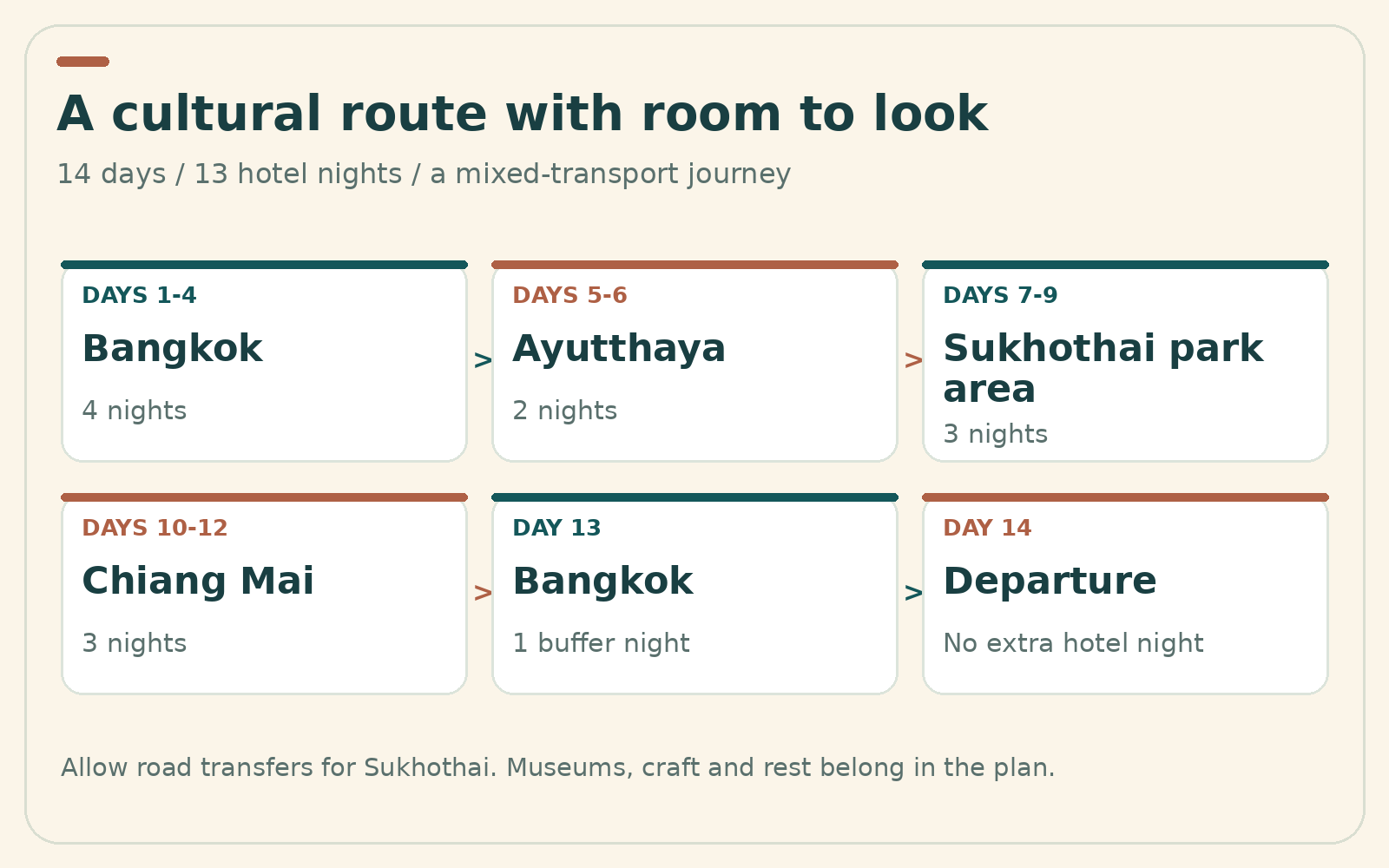
This two-week route uses four nights in Bangkok, two in Ayutthaya, three near Sukhothai Historical Park, three in Chiang Mai and one final night in Bangkok. It deliberately leaves room for museums, craft, neighbourhoods and rest. Culture is not confined to temples, and a holiday built from religious sites alone can become tiring even for an enthusiastic visitor.
The selections are research-led planning recommendations, not claims of first-hand visits. Sites were grouped by geographical practicality, historical contrast and a manageable daily workload. Official heritage descriptions explain the significance; the proposed pace is editorial judgement. Current admission details should be checked again if your visit is much later than the review date. [1] [2]
This article contains affiliate links. If you book or buy through them, Taylor’s Trailblazing Travels may earn a commission at no extra cost to you. The route recommendations are based on the planning considerations explained in the guide.
Bangkok to Chiang Mai
Ayutthaya and Sukhothai deserve their own stays.
Three Sukhothai nights
Stay near the park, not just anywhere in town.
Two main visits
Add museums, neighbourhoods and rest.
Worship takes priority
Read the rules for each individual space.
Thailand temples and culture itinerary: the route at a glance
The thirteen-night allocation
Arriving on day one and departing on day fourteen means thirteen nights. The four-two-three-three-one split gives the largest city enough time at the start, protects Sukhothai from becoming a rushed roadside stop and reserves a final Bangkok night for the flight home. No sleeper night is hidden inside the hotel count in this version.
Travel between the bases is mixed. Bangkok-Ayutthaya can use rail; Ayutthaya-Sukhothai requires a rail-and-road combination or another suitable overland arrangement; Sukhothai-Chiang Mai is a road journey in this plan. The return from Chiang Mai to Bangkok uses a domestic flight, with the last hotel night separating that flight from the international departure. [3] [4]
| Days | Overnight location | Nights | Main purpose |
|---|---|---|---|
| 1-4 | Bangkok | 4 | Palace, selected temples, museum and neighbourhood time. |
| 5-6 | Ayutthaya | 2 | Arrival cluster and one fuller historical day. |
| 7-9 | Near Sukhothai Historical Park | 3 | Arrival, park day and optional Si Satchanalai excursion. |
| 10-12 | Chiang Mai | 3 | Road arrival, old-city day and one separate outing. |
| 13 | Bangkok | 1 | Domestic flight back and a protected gateway night. |
| 14 | Departure | 0 | International departure from the correct airport. |
Total: 13 hotel nights. Sukhothai needs road transport; this is not an entirely rail-based itinerary.
Why the order matters
The route is not a claim that Thai history developed in one simple straight line from one capital to another. Instead, it lets you compare different settings while moving sensibly north. Ask local guides about overlapping influences, surviving evidence and later restoration rather than expecting each destination to represent a neatly sealed historical chapter.
Similarly, a temple that appears less dramatic in a photograph can still be meaningful as an active place of worship. The selection below balances monumental sites with ordinary streets and working communities. That prevents the trip from becoming a visual ranking of which building has the most gold.
Days 1-2: Bangkok's royal and religious setting
Day 1: arrive and get your bearings
Spend the first evening close to the hotel. A nearby meal and a short walk give you time to adjust without making an international arrival depend on a timed cultural booking. Save the first major visit for the following morning, when clothing, transport and attention are easier to organise.
Choose a Bangkok hotel that suits the old-city and riverside visits you intend to make, or one with a practical urban transport connection. Check the actual journey to the sights rather than a broad description such as 'central'. Four nights in an inconvenient location can add repeated transfers and make afternoon breaks less appealing.
Day 2: give the Grand Palace enough attention
Make the Grand Palace and Wat Phra Kaew the day's main visit. The official palace information explains that the complex was established in 1782; use its visitor material to understand the relationship between the royal setting and the temple, rather than treating the grounds solely as a photographic backdrop. Check the official schedule for access changes before leaving the hotel. [5]
For foreign visitors, the official practical-information page lists THB 500, including Wat Phra Kaew and the Queen Sirikit Museum of Textiles; this fee was checked on 5 October 2026. Read current ticket conditions and confirm which areas are open on the visit date. A ticket price does not guarantee uninterrupted access during every ceremony or special event. [6]
Plan a proper lunch break afterwards. The textile museum, where accessible under the current ticket arrangements, can provide a different kind of cultural focus from the outdoor palace spaces. However, do not use the included admission as a reason to keep going when everyone is exhausted.
Days 3-4: Bangkok beyond a temple checklist
Day 3: Wat Pho, then a different perspective
Give Wat Pho a focused morning rather than combining it with every major Bangkok temple before lunch. The temple's own visitor guidance covers respectful behaviour, clothing and removing shoes before entering religious buildings. Its published admission fee was THB 300 when checked on 5 October 2026. Follow signs for individual spaces rather than assuming one rule applies identically throughout the grounds. [7]
Afterwards, cross the river only when it adds an experience you want. Wat Arun can provide a contrasting riverside setting, but it should remain optional if the morning has already been substantial. A quiet lunch or a neighbourhood walk can be the better second half of the day.
Day 4: choose a museum and a lived-in neighbourhood
Reserve one block for a museum that matches your interests, such as the Bangkok National Museum, checking its current opening calendar and exhibitions directly. A museum day is especially useful before Ayutthaya and Sukhothai because objects, labels and maps can help you look beyond the surviving outlines of buildings later. [8]
For the second block, choose a compact riverside neighbourhood rather than another long list of monuments. TAT's writing on Yaowarat and Talat Noi describes Thai-Chinese heritage expressed through streets, food, shrines and working communities. Observe without treating people's homes or workshops as unrestricted visitor attractions. [9]
Keep some of the day unbooked. A museum may take longer than expected, a conversation may hold your attention or the weather may make an outdoor walk less enjoyable. The advantage of four Bangkok nights is the ability to change the sequence without losing the whole city.
Days 5-6: Ayutthaya with time to understand the scale
Day 5: transfer first, then one manageable cluster
Travel to Ayutthaya, leave the bags at the accommodation and choose a modest afternoon outing. The railway is a practical option, but the station, hotel and principal historical sites are not the same location. Arrange the local transfer before deciding how much sightseeing will fit after arrival. [3]
Choose accommodation by the particular area you want to explore. A riverside stay can be appealing, while a location closer to your chosen historical cluster may reduce transfers. Ask about evening food options and the practical pickup point for a guide or driver, not only whether the hotel offers a temple view.
Day 6: compare a few sites rather than collecting all of them
UNESCO describes Ayutthaya as a major capital and centre of international exchange that was destroyed in 1767. Let that context shape the visit: notice the scale of the surviving structures and ask what is known about how the city functioned. Two carefully interpreted sites can be more rewarding than six quick photographs. [1]
A route might include Wat Mahathat and Wat Phra Si Sanphet, with another site added only when transport, energy and interest support it. Ask the guide to explain the differences rather than repeat the same general history at each stop. Meanwhile, leave time to sit, drink water and review what you have seen.
Avoid climbing on ruins, crossing barriers or positioning yourself above sacred images for a photograph. An archaeological setting can still carry religious meaning. Follow current site signs, and keep the visit respectful even where the buildings are no longer used in the same way as an active temple.
Day 7: reach the correct Sukhothai
The rail-and-road connection needs a whole travel block
A practical option is a reserved train from Ayutthaya to Phitsanulok, followed by road transport to your Sukhothai accommodation. Compare the train's actual arrival time with the onward arrangement rather than assuming a vehicle will always be waiting. If using separate tickets, you are responsible for making the connection. [10]
For the road section, specify the hotel's exact address. Modern Sukhothai town and the historical park area are separate; TAT places the historical park around twelve kilometres from the modern town centre. A transfer that ends at a bus station may therefore leave another local journey. [11]
Stay near the historical park for this version
Three nights near the park make early outings and afternoon breaks easier. That location is the point of the stop: you are not merely sleeping in Sukhothai province before moving on. Check the walking route, local food options and whether the hotel offers bikes or can arrange a driver when needed.
Keep the arrival evening gentle. A first look at the surroundings and a nearby dinner are enough after the transfer. If a delay removes the hoped-for sunset outing, the next two days still provide substantial time; there is no need to rush into the park without understanding the current access arrangements.
Days 8-9: Sukhothai at a pace that rewards looking
Day 8: one historical landscape, not isolated photo stops
Start with the central historical area and a small selection of sites. UNESCO's property includes Sukhothai and associated historic towns, recognising a wider historical achievement rather than a single photogenic monument. Use the layout, water features and distances between structures as part of the visit, not just the largest image on a souvenir postcard. [2]
A guide can help distinguish evidence, interpretation and later restoration. Ask how scholars know what a building was used for, which features survive from earlier periods and which parts you are seeing after conservation work. Those questions make the experience more useful than a recital of dates you will forget by lunchtime.
Match transport to the conditions
Cycling can suit a visitor who is comfortable with the route and the heat, but it is not obligatory. Walking a smaller area or arranging local transport can be equally worthwhile. Check the bicycle's brakes, fit and condition before setting out, and avoid planning distances that make the return uncomfortable.
Return for a proper break before deciding on a second outing. In the afternoon, choose a different area only when your ticket arrangements, transport and energy make it sensible. Otherwise, revisiting one place with more time to look is a valid choice, particularly for sketching, reading or photography that respects the site's rules.
Day 9: Si Satchanalai or a deeper Sukhothai day
Si Satchanalai is part of the associated UNESCO heritage property, but visiting it adds a separate road excursion. Arrange the journey as a complete outing with return transport, food and enough time at the sites. It should not be sold to yourself as a small extension of a walk around the central Sukhothai park. [2] [12]
Alternatively, remain in Sukhothai and visit a museum or another park zone at a slower pace. The three-night stay gives you this choice. It is especially useful when the weather changes or the first day reveals that you would rather understand fewer places properly than add another name to the itinerary.
Day 10: travel to Chiang Mai without adding a sightseeing race
Reserve the overland day honestly
The proposed Sukhothai-Chiang Mai leg uses road transport. Current route listings provide bus and transfer options, but the departure point may be in the modern town rather than beside your historical-park hotel. Verify pickup, luggage terms and the final drop-off, then allow the day for the move rather than treating it as a brief interruption. [4]
Choose a service that reaches Chiang Mai with a manageable hotel transfer. A slightly longer but clearer journey can be preferable to a complicated combination that saves only a small amount on paper. Meanwhile, avoid booking a non-refundable evening performance so tightly that a late arrival turns the whole transfer into a worry.
Make the first Chiang Mai evening local
Stay in an area convenient for the old-city visits planned tomorrow. Check the actual streets and distances, particularly when someone has limited walking stamina. 'Central Chiang Mai' can describe a broad area, and a property outside the old city may still suit you better when its access is simpler.
After check-in, eat nearby and review the next two days. This is also the moment to reconfirm any guide, temple access requirement or craft appointment. A quiet evening makes the final northern stay feel different from another rushed stop between transport bookings.
Days 11-12: northern culture and living religious spaces
Day 11: a compact old-city route
Choose a small route including Wat Phra Singh and Wat Chedi Luang, checking current access and any restricted areas. Do not expect them to tell exactly the same story as the former capitals further south. Use the visit to ask about northern artistic traditions and the contemporary life of the temples, not simply to compare building sizes. [13]
Between visits, allow time for a neighbourhood lunch or a museum that deepens a particular interest. The best cultural itinerary has changes of pace. A conversation about a local craft or time spent reading a good exhibition label may add more than another hurried temple courtyard.
Day 12: Doi Suthep with practical access planning
Doi Suthep is a distinct outing from the city, requiring road transport and an ascent to the temple area. TAT describes the stair approach and an assisted alternative, but confirm current operation, steps and the full access route for anyone with mobility needs. A lift at one point does not prove that the whole visit is step-free. [14]
Later, choose a craft workshop, a local museum or an unhurried market visit. Book a workshop for the chance to learn from someone, not merely to be brought into a shop. Ask what you will make, how long the teaching lasts and whether the session ends with an expectation to purchase additional goods.
Days 13-14: return with a real departure margin
Day 13: reach Bangkok before the international flight day
Fly from Chiang Mai to Bangkok and stay overnight. Check the arrival airport and your next day's departure airport before choosing the hotel. Suvarnabhumi and Don Mueang are separate airports, so a room described simply as an 'airport hotel' may not serve the journey you have in mind.
Keep the evening modest. A final dinner, packing and a check of tomorrow's transfer are a better use of the margin than a distant paid excursion. You have already spent twelve days moving through cultural settings; the last night exists partly to make the departure more resilient.
Day 14: departure is the main task
Follow the airline's check-in guidance and allow a realistic transfer to the correct airport. Reconfirm a pre-booked pickup, keep travel documents accessible and leave enough time for a changed road or rail situation. At the review date, UK advice carried a severe-flooding notice, so travellers departing soon should check current local conditions rather than rely only on a saved journey estimate. [15]
A late international flight may allow a nearby morning outing, but choose something you can abandon easily. The final day should not create a new chain of separate transport bookings that undermines the buffer you carefully preserved.
How to visit temples respectfully
Clothing should remove uncertainty at the entrance
Choose a sleeved top and clothing that covers the knees, with an extra light layer when necessary. Site requirements can be stricter than the casual dress you see elsewhere in Thailand. Check the official guidance for major attractions, and do not assume a scarf will always substitute for clothing the venue specifically requires. [7] [6]
Wear footwear that is comfortable outdoors and straightforward to remove where instructed. Carrying fewer loose accessories also makes the process easier at crowded entrances. Meanwhile, secure sunglasses and hats rather than leaving them where another visitor may mistake them for abandoned belongings.
Let worship take priority
Speak quietly, step aside when a ceremony is taking place and avoid using worshippers as props for photographs. Follow signs about photography in individual halls. When unsure, ask a member of staff rather than copying the behaviour of another visitor who may also be guessing.
Avoid touching sacred objects or religious figures without permission, and follow the temple's guidance on interactions with monks. Wat Pho's visitor instructions explicitly discuss respectful behaviour, removing shoes and restrictions on physical contact with monks. These are practical signals to be attentive to each setting, not an invitation to treat all religious life as one tourist script. [7]
Observe without turning ritual into a performance
Watching a ritual does not require joining it. If you choose to make an offering or participate in an activity open to visitors, ask what is appropriate and follow the host's lead. Declining politely is preferable to participating purely for a photograph or doing something you do not understand.
The same principle applies to alms-related experiences. Seek clear local guidance and avoid crowding, flash photography or arrangements that treat people as an attraction. Cultural curiosity works best when the people involved retain space, choice and dignity.
Museums, craft and guides: what is worth paying for?
Use a guide where interpretation changes the visit
Before paying, ask about language, group size, walking pace, included tickets and the proposed sites. Also ask whether the guide can adapt to your interests rather than following a fixed photographic circuit. A low headline price is less useful when the tour spends little time at the place you most want to understand.
Clarify what a workshop actually includes
For a craft experience, check the time spent learning, the number of participants and what happens to the item you make. Some processes require drying or firing, which may not fit a short stay. Confirm collection or shipping before starting, and do not assume a fragile object can be carried safely in your hand luggage.
Choose a workshop whose teaching you would value even without a souvenir. That makes it easier to judge the experience on its actual content. Conversely, a shopping visit can be enjoyable when it is honestly described as shopping; the problem is confusing it with a substantial class.
Do not let commissions choose the itinerary
Ask whether any shopping stops are optional and whether the guide or driver receives a commission. A transparent answer helps you decide how to use the time. You are entitled to prefer another museum, a longer lunch or an earlier return without being made to feel that a purchase is part of respectful travel.
The commercial links in this guide are comparison tools for relevant services. They do not mean every listed tour is equally suitable, and they do not replace checking the actual itinerary. Select the experience that answers your interests, access needs and available time.
A simple way to get more from each visit
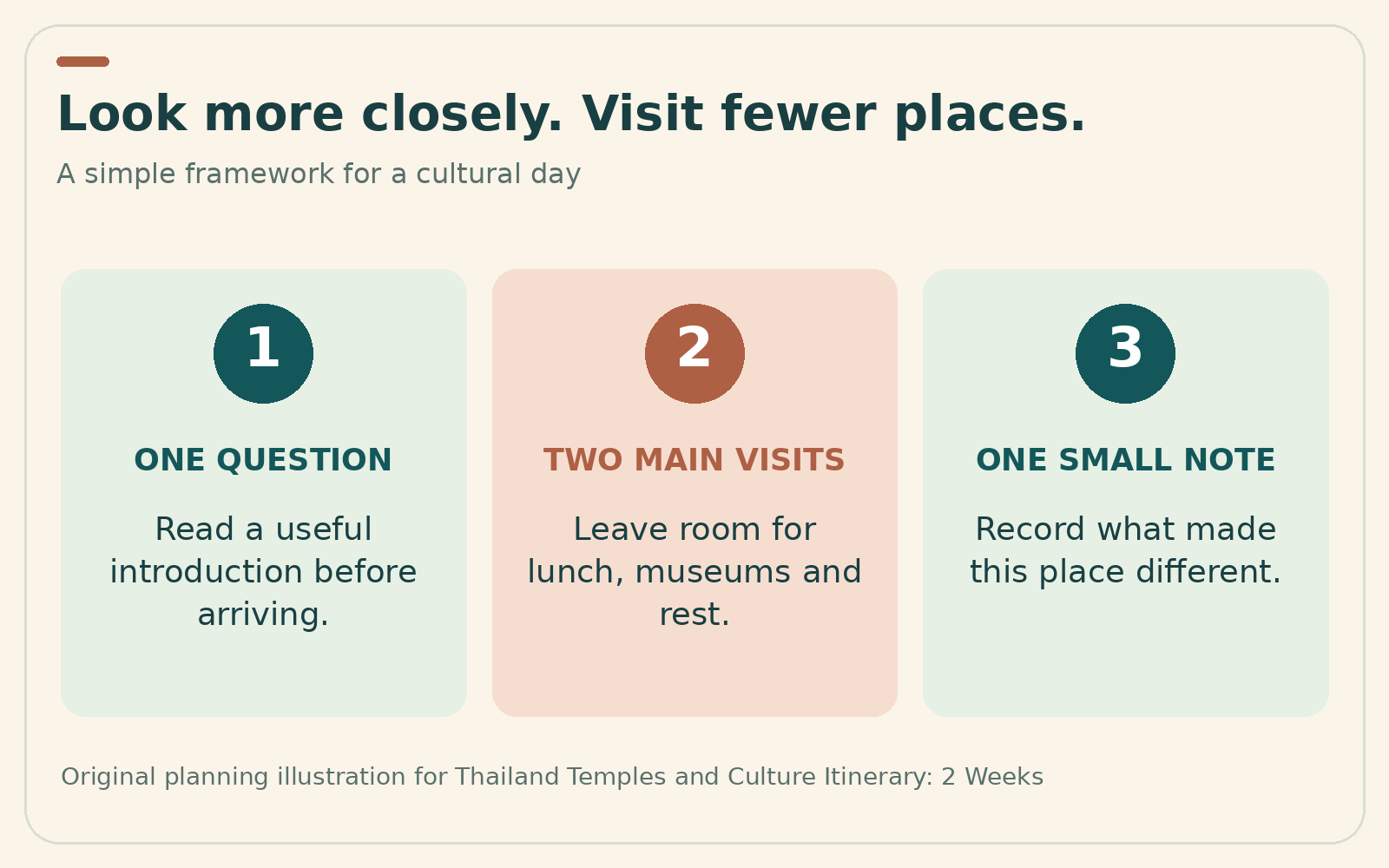
Read one useful thing before arriving
Choose a short official description, a museum introduction or a reliable historical overview before the visit. You do not need to memorise a dynasty list. Instead, arrive with a question: why was the site built here, what did the surrounding settlement do, or which part of the building tells you something distinctive about this place?
That question gives the visit a focus without forcing a single interpretation. When an information board or guide answers it, allow a second question to emerge. Meanwhile, acknowledge what is not known. An honest explanation of uncertain evidence is more valuable than a confident story that cannot be supported.
Look at layout before individual decoration
On arrival, spend a moment understanding the entrance, main structures and route through the site. Notice where people move, where you are allowed to stand and which areas remain in active use. This helps both with interpretation and with avoiding an accidental intrusion into a restricted or ceremonial space.
Then choose a small detail to examine closely: the relationship between structures, a decorative pattern or an object described by a label. Comparing two carefully observed details across different destinations creates a more memorable experience than taking the same wide photograph at every stop. However, do not touch or approach fragile surfaces simply to inspect them more closely.
Keep a small record that is useful later
After the visit, write a few lines about what made it different from yesterday's site. Record the correct name and one question you still have, rather than relying on a phone full of similar-looking photographs. When a guide provides a particularly useful explanation, ask for a recommended source to read afterwards.
For a family, let each person choose one detail to discuss over lunch. The aim is not a quiz or a compulsory educational exercise. It is a way to let different interests shape the holiday: one person may remember architecture, another an object in a museum, and someone else the practical life of the neighbourhood around it.
Adjustments for different interests
For archaeology rather than active temples
Keep the three Sukhothai nights and the Ayutthaya stay, then reduce the number of active-temple visits in Bangkok or Chiang Mai. Use the freed time for museums, a longer guided historical visit or simply another look at a landscape that interested you. This creates depth without changing the hotel route.
Confirm specialist guiding in advance when the subject matters strongly. A general sightseeing guide may be excellent at logistics yet not the right fit for detailed questions about conservation or archaeological interpretation. Explain your interests clearly and ask what evidence, collections or sites the guide proposes to discuss.
For craft and contemporary culture
Retain one major historical visit in each base, then substitute workshops, local museums and neighbourhood time for the remaining temple slots. Check that workshops fit the length of your stay and that any item you make can be finished or collected before departure. Contemporary culture should not be treated merely as shopping between ancient monuments.
Choose a smaller number of appointments with enough time to talk and learn. An experience can be worthwhile without a performance, costume or dramatic photograph. Paying fairly for someone's teaching and respecting the boundaries of a working space are more meaningful than trying to label every encounter as an undiscovered local secret.
Admission costs and a realistic planning budget
Keep entrance tickets separate from transport and guiding
The official foreign-visitor fees checked on 5 October 2026 include THB 500 for the Grand Palace ticket and THB 300 for Wat Pho. TAT's Sukhothai information lists THB 200 for the central historical area and THB 120 for each of the northern and western zones. Confirm eligibility, inclusions and current local arrangements before visiting. [6] [7] [11]
| Place / area | Published fee | Check before visiting |
|---|---|---|
| Grand Palace ticket | THB 500 | Current inclusions and any ceremony-related restrictions. [6] |
| Wat Pho | THB 300 | Current visitor arrangements and rules for individual halls. [7] |
| Sukhothai central zone | THB 200 | Ticket coverage and separate local transport costs. [11] |
| Sukhothai northern zone | THB 120 | Whether this zone is part of your chosen route. [11] |
| Sukhothai western zone | THB 120 | Separate access and transport arrangements. [11] |
These are the published visitor fees reviewed, not the total cost of a guided excursion. Eligibility, access and fees can change.
These figures are not the cost of the whole outing. A guide, driver, bicycle, museum, refreshment stop or separate site ticket may be additional. Ask for an itemised total when comparing a tour with independent travel, rather than comparing a full-day package against admission alone.
A couple's example with clear assumptions
An illustrative two-adult budget assigns THB 26,000 to thirteen hotel nights, THB 12,000 to intercity and local transport, THB 14,000 to meals and everyday drinks, and THB 8,000 to admissions and selected guided experiences. The total is THB 60,000 before contingency, international flights and insurance. This model was prepared on 5 October 2026; it is not a set of supplier quotations.
A separate ten-percent contingency would add THB 6,000 to that illustrative model, also dated 5 October 2026. Use more room in the budget when booking private guiding frequently or travelling during a busy holiday period. Meanwhile, solo travellers should not simply halve the couple's room and vehicle allowances, because many of those costs remain substantially shared-unit costs.
Weather, walking and accessible alternatives
Design the day around attention as well as temperature
An early main visit, an indoor or shaded middle period and an optional later outing usually produce a more enjoyable cultural day than uninterrupted sightseeing. You need enough concentration to read, listen and notice details. Once everyone is tired, adding another historic site rarely improves the experience.
The Thai Meteorological Department describes broad seasonal patterns, while UK health advice highlights issues including northern air quality. Use those as reasons to check conditions for your date, not as fixed promises about a whole month. Keep indoor alternatives and flexible bookings where conditions may affect outdoor-heavy days. [16] [17]
Ask specific accessibility questions
Rather than asking only whether a site is 'accessible', describe the distance, steps, uneven surfaces, heat exposure or wheelchair requirements that matter to you. Ask about the actual route from drop-off to the area you want to visit, seating and toilets. A property or attraction may offer useful assistance without meeting every visitor's needs.
For Sukhothai, local transport can replace a bicycle-based plan. In Bangkok, one well-chosen temple plus a museum may be preferable to repeated river crossings. Meanwhile, a northern city day can replace a mountain excursion without making the trip less culturally meaningful.
Pros and cons of this culture-focused route
What the extra nights achieve
The itinerary allows comparison without constant movement. Ayutthaya receives a full day; Sukhothai gains two days of choice; Chiang Mai has room for both an old-city route and a separate outing. Museums and workshops also provide a different mode of learning from outdoor monuments.
A final Bangkok night creates a practical end to the journey. More importantly, the route does not pretend that fourteen days can cover every historical period, region or cultural tradition. It offers a coherent introduction with space to notice what interests you most.
The compromises to accept
There are several hotel changes and two substantial overland travel blocks. Admission, guiding and local transport can add more than expected when planned separately. In addition, outdoor historical landscapes may be demanding in heat or rain, even when the distances appear modest on a map.
This is not a beach itinerary, and it will not suit someone who enjoys only occasional temple visits. In that case, shorten the cultural route and spend longer in fewer bases. Repeating experiences out of obligation does not make a holiday deeper.
Common mistakes that flatten a cultural trip
Assuming every temple offers the same experience
Different sites have different religious, historical and community roles. Read a little before arriving, ask one or two specific questions and notice what distinguishes the setting. A photograph of the largest structure is a record of appearance, not necessarily an understanding of the place.
Booking Sukhothai accommodation by name alone
A hotel in modern town may be entirely suitable for another plan, but this itinerary benefits from proximity to the historical park. Check the exact address and transfer arrangements before booking. Otherwise, the expected early starts and afternoon breaks may require repeated journeys you did not budget for.
Filling every quiet period with another attraction
Rest, food and time to reflect are part of the itinerary. Leave room to write a few notes, discuss what you saw or revisit a museum label that interested you. Without those pauses, distinct places can blur together into one long procession of courtyards and ticket gates.
Frequently asked questions
Is this itinerary suitable for a first visit to Thailand?
Yes, particularly when history, religion, museums and everyday culture are your main interests. It is more specialised than a standard Bangkok-north-beach route. Travellers who only want a few major temples should reduce the number of cultural bases rather than complete the route out of obligation.
Do I need a guide at every historical site?
No. Choose guiding where interpretation will add the most, then explore independently elsewhere. Ask about language, pace and the subject matter before booking. One thoughtful guided day can provide a framework that helps you understand several later visits without paying for a guide throughout.
Can I visit Sukhothai as a day trip instead?
It is possible to arrange a road excursion from another base, but that changes the purpose of this itinerary. Three nights near the historical park provide time for a fuller visit and an optional Si Satchanalai day. A short excursion cannot reproduce the same pace simply by starting earlier.
Are museum visits fixed to the numbered days?
No. The day numbers describe a workable sequence, not a guarantee about opening calendars. Once your dates are known, check the museums and any special exhibitions, then swap activities within each base. Keep essential travel days fixed only after the transport is confirmed.
Should I bring formal clothing for temples?
You do not need an elaborate wardrobe, but choose clothing that meets the venue's current rules. A sleeved top, knee-covering clothing and straightforward footwear are practical starting points. Some major sites apply stricter requirements, so check official guidance rather than relying solely on what other tourists wore.
Can I photograph inside every temple building?
No blanket permission should be assumed. Read the signs for each hall and ask when uncertain. Even where photography is allowed, avoid disturbing worship, blocking entrances or photographing people closely without consent. A place being popular with tourists does not make every activity within it a public performance.
Is cycling compulsory at Sukhothai?
No. Choose walking, a bicycle or arranged local transport according to your abilities, the route and the conditions. A shorter visit with more attention can be better than cycling a large area while uncomfortable. Confirm vehicle arrangements and site access before relying on a particular option.
Can I replace the flight back to Bangkok with a train?
Yes, but recalculate the nights and travel time. A sleeper uses a night that cannot also be counted as a hotel stay, and a daytime train uses most of a day. Preserve an adequate Bangkok buffer before the international departure rather than making the replacement appear free of scheduling consequences.
Which stop should I remove to slow the trip down?
Choose according to your main interest, not a generic ranking. Removing Ayutthaya reduces one hotel change, while omitting Sukhothai simplifies the more involved rail-and-road section. Either choice deserves a fresh transport check and a revised night allocation before existing bookings are changed.
Final recommendation: give each place a different role
Follow this route when you want more than a handful of famous temple photographs. Let Bangkok introduce the living capital, Ayutthaya raise questions about an earlier city, Sukhothai reward slower looking and Chiang Mai provide a northern perspective.
Keep the maximum of two main visits as a useful daily guide, not a target that must always be reached. A museum, a workshop or an ordinary neighbourhood can be the day's most memorable experience. The quality of attention matters more than the number of sacred buildings you manage to enter.
Sources and fact-checking notes
- UNESCO: Historic City of AyutthayaHistorical significance and context, not current visitor-ticket information. Reviewed 5 October 2026.
- UNESCO: Historic Town of Sukhothai and Associated Historic TownsThe heritage property and its associated historical towns. Reviewed 5 October 2026.
- SRT D-Ticket: reservations and conditionsCheck exact stations, travel dates, train category and issued-ticket instructions. Older terms are not treated as overriding the dated booking-window notice. Reviewed 5 October 2026.
- 12Go: Sukhothai-Chiang Mai transport listingsCheck the actual road service, terminal and hotel connection. Reviewed 5 October 2026.
- The Grand Palace: historyOfficial historical context for the palace complex. Reviewed 5 October 2026.
- The Grand Palace: practical informationOfficial foreign-visitor admission, inclusions and clothing restrictions. Reviewed 5 October 2026.
- Wat Pho: visit planPublished admission and temple etiquette. Reviewed 5 October 2026.
- Fine Arts Department: Bangkok National MuseumMuseum programme and current visit-calendar checks. Do not assume all museums open every day. Reviewed 5 October 2026.
- TAT: Woks and wats – Chinese heritage, culture and cuisineContext for Yaowarat, Talat Noi and Thai-Chinese culinary heritage. Reviewed 5 October 2026.
- 12Go: Ayutthaya-Phitsanulok train listingsService examples only; dates, times, classes and inventory must be checked again. Reviewed 5 October 2026.
- TAT: Sukhothai Historical ParkPark location, visitor context and published zone admissions. Check current access locally. Reviewed 5 October 2026.
- TAT: Si Satchanalai Historical ParkLocation and visitor context for a separate road excursion. Reviewed 5 October 2026.
- TAT: Wat Chedi Luang VaraviharaTemple location and visitor context; historical dates and measurements are not reproduced from conflicting text. Reviewed 5 October 2026.
- TAT: Wat Phra That Doi SuthepTemple location and approaches. Confirm present access arrangements directly. Reviewed 5 October 2026.
- UK Foreign, Commonwealth & Development Office: Thailand travel adviceCurrent travel notices, including the flooding notice visible at editorial review. Recheck before travel. Reviewed 5 October 2026.
- Thai Meteorological Department: seasons of ThailandBroad monsoon and seasonal context, not a forecast for an individual holiday. Reviewed 5 October 2026.
- FCDO: Thailand health guidanceTravel-health preparation and environmental health considerations. Reviewed 5 October 2026.
Illustrations in this article were created for Taylor’s Trailblazing Travels. Third-party photographs, where used, are credited beside the image or in the source list.