Marble Mountains in Da Nang: Planning Stairs, Caves and Time
Choose your caves, understand the lift and leave enough time for the way down.
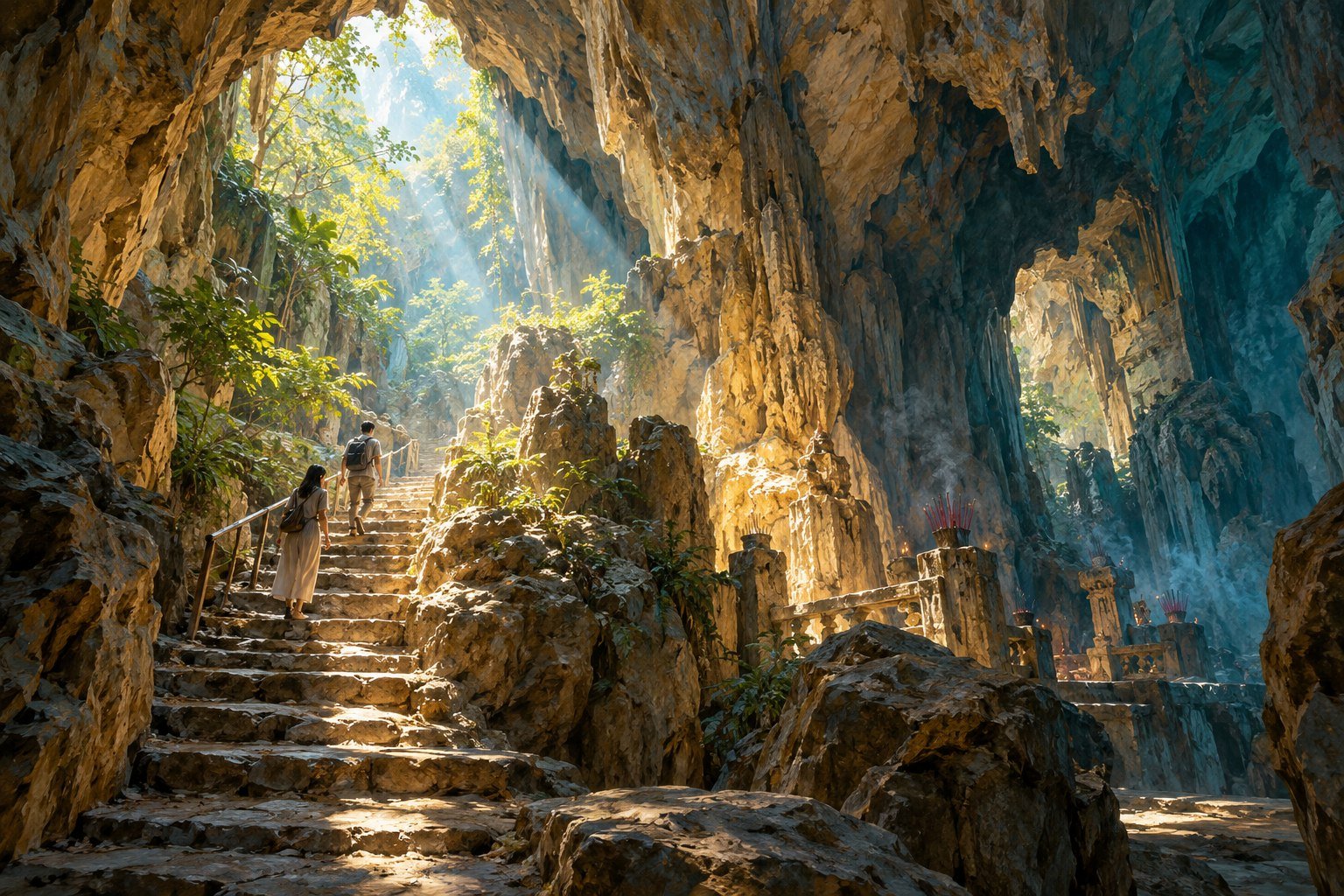
AI-generated editorial illustration inspired by the Marble Mountains; not a photograph of a named cave or an exact access route.
A good visit to the Marble Mountains starts with a choice: which caves and temples matter to you, and how much climbing feels reasonable? Trying to fit every signposted turn into a short stop can leave very little time to enjoy the place.
This guide concentrates on Thuy Son and the separately ticketed Am Phu Cave. It gives you a workable visit plan, the limits of the lift, and a way to adjust the time for your own pace.
For the wider route, start with the Vietnam travel hub.
First visit
Prioritise a temple area and Huyen Khong Cave; keep extra climbs optional.
Reduce the initial climb
Consider the lift in both directions, then assess the remaining paths individually.
Add another cave
Treat Am Phu as a separate ticket, time allowance and effort decision.
Fixed onward departure
Set a firm time to leave the site before adding another cave or viewpoint.
Choose the visit you can comfortably finish
The Marble Mountains, or Ngu Hanh Son, are a group of limestone hills. Thuy Son is the main visitor focus, with Linh Ung and Tam Thai pagodas, caves and stepped paths. You do not need to visit every hill to have a satisfying first visit. [2]
| Your priority | Build the visit around | Leave optional |
|---|---|---|
| A shorter temple visit | The lift-side Xa Loi and Linh Ung area; assess nearby paths as you go | Distant caves and upper climbs |
| Caves and temples | Linh Ung and Tang Chon, then Huyen Khong and Tam Thai if the steps suit you | The narrow Van Thong climb |
| A fuller cave visit | The main Thuy Son visit, followed by separately ticketed Am Phu | Extra viewpoints once energy or time runs low |
On a small screen, scroll the table sideways to read every column.
For most first-time visitors who are comfortable with stairs, the middle choice is the useful starting point. Select one main cave and one temple area as your minimum; the rest depends on conditions and how the walking feels.
At the entrance, check the site plan and ask which paths are open. Agree a meeting point if your group divides, and keep the return route in mind before taking a downhill branch. The diagram is a choice aid: follow the on-site signs and staff directions for the actual connections.

What the lift saves—and which stairs remain
The lift connects the foot of Thuy Son with the Xa Loi tower terrace. It helps with the entrance climb; it does not deliver you to every cave, viewpoint or temple doorway. The management board describes the terrace’s connection to the lift, while the city guide describes the mountain’s stepped paths. [4] [2]
Think about the descent as well as the ascent. If going downstairs is the harder part for you, a one-way lift up followed by a long staircase down may solve the wrong problem. Ask about the return lift service before buying, then choose an internal route you can retrace without exhausting yourself.
Huyen Khong itself involves steps down into the cave. Higher viewpoints and the Van Thong passage add different demands again. Saving the first climb does not establish that the remaining visit is suitable for a wheelchair, a pushchair, limited balance or a painful knee. [5] [6]
If avoiding steps is essential, ask the attraction staff for the exact route from the lift exit, including thresholds, gradients, toilets and the route back. A general claim that a tour includes a lift is insufficient. Be prepared to choose a smaller visit or another outing if those details cannot be confirmed.
There is no single useful “total number of steps” for this guide: your entrance, caves, viewpoints and exit determine the workload. Choose by the parts of the visit you want, rather than treating one advertised stair count as the whole experience.
Choose the caves for their differences
Huyen Khong: the main cave priority
Huyen Khong combines a large sacred cavern with openings that admit daylight from above. That changing light is part of its appeal, but a shaft of sunlight depends on conditions; no particular arrival time guarantees the familiar photographs. There are steps into the chamber. [3] [5]
If you have the energy for one substantial cave visit, make this the planning priority. Pause on a level standing area to let your eyes adjust, keep the route clear for worshippers and other visitors, and save time for the climb back out.
Linh Ung and Tang Chon: a useful pairing
Tang Chon is behind Linh Ung Pagoda on Thuy Son. This makes the temple and cave a sensible pair to consider when choosing stops near that side of the mountain. Ask about the path before committing if your aim is to minimise stairs. [2]
Use the full location name when arranging transport. A tour that also advertises the Lady Buddha on Son Tra is adding a different destination; it is not simply describing another doorway at this Linh Ung pagoda. [9]
Tam Thai: leave room for a temple stop
Tam Thai is another of Thuy Son’s principal pagodas. Include it if temples matter as much as caves, rather than spending all your available time on viewpoint detours. [2] A quieter few minutes in a courtyard can be a better choice than another climb when your group needs a rest.
Van Thong: an optional, more demanding passage
The site’s management describes the upper passage through Van Thong as dark and narrow, with a section only wide enough for one person. Treat it as an optional climb, not an essential connection that every visitor must complete. [6]
Skip this branch if confined spaces, awkward footing or the prospect of returning the same way concern you. Check the conditions with staff before entering, and do not follow another group through an opening simply because they appear confident.
Am Phu: a separate visit at the base
Am Phu has its own admission and sits at the foot of Thuy Son. Its religious imagery explores judgement and the underworld; its interior includes different levels and passages. Being at the base does not make it a level, step-free substitute for the mountain. [1] [8]
Choose it because that setting interests you, after considering the darker spaces and imagery with any children in your group. Leave it for another time if the main visit has already used your energy.
Budget for the right tickets and an early enough start
The city’s reference table published on 22 January 2026 lists both Thuy Son and Am Phu as open 07:00–17:00. The national tourism guide still gives 17:30, so plan around the earlier local closing time and ask separately about last admission and the final lift ride. Opening hours do not mean that arriving just before closing leaves enough time to visit. [1] [3]
Adult Thuy Son admission is listed at 40,000 VND and Am Phu at 20,000 VND. The city’s attraction page lists the lift at 15,000 VND one way or 30,000 VND return, in addition to admission. [1] [2]
| Lift choice | Thuy Son only | Thuy Son + Am Phu |
|---|---|---|
| No lift | 40,000 | 60,000 |
| One lift ride | 55,000 | 75,000 |
| Return lift | 70,000 | 90,000 |
On a small screen, scroll the table sideways to read every column.
The calculation is 40,000 + 15,000 for each lift ride + 20,000 if you add Am Phu. Two adults choosing Thuy Son, Am Phu and a return lift therefore allow 180,000 VND for these tickets alone.
The 2026 table lists student rates of 10,000 VND for Thuy Son and 7,000 VND for Am Phu, with admission free for under-sixes. Confirm eligibility, required proof and any separate lift charge for your child or concession. These are published reference prices, so check the displayed tariff before paying. [1]
Build a time allowance that survives slower stairs
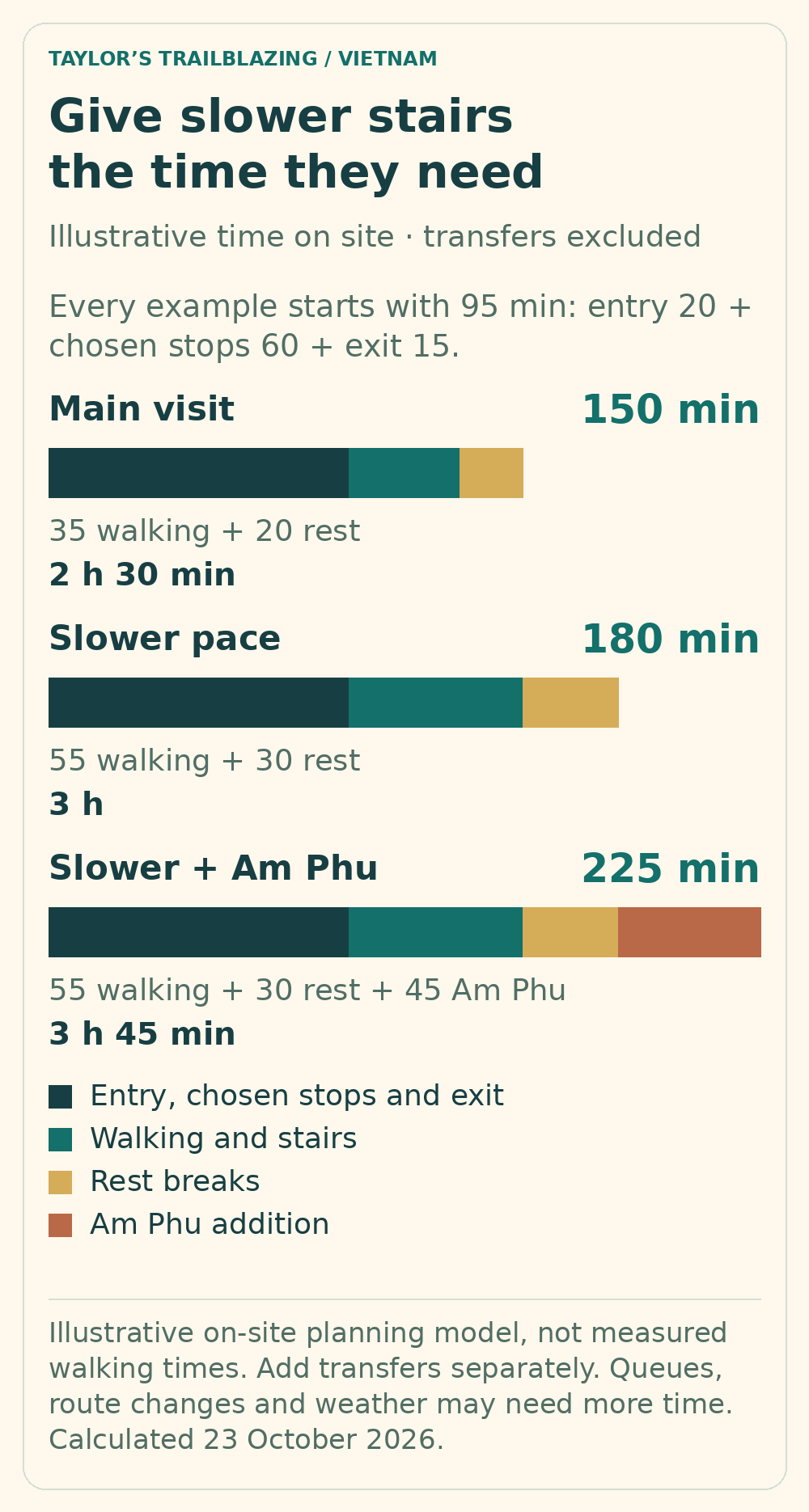
The useful number is the time from arrival at the entrance to meeting your driver again. It includes buying tickets, reading the site plan, moving between stops and taking breaks. The following is an original planning worksheet for a selective main visit, not a recorded walk or the operator’s timetable.
| Part of the visit | Assumed minutes |
|---|---|
| Tickets and orientation | 20 |
| Time at selected caves and temples | 60 |
| Walking and stairs between stops | 35 |
| Rests and water breaks | 20 |
| Exit and finding your pickup point | 15 |
| Main-visit total | 150 minutes / 2½ hours |
On a small screen, scroll the table sideways to read every column.
If walking takes 55 rather than 35 minutes, and rests take 30 rather than 20, the same visit becomes 180 minutes: three hours. Add a further assumed 45 minutes for moving to Am Phu, its separate entry and a selective cave visit, and the slower version becomes 225 minutes: three hours and 45 minutes.
Those extra 75 minutes have not bought another ambitious summit. They have bought a slower pace, more rest and one additional cave. This is why a tightly packed sightseeing tour can feel rushed even when its list of stops looks attractive.
Add your actual travel time separately. For example, if you allow 30 minutes each way, the 150-minute visit occupies 210 minutes away from your accommodation. That is arithmetic using a hypothetical transfer allowance, not a promise about Da Nang traffic. For a flight or train afterwards, also allow the onward journey, baggage collection and the carrier’s required arrival margin.
Let heat, rain and daylight shape the visit
The national tourism guide recommends starting early and avoiding the hottest or rainiest conditions. That is useful planning advice, although an early arrival cannot guarantee an empty cave. [3] If you can choose between days, give the mountain the more comfortable weather window and keep a flexible activity for the wetter one.
Caves do not make the whole outing an indoor activity. You still have exposed approaches and paths between stops. If the steps are wet, visibility is poor or staff restrict a route, shorten the plan or postpone it. A prepaid tour should not become a reason to press on with a climb that feels unsuitable; check the operator’s cancellation and weather arrangements before booking.
For photographs, give yourself time to wait briefly without obstructing a narrow route. Bright openings and darker interiors can make a phone struggle with exposure. Stop somewhere stable before framing the picture, and keep flash, tripods and photography subject to local signs and worshippers’ privacy.
Bring water, a hat and comfortable shoes with grip. Wear clothing suitable for visiting temples, and follow signs about removing shoes and hats inside pagodas. [3] Keep your load small enough that both hands can be available on stairs; this visit does not require buying a new set of travel equipment.
For the wider seasonal decision, use the best time to visit Vietnam guide, then check the local forecast close to your visit.
Choose independent transport or a tour with enough time
The city tourism office gives the address as 81 Huyen Tran Cong Chua Street, Ngu Hanh Son Ward, Da Nang. Save that location and your agreed pickup point before leaving your accommodation. [2] A pin for the whole mountain group is less useful than a clear meeting point at the entrance you will use.
Independent visit
A taxi, ride booking or arranged driver can suit travellers who want to choose their own start and pace. Agree whether the driver waits, what waiting time is included, the exact collection point and how to contact each other. Obtain the actual fare or quote before treating transport as a fixed part of your budget.
If you are fitting the visit between Da Nang and Hoi An, specify the sightseeing stop and waiting time when arranging the journey. An ordinary transfer does not automatically include several hours at the mountain. Clarify luggage arrangements too; do not assume an attraction entrance provides storage.
A focused guided visit
For help with interpretation and transport, compare Vyvu Travel’s private Marble Mountains tour. The listing names an English-speaking guide, hotel pickup and drop-off in Da Nang city centre or Hoi An, and a lift ticket. The listing excludes pregnant travellers and wheelchair users, and warns that uneven surfaces and walking make it unsuitable for some other mobility needs. [7]
Before paying, ask which caves are included, whether Am Phu admission is covered, whether the lift ticket is one way or return, and how much time is actually spent on the mountain. The listing’s two-hour headline and broad admission wording do not answer all of those questions. Select your date and hotel area to confirm the arrangement and cancellation terms. [7]
Choose a combined sightseeing tour only when its other stops appeal and the time here matches your priorities. If Huyen Khong and a slower temple visit are the reason for coming, protect that time rather than adding destinations to the same morning.
Use the Da Nang travel guide or Hoi An travel guide for the surrounding stay. The mountain visit works best once its return time is settled within that larger plan.
Frequently asked questions
Can I visit independently without a guide?
Yes. The attraction sells admission separately from guiding and transport. Use the entrance plan and signposts, ask staff about current path restrictions, and choose a smaller set of stops if navigation or stairs are taking longer than expected. A guide is most useful when you want interpretation or someone to organise a suitable pace. [2]
Is one hour enough for Marble Mountains?
One hour allows only a very selective stop and leaves little room for tickets, lift queues, rests or the return to your driver. If that is your firm limit, choose a temple area or one specific cave with staff guidance; do not plan the main Thuy Son visit plus Am Phu within it.
Is Am Phu included in the Thuy Son ticket?
The city lists them as separate admissions. A tour may bundle them, but the wording “entrance fees included” should be checked against its named caves. Ask specifically about Am Phu before buying a package. [1]
Can children enjoy the visit?
Plan around the child who tires first, with water breaks and a clear return route. A lift ride can reduce the initial climb, while internal stairs remain. Consider whether darker spaces and Am Phu’s underworld imagery will suit your child, and leave the narrow Van Thong climb out of an ordinary family plan. [6] [8]
Is this a good stop immediately before a flight?
Only when the actual transfer, visit, baggage arrangements and airport arrival margin leave room for delays. Set a time to leave the site and shorten the visit if necessary. The illustrative time model excludes travel, so its 2½-hour main visit should never be treated as the whole gap between hotel checkout and the airport.
Choose a visit that leaves energy for the way down
For a first visit, start with a manageable Thuy Son plan: a temple area, Huyen Khong if its stairs suit you, and time to get back down without rushing. Use the lift for the part of the climb it actually replaces, then judge the internal paths separately.
Add Am Phu when you still have the interest, energy and time for another cave. The successful plan is the one that leaves you with a clear return route and enough attention for the places you chose.
Sources and research notes
Provider and official information checked on 23 October 2026. The planning models are original editorial examples, with their assumptions stated beside them. Prices, timetables, products and terms can change; check the relevant provider before booking. This guide does not claim a personal visit, product test or live booking.
- Da Nang Tourism Promotion Center — 2026 opening hours and reference admission prices (22 January 2026)
- Da Nang Tourism Promotion Center — The Marble Mountains (2 August 2025)
- Vietnam National Authority of Tourism — Around the Marble Mountains
- Ngu Hanh Son Management Board — Xa Loi Tower and its lift connection
- Ngu Hanh Son Management Board — Huyen Khong Cave
- Ngu Hanh Son Management Board — Heaven’s Gate and the Van Thong passage
- GetYourGuide / Vyvu Travel — Hoi An: Marble Mountains Tour, product 876590
- Da Nang newspaper — Exploring Am Phu Cave, report by Thai My (9 October 2022)
- Da Nang Tourism Promotion Center — Linh Ung Bai But and the three Linh Ung pagodas
Illustrations in this article were created for Taylor’s Trailblazing Travels. Third-party photographs, where used, are credited beside the image or in the source list.