Vietnam Travel Safety: Common Risks and How to Plan Around Them
A practical plan for transport, health, weather and getting help — with clear reasons to pause or change an activity.
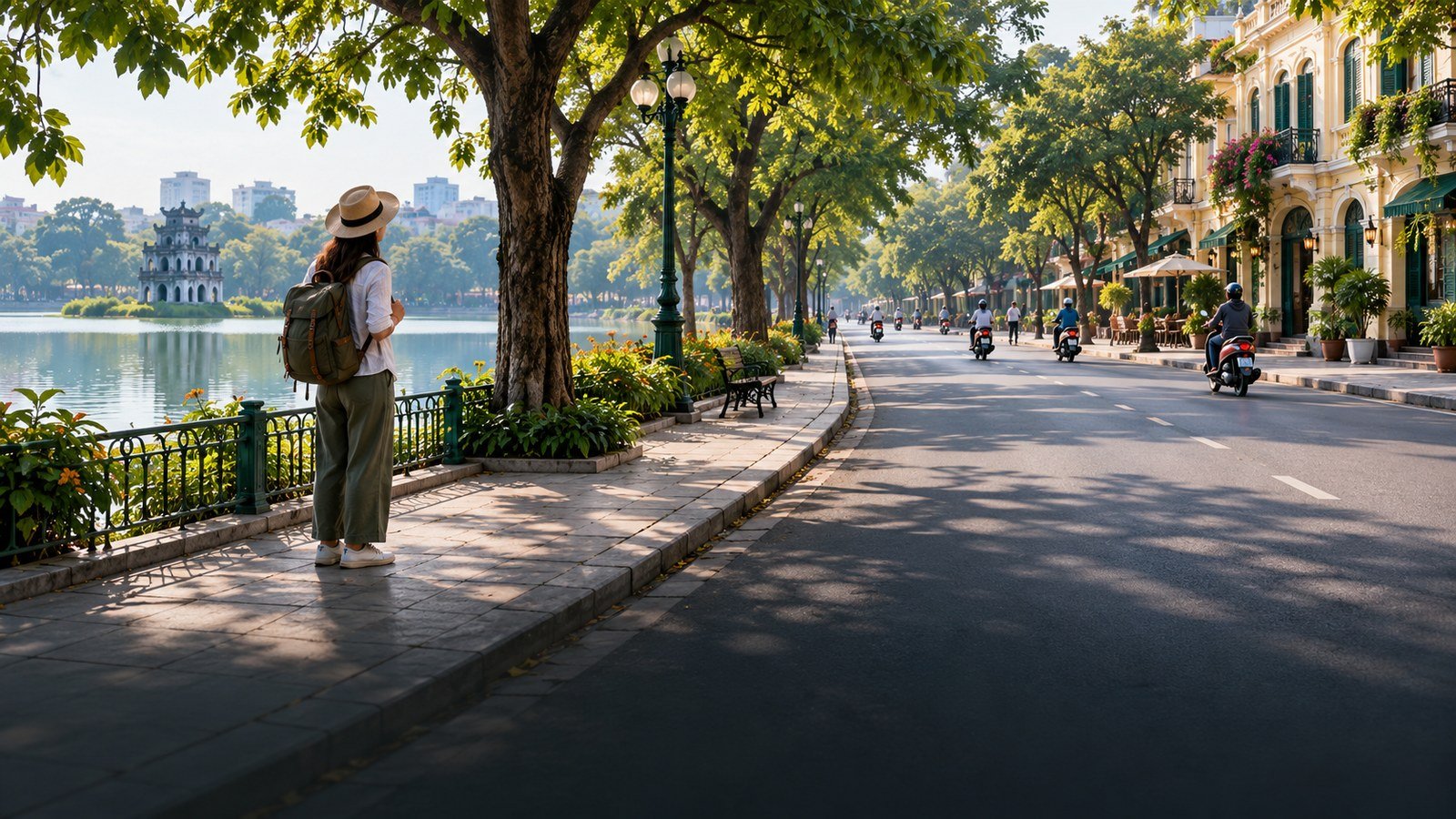
AI-created illustration of a calm Hanoi-inspired streetscape; not a documentary photograph or a statement about current street conditions.
Vietnam travel safety starts with the choices inside your itinerary: how you travel after a long flight, whether you ride a motorbike, and what happens if a boat trip is cancelled. FCDO describes violent crime against foreigners as rare, while theft and pickpocketing occur regularly. [1]
Use this guide to make those decisions before you feel rushed. The priorities below are an editorial planning framework, not a statistical ranking of danger. Check the current official advice again before departure and during your trip. [2]
Transport first
Choose the journey, vehicle and arrival time together.
Cover the activity
Ask about riding, trekking, boating and evacuation explicitly.
Recheck locally
A monthly weather pattern cannot clear today’s route.
Keep a fallback
Save contacts and addresses somewhere beyond your phone.
Vietnam travel safety: decide what needs checking
Give each planned day one of three actions: settle the practical details now, recheck conditions locally, or replace an activity if an essential condition cannot be met. This avoids treating every unfamiliar situation as an emergency while leaving clear limits for decisions that matter.
| Your situation | Settle before departure | Reason to pause or change |
|---|---|---|
| Late arrival | Agree the pickup, meeting point and destination. | The person or vehicle does not match your booking. |
| Motorbike day | Confirm your entitlement, experience and insurance. | You cannot establish that all three fit the proposed ride. |
| Boat or coastal excursion | Ask how cancellations and transfers are handled. | A closure, unsafe conditions or missing safety arrangements. |
| Remote hike or adventure | Discuss the route, guide, equipment and evacuation plan. | The organiser cannot explain how you would get help. |
| Existing health needs | Plan access to treatment and permitted medicines. | You cannot obtain the care or medication your clinician says you need. |
| Independent travel | Save an offline route and someone to contact. | No working way to communicate a changed plan. |
For a first visit, simplify the parts you feel least confident about. A private arrival transfer may be worth more to you than an upgraded room; an extra free day may be more useful than another tightly connected excursion. These are priorities to choose around your own needs, not compulsory purchases.
Transport: choose the safer version of the journey
Build the journey around daylight and a usable seatbelt
CDC advises seatbelts, helmets where appropriate and daylight travel, especially in rural areas. Compare the complete journey rather than only its fare: vehicle, departure time, rest stops and how you will reach your hotel. [4] A cheap arrival at an unfamiliar roadside stop may be a poor fit if you are tired or travelling with children.
For walking, use pedestrian bridges or elevated walkways where available. Pavements may be obstructed or used by motorcycles, and traffic can be unpredictable. Do not rely on the advice to step out and assume drivers will flow around you; wait for a manageable crossing or ask local staff about a better route. [5]
A rental offer does not establish your right to ride
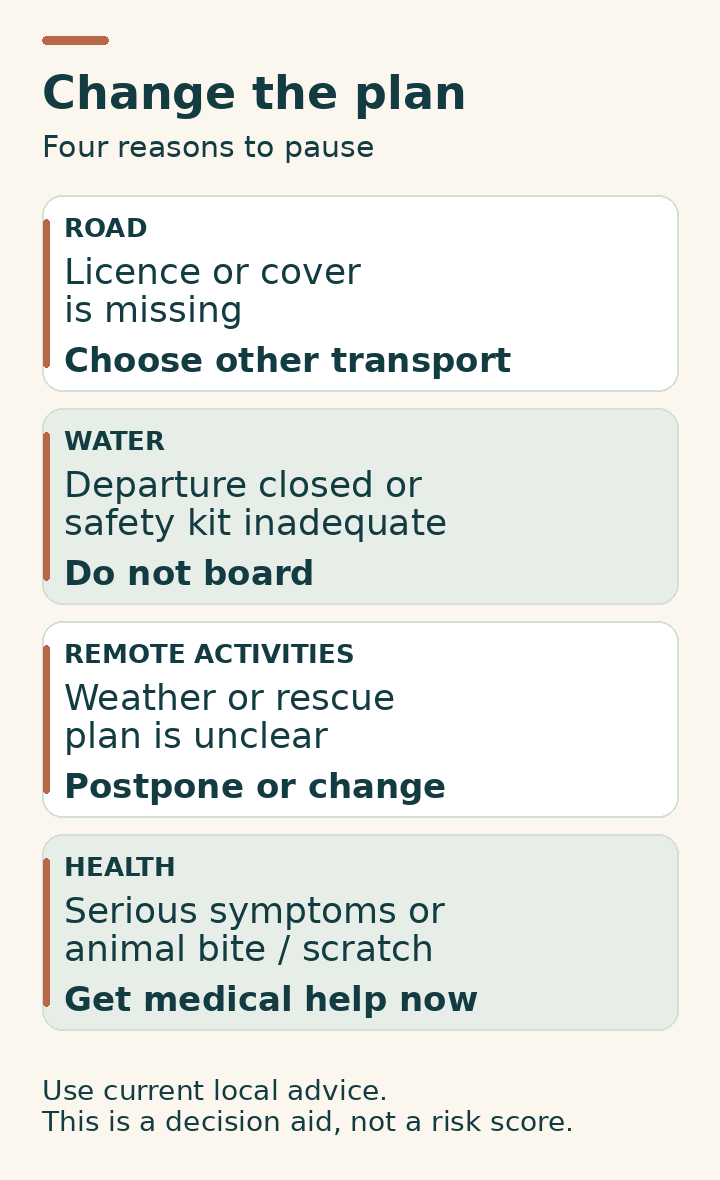
FCDO says UK visitors driving a car or motorbike need their UK licence and a 1968 international driving permit; third-party insurance is legally required. Riders and passengers must wear helmets. [1] [6] An IDP only covers vehicle classes for which you hold a full licence, so a car entitlement does not itself establish motorcycle entitlement. [7]
If you are inexperienced, choose a car transfer or another suitable alternative. If you do ride, ask your insurer specifically about the vehicle, engine size, rider or passenger status, licence requirements and the planned activity. Get an answer you can retain; a hire shop’s reassurance is not your policy wording. Motorbike hire can be excluded from standard travel cover. [3]
Back to the guide ↑Protect belongings and avoid pressured decisions
Official Australian advice identifies phone and bag theft, ATM and card fraud, and taxi scams. Keep your phone away from the road edge, carry a limited amount of cash and use an ATM inside a bank or reputable business. If someone tries to snatch an item, protecting yourself matters more than retaining it. [8]
Use a pause, verify, then pay routine
- For a pickup, match the driver and registration to the booking. Confirm the hotel address before getting in. [5]
- For a changed price, ask for the total, currency and inclusions in writing before agreeing.
- For an unexpected payment link, reopen the booking platform or contact the business through the details you already saved.
- For a claim that your hotel, ticket or route is unavailable, verify it yourself before buying a replacement.
The last three steps are practical checks for pressured decisions, not claims that every offer is fraudulent. Photograph receipts and keep a separate payment option so one missing card does not end the trip.
At accommodation, ask to see the room and access arrangements if anything differs from what you booked. When travelling alone, choose an arrival time and reception arrangement you can manage; share a simple check-in message with someone you trust. A good location for you includes the journey back after dinner, not just the distance to daytime sights.
Back to the guide ↑Rain, water and remote trips: when to change the plan
FCDO places Vietnam’s tropical storm season broadly between May and November and warns that storms can disrupt travel. Its advice links to the National Centre for Hydro-Meteorological Forecasting and the Japan Meteorological Agency. Read current warnings for your route; a dry city forecast does not describe an offshore sailing or mountain road. [2]
Choose your alternative before a cancellation
For a bay cruise, island transfer or mountain excursion, decide what you would do if it cannot operate. Keep a land-based alternative and avoid making an international departure depend on the final boat of the day. That is an editorial resilience rule, not an assertion that a particular connection is safe or unsafe.
Canada warns of hazardous coastal currents, unsupervised beaches and boat accidents involving poor maintenance or overloading. Respect warning flags, avoid water activities in adverse weather, and decline a vessel with doubtful condition or safety equipment. [5]
Before an adventure activity, ask who is responsible for the group, what equipment is provided, and where an injured participant would be taken. Ask how weather decisions are made and whether you can opt out. The answers should refer to this activity and location, rather than simply promising that everything is safe.
Stop signals: an official closure, an overloaded boat, missing suitable lifejackets, a flooded crossing, or an operator pressing you to ignore a warning. Stay out of damaged or flooded areas and follow local instructions. [8]
Keep to established routes in former conflict areas. Unexploded ordnance remains a hazard in parts of Vietnam; do not investigate unfamiliar metal objects or take an unmarked shortcut. [5]
Back to the guide ↑Health planning that fits your itinerary
Start with your route and medical history
FCDO recommends checking vaccine advice at least eight weeks before departure. A late appointment is still worthwhile: NaTHNaC recommends an individual assessment of your destination, health and activities. Bring your actual route, including rural stays, rather than asking only which vaccines “Vietnam needs”. [9] [10]
Vietnam restricts some medicines, including those it classifies as addictive or psychotropic. Ask the Vietnamese Embassy about your exact medicine and quantity before travelling if these rules may apply; a UK prescription alone does not settle permission. [9]
Protect against bites throughout the day
Mosquito bite prevention matters beyond evenings. Use an effective repellent according to its instructions, cover exposed skin when practical, and choose screened or suitably protected sleeping accommodation. Seek prompt medical advice for fever or other worrying symptoms, and tell the clinician where you have travelled. [11]
Malaria advice depends on the places you visit and your individual circumstances. Do not decide on tablets from a country name alone: NaTHNaC distinguishes low-risk rural areas from places with no malaria risk, and recommends individual assessment for travellers at greater risk. [10]
Reduce food and water risks
Choose food cooked thoroughly and served hot, wash your hands before eating, and use reliably treated water or sealed bottled drinks. Avoid ice when you cannot establish the water source, and be cautious with raw seafood, exposed buffets and unpeeled produce. A crowded stall is not a hygiene guarantee. Seek medical help for bloody diarrhoea, significant fever, severe symptoms or inability to retain fluids. [12]
Heat and animal contact need clear responses
Build shade, water and rest into active days. If heat makes someone unwell, stop activity, move to a cool place and cool them. Confusion, collapse, breathing difficulty or failure to improve after cooling are reasons for urgent medical help; do not continue the itinerary. [13]
Avoid feeding or handling animals. After a bite or scratch, wash the wound with soap and water and get medical help immediately, even after rabies vaccination. Do not wait to return home or wait for symptoms. [14]
Back to the guide ↑Alcohol, evenings and local rules
Plan the journey home before going out and keep your drink in sight. Avoid accepting drinks from strangers or leaving them unattended. If someone becomes unexpectedly confused or unwell, stay with them and seek help. [15] Nothing about drinking or travelling alone makes someone responsible for another person’s assault.
Do not mistake poisoning for a bad hangover
Methanol-contaminated alcohol has caused serious illness and deaths in Vietnam. [1] Avoid unlabelled bottles, unusually cheap spirit offers and free shots. Sealed branded drinks can reduce risk but do not create a guarantee. Blurred vision, breathing problems or severe illness after drinking require urgent medical attention; do not try to sleep it off. [15]
Check the rules before bringing an item
Vapes and related products are banned, including bringing them into Vietnam. Illegal drug penalties are severe. Carry photographic ID: FCDO says a printed copy of your passport photo page and visa is accepted. Do not surrender your passport as a rental deposit. [1]
Keep the original securely available for journeys and formal checks; a photocopy is not a replacement travel document. Avoid political demonstrations and follow restrictions around military and border areas. [1] If your route enters a sensitive area, resolve the permissions with the relevant authority before travelling.
Back to the guide ↑Make insurance and communication work in practice
Ask about the activity you will actually do
Check the full trip length, declared health conditions, destinations including transit stops, and medical evacuation. Ask how the policy treats riding, trekking, diving or a cruise, as applicable. Also check weather-related disruption and the evidence needed for a claim; policy exclusions can differ. Save the insurer’s emergency assistance details and share them with a trusted contact. [3]
A useful question is: “If I am injured doing this named activity in this place, what treatment and transport would you cover, and what conditions must I meet?” It exposes gaps more clearly than asking whether you are insured for Vietnam.
Arrange data and a separate calling plan
Save your accommodation’s address in Vietnamese, offline maps and key bookings before arrival. Keep a small paper contact card as well. Decide how you would make an ordinary phone call if an app is unavailable or your data stops working.
If your device supports eSIMs and is not network-locked, Airalo is one option for mobile data. Its Vietnam page offers data plans; check the current coverage, validity and activation terms before buying. A data-only plan does not include ordinary voice calls, so do not treat it as your complete emergency calling arrangement. [17] [18]
Compare that option with your own network’s roaming or a local SIM, especially if you need a phone number or calls. Connectivity helps you contact people; it does not replace a local guide, rescue plan or current warning.
Back to the guide ↑Emergency contacts and the first steps
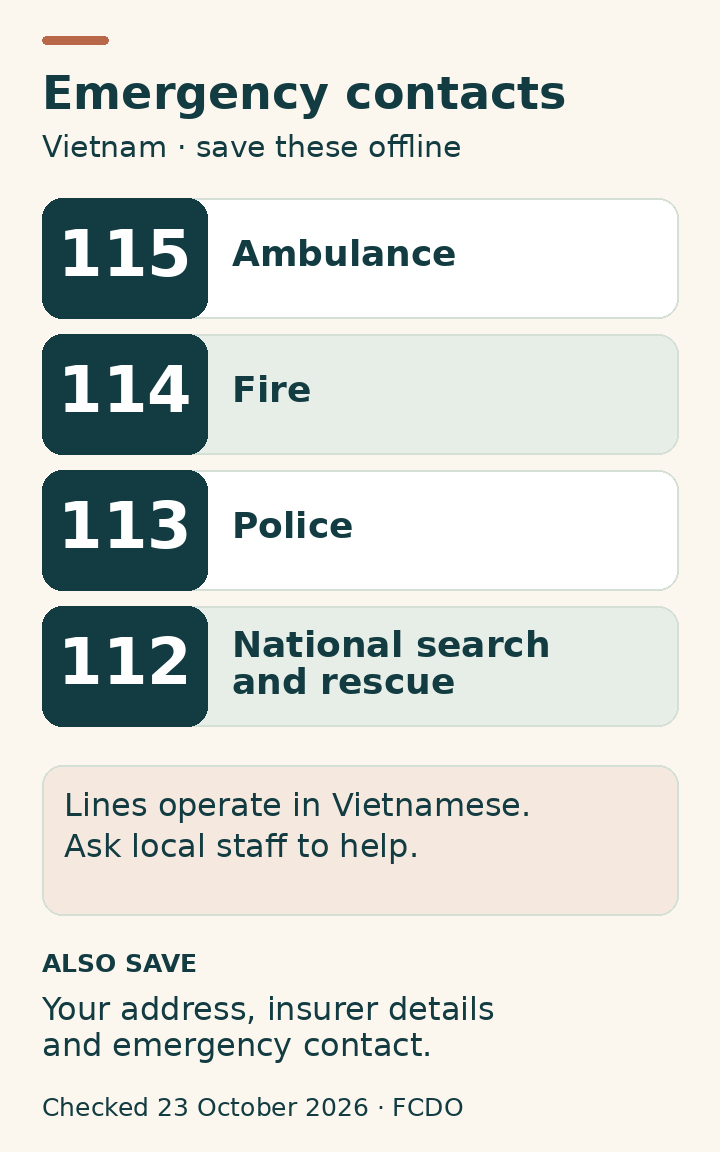
| Service | Number |
|---|---|
| Ambulance | 115 |
| Fire | 114 |
| Police | 113 |
| National search and rescue | 112 |
FCDO says these lines operate in Vietnamese. Ask hotel staff, your guide or another local person to help explain your location and the problem. Do not assume an English-speaking operator or an immediate response. [16]
Save a usable offline contact card
- Your accommodation name and address in Vietnamese.
- Your insurer’s assistance number and policy number.
- A companion’s or trusted contact’s number.
- Relevant allergies, conditions and medicines you would want clinicians to know.
- The official British Embassy Hanoi contact page, with its current help route saved before departure. [19]
For immediate danger or serious illness, get to a safer position if possible and seek emergency help first. Then contact your insurer and a trusted person. The insurer can advise about treatment arrangements; contact should not delay urgent care. The British Embassy does not pay medical bills. [9] [16]
For theft, freeze affected cards or accounts when you can do so safely, retain transaction records and obtain a police report. Take someone who can translate when reporting a crime. [16] Keep photographs of documents in a protected account and a separate copy accessible to your trusted contact.
Frequently asked questions
Does booking through a platform prove a tour is safe?
A confirmation establishes what you have booked. Ask the operator who will run the activity, which equipment is included, how weather cancellations work and what happens in an emergency. If an essential answer is missing, choose another activity or operator. Reviews and attractive photographs cannot answer those questions for you.
What changes if I am travelling alone?
Choose arrivals and accommodation access you can manage without a companion, agree a check-in routine with someone you trust and avoid making your last transport option depend on a late finish. Share specific plans when going somewhere remote. The useful test is whether someone would notice a problem and know where to start looking.
What happens if I lose my British passport?
Report the loss and contact FCDO through its official help route. An emergency travel document may be available, but leaving Vietnam on one issued there also requires an exit visa. Allow for that process before rearranging flights; replacing the document alone may not resolve departure formalities. [19]
Your next step
Choose the version of Vietnam that you can manage comfortably: a car arrival after a late flight, an alternative day when a boat cannot sail, and an activity you can stop without breaking the rest of the itinerary. Before leaving, settle your transport, health and insurance questions; then save your emergency details offline. Leave enough flexibility to act on new information once you are there.
This research-led guide uses UK government travel advice, NaTHNaC and NHS health guidance, with other government sources for specific transport and activity risks. The decision tables and suggested questions are editorial planning tools, not individual medical advice, insurance approval or a guarantee of operator safety. Official information was checked on 23 October 2026; conditions and rules can change.
Sources and research
Sources checked for this editorial review on 23 October 2026. Conditions can change; use the relevant official page when finalising your plans.
- FCDO: Vietnam — safety and security
- FCDO: Vietnam — warnings and insurance
- FCDO: Foreign travel insurance
- CDC: Vietnam — traveller health and transport precautions
- Government of Canada: Vietnam travel advice
- GOV.UK: Check which international driving permit you need
- UK legislation: Motor Vehicles (International Circulation) Order 1975, article 1
- Australian Government Smartraveller: Vietnam
- FCDO: Vietnam — health
- NaTHNaC TravelHealthPro: Vietnam
- NaTHNaC: Insect and tick bite avoidance
- NaTHNaC: Food and water hygiene
- NHS: Heat exhaustion and heatstroke
- NHS: Rabies
- FCDO Travel Aware: Spiking and methanol poisoning
- FCDO: Vietnam — getting help
- Airalo: Vietnam eSIM plans
- Airalo: Device compatibility
- FCDO: British Embassy Hanoi — help and emergency travel documents
Illustrations in this article were created for Taylor’s Trailblazing Travels. Third-party photographs, where used, are credited beside the image or in the source list.