Hoi An Countryside Cycling: Villages, Rice Fields and Safe Route Choices
Choose the scenery you want, the riding you can manage and a return plan that still works when conditions change.
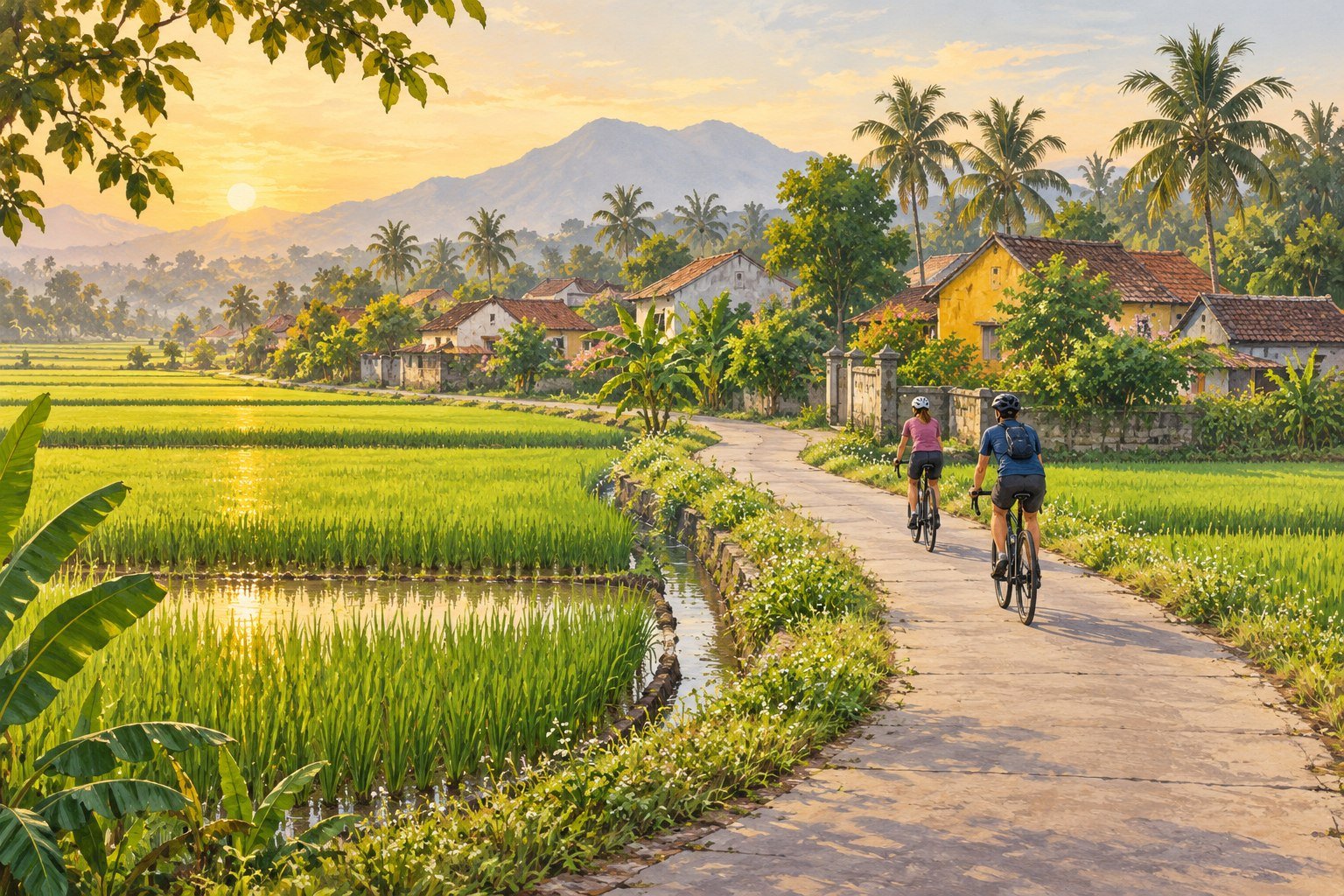
AI-generated editorial illustration inspired by Hoi An’s countryside; not a photograph or a verified cycling route.
Hoi An countryside cycling can mean a short ride to vegetable gardens, a morning among rice fields or a whole day linking craft villages with boat journeys. Vietnam Tourism highlights Cam Chau and Cam Thanh for cycling, with Tra Que offering a vegetable-growing village focus. These are different outings, with different demands. [1]
The useful starting point is your confidence on a bicycle and the roads between your accommodation and the countryside. This guide groups the main options, explains what to confirm locally and gives an adjustable time model. It does not certify any route as continuously traffic-free or safe in every condition.
For the wider route, start with the Vietnam travel hub.
A shorter first outing
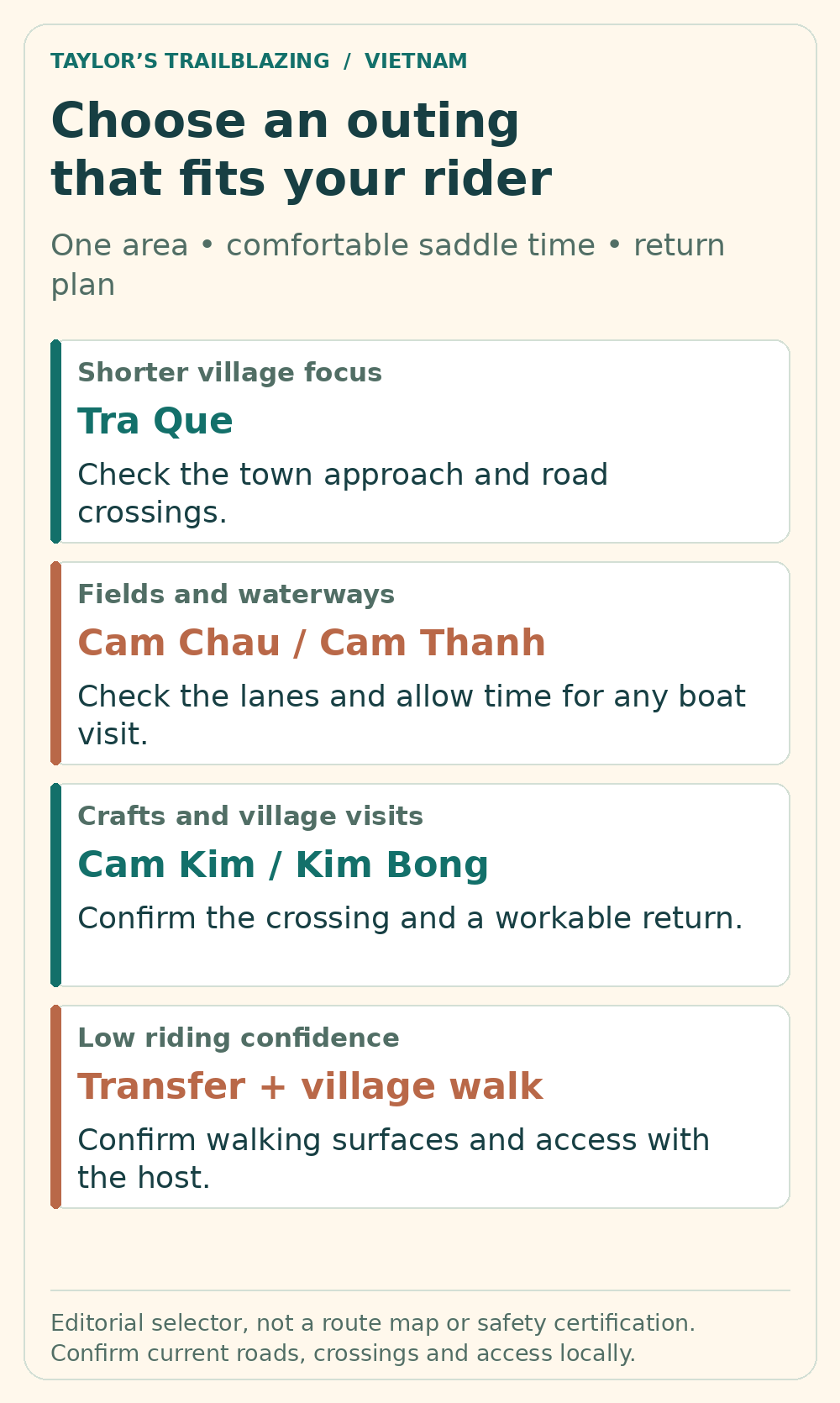
Tra Que gives the ride a clear destination. Check the approach from your actual accommodation before adding distance.
Fields and waterways
Group Cam Chau with a selected part of Cam Thanh. Allow separate time for any basket-boat activity.
Crafts and village visits
Consider Cam Kim and Kim Bong. A guide can coordinate visits and the current crossing arrangements.
Low riding confidence
Do not make a road tour your first cycling lesson. A village transfer and walking visit can fulfil the same interest.
Choose one area before choosing a route
Use three decisions together: one destination area, a maximum amount of comfortable saddle time, and an agreed way home. A small distance on a map cannot tell you how you will feel at junctions, on a narrow path or after an hour in the heat.
| Area | Best reason to choose it | Confirm before riding |
|---|---|---|
| Tra Que | A defined vegetable-village destination and a shorter outing | The town approach, road crossings and any farm visit |
| Cam Chau / Cam Thanh | Rice fields, gardens and waterways | Which lanes are suitable today, and whether a boat stop changes the return time |
| Cam Kim / Kim Bong | Carpentry and other village crafts | The actual bridge or boat crossings and a workable return if plans change |
On a small screen, scroll the table sideways to read every column.
These groupings draw on tourism and heritage descriptions; they are not a turn-by-turn cycling network. [1] [2] [4] [5]
Before accepting a suggested ride, ask four concrete questions: can every rider brake and steer predictably; where will you share or cross roads; what surfaces and crossings are involved today; and who can collect a rider or bicycle if necessary? A satisfactory answer to just the distance question is not enough.
If your accommodation proposes a loop, ask staff to show both the outward and return route. Include the hotel approach in the assessment. Walking a bike through a busy section can be sensible where there is a suitable pedestrian route, but an unsuitable road should prompt a different itinerary.
Tra Que: a clear destination for a shorter ride
The city tourism portal places Tra Que approximately 3 km from Hoi An Ancient Town. That is an orientation distance, not the length of your ride: accommodation access, field lanes and the return all add distance. The portal describes an approach along Hai Ba Trung Street, without establishing a segregated cycle route. Ask locally about a suitable approach for your ability. [2]
Make the vegetable village the main event. A booked farm visit or cooking session gives the outing a purpose without requiring a long loop. The official listing currently gives daily opening of 08:00–18:00 and approximate admission of VND35,000 per person; confirm the current fee and what your chosen visit includes. Classes and hosted activities have their own arrangements. [2]
A practical sequence is bike fitting, a locally checked ride, the village visit, a rest and the return. Only add An Bang if the extra roads, distance and return time still suit everyone. A nearby name on the map is not a reason to extend an already enjoyable outing.
Choose rice fields, waterways or craft villages
Cam Chau and Cam Thanh
Cam Chau and Cam Thanh are useful areas to investigate for a countryside ride: Vietnam Tourism describes gardens and rural scenery here, while the local tourism portal places Bay Mau’s nipa-palm waterways in Cam Thanh. Decide whether the day is principally a ride or a boat-and-village visit. [1] [4]
A basket-boat stop adds an activity with its own boarding arrangements, duration and operator. It should not be squeezed into the remaining minutes before another booking. Ask whether bicycle storage and the return transfer are covered, and whether anyone who prefers not to board can wait comfortably.
For rice-field photographs, accept the agricultural season you find. The local tourism portal describes the changing green and golden appearance of Hoi An’s fields; it does not promise one landscape throughout the year. Keep bicycles off crops and garden beds, leave working access clear and ask before photographing people or entering a workshop. [3]
Cam Kim and Kim Bong
Choose this area when craft visits matter more than accumulating kilometres. Hoi An’s heritage centre documents Kim Bong’s carpentry tradition and associated boatbuilding and other crafts. A guide can help arrange an appropriate visit rather than treating every working yard as an open attraction. [5]
Get the crossing plan in plain terms: which bridge or boat, whether bicycles are carried, what is included and what happens if that crossing cannot be used. Published countryside tours themselves qualify floating-bridge crossings as dependent on availability. No public ferry timetable or day-specific bridge condition is assumed here. For a boat leg, expect a safety briefing and a suitable life jacket. [9] [7]
Calculate the outing, not just the cycling distance
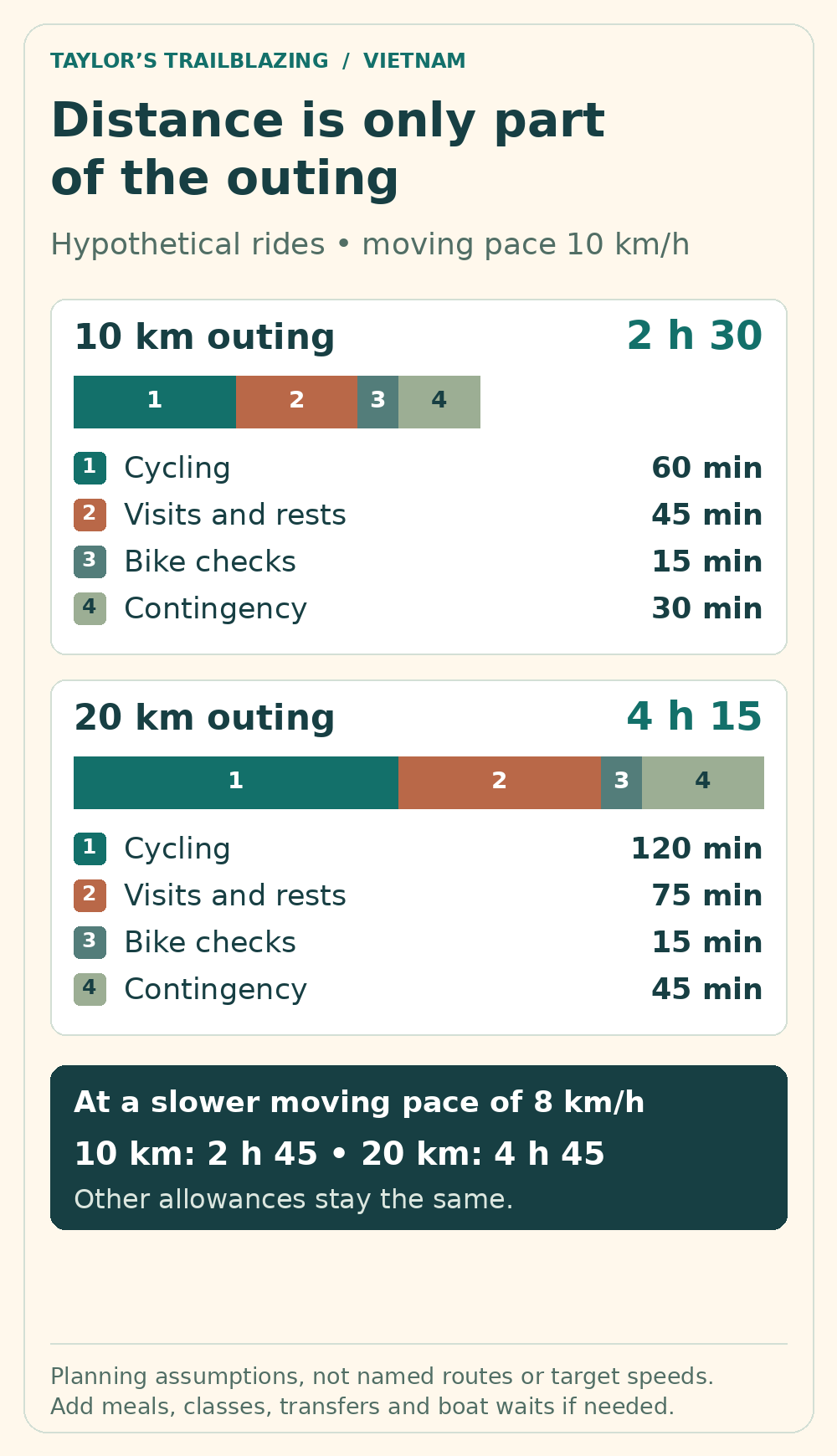
Use this planning formula: total time equals cycling time plus visits and rests, preparation and contingency. Calculate cycling time from the full route, including the return, divided by your realistic moving pace. Moving pace excludes stops.
| Allowance | 10 km outing | 20 km outing |
|---|---|---|
| Cycling | 60 minutes | 120 minutes |
| Visits and rests | 45 minutes | 75 minutes |
| Bike fitting and checks | 15 minutes | 15 minutes |
| Contingency | 30 minutes | 45 minutes |
| Total | 150 minutes: 2 hours 30 | 255 minutes: 4 hours 15 |
On a small screen, scroll the table sideways to read every column.
At a moving pace of 8 km/h, the same examples become 2 hours 45 and 4 hours 45 respectively. These are adjustable illustrations, not target speeds or promises that a novice can comfortably ride either distance. Add meals, classes, transfers and boat waits if they are not already within your allowances.
The longer example doubles the riding but also needs more recovery time. If a child, the heat or the surface makes the expected pace unrealistic, shorten the route before reducing the rest allowance. Set a return time that leaves room for a delay and daylight, and keep optional stops genuinely optional.
Decide what a guide would solve
Independent cycling suits riders who can manage their bicycle around other road users, navigate without distraction and change plans calmly. It works best with a modest route checked locally and a rental contact who explains breakdown arrangements.
A guided ride is useful when coordinating village visits, crossing the river or keeping a mixed-ability party together. Ask about group pace, the least confident rider, bike sizes, where the ride starts and whether recovery transport exists. A guide does not remove the need for riding ability.
| Programme | Published riding and duration | Who should consider it |
|---|---|---|
| Countryside morning or afternoon | 9 km; morning 6½ hours, afternoon 5 hours | Riders wanting a modest distance with substantial village and boat time |
| Full-day countryside | 25 km, increasing to 28 km October–February; 9 hours | Confident riders comfortable committing a full day to cycling and cultural stops |
On a small screen, scroll the table sideways to read every column.
The operator’s own morning programme confirms why 9 km is not a brief excursion: it occupies 08:30–15:00 with visits, lunch and boat travel. Check the meeting time separately from departure. [8]
Compare the 9 km guided countryside programme if organising the visits and boat legs is the main benefit. The listing includes a bicycle and helmet; lunch depends on the selected morning or afternoon option. Compare the full-day countryside programme if the longer seasonal distance suits everyone. Read each option’s pickup arrangements, inclusions, cancellation terms and weather changes before paying; neither link implies availability on your date. [9] [10]
Let weather and local conditions change the plan
FCDO guidance identifies October–December as central Vietnam’s rain season and October–November as a period of seasonal flooding. Check the local forecast and advice for the actual outing; a seasonal pattern cannot establish whether a lane is usable today. Avoid flooded areas and follow local instructions. [7]
Ask your accommodation or operator about the specific route after rain, including narrow sections, slippery surfaces and crossings. If the surface or traffic feels beyond your control, turn back by a suitable route or arrange collection. Do not follow a navigation line through water or a closed route.
In hot conditions, an early start with adequate daylight, shaded breaks and a shorter plan is a practical default. Carry water you can access easily and avoid scheduling a fixed afternoon attraction immediately after the ride. If considering an afternoon tour, confirm the actual return time, light conditions and equipment rather than assuming every advertised finish is before dark.
FCDO also cautions that road-law compliance is poor and operator standards vary. Check that your insurance covers the planned activity and reject equipment you doubt. Ask the provider how weather cancellations, altered itineraries and an unfinished ride are handled. [7]
For broader seasonal planning, use the Vietnam weather guide; use local updates to make the final cycling decision.
Check the bicycle and the needs of every rider
A free hotel bicycle still needs a proper check. Cycling UK’s pre-ride inspection covers tyres, wheels, frame, saddle, steering, drivetrain and brakes. Check the basics before leaving, then test starting, stopping and turning in a suitable quiet space. Ask for a different bike if the fit or controls are wrong. [6]
Use a well-fitting helmet, secure loose clothing away from the chain and wheels, and carry belongings so they cannot swing into the bicycle. Confirm the lock, damage terms, breakdown contact and whether collection costs extra. FCDO advises against leaving a passport as a vehicle-hire deposit. [7]
Children and less confident riders
Judge a child’s control and stamina, not simply a tour’s advertised minimum age. Ask for the actual bicycle or seat dimensions, helmet sizes and any seat weight limit. An adult carrying a child should already be comfortable handling that arrangement. If one rider needs a private pace, discuss a private outing rather than assuming the whole group can adapt.
Electric assistance can reduce pedalling effort, but it does not remove the demands of balance, braking, traffic or a heavier bicycle. Confirm the exact model, route and hire conditions, and test it before accepting it.
For limited mobility or balance, a vehicle transfer and a selected village visit may be a better fit. Confirm walking surfaces, steps, toilets and any boat boarding directly with the host. Neither a short distance nor the word “easy” establishes accessible facilities.
Frequently asked questions
Can a complete beginner join a countryside cycling tour?
A countryside tour should not be a first lesson in controlling a bicycle. Discuss your ability with the operator and ask where any practice happens. If mixed roads or narrow paths are beyond your confidence, arrange transport to a village and explore on foot.
Is there one traffic-free route that this guide recommends?
No continuous route has been independently verified here as traffic-free. Descriptions of quiet countryside do not establish the conditions at every town approach, junction or crossing. Ask for the exact route and its current conditions before deciding.
Can rice fields, Tra Que and Cam Kim all fit into one short ride?
Do not assume so. They offer different reasons to stop, and combining them adds approaches, crossings and visits. Choose one area for a shorter outing; only combine areas after checking the full route and the riding time for your party.
Should a rainy forecast automatically cancel the ride?
Make the decision from local conditions and the operator’s weather policy, not the rain icon alone. Flooding, a closed crossing or conditions beyond your control are reasons to change the plan. Confirm cancellation and rescheduling terms before booking.
Choose the ride you can enjoy all the way back
Choose Tra Que for a clear village destination, Cam Chau and Cam Thanh for fields and waterways, or Cam Kim for craft visits with a confirmed crossing plan. Build the outing around the least confident rider, protect time for stops and keep a workable return. A shorter ride that fits the conditions leaves more room to enjoy the countryside.
Sources and research notes
Provider and official information checked on 23 October 2026. The planning models are original editorial examples, with their assumptions stated beside them. Prices, timetables, products and terms can change; check the relevant provider before booking. This guide does not claim a personal visit, product test or live booking.
- Vietnam Tourism — Top things to do in Hoi An
- Da Nang Tourism — Tra Que Vegetable Village, 16 June 2026
- Da Nang Tourism — Hoi An rice fields, 15 April 2026
- Da Nang Tourism — Bay Mau Coconut Forest
- Hoi An Cultural Heritage Management and Preservation Centre — Kim Bong carpentry, 21 April 2026
- Cycling UK — Video guide: what to do before setting off
- FCDO — Vietnam: safety and security
- Heaven and Earth Bicycle Tours — Countryside morning tour, 9 km
- GetYourGuide — Hoi An Countryside: Guided Morning or Afternoon Bicycle Tour
- GetYourGuide — Hoi An Countryside Bicycle Tour: 25 Km Real Vietnam
- 12Go — Da Nang to Hoi An
- Airalo — Vietnam eSIMs
Illustrations in this article were created for Taylor’s Trailblazing Travels. Third-party photographs, where used, are credited beside the image or in the source list.