
How Many Days Do You Need in Vietnam? Choose Your Trip Length
Choose a holiday length by the time you can enjoy, with travel days and hotel moves counted properly.
A central Vietnam-inspired coastal rail scene. AI-generated editorial illustration; not a verified view or railway map.
Ten to fourteen days in Vietnam is a useful starting point for a first visit. It gives you room to combine different places without making every other day a transfer. A week can still work well when you concentrate on one region; three weeks buys a broader route or a slower pace.
The right answer depends less on the number of famous places on your list than on how often you want to pack, travel and settle into another hotel. Start with the dates you will actually be in Vietnam, then subtract the parts that are already spoken for.
Some links in this guide are affiliate links. If you book or buy through them, Taylor’s Trailblazing Travels may earn a commission at no extra cost to you.
A focused week
Keep roughly six nights in one region, with one main base and a nearby stay if useful.
A balanced first visit
Start with 10–14 local calendar days and decide which region can wait.
Count the whole move
A short domestic flight also needs transfers, airport time and arrival formalities.
Spend extra days well
Adding time to existing bases often improves a trip more than adding another stop.
How many days in Vietnam fit your priorities?
Use this table to choose a shape for the trip before choosing individual hotels. The suggested number of bases is an editorial starting point: a base is somewhere you sleep, rather than every town you visit on a day trip.
| Time in Vietnam | Usual nights | Sensible scope | Main compromise |
|---|---|---|---|
| 7 days | 6 | One region; about two bases | Leave distant regions for another trip. |
| 10 days | 9 | One region in depth, or two regions with two or three bases | Choose between extra variety and slower mornings. |
| 14 days | 13 | Two regions comfortably, or three selectively; roughly three or four bases | Three regions usually means accepting more airport time. |
| 21 days | 20 | A broader three-region route; around four to six bases | Extra excursions can still use up the breathing space. |
Seven days spread between Hanoi, central Vietnam and Ho Chi Minh City can be made to look possible on a map. It leaves less room for late arrivals, slow meals or a change of plan. Treat it as a deliberate fast trip rather than the default first visit.
Separate local days, nights and UK annual leave
Write down three different quantities: days away from home, dates spent in Vietnam, and nights needing accommodation. If you arrive on the 1st and leave on the 14th, that is 14 local calendar dates and 13 intervening nights. Only the 12 dates between arrival and departure are automatically free of international travel.
Vietnam Airlines describes its direct London–Hanoi journey as roughly 12 hours. The actual booking determines which local date you arrive, and a connecting itinerary adds its own waiting time. Do not count a UK departure date as a full Vietnamese sightseeing day. [8]
A ten-day leave allowance can cover different trips
For someone working Monday to Friday, ten weekdays of leave can sit between three weekends, creating 16 consecutive days away from work. In a hypothetical flight plan, leaving the UK on the first Saturday, reaching Vietnam on Sunday, leaving Vietnam on the final Saturday and reaching home on Sunday gives 14 local dates and 13 nights in Vietnam. This is calendar arithmetic, not a promise that those flights operate.
Check both directions before requesting leave. An awkward return arrival, a long connection or a recovery day at home may change the usable time more than adding one night to the hotel booking.
Count the whole transfer, not just the flight
The Hanoi–Da Nang flight itself is approximately 80–85 minutes in Vietnam Airlines’ published guidance. Hoi An then requires an onward road transfer from Da Nang; the airline describes roughly 45–60 minutes by car. Neither figure includes leaving your first hotel or collecting luggage. [1] [3]
| Part of the move | Allowance | Basis |
|---|---|---|
| Hotel to Noi Bai airport | 60 minutes | Example allowance; replace with your pickup location and traffic estimate. |
| Airport before departure | 120 minutes | Planning margin, not a universal minimum arrival rule. |
| Hanoi to Da Nang flight | 90 minutes | Rounded above the published typical flight duration. |
| Leaving aircraft and collecting luggage | 45 minutes | Example allowance. |
| Da Nang airport to Hoi An | 60 minutes | Upper end of the cited indicative car-transfer range. |
| Reaching the room and settling in | 30 minutes | Assumes the room is available. |
| Total | 405 minutes / 6 hours 45 minutes | Before a disruption allowance. |
Vietnam Airlines lists domestic check-in as opening two hours and closing 40 minutes before departure. The closing time is a deadline, not a sensible target for reaching the terminal; follow your operating airline’s instructions. [2]
Overnight travel changes the calculation
The official railway timetable consulted on 23 October 2026 lists SE3 leaving Hanoi at 19:20 and reaching Da Nang at 10:43 the next day: 15 hours 23 minutes on the train, calculated from those times. Recheck the dated service before booking. [4] A sleeper journey can replace a hotel night, but its arrival morning, transfers and possible recovery time still belong in the plan.
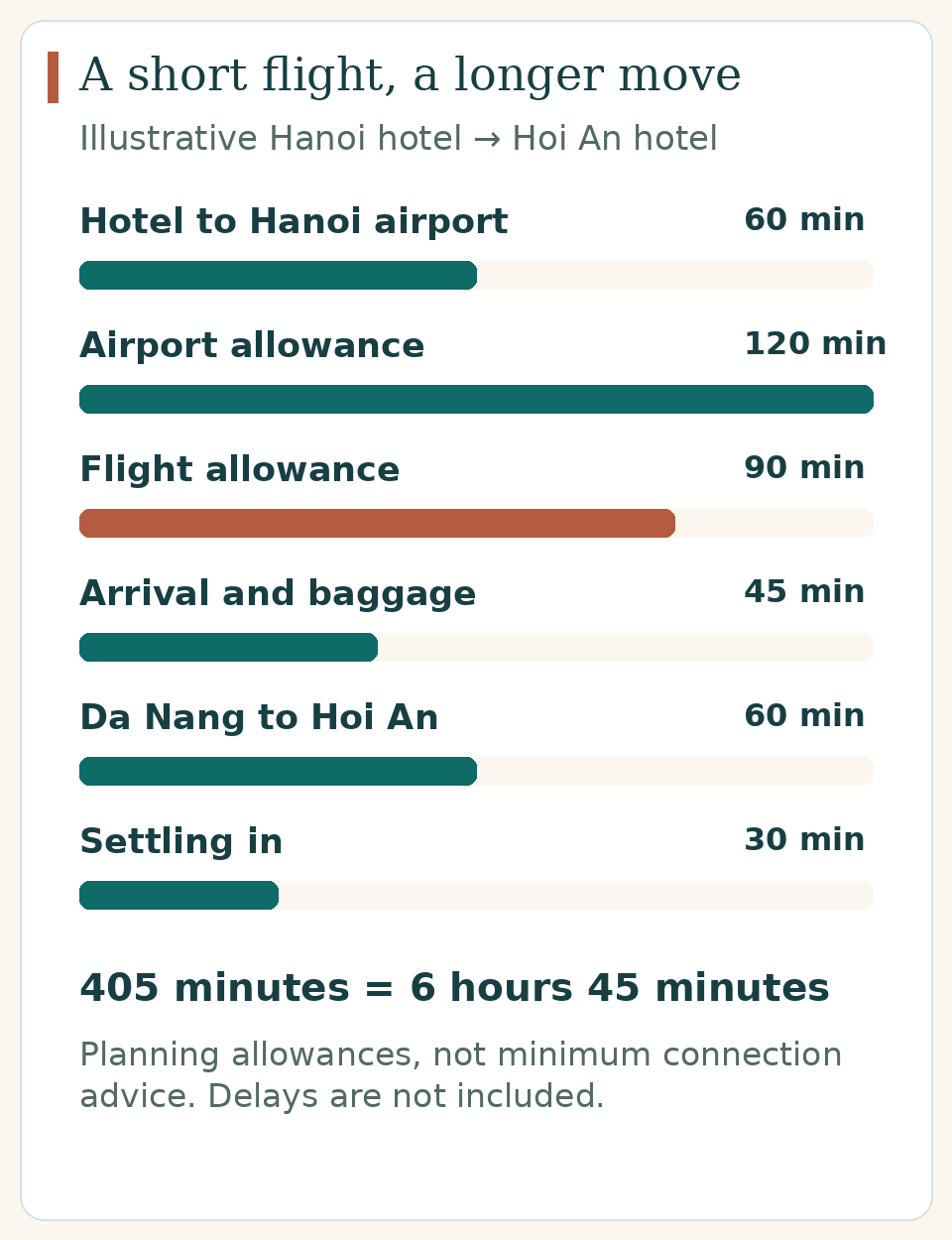
A usable-time calculation you can adapt
For a comparison, choose an eight-hour daytime window on each local calendar date. Deduct the parts of that window occupied by arrival, departure and travel between bases. This is a planning model, not a prediction of your energy or the amount you will see.
Usable daytime hours = local dates × 8 − arrival/departure hours − daytime hours spent moving between bases.
The examples below reserve eight hours in total for arrival and departure, and six daytime hours per move. Six hours is a deliberately simple comparison input: replace it with the whole journey for your actual route. A move within one region may be shorter, while a distant overland journey can be much longer.
| Local dates | Bases / moves | Hours after deductions | Eight-hour equivalents |
|---|---|---|---|
| 7 | 2 / 1 | 56 − 8 − 6 = 42 | 5.25 |
| 10 | 3 / 2 | 80 − 8 − 12 = 60 | 7.5 |
| 14 | 4 / 3 | 112 − 8 − 18 = 86 | 10.75 |
| 21 | 6 / 5 | 168 − 8 − 30 = 130 | 16.25 |
What happens when you add another stop?
Keep the 14-day trip but increase it from four to six bases. Five moves at six hours each leave 74 usable hours, or 9.25 eight-hour equivalents. The same holiday has lost 12 hours to the extra moves.
By contrast, adding three dates without adding a base gives the model 24 more usable hours. That is why extending an existing stay can feel more generous than extending the destination list.
Count only the travel hours that overlap your chosen daytime window; do not subtract the sleeping hours of a night train again. If arrival consumes the entire first day, increase that deduction. Keep meals, rest, weather buffers and local sightseeing transport within the remaining time, rather than treating every remaining hour as a scheduled attraction.
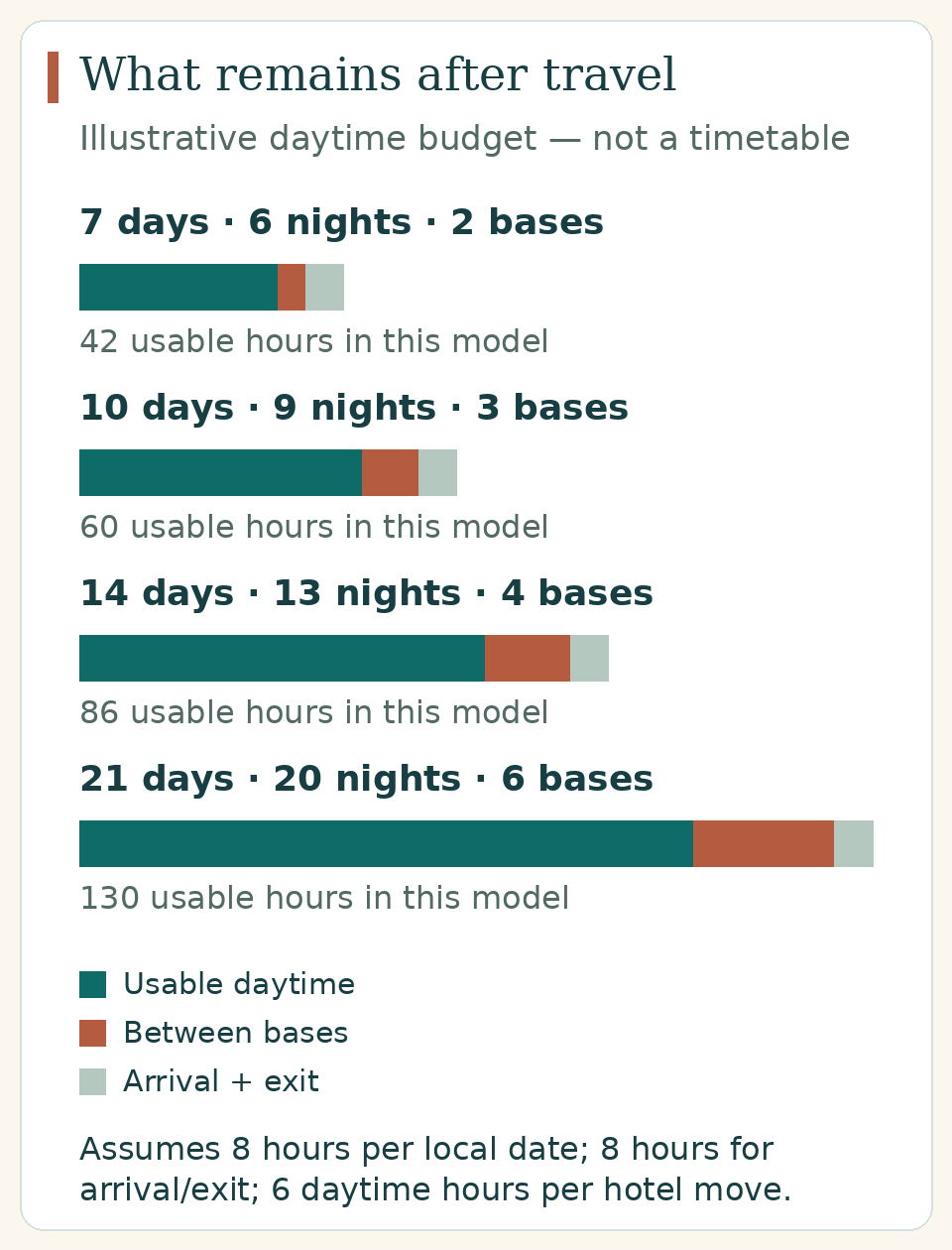
When a week, ten days, two weeks or three weeks works
Seven days: choose one clear contrast
A city and nearby countryside make a more forgiving pairing than a whole-country circuit. Hanoi and Ninh Binh offer that contrast: the tourism board describes Ninh Binh’s limestone landscapes and boat excursions, while the railway timetable includes a 06:00–08:16 Hanoi–Ninh Binh service. That is 2 hours 16 minutes station to station; your countryside accommodation needs another transfer. [7] [4]
Alternatively, build the week around central Vietnam or the south if those places match your interests and season. The point is to spend most of the week in one part of the country. A single base with excursions also works if unpacking once matters more than staying out after day-trippers leave.
Ten days: add a second region selectively
Ten local days can support two contrasting regions if the flights and ground transfers line up. Choose the main experience in each, then leave a little unscheduled time. If the domestic transfer forces a very early start or late hotel arrival, a deeper single-region trip may be the better use of the extra dates.
Fourteen days: the useful first-trip starting point
Two weeks allows variety without requiring every region. A selective north–centre–south trip is an option for travellers who value breadth and accept the moves; two regions leave more room for local excursions, different neighbourhoods and rest. Choose three or four bases first, then add attractions around them.
Twenty-one days: protect the slower pace
Three weeks makes a broader route easier and gives you room to choose slower transport for its own interest. It also makes a countryside stay or a proper beach break less likely to displace everything else. Keep some of that extra time unassigned. Six or more bases, several overnight journeys and a new excursion every day can still create a tiring holiday.
When to add days or reduce the route
- For families, a traveller who needs regular breaks or anyone who dislikes repeated packing, reduce the number of bases before adding more activities. Use a shorter daily planning window if eight hours feels unrealistic.
- For a rail-focused journey, count long-distance travel as part of the experience and reserve recovery time where needed. Do not treat every overnight leg as a free extra day.
- For a trip built around one weather-sensitive activity, leave a movable day nearby rather than scheduling it immediately before a fixed departure.
- For a strict budget, compare the cost of extra nights with the transport cost of another stop. More days in the same base and more destinations are different purchases.
Match the plan to the region’s season
Vietnam has regional weather patterns rather than one nationwide “best season”. Official tourism guidance describes cool or cold northern winters, heavier rain around Hoi An in the later months of the year, and possible bay-cruise cancellations during tropical storms. [5] An additional day creates flexibility, but cannot guarantee clear skies or that a cancelled excursion will resume.
Around Tết, demand for domestic transport and rooms rises, while some restaurants and businesses close for the first holiday days. [6] Choose and confirm the essential moves early. Check the dates for the year you are travelling rather than relying on an old Lunar New Year calendar.
Make bookings that protect your time
Price the international arrival and departure points before fixing the number of nights in each place. Arriving in one city and leaving from another can avoid a return domestic journey, but compare the complete fare, baggage and connection arrangements. An apparent saving is less useful if it adds a day of backtracking.
Next, check the actual departure and arrival times of the longest domestic leg. Compare a short flight with its complete airport transfers, or a train with its station transfers and arrival hour. A lower fare and a usable arrival time are separate questions. For the route used in the example, compare Hanoi–Da Nang transport on 12Go and check the exact service, operator and arrival point before committing.
For accommodation, assess the location against the excursions and departure point you will use. A cheaper room that requires repeated cross-city travel may spend the time you meant to save. Compare the total stay cost and cancellation terms for the same dates and room occupancy. If Hanoi is one of your bases, compare Hanoi accommodation on Agoda with Hanoi accommodation on Booking.com. Both links open city searches; use the map to check the actual location.
Finally, compare a nearby overnight stay with a full-day excursion. Read the tour’s whole duration, pickup area, free time and return point. A day trip can avoid another hotel move, but it still uses a day; an overnight stay may suit someone who values quieter early mornings or evenings. Browse Hanoi activities on GetYourGuide when comparing an excursion with an independent overnight stop, and read the complete itinerary and return time rather than only the headline attraction.
Check the route before paying
- Count local calendar dates and accommodation nights separately.
- Write one door-to-door time beside every change of base.
- Keep arrival and departure days lighter than the middle of the trip.
- Look for the stop that adds the most travel for the least personal interest.
- Place one unscheduled block where you most want flexibility.
If removing one stop lets you enjoy the remaining places at your preferred pace, you probably need a smaller route rather than a longer holiday. If you are removing the very experience you are travelling for, extra days may be worth buying.
Questions travellers ask
Does an overnight cruise count as a hotel change?
Count its night once in your accommodation plan, whether it is on a boat or on land. For pacing, count the complete excursion: hotel collection, travel to the harbour, boarding and the return transfer. Leaving your main suitcase at a hotel can reduce packing work, but it does not remove those travel hours.
Should the final night be in the city I fly home from?
For an itinerary involving a separate domestic ticket, distant countryside or a weather-sensitive boat transfer, the final night in your departure city is a useful planning buffer. It costs a night elsewhere, so build it into the first draft of the route. It reduces dependence on a last-day connection without guaranteeing that disruption cannot occur.
Can I use an airport layover as another day in Vietnam?
Only count time you can realistically spend outside the airport after allowing for entry eligibility, immigration, baggage, transport and the return check-in requirements. A long connection is not automatically a usable sightseeing day. Confirm transit and entry rules for your passport and tickets before adding a city visit.
Sources and research notes
Sources checked on 23 October 2026. Operator prices, schedules, border procedures and availability can change. Planning models and recommendations are editorial judgements with their assumptions stated in the guide.
- Vietnam Airlines — Hanoi to Da Nang flightsConsulted 23 October 2026. Route page gives an average flight duration of approximately 1 hour 20 minutes; its FAQ says approximately 1 hour 25 minutes. The worked model rounds this to a 90-minute allowance.
- Vietnam Airlines — airport check-inConsulted 23 October 2026. Domestic check-in opening and closing times; check the operating airline and ticket for the journey booked.
- Vietnam Airlines — travelling to Hoi An by planeConsulted 23 October 2026. Da Nang airport as an access point for Hoi An and an indicative 45–60-minute car transfer.
- Vietnam Railways — official train timetableConsulted 23 October 2026. Listed SE3 Hanoi 19:20 to Da Nang 10:43 the following day, and SE7 Hanoi 06:00 to Ninh Binh 08:16. Times must be rechecked for the date travelled.
- Vietnam Tourism — weather and climate in VietnamConsulted 23 October 2026. Regional climate patterns and the possibility of weather-related bay cruise cancellations; climate guidance is not a forecast.
- Vietnam Tourism — a traveller’s guide to TếtConsulted 23 October 2026 for general holiday travel demand and business closures. Historical calendar dates on the source page are not used.
- Vietnam Tourism — Ninh BinhConsulted 23 October 2026. Landscape and activity context for a northern city-and-countryside trip.
- Vietnam Airlines — London to Hanoi flightsConsulted 23 October 2026. Approximate direct-flight duration only; fares, terminal details and frequency are not relied upon here.
Illustrations in this article were created for Taylor’s Trailblazing Travels. Third-party photographs, where used, are credited beside the image or in the source list.