Langkawi Kilim Geoforest Park Mangrove Tours: Choosing Responsible Boats
Choose the boat by its behaviour, the guide by their role, and the price by what your whole party will pay.
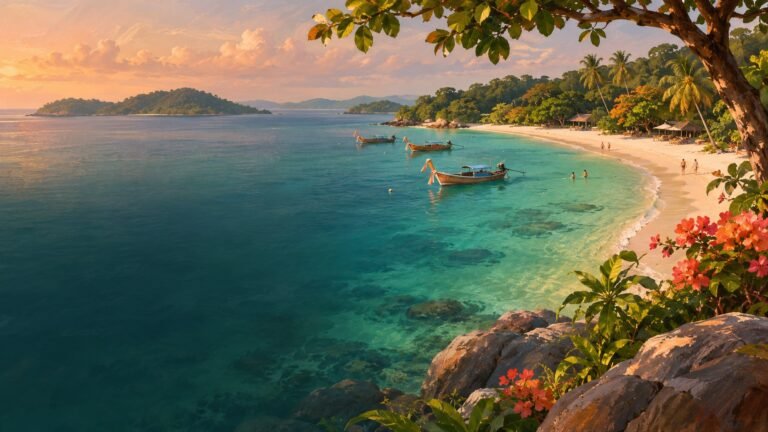
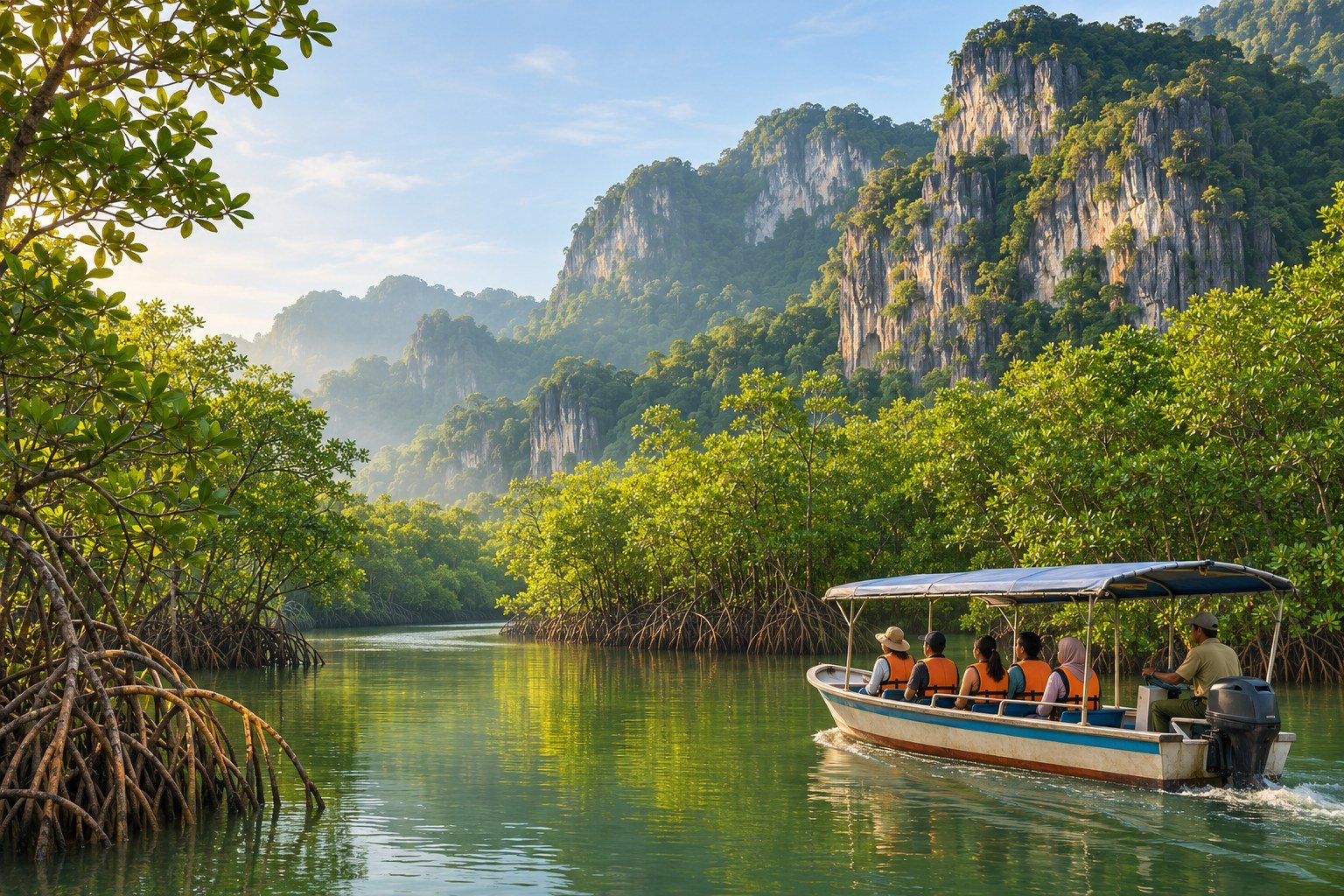
Original conceptual illustration inspired by Kilim’s mangroves and limestone landscape; it does not depict or verify the behaviour of any named tour operator.
Affiliate disclosure: Taylor’s Trailblazing Travels may earn a commission if you book or buy through links in this guide, at no extra cost to you. Recommendations are selected for their usefulness to the trip.
A Kilim mangrove tour is a chance to pay attention: to the roots at the waterline, the changing shape of the limestone and whatever wildlife happens to be there. It becomes a different outing if the main attraction is baiting animals into a photograph. Choose the kind of experience you want before choosing a departure.
Kilim is part of the wider Langkawi UNESCO Global Geopark. That geographical designation does not, by itself, tell you how a particular excursion treats wildlife or handles its boat. This guide uses an explicit editorial preference for observation without feeding, then compares the practical choices that make a booking work. [1]
Choose behaviour first
Treat baiting, feeding and promised close wildlife encounters as reasons to question a tour before discussing price.
Compare the whole party
A per-boat figure and a per-person figure only become comparable after transfers, fees, meals and guide arrangements are aligned.
Allow room in the day
The worked example turns a 150-minute cruise into a 280-minute outing once travel, briefing and departure are included.
Understand the place and the product
LADA describes Kilim as a landscape of mangroves, tidal waterways, limestone cliffs and caves in north-eastern Langkawi, with places reached by boat. The appeal is the relationship between water, rock and forest, rather than a fixed sequence of animal appearances. [2]
“Mangrove tour” can mean a boat hired at a jetty, a shared nature excursion, a private guided outing or a package with a meal and several scheduled stops. Similar photographs do not establish that two products have the same starting point, route, guide or boat capacity.
Begin with three decisions. Do you want someone to explain the landscape, or primarily a scenic ride? Are you happy to share a departure? Is your priority time on the water, or a broader outing with lunch? Answering these makes an itinerary easier to evaluate. A longer list of stops is not automatically better if it leaves little time to listen, look or ask questions.
Do not assume that a geopark label is a tour-specific wildlife standard. The criteria below are this guide’s selection framework. They are not a claim that every listed practice is governed by a single local certification or prohibition.
Back to top ↑Five checks before a boat reaches your shortlist
| Check | Ask this | A useful answer contains |
|---|---|---|
| Wildlife policy | Will anyone on this trip feed, bait, handle or deliberately lure wildlife, including at organised stops? | A clear answer covering the operator, crew and passengers, rather than a vague promise to be “eco”. |
| Boat behaviour | How do you minimise wake and disturbance near banks and animals? | A practical explanation of how the skipper adapts the route and boat handling. |
| Guide involvement | Who explains the mangroves and geology, and in which language? | A named role and confirmed guiding language; “driver included” alone is insufficient. |
| Boarding and safety | What is the passenger limit, boarding arrangement and lifejacket provision for our party? | Specific answers for the booked boat, including children or anyone needing assistance. |
| Weather and payment | What happens if conditions change before departure or after the trip begins? | The applicable cancellation, rescheduling and shortened-trip terms in writing. |
Why boat handling matters
A 2025 field study compared bank erosion at Sg. Kilim and Selat Tuba and identified differing erosion patterns influenced by monsoon conditions and human activity. It supports taking boat impacts seriously; it does not measure the footprint of a particular operator or prove that a specific boat speed is safe everywhere. [3]
Request no feeding even when it is described as optional. Declining to throw food yourself does not settle the issue if the crew still baits animals for the group. Ask whether the stop can be omitted entirely. If the answer is uncertain, keep looking rather than assuming the boat will change its routine after you arrive.
Be equally careful with guarantees. A guide can promise time, interpretation and a considered approach. Wild animals remain free to be elsewhere. A quiet trip with few sightings can still meet the purpose of a responsible nature outing.

Two starting points, plus a useful jetty-price benchmark
JungleWalla: compare the exact nature-cruise product
JungleWalla’s own website says its experiences avoid staged encounters and animal feeding. That written position earns it a place on a shortlist, but it remains the operator’s statement, not a field audit by this publication. [5]
Its direct UNESCO Geopark Cruise page describes a roughly 2½-hour excursion, meeting at Tanjung Rhu Jetty. Hotel transfers and meals are excluded from the base tour description; optional arrangements need checking separately. The page also says wildlife sightings are not guaranteed. [7]
You can check the JungleWalla mangrove cruise on Viator to compare a dated option. The listing opened for this review names JungleWalla Tours as supplier and lists an English-speaking nature guide and lifejacket. Check the final party total, meeting point and selected cancellation conditions before paying. A marketplace booking does not replace the questions about the actual departure. [8]
Dev’s Adventure Tours: compare duration and format
Dev’s Adventure Tours, at langkawi-nature.com, states a no-wildlife-feeding policy. Its current menu includes a Classic Mangrove Boat Tour shown as 09:30–13:30, alongside kayaking options. Ask what that time window includes, which jetty is used and whether the same policy covers every planned stop. The website’s stated approach is a useful lead, not independent verification of each trip. [6]
The cooperative’s menu: a benchmark, not a responsibility award
The Kilim park manager’s published menu shows a two-hour boat tour at RM400 per boat, with a maximum of ten people and lifejackets stated. Treat this as a published reference checked on 6 November 2026, not a guaranteed checkout price. The wider menu includes fish feeding, so do not assume every package meets a no-feeding preference. Confirm the precise itinerary and inclusions directly. [4]
These examples are not an exhaustive ranking. They show why a credible shortlist needs both a policy and a product: a business can offer several excursions, while a booking platform may show several suppliers under similar titles. Save the exact product name and supplier with your confirmation.
Back to top ↑Compare a whole-party price, not the headline fare
Use this calculation: tour price + return transfers + separately charged stops + meals or other chosen extras = whole-party total. Write down what is excluded beside each quote. If one price includes a guide and another does not, the totals still describe different products.
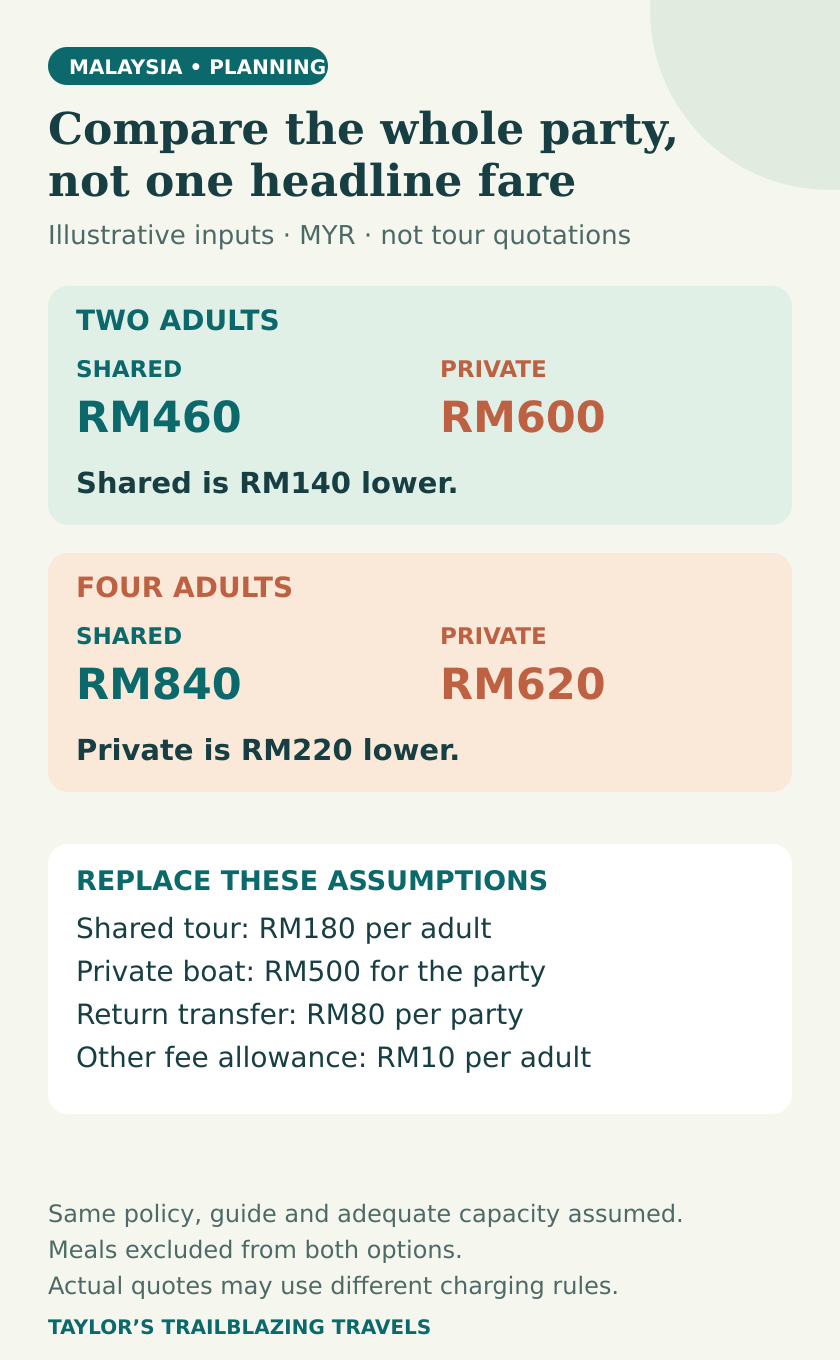
The following is an invented comparison for planning, not an operator quotation or a claim about typical prices. Assume a shared tour at RM180 per adult, a private boat at RM500 for the party, return transport at RM80 per party and a separate fee allowance of RM10 per adult. Assume both options meet the same policy, guiding and capacity needs; meals are excluded from both.
| Party | Shared calculation | Private calculation | Difference |
|---|---|---|---|
| Two adults | 2 × RM180 + RM80 + 2 × RM10 = RM460 | RM500 + RM80 + 2 × RM10 = RM600 | Shared is RM140 lower. |
| Four adults | 4 × RM180 + RM80 + 4 × RM10 = RM840 | RM500 + RM80 + 4 × RM10 = RM620 | Private is RM220 lower. |
The change comes from the charging unit: one option grows with each adult, while the assumed private-boat charge stays fixed. It does not establish a real-world break-even point, because passenger limits, child fares, guide charges and transfers may differ between actual products.
Keep the comparison in MYR until you have chosen an option. If you use the travel budget calculator for the wider holiday, enter your own GBP equivalent as a group extra. The tool does not provide live currency conversion or fetch these boat prices.
A cheaper trip that fails your basic conditions should not remain the benchmark. First decide what you are buying; then decide whether the difference is worth paying.
Give the excursion enough space in the day
A tour duration is only one part of a day away from your accommodation. Confirm the jetty by the operator’s map pin, not simply the word “Kilim”. JungleWalla’s direct cruise page specifies Tanjung Rhu and asks guests to arrive at least ten minutes before departure. Other products require their own meeting instructions. [7]
Here is an illustrative 280-minute outing built around a 150-minute cruise. The road journeys, twenty-minute arrival allowance and twenty-minute departure pause are chosen assumptions, not measured transfer times or additional operator requirements.
| Stage | Assumed time | Example clock time |
|---|---|---|
| Travel to the confirmed jetty | 45 minutes | 09:25–10:10 |
| Find the crew, check in and prepare | 20 minutes | 10:10–10:30 |
| Cruise | 150 minutes | 10:30–13:00 |
| Disembark, organise belongings and meet the car | 20 minutes | 13:00–13:20 |
| Return journey | 45 minutes | 13:20–14:05 |
The result is 4 hours 40 minutes. Adding a separate forty-five-minute lunch makes it 5 hours 25 minutes. Do not add a second lunch allowance if your chosen tour’s duration already includes its meal stop.
Replace both road allowances with the transfer arrangement for your hotel, and allow extra margin before a ferry, flight or another fixed booking. This model is not a connection guarantee. For a short stay, a flexible later afternoon is easier to defend than a tightly chained second excursion.
Back to top ↑Weather, access and what to do on the boat
Weather needs a decision, not a seasonal promise
MET Malaysia advises postponing outdoor activity when thunderstorms are expected and returning to land and shelter when boating in a thunderstorm. Check its current warnings before departure and follow the skipper’s instructions on the water. Calm conditions at the jetty are not a substitute for the assessment of the whole route. [9]
Ask whether the itinerary includes an exposed sea section, where shelter or an early return is possible, and who decides to cancel. No month, departure hour or booking-platform weather icon guarantees suitable conditions for a particular trip.
JungleWalla’s direct page distinguishes light rain from unsafe weather or sea conditions, when the excursion may be delayed, rescheduled or cancelled. That is a product statement, not a universal rule for other operators. The contract you buy must also answer what happens if only part of the itinerary is completed. [7]
Resolve access needs with the actual boat
“Suitable for families” is not a description of a jetty step, a gangway or a toilet. Ask for the boarding height, available assistance, seat arrangement, shelter and planned walking surfaces. Explain practical needs in advance without accepting a generic reassurance. Request appropriately sized lifejackets for every passenger and confirm how they should be worn.
For a wheelchair user or someone who cannot manage a high step, ask for photographs or dimensions of the boarding arrangement. Establish whether the person can remain in their chair and how any mobility equipment is carried. If the details are unresolved, choose an outing whose access can be explained clearly.
Keep the visit consistent with the policy you chose
Stay seated when instructed, keep hands and loose belongings inside the boat and let the guide control movement near animals. Use a longer camera view instead of asking the skipper to close the gap. Keep food packed away, do not offer it to wildlife and take litter back with you.
At caves or other stops, follow current site instructions. Avoid flash or noise around wildlife and leave formations and roots untouched. A stop omitted because of conditions is preferable to treating a published itinerary as an entitlement to enter everywhere.
If feeding begins despite the policy you booked, calmly ask the guide to stop and refer to the agreed terms. Avoid an argument or sudden movement on board. After the trip, give the operator specific factual feedback: what happened, at which stop and what was promised.
Back to top ↑Get these answers before you pay
- Exact product and crew: operator, departure, guide language, boat type and maximum group size.
- Wildlife policy: no feeding or baiting by crew or passengers, including organised stops; whether any fish-farm visit can be omitted.
- Meeting and return: confirmed jetty pin, arrival instruction, included transfers and the return arrangement.
- Total cost: the whole-party amount, currency, child categories, guide, fees, meals and optional extras.
- Practical fit: boarding details, suitable lifejackets, walking at stops, toilet arrangements and help that is actually available.
- Changes: cancellation deadline, bad-weather procedure and the terms for a shortened route.
Save the supplier’s replies with the booking confirmation. For the named JungleWalla option, check the JungleWalla mangrove cruise on Viator; compare the selected offer with the direct operator details before committing. Confirm availability and the final price for your date before paying. [8]
Bring drinking water, sun protection, suitable footwear for the stops and a way to protect your phone from splashes. Keep your bag small enough to manage while boarding. The most useful preparation is not extra equipment: it is knowing which jetty to reach and what kind of outing you have agreed to.
Back to top ↑Questions travellers ask
Is every Kilim mangrove tour a responsible wildlife tour?
No. This guide uses specific selection criteria, including no feeding, considered boat handling and clear guiding arrangements. A scenic location, a high review score or the word “eco” does not answer those questions for an individual departure.
Does a private boat automatically make the better choice?
No. Compare policy and guiding first. A private boat may suit your pace or party size, but establish whether the price includes a nature guide and whether the route can be changed. The cost example illustrates charging units, not an ethical ranking.
Can I guarantee eagle, otter or dolphin sightings?
No. Choose an outing you would still value for the landscape and interpretation if wildlife is distant or absent. Do not use a feeding stop as insurance against an uncertain sighting.
Should I choose the cheapest jetty boat?
Only after it answers the same questions as the other options. Ask for the final price and inclusions, the exact stops, guiding language and no-feeding agreement. A lower amount can reflect a different product rather than a like-for-like saving.
Can a short cruise fit into a spare morning?
It may, but calculate the full outing. The example here uses 150 minutes on the water and totals 280 minutes with chosen road and boarding allowances. Replace those assumptions with your own arrangements before committing to another timed booking.
Your next decision
Choose the policy, the guide and the practical fit before the price. Start with an operator willing to describe its no-feeding approach in writing, confirm the exact departure and compare the total for your whole party. Leave enough space for travel and a changed weather plan.
A successful Kilim outing need not produce an animal close-up or tick every advertised stop. It should give you time to understand the place while accepting that the crew, conditions and wildlife set limits on what happens that day.
Sources and editorial checks
This is a research-led guide, reviewed on 6 November 2026, not an account of a first-hand tour. Sources include UNESCO, LADA, the park manager, a published erosion study, operator websites, a specific booking listing and MET Malaysia. Operator policies are reported as their own statements; no independent boat inspection or wildlife-practice audit was conducted.
The cost comparison and journey timetable are original editorial calculations using clearly stated assumptions. Published menu prices are reference points, not confirmed availability or dated checkout quotations. Recheck the exact departure, access, inclusions and booking terms before paying.
- UNESCO — Langkawi UNESCO Global GeoparkChecked 6 November 2026
- LADA — Langkawi UNESCO Global GeoparkChecked 6 November 2026
- Hashim and colleagues (2025) — lateral bank erosion in Langkawi mangrove channelsChecked 6 November 2026
- Kilim park manager — published mangrove boat menuChecked 6 November 2026
- JungleWalla — operator approach and no-feeding statementChecked 6 November 2026
- Dev’s Adventure Tours — boat, kayak and no-wildlife-feeding statementsChecked 6 November 2026
- JungleWalla — Langkawi UNESCO Geopark CruiseChecked 6 November 2026
- Viator — JungleWalla Langkawi UNESCO Geopark Mangrove CruiseChecked 6 November 2026
- MET Malaysia — weather phenomena and thunderstorm precautionsChecked 6 November 2026
Illustrations in this article were created for Taylor’s Trailblazing Travels. Third-party photographs, where used, are credited beside the image or in the source list.